
Uganda Primates and Wildlife Safari: The Ultimate Introduction to Uganda’s Primate and Big-Game Adventures

A Uganda primates and wildlife safari is one of the most rewarding ways to experience East Africa because it brings together intimate rainforest encounters, traditional African game viewing, spectacular landscapes, birdlife, and cultural experiences within one journey. Uganda is particularly remarkable for travelers who want more than a conventional savannah safari. Here, you can walk through an ancient rainforest in search of mountain gorillas, listen to chimpanzees calling through the canopy, watch monkeys leap between branches, photograph elephants and lions on open plains, and cruise past hippos and crocodiles along some of Africa’s most impressive waterways.
For travelers seeking this variety, Safari Vacations and Travel Services designs customized Uganda primates and wildlife safari itineraries that connect the country’s major primate forests with its leading wildlife destinations. A journey can combine Bwindi for mountain gorillas, Kibale for chimpanzees, Mgahinga for golden monkeys, and Queen Elizabeth or Murchison Falls National Parks for classic wildlife viewing. This diversity makes a Uganda primate and wildlife safari particularly suitable for first-time visitors to Africa as well as experienced safari travelers seeking deeper, more varied wildlife encounters.
Why Choose a Uganda Primates and Wildlife Safari?
The greatest advantage of a Uganda primates and wildlife safari is variety. Many African safari destinations are primarily associated with savannah wildlife, but Uganda combines extensive forests, wetlands, lakes, rivers, mountains and open grasslands. These different ecosystems create opportunities to experience dramatically different wildlife encounters during the same vacation.
Your morning might begin by following a ranger through mist-covered rainforest in search of mountain gorillas, while another day could start with a sunrise game drive searching for lions, elephants, buffaloes and antelopes. Later, you could take a boat safari where hippos gather in the water, and elephants approach the shoreline. This combination of walking, tracking, driving and boating creates a constantly changing safari experience.
Travelers who want to understand the broader possibilities can explore our Uganda safaris and compare different ways of combining primate trekking with traditional wildlife viewing. Safari Vacations and Travel Services can customize each Uganda primates and wildlife safari according to available days, budget, preferred accommodation category, physical ability, and particular wildlife interests.
Mountain Gorilla Trekking: The Signature Uganda Primate Experience
Mountain gorilla trekking is frequently the centerpiece of a Uganda primates and wildlife safari. Uganda offers gorilla trekking in Bwindi Impenetrable National Park and Mgahinga Gorilla National Park, both situated in the mountainous southwest of the country. The experience involves entering the forest with trained ranger guides and trackers to search for a habituated mountain gorilla family.
Bwindi is divided into several trekking areas, meaning travelers need to consider their allocated sector when planning accommodation and transfers. Safari Vacations and Travel Services can help travelers understand the different sectors, organize the correct accommodation, and coordinate the safari route around the confirmed trekking location.
The trek itself can vary significantly because gorillas move naturally through the forest. Some encounters require comparatively short walks, while others involve longer hikes across steep and sometimes muddy terrain. That unpredictability is part of what makes gorilla trekking such an authentic wildlife experience. Travelers are not visiting animals in an enclosed setting; they are entering a protected rainforest ecosystem and following the movements of wild primates.
Once the gorillas are located, the viewing period creates extraordinary opportunities to observe their social behavior. Travelers may watch adults feeding, juveniles climbing and playing, mothers caring for infants, or a dominant silverback resting close to his family. These quiet behavioral details are often among the most memorable moments of an entire Uganda primates and wildlife safari.
Chimpanzee Trekking in Kibale National Park
Chimpanzees provide an entirely different primate encounter. Whereas gorillas frequently spend long periods feeding or resting relatively close to the ground, chimpanzees can be highly active. Their calls can travel through the forest before they are visible, and a trekking group may follow them as they move between trees or across the forest floor.
Kibale National Park is Uganda’s flagship chimpanzee trekking destination and an important component of a comprehensive Uganda primates and wildlife safari. The forest protects an exceptional diversity of primates, allowing travelers to look for chimpanzees alongside several monkey species. Safari Vacations and Travel Services regularly incorporates chimpanzees into longer safari circuits that continue south toward Queen Elizabeth National Park and Bwindi.
This geographical relationship makes Kibale particularly useful when building an itinerary. Travelers can move from forest-based primate experiences into savannah wildlife areas without having to treat each activity as a completely separate vacation. A well-planned Uganda primates and wildlife safari therefore creates a natural progression from chimpanzees and forest walks to game drives, boat safaris, and eventually mountain gorilla trekking.
Discover More Primates Beyond Gorillas and Chimpanzees
Gorillas and chimpanzees may receive most of the attention, but a Uganda primates and wildlife safari offers much more for travelers interested in primatology and forest ecology. Depending on the destination, visitors can search for red-tailed monkeys, black-and-white colobus monkeys, blue monkeys, vervet monkeys, olive baboons and other primates.
Mgahinga Gorilla National Park adds another particularly exciting experience: golden monkeys. Their energetic movements through bamboo vegetation make golden monkey trekking very different from gorilla trekking and highly rewarding for photographers. Travelers with enough time can combine gorillas, chimpanzees and golden monkeys, creating a specialized Uganda primates and wildlife safari focused on experiencing several of the country’s most distinctive primate species.
Forest walks can further deepen the experience. Instead of concentrating entirely on one target species, travelers can observe how primates, birds, insects and plants interact within a rainforest ecosystem. Guided forest walks around Kibale are especially valuable for visitors interested in natural history and photography.

Combining Primates with Uganda’s Savannah Wildlife
The wildlife element transforms a primate-focused trip into a complete Uganda primates and wildlife safari. After several days walking through forests, travelers can enter Uganda’s savannah parks and experience wildlife from a completely different perspective.
Queen Elizabeth National Park fits especially well into the classic western Uganda safari circuit because it lies between the Kibale and Bwindi regions. Game drives introduce travelers to elephants, buffaloes, Uganda kobs, warthogs and predators, while the Kazinga Channel offers excellent opportunities for viewing aquatic and shoreline wildlife. The Ishasha region is particularly famous for its tree-climbing lions, although sightings of wild animals can never be guaranteed.
Murchison Falls National Park can add an even broader dimension to a longer Uganda primates and wildlife safari. Travelers can combine game drives with a Nile boat experience and views of the dramatic Murchison Falls. Adding the park is particularly attractive when travelers have enough time to create a longer circuit through western Uganda rather than concentrating only on the southwestern destinations.
Those comparing different combinations can review a representative itinerary connecting chimpanzee trekking, wildlife viewing and mountain gorilla trekking.
Boat Safaris Add Another Dimension to Wildlife Viewing
A Uganda primates and wildlife safari does not depend entirely on trekking and game drives. Boat experiences provide a slower and often exceptionally productive way of watching wildlife. On waterways such as the Kazinga Channel and Victoria Nile, visitors can observe hippos, crocodiles, waterbirds and mammals approaching the banks to drink.
This creates excellent photographic opportunities because wildlife can often be viewed from a different angle than during vehicle-based safaris. Boat excursions also provide a welcome change of pace after demanding forest treks. A thoughtfully designed Uganda primates and wildlife safari alternates strenuous activities with more relaxed experiences so that travelers can enjoy the country’s biodiversity without feeling that every day follows the same pattern.

Birdwatching on a Uganda Primates and Wildlife Safari
Birdlife is another major attraction. Uganda’s varied habitats mean birdwatching naturally becomes part of the journey even when travelers are primarily interested in mammals. Forests, wetlands, lakeshores, savannahs and river systems support an extraordinary range of species.
Travelers can encounter colorful forest birds during chimpanzee trekking, raptors and grassland species on game drives, and large numbers of waterbirds during boat cruises. Around Kibale, combining chimpanzee trekking with Bigodi provides another opportunity to appreciate the relationship between primate tourism, birdwatching, wetlands and local conservation.

Culture and Communities Along the Safari Route
Wildlife may motivate the journey, but Uganda’s people can add important context to the landscapes being explored. Depending on the itinerary, travelers can incorporate community walks, cultural performances, craft experiences and visits that introduce the traditions and livelihoods of communities living near protected areas.
A thoughtfully arranged cultural experience can help visitors understand the relationship between tourism, conservation and neighboring communities. This adds depth to a Uganda primates and wildlife safari because protected forests and wildlife areas do not exist separately from the people living around them.

Who Should Book a Uganda Primates and Wildlife Safari?
This type of journey suits wildlife enthusiasts, photographers, couples, families with eligible teenagers, honeymooners, birdwatchers, researchers and travelers interested in conservation. It is especially appropriate for people who would find a safari consisting exclusively of vehicle-based game drives too repetitive.
Active travelers can emphasize gorilla trekking, chimpanzee trekking, golden monkey trekking and forest walks, while travelers who prefer a gentler pace can spend more time on game drives, scenic transfers and boat cruises. Longer journeys can include primate habituation experiences, allowing travelers who want extended observation opportunities to explore a specialized habituation safari.
How Long Should a Uganda Primates and Wildlife Safari Be?
The ideal duration depends on the number of experiences included. Short trips can concentrate on mountain gorillas and one wildlife park, but travelers who want gorillas, chimpanzees and meaningful savannah wildlife viewing should allow additional time. Longer journeys make it possible to add Murchison Falls, Mgahinga, golden monkey trekking, additional forest experiences, cultural encounters and more relaxed travel days.
A carefully paced Uganda primates and wildlife safari is generally more rewarding than trying to include every major destination in too few days. Safari Vacations and Travel Services considers driving distances, trekking schedules, permit availability,y and accommodation location when developing each route. Travelers planning a longer primate-focused journey can explore our primate tour guide for ideas on combining Uganda’s major forests and wildlife destinations.
Best Time to Plan a Uganda Primates and Wildlife Safari
Uganda can be visited throughout the year, but seasonal conditions influence trekking trails, photography, vegetation and general safari comfort. The drier periods are popular because forest trails may be easier to navigate and wildlife drives can be more comfortable. Wetter periods can produce lush landscapes, dramatic skies and excellent photographic conditions, although rainforest trekking may become muddier and more physically demanding.
Travel dates should therefore be selected according to personal priorities rather than assuming that one month is perfect for every traveler. Our detailed planning guide can help travelers understand seasonal considerations before choosing their safari dates.
Planning Your Uganda Primates and Wildlife Safari with Safari Vacations and Travel Services
A successful Uganda primates and wildlife safari depends on much more than selecting national parks. Gorilla and chimpanzee permits need to align with accommodation locations, transfer times must be realistic, trekking days should be positioned carefully, and wildlife activities need enough time to deliver meaningful experiences.
Safari Vacations and Travel Services creates personalized itineraries that bring these elements together into one practical journey. Whether your priority is photographing mountain gorillas, tracking chimpanzees, searching for tree-climbing lions, watching elephants beside a river, discovering Uganda’s monkeys,s or experiencing several of these highlights together, the itinerary can be designed around your interests and available travel time.
For many visitors, that combination is precisely what makes a Uganda primates and wildlife safari extraordinary. It is not simply a gorilla trekking holiday with a game drive added at the end. It is a journey through interconnected rainforests, savannahs, wetlands, mountains and communities where each destination reveals a different side of Uganda’s natural heritage. From the first chimpanzee call echoing through Kibale to a mountain gorilla encounter in Bwindi and an evening wildlife drive across the savannah, a Uganda primates and wildlife safari offers the diversity needed to create one of Africa’s most complete wildlife adventures.
Best Destinations for a Uganda Primates and Wildlife Safari
A Uganda Primates and Wildlife Safari becomes truly rewarding when the itinerary connects the country’s leading rainforest destinations with its most productive savannah parks. Uganda offers an unusual concentration of primate habitats and traditional African wildlife areas within one country, making it possible to encounter mountain gorillas, chimpanzees, golden monkeys and several other primates before continuing to landscapes inhabited by elephants, lions, buffaloes, hippos, crocodiles, giraffes, zebras and numerous antelope species.
For Safari Vacations and Travel Services, designing a Uganda Primates and Wildlife Safari is therefore about more than simply choosing famous national parks. The destinations need to complement each other geographically and experientially. A well-planned route might begin with chimpanzees in Kibale National Park, continue into Queen Elizabeth National Park for game drives and a Kazinga Channel boat cruise, and finish in Bwindi Impenetrable National Park with mountain gorilla trekking. Longer journeys can add Murchison Falls National Park, Ziwa Rhino Sanctuary, Mgahinga Gorilla National Park and Lake Mburo National Park. This creates a safari in which every destination introduces a different ecosystem and wildlife experience.
Bwindi Impenetrable National Park – The Gorilla Highlight
For many travelers, Bwindi Impenetrable National Park is the emotional highlight of a Uganda Primates and Wildlife Safari. The ancient forest in southwestern Uganda is internationally known for mountain gorilla trekking and provides an entirely different atmosphere from Uganda’s open savannah parks.
The experience begins long before travelers see gorillas. Walking beneath a dense forest canopy, listening for wildlife and following ranger guides through the vegetation creates a sense of entering a genuinely wild environment. The duration and difficulty of a trek vary because gorillas move freely through the forest. Once a habituated family is located, visitors can observe social interactions, feeding, grooming, resting, and the behavior of young gorillas under established trekking regulations.
Bwindi has several trekking areas, and understanding the gorilla sectors is important when arranging accommodation and transport. Safari Vacations and Travel Services coordinates the trekking sector, permit, and lodge so that travelers do not accidentally book accommodation far from their assigned starting point.
Including Bwindi also creates excellent opportunities to combine gorilla trekking with other attractions in southwestern Uganda. Travelers can continue toward Queen Elizabeth National Park, Lake Bunyonyi, Mgahinga Gorilla National Park or Rwanda depending on the overall structure of their Uganda Primates and Wildlife Safari.
Kibale National Park – Uganda’s Premier Chimpanzee Destination
If Bwindi delivers the signature gorilla experience, Kibale National Park provides the other great primate encounter of a Uganda Primates and Wildlife Safari: tracking wild chimpanzees. Kibale is renowned for its exceptional primate diversity, and the forest supports chimpanzees alongside numerous monkey species.
Chimpanzee trekking feels very different from gorilla trekking. Visitors may first hear powerful calls traveling through the forest before seeing the chimpanzees themselves. Chimpanzees can be energetic, vocal,l and mobile, sometimes feeding high in trees before descending to the forest floor. Observing these behaviors gives travelers another perspective on primate ecology and social organization.
Our guide to the primates of Kibale provides additional information for travelers who want to understand the extraordinary primate diversity that makes the forest such an important component of a Uganda Primates and Wildlife Safari.
Kibale’s location also makes it highly practical for multi-destination travel. It combines naturally with Queen Elizabeth National Park, allowing visitors to transition from rainforest primate tracking to savannah game viewing and a Kazinga Channel cruise. A classic route can therefore combine Kibale, Queen Elizabeth and Bwindi without treating primate trekking and traditional wildlife viewing as separate vacations.
Bigodi Wetland Sanctuary – Primates, Birds and Community Conservation
Bigodi Wetland Sanctuary is an excellent addition to the Kibale portion of a Uganda Primates and Wildlife Safari. Rather than duplicating the chimpanzee experience, Bigodi introduces travelers to a different environment where guided walks can reveal monkeys, birds, butterflies and wetland vegetation.
The experience works particularly well after chimpanzee trekking because visitors can slow down and pay attention to smaller details. Black-and-white colobus monkeys, red-tailed monkeys and other primates may be encountered, while birdwatchers can search the wetland and surrounding vegetation for numerous species. The sanctuary is also closely associated with community-based tourism, giving the visit an important human dimension.
Travelers particularly interested in combining primates and birds can read more about Bigodi birding when planning their Uganda Primates and Wildlife Safari.

Queen Elizabeth National Park – The Perfect Wildlife Connection
Queen Elizabeth National Park is one of the most logical wildlife additions to a Uganda Primates and Wildlife Safari because it connects conveniently with both Kibale and Bwindi. This allows travelers to move from chimpanzee country into classic savannah landscapes before continuing toward the mountain gorillas.
Game drives can produce sightings of elephants, buffaloes, Uganda kobs, warthogs and other mammals, with predators including lions and leopards also present. Wildlife encounters remain natural, and sightings cannot be guaranteed, which is part of the excitement of exploring a free-ranging ecosystem.
The park’s southern Ishasha area is famous for tree-climbing lions. When conditions and animal movements cooperate, lions may be seen resting in trees, creating one of Uganda’s most recognizable wildlife scenes. Ishasha also fits conveniently into some journeys between the main Queen Elizabeth tourism areas and Bwindi.
For travelers who want primates as well as big-game viewing, Queen Elizabeth prevents a Uganda Primates and Wildlife Safari from becoming exclusively forest-based. It introduces open landscapes, predators, large herbivores, es and spectacular views that contrast beautifully with the enclosed rainforest environments of Kibale and Bwindi.
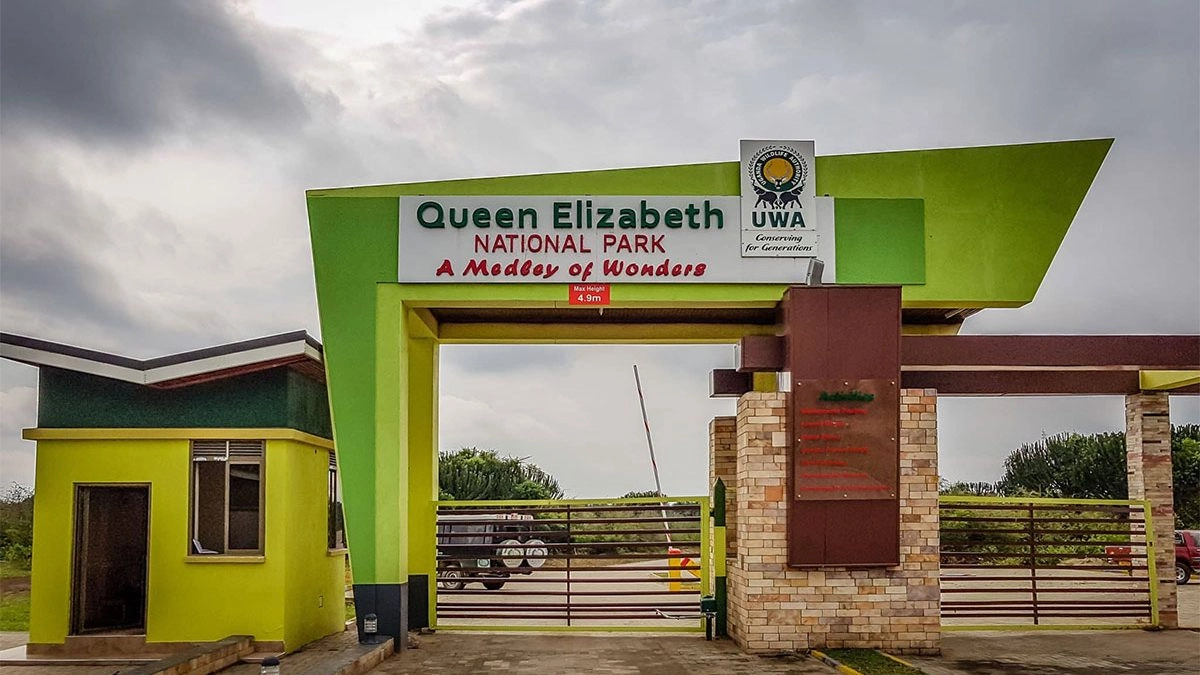
The entrance to Queen Elizabeth National Park, one of Uganda’s most popular wildlife safari destinations.
Kazinga Channel – Wildlife Viewing from the Water
The Kazinga Channel is one of Queen Elizabeth National Park’s defining attractions and provides a completely different way to experience wildlife. The natural channel connects Lake George and Lake Edward, and boat excursions offer opportunities to observe hippos, crocodiles, waterbirds, and mammals using the shoreline.
Adding a Kazinga Channel cruise is particularly valuable during a Uganda Primates and Wildlife Safari because it creates a relaxed interval between physically active forest treks. Instead of walking or spending another extended period inside a safari vehicle, travelers can watch wildlife from the water.
Elephants and buffaloes may approach the shoreline, hippos can be observed in and around the water, and birdlife can be excellent. Photographers appreciate the lower viewing perspective and opportunities to photograph wildlife against water and open skies.
Mgahinga Gorilla National Park – Gorillas and Golden Monkeys
Mgahinga Gorilla National Park deserves serious consideration for travelers who want to make primates the dominant theme of their Uganda Primates and Wildlife Safari. Located in southwestern Uganda within the Virunga landscape, the park provides opportunities for mountain gorilla trekking and golden monkey tracking.
Golden monkeys create a particularly interesting contrast with gorillas. They are smaller, faster,ter and frequently active among bamboo vegetation, making the tracking experience lively and highly engaging. Travelers interested in expanding their primate checklist can include golden monkey trekking alongside gorillas and chimpanzees.
A Uganda Primates and Wildlife Safari incorporating Bwindi, Mgahinga and Kibale can therefore provide three headline primate experiences: mountain gorillas, chimpanzees and golden monkeys. Adding Queen Elizabeth National Park then introduces classic big-game viewing without abandoning the primate focus of the journey.
Murchison Falls National Park – Wildlife and the Nile
Travelers with more time can extend their Uganda Primates and Wildlife Safari northward to Murchison Falls National Park. The park brings together savannah wildlife, the Nile and one of Uganda’s most dramatic natural landmarks.
Game drives provide opportunities to search for giraffes, elephants, buffaloes, antelopes, lions and other wildlife. A boat journey on the Nile adds another perspective, with hippos, crocodiles, birds and mammals potentially appearing along the riverbanks. Safari Vacations and Travel Services includes Murchison Falls most effectively in longer itineraries where travelers have enough time to appreciate the park without creating rushed transfers.
Murchison also works well in itineraries that include chimpanzee trekking farther south. Our Uganda primate tour guide demonstrates how longer journeys can combine Murchison Falls, Kibale, Queen Elizabeth and Bwindi into a broad exploration of Uganda’s primates and wildlife.

Ziwa Rhino Sanctuary – Completing the Big Five Theme
Ziwa Rhino Sanctuary can be incorporated into an extended Uganda Primates and Wildlife Safari when traveling between central Uganda and Murchison Falls. The stop is particularly attractive to visitors interested in broadening the large-mammal component of their journey.
When combined with lion, leopard, elephant and buffalo viewing opportunities elsewhere, rhino tracking gives travelers the possibility of pursuing the traditional Big Five theme while still making gorillas and chimpanzees the defining experiences of the safari. The result is a Uganda Primates and Wildlife Safari that goes far beyond conventional game viewing.

Lake Mburo National Park – A Relaxed Wildlife Finale
Lake Mburo National Park works particularly well near the beginning or end of some western Uganda circuits. The park’s wildlife includes zebras, impalas, buffaloes, hippos and other species, while activities can include game drives, boat excursions and selected guided experiences.
Because Lake Mburo offers wildlife that differs from the rainforest encounters of Bwindi and Kibale, it adds another layer of diversity to a Uganda Primates and Wildlife Safari. Travelers can explore Lake Mburo safaris when considering a longer itinerary that combines multiple wildlife areas.

Impalas grazing across the scenic savannah grasslands of Lake Mburo National Park in western Uganda.
How to Combine Uganda’s Best Primate and Wildlife Destinations
The strongest Uganda Primates and Wildlife Safari itinerary is not necessarily the one containing the greatest number of parks. Quality depends on selecting destinations that fit naturally together while allowing enough time for each major experience.
For a relatively compact journey, Kibale National Park, Queen Elizabeth National Park and Bwindi Impenetrable National Park form an excellent core circuit. This combination delivers chimpanzee trekking, other primates, savannah wildlife, a boat safari and mountain gorilla trekking. Safari Vacations and Travel Services already operates routes combining these destinations, including a 7-day primate safari featuring Kibale, Queen Elizabeth and Bwindi.
With additional days, travelers can extend the Uganda Primates and Wildlife Safari to Murchison Falls and Ziwa Rhino Sanctuary in the north or add Mgahinga Gorilla National Park and Lake Bunyonyi in the southwest. Lake Mburo can also provide a convenient wildlife stop depending on the direction of travel.
Why Destination Order Matters on a Uganda Primates and Wildlife Safari
Destination order has a major influence on safari comfort. Uganda’s national parks cover different parts of the country, so poor routing can create unnecessarily long driving days. Safari Vacations and Travel Services plans each Uganda Primates and Wildlife Safari around confirmed permits, accommodation locations, road connections, and the sequence of activities.
For example, Kibale naturally connects with Queen Elizabeth National Park, while Queen Elizabeth provides an onward route toward Bwindi. Travelers entering Uganda from Rwanda can sometimes reverse the sequence, beginning with Bwindi before continuing north toward Queen Elizabeth and Kibale. Our guide to a Uganda safari from Rwanda explains how these southwestern routes can work for travelers arriving through Kigali.
Choosing the Right Uganda Primates and Wildlife Safari with Safari Vacations and Travel Services
Ultimately, the best Uganda Primates and Wildlife Safari should reflect the traveler’s priorities rather than simply follow a standard list of national parks. A primate enthusiast may prefer additional days in Kibale, Bwindi and Mgahinga. A wildlife photographer may want more game drives in Queen Elizabeth and Murchison Falls. Birdwatchers may want additional forest and wetland walks, while couples may prefer a slower itinerary with comfortable lodges and fewer long transfer days.
Safari Vacations and Travel Services can build these experiences into one coordinated journey. Travelers can begin by exploring our broader Uganda safari tours and then customize the route according to available time, budget,t and preferred activities.
The defining strength of a Uganda Primates and Wildlife Safari is its diversity. Bwindi introduces travelers to mountain gorillas and ancient rainforest. Kibale reveals the energetic world of chimpanzees and other primates. Mgahinga adds golden monkeys and dramatic mountain scenery. Queen Elizabeth introduces lions, elephants, buffaloes and the wildlife-rich Kazinga Channel. Murchison Falls combines big-game viewing with the Nile, while Lake Mburo adds zebras, antelopes and another distinctive savannah environment.
When these destinations are connected carefully, a Uganda Primates and Wildlife Safari becomes much more than a collection of individual attractions. It becomes a journey through Uganda’s forests, wetlands, rivers, lakes and savannahs, allowing travelers to understand why the country is one of Africa’s most compelling destinations for anyone who wants primates and classic wildlife in the same safari.
Gorilla, Chimpanzee and Primate Trekking Experiences on a Uganda Primates and Wildlife Safari
The defining feature of a Uganda Primates and Wildlife Safari is the opportunity to move beyond observing animals from a safari vehicle and enter their natural habitats on foot. Uganda’s forests provide remarkable encounters with mountain gorillas, chimpanzees, golden monkeys and numerous other primate species. When these experiences are combined with traditional wildlife viewing, travelers receive one of the most diverse safari experiences available in East Africa.
Safari Vacations and Travel Services designs each Uganda Primates and Wildlife Safari so that primate trekking is properly balanced with wildlife viewing, comfortable transfers and sufficient recovery time. Mountain gorilla trekking in Bwindi or Mgahinga can form the centerpiece of the journey, while chimpanzee trekking in Kibale introduces an entirely different forest experience. Golden monkey tracking, wetland walks and other guided forest activities can then expand the safari for travelers who want to discover Uganda’s exceptional primate diversity.
Mountain Gorilla Trekking in Bwindi Impenetrable National Park
Mountain gorilla trekking is frequently the most anticipated experience on a Uganda Primates and Wildlife Safari. Bwindi Impenetrable National Park in southwestern Uganda protects an extraordinary rainforest environment and is Uganda’s principal destination for travelers hoping to encounter habituated mountain gorilla families.
The experience normally begins early in the morning at the relevant park briefing point. Visitors receive guidance about trekking procedures, forest conditions and appropriate behavior around the gorillas before being allocated to trekking groups. Ranger guides and trackers then lead visitors into the forest in search of their assigned gorilla family.
The trek can vary considerably in duration and physical demand. Mountain gorillas move freely, so their location changes from day to day. Trails may involve steep slopes, tangled vegetation, muddy sections and changes in elevation. Travelers preparing for a Uganda Primates and Wildlife Safari should therefore bring appropriate footwear, rain protection, drinking water and suitable clothing.
Our detailed Bwindi gorilla trekking information can help travelers understand what to expect before arriving at the forest.
What Happens When You Find the Mountain Gorillas?
The moment a gorilla family is located can become the emotional high point of a Uganda Primates and Wildlife Safari. After hours of following forest trails, visitors suddenly find themselves observing one of the world’s most remarkable primates in its natural environment.
A dominant silverback may sit quietly nearby while females feed among the vegetation and juveniles climb branches, wrestle, or investigate their surroundings. The experience is compelling because visitors are observing natural behavior rather than a staged wildlife encounter.
Standard gorilla trekking allows a regulated viewing period once the gorillas have been located. During this time, visitors must follow ranger instructions concerning distance, movement, photography,y and behavior. Flash photography should not be used, and trekkers should remain calm and avoid unnecessary noise.
Travelers preparing for this central element of a Uganda Primates and Wildlife Safari can review our gorilla trekking rules before traveling.

A rare and intimate look at a mountain gorilla family nesting deep within the jungles of Bwindi.
Choosing the Right Bwindi Gorilla Trekking Sector
Bwindi is not a single trekking location. Gorilla trekking takes place from different sectors, including Buhoma, Ruhija, Rushaga and Nkuringo. The sector associated with a traveler’s permit has important consequences for accommodation selection, transfer times and the overall structure of a Uganda Primates and Wildlife Safari.
Buhoma is situated in northern Bwindi and has a long history of gorilla tourism. Ruhija is located on the eastern side of the forest, while Rushaga and Nkuringo serve the southern region. Each sector provides access to habituated gorilla families, but the surrounding terrain, lodge choices,s and onward travel connections differ.
This is why Safari Vacations and Travel Services coordinates permits and accommodation rather than treating them as separate bookings. Travelers can learn more about the Bwindi trekking sectors when comparing options for their Uganda Primates and Wildlife Safari.
Gorilla Trekking in Mgahinga Gorilla National Park
Although Bwindi receives much of the attention, Mgahinga Gorilla National Park offers another valuable mountain gorilla experience. Located within Uganda’s portion of the Virunga landscape, Mgahinga is particularly attractive for travelers who want a Uganda Primates and Wildlife Safari combining gorillas, golden monkeys and mountain scenery.
Mgahinga can also fit naturally into itineraries involving Kisoro, Lake Mutanda, Lake Bunyonyi or cross-border travel through Rwanda. The surrounding volcanic landscape creates a striking setting and gives this part of a Uganda Primates and Wildlife Safari a distinctly different atmosphere from the savannah environments experienced elsewhere.
Gorilla Habituation Experience for Extended Observation
Travelers wanting more time around mountain gorillas can consider the gorilla habituation experience. This specialized activity differs from standard gorilla trekking because visitors accompany researchers, trackers, and conservation personnel as gorillas become accustomed to controlled human presence.
The extended experience can be particularly valuable for photographers, wildlife enthusiasts and travelers who want deeper insight into gorilla behavior and conservation. Rather than making the Uganda Primates and Wildlife Safari primarily about checking species off a list, habituation encourages slower observation and greater appreciation of how researchers study and protect wild gorillas.
Travelers considering this option can explore our gorilla habituation experience information before deciding whether standard trekking or habituation better suits their interests.
Chimpanzee Trekking in Kibale National Park
No comprehensive Uganda Primates and Wildlife Safari feels complete without considering chimpanzee trekking. Kibale National Park is Uganda’s leading destination for this experience and provides an excellent contrast to mountain gorilla trekking.
Chimpanzees are often more vocal and mobile than gorillas. Their calls can echo through the forest, sometimes providing the first indication that a community is nearby. Visitors may then follow their movements as they feed in trees, travel across the forest floor, interact socially or rest.
The forest itself is a major part of the experience. Tall trees, dense vegetation, bird calls and sightings of other monkeys make chimpanzee tracking much more than a search for a single species. Including chimpanzee trekking gives a Uganda Primates and Wildlife Safari two dramatically different great-ape encounters.
Chimpanzee Habituation Experience in Kibale
For travelers who want more extensive observation, chimpanzee habituation can be incorporated into a specialized Uganda Primates and Wildlife Safari. Habituation involves spending longer periods following chimpanzees that are being accustomed to the presence of researchers and controlled visitor groups.
The longer observation period can reveal behavioral details that may be difficult to appreciate during a shorter encounter. Travelers may witness changes in feeding behavior, movement patterns, vocal communication, and social interactions as the chimpanzees move through their forest environment.
This experience particularly suits photographers, researchers, serious primate enthusiasts and repeat visitors. Safari Vacations and Travel Services can build a primate habituation safari around both extended primate encounters and traditional wildlife viewing.
Other Places to Track Chimpanzees in Uganda
Kibale is the country’s flagship chimpanzee destination, but a Uganda Primates and Wildlife Safari can include other chimpanzee habitats depending on the route. Kyambura Gorge in the Queen Elizabeth landscape can provide a convenient primate experience for travelers already visiting the park, while other forest areas also support chimpanzees.
The best location depends on priorities. Travelers primarily interested in chimpanzees often choose Kibale because the destination allows the safari to concentrate strongly on primates. Visitors whose itinerary is centered on Queen Elizabeth National Park may prefer to investigate options that minimize additional travel.
This flexibility allows Safari Vacations and Travel Services to customize a Uganda Primates and Wildlife Safari rather than forcing every traveler into an identical route.
Golden Monkey Tracking in Mgahinga
Golden monkey tracking adds color, speed,d and energy to a Uganda Primates and Wildlife Safari. These attractive primates inhabit the Virunga region and are particularly associated with bamboo forest. Their behavior creates a very different experience from watching the much larger mountain gorillas.
Golden monkeys can move quickly through vegetation, jump between branches,s and feed actively, making photography challenging but rewarding. Travelers who combine gorilla trekking and golden monkey tracking in Mgahinga experience two distinctive primates within the same broader landscape.
Adding Kibale afterward can create an exceptional Uganda Primates and Wildlife Safari featuring mountain gorillas, golden monkeys,s and chimpanzees before the itinerary even begins focusing heavily on savannah mammals.
Other Monkey Species to Look for During Your Safari
The phrase Uganda Primates and Wildlife Safari should not be understood as referring only to gorillas and chimpanzees. Uganda supports an impressive variety of monkeys, and travelers who pay attention during forest walks and road transfers can discover many additional species.
Depending on habitat and itinerary, sightings may include black-and-white colobus monkeys, red-tailed monkeys, blue monkeys, vervet monkeys and olive baboons. Some forest destinations support several primate species within relatively compact areas, making every walk potentially rewarding.
Visitors interested in this broader diversity can learn about the primates of Kibale before planning their journey.
Combining Bigodi Wetland with Chimpanzee Trekking
Bigodi Wetland Sanctuary provides an excellent supplementary activity during the Kibale stage of a Uganda Primates and Wildlife Safari. A guided walk can reveal monkeys, birds, butterflies and wetland vegetation while introducing travelers to community-oriented conservation.
Bigodi is particularly useful because it changes the rhythm of the itinerary. Chimpanzee trekking involves concentrating on finding and following a particular primate community, whereas a wetland walk encourages travelers to notice the entire ecosystem.
Birdwatchers can combine their primate experience with birding in Bigodi, adding another layer of biodiversity to the Uganda Primates and Wildlife Safari.
How Difficult Is Primate Trekking in Uganda?
Physical difficulty varies significantly across a Uganda Primates and Wildlife Safari. Gorilla trekking can range from relatively manageable walks to demanding hikes lasting several hours. Steep slopes, mud, tangled vegetation, and altitude can increase the challenge. Chimpanzee trekking can also require sustained walking, particularly when chimpanzees are moving quickly through the forest.
Travelers should provide their tour operator with realistic information about mobility and fitness before the safari. Porters can be extremely helpful during gorilla trekking because they can carry backpacks and assist on difficult sections of trail. Proper hiking boots, gloves, long trousers and rain protection can also make trekking considerably more comfortable.
Our gorilla trekking packing list provides practical guidance for travelers preparing for the forest portion of a Uganda Primates and Wildlife Safari.
Photography During Gorilla and Chimpanzee Trekking
Primate photography is one of the most rewarding yet challenging elements of a Uganda Primates and Wildlife Safari. Forest light can be limited, vegetation may partially obscure animals, and primates do not position themselves according to a photographer’s preferences.
Travelers should know their camera controls before entering the forest and avoid relying entirely on automatic settings. Flash photography is not appropriate around gorillas, making equipment capable of handling lower-light conditions useful. Protective equipment for cameras is also advisable because rainforest weather can change quickly.
Patience is often more important than constantly taking photographs. Watching a gorilla family quietly or observing chimpanzees communicate can become more memorable than returning home with hundreds of nearly identical images.
Why Primate Trekking Makes Uganda Different
Traditional African game drives can deliver extraordinary wildlife encounters, but a Uganda Primates and Wildlife Safari adds something fundamentally different: participation. Instead of remaining inside a vehicle throughout the journey, travelers put on hiking boots, enter forests and actively search for some of the world’s most fascinating primates.
The next day can be completely different. After walking beneath the rainforest canopy, visitors may be watching elephants from a safari vehicle, photographing hippos from a boat, or searching for lions on the plains. A carefully structured chimpanzee and gorilla safari demonstrates how these contrasting experiences can be connected efficiently.
Planning Your Primate Experiences with Safari Vacations and Travel Services
Primate trekking requires planning because permits, trekking sectors, accommodation, and transport must work together. Safari Vacations and Travel Services coordinates these elements when designing a Uganda Primates and Wildlife Safari so that the experience is practical as well as exciting.
A traveler primarily interested in gorillas may choose two separate gorilla treks. A serious primate enthusiast might combine gorillas, chimpanzees, golden monkeys and habituation experiences. Wildlife-focused travelers can concentrate on one gorilla trek and one chimpanzee trek before allocating more days to Queen Elizabeth, Murchison Falls or other savannah destinations.
Our broader Uganda safari options can provide a starting point before Safari Vacations and Travel Services adapts the route around individual interests.
Ultimately, primate trekking is what gives a Uganda Primates and Wildlife Safari its distinctive identity. Watching lions and elephants on Uganda’s plains is exciting, but entering a rainforest to find mountain gorillas or following the calls of chimpanzees through Kibale creates a different kind of connection with the natural world. Add golden monkeys, colobus monkeys, wetland walks and Uganda’s extraordinary birdlife, and the Uganda Primates and Wildlife Safari becomes an immersive journey through some of Africa’s richest and most varied wildlife habitats.
Wildlife Experiences and Safari Activities on a Uganda Primates and Wildlife Safari
A Uganda Primates and Wildlife Safari becomes especially rewarding when rainforest trekking is combined with classic African wildlife experiences. Mountain gorillas and chimpanzees may provide the most intimate encounters of the journey, but Uganda’s savannah parks, rivers, wetlands and lakes introduce travelers to an entirely different collection of animals and landscapes. Lions, elephants, buffaloes, giraffes, zebras, hippos, crocodiles, antelopes and an extraordinary variety of birds can all become part of a carefully planned Uganda Primates and Wildlife Safari.
Safari Vacations and Travel Services designs a Uganda Primates and Wildlife Safari around variety rather than repeating the same activity every day. After trekking chimpanzees through Kibale’s rainforest, travelers can continue to Queen Elizabeth National Park for game drives and a boat cruise. Mountain gorilla trekking in Bwindi can be followed by a scenic journey through southwestern Uganda, while longer itineraries can include Murchison Falls National Park, Ziwa Rhino Sanctuary and Lake Mburo National Park. The result is a journey that alternates between trekking, driving, boating, photography and nature observation.
Game Drives on a Uganda Primates and Wildlife Safari
Game drives provide the classic wildlife component of a Uganda Primates and Wildlife Safari. Unlike primate trekking, where visitors follow animals through dense forests on foot, game drives allow travelers to cover larger areas of open savannah while searching for mammals and birds from a safari vehicle.
Early mornings and later afternoons are particularly rewarding periods for wildlife viewing because temperatures are generally cooler and many animals can be active. A professional driver-guide interprets tracks, alarm calls, animal behavior,r and habitat conditions while searching for wildlife. Because Uganda’s animals live freely within natural ecosystems, every game drive is different, and sightings are never guaranteed.
Travelers researching the country’s broader safari possibilities can explore our Uganda safaris before deciding which wildlife parks should complement their primate experiences.
Wildlife Viewing in Queen Elizabeth National Park
Queen Elizabeth National Park is one of the most important destinations on a Uganda Primates and Wildlife Safari because it fits naturally between Kibale National Park and Bwindi Impenetrable National Park. This makes it possible to move from chimpanzee trekking into savannah wildlife viewing and later continue toward mountain gorilla trekking without unnecessary detours.
The park’s varied landscapes include open grasslands, woodland, wetlands, crater areas and waterways. Game drives can reveal Uganda kobs, elephants, buffaloes, warthogs and numerous other mammals. Lions and leopards are also present, although successful predator sightings depend on natural animal movements, timing and a degree of luck.
This unpredictability is part of an authentic Uganda Primates and Wildlife Safari. Instead of expecting a fixed sequence of sightings, travelers learn to appreciate tracks, sounds, landscapes and smaller wildlife while guides search for larger animals. A herd of elephants crossing the savannah can become just as memorable as an unexpected predator encounter.
Searching for the Tree-Climbing Lions of Ishasha
The Ishasha sector in southern Queen Elizabeth National Park is famous for its tree-climbing lions. For travelers moving between the main Queen Elizabeth area and Bwindi, Ishasha can add another distinctive experience to a Uganda Primates and Wildlife Safari.
When lions choose to rest in trees, visitors may see them stretched along large branches or watching the surrounding grasslands from above. The behavior has become one of Uganda’s most recognizable wildlife attractions, although it is important to remember that these are wild animals and tree-climbing sightings cannot be guaranteed on every visit.
Travelers interested in combining gorillas with Queen Elizabeth can consider a gorilla and wildlife safari that connects rainforest trekking with traditional big-game viewing.
Kazinga Channel Boat Safari
The Kazinga Channel introduces a completely different wildlife experience. Connecting Lake George and Lake Edward, this natural waterway is one of the defining attractions of Queen Elizabeth National Park. A boat cruise can provide opportunities to observe hippos, crocodiles, waterbirds, and mammals visiting the shoreline.
Boat safaris work particularly well within a Uganda Primates and Wildlife Safari because they offer a relaxing contrast after demanding trekking and game-drive activities. Travelers can sit comfortably while watching wildlife activity along the banks rather than searching through dense forest or driving across the savannah.
Elephants and buffaloes may appear near the water, while hippos are among the channel’s most characteristic residents. Birdlife can also be exceptionally rewarding. Travelers can learn more about incorporating a boat cruise into their Uganda Primates and Wildlife Safari.
Murchison Falls National Park and the Victoria Nile
Murchison Falls National Park adds significant wildlife diversity to a longer Uganda Primates and Wildlife Safari. The park combines open savannah, riverine environments and the Victoria Nile with the dramatic geological spectacle of Murchison Falls.
Game drives provide opportunities to search for giraffes, elephants, buffaloes, antelopes and predators. The open landscapes create excellent conditions for photography, particularly during early morning and late afternoon when softer light can enhance the scenery.
The Nile introduces another dimension. Boat excursions allow travelers to watch hippos, crocodiles and birds while scanning the riverbanks for mammals. Including Murchison Falls therefore adds both traditional game viewing and river-based wildlife observation to a Uganda Primates and Wildlife Safari.
Experience the Power of Murchison Falls
Wildlife is not the only reason to include Murchison Falls National Park. The falls themselves provide one of Uganda’s most dramatic natural spectacles. The Nile is forced through a narrow rocky passage before plunging onward with extraordinary power.
After several days focused on individual species, standing near the falls reminds travelers that a Uganda Primates and Wildlife Safari is also about landscapes. Uganda’s biodiversity is inseparable from its rivers, forests, wetlands, mountains and savannahs.
Safari Vacations and Travel Services can incorporate Murchison Falls into longer Uganda wildlife tours for travelers who have enough time to explore both northern and southwestern Uganda.
Rhino Tracking at Ziwa Rhino Sanctuary
Travelers heading toward Murchison Falls can consider rhino tracking at Ziwa Rhino Sanctuary. This adds another distinctive activity to a Uganda Primates and Wildlife Safari because the experience differs from both vehicle-based game drives and rainforest primate trekking.
For travelers interested in the traditional African Big Five concept, rhino tracking is particularly important. Lions, leopards, elephants and buffaloes may be encountered in Uganda’s national parks, while Ziwa provides the country’s principal opportunity for observing rhinos in a managed conservation setting.
Combining rhino tracking with gorillas and chimpanzees creates an exceptionally broad Uganda Primates and Wildlife Safari. Within one itinerary, visitors can search for great apes in rainforest, rhinos on foot, predators on game drives and aquatic wildlife from boats.
Wildlife Experiences in Lake Mburo National Park
Lake Mburo National Park is smaller than Uganda’s largest savannah parks but can be extremely useful when constructing a Uganda Primates and Wildlife Safari. Its location makes it a practical stop on some routes between central Uganda and the southwest.
The park is particularly associated with plains wildlife, including zebras and impalas, alongside buffaloes and other species. This creates a useful contrast with destinations such as Bwindi and Kibale, where the emphasis is on dense forest and primates.
Travelers interested in incorporating this region can explore Lake Mburo as part of a broader Uganda Primates and Wildlife Safari.
Boat Safaris Versus Game Drives
One of the strengths of a Uganda Primates and Wildlife Safari is that travelers do not have to choose between boat safaris and game drives. The two activities complement each other.
Game drives allow visitors to explore larger areas and search for animals living across grassland and woodland habitats. Boat safaris concentrate attention around waterways, where hippos, crocodiles, waterbirds and thirsty mammals can produce excellent sightings.
The perspective also changes. From a vehicle, travelers may photograph an elephant against a wide savannah landscape. From a boat, the same species might appear beside the water with reflections and birdlife in the foreground. Combining both activities creates a more visually diverse Uganda Primates and Wildlife Safari.
Birdwatching Throughout the Safari
Birdwatching is not restricted to specialist tours. It naturally becomes part of almost every Uganda Primates and Wildlife Safari because the journey passes through forests, wetlands, rivers, lakes and grasslands.
Kibale and Bwindi introduce forest species, while Queen Elizabeth and Murchison Falls offer a mixture of savannah and water-associated birds. Wetland experiences such as Bigodi can further expand the birding component.
Travelers who want to place greater emphasis on birds can combine chimpanzee trekking with Bigodi birding. This creates a Uganda Primates and Wildlife Safari where smaller species receive attention alongside gorillas, chimpanzees, elephants and lions.
Wildlife Photography in Uganda
Photography can transform the way travelers experience a Uganda Primates and Wildlife Safari. Instead of concentrating solely on finding animals, photographers begin paying attention to light, background, behavior, landscapes and interaction between species.
Early morning game drives can provide softer light and active wildlife. Boat cruises create opportunities to photograph animals close to water, while forest trekking challenges photographers to work with limited light and dense vegetation.
A comprehensive Uganda Primates and Wildlife Safari therefore offers an unusually wide range of photographic situations. One day may involve photographing chimpanzees beneath a forest canopy, another mountain gorillas among dense vegetation, and another elephants crossing an open savannah.
Predator Viewing on a Uganda Primates and Wildlife Safari
For many visitors, seeing predators is an important safari goal. Uganda’s savannah ecosystems support lions and leopards, while smaller carnivores may also be encountered depending on destination and luck.
Predator searches require patience. Guides may investigate tracks, listen to alarm calls, or scan areas where prey animals are concentrated. Sometimes the search produces an exceptional sighting; at other times, the animals remain hidden.
This is one reason Safari Vacations and Travel Services recommends allowing adequate time for wildlife parks instead of scheduling only a brief drive between primate destinations. A Uganda Primates and Wildlife Safari should provide enough time to appreciate the ecosystem rather than treating game viewing as a transfer-day activity.
Elephants, Buffaloes and Uganda’s Large Mammals
Large herbivores add scale and drama to a Uganda Primates and Wildlife Safari. Elephants can be encountered in several protected areas, while buffaloes are common in suitable savannah habitats. Giraffes are an important feature of northern wildlife circuits, while zebras and impalas make Lake Mburo particularly distinctive.
Antelope species also contribute significantly to game drives. Travelers should resist the temptation to concentrate only on famous animals. Watching territorial behavior among antelopes, observing warthogs with young, or seeing a mixed herd moving across open grassland can produce memorable moments.
Combining Wildlife Activities with Gorilla and Chimpanzee Trekking
The strongest Uganda Primates and Wildlife Safari itineraries alternate physically demanding experiences with less strenuous activities. For example, chimpanzee trekking in Kibale can be followed by a transfer to Queen Elizabeth National Park and an afternoon at leisure. The following day can include a morning game drive and an afternoon boat cruise before continuing toward Bwindi.
Mountain gorilla trekking can then become the climax of the journey. This sequence allows travelers to experience several ecosystems without rushing. A representative 7-day Uganda safari demonstrates how chimpanzees, wildlife and gorillas can be combined within one route.
Why a Private Safari Vehicle Can Improve the Experience
A private vehicle gives travelers greater flexibility during a Uganda Primates and Wildlife Safari. Photographers may need additional time at particular sightings, while families or couples may prefer a personalized pace. A private guide can also adjust stops according to interests in birds, landscapes, mammals,s or photography.
Safari Vacations and Travel Services uses safari vehicles suited to Uganda’s road and wildlife conditions, with experienced driver-guides responsible for both transportation and interpretation throughout much of the journey. This continuity can make a Uganda Primates and Wildlife Safari feel more personalized because the guide gradually understands each traveler’s interests.
How Many Wildlife Days Should You Include?
The ideal balance depends on personal priorities. Travelers mainly interested in primates might devote most of their Uganda Primates and Wildlife Safari to Bwindi, Kibale and Mgahinga while including two or three wildlife days in Queen Elizabeth National Park.
Visitors seeking a more balanced primate-and-big-game experience can add Murchison Falls and Lake Mburo. A longer journey allows more game drives, boat cruises and relaxed wildlife observation without sacrificing gorilla or chimpanzee trekking.
Our Uganda primate tour guide provides additional ideas for balancing forests and savannah parks.
Why Wildlife Makes the Uganda Primates and Wildlife Safari Complete
Mountain gorillas and chimpanzees are extraordinary, but the broader wildlife component gives a Uganda Primates and Wildlife Safari its remarkable diversity. After listening to chimpanzees calling through Kibale, travelers can watch elephants cross Queen Elizabeth’s plains. After standing quietly near mountain gorillas in Bwindi, they can cruise past hippos or search for lions resting in the Ishasha sector.
Each activity reveals a different relationship between animals and their environment. Forest primates depend on complex rainforest ecosystems. Savannah mammals respond to grasslands, water availability, and predator-prey relationships. Hippos and crocodiles depend heavily on aquatic habitats, while hundreds of bird species occupy ecological niches throughout the journey.
Plan Your Wildlife Experiences with Safari Vacations and Travel Services
Safari Vacations and Travel Services plans each Uganda Primates and Wildlife Safari according to available time, interests, permit availability, accommodation preferences, and travel pace. Some travelers want gorillas and chimpanzees to dominate the itinerary. Others want an equal balance between primates and traditional wildlife, while photographers may request additional game drives and carefully timed activities.
Travelers can begin with our Uganda tours and customize the route around the experiences that matter most to them. Another useful option is a dedicated gorilla wildlife safari combining Uganda’s rainforest and savannah highlights.
Ultimately, the Uganda Primates and Wildlife Safari is powerful because no single experience defines the entire journey. Mountain gorillas provide intimacy, chimpanzees bring energy and vocal forest encounters, lions introduce the excitement of predator searches, elephants bring scale, boat cruises reveal aquatic ecosystems, and Uganda’s landscapes connect everything. By combining these experiences carefully, Safari Vacations and Travel Services can create a Uganda Primates and Wildlife Safari that showcases the extraordinary breadth of wildlife experiences available within one East African destination.
Best Time, Costs, Accommodation and Planning a Uganda Primates and Wildlife Safari
Planning a Uganda Primates and Wildlife Safari requires careful consideration of travel seasons, primate permits, accommodation, transportation, physical preparation and the number of days available. Uganda can be explored throughout the year, but different months create different conditions for gorilla trekking, chimpanzee tracking, wildlife viewing, photography and road travel. Understanding these differences helps travelers choose a Uganda Primates and Wildlife Safari that matches their expectations rather than simply selecting dates because they are described as the traditional safari season.
Safari Vacations and Travel Services plans each Uganda Primates and Wildlife Safari around the traveler’s budget, available time, accommodation preference, and priority experiences. Some travelers want mountain gorillas and chimpanzees to dominate the itinerary, while others want an equal combination of primate trekking and traditional game viewing. The objective is to create a realistic route that provides enough time in each destination without filling the holiday with unnecessarily long transfers.
What Is the Best Time for a Uganda Primates and Wildlife Safari?
A Uganda Primates and Wildlife Safari can be organized throughout the year because mountain gorillas, chimpanzees, and Uganda’s resident wildlife do not disappear outside a short tourism season. However, rainfall patterns influence trekking conditions, vegetation, road conditions, photography and the overall character of the safari.
The relatively drier periods, particularly around June through September and December through February, are popular with international travelers. Forest trails can be comparatively easier during extended dry spells, although rain remains possible at any time in tropical rainforest environments.
These months are therefore attractive for travelers whose Uganda Primates and Wildlife Safari includes demanding gorilla and chimpanzee trekking. Drier conditions do not guarantee dry trails, but they can improve general trekking comfort.
Travelers comparing seasons can consult our best time guide before choosing dates for their Uganda Primates and Wildlife Safari.
Uganda Primates and Wildlife Safari During the Rainy Seasons
The wetter periods should not automatically be dismissed. Rain transforms Uganda’s forests, hills and savannahs into exceptionally green landscapes. Photographers may appreciate dramatic skies, lush vegetation and atmospheric rainforest conditions, while some travelers prefer periods when major attractions can feel less busy.
The main consideration is preparation. Gorilla trekking trails can become muddy and slippery, and rain can arrive during the trek. Waterproof hiking boots, rain protection,n and suitable clothing become especially important. A well-prepared traveler can still have an outstanding Uganda Primates and Wildlife Safari during wetter months.
Wildlife remains present throughout the year, although vegetation and water availability can influence how easily particular species are observed. Travelers should therefore choose the season according to their broader priorities rather than assuming that a rainy month makes a Uganda Primates and Wildlife Safari impossible.
Gorilla Permits and Why Early Booking Matters
Gorilla permits are among the most important logistical components of a Uganda Primates and Wildlife Safari. A permit is required for each traveler participating in mountain gorilla trekking, and availability can become limited during popular travel periods.
For foreign non-residents, Uganda’s standard gorilla trekking permit is currently USD 800 per person. Permit policies and rates can change, so travelers should reconfirm the applicable tariff for their exact travel dates before booking.
Permits are particularly important because they determine where and when the gorilla trek takes place. In Bwindi, the allocated trekking sector influences the correct accommodation location. Safari Vacations and Travel Services therefore considers the permit, sector, lodge and transfer route together when arranging a Uganda Primates and Wildlife Safari.
Travelers can read more about gorilla permits before confirming their safari.
Chimpanzee Permits on a Uganda Primates and Wildlife Safari
Chimpanzee trekking also requires planning, especially when Kibale National Park forms part of the itinerary. Kibale is one of Uganda’s most important primate destinations, and including it allows a Uganda Primates and Wildlife Safari to combine the country’s two headline great-ape experiences.
For 2026, the standard Kibale chimpanzee tracking permit for foreign non-residents is USD 250 per person. The applicable tariff depends on visitor category and travel date, and rates may change, making confirmation during the booking process essential.
Travelers interested in the experience can review our chimpanzee trekking information while planning their Uganda Primates and Wildlife Safari.
How Much Does a Uganda Primates and Wildlife Safari Cost?
There is no single price for a Uganda Primates and Wildlife Safari because the final cost depends on duration, number of travelers, accommodation category, permits, destinations, transportation, and optional activities.
Primate permits form an important portion of the budget because gorilla and chimpanzee trekking fees are charged per participant. Accommodation is another major factor. Budget-oriented travelers may use simpler lodges, while midrange visitors can select comfortable properties with private facilities and convenient locations. Luxury travelers may choose premium forest lodges and high-end safari camps.
Transportation costs are also influenced by the route. A Uganda Primates and Wildlife Safari covering Kibale, Queen Elizabeth and Bwindi generally requires fewer days and less driving than a longer itinerary adding Murchison Falls, Ziwa Rhino Sanctuary, Mgahinga and Lake Mburo.
The most useful approach is therefore to build the safari around a realistic total budget instead of comparing only the advertised headline price of individual packages.
Budget Uganda Primates and Wildlife Safari
A budget Uganda Primates and Wildlife Safari does not have to mean sacrificing the central experiences. Mountain gorilla trekking, chimpanzee trekking and game drives remain possible while accommodation and routing are selected carefully to control costs.
Travelers can stay in clean, practical lodges rather than premium properties and concentrate on a smaller number of destinations. Kibale, Queen Elizabeth and Bwindi make an excellent core route because they deliver chimpanzees, traditional wildlife and mountain gorillas without requiring a countrywide circuit.
Choosing an efficient itinerary can therefore be more important than reducing the quality of every component. A well-planned Uganda Primates and Wildlife Safari should protect the experiences that motivated the journey in the first place.
Midrange Uganda Primates and Wildlife Safari
Midrange travel provides an attractive balance between comfort and cost. Lodges generally offer private rooms, comfortable beds, good meals,s and convenient access to the main activities without the premium pricing associated with high-end safari properties.
This category works particularly well for travelers spending seven to fourteen days in Uganda. Because a Uganda Primates and Wildlife Safari can involve long drives and physically demanding trekking, returning to a comfortable lodge can significantly improve the overall experience.
Safari Vacations and Travel Services can select properties according to the confirmed trekking sector and safari route rather than choosing accommodation based only on photographs or price.
Luxury Uganda Primates and Wildlife Safari
A luxury Uganda Primates and Wildlife Safari places greater emphasis on accommodation, personalized service, privacy and carefully paced travel. High-end forest lodges around Bwindi can create an exceptional setting before and after gorilla trekking, while premium safari lodges in wildlife parks provide attractive views, spacious rooms and refined dining.
Luxury does not change the fundamental rules of primate trekking. Guests still enter the forest under ranger supervision and must respect the same conservation regulations. What luxury changes is the experience surrounding those activities.
Travelers may also incorporate domestic flights where practical to reduce selected long road journeys. This can be particularly attractive for visitors with limited vacation time who want a comprehensive Uganda Primates and Wildlife Safari without spending too many hours driving.
Choosing Accommodation Near Bwindi
Accommodation selection around Bwindi requires particular care because the national park has different gorilla trekking sectors. A lodge that looks geographically close to Bwindi on a general map may not be conveniently located for a particular trekking briefing point.
Safari Vacations and Travel Services first considers the confirmed gorilla permit and sector before recommending accommodation. This prevents travelers from facing an unnecessarily long early-morning transfer on trekking day.
Visitors can review the Bwindi sectors to understand why lodge location is so important when organizing a Uganda Primates and Wildlife Safari.
Accommodation Around Kibale National Park
Kibale offers accommodation options ranging from relatively simple guesthouses to comfortable forest lodges and more exclusive properties. Location should be considered alongside price because an early chimpanzee trekking session is easier when travelers stay within practical reach of the briefing area.
Some lodges overlook crater landscapes, forest environments or rural communities, adding scenic value to the Uganda Primates and Wildlife Safari. Travelers spending multiple nights in Kibale can also incorporate Bigodi Wetland, birdwatching, community experiences or additional forest activities.
Safari Lodges in Queen Elizabeth National Park
Queen Elizabeth National Park provides a broad range of accommodation options. Some properties are positioned conveniently for game drives and Kazinga Channel activities, while others work better for travelers continuing toward Ishasha and Bwindi.
Choosing the correct area helps reduce unnecessary driving and leaves more time for wildlife viewing. This principle applies throughout a Uganda Primates and Wildlife Safari: the cheapest lodge is not always the best-value lodge if its location creates long transfers to scheduled activities.
Road Transfers and Safari Vehicles
Most Uganda Primates and Wildlife Safari itineraries rely heavily on road travel because driving between destinations allows travelers to see rural landscapes, towns, farms and changing ecosystems. A suitable safari vehicle and experienced driver-guide are therefore important parts of the journey.
Safari Vacations and Travel Services organizes private safari transportation for customized journeys. A private vehicle allows travelers to stop for photographs, adjust comfort breaks, ks and spend more time at wildlife sightings where park regulations permit.
Road journeys can be lengthy, especially when connecting central Uganda with southwestern national parks. A realistic Uganda Primates and Wildlife Safari should therefore avoid placing demanding treks immediately after unnecessarily exhausting transfers whenever possible.
Flying to Southwestern Uganda
Domestic flights can shorten selected transfers for travelers who have limited time or prefer additional comfort. Flights from the Entebbe area toward airstrips serving southwestern Uganda can reduce the amount of road travel required before reaching gorilla trekking regions.
Even when flying, road transfers remain necessary between airstrips, lodges and national parks. A fly-in Uganda Primates and Wildlife Safari should therefore be planned as an integrated journey rather than assuming every destination can be reached directly by air.
What to Pack for a Uganda Primates and Wildlife Safari
Packing should account for both rainforest trekking and savannah game viewing. Gorilla and chimpanzee trekking require sturdy footwear, long trousers, suitable shirts, rain protection and a practical daypack. Gardening-style gloves can be useful when navigating vegetation, while gaiters can provide additional protection in muddy conditions.
For game drives, travelers should pack lightweight clothing suitable for changing temperatures, sun protection and a warm layer for cooler mornings. Binoculars are extremely useful for birds and distant wildlife, while photographers should carry adequate batteries and memory cards.
Our detailed trekking packing list can help travelers prepare for the primate portion of their Uganda Primates and Wildlife Safari.
Physical Preparation for Gorilla and Chimpanzee Trekking
A moderate level of fitness can make a Uganda Primates and Wildlife Safari more enjoyable. Gorilla trekking can involve steep slopes, uneven forest trails, and several hours of walking. Chimpanzee trekking may require visitors to move quickly when the animals are traveling through the forest.
Regular walking before departure can help. Travelers do not necessarily need advanced hiking experience, but arriving with reasonable cardiovascular fitness and comfortable walking footwear can make a considerable difference.
Porters are highly recommended for gorilla trekking. Besides carrying daypacks, they can provide valuable assistance on steep or slippery terrain. Hiring a porter can also contribute directly to local livelihoods around the protected areas.
How Many Days Do You Need?
A Uganda Primates and Wildlife Safari can vary from a relatively compact journey to an extensive two-week exploration. Travelers wanting the essential combination of gorillas, chimpanzees and wildlife should allocate enough time to connect Kibale, Queen Elizabeth and Bwindi without turning every day into a long transfer.
A seven-day itinerary can provide a strong introduction, while ten to fourteen days allows a more relaxed pace and additional destinations. Longer safaris can incorporate Murchison Falls, Ziwa Rhino Sanctuary, Mgahinga, Lake Mburo or Lake Bunyonyi.
Travelers can examine a 7-day itinerary as a starting point before customizing a longer Uganda Primates and Wildlife Safari.
Should You Start in Entebbe or Kigali?
Many Uganda Primates and Wildlife Safari itineraries begin through Entebbe, particularly when travelers intend to explore several Ugandan national parks. However, Kigali can also be useful for certain southwestern Uganda itineraries because Rwanda’s capital provides road access toward the Bwindi and Mgahinga regions through an international border crossing.
The correct gateway depends on the complete route, flight schedule and planned destinations. Travelers beginning with gorilla trekking in southwestern Uganda may investigate a Uganda safari from Rwanda, while broader circuits through Kibale, Queen Elizabeth, Murchison Falls and other destinations may be better structured through Entebbe.
Booking Your Uganda Primates and Wildlife Safari Early
Early planning is particularly valuable because primate permits and popular lodges have limited availability. Confirming a Uganda Primates and Wildlife Safari several months in advance gives travelers more flexibility when selecting trekking dates, accommodation,n and the overall itinerary.
Last-minute travel can still be possible when permits and lodges remain available, but flexibility may be required. Travelers with fixed international flights or specific accommodation preferences benefit most from arranging the safari well in advance.
Planning with Safari Vacations and Travel Services
Safari Vacations and Travel Services coordinates the major components of a Uganda Primates and Wildlife Safari, including itinerary design, primate permits, accommodation, transportation, professional driver-guides,s and scheduled safari activities. Travelers can begin with existing Uganda safari packages and customize them according to budget, time, and interests.
A traveler interested primarily in primates might include two gorilla experiences, chimpanzee trekking and golden monkeys. Someone seeking a balanced Uganda Primates and Wildlife Safari could combine one gorilla trek, one chimpanzee trek, Queen Elizabeth National Park and Murchison Falls. Photographers may prefer extra game drives and slower transfers, while couples may prioritize comfortable lodges and private experiences.
The best Uganda Primates and Wildlife Safari is therefore not necessarily the most expensive or longest itinerary. It is the journey in which permits, accommodation, transportation, trekking, game drives and rest periods work together efficiently. With careful planning, travelers can experience mountain gorillas, chimpanzees, golden monkeys, lions, elephants, buffaloes, hippos, birds and some of Uganda’s most spectacular landscapes within one thoughtfully organized safari.
Best Uganda Primates and Wildlife Safari Itineraries, FAQs and Why Book with Safari Vacations and Travel Services
A Uganda Primates and Wildlife Safari can be designed in many different ways depending on the number of days available, preferred travel pace, budget, and the wildlife experiences that matter most to the traveler. Some visitors come to Uganda primarily for mountain gorillas and add a short wildlife experience, while others want an extensive journey combining gorillas, chimpanzees, golden monkeys, lions, elephants, buffaloes, rhinos, hippos, birds and several national parks.
Safari Vacations and Travel Services approaches every Uganda Primates and Wildlife Safari as a connected journey rather than a collection of unrelated activities. Driving times, gorilla and chimpanzee permits, lodge locations, park activities and recovery time after demanding treks all need to work together. For most first-time visitors, Kibale National Park, Queen Elizabeth National Park and Bwindi Impenetrable National Park create an excellent core route. Longer itineraries can add Murchison Falls National Park, Ziwa Rhino Sanctuary, Mgahinga Gorilla National Park, Lake Mburo National Park and Lake Bunyonyi.
5-Day Uganda Primates and Wildlife Safari
A five-day Uganda Primates and Wildlife Safari is best suited to travelers with limited time who want to concentrate on the country’s most important primate and wildlife experiences. Because five days is relatively short for overland travel, the itinerary needs to remain focused and avoid attempting to include too many distant national parks.
A practical route can combine Bwindi Impenetrable National Park with Queen Elizabeth National Park, giving travelers mountain gorilla trekking and classic savannah wildlife. Depending on the exact arrival point and logistics, the journey can begin from Entebbe or Kigali. Travelers starting through Kigali can often reach southwestern Uganda without first crossing the entire country by road.
One full day should be reserved for mountain gorilla trekking. Queen Elizabeth National Park can then provide game viewing, with opportunities to search for elephants, buffaloes, antelopes and predators. A Kazinga Channel cruise can add hippos, crocodiles, waterbirds and shoreline wildlife.
This compact Uganda Primates and Wildlife Safari works best for visitors who regard gorilla trekking as the priority but still want a meaningful introduction to Uganda’s savannah wildlife.
7-Day Uganda Primates and Wildlife Safari
Seven days creates a much stronger opportunity to combine Uganda’s two headline primate encounters with traditional wildlife viewing. Kibale National Park, Queen Elizabeth National Park and Bwindi Impenetrable National Park form one of the most efficient routes for this length of Uganda Primates and Wildlife Safari.
The journey can begin with a transfer toward Kibale, followed by chimpanzee trekking. Travelers can then continue to Queen Elizabeth National Park for game drives and a Kazinga Channel boat cruise before traveling south toward Bwindi for mountain gorilla trekking.
This route works particularly well because each destination changes the character of the safari. Kibale introduces tropical forest and chimpanzees, Queen Elizabeth brings open savannah and large mammals, while Bwindi delivers the mountain gorilla experience.
Travelers considering this combination can review a 7-day safari and use it as a foundation for a customized Uganda Primates and Wildlife Safari.
10-Day Uganda Primates and Wildlife Safari
A ten-day Uganda Primates and Wildlife Safari provides greater flexibility and is an excellent choice for travelers who want a balanced journey without feeling rushed. Additional time can be used for more wildlife drives, community activities, birdwatching, Lake Bunyonyi, or another primate experience.
A typical route can connect Kibale National Park, Queen Elizabeth National Park and Bwindi before adding Lake Mburo or another complementary destination. Travelers interested in primates can add golden monkey tracking in Mgahinga, while wildlife enthusiasts may prefer additional time searching for predators in Queen Elizabeth.
Ten days also allows Safari Vacations and Travel Services to avoid scheduling every major experience immediately after a long road transfer. This improves the overall rhythm of a Uganda Primates and Wildlife Safari and creates more time to appreciate the landscapes between national parks.
12-Day Uganda Primates and Wildlife Safari
Twelve days allows travelers to explore significantly more of Uganda. A Uganda Primates and Wildlife Safari of this length can include Murchison Falls National Park, Kibale National Park, Queen Elizabeth National Park and Bwindi Impenetrable National Park, with Ziwa Rhino Sanctuary incorporated according to the route.
The northern portion of the journey introduces rhino conservation, the Nile, giraffes and savannah wildlife. Kibale then shifts the experience toward chimpanzees and rainforest before Queen Elizabeth returns travelers to game drives and boat-based wildlife viewing. Bwindi provides a powerful finale with mountain gorilla trekking.
This creates one of the most comprehensive Uganda Primates and Wildlife Safari combinations because travelers experience several major ecosystems instead of concentrating only on southwestern Uganda.
14-Day Uganda Primates and Wildlife Safari
Travelers who have approximately two weeks can create an exceptionally complete Uganda Primates and Wildlife Safari. Fourteen days provides enough time to include several major destinations while maintaining a more comfortable pace.
The route can incorporate Ziwa Rhino Sanctuary, Murchison Falls, Kibale, Queen Elizabeth, Bwindi and Lake Mburo. Alternatively, Mgahinga can be included for golden monkey tracking, or travelers can spend additional time around Bwindi and Kibale for specialized primate experiences.
A two-week Uganda Primates and Wildlife Safari is particularly suitable for photographers and serious wildlife enthusiasts because additional days create more opportunities to revisit productive wildlife areas instead of depending on a single game drive.
Gorilla and Chimpanzee Focused Safari
Not every traveler needs to visit numerous savannah parks. For primate enthusiasts, the Uganda Primates and Wildlife Safari can place much greater emphasis on Bwindi, Mgahinga and Kibale.
Travelers can undertake mountain gorilla trekking, chimpanzee trekking, golden monkey tracking and selected forest walks while still including Queen Elizabeth National Park for a short wildlife component. Those seeking extended observation can investigate primate habituation experiences.
This version of the Uganda Primates and Wildlife Safari is especially rewarding for photographers, primate enthusiasts and visitors whose main motivation is spending as much time as practical within Uganda’s forest ecosystems.
Gorilla and Big Five Focused Safari
Some travelers want mountain gorillas but also hope to pursue the traditional African Big Five theme. A longer Uganda Primates and Wildlife Safari can be structured accordingly.
Ziwa Rhino Sanctuary adds rhino tracking, while Uganda’s national parks provide opportunities to search for lions, leopards, elephants,s and buffalo. Combining these experiences with gorilla trekking creates a safari that extends well beyond the standard primate circuit.
Travelers interested in this balance can explore a gorilla wildlife safari before discussing customization with Safari Vacations and Travel Services.
Photography-Focused Uganda Primates and Wildlife Safari
Photographers benefit from slower itineraries. Instead of attempting to visit as many parks as possible, a photography-focused Uganda Primates and Wildlife Safari should allow additional game drives, sufficient time at sightings and careful consideration of morning and afternoon light.
Gorilla and chimpanzee photography presents very different challenges from savannah photography. Forest conditions may be dark, vegetation can obscure subjects, and flash is not appropriate around gorillas. Savannah destinations provide brighter conditions but introduce challenges such as distance and unpredictable animal movement.
Boat cruises add another photographic perspective, particularly for hippos, crocodiles, birds, elephants and buffaloes near water. This variety makes a Uganda Primates and Wildlife Safari exceptionally rewarding for photographers.
Can I See Gorillas and Chimpanzees on the Same Safari?
Yes. Combining mountain gorillas and chimpanzees is one of the main reasons to choose a Uganda Primates and Wildlife Safari. Bwindi and Mgahinga provide mountain gorilla trekking, while Kibale is Uganda’s flagship chimpanzee destination.
Queen Elizabeth National Park fits naturally between Kibale and Bwindi on many routes, allowing travelers to add game drives and a Kazinga Channel cruise between the two primate experiences.
Our Uganda primate safari guide provides additional ideas for combining these destinations.
Can I See the Big Five During a Uganda Primates and Wildlife Safari?
It is possible to design an itinerary that gives travelers opportunities to seek the traditional Big Five, but wildlife sightings can never be guaranteed. Lions, leopards, elephants, and buffaloes occur in Uganda’s protected areas, while rhinos can be visited at Ziwa Rhino Sanctuary.
The greater attraction, however, is the diversity beyond the Big Five. A Uganda Primates and Wildlife Safari can also include mountain gorillas, chimpanzees, golden monkeys, giraffes, zebras, hippos, crocodiles, numerous antelopes and extraordinary birdlife.
How Difficult Is Gorilla Trekking?
Gorilla trekking difficulty varies according to the gorillas’ location, terrain, weather and the traveler’s fitness. A trek can involve steep slopes, muddy trails and several hours of walking. Because mountain gorillas move freely, nobody can accurately predict the exact duration of a particular trek in advance.
Travelers planning a Uganda Primates and Wildlife Safari should arrive with suitable hiking boots, rain protection and a reasonable level of fitness. Hiring a porter is highly recommended because porters can carry daypacks and assist on challenging sections of trail.
Visitors can use our gorilla packing guide when preparing for the trek.
Is a Uganda Primates and Wildlife Safari Suitable for Senior Travelers?
Age alone should not automatically prevent travelers from considering a Uganda Primates and Wildlife Safari. Physical ability varies greatly between individuals, and many older travelers successfully participate in gorilla trekking.
What matters is realistic planning. Safari Vacations and Travel Services should be informed about mobility considerations before the safari so that appropriate logistical arrangements can be discussed. Porters can provide valuable support, and assistance options may be available for travelers who require additional help on forest trails.
What Should I Pack?
A Uganda Primates and Wildlife Safari requires clothing suitable for both rainforest trekking and traditional safari activities. Travelers should bring sturdy hiking boots, long trousers, long-sleeved shirts, rain protection, a daypack, sun protection and comfortable clothing for game drives.
Binoculars are extremely useful throughout the safari, while photographers should carry sufficient batteries, memory cards and suitable protection for camera equipment. Lightweight layers work well because temperatures can change between cool mornings, warm afternoons and higher-elevation forest areas.
Is Uganda Suitable for First-Time Safari Travelers?
Uganda can be an excellent choice for a first African safari because it combines several different experiences within one country. Instead of choosing between primate trekking and traditional wildlife viewing, visitors can experience both.
A first-time traveler can track chimpanzees in Kibale, search for lions and elephants in Queen Elizabeth, cruise the Kazinga Channel, and trek mountain gorillas in Bwindi within one Uganda Primates and Wildlife Safari.
Travelers can explore broader Uganda tours before selecting the itinerary that best matches their available time.
Can a Uganda Primates and Wildlife Safari Start in Kigali?
Yes. Certain itineraries, particularly those focused on southwestern Uganda, can begin in Kigali, Rwanda. Travelers can transfer by road toward Uganda through an international border crossing, subject to applicable immigration requirements.
This option can work especially well for shorter trips focused on Bwindi, Mgahinga and nearby destinations. Travelers can review a Uganda safari from Kigali when comparing arrival options.
Can Lake Bunyonyi Be Added After Gorilla Trekking?
Lake Bunyonyi is a popular addition to a Uganda Primates and Wildlife Safari, particularly after gorilla trekking in southwestern Uganda. Its scenery and relaxed atmosphere can provide a pleasant contrast to the physical demands of forest trekking.
Travelers can use the lake as a slower-paced stop before continuing toward another destination or beginning the return journey. It is particularly suitable for itineraries where the goal is to balance wildlife activities with scenic relaxation.
Why Book with Safari Vacations and Travel Services?
Planning a Uganda Primates and Wildlife Safari involves many interconnected arrangements. Gorilla permits need to correspond with the correct trekking sector, accommodation needs to be conveniently located, chimpanzee permits must fit the itinerary, and transfers between national parks need realistic timing.
Safari Vacations and Travel Services brings these components together into one customized journey. Instead of travelers independently booking permits, lodges, vehicles,s and activities, the safari can be coordinated around one complete itinerary.
This is particularly valuable in Bwindi, where understanding the gorilla trekking sectors is essential for selecting suitable accommodation.
Customized Uganda Primates and Wildlife Safari Planning
No two travelers need the same Uganda Primates and Wildlife Safari. Couples may prefer a slower journey with comfortable lodges and private transfers. Families may require carefully selected activities and accommodation arrangements. Photographers may request additional game drives, while serious primate enthusiasts may want multiple gorilla treks or habituation experiences.
Safari Vacations and Travel Services can customize the route according to travel dates, group size, budget, fitness, accommodation preference, and specific wildlife interests. Travelers can also combine their Uganda Primates and Wildlife Safari with golden monkey trekking for even greater primate diversity.
Private Transportation and Professional Safari Guiding
Transportation is a major part of any Uganda Primates and Wildlife Safari because national parks are spread across different regions. A professional driver-guide does much more than move travelers between lodges. The guide provides interpretation, helps manage the daily schedule, and assists travelers throughout the road portion of the journey.
A private safari vehicle also creates flexibility. Travelers can stop for scenery, photographs and comfort breaks, while game-drive timing can be adapted within park regulations and the planned itinerary.
Responsible Primate and Wildlife Tourism
A Uganda Primates and Wildlife Safari should contribute to the long-term protection of the environments that make these experiences possible. Gorilla and chimpanzee trekking operates under strict rules designed to manage human contact with wild primates. Visitors should follow ranger instructions carefully, maintain required distances, and avoid trekking when suffering from illnesses that could potentially affect primates.
Travelers can prepare by reviewing the gorilla trekking rules before arriving in Uganda.
Responsible tourism also means respecting local communities, reducing unnecessary waste, following national park regulations,s and avoiding behavior that disturbs wildlife. These practices help ensure that future travelers can continue enjoying a Uganda Primates and Wildlife Safari while supporting conservation and tourism livelihoods.
Book Your Uganda Primates and Wildlife Safari
A Uganda Primates and Wildlife Safari brings together experiences that would define entire vacations elsewhere. Travelers can walk through ancient rainforest in search of mountain gorillas, follow chimpanzee calls through Kibale, watch golden monkeys move through bamboo, search for lions and elephants across open savannah, ah and cruise waterways inhabited by hippos, crocodiles,les and extraordinary birdlife.
The greatest strength of a Uganda Primates and Wildlife Safari is therefore not one individual animal or national park. It is the ability to experience dramatically different ecosystems and wildlife encounters within a single journey.
Safari Vacations and Travel Services can tailor the itinerary around the experiences that matter most to each traveler. Those wanting a shorter trip can concentrate on Bwindi and Queen Elizabeth. Travelers with a week can combine Kibale, Queen Elizabeth and Bwindi. Longer journeys can introduce Murchison Falls, Ziwa Rhino Sanctuary, Mgahinga, Lake Mburo and Lake Bunyonyi.
Travelers ready to begin planning can explore our Uganda safari packages or consider a dedicated gorilla and wildlife safari as the starting point for a personalized itinerary.
Whether your dream is standing quietly near a mountain gorilla, hearing chimpanzees calling through an ancient forest, watching a lion on the savannah, or photographing elephants beside a river, a Uganda Primates and Wildlife Safari can combine these moments into one extraordinary African journey. With careful route planning, appropriate permits, comfortable accommodation and experienced local guiding, Safari Vacations and Travel Services can transform a Uganda Primates and Wildlife Safari into a complete exploration of the landscapes, primates and wildlife that make Uganda one of Africa’s most diverse safari destinations.