
Few wildlife encounters on Earth compare to standing three meters from a 200-kilogram silverback in a rain-soaked forest, watching him watch you back. That single hour is why gorilla trekking in Uganda and Rwanda has become one of the most sought-after bucket-list experiences in African travel. Every year, thousands of travelers fly into Entebbe or Kigali chasing the same moment: a quiet clearing, a rustle in the vines, and the unmistakable, calm gaze of a mountain gorilla.
This guide pulls together everything a first-time trekker needs to plan gorilla trekking in Uganda and Rwanda with confidence — permit prices for 2026, the parks where gorillas actually live, the best months to go, what a trekking day really feels like, and how to turn a single permit into a complete East African safari. Whether you’re comparing Uganda’s Bwindi Impenetrable National Park against Rwanda’s Volcanoes National Park, or simply trying to figure out what a gorilla trekking permit costs this year, you’ll find the answer here.
If you’d rather have a local specialist handle the logistics, Safari Vacations & Travel Services designs custom gorilla trekking itineraries across both countries, and their team can secure permits, transport, and lodging in a single booking.
Why Gorilla Trekking in Uganda and Rwanda Tops Every Safari Bucket List
Mountain gorillas exist in only two places on the planet: the Virunga Massif, shared by Uganda, Rwanda, and the Democratic Republic of Congo, and the Bwindi Impenetrable Forest in southwestern Uganda. That means gorilla trekking in Uganda and Rwanda isn’t just a nice-to-have safari add-on — for most travelers, it’s the only realistic way to see a wild mountain gorilla in their lifetime.
A few reasons this experience consistently ranks above lions, elephants, and even the Great Migration on travelers’ wish lists:
- Genuine conservation impact. A large share of every gorilla trekking permit fee funds anti-poaching patrols, veterinary care, and community development projects around the parks.
- Guaranteed sightings. Because gorilla families are habituated and tracked daily by rangers, the vast majority of treks end in a successful sighting — a rarity in wildlife tourism.
- A true hour with wild gorillas. Unlike a game drive where animals are often distant, trekkers are permitted to sit within a few meters of a resting gorilla family for a full hour.
- Two very different park experiences. Uganda’s forest is dense, ancient, and physically demanding; Rwanda’s Volcanoes National Park sits on bamboo-covered volcanic slopes with easier access from Kigali.
- Combinable with other safari activities. Both countries let you pair a gorilla trek with chimpanzee tracking, savannah game drives, or a Lake Kivu beach stop.
- A once-in-a-lifetime story. Very few wildlife experiences leave travelers as visibly moved as the first minute of eye contact with a habituated gorilla family.
Where to Go Gorilla Trekking: Uganda and Rwanda’s National Parks
Understanding the actual parks is the first step in planning gorilla trekking in Uganda and Rwanda, because your choice of park shapes your budget, fitness requirements, and itinerary.
Bwindi Impenetrable National Park, Uganda

Bwindi is Uganda’s flagship gorilla trekking destination and home to roughly half of the world’s remaining mountain gorilla population. The park is split into four trekking sectors — Buhoma, Ruhija, Rushaga, and Nkuringo — each with its own habituated gorilla families and its own access roads. Trekking here typically means uneven, muddy trails through genuinely dense rainforest, which is exactly how the park earned the name “Impenetrable.” For travelers researching Bwindi Impenetrable National Park, sector choice matters as much as timing, since Rushaga and Nkuringo tend to have steeper terrain than Buhoma, while Ruhija sits at higher altitude and can feel noticeably colder in the early morning.
Each sector also differs in accessibility. Buhoma, the park’s original trekking base, has the widest range of lodges and the smoothest access road from Kampala or Entebbe. Rushaga and Nkuringo sit closer to the Rwandan border, which makes them a natural launch point for travelers planning a combined Uganda–Rwanda circuit.
Mgahinga Gorilla National Park, Uganda
Tucked into Uganda’s southwestern corner where the country meets Rwanda and the DRC, Mgahinga Gorilla National Park is smaller and quieter than Bwindi. Only one habituated gorilla family typically resides here, so permit availability is limited, but the volcanic scenery — three dormant Virunga volcanoes rising behind the forest — makes it a strikingly beautiful alternative for travelers seeking fewer crowds. Mgahinga also offers golden monkey tracking, a lesser-known primate experience that pairs well with a gorilla permit for travelers who want more than one wildlife encounter in a single park.
Volcanoes National Park, Rwanda
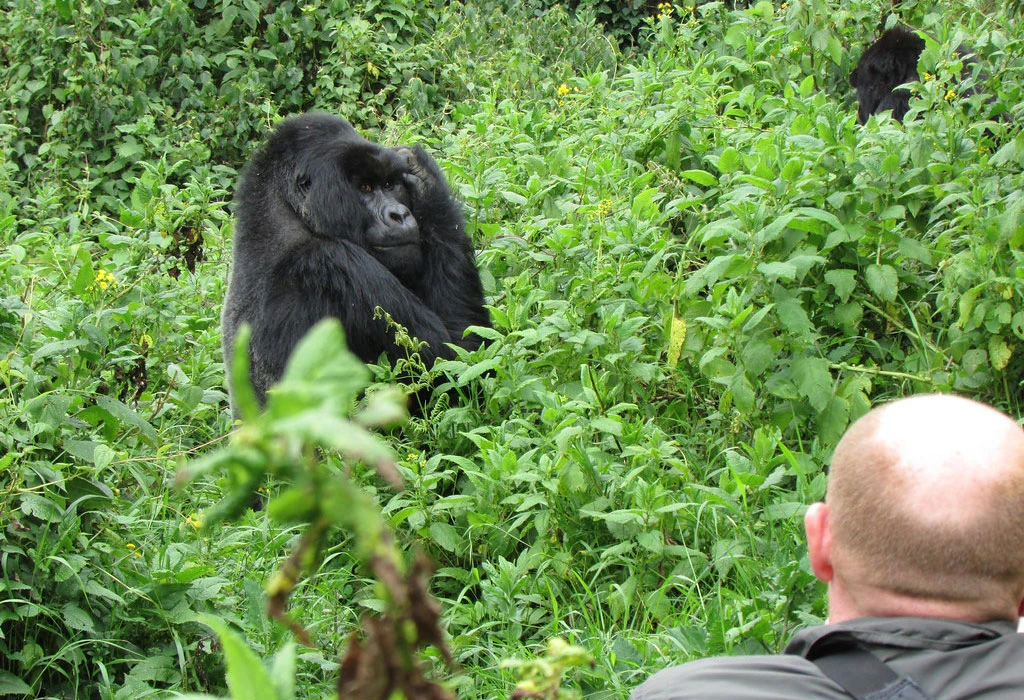 Volcanoes National Park sits on the Rwandan side of the Virunga Massif, only two to three hours by paved road from Kigali International Airport. This is the park made famous by primatologist Dian Fossey, whose former research camp can still be visited on a separate hike. Around a dozen habituated gorilla families live here, and the terrain, while still a workout, is generally considered gentler than Bwindi’s tangled undergrowth. Because of its easy access and polished infrastructure, Volcanoes National Park in Rwanda is the preferred choice for travelers on shorter trips or tighter timelines, and it consistently draws travelers who want a premium, low-hassle version of gorilla trekking in Uganda and Rwanda’s shared ecosystem.
Virunga National Park, DR Congo
Technically part of the same ecosystem, Virunga National Park in the DRC also offers gorilla trekking at a lower permit cost than either Uganda or Rwanda. However, ongoing regional security concerns mean most tour operators, including specialists in gorilla trekking in Uganda and Rwanda, currently advise against including Congo in a first-time itinerary until conditions stabilize further.
| Park | Country | Habituated Families (approx.) | Terrain Difficulty | Nearest Airport |
|---|---|---|---|---|
| Bwindi Impenetrable National Park | Uganda | 20+ | Steep, dense, muddy | Kihihi / Kisoro airstrips, or Entebbe (road) |
| Mgahinga Gorilla National Park | Uganda | 1 | Moderate, volcanic slopes | Kisoro airstrip |
| Volcanoes National Park | Rwanda | 12+ | Moderate, bamboo forest | Kigali International Airport |
| Virunga National Park | DR Congo | 8+ | Steep, volcanic | Goma airstrip |
Gorilla Trekking Permit Prices in 2026
Permit pricing is usually the single biggest factor separating a Uganda gorilla trekking itinerary from a Rwanda one, and it’s the number most travelers search for first. Both the Uganda Wildlife Authority (UWA) and the Rwanda Development Board (RDB) set fixed permit prices, and both require full payment well in advance of your trek date.
| Permit Type | Country | Foreign Non-Resident Price | Foreign Resident Price | East African Citizen Price |
|---|---|---|---|---|
| Standard gorilla trekking permit | Uganda | $800 | $700 | UGX 300,000 |
| Low-season discounted permit (April, May, November) | Uganda | $600 | $500 | Unchanged |
| Gorilla habituation experience permit | Uganda | $1,800 (effective Jan 1, 2027) | $1,600 | Reduced rate applies |
| Standard gorilla trekking permit | Rwanda | $1,500 | $500 | $200 (2026 promotional rate) |
A few important notes on Uganda and Rwanda gorilla trekking permit pricing worth knowing before you book:
- Uganda’s discount window is real but rigid. The $600 low-season permit only applies to treks in April, May, and November, and as of March 2026, these discounted permits cannot be rescheduled if your plans change.
- Uganda no longer holds a reservation without full payment. The old 7-day reservation hold has been eliminated, so full payment is required at the time of booking.
- Rwanda’s price is flat year-round. Unlike Uganda, Rwanda does not discount its standard $1,500 permit by season, though it does run a 2026 promotional rate for African citizens and residents outside the June-to-October peak period.
- What’s included: In both countries, the permit covers park entry, one hour with a habituated gorilla family, and your ranger and tracker team. It does not cover porters, tips, transport, meals, or accommodation.
- Book three to six months ahead. Permits for both Bwindi and Volcanoes National Park sell out quickly in peak months (June–September and December–February), so early booking is strongly advised.
- Minimum age is 15. This rule is enforced across Uganda, Rwanda, and the DRC with no exceptions.
- Gorilla trekking permit cost is only one line item. Once you factor in transport, lodging, meals, and tips, the realistic all-in cost of a Uganda gorilla trek ranges from roughly $1,550 on a budget trip to $5,000 or more for a fully luxury itinerary.
For current package pricing that bundles permits with accommodation and transport, the gorilla trekking packages page at Safari Vacations & Travel Services breaks down budget, mid-range, and luxury options for both countries.
Uganda vs Rwanda Gorilla Trekking: Which Should You Choose?
This is the question almost every traveler asks once they’ve confirmed gorilla trekking in Uganda and Rwanda is genuinely possible on their trip. There’s no universally “better” option — the right choice depends on your budget, fitness level, and how much time you have.
| Factor | Uganda | Rwanda |
|---|---|---|
| Permit cost | $800 (or $600 low season) | $1,500 |
| Travel time from capital/airport | 6–9 hours by road to Bwindi | 2–3 hours by road to Volcanoes NP |
| Terrain | Steep, dense, muddy forest | Moderate volcanic slopes |
| Accommodation style | Wide range, from budget to ultra-luxury | Mostly mid-range to luxury lodges |
| Ease of combining with other wildlife | Excellent — savannah parks, chimp tracking nearby | Good — Akagera National Park, Lake Kivu nearby |
| Best for | Budget-conscious travelers, longer safari circuits | Short trips, first-time Africa visitors, comfort-focused travelers |
Many seasoned safari planners actually recommend doing both. Because Bwindi and Volcanoes National Park sit only a few hours apart across the Uganda–Rwanda border, a well-designed circuit can include a Uganda gorilla trek, a short border crossing, and a Rwanda gorilla trek or Kigali city stop, all within a 10 to 12 day trip. This kind of combined circuit is quickly becoming the most popular way travelers experience gorilla trekking in Uganda and Rwanda, since it lets you compare both parks without sacrificing depth in either.
Best Time for Gorilla Trekking in Uganda and Rwanda
Gorilla trekking is technically possible year-round in both countries, since gorilla families are tracked daily regardless of weather. But rainfall, trail conditions, and permit pricing all shift with the seasons, and picking the right window matters more than most first-time trekkers expect.
| Season | Months | Conditions | Permit Pricing Impact |
|---|---|---|---|
| Long dry season | June–September | Firmer trails, easier hiking, peak crowds | Standard pricing in both countries |
| Short dry season | December–February | Good trail conditions, busy holiday period | Standard pricing in both countries |
| Short rains | October–November | Occasional showers, greener forest, thinner crowds | Uganda offers a discount in November |
| Long rains | March–May | Muddiest trails, lush scenery, lowest visitor numbers | Uganda offers a discount in April and May |
A few practical takeaways for timing your trip:
- Dry season is easier, not necessarily better. Slippery volcanic soil and rainforest mud are part of the adventure regardless of season, so don’t let light rain deter a booking outside peak months.
- Rainy season means real savings in Uganda. Because the $600 permit discount applies only to April, May, and November, budget-focused travelers can plan gorilla trekking in Uganda and Rwanda around these windows deliberately.
- Photographers often prefer the shoulder seasons. Overcast skies during the rains soften harsh midday light and keep the forest a deeper, richer green, which tends to produce better images than the flat light of a cloudless midday sky.
- Book earlier for peak months. June through September and December through February are the busiest stretches for both Bwindi and Volcanoes National Park, so permits for these months can sell out four to six months in advance.
- Consider the shoulder months for a quieter trek. Fewer visitors during October and the low-season months in Uganda often means a calmer, less rushed morning briefing and smaller trekking groups on the trail.
What to Expect on a Gorilla Trekking Day
 Understanding the actual flow of a trekking day helps set realistic expectations, since gorilla trekking in Uganda and Rwanda is as much a physical hike as it is a wildlife encounter.
- Early morning briefing. Trekkers gather at park headquarters around 7:00–8:00 a.m. for a safety briefing and group assignment. Rangers typically match groups to gorilla families based on fitness level, so it’s worth being honest about your hiking ability at this stage.
- The hike in. Depending on where the gorilla family was last located, the hike can take anywhere from 30 minutes to six or seven hours through forest, farmland, or volcanic slopes. Trackers who set out at dawn radio updates back to the guides throughout the morning.
- Approaching the gorillas. Once trackers locate the family, rangers ask visitors to leave backpacks and walking sticks with porters and approach quietly in single file, keeping voices to a whisper.
- The one-hour visit. Visitors are permitted a strict 60 minutes with the gorilla family, maintaining a recommended distance of around seven meters, though gorillas themselves often close that gap on their own, wandering past trekkers as if they aren’t there at all.
- The hike out. The return hike retraces the morning’s route, often faster since the destination is no longer unknown and adrenaline tends to carry tired legs the last stretch.
- Certificate presentation. Most parks conclude the day with a small ceremony where trekkers receive a certificate confirming their successful gorilla trek — a popular keepsake alongside photographs from the encounter.
How to Book a Gorilla Trekking Permit
Because permits are limited and issued directly by government bodies, booking correctly and early is essential for anyone serious about gorilla trekking in Uganda and Rwanda.
- Decide on your park and dates first. Bwindi’s four sectors and Volcanoes National Park’s family groupings each have different availability, so lock in dates before anything else.
- Book through a licensed tour operator. As of 2026, Uganda requires foreign visitors to book through licensed operators rather than directly with UWA, and Rwanda strongly recommends the same route through RDB-registered agents.
- Pay in full at booking. Both countries now require full, non-refundable payment upfront rather than a partial deposit, so make sure your travel dates are firm before paying.
- Submit accurate passport details. Your permit is issued in your legal name and passport number, so double-check these details before submitting payment, since corrections after issuance can be difficult.
- Confirm your sector or family assignment. In Uganda particularly, ask which sector your permit covers, since Buhoma, Ruhija, Rushaga, and Nkuringo each require different lodging and access routes.
- Build in buffer days. Weather delays, flight changes, or road conditions can shift arrival times, so plan at least one buffer day around your trekking date rather than flying in the same morning as your trek.
- Keep a digital and printed copy of your permit. Park gates request identification alongside the permit, so having both an email confirmation and a printed copy avoids delays at the entrance.
The how to book a gorilla trekking permit guide from Safari Vacations & Travel Services walks through the exact booking sequence for both countries side by side, which is useful if you’re weighing Uganda against Rwanda for the same travel window.
What to Pack for Gorilla Trekking
Trail conditions in both Bwindi and Volcanoes National Park can shift quickly, so packing correctly makes a meaningful difference in comfort during the trek.
- Waterproof hiking boots with solid ankle support for uneven, often muddy terrain.
- Gaiters to keep mud, water, and biting ants out of your boots and trouser legs.
- A lightweight rain jacket, even in the dry season, since forest weather changes quickly.
- Long-sleeved shirts and trousers in neutral colors to protect against nettles and insects.
- Gardening-style gloves for gripping vegetation on steep sections.
- A daypack to carry water, snacks, and a rain cover for your camera.
- A reusable water bottle and at least two liters of water for longer treks.
- A camera with a fully charged battery — flash photography is prohibited near the gorillas, so a lens that performs well in low light is a bonus.
- Cash in small denominations for porter fees and ranger tips, since card payment is rarely available at trailheads.
- A basic first-aid kit including blister plasters, rehydration salts, and insect repellent.
- A wide-brimmed hat or cap for sun protection during the open, farmland stretches of some routes.
- A walking stick, often provided free at the trailhead, to help with balance on steep or muddy sections.
Gorilla Trekking Rules and Etiquette
Strict rules and etiquette protect both visitors and the gorillas themselves, and every reputable operator running gorilla trekking in Uganda and Rwanda will brief guests on these before the hike begins.
- Maintain a minimum distance of 10 meters from the gorillas at all times, even if they approach you —don’t run a way.
- Keep your voice low and avoid sudden movements that could startle the family.
- No flash photography is allowed, as it can disturb or distress the gorillas.
- Do not trek if you’re feeling unwell. Gorillas share close to 98% of human DNA and are highly susceptible to human illnesses, particularly respiratory infections, so a visible cold or cough may see you rescheduled to protect the family.
- Wear a face mask if required by park regulations at the time of your visit.
- No eating or drinking in front of the gorillas, though water breaks are fine at a distance from the family.
- Groups are capped at eight visitors per gorilla family, per day, to limit stress on the animals.
- The one-hour limit is strictly enforced, regardless of how compelling the encounter becomes, so guides will call time even mid-photograph.
- Follow ranger instructions immediately if a silverback displays or charges, since sudden retreats can escalate rather than calm the situation.
Combining Gorilla Trekking with a Wider Safari
Most travelers don’t fly to East Africa for gorillas alone. Because gorilla trekking in Uganda and Rwanda typically requires only one or two days of actual trekking, it pairs naturally with a longer circuit.
- Uganda pairings: Queen Elizabeth National Park for tree-climbing lions and boat cruises along the Kazinga Channel, Kibale Forest for chimpanzee tracking, or Murchison Falls National Park for the Nile’s most dramatic waterfall.
- Rwanda pairings: Akagera National Park for a classic Big Five game drive, or a relaxed stopover on the shores of Lake Kivu before or after the trek to unwind after several days of hiking.
- Cross-border circuits: Because Bwindi and Volcanoes National Park sit close to the shared border, many operators build combined Uganda–Rwanda itineraries that include both a Bwindi trek and a Volcanoes National Park trek in a single trip, giving travelers a direct comparison of both countries’ gorilla trekking experiences.
- Cultural add-ons: Batwa community visits near Bwindi and genocide memorial tours in Kigali give travelers a deeper understanding of each country beyond its wildlife.
The Uganda safari packages and Rwanda safari packages pages outline pre-built circuits that combine gorilla trekking with these wider wildlife experiences.
Notable Gorilla Families You Might Trek
Every habituated gorilla family has its own personality, history, and dominant silverback, and rangers assign trekkers to a specific family on the morning of the hike based on fitness level and permit type. A few of the better-known families that regularly feature in trip reports on gorilla trekking in Uganda and Rwanda include:
- Rushegura family (Bwindi, Buhoma sector). Known for a relatively calm temperament and relatively easy access from the Buhoma trailhead, making it a popular assignment for first-time trekkers.
- Nkuringo family (Bwindi, Nkuringo sector). One of the first families habituated in southern Bwindi, often involving a steeper hike but rewarding trekkers with dramatic valley views.
- Susa family (Volcanoes National Park). Famous as the largest group studied by Dian Fossey, though its size and range mean it can require one of the longer hikes in Rwanda
- Sabyinyo family (Volcanoes National Park). Home to one of the largest silverbacks in the region, and generally considered one of the more accessible families for less experienced hikers.
- Nyakagezi family (Mgahinga). Uganda’s sole Mgahinga family, known for occasionally roaming across the border into Rwanda or the DRC, which can affect availability on any given day.
Because family assignments happen the morning of the trek rather than at the time of permit purchase, it’s worth discussing fitness level honestly with your guide so rangers can match you to an appropriate group.
Where to Stay: Accommodation Options Near the Parks
Lodging near Bwindi and Volcanoes National Park spans a wide range of budgets, and where you stay significantly shapes both cost and comfort for anyone planning gorilla trekking in Uganda and Rwanda.
- Budget lodges and guesthouses. Simple, comfortable rooms close to the park gate, typically the most affordable way to combine a gorilla trekking permit with a place to sleep and eat.
- Mid-range lodges. En-suite cottages or bandas with hot water, generator power, and often excellent views over the forest canopy or volcanic peaks, a popular choice for travelers who want comfort without ultra-luxury pricing.
- Luxury lodges. High-end properties with private verandas, spa services, gourmet dining, and sometimes even in-room fireplaces, common around both Buhoma and the Kinigi area near Volcanoes National Park.
- Tented camps. A middle-ground option offering a more immersive forest experience while still providing proper beds, en-suite bathrooms, and full board.
A general rule of thumb: because gorilla trekking mornings start early, choosing a lodge within a 20 to 40 minute drive of your trailhead is worth prioritizing over a slightly cheaper option further away, since it protects your sleep and reduces the risk of a delayed start.
Environmental and Community Impact of Gorilla Trekking
Beyond the personal experience, gorilla trekking in Uganda and Rwanda plays a direct role in mountain gorilla conservation. Mountain gorillas were once projected toward extinction, yet controlled, permit-funded tourism has been widely credited with helping stabilize and grow the population over the past three decades.
- Revenue sharing with local communities. Both Uganda and Rwanda return a percentage of permit revenue to communities living around the parks, funding schools, health centers, and small infrastructure projects.
- Anti-poaching patrols. Permit fees directly fund ranger salaries and patrol operations that protect gorilla families from snares and illegal hunting.
- Veterinary monitoring. Dedicated veterinary teams, such as Gorilla Doctors, monitor habituated families for injury and disease, an effort largely funded through park revenue.
- Incentive against poaching and land conversion. Because gorilla trekking tourism generates significant income for surrounding communities, it creates a strong economic incentive to protect forest habitat rather than convert it to farmland.
Choosing to go gorilla trekking in Uganda and Rwanda, in other words, isn’t only a personal bucket-list experience — it’s a direct contribution to one of conservation’s genuine long-term success stories.
Sample Itineraries for Gorilla Trekking in Uganda and Rwanda
The sample itineraries below give a quick sense of how much time to budget depending on whether you’re trekking one country or both.
| Itinerary | Duration | Highlights | Best For |
|---|---|---|---|
| Uganda Gorilla Express | 4 days | Entebbe – Bwindi gorilla trek – return | Short trips, single-country focus |
| Rwanda Gorilla Getaway | 3 days | Kigali – Volcanoes National Park trek – Lake Kivu | Travelers with limited time |
| Uganda Primates & Savannah | 8 days | Bwindi gorillas, Kibale chimpanzees, Queen Elizabeth NP game drives | Wildlife-focused travelers |
| Uganda–Rwanda Combined Circuit | 10–12 days | Bwindi trek, border crossing, Volcanoes NP trek, Kigali city tour | Travelers wanting both countries in one trip |
Getting There: Practical Travel Logistics
Beyond permits and packing, a few logistical details make a real difference to how smoothly a gorilla trekking in Uganda and Rwanda trip unfolds from the moment you land.
- Flying into Uganda. Entebbe International Airport is the main gateway, with a scenic but long road transfer of roughly 8 to 9 hours to Bwindi, depending on which sector you’re trekking. Domestic flights to airstrips near Kihihi or Kisoro can cut this significantly for travelers short on time.
- Flying into Rwanda. Kigali International Airport connects directly to Volcanoes National Park via a well-paved 2 to 3 hour drive, making Rwanda the more time-efficient entry point for a quick gorilla trekking add-on, as outlined in Kigali transfer guide.
- Currency and payments. Uganda uses the Ugandan Shilling and Rwanda uses the Rwandan Franc, though US dollars are widely accepted for permits, lodges, and larger purchases in both countries. Small denominations and notes printed after 2009 are generally preferred.
- Border crossings. Travelers combining both countries typically cross at the Cyanika or Katuna/Gatuna border posts, both of which are well-served by tour operators running combined circuits.
- Health precautions. Yellow fever vaccination is required for entry into both Uganda and Rwanda, and travelers should consult a physician about malaria prophylaxis well before departure.
- Connectivity. Mobile data coverage is reasonably good in towns near both parks, though it thins out considerably inside the forest itself, so downloading offline maps in advance is a smart precaution.
Frequently Asked Questions About Gorilla Trekking in Uganda and Rwanda
Is gorilla trekking in Uganda and Rwanda safe?
Yes. Both Bwindi Impenetrable National Park and Volcanoes National Park are patrolled by armed rangers, and gorilla trekking is considered a well-regulated, low-risk activity when guidelines are followed. The greater physical risk comes from the hike itself — steep, sometimes slippery terrain — rather than from the gorillas.
How physically demanding is a gorilla trek?
It varies widely by day and by gorilla family location. Some treks take under an hour to reach the gorillas, while others involve five to seven hours of hiking on steep, muddy trails. A reasonable level of fitness is recommended, and hiring a porter can significantly ease the physical demand for less experienced hikers.
Can I get a refund if I cancel my gorilla trekking permit?
Generally, no. Both Uganda and Rwanda gorilla trekking permits are non-refundable once purchased, and Uganda’s discounted low-season permits cannot even be rescheduled. Travel insurance that covers trip cancellation is strongly recommended for anyone booking months in advance.
What is the minimum age for gorilla trekking?
Fifteen years old, a rule enforced consistently across Uganda, Rwanda, and the Democratic Republic of Congo with no exceptions made for younger travelers.
Should I trek in Uganda or Rwanda if I only have time for one?
If budget is the priority, Uganda’s $800 standard permit (or $600 in the discounted low-season months) is significantly cheaper than Rwanda’s $1,500 permit. If time and convenience matter more, Rwanda’s Volcanoes National Park is only two to three hours from Kigali International Airport, compared to a much longer journey to reach Bwindi.
Do I need a visa to go gorilla trekking in Uganda or Rwanda?
Most foreign visitors need a visa for both countries, though the East Africa Tourist Visa allows travel between Uganda, Rwanda, and Kenya on a single visa, which is useful for combined itineraries that cross the border more than once.
How many gorilla permits are available each day?
Uganda issues around 160 permits daily across Bwindi and Mgahinga combined, while Rwanda issues roughly 112 permits daily across its habituated families in Volcanoes National Park, which is why early booking matters so much during peak months.
Final Thoughts on Planning Your Gorilla Trekking Trip
Gorilla trekking in Uganda and Rwanda rewards travelers who plan ahead — booking permits months in advance, choosing the right season for their budget and comfort level, and packing properly for genuinely demanding terrain. Whether you choose Uganda’s lower-cost Bwindi Impenetrable National Park, Rwanda’s more accessible Volcanoes National Park, or a combined circuit through both countries, the hour spent with a wild gorilla family tends to become the defining memory of an East African safari.
For personalized itinerary planning, permit booking, and lodge recommendations across both countries, the team at Safari Vacations & Travel Services specializes in building custom gorilla trekking trips from start to finish. You can get in touch with a safari consultant to start planning.