
Experience the Most Rewarding Chimpanzee Trekking Safari in Africa
Discover why Uganda is widely regarded as the best destination for chimpanzee trekking in Africa. Home to more than 5,000 wild chimpanzees, Uganda offers unmatched opportunities to observe our closest living relatives in their natural rainforest habitat. Whether you choose the world-famous Kibale National Park, the scenic Kyambura Gorge, the ancient Budongo Forest, or the beautiful Kalinzu Forest Reserve, every trek promises an unforgettable wildlife encounter led by experienced Uganda Wildlife Authority ranger guides.
Chimpanzee trekking in Uganda is much more than a simple forest walk. It is an immersive journey through lush tropical rainforests filled with towering trees, colorful butterflies, unique birdlife, and diverse wildlife. As you follow fresh calls and footprints through the forest, anticipation builds until you finally come face-to-face with a family of wild chimpanzees. Watching them communicate, groom one another, play, forage, and swing effortlessly through the forest canopy is a thrilling experience that few wildlife adventures can equal.
A Detailed Map Showing Uganda’s Major Chimpanzee Trekking Destinations
This comprehensive guide covers everything you need to know before planning your trip, including the best chimpanzee trekking destinations in Uganda, permit prices, chimpanzee habituation experiences, the best time to visit, trekking difficulty, packing lists, accommodation options, photography tips, safari itineraries, travel advice, conservation efforts, and answers to the most frequently asked questions. Whether you are planning a short primate safari or combining chimpanzee trekking with gorilla trekking and wildlife viewing, this guide will help you make informed decisions and plan the perfect adventure.
At Safari Vacations and Travel Services Ltd, we specialize in creating tailor-made chimpanzee trekking safaris that match your interests, travel dates, and budget. Our experienced safari consultants handle every detail, from securing permits and selecting the best lodges to arranging comfortable transportation and experienced professional guides, allowing you to focus entirely on enjoying one of Africa’s greatest wildlife experiences.
Ready to experience the excitement of meeting wild chimpanzees in their natural habitat? Contact our safari specialists today for a personalized itinerary, the latest permit availability, and a free no-obligation quotation. We will help you plan an unforgettable chimpanzee trekking safari in Uganda that perfectly matches your travel style and schedule.
Quick Facts About Chimpanzee Trekking in Uganda
Chimpanzee trekking in Uganda is one of Africa’s most rewarding wildlife experiences, giving visitors the rare opportunity to observe our closest living relatives in their natural rainforest habitat. Uganda is internationally recognized as one of the best destinations for primate tourism thanks to its healthy chimpanzee populations, well-protected forests, experienced Uganda Wildlife Authority ranger guides, and exceptionally high chimpanzee sighting rates. Before planning your safari, here are the essential facts every traveler should know about chimpanzee trekking in Uganda.
Over 5,000 Wild Chimpanzees
Uganda is home to more than 5,000 wild chimpanzees, making chimpanzee trekking in Uganda one of the finest primate experiences anywhere in Africa. These intelligent great apes inhabit several protected forests, including Kibale National Park, Budongo Forest, Kyambura Gorge, and Kalinzu Forest Reserve. Uganda’s successful conservation efforts have helped maintain thriving chimpanzee populations, allowing visitors to enjoy unforgettable wildlife encounters while directly supporting conservation and local communities.
Four Major Chimpanzee Trekking Destinations
One of the greatest advantages of chimpanzee trekking in Uganda is the variety of destinations available. Uganda offers four outstanding locations where visitors can track habituated chimpanzees in different rainforest ecosystems. Kibale National Park is widely regarded as Africa’s premier chimpanzee trekking destination, while Budongo Forest offers beautiful mahogany woodlands within Murchison Falls National Park. Kyambura Gorge provides a unique trekking experience inside Queen Elizabeth National Park, and Kalinzu Forest Reserve offers excellent value for money.
Up to 98% Success Rate in Kibale National Park
Kibale National Park offers one of the highest chimpanzee sighting rates on the continent, making chimpanzee trekking in Uganda highly successful for most visitors. With an impressive success rate of up to 98%, travelers have an excellent chance of locating habituated chimpanzees during their trek. This remarkable success is made possible by experienced trackers who monitor chimpanzee movements daily and guide visitors directly to the communities.
Chimpanzee Trekking is Available All Year Round
One of the major benefits of chimpanzee trekking in Uganda is that it can be enjoyed throughout the year. The dry seasons between June and September and December to February generally offer easier hiking conditions with drier forest trails. However, the rainy seasons also provide rewarding trekking experiences, featuring lush green forests, abundant birdlife, fewer visitors, and excellent photography opportunities.
Chimpanzee Habituation Experience Available
In addition to standard trekking, chimpanzee trekking in Uganda also includes the exclusive Chimpanzee Habituation Experience. This unique activity allows visitors to spend up to four hours with a semi-habituated chimpanzee community while accompanying researchers and Uganda Wildlife Authority rangers. It offers exceptional opportunities to observe feeding behavior, social interactions, vocal communication, nesting, and daily movements in much greater detail than a standard trek.
Guided by Uganda Wildlife Authority Rangers
Every chimpanzee trekking in Uganda experience is conducted under the supervision of highly trained Uganda Wildlife Authority (UWA) ranger guides and professional trackers. Before entering the forest, visitors receive a comprehensive safety briefing covering chimpanzee behavior, trekking rules, conservation guidelines, and what to expect during the adventure. Throughout the trek, the guides share valuable knowledge about the rainforest ecosystem and ensure the safety of both visitors and wildlife.
Suitable for Most Fitness Levels
Although chimpanzee trekking in Uganda involves walking through tropical rainforest, it is suitable for most travelers with a reasonable level of physical fitness. The trails vary from relatively gentle walks to more challenging hikes depending on where the chimpanzees are located on a particular day. Comfortable hiking boots, long trousers, and a moderate fitness level are usually all that is required to enjoy this unforgettable adventure.
Trek Duration
A typical chimpanzee trekking in Uganda excursion lasts between two and five hours, depending on how quickly the chimpanzees are located. Once the chimpanzees are found, visitors spend one unforgettable hour observing them as they feed, groom, play, rest, and interact within their family groups. Those participating in the Chimpanzee Habituation Experience enjoy up to four hours with the chimpanzees, providing an even richer wildlife experience.
Minimum Age Requirement
To participate in chimpanzee trekking in Uganda, visitors must be at least 12 years old. This minimum age requirement helps ensure the safety of participants while minimizing disturbance to the chimpanzees. Families traveling with younger children can often arrange alternative activities such as guided nature walks, birdwatching excursions, community visits, or cultural experiences while other family members go trekking.
Permit Validity
Every permit issued for chimpanzee trekking in Uganda is valid for one scheduled trekking session on the specific date shown on the permit. Permits are non-transferable and cannot be used on another day unless officially rescheduled under Uganda Wildlife Authority regulations. Since the number of permits available each day is limited—particularly in Kibale National Park—it is highly recommended to reserve permits several months in advance, especially during the peak travel seasons.
These quick facts clearly demonstrate why chimpanzee trekking in Uganda is regarded as one of the world’s greatest primate adventures. With thriving chimpanzee populations, multiple trekking destinations, knowledgeable ranger guides, year-round availability, and exceptional conservation efforts, Uganda offers an unforgettable wildlife experience for photographers, families, researchers, birdwatchers, and nature lovers from around the world.
Why Uganda is the Best Country for Chimpanzee Trekking
Uganda has earned its reputation as Africa’s premier destination for chimpanzee trekking thanks to its remarkable chimpanzee population, diverse rainforest habitats, exceptional conservation efforts, and world-class tourism infrastructure. While several African countries are home to wild chimpanzees, chimpanzee trekking in Uganda stands out because it offers visitors the highest chances of successful sightings, multiple trekking destinations, affordable permit prices, and the unique opportunity to combine chimpanzee trekking with mountain gorilla trekking on a single safari. Whether you are a first-time visitor or an experienced wildlife enthusiast, Uganda offers an unforgettable primate adventure that is difficult to match anywhere else on the continent.
Largest Habituated Chimpanzee Population
One of the biggest reasons why chimpanzee trekking in Uganda is so popular is the country’s thriving chimpanzee population. Uganda is home to more than 5,000 wild chimpanzees, one of the largest populations remaining in Africa. These chimpanzees inhabit a network of protected national parks and forest reserves, where decades of conservation work have helped maintain healthy and stable communities.
Kibale National Park alone protects approximately 1,500 chimpanzees, making it the largest concentration of chimpanzees in East Africa. Additional populations thrive in Budongo Forest, Kyambura Gorge, and Kalinzu Forest Reserve. Several of these communities have been carefully habituated to human presence, allowing visitors to observe their natural behavior without causing unnecessary disturbance.
The abundance of habituated chimpanzees significantly increases the likelihood of unforgettable wildlife encounters while supporting important conservation initiatives that protect these endangered great apes for future generations.
Highest Chimpanzee Sighting Success Rates
Few wildlife experiences offer the reliability of chimpanzee trekking in Uganda. Kibale National Park consistently records chimpanzee sighting success rates of up to 98%, making it one of the most dependable places in the world to see wild chimpanzees. This remarkable success is made possible by experienced Uganda Wildlife Authority trackers who monitor chimpanzee movements every day before visitors enter the forest.
Other destinations such as Budongo Forest and Kalinzu Forest Reserve also provide excellent chances of locating chimpanzees, while Kyambura Gorge offers a more adventurous experience with rewarding sightings inside one of Africa’s most spectacular forested gorges. The consistently high success rates give travelers confidence that they are likely to enjoy the experience they have traveled thousands of miles to see.
Diverse Chimpanzee Trekking Destinations
Unlike many African countries that offer only one trekking location, chimpanzee trekking in Uganda can be enjoyed in five distinct destinations, each offering its own scenery, ecosystems, wildlife, and level of adventure.
Kibale National Park is famous for its dense tropical rainforest and exceptional chimpanzee population. Budongo Forest is renowned for its giant mahogany trees and can easily be combined with a safari in Murchison Falls National Park. Kyambura Gorge provides a dramatic setting deep within Queen Elizabeth National Park, while Kalinzu Forest Reserve offers excellent value and fewer crowds. Toro-Semliki Wildlife Reserve delivers an off-the-beaten-path experience for adventurous travelers seeking a quieter rainforest environment.
This diversity allows visitors to choose the destination that best matches their interests, fitness level, itinerary, and budget.
Affordable Chimpanzee Trekking Permits
Another reason travelers choose chimpanzee trekking in Uganda is its excellent value for money. Uganda offers some of Africa’s most affordable chimpanzee trekking permits while maintaining exceptional conservation standards and visitor experiences.
Compared to many wildlife activities across Africa, chimpanzee trekking provides extraordinary value because visitors enjoy professionally guided forest walks, highly successful wildlife encounters, and direct contributions to chimpanzee conservation and local community development. Uganda also periodically introduces low-season permit discounts, making chimpanzee trekking even more accessible for budget-conscious travelers.
The combination of affordability and quality makes Uganda one of the best destinations for travelers seeking a world-class primate safari without the significantly higher costs found elsewhere.
Combine Gorilla Trekking and Chimpanzee Trekking on One Safari
One of the greatest advantages of chimpanzee trekking in Uganda is the opportunity to combine it with mountain gorilla trekking during the same holiday. Uganda is one of the few countries in the world where visitors can observe both endangered mountain gorillas and wild chimpanzees in their natural habitats within a single itinerary.
Many travelers choose safaris that combine Kibale National Park for chimpanzee trekking with Bwindi Impenetrable National Park or Mgahinga Gorilla National Park for gorilla trekking. These unforgettable experiences can also be combined with game drives in Queen Elizabeth National Park, boat cruises on the Kazinga Channel, chimpanzee trekking in Budongo Forest, or visits to Murchison Falls National Park.
This unique combination makes Uganda one of Africa’s most rewarding primate safari destinations.
Exceptional Biodiversity Beyond Chimpanzees
While chimpanzee trekking in Uganda is the primary attraction, the country’s rainforests are also home to an extraordinary diversity of wildlife. Kibale National Park alone supports 13 species of primates, including red colobus monkeys, black-and-white colobus monkeys, L’Hoest’s monkeys, blue monkeys, grey-cheeked mangabeys, red-tailed monkeys, olive baboons, bush babies, and pottos.
Beyond primates, Uganda’s forests protect hundreds of bird species, colorful butterflies, forest elephants, bush pigs, giant forest squirrels, reptiles, amphibians, and countless plant species. Every chimpanzee trek becomes a complete rainforest safari filled with remarkable wildlife encounters and spectacular scenery.
Highly Experienced Uganda Wildlife Authority Guides
Every chimpanzee trekking in Uganda experience is led by highly trained Uganda Wildlife Authority ranger guides and professional trackers. These experts possess extensive knowledge of chimpanzee behavior, rainforest ecology, conservation practices, and visitor safety.
Before each trek, visitors receive a detailed briefing explaining the rules of responsible chimpanzee viewing, health precautions, and what to expect during the forest walk. Throughout the experience, the guides interpret chimpanzee vocalizations, identify animal tracks, explain forest plants, and provide fascinating insights into the daily lives of these remarkable primates.
Their expertise greatly enhances the overall safari experience while ensuring both visitor safety and the long-term protection of Uganda’s wildlife.
Excellent Tourism Infrastructure
Uganda has invested significantly in tourism infrastructure, making chimpanzee trekking in Uganda both comfortable and accessible. Well-maintained road networks connect the country’s major national parks, while scheduled domestic flights provide fast access to key safari destinations for travelers with limited time.
Visitors can choose from a wide selection of luxury safari lodges, boutique forest camps, mid-range accommodations, and budget-friendly guesthouses located near each trekking destination. Professional tour operators, experienced safari guides, reliable transport services, and modern visitor facilities ensure that travelers enjoy a seamless experience from arrival to departure.
Combined with Uganda’s warm hospitality and breathtaking natural beauty, this excellent infrastructure makes planning and enjoying a chimpanzee trekking safari remarkably easy.
An Unforgettable Primate Adventure
There are many places in Africa where chimpanzees can be found, but chimpanzee trekking in Uganda offers the perfect combination of abundant wildlife, exceptionally high sighting success, multiple trekking destinations, affordable permits, experienced ranger guides, rich biodiversity, and the unique opportunity to combine chimpanzees with mountain gorillas and classic African wildlife safaris. Whether your dream is to photograph wild chimpanzees, explore ancient tropical rainforests, or experience Africa’s incredible biodiversity firsthand, Uganda delivers one of the most rewarding wildlife adventures on Earth.
What is Chimpanzee Trekking?
Chimpanzee trekking in Uganda is a guided wildlife experience that allows visitors to search for and observe wild habituated chimpanzees in their natural rainforest habitat. Unlike visiting animals in a zoo or sanctuary, chimpanzee trekking takes place deep within protected forests where the chimpanzees roam freely, feed naturally, build nests, and interact with one another without human interference. It is one of the most authentic wildlife encounters in Africa, offering an opportunity to witness the daily lives of one of humanity’s closest relatives while supporting conservation and local communities.
Chimpanzees share approximately 98.7% of their DNA with humans, making them our closest living relatives alongside bonobos. Their intelligence, emotional expressions, complex social structures, and use of tools make every encounter fascinating. During chimpanzee trekking in Uganda, visitors have the rare chance to observe these remarkable primates communicating through loud calls, grooming one another, caring for their young, playing in the forest canopy, hunting for food, and displaying behaviors that closely resemble our own.
How Does Chimpanzee Trekking Work?
Every chimpanzee trekking in Uganda adventure begins early in the morning at the designated visitor center. After registration, visitors meet experienced Uganda Wildlife Authority ranger guides who conduct a comprehensive briefing about safety regulations, chimpanzee behavior, trekking etiquette, and conservation guidelines. The briefing also explains what to expect during the hike and how visitors should behave once they locate the chimpanzees.
Before tourists enter the forest, professional trackers set out to locate the habituated chimpanzee communities by following fresh nests, vocalizations, feeding signs, footprints, and previous movement patterns. They remain in radio communication with the ranger guides, allowing trekking groups to follow the most recent location of the chimpanzees.
Once the trackers have confirmed the chimpanzees’ position, visitors begin walking through the rainforest in small guided groups. The pace is comfortable, with frequent stops for wildlife interpretation, photography, and explanations about the forest ecosystem. Depending on where the chimpanzees have moved that day, the hike may last anywhere from a few minutes to several hours before the first encounter.
What to Expect During Chimpanzee Trekking
Every chimpanzee trekking in Uganda experience is unique because chimpanzees are completely wild and move freely through the forest. No two treks are ever exactly the same. Some days visitors may find the chimpanzees feeding quietly in fruiting trees close to the trail, while on other days they may need to follow them as they travel rapidly through the forest canopy.
The excitement usually begins long before the chimpanzees are visible. Visitors often hear loud pant-hoots, screams, drumming on tree buttresses, or branches shaking high above the canopy before finally catching sight of the animals. As the chimpanzees become visible, visitors are rewarded with incredible opportunities to observe their natural behavior at close range.
You may watch dominant males defending their territory, mothers nursing young infants, juveniles chasing each other through the trees, adults grooming family members, or groups feeding on wild fruits, leaves, termites, and figs. Their remarkable intelligence and human-like interactions make every moment unforgettable.
Throughout chimpanzee trekking in Uganda, your ranger guide interprets these behaviors, helping visitors understand the complex social structure, communication methods, feeding habits, conservation challenges, and fascinating ecology of these endangered primates.
Typical Trek Duration
The duration of chimpanzee trekking in Uganda varies from one destination to another and depends largely on the location of the chimpanzees on the day of your visit. On average, the complete experience lasts between two and five hours, including the briefing, the forest hike, the time spent with the chimpanzees, and the return walk.
Occasionally, the chimpanzees may be located within a short distance of the starting point, allowing visitors to reach them in less than an hour. On other occasions, trekkers may spend several hours hiking through dense rainforest before locating the chimpanzee community. Regardless of the trekking time, the journey itself is part of the adventure, offering opportunities to discover Uganda’s rich rainforest biodiversity.
Visitors participating in the Chimpanzee Habituation Experience enjoy a much longer excursion, often spending most of the day in the forest and up to four hours observing the chimpanzees as they go about their daily activities.
The Rainforest Experience
One of the highlights of chimpanzee trekking in Uganda is the opportunity to explore some of Africa’s oldest and most beautiful tropical rainforests. Destinations such as Kibale National Park and Budongo Forest are characterized by towering hardwood trees, dense undergrowth, colorful butterflies, crystal-clear streams, hanging vines, and a rich diversity of plants and wildlife.
As you walk beneath the forest canopy, you may encounter several other primate species, including red-tailed monkeys, black-and-white colobus monkeys, red colobus monkeys, blue monkeys, grey-cheeked mangabeys, olive baboons, bush babies, and L’Hoest’s monkeys. Bird enthusiasts may also spot colorful forest birds such as the Great Blue Turaco, African Grey Parrot, Green-breasted Pitta, hornbills, barbets, and numerous sunbirds.
The rainforest is alive with natural sounds, from birdsong and insect calls to rustling leaves and distant chimpanzee vocalizations. Every step through the forest provides a deeper appreciation of Uganda’s remarkable biodiversity and the importance of protecting these fragile ecosystems.
The One-Hour Viewing Rule
A fundamental rule of chimpanzee trekking in Uganda is the one-hour viewing limit. Once the chimpanzees are located, visitors are allowed to spend a maximum of one hour observing them in their natural environment. This regulation has been established by the Uganda Wildlife Authority to minimize stress on the chimpanzees and reduce the risk of disease transmission between humans and wildlife.
During this hour, visitors can quietly observe and photograph the chimpanzees as they feed, groom, communicate, rest, play, and interact with one another. Maintaining a respectful distance, avoiding loud noises, and following the instructions of the ranger guide are essential for protecting both visitors and the chimpanzees.
Although one hour may seem brief, it provides ample time to witness remarkable behaviors and capture unforgettable memories. For travelers seeking a more in-depth encounter, the Chimpanzee Habituation Experience extends this viewing time to up to four hours, offering an even greater understanding of chimpanzee behavior and rainforest ecology.
A Once-in-a-Lifetime Wildlife Experience
For many travelers, chimpanzee trekking in Uganda becomes the highlight of their African safari. The combination of walking through ancient tropical rainforests, hearing the echoes of wild chimpanzees before seeing them, and finally standing just a few meters away from these intelligent primates creates memories that last a lifetime. It is not simply a wildlife activity but a deeply moving conservation experience that connects visitors with one of the world’s most extraordinary species while contributing directly to their long-term protection.
Why Choose Uganda for Chimpanzee Trekking?
When planning a primate safari in Africa, many travelers ask which country offers the best chimpanzee trekking experience. While chimpanzees can also be found in countries such as Rwanda, Tanzania, and the Democratic Republic of Congo, chimpanzee trekking in Uganda consistently stands out as the preferred choice for wildlife enthusiasts from around the world. Uganda combines thriving chimpanzee populations, world-class conservation, beautiful tropical rainforests, excellent tourism infrastructure, affordable permit prices, and the unique opportunity to combine chimpanzee trekking with mountain gorilla trekking and classic African wildlife safaris.
Whether you are visiting Africa for the first time or returning for another adventure, chimpanzee trekking in Uganda offers an authentic, safe, and unforgettable wildlife experience that few destinations can rival.
Outstanding Conservation Success
One of the biggest reasons to choose chimpanzee trekking in Uganda is the country’s long-standing commitment to wildlife conservation. Uganda Wildlife Authority (UWA), together with conservation organizations, researchers, local communities, and tourism stakeholders, has worked tirelessly to protect chimpanzees and their rainforest habitats for decades.
Protected areas such as Kibale National Park, Budongo Forest, Kyambura Gorge, Kalinzu Forest Reserve, and Toro-Semliki Wildlife Reserve are carefully managed to ensure that chimpanzee populations continue to thrive. Strict visitor regulations, controlled permit numbers, professional ranger guidance, and ongoing scientific research all contribute to the long-term survival of these endangered great apes.
Every permit purchased for chimpanzee trekking in Uganda directly supports conservation programs, anti-poaching patrols, habitat restoration, wildlife monitoring, ranger training, and community development projects that encourage local people to protect the forests rather than exploit them.
Easy Accessibility to Trekking Destinations
Another major advantage of chimpanzee trekking in Uganda is the ease of reaching the country’s leading trekking destinations. Uganda has an excellent network of paved highways and well-maintained roads connecting its national parks, making travel both convenient and scenic.
Kibale National Park is approximately five to six hours by road from Kampala or Entebbe, while Budongo Forest is easily combined with Murchison Falls National Park. Kyambura Gorge lies within Queen Elizabeth National Park, allowing visitors to combine chimpanzee trekking with game drives and boat cruises. Kalinzu Forest Reserve is located near Bushenyi and Queen Elizabeth National Park, making it an excellent addition to southern Uganda safaris.
For travelers with limited time, scheduled domestic flights operate to airstrips near several national parks, significantly reducing travel time while providing spectacular aerial views of Uganda’s diverse landscapes.
Spectacular Tropical Rainforests
One of the unforgettable highlights of chimpanzee trekking in Uganda is the breathtaking rainforest scenery. Uganda’s forests are among the oldest and most biologically diverse ecosystems in Africa, creating a truly immersive wilderness experience.
Walking beneath towering mahogany trees in Budongo Forest, exploring the lush evergreen forests of Kibale National Park, or descending into the dramatic Kyambura Gorge offers much more than simply searching for chimpanzees. Visitors are surrounded by colorful butterflies, towering ferns, ancient vines, crystal-clear streams, giant fig trees, and an astonishing variety of birds, monkeys, and other forest wildlife.
These magnificent landscapes provide incredible opportunities for photography while allowing visitors to experience the beauty of Africa’s tropical rainforests in their natural state.
Safe, Well-Organized, and Professionally Guided
Safety is one of the reasons why thousands of travelers confidently choose chimpanzee trekking in Uganda every year. All trekking activities are carefully managed by the Uganda Wildlife Authority, whose highly trained ranger guides and professional trackers accompany every visitor throughout the experience.
Before entering the forest, guests receive a comprehensive briefing covering trekking procedures, health protocols, chimpanzee behavior, emergency procedures, and responsible wildlife viewing practices. Throughout the trek, guides monitor the group, communicate with trackers by radio, and ensure that visitors maintain a safe distance from the chimpanzees.
Uganda’s long history of successful wildlife tourism, combined with experienced safari operators, quality accommodation, reliable transportation, and professional guiding services, ensures that visitors enjoy a safe, comfortable, and memorable safari from beginning to end.
Outstanding Value for Money
Compared to many wildlife destinations across Africa, chimpanzee trekking in Uganda offers exceptional value for money. Uganda provides one of the highest-quality chimpanzee trekking experiences while maintaining relatively affordable permit prices, making it accessible to a wider range of travelers.
Visitors receive much more than simply an hour with chimpanzees. Every trek includes experienced ranger guides, expert trackers, conservation support, access to protected national parks, and the opportunity to explore some of Africa’s richest rainforest ecosystems. The combination of outstanding wildlife encounters, excellent guiding, and affordable pricing makes Uganda one of the best-value primate safari destinations on the continent.
Travelers can further maximize their investment by combining chimpanzee trekking with mountain gorilla trekking, wildlife safaris, birdwatching, cultural experiences, and scenic lake tours, creating an extraordinary African adventure within a single itinerary.
Incredible Variety of Wildlife Experiences
One of the greatest strengths of chimpanzee trekking in Uganda is the incredible variety of experiences available beyond chimpanzee tracking itself. Uganda is one of the few countries where visitors can enjoy multiple world-class wildlife adventures during one safari.
Many travelers combine chimpanzee trekking in Kibale National Park with gorilla trekking in Bwindi Impenetrable National Park or Mgahinga Gorilla National Park. Others add exciting game drives in Queen Elizabeth National Park or Murchison Falls National Park, boat cruises along the Kazinga Channel or the Nile River, birdwatching excursions, Bigodi Wetland Sanctuary walks, cultural village visits, crater lake tours, mountain hiking, and relaxation at Lake Bunyonyi.
This diversity allows every traveler to customize their safari according to their interests, whether they are passionate about primates, photography, birdwatching, wildlife, culture, or adventure.
A Destination Unlike Any Other
Choosing chimpanzee trekking in Uganda means choosing one of Africa’s richest wildlife destinations. Uganda combines thriving chimpanzee populations, internationally recognized conservation programs, spectacular tropical rainforests, experienced Uganda Wildlife Authority ranger guides, excellent accessibility, affordable permits, and an incredible diversity of safari experiences. Few countries can match the opportunity to track wild chimpanzees in the morning, encounter endangered mountain gorillas the following day, and enjoy classic African wildlife safaris shortly afterward.
For travelers seeking an authentic, educational, and unforgettable primate adventure, chimpanzee trekking in Uganda remains the ultimate destination and continues to set the standard for responsible wildlife tourism in Africa.
Best Places for Chimpanzee Trekking in Uganda
Uganda boasts several exceptional destinations where visitors can enjoy unforgettable chimpanzee trekking in Uganda, each offering unique rainforest landscapes, habituated chimpanzee communities, and remarkable wildlife encounters. From the world-renowned Kibale National Park to the scenic Budongo Forest and Kyambura Gorge, every destination provides a distinct experience suited to different travel interests and safari itineraries.
Kibale National Park – The Best Place for Chimpanzee Trekking in Uganda
When people think about chimpanzee trekking in Uganda, Kibale National Park is almost always the first destination that comes to mind. Often referred to as the Primate Capital of the World, Kibale National Park is widely recognized as the finest place in Africa to observe wild chimpanzees in their natural habitat. The park combines one of the largest protected chimpanzee populations on the continent with exceptionally high sighting success rates, experienced Uganda Wildlife Authority ranger guides, excellent tourism infrastructure, and breathtaking tropical rainforest scenery.

Located in western Uganda, approximately 320 kilometers from Kampala and about a five to six-hour drive from Entebbe International Airport, Kibale National Park covers 795 square kilometers of tropical rainforest, woodland, and grassland. The park lies at an altitude ranging from approximately 1,100 to 1,600 meters above sea level, creating a cool and pleasant climate that supports extraordinary biodiversity.
For anyone planning chimpanzee trekking in Uganda, Kibale National Park offers the highest chance of an unforgettable wildlife encounter.
Why Kibale National Park is Number One
There are many reasons why Kibale National Park is consistently ranked as the best destination for chimpanzee trekking in Uganda. Unlike most forests in Africa, Kibale has spent decades habituating several chimpanzee communities, allowing visitors to observe these remarkable primates at close range while minimizing disturbance to their natural behavior.
The park offers excellent visitor management, experienced ranger guides, well-maintained trekking trails, and some of the highest chimpanzee sighting rates anywhere in Africa. Every day, professional trackers enter the forest before sunrise to locate chimpanzee communities, greatly increasing visitors’ chances of finding them during their trek.
Kibale is also one of the few places in the world where travelers can choose between the standard one-hour chimpanzee trekking experience and the exclusive Chimpanzee Habituation Experience, which allows up to four hours with a semi-habituated chimpanzee community. This unique opportunity makes Kibale National Park the leading destination for researchers, photographers, filmmakers, and serious wildlife enthusiasts.
Chimpanzee Population
Kibale National Park protects an estimated 1,500 wild chimpanzees, representing the largest protected population in East Africa and one of the largest remaining populations on the African continent. These chimpanzees live within an extensive network of tropical rainforest that provides abundant fruit, leaves, insects, and nesting sites throughout the year.
Several chimpanzee communities have become fully habituated to human presence through years of careful conservation work. Habituation allows visitors to safely observe natural behaviors such as feeding, grooming, hunting, nesting, territorial displays, and caring for infants without significantly altering the animals’ daily routines.
The large chimpanzee population is one of the primary reasons why chimpanzee trekking in Uganda is considered among the best wildlife experiences in Africa.
Outstanding Chimpanzee Sighting Success Rate
Kibale National Park consistently records a chimpanzee sighting success rate of up to 98%, making it one of the most reliable places in the world to see wild chimpanzees. This remarkable success is achieved through the combined efforts of experienced Uganda Wildlife Authority trackers and ranger guides who closely monitor chimpanzee movements every day.
Although chimpanzees remain completely wild and free to roam the forest, their regular movement patterns and the expertise of professional trackers mean that visitors have an exceptionally high probability of locating them during their trek. This outstanding success rate gives travelers confidence that their investment in chimpanzee trekking in Uganda will be rewarded with an unforgettable encounter.
A Rich and Diverse Forest Ecosystem
The rainforest ecosystem of Kibale National Park is one of the richest and most biologically diverse in Africa. The forest consists of evergreen rainforest, moist semi-deciduous woodland, riverine forests, swamps, and open grasslands, creating a mosaic of habitats that support an extraordinary variety of wildlife.
In addition to chimpanzees, Kibale National Park is home to 13 species of primates, including red colobus monkeys, black-and-white colobus monkeys, L’Hoest’s monkeys, blue monkeys, grey-cheeked mangabeys, red-tailed monkeys, olive baboons, bush babies, and pottos.
The park also supports more than 375 bird species, over 70 mammal species, hundreds of butterfly species, reptiles, amphibians, and towering tropical trees that create a spectacular rainforest environment. Every chimpanzee trekking in Uganda adventure in Kibale becomes a complete wildlife experience rather than simply a search for chimpanzees.
Trek Difficulty
One of the reasons Kibale National Park is suitable for a wide range of visitors is its moderate trekking difficulty. Most forest trails are relatively well established, although sections may become muddy or slippery during the rainy seasons. Depending on where the chimpanzees are located on a particular day, visitors may walk anywhere from a few hundred meters to several kilometers.
The total experience generally lasts between two and five hours, including the briefing, the forest walk, the one-hour chimpanzee viewing session, and the return hike. Most travelers with a reasonable level of fitness complete the trek comfortably, making chimpanzee trekking in Uganda suitable for families, photographers, senior travelers, and wildlife enthusiasts alike.
Excellent Photography Opportunities
For wildlife photographers, Kibale National Park offers some of the finest opportunities for chimpanzee trekking in Uganda. The park’s habituated chimpanzees often remain relatively relaxed in the presence of visitors, allowing photographers to capture natural behaviors at close range.
Photographers frequently capture remarkable images of chimpanzees feeding on figs, climbing towering trees, grooming one another, caring for infants, resting in the forest canopy, and communicating through expressive facial gestures. Early morning treks generally provide the best lighting conditions, although the rainforest canopy creates soft natural light throughout much of the day.
In addition to chimpanzees, photographers have opportunities to capture colorful birds, playful monkeys, butterflies, forest landscapes, and impressive tropical vegetation, making Kibale a paradise for nature photography.
Nearby Attractions
One of the reasons Kibale National Park is the most popular destination for chimpanzee trekking in Uganda is the wealth of nearby attractions that can easily be incorporated into a longer safari itinerary.
The nearby Bigodi Wetland Sanctuary offers one of Uganda’s finest guided nature walks, famous for birdwatching and monkey sightings. Visitors can also explore the spectacular Ndali-Kasenda Crater Lakes, enjoy cultural experiences with local communities, visit tea plantations around Fort Portal, hike to scenic viewpoints overlooking volcanic crater lakes, or continue to Queen Elizabeth National Park for wildlife game drives and boat cruises along the Kazinga Channel.
Other nearby attractions include Semuliki National Park, the Rwenzori Mountains National Park, Amabere ga Nyina Mwiru caves, and the Tooro Kingdom cultural sites, making Kibale an excellent base for exploring western Uganda.
Advantages of Chimpanzee Trekking in Kibale National Park
Kibale National Park offers numerous advantages that make it the leading destination for chimpanzee trekking in Uganda. These include the highest chimpanzee sighting success rate in Africa, the largest protected chimpanzee population in East Africa, exceptional biodiversity, experienced Uganda Wildlife Authority ranger guides, well-developed tourism infrastructure, excellent accommodation choices, and the exclusive Chimpanzee Habituation Experience.
Its convenient location also makes it easy to combine chimpanzee trekking with gorilla trekking, wildlife safaris, crater lake tours, birdwatching, and cultural experiences, creating one of Africa’s most complete safari destinations.
Cons of Chimpanzee Trekking in Kibale National Park
Although Kibale National Park is widely regarded as the finest destination for chimpanzee trekking in Uganda, there are a few considerations for visitors. Its popularity means that permits can sell out months in advance during the peak travel seasons, making early booking essential.
The rainforest can also become wet and muddy during the rainy seasons, requiring appropriate hiking boots and rain gear. The dense forest canopy occasionally limits natural light for photography, so photographers often benefit from cameras that perform well in low-light conditions. Finally, because chimpanzees are wild animals that move freely through the forest, trekking distances and viewing conditions vary from day to day.
Despite these minor considerations, Kibale National Park continues to provide the most rewarding, reliable, and unforgettable chimpanzee trekking in Uganda experience, making it the benchmark against which all other chimpanzee destinations in Africa are measured.
Budongo Forest – The Best Chimpanzee Trekking Destination in Murchison Falls National Park
After Kibale National Park, Budongo Forest is widely regarded as one of the finest destinations for chimpanzee trekking in Uganda. Located on the southern edge of the Murchison Falls Conservation Area, Budongo Forest offers visitors an exceptional opportunity to track wild habituated chimpanzees within one of East Africa’s largest and oldest natural mahogany forests. The forest combines outstanding chimpanzee sightings with spectacular biodiversity, making it the perfect destination for travelers who wish to experience both primates and classic African wildlife on a single safari.

Budongo Forest lies approximately 250 kilometers northwest of Kampala and forms part of the greater Murchison Falls ecosystem. Covering about 825 square kilometers, the forest is managed by the National Forestry Authority and is internationally recognized for its ecological importance, ancient hardwood trees, and rich wildlife diversity. For visitors planning chimpanzee trekking in Uganda, Budongo offers a quieter and less crowded alternative to Kibale National Park while still delivering an unforgettable rainforest adventure.
Africa’s Largest Mahogany Forest
One of the defining features of Budongo Forest is its magnificent mahogany forest, which is among the largest natural mahogany forests remaining in East Africa. Towering mahogany trees, some over 80 years old, rise high above the forest floor, creating a cool, shaded environment that supports an incredible variety of plants and animals.
Walking beneath these giant trees is an experience in itself. Massive buttress roots, hanging vines, towering ironwood trees, and lush vegetation create an enchanting rainforest atmosphere unlike anywhere else in Uganda. The dense canopy provides ideal habitat for chimpanzees while offering visitors a truly immersive forest experience. For photographers and nature lovers, the forest’s ancient trees provide dramatic scenery that makes chimpanzee trekking in Uganda even more memorable.
An Ideal Combination with Murchison Falls National Park
One of Budongo Forest’s greatest advantages is its location within the greater Murchison Falls Conservation Area. This makes it easy for travelers to combine chimpanzee trekking in Uganda with one of Africa’s most spectacular wildlife safaris.
Many visitors begin their day tracking chimpanzees in Budongo Forest before continuing to Murchison Falls National Park for afternoon game drives or a boat cruise along the Victoria Nile. The park is famous for its large populations of elephants, lions, giraffes, buffaloes, leopards, hippos, crocodiles, and numerous antelope species.
The highlight of any visit is the breathtaking Murchison Falls, where the Nile River forces itself through a narrow seven-meter gorge before plunging over 40 meters into the Devil’s Cauldron. Combining chimpanzee trekking with Murchison Falls creates one of Uganda’s most complete safari experiences, allowing visitors to enjoy both rainforest primates and classic savannah wildlife within the same itinerary.
Rich Wildlife Beyond Chimpanzees
Although chimpanzee trekking in Uganda is the primary attraction in Budongo Forest, the reserve protects an extraordinary diversity of wildlife. The forest is home to approximately 700–800 chimpanzees, with several communities fully habituated for tourism and research.
Visitors frequently encounter other primate species, including black-and-white colobus monkeys, blue monkeys, red-tailed monkeys, olive baboons, and vervet monkeys. Budongo is also a paradise for birdwatchers, supporting more than 360 bird species, including the sought-after Puvel’s Illadopsis, Chocolate-backed Kingfisher, White-thighed Hornbill, Nahan’s Francolin, and numerous forest specialists.
The forest also shelters forest elephants, bush pigs, duikers, giant forest squirrels, civets, mongooses, reptiles, butterflies, and countless insects. Every walk through Budongo becomes a fascinating exploration of one of Uganda’s richest rainforest ecosystems.
Chimpanzee Trekking Experience
The chimpanzee trekking experience in Uganda in Budongo Forest begins at the Kaniyo Pabidi Visitor Centre or Budongo Eco Lodge, depending on the trekking location. Visitors receive a detailed safety briefing from experienced guides before entering the forest in small groups.
Professional trackers locate the habituated chimpanzee communities early each morning, greatly increasing the likelihood of successful sightings. As visitors walk through the ancient forest, they may hear the loud pant-hoots and calls of chimpanzees echoing through the canopy before finally seeing them feeding, grooming, climbing trees, or interacting with family members.
Once the chimpanzees are located, visitors spend one hour observing their natural behavior while learning about their complex social structure, feeding habits, communication, and ongoing conservation efforts.
Photography Opportunities
Budongo Forest offers excellent opportunities for wildlife photography during chimpanzee trekking in Uganda. The towering mahogany trees create beautiful forest scenery, while the relatively open sections of the forest occasionally provide better natural light than denser tropical forests.
Photographers can capture remarkable images of chimpanzees feeding in fruiting trees, mothers carrying infants, juveniles playing, and dominant males displaying impressive social behaviors. The combination of ancient trees, colorful birds, butterflies, and diverse primates also makes Budongo one of Uganda’s finest rainforest photography destinations.
Advantages of Chimpanzee Trekking in Budongo Forest
Budongo Forest offers numerous advantages for travelers seeking an exceptional chimpanzee trekking in Uganda experience. Its greatest strength is the ability to combine chimpanzee trekking with a wildlife safari in Murchison Falls National Park, creating excellent value for visitors who want to experience both rainforest primates and savannah wildlife.
The forest is generally less crowded than Kibale National Park, allowing for a quieter and more intimate trekking experience. Visitors also enjoy the beauty of Africa’s largest natural mahogany forest, excellent birdwatching opportunities, experienced guides, healthy habituated chimpanzee communities, and comfortable accommodation options located close to the trekking starting point.
Budongo is particularly popular among photographers, birdwatchers, families, and travelers exploring northern Uganda.
Disadvantages of Chimpanzee Trekking in Budongo Forest
Although Budongo Forest is one of the best destinations for chimpanzee trekking in Uganda, there are a few considerations to keep in mind. The chimpanzee population is smaller than that of Kibale National Park, and the overall sighting success rate is slightly lower, although still very high.
Because Budongo lies farther north, it may require additional travel time for visitors focusing exclusively on western Uganda’s primate destinations. During the rainy seasons, some forest trails can become muddy and slippery, requiring appropriate hiking footwear. Like all chimpanzee trekking destinations, sightings cannot be guaranteed because the chimpanzees remain completely wild and free-ranging.
Despite these minor considerations, Budongo Forest remains one of Uganda’s premier chimpanzee trekking destinations. Its ancient mahogany forest, remarkable biodiversity, peaceful atmosphere, and seamless combination with Murchison Falls National Park make it an outstanding choice for travelers looking to enjoy one of the most diverse and rewarding chimpanzee trekking experiences in Uganda.
Kyambura Gorge
Among the most unique destinations for chimpanzee trekking in Uganda is the spectacular Kyambura Gorge, often referred to as the “Valley of Apes” or the “Lost Valley.” Located within Queen Elizabeth National Park in western Uganda, Kyambura Gorge offers a completely different chimpanzee trekking experience compared to Kibale National Park and Budongo Forest. Instead of walking through an expansive rainforest, visitors descend nearly 100 meters into a hidden tropical forest surrounded by open savannah, creating one of Africa’s most dramatic wildlife settings.

Stretching for approximately 16 kilometers and carved over thousands of years by the Kyambura River, the gorge is a remarkable natural wonder. From above, it appears as a massive green crack cutting through the golden plains of Queen Elizabeth National Park. Once inside, however, visitors discover a lush tropical rainforest filled with towering trees, vines, birds, butterflies, monkeys, and one of Uganda’s most isolated chimpanzee communities.
For travelers looking for a unique and adventurous chimpanzee trekking in Uganda experience, Kyambura Gorge offers scenery and landscapes found nowhere else in the country.
The Famous Underground Forest
One of the most fascinating features of Kyambura Gorge is its reputation as an “underground forest.” Although the forest is not literally underground, the steep walls of the gorge create the illusion of descending into a hidden rainforest concealed beneath the surrounding savannah.
As visitors hike down the steep trail, the environment changes dramatically within minutes. The hot open grasslands give way to cool temperatures, dense vegetation, flowing streams, giant fig trees, and a rich tropical ecosystem that feels completely isolated from the landscape above.
This unique habitat has supported wildlife for thousands of years and provides an ideal sanctuary for chimpanzees and many other forest species. The striking contrast between the dry savannah above and the lush rainforest below makes chimpanzee trekking in Uganda at Kyambura Gorge unlike any other trekking destination in Africa.
A Spectacular Scenic Gorge
The breathtaking scenery is one of the biggest attractions of chimpanzee trekking in Uganda at Kyambura Gorge. The gorge itself is one of the most impressive geological formations in Uganda, with steep cliffs rising over 100 meters above the forest floor.
Visitors enjoy panoramic viewpoints overlooking the entire gorge before beginning their descent into the rainforest. Along the hike, beautiful viewpoints reveal dense green vegetation surrounded by endless savannah grasslands, creating incredible photographic opportunities.
The peaceful sounds of flowing water, singing birds, rustling leaves, and distant chimpanzee calls create an unforgettable rainforest atmosphere. Even travelers who do not locate chimpanzees often describe the gorge itself as one of the highlights of their safari due to its extraordinary beauty.
A Smaller but Fascinating Chimpanzee Community
Unlike Kibale National Park, which has numerous habituated chimpanzee groups, Kyambura Gorge is home to a smaller isolated chimpanzee community that has adapted to life within the gorge’s unique ecosystem.
Because the chimpanzees move freely through dense vegetation and occupy a relatively smaller habitat, locating them can sometimes be more challenging than in Kibale National Park. However, this also makes every successful sighting feel even more rewarding and authentic.
During chimpanzee trekking in Uganda at Kyambura Gorge, visitors may observe chimpanzees feeding in fruiting trees, grooming one another, carrying infants, or moving swiftly through the forest canopy. Experienced Uganda Wildlife Authority ranger guides and trackers use fresh nests, feeding signs, footprints, and vocalizations to locate the chimpanzees each day.
Although the sighting success rate is lower than Kibale National Park, the experience offers an exciting sense of exploration and adventure that appeals to many wildlife enthusiasts.
Rich Biodiversity Beyond Chimpanzees
While chimpanzee trekking in Uganda is the main attraction, Kyambura Gorge supports an impressive variety of wildlife. Visitors frequently encounter black-and-white colobus monkeys, red-tailed monkeys, vervet monkeys, olive baboons, and numerous bird species that thrive within the rainforest.
The gorge is also home to colorful butterflies, reptiles, amphibians, and a remarkable diversity of tropical plants. Along the trails, ranger guides explain the ecology of the forest, medicinal plants, and the important role the gorge plays in conserving wildlife within Queen Elizabeth National Park.
The surrounding savannah is equally rewarding, supporting elephants, buffaloes, lions, Uganda kobs, warthogs, hyenas, and many other iconic African mammals.
Combine Chimpanzee Trekking with Queen Elizabeth National Park
One of the greatest advantages of chimpanzee trekking in Uganda at Kyambura Gorge is the opportunity to combine rainforest primates with one of Africa’s finest wildlife safari destinations.
Queen Elizabeth National Park is Uganda’s most popular savannah national park and offers an incredible diversity of wildlife experiences. Visitors can enjoy game drives in the Kasenyi Plains, where lions, elephants, buffaloes, leopards, Uganda kobs, and giant forest hogs are commonly seen. The famous boat cruise along the Kazinga Channel provides close encounters with hippos, Nile crocodiles, elephants, buffaloes, and hundreds of water birds.
The southern Ishasha Sector is internationally famous for its unique tree-climbing lions, while nearby crater lakes, explosion craters, and scenic viewpoints add even more attractions to the itinerary.
Combining chimpanzee trekking in Uganda at Kyambura Gorge with these wildlife experiences creates one of the country’s most diverse and rewarding safari adventures.
Photography Opportunities
Kyambura Gorge offers exceptional photography opportunities for visitors interested in landscapes, wildlife, and rainforest scenery. The viewpoints overlooking the gorge provide dramatic panoramic images, while the rainforest below allows photographers to capture chimpanzees in a completely different environment from other trekking destinations.
The contrast between towering forest trees and surrounding savannah creates striking compositions that are unique to Kyambura Gorge. Bird photographers will also appreciate the abundance of forest and savannah bird species found within the conservation area.
Advantages of Chimpanzee Trekking in Kyambura Gorge
Kyambura Gorge offers one of the most scenic chimpanzee trekking in Uganda experiences. Visitors enjoy the excitement of exploring a hidden rainforest, spectacular panoramic views, fewer tourists, knowledgeable Uganda Wildlife Authority ranger guides, and the opportunity to combine chimpanzee trekking with game drives, boat cruises, birdwatching, crater lake tours, and the famous tree-climbing lions of Ishasha.
Its location within Queen Elizabeth National Park makes it one of the easiest destinations to include in a classic Ugandan safari itinerary.
Disadvantages of Chimpanzee Trekking in Kyambura Gorge
Although Kyambura Gorge is one of the most beautiful destinations for chimpanzee trekking in Uganda, travelers should be aware that its chimpanzee community is smaller than those found in Kibale National Park or Budongo Forest. As a result, the overall sighting success rate is lower and trekkers may need to walk longer distances depending on the chimpanzees’ movements.
The steep descent into the gorge and the climb back to the rim can also be physically demanding, particularly during the rainy season when trails become slippery. Visitors should wear sturdy hiking boots and be prepared for moderate physical activity.
Despite these considerations, Kyambura Gorge remains one of Uganda’s most extraordinary chimpanzee trekking destinations. Its dramatic scenery, hidden rainforest, adventurous atmosphere, and seamless combination with Queen Elizabeth National Park make it an exceptional choice for travelers seeking a unique and unforgettable chimpanzee trekking in Uganda experience.
Kalinzu Forest Reserve – An Affordable Gem for Chimpanzee Trekking in Uganda
For travelers seeking an affordable yet rewarding primate adventure, Kalinzu Forest Reserve is one of the best destinations for chimpanzee trekking in Uganda. Situated in western Uganda between Queen Elizabeth National Park and the towns of Bushenyi and Ishaka, Kalinzu Forest Reserve is renowned for its healthy chimpanzee population, scenic rainforest, abundant birdlife, and excellent value for money.
Although often overshadowed by the famous Kibale National Park, Kalinzu has become increasingly popular among travelers looking for a quieter trekking experience with fewer visitors and lower permit costs. The reserve covers approximately 147 square kilometers of tropical rainforest and supports one of Uganda’s most important forest ecosystems. With experienced ranger guides, beautiful scenery, and consistently good chimpanzee sightings, chimpanzee trekking in Uganda at Kalinzu Forest Reserve offers exceptional value for nature lovers and budget-conscious travelers.
Excellent Value for Money
One of the biggest reasons travelers choose chimpanzee trekking in Uganda at Kalinzu Forest Reserve is its affordability. Chimpanzee trekking permits at Kalinzu are generally less expensive than those for Kibale National Park, making the reserve an attractive option for visitors who want an authentic chimpanzee encounter without exceeding their travel budget.
Despite the lower permit price, the overall experience remains outstanding. Visitors enjoy guided forest walks led by knowledgeable rangers, excellent chances of locating habituated chimpanzees, and opportunities to observe many other wildlife species. This combination of affordability and quality has made Kalinzu Forest Reserve one of Uganda’s best-value primate destinations.
For travelers combining multiple national parks or longer safari itineraries, Kalinzu provides an excellent opportunity to enjoy chimpanzee trekking in Uganda while keeping overall travel costs manageable.
Easy Access and Convenient Location
Another major advantage of chimpanzee trekking in Uganda at Kalinzu Forest Reserve is its strategic location. The reserve is situated just a short drive from Queen Elizabeth National Park, making it easy to combine chimpanzee trekking with wildlife game drives, boat cruises on the Kazinga Channel, and visits to the famous tree-climbing lions of Ishasha.
The reserve is also conveniently located along the main highway connecting Kampala, Mbarara, Bushenyi, Queen Elizabeth National Park, and Bwindi Impenetrable National Park. This makes Kalinzu an ideal stop for travelers moving between Uganda’s major safari destinations.
Because of its excellent accessibility, many tour operators include Kalinzu Forest Reserve as part of western Uganda safari circuits, allowing visitors to experience both rainforest primates and classic African wildlife within a single itinerary.
Healthy Chimpanzee Population
Kalinzu Forest Reserve is home to approximately 300 wild chimpanzees, with around 70 individuals fully habituated for tourism. These habituated communities have become accustomed to the presence of visitors through years of careful conservation and research, allowing guests to observe their natural behavior at relatively close range.
During chimpanzee trekking in Uganda, visitors may witness chimpanzees feeding on wild fruits, grooming one another, climbing towering trees, caring for infants, or communicating through their famous pant-hoots and vocal calls. Experienced ranger guides work closely with trackers to locate the chimpanzees each day, providing visitors with a high probability of successful sightings.
Although the reserve has fewer chimpanzees than Kibale National Park, it still offers an excellent wildlife experience with relatively few tourists.
Outstanding Birdlife
Beyond chimpanzee trekking in Uganda, Kalinzu Forest Reserve is one of western Uganda’s finest birdwatching destinations. The reserve supports more than 370 bird species, making it a paradise for bird enthusiasts.
Birdwatchers regularly encounter Great Blue Turacos, Black-and-white Casqued Hornbills, African Grey Parrots, Narina Trogons, Green Hylia, White-tailed Ant Thrushes, Cuckoos, Sunbirds, Barbets, Bee-eaters, and numerous forest specialists.
The diversity of birdlife makes Kalinzu an excellent destination for travelers who wish to combine chimpanzee trekking with birdwatching, photography, and rainforest exploration.
Beautiful Tropical Forest Scenery
One of the highlights of chimpanzee trekking in Uganda at Kalinzu Forest Reserve is the beautiful rainforest scenery. The reserve features lush tropical vegetation, towering hardwood trees, colorful butterflies, winding forest trails, crystal-clear streams, and impressive viewpoints overlooking the surrounding landscape.
Walking through the forest is a peaceful experience, with sunlight filtering through the canopy while birds sing overhead and monkeys move through the trees. The reserve’s diverse vegetation creates ideal habitat not only for chimpanzees but also for numerous other primates and forest mammals.
The scenic beauty of Kalinzu Forest Reserve makes every trek enjoyable, even before the chimpanzees are located.
Wildlife Beyond Chimpanzees
Although chimpanzee trekking in Uganda is the main attraction, Kalinzu Forest Reserve protects a remarkable variety of wildlife. In addition to chimpanzees, visitors frequently encounter black-and-white colobus monkeys, blue monkeys, red-tailed monkeys, vervet monkeys, olive baboons, and L’Hoest’s monkeys.
The forest also supports forest elephants, bush pigs, duikers, butterflies, reptiles, amphibians, and countless insects that contribute to its rich biodiversity. Every guided walk becomes an educational journey through one of Uganda’s most important tropical forests.
Photography Opportunities
Kalinzu Forest Reserve provides excellent photography opportunities during chimpanzee trekking in Uganda. The relatively open forest sections often allow more natural light to reach the forest floor, making wildlife photography easier than in denser rainforests.
Photographers can capture chimpanzees feeding, climbing trees, resting in the canopy, or interacting with family members while also photographing colorful birds, butterflies, tropical vegetation, and scenic forest landscapes. The peaceful atmosphere and smaller visitor numbers often allow photographers more flexibility when composing their shots.
Advantages of Chimpanzee Trekking in Kalinzu Forest Reserve
Kalinzu Forest Reserve offers many advantages for visitors seeking chimpanzee trekking in Uganda. These include affordable permit prices, excellent accessibility, fewer crowds, experienced ranger guides, healthy habituated chimpanzee communities, outstanding birdwatching opportunities, beautiful rainforest scenery, and convenient proximity to Queen Elizabeth National Park.
Its strategic location allows visitors to combine chimpanzee trekking with wildlife safaris, boat cruises, gorilla trekking in Bwindi, and cultural experiences, making it an excellent addition to any western Uganda itinerary.
Disadvantages of Chimpanzee Trekking in Kalinzu Forest Reserve
Although Kalinzu Forest Reserve provides an excellent chimpanzee trekking in Uganda experience, there are a few limitations to consider. The chimpanzee population is smaller than that of Kibale National Park, and visitor facilities are generally less developed than those found in Uganda’s largest national parks.
Accommodation is available nearby rather than inside the reserve itself, and some travelers may prefer the larger selection of luxury lodges offered around Kibale National Park. During the rainy season, sections of the forest trails can become muddy and slippery, requiring appropriate hiking footwear.
Despite these minor considerations, Kalinzu Forest Reserve remains one of the best-value destinations for chimpanzee trekking in Uganda. Its affordable permits, beautiful rainforest, rich birdlife, easy accessibility, and rewarding chimpanzee encounters make it an outstanding choice for travelers seeking an authentic and less crowded primate adventure.
Comparing Chimpanzee Trekking Destinations in Uganda
| Destination | Chimpanzee Population | Success Rate | 2026 Permit Price | Trek Difficulty | Photography | Nearby Attractions | Accommodation | Best For |
|---|---|---|---|---|---|---|---|---|
| Kibale National Park | Approximately 1,500 | Up to 98% | US$250 Foreign non-resident | Easy to moderate | Excellent opportunities to photograph relaxed, habituated chimpanzees. However, the dense canopy can create low-light conditions. | Bigodi Wetland Sanctuary, Ndali–Kasenda Crater Lakes, Fort Portal, tea plantations, Semuliki National Park and Queen Elizabeth National Park. | Excellent selection of luxury, mid-range and budget forest lodges close to the Kanyanchu Visitor Centre. | First-time visitors, photographers, families, primate enthusiasts and travelers seeking the most reliable chimpanzee sightings. |
| Budongo Forest | Approximately 700–800 | Generally high | Approximately US$130 Foreign non-resident | Easy to moderate | Excellent forest photography among giant mahogany trees, with some relatively open areas providing better natural light. | Murchison Falls, Victoria Nile boat cruises, game drives, the Top of the Falls, Ziwa Rhino Sanctuary and Nile Delta birdwatching. | Forest lodges, safari camps and accommodation within or near Murchison Falls National Park. | Travelers combining chimpanzees with Murchison Falls, birdwatchers, photographers and visitors seeking fewer crowds. |
| Kyambura Gorge | Small, isolated community | Moderate and variable | US$100 Foreign non-resident | Moderate to challenging | Outstanding landscape photography from the gorge rim, although dense vegetation can make chimpanzee photography more challenging. | Queen Elizabeth National Park, Kazinga Channel, Kasenyi Plains, explosion craters, Lake Katwe and the tree-climbing lions of Ishasha. | Wide selection of luxury, mid-range and budget safari lodges around Queen Elizabeth National Park. | Adventurous travelers, landscape photographers and visitors combining chimpanzee trekking with a classic wildlife safari. |
| Kalinzu Forest Reserve | Approximately 300 | Generally good | Approximately US$130 Foreign non-resident | Moderate | Good opportunities for chimpanzee, bird and forest photography, with quieter trails and some areas receiving attractive natural light. | Queen Elizabeth National Park, Maramagambo Forest, Kazinga Channel, Lake Edward, Ishasha and the Rift Valley escarpment. | Accommodation is mainly available near the forest, in Bushenyi, or around Queen Elizabeth National Park. | Budget-conscious travelers, birdwatchers, independent visitors and travelers looking for an affordable, less-crowded forest experience. |
Important: Permit prices shown are based on the foreign non-resident visitor category and may exclude park entrance fees at some destinations. Chimpanzee populations and sighting success rates are estimates because the animals are wild and move freely. Confirm the latest prices and permit availability before booking. Also, you need to remember that the park entrance fees are charged separately for Murchison Falls National Park and Queen Elizabeth National Park for chimpanzee trekking in Budongo forest and Kyambura Gorge respectively.
Comparison Between Chimpanzee Trekking and Chimpanzee Habituation
Chimpanzee trekking and the Chimpanzee Habituation Experience both offer incredible opportunities to observe wild chimpanzees in their natural habitat, but they differ significantly in terms of duration, cost, and the overall experience. A standard chimpanzee trekking excursion typically lasts between two and five hours, depending on how long it takes to locate the chimpanzees. Once the group is found, visitors are allowed to spend a maximum of one hour observing and photographing them. In contrast, the Chimpanzee Habituation Experience begins early in the morning and allows visitors to spend up to four hours with a chimpanzee community as researchers and rangers gradually habituate them to human presence.
The permit fees also vary. In 2026, a chimpanzee trekking permit costs US$250 for foreign non-residents, US$200 for foreign residents and African citizens, and UGX 180,000 for East African citizens. The Chimpanzee Habituation Experience is priced slightly higher at US$300 for foreign non-residents, US$250 for foreign residents and African citizens, and UGX 250,000 for East African citizens, reflecting the longer and more exclusive nature of the activity.
In terms of the experience itself, chimpanzee trekking is ideal for travellers seeking a shorter, well-organised forest adventure that focuses on locating a fully habituated chimpanzee community and enjoying one unforgettable hour watching their daily activities. The Chimpanzee Habituation Experience, on the other hand, is designed for visitors who want a deeper understanding of chimpanzee behaviour and conservation. Participants accompany researchers and trackers, witnessing how chimpanzees gradually become accustomed to human presence while observing a wider range of natural behaviours over an extended period.
Photography enthusiasts will also notice a difference between the two experiences. Standard chimpanzee trekking offers excellent opportunities to capture memorable images, but the one-hour viewing limit can make it challenging to wait for ideal lighting or unique animal behaviours. The Chimpanzee Habituation Experience is considered the better option for serious wildlife photographers because the additional time in the forest provides greater flexibility to adjust camera settings, experiment with different compositions, and capture a broader variety of chimpanzee interactions in natural conditions.
Comparing 2026 and 2027 Chimpanzee permit prices in Uganda
From 1 January 2027, the Uganda Wildlife Authority (UWA) will introduce revised permit prices for chimpanzee activities across Uganda. At Kibale National Park, the cost of a chimpanzee tracking permit for Foreign Non-Residents will increase from US$250 to US$300, representing a US$50 (20%) increase. However, the permit fee for Foreign Residents will remain unchanged at US$200, while East African Citizens will continue to pay UGX 180,000. A new pricing category has also been introduced for Rest of Africa visitors, who will pay US$100 for chimpanzee tracking.
The Chimpanzee Habituation Experience at Kibale National Park will also see revised pricing. The permit for Foreign Non-Residents will increase from US$300 to US$400, an increase of US$100 (33.3%), making it the most expensive chimpanzee experience in Uganda due to the extended four-hour encounter with researchers and chimpanzees. Foreign Residents will pay US$300, up from US$250, while the Rest of Africa rate remains unchanged at US$250. East African Citizens will continue to enjoy the current rate of UGX 250,000, with no increase.
Significant changes have also been announced for Kyambura Gorge in Queen Elizabeth National Park. The chimpanzee tracking permit for Foreign Non-Residents will double from US$100 to US$200, representing a 100% increase. Foreign Residents will see the permit price rise from US$80 to US$150, an increase of US$70 (87.5%). Visitors from the Rest of Africa will pay US$100, while East African Citizens will continue to pay UGX 50,000, with no changes to the local rate.
Overall, the 2027 pricing adjustments primarily affect international visitors, particularly Foreign Non-Residents, while maintaining affordable access for East African Citizens and, in most cases, Foreign Residents. Travellers planning a chimpanzee safari in Uganda are therefore encouraged to secure their permits before the new rates take effect to take advantage of the current prices.
Important: The current Kibale chimpanzee tracking permit includes the guide fee and park entrance for the tracking day. The current Kyambura Gorge permit includes the guide fee but excludes Queen Elizabeth National Park entrance fees. Permit prices are charged per person and remain subject to Uganda Wildlife Authority booking conditions.
Low-season Chimpanzee Permit Discounts
During Uganda’s low season, particularly in April, May, and November, travelers can take advantage of discounted chimpanzee tracking permits in Kibale National Park. Foreign non-residents pay US$200 instead of US$250, while foreign residents and Rest of Africa citizens pay US$150 instead of US$200, making these months ideal for budget-conscious visitors. Besides the savings, the low season offers fewer crowds, lush green forests, and excellent photography opportunities. It is important to note that chimpanzee habituation permits are not discounted during the low season and remain at the standard published rates. As discounted tracking permits are limited and cannot be rescheduled, early booking is strongly recommended.
Chimpanzee Permit Booking Process
Booking a chimpanzee permit is a straightforward process when arranged through a licensed Ugandan tour operator. Once your travel dates are confirmed, your tour operator checks permit availability with the Uganda Wildlife Authority and reserves the permits on your behalf. Since permits are allocated on a first-come, first-served basis, early reservation is strongly recommended.
After payment is made, the permits are secured in your name and linked to your passport details. On the day of trekking, visitors simply present their passport or identification during registration before attending the ranger briefing. Most travelers book permits together with accommodation, transport, park entrance fees, and guiding services as part of a complete safari package, making the entire planning process convenient and hassle-free.
Chimpanzee Permit Cancellation Policy
Chimpanzee permits are subject to the Uganda Wildlife Authority’s cancellation policy. If a visitor cancels 91 days or more before the tracking date, 75% of the permit fee is refunded. Cancellations made 46 to 90 days before the activity receive a 50% refund, while cancellations made 9 to 45 days before the trekking date qualify for a 25% refund. Unfortunately, no refund is provided for cancellations made within 0 to 8 days of the scheduled activity.
In cases where a visitor is unable to participate due to a certified medical condition, the Uganda Wildlife Authority may approve a 50% refund, subject to supporting medical documentation and official approval. It is also important to note that discounted low-season permits are generally non-reschedulable. Because policies may be updated from time to time, travelers should always confirm the latest cancellation terms before making payment.
Step-by-Step Chimpanzee Trekking Experience in Uganda
One of the questions travelers frequently ask before booking chimpanzee trekking in Uganda is, “What actually happens on the day of the trek?” Knowing what to expect helps you prepare both mentally and physically for this unforgettable adventure. From the early morning briefing to the thrilling moment you come face to face with a family of wild chimpanzees, every stage of the experience is carefully organized by the Uganda Wildlife Authority (UWA) to ensure visitor safety while protecting the chimpanzees and their natural habitat.
Whether you are tracking chimpanzees in Kibale National Park, Budongo Forest, Kyambura Gorge, or Kalinzu Forest Reserve, the overall procedure is similar. Below is a step-by-step guide to help you understand exactly what your chimpanzee trekking safari in Uganda will look like.
Early Breakfast and Preparation
Your day begins early, usually between 5:30 AM and 6:30 AM, depending on the location of your lodge and the trekking destination. Most safari lodges serve an early breakfast specifically for chimpanzee trekkers, ensuring you have enough energy for the morning’s adventure.
A nutritious breakfast is highly recommended because trekking can last anywhere from two to five hours, depending on where the chimpanzees are located. It is also advisable to carry enough drinking water, energy snacks, insect repellent, sunscreen, a waterproof jacket, and your camera. Wearing long trousers, a long-sleeved shirt, sturdy hiking boots, gardening gloves for gripping vegetation, and a hat will make your Uganda chimpanzee trekking experience much more comfortable.
Before leaving the lodge, double-check that you have your passport or identification, as this may be required during registration.
Arrival at the Visitor Centre and Registration
After breakfast, your safari guide transfers you to the designated visitor center. In Kibale National Park, this is usually the Kanyanchu Visitor Centre, while other destinations have their own registration points.
Upon arrival, visitors register with Uganda Wildlife Authority officials who verify permit details and passport information. Registration helps park authorities monitor visitor numbers and ensure that only those with valid permits participate in the trek.
This is also an excellent opportunity to use the restroom, purchase souvenirs, refill your water bottle, and ask any last-minute questions before entering the forest. The atmosphere is usually filled with excitement as travelers from around the world gather in anticipation of one of Africa’s most rewarding wildlife experiences.
Ranger Briefing
Once registration is complete, everyone assembles for a comprehensive briefing conducted by an experienced Uganda Wildlife Authority ranger. This briefing normally lasts between 20 and 30 minutes and is one of the most important parts of chimpanzee trekking in Uganda.
The ranger explains the trekking rules, expected behaviour in the forest, safety precautions, and conservation guidelines. Visitors are reminded to maintain a minimum viewing distance from the chimpanzees, avoid making loud noises, never feed wildlife, and refrain from using flash photography. The briefing also covers what to do if a chimpanzee approaches the group, how to behave during close encounters, and why following the ranger’s instructions at all times is essential.
Guests are encouraged to ask questions before the trek begins, ensuring everyone feels well prepared for the adventure ahead.
Ranger Allocation and Group Assignment
Following the briefing, visitors are divided into small trekking groups, usually consisting of six to eight participants, depending on the destination and the number of available permits.
Each group is assigned an experienced Uganda Wildlife Authority ranger guide who is familiar with the movements and behaviour of the habituated chimpanzee communities. Rangers work closely with trackers who leave the visitor center before dawn to locate the chimpanzees using fresh nests, footprints, feeding signs, vocalizations, and previous sightings.
Smaller group sizes reduce disturbance to the chimpanzees while providing visitors with a more personal and enjoyable wildlife experience.
Entering the Forest

With preparations complete, the real adventure begins as your group follows the ranger into the rainforest. The forest immediately comes alive with the sounds of birds singing, insects buzzing, leaves rustling, and monkeys moving through the canopy.
Walking through Uganda’s tropical forests is an experience in itself. Towering mahogany trees, giant figs, dense vines, ferns, medicinal plants, colorful butterflies, and crystal-clear streams create an unforgettable natural environment. Along the way, your ranger explains the forest ecosystem, identifies birds and other primates, and shares fascinating facts about the plants and wildlife encountered.
Even before locating the chimpanzees, chimpanzee trekking in Uganda offers an immersive rainforest experience unlike any other.
Tracking the Chimpanzees
The actual tracking phase is both exciting and unpredictable because chimpanzees are completely wild and move freely through the forest. Trekking time varies depending on where the chimpanzees spent the previous night and where they have moved in search of food.
Professional trackers communicate with your ranger using radios, providing updates on the chimpanzees’ latest location. As you get closer, you may begin hearing loud pant-hoots, screams, drumming on tree trunks, and branches breaking high above the forest floor.
These sounds often signal that the chimpanzees are nearby, creating an incredible sense of anticipation among visitors. Every step through the forest brings you closer to one of humanity’s closest living relatives, making chimpanzee trekking in Uganda one of Africa’s most exhilarating wildlife experiences.
Your First Encounter with the Chimpanzees

Few wildlife experiences compare to the moment you first see wild chimpanzees in their natural habitat. After following the sounds through the forest, your ranger quietly leads the group to a safe viewing position where the chimpanzees can be observed without disturbance.
Visitors often witness chimpanzees feeding on wild fruits, grooming one another, resting in trees, chasing each other through the canopy, or caring for their young. Dominant males may display impressive strength by shaking branches and vocalizing loudly, while playful juveniles swing effortlessly between trees.
Watching these intelligent primates interact with one another provides remarkable insight into their complex social lives and close evolutionary relationship with humans.
One-Hour Observation
Once the chimpanzees are located, the official one-hour observation period begins. This time limit is carefully enforced by the Uganda Wildlife Authority to minimize stress on the animals while allowing every visitor an unforgettable viewing experience.
During this hour, your ranger interprets the behaviour of the chimpanzees, explaining family relationships, feeding habits, communication, social hierarchy, breeding behaviour, and conservation efforts. Visitors are free to take photographs, observe quietly, and simply enjoy being surrounded by these fascinating primates.
Although one hour may seem short, it is often filled with constant activity as different members of the chimpanzee community move through the forest.
Return Trek Through the Forest
After the observation period ends, the ranger guides the group back through the forest to the visitor center. The return journey is another opportunity to appreciate the rainforest and its incredible biodiversity.
Many visitors continue spotting monkeys, birds, butterflies, and unique plant species while discussing the highlights of the encounter with fellow trekkers. Depending on the destination, the return walk may take between 30 minutes and two hours.
Reaching the visitor center marks the successful completion of one of Uganda’s most memorable wildlife adventures.
Certificate of Participation
At several chimpanzee trekking destinations, visitors receive a Certificate of Participation or an official souvenir recognizing their successful completion of chimpanzee trekking in Uganda. While certificate availability may vary by location, many travelers enjoy receiving this keepsake as a reminder of their incredible encounter with one of the world’s most intelligent primates.
After the trek, many visitors return to their lodge for lunch before continuing with other safari activities such as birdwatching, crater lake tours, game drives, boat cruises, or cultural experiences. Whether it is your first visit to Uganda or one of many, the memories created during chimpanzee trekking in Uganda will remain with you for a lifetime, making it one of the country’s most rewarding and unforgettable wildlife experiences.
Wildlife You Can See While Chimpanzee Trekking in Uganda
Although the main highlight of chimpanzee trekking in Uganda is spending time with wild chimpanzees, the forests that protect these remarkable primates are also home to an incredible diversity of other wildlife. Every trek through Kibale National Park, Budongo Forest, Kyambura Gorge, or Kalinzu Forest Reserve offers opportunities to encounter numerous monkey species, nocturnal primates, colorful birds, butterflies, reptiles, and unique rainforest plants.
Uganda is recognized as one of Africa’s premier primate destinations, hosting more than 20 primate species. During chimpanzee trekking in Uganda, visitors frequently see several of these primates sharing the same forest habitat with chimpanzees. Each forest has its own unique wildlife composition, making every trekking destination different and rewarding.
Red Colobus Monkey
The Red Colobus Monkey is one of the rarest and most beautiful monkeys found during chimpanzee trekking in Uganda. These highly social monkeys live in large troops that often move noisily through the upper forest canopy while feeding on young leaves and shoots. Their rusty-red backs and dark faces make them easy to distinguish from other monkey species.
Kibale National Park is the best place in Uganda to see red colobus monkeys, where they are particularly common and are frequently encountered during chimpanzee treks. Smaller populations may occasionally be seen in Kalinzu Forest Reserve, but sightings are much less frequent. They are generally absent from Budongo Forest and Kyambura Gorge.
 Black-and-White Colobus Monkey
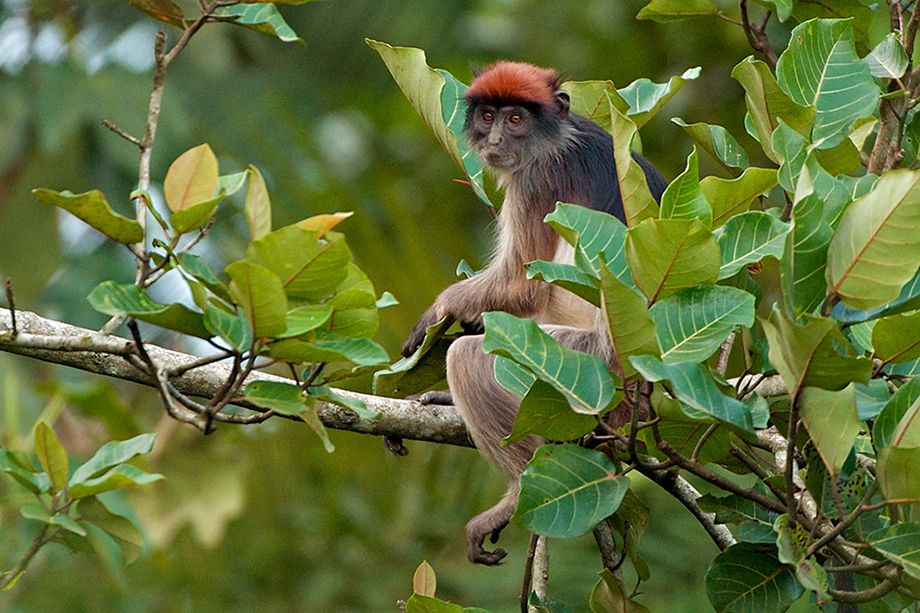 Black-and-White Colobus Monkey
One of the easiest primates to identify is the striking Black-and-White Colobus Monkey, recognized by its glossy black coat, long white mantle, and spectacular white tail. These graceful monkeys spend most of their time high in the canopy feeding on leaves, flowers, and fruits.
Visitors regularly encounter black-and-white colobus monkeys during chimpanzee trekking in Uganda at Kibale National Park, Budongo Forest, Kyambura Gorge, and Kalinzu Forest Reserve. Their slow, elegant movements and dramatic appearance make them a favorite among photographers.
L’Hoest’s Monkey
The L’Hoest’s Monkey, sometimes called the Mountain Monkey, is one of Uganda’s most elusive forest primates. It has a dark coat, distinctive white beard, and prefers the dense undergrowth of mature tropical forests.
L’Hoest’s monkeys are most commonly seen during chimpanzee trekking in Uganda in Kibale National Park and Kalinzu Forest Reserve, where healthy populations inhabit the forest floor and lower vegetation. Sightings in Budongo Forest are uncommon, while they are rarely recorded in Kyambura Gorge.
Red-Tailed Monkey
The Red-Tailed Monkey is among the most frequently observed primates during chimpanzee trekking in Uganda. It is easily recognized by its reddish tail, white nose, expressive eyes, and agile movements through the trees.

Visitors have an excellent chance of seeing red-tailed monkeys in Kibale National Park, Budongo Forest, Kyambura Gorge, and Kalinzu Forest Reserve. These curious monkeys often forage close to chimpanzee groups and are active throughout the day, making sightings very common.
Blue Monkey
Despite its name, the Blue Monkey appears greyish-blue with a dark face and lighter body. It is an agile forest monkey that feeds mainly on fruits, leaves, flowers, and insects.
Blue monkeys are regularly encountered during chimpanzee trekking in Uganda in Kibale National Park, Budongo Forest, Kyambura Gorge, and Kalinzu Forest Reserve. Their calm nature allows visitors to observe them at relatively close range as they move quietly through the middle levels of the forest canopy.
Grey-Cheeked Mangabey
The Grey-Cheeked Mangabey is one of Uganda’s most charismatic forest primates. Larger than many monkey species, it is recognized by its grey cheeks, dark body, and energetic behavior. Mangabeys often travel in noisy groups and spend considerable time searching for fruits high in the canopy.

The best destination to observe grey-cheeked mangabeys during chimpanzee trekking in Uganda is Kibale National Park, where the species is abundant. They are also found in Budongo Forest, although in smaller numbers. They are generally absent from Kyambura Gorge and Kalinzu Forest Reserve.
Olive Baboon
The Olive Baboon is the largest monkey species commonly encountered in Uganda’s forests and surrounding savannahs. Highly intelligent and adaptable, baboons live in large troops and feed on fruits, roots, seeds, insects, and small animals.
Visitors frequently see olive baboons while enjoying chimpanzee trekking in Uganda in Kibale National Park, Budongo Forest, Kyambura Gorge, and Kalinzu Forest Reserve. They are particularly common near forest edges, roads, and visitor centers.
Vervet Monkey
The Vervet Monkey is a small, active monkey recognized by its grey coat, black face, and long tail. These intelligent primates are highly adaptable and often live near forest edges and open woodland.
During chimpanzee trekking in Uganda, vervet monkeys are commonly seen in Budongo Forest, Kyambura Gorge, and Kalinzu Forest Reserve, while they are less frequently encountered in the interior forests of Kibale National Park.
Bushbaby
The Bushbaby, also known as the Galago, is a tiny nocturnal primate famous for its enormous eyes, remarkable jumping ability, and loud nighttime calls. Although visitors rarely see bushbabies during daytime chimpanzee trekking, they are present in several of Uganda’s tropical forests.
 Bushbabies occur in Kibale National Park, Budongo Forest, and Kalinzu Forest Reserve, where they are most easily observed during guided night walks. They are believed to occur in Kyambura Gorge as well, but sightings are extremely rare because of the limited opportunities for nocturnal excursions.
Potto
The Potto is one of Africa’s most secretive primates. Unlike the fast-moving bushbaby, the potto moves slowly and deliberately through dense vegetation at night. It feeds mainly on fruits, insects, tree gum, and nectar and is rarely seen without a specialized night walk.
Pottos are found in Kibale National Park, Budongo Forest, and Kalinzu Forest Reserve, where occasional night excursions provide the best opportunity to observe them. They are not commonly recorded during standard daytime chimpanzee trekking in Uganda, and confirmed sightings in Kyambura Gorge are extremely uncommon.
Why These Primates Make Chimpanzee Trekking Even More Rewarding
One of the greatest advantages of chimpanzee trekking in Uganda is that visitors are not simply searching for one species. Every walk through Uganda’s tropical forests becomes a complete Uganda primate safari, where several monkey species can be observed within a single morning. It is not unusual to encounter chimpanzees alongside black-and-white colobus monkeys, red-tailed monkeys, blue monkeys, olive baboons, and grey-cheeked mangabeys during the same trek.
This remarkable diversity is one of the reasons Uganda is widely regarded as the Primate Capital of East Africa, offering wildlife enthusiasts, photographers, birdwatchers, and nature lovers one of the richest rainforest experiences anywhere on the continent.
Best Time for Chimpanzee Trekking in Uganda
One of the greatest advantages of Chimpanzee Trekking in Uganda is that it can be enjoyed throughout the year. Unlike some wildlife experiences that are highly seasonal, chimpanzee tracking takes place every day because the habituated chimpanzee communities remain within their forest habitats year-round. However, weather conditions, forest trails, photography opportunities, bird activity, and permit prices vary from month to month. Understanding these seasonal differences will help you choose the best time for your Uganda Primate Safaris or Chimpanzee Tours Uganda based on your interests, budget, and travel style.
Whether you are visiting Kibale National Park, Budongo Forest, Kyambura Gorge, or Kalinzu Forest Reserve, every season offers unique experiences that make Chimpanzee Trekking in Uganda unforgettable.
Chimpanzee Trekking in Uganda During the Dry Seasons
Uganda experiences two main dry seasons: December to February and June to September. These are generally considered the best months for Chimpanzee Trekking in Uganda because forest trails are drier, less slippery, and easier to navigate. The reduced rainfall also makes hiking more comfortable, especially for first-time trekkers and families.
During these months, chimpanzees remain active as they search for food throughout the forest. Although the animals continue to move naturally, the improved trail conditions allow visitors to walk more comfortably through the rainforest. These months are also the busiest tourism seasons, meaning accommodation and chimpanzee permits can sell out several months in advance.
The dry season is ideal for travelers planning comprehensive Uganda Primate Safaris, combining chimpanzee tracking with gorilla trekking, wildlife safaris in Queen Elizabeth National Park, Murchison Falls National Park, or Bwindi Impenetrable National Park.
Chimpanzee Trekking in Uganda During the Wet Seasons
The wet seasons occur from March to May and October to November. Although rainfall is more frequent, many experienced travelers actually prefer visiting during these months because Uganda’s rainforests become exceptionally lush, green, and vibrant.
Rain showers are often short and occur mainly in the afternoon, leaving plenty of time for successful morning trekking. The forests appear fresh and alive, waterfalls flow more strongly, and the landscape becomes incredibly scenic. Since fewer tourists visit during these months, visitors enjoy quieter trails, smaller trekking groups, and a more intimate wildlife experience.
While some forest paths may become muddy and slightly more challenging, proper hiking boots and waterproof clothing make trekking comfortable. For adventurous travelers looking for authentic rainforest experiences, the wet season remains an excellent time for Chimpanzee Tours Uganda.
Month-by-Month Guide for Chimpanzee Trekking in Uganda
January
January is one of the most popular months for Chimpanzee Trekking in Uganda. Warm temperatures, relatively dry conditions, and excellent road access make it ideal for combining chimpanzee tracking with gorilla trekking and wildlife safaris. Because this is peak season, permits and accommodation should be booked well in advance.
February
February continues the dry conditions, offering excellent trekking conditions and clear forest trails. Wildlife viewing is outstanding, making it one of the best months for extended Uganda Primate Safaris.
March
March marks the beginning of the long rainy season. Afternoon showers become more frequent, but the forests become greener and more beautiful. Visitor numbers begin to decrease, creating a quieter trekking experience.
April
April is one of the wettest months of the year. Although trails can be muddy, this month offers excellent value because discounted chimpanzee trekking permits are available in Kibale National Park. Travelers looking for affordable Chimpanzee Tours Uganda often choose April to take advantage of lower permit prices and fewer crowds.
May
May remains part of the low season, with occasional rainfall and spectacular rainforest scenery. Birdlife is particularly active, vegetation is lush, and discounted chimpanzee permits continue to make this month attractive for budget-conscious travelers.
June
June signals the return of the dry season. Forest trails begin drying out, temperatures remain pleasant, and visitor numbers increase significantly. This is one of the best months for Chimpanzee Trekking in Uganda.
July
July offers excellent trekking conditions with comfortable temperatures and minimal rainfall. It is one of Uganda’s busiest tourism months, making early booking essential for both permits and accommodation.
August
August continues to provide ideal weather for trekking, photography, and wildlife viewing. Many visitors combine chimpanzee tracking with gorilla trekking, making this one of the peak months for Uganda Primate Safaris.
September
September remains relatively dry while visitor numbers begin to reduce slightly toward the end of the month. It is an excellent time for travelers seeking good weather with fewer crowds.
October
October introduces the shorter rainy season. The forests become greener again, bird activity increases, and photography benefits from softer natural lighting. Visitor numbers are generally lower than during the dry months.
November
November is another excellent month for travelers seeking discounted chimpanzee permits in Kibale National Park. Despite occasional rainfall, chimpanzee sightings remain excellent, while the reduced visitor numbers create a peaceful trekking experience.
December
December marks the beginning of another dry season and is one of the busiest months for tourism in Uganda. Families and holiday travelers flock to the country’s national parks, making advance booking highly recommended for anyone planning Chimpanzee Trekking in Uganda.
Best Time for Wildlife Photography
Photography is rewarding throughout the year, but each season offers different advantages. During the dry months, sunlight filters beautifully through the forest canopy, producing bright images with excellent visibility. Forest trails are cleaner, making it easier to move between photography locations.
During the wet season, photographers enjoy richer colors, vibrant vegetation, dramatic mist-covered forests, and softer natural lighting that reduces harsh shadows. The rainforest appears more alive, creating spectacular opportunities for wildlife and landscape photography. For many professional photographers, the wet season actually provides the most visually stunning images during Chimpanzee Trekking in Uganda.
Best Time for Birdwatching
Uganda is home to more than 1,090 bird species, making it one of Africa’s leading birding destinations. The forests visited during Chimpanzee Trekking in Uganda support hundreds of forest birds, including hornbills, turacos, pittas, flycatchers, greenbuls, sunbirds, and numerous Albertine Rift endemics.
Birdwatching is productive throughout the year, but many birders prefer the wetter months from March to May and October to November, when breeding activity increases and migratory species are present. The abundant food supply also makes birds more active and vocal, improving sighting opportunities during guided forest walks.
Low-Season Discounts
One of the biggest advantages of traveling during the low season is the availability of discounted chimpanzee trekking permits in Kibale National Park. During April, May, and November, foreign non-residents pay US$200 instead of US$250, while foreign residents pay US$150 instead of US$200 for standard chimpanzee trekking permits. These discounts make Chimpanzee Tours Uganda considerably more affordable without affecting the quality of the trekking experience.
It is important to note that the discounted rates apply only to standard chimpanzee trekking permits. The Chimpanzee Habituation Experience remains at the standard published price throughout the year. Because discounted permits are limited and cannot normally be rescheduled, travelers planning Uganda Primate Safaris are encouraged to reserve well in advance to secure their preferred trekking dates.
Which Season Is Best?
There is no single perfect time for Chimpanzee Trekking in Uganda because every season offers unique advantages. Travelers seeking easier hiking conditions and sunny weather generally prefer the dry seasons, while photographers, birdwatchers, and budget-conscious visitors often choose the wetter months for their lush scenery, quieter forests, and discounted permits. Regardless of when you visit, Uganda’s habituated chimpanzees can be tracked throughout the year, ensuring an unforgettable rainforest adventure as part of your Uganda Primate Safaris or Chimpanzee Tours Uganda.
What to Pack for Chimpanzee Trekking in Uganda

Packing the right gear is essential for a safe, comfortable, and enjoyable Chimpanzee Trekking experience in Uganda. Although chimpanzee tracking is suitable for most travelers with a reasonable level of fitness, you will spend several hours walking through tropical rainforest, where weather conditions can change quickly and forest trails may become muddy or slippery. Whether you are joining Uganda Primate Safaris, Chimpanzee Tours Uganda, or a combined gorilla and chimpanzee safari, carrying the right equipment will significantly improve your adventure. Below are the essential items every trekker should pack before entering Kibale National Park, Budongo Forest, Kyambura Gorge, or Kalinzu Forest Reserve.
Hiking Boots
A good pair of waterproof hiking boots is one of the most important items for Chimpanzee Trekking in Uganda. Forest trails can be uneven, muddy, steep, and occasionally slippery, especially during the rainy seasons. Quality hiking boots provide excellent grip, ankle support, and stability while walking over roots, rocks, and wet ground. Comfortable, well-broken-in boots also reduce fatigue and help prevent blisters during longer treks.
Rain Jacket
Uganda’s tropical rainforests can experience sudden showers at any time of the year, even during the dry season. A lightweight waterproof rain jacket will keep you dry without adding unnecessary weight to your backpack. Since chimpanzee trekking continues regardless of light rainfall, carrying a rain jacket ensures that changing weather does not interrupt your safari experience. Jackets with breathable fabric are particularly recommended for comfort in the humid rainforest environment.
Gloves
A pair of lightweight gardening or trekking gloves is surprisingly useful during Chimpanzee Trekking in Uganda. Rangers often guide visitors through sections of dense vegetation where gloves help protect your hands from thorny plants, stinging nettles, rough tree bark, and sharp branches. Gloves also provide better grip when climbing small slopes or holding onto vegetation along the trail.
Camera
A quality camera is essential for capturing one of the most memorable wildlife experiences in Africa. Whether you use a professional DSLR, mirrorless camera, or a modern smartphone with a powerful zoom lens, you will have numerous opportunities to photograph chimpanzees feeding, grooming, playing, and interacting in their natural habitat. Since flash photography is prohibited around wildlife, ensure your camera performs well in the low-light conditions typical of tropical forests. Carrying an extra battery and memory card is also highly recommended.
Binoculars
Although chimpanzees are the main attraction, Chimpanzee Tours Uganda also provide exceptional opportunities to observe birds, monkeys, butterflies, and other wildlife throughout the forest. A compact pair of binoculars allows you to enjoy distant chimpanzees high in the canopy and appreciate Uganda’s rich birdlife, including hornbills, turacos, kingfishers, and many Albertine Rift endemic species. Birdwatchers, in particular, will find binoculars indispensable during their Uganda Primate Safaris.
Long Trousers
Long trousers are strongly recommended for every chimpanzee trek. They protect your legs from scratches caused by branches, thorny shrubs, tall grass, insects, and stinging plants commonly found in tropical forests. Lightweight, breathable hiking trousers are ideal because they provide protection while remaining comfortable in Uganda’s warm climate. Neutral colours such as green, brown, or khaki are preferable as they blend naturally into the forest environment.
Drinking Water
Chimpanzee trekking can last anywhere from one to several hours depending on where the chimpanzees are located. Carrying at least one to two litres of drinking water helps you stay hydrated throughout the trek, particularly during warmer months. Reusable water bottles are encouraged to reduce plastic waste within Uganda’s protected areas. Many visitors also carry a few energy snacks such as nuts, granola bars, or dried fruit to maintain energy levels before or after the trek.
Insect Repellent
Uganda’s rainforests are home to mosquitoes and other insects, making insect repellent an essential item for Chimpanzee Trekking in Uganda. Applying repellent before entering the forest helps reduce insect bites and improves overall comfort during the trek. Products containing DEET, picaridin, or natural alternatives such as lemon eucalyptus are commonly recommended. Wearing long sleeves and long trousers further enhances protection against insects while exploring Uganda’s beautiful rainforest ecosystems.
Optional Items Worth Carrying
In addition to the essential equipment listed above, many experienced travelers choose to pack a small daypack, sunscreen, sunglasses, a wide-brimmed hat, personal medications, lip balm, a microfiber towel, extra camera batteries, memory cards, and a waterproof bag to protect electronic devices from rain. A walking stick, often provided at the visitor centre for a small fee, can also be extremely helpful on steep or muddy sections of the trail.
Packing wisely allows you to fully enjoy Chimpanzee Trekking in Uganda, ensuring you remain comfortable from the moment you enter the rainforest until you return with unforgettable memories of one of Africa’s most extraordinary wildlife encounters.
Accommodation for Chimpanzee Trekking in Uganda
Choosing the right accommodation is an important part of planning Chimpanzee Trekking in Uganda. Fortunately, every major chimpanzee trekking destination offers a wide selection of lodges, camps, and hotels ranging from luxurious forest retreats to comfortable mid-range lodges and affordable budget accommodations. Whether you are planning a luxury honeymoon, a family holiday, a photography expedition, or a budget-friendly Uganda Primate Safari, there is accommodation to suit every travel style and budget.
Many lodges are located within a few minutes of the trekking briefing points, allowing visitors to enjoy early breakfasts before heading to the forest. Most properties also organize airport transfers, packed lunches, guided nature walks, birdwatching excursions, and cultural experiences, making them ideal bases for Chimpanzee Tours Uganda.
Accommodation Near Kibale National Park
Kibale National Park is Uganda’s premier destination for Chimpanzee Trekking in Uganda, and consequently offers the country’s widest selection of safari accommodation. Most lodges are located around Kanyanchu, Bigodi, Fort Portal, and the crater lake region, all within convenient driving distance of the chimpanzee trekking starting point.
Luxury Accommodation
Travelers seeking luxury can choose from some of Uganda’s finest rainforest lodges. Kyaninga Lodge is widely regarded as one of the country’s most exclusive boutique lodges, offering handcrafted log cabins overlooking the spectacular Kyaninga Crater Lake. Guests enjoy elegant suites, gourmet dining, a swimming pool, spa services, and breathtaking views of the Rwenzori Mountains.
Another exceptional choice is Ndali Lodge, beautifully situated on a crater lake with panoramic views across Kibale Forest. The lodge combines colonial charm, personalized service, spacious cottages, and outstanding cuisine, making it popular among honeymooners and luxury safari travelers.

Papaya Lake Lodge provides another premium option, featuring luxurious cottages, infinity pools, beautifully landscaped gardens, and easy access to both chimpanzee trekking and crater lake excursions.
Mid-Range Accommodation
Mid-range travelers have numerous excellent choices that combine comfort with affordability. Turaco Treetops Lodge offers stylish forest cottages surrounded by nature and is conveniently located near Kibale National Park. The lodge features spacious rooms, excellent meals, and opportunities to observe monkeys and birds directly from the property.
Kibale Tourist Safari Lodge has become one of the most popular choices for visitors undertaking Chimpanzee Tours Uganda. It offers comfortable cottages, modern amenities, a swimming pool, and close proximity to the park headquarters.
Other reliable options include Isunga Lodge, Guereza Canopy Lodge, Chimpnest Safari Lodge, Ensiko Primates Lodge, and Crater Safari Lodge, each providing quality accommodation, attentive service, and beautiful natural surroundings.
Budget Accommodation
Budget travelers can still enjoy comfortable accommodation near Kibale without compromising their safari experience. Chimpanzee Forest Guesthouse, operated by the Jane Goodall Institute, provides simple but pleasant rooms close to the forest.
Kibale Forest Lodge, Kibale Guest Cottages, Chimpanzee Capital Safari Lodge, Kibale Forest Camp , and several guesthouses in Bigodi offer affordable accommodation with friendly hospitality, local cuisine, and easy access to chimpanzee tracking activities. These properties are excellent choices for backpackers, students, and travelers seeking economical Uganda Primate Safaris.
Accommodation Near Budongo Forest
Budongo Forest lies within the Murchison Falls Conservation Area, allowing visitors to combine Chimpanzee Trekking in Uganda with spectacular wildlife safaris and boat cruises on the Nile.
Luxury Accommodation
The finest luxury property in the area is Nile Safari Lodge, overlooking the River Nile. Guests enjoy spacious bandas, luxury tents, fine dining, infinity pools, spa treatments, and exceptional wildlife viewing.
Entikko Safari Lodge and Paraa Safari Lodge are other iconic luxury lodge offering elegant rooms, swimming pools, river views, and convenient access to Budongo Forest, Murchison Falls National Park, and the famous Nile boat cruise.
Mid-Range Accommodation
Excellent mid-range choices include Pakuba Safari Lodge, Fort Murchison Lodge, and Murchison River Lodge. These lodges provide comfortable rooms, quality meals, swimming pools, and excellent value for visitors combining chimpanzee trekking with classic wildlife safaris.
Budget Accommodation
Budget travelers can stay at Red Chilli Rest Camp, Bamboo Village Safari Lodge are some of Uganda’s most popular budget facilities offering affordable bandas, safari tents, camping facilities, and an excellent social atmosphere. Other economical guesthouses around Masindi also provide convenient overnight options before early morning chimpanzee trekking.
Accommodation Near Kyambura Gorge
Kyambura Gorge is located within Queen Elizabeth National Park, allowing visitors to combine Chimpanzee Trekking in Uganda with game drives, boat cruises on the Kazinga Channel, and lion tracking.
Luxury Accommodation
Luxury visitors often choose Kyambura Gorge Lodge, an elegant eco-lodge overlooking the dramatic gorge itself. Beautiful bandas, gourmet cuisine, personalized service, and spectacular scenery make it one of Uganda’s premier safari lodges.
Other outstanding luxury options include Elephant Plains Lodge, and Mweya Safari Lodge, and Ishasha Wilderness Camp, each offering exceptional comfort, magnificent views, and easy access to chimpanzee trekking and wildlife safaris.
Mid-Range Accommodation
Popular mid-range choices include Twin Lakes Safari Lodge, Buffalo Safari Lodge, Park View Safari Lodge, and Enganzi Game Lodge. These lodges provide spacious rooms, excellent restaurants, swimming pools, and comfortable accommodation at reasonable prices.
Budget Accommodation
Budget-conscious travelers can stay at Pumba Safari Cottages, The Bush Lodge, or various guesthouses in Katunguru and Kasenyi. These accommodations provide clean rooms, good meals, and convenient access to Kyambura Gorge without stretching the travel budget.
Accommodation Near Kalinzu Forest Reserve
Kalinzu Forest Reserve is one of Uganda’s most affordable chimpanzee trekking destinations and is conveniently located near Queen Elizabeth National Park.
Luxury Accommodation
Although Kalinzu itself has limited luxury accommodation, visitors commonly stay at nearby premium lodges such as Elephant Hab Lodge, Mweya Safari Lodge, and Buffalo Safari Lodge, all within comfortable driving distance of the forest.
Mid-Range Accommodation
Excellent mid-range options include Aardvark Safari Lodge, Engiri Game Lodge, and Buffalo Safari Lodge standard cottages, offering comfortable rooms, excellent meals, and peaceful surroundings close to the trekking area.
Budget Accommodation
Budget travelers have several affordable choices including Engiri Game Lodge, Enshama Game Lodge, Pumba Safari Cottages, and others in the surrounding communities. These accommodations provide clean facilities, warm Ugandan hospitality, and easy access to Kalinzu’s chimpanzee tracking starting point.
Which Accommodation Category Should You Choose?
The best accommodation depends on your travel preferences, comfort expectations, and budget. Luxury lodges provide exceptional service, gourmet cuisine, spa facilities, and breathtaking views, making them perfect for honeymooners and premium Chimpanzee Tours Uganda. Mid-range lodges strike an excellent balance between comfort and affordability, making them the preferred choice for most visitors undertaking Uganda Primate Safaris. Budget lodges and guesthouses offer clean, comfortable accommodation with friendly hospitality, allowing travelers to experience Chimpanzee Trekking in Uganda without spending heavily on accommodation.
Regardless of your budget, staying close to your chosen chimpanzee trekking destination allows you to enjoy an early start, reduce travel time on trekking day, and fully immerse yourself in the beauty of Uganda’s remarkable rainforest landscapes.
Frequently Asked Questions About Chimpanzee Trekking in Uganda
Planning your first Chimpanzee Trekking in Uganda adventure naturally comes with many questions. From permit availability and trekking difficulty to photography and combining chimpanzees with gorilla trekking, travelers want to know exactly what to expect before they arrive. Below are detailed answers to the most frequently asked questions about Chimpanzee Tours Uganda and Uganda Primate Safaris.
Which Is the Best Place for Chimpanzee Trekking in Uganda?
The best destination depends on the type of experience you are looking for, but Kibale National Park is widely regarded as the premier destination for Chimpanzee Trekking in Uganda. The park is home to more than 1,500 chimpanzees, including several habituated communities that can be visited by tourists. Kibale also boasts one of the highest chimpanzee sighting success rates in Africa, often exceeding 95%.
If you would like to combine chimpanzee trekking with the famous Murchison Falls safari, Budongo Forest is an excellent choice. Travelers visiting Queen Elizabeth National Park often choose Kyambura Gorge, while Kalinzu Forest Reserve offers an affordable alternative with excellent sightings and fewer visitors.
Are Chimpanzee Permits Guaranteed?
Chimpanzee permits are guaranteed only after they have been officially booked and confirmed by the Uganda Wildlife Authority (UWA). Because only a limited number of permits are issued each day, availability can become limited during peak travel periods, especially between June and September and from December to February.
To avoid disappointment, it is advisable to reserve your permit several months before your intended travel date. Booking through a licensed tour operator ensures that your permit, accommodation, and transport are secured together, making your Chimpanzee Tours Uganda planning much easier.
Is Chimpanzee Trekking Difficult?
Most visitors consider Chimpanzee Trekking in Uganda to be moderately easy to moderate. Unlike mountain gorilla trekking, chimpanzee tracking usually involves walking on relatively gentle forest trails, although the exact difficulty depends on where the chimpanzees are located on the day of your visit.
Some treks may last less than one hour, while others can take several hours if the chimpanzees have travelled deeper into the forest. Anyone with a reasonable level of fitness can comfortably complete the trek. Rangers maintain a manageable walking pace and regularly stop to explain interesting wildlife and forest features along the way.
Can Children Go Chimpanzee Trekking?
Uganda Wildlife Authority regulations require visitors to be at least 12 years old to participate in standard Chimpanzee Trekking in Uganda. This age limit helps ensure visitor safety while reducing unnecessary disturbance to the chimpanzees.
Children younger than 12 are not permitted to join the trek. Families travelling with younger children can instead enjoy nature walks, birdwatching, cultural experiences, or wildlife game drives while older family members participate in chimpanzee tracking.
How Close Do You Get to the Chimpanzees?
 During Chimpanzee Trekking in Uganda, visitors are normally required to maintain a minimum distance of approximately 8 metres (26 feet) from the chimpanzees whenever possible. This guideline helps reduce the risk of transmitting diseases between humans and our closest living relatives.
However, because chimpanzees are completely wild animals, they occasionally move closer to visitors on their own. If this happens, your ranger will advise everyone to remain calm, avoid sudden movements, and allow the chimpanzees to move away naturally.
Is Chimpanzee Trekking Safe?
Yes. Chimpanzee Trekking in Uganda is considered very safe when conducted under the supervision of trained Uganda Wildlife Authority rangers. Before every trek, visitors receive a comprehensive safety briefing covering appropriate behaviour around wildlife and emergency procedures.
Experienced trackers locate the chimpanzees before visitors enter the forest, and armed rangers accompany every group as a precaution against large wildlife such as forest elephants or buffalo. Incidents involving tourists are extremely rare, and Uganda has decades of experience successfully managing primate tourism.
Can I Combine Chimpanzee Trekking with Gorilla Trekking?
Absolutely. In fact, combining chimpanzee tracking with gorilla trekking is one of the most popular safari itineraries in East Africa. Many visitors begin their journey with Chimpanzee Trekking in Uganda at Kibale National Park before travelling to Bwindi Impenetrable National Park or Mgahinga Gorilla National Park for mountain gorilla trekking.
These combined Uganda Primate Safaris offer visitors the unique opportunity to encounter two of humanity’s closest relatives in a single holiday. Many itineraries also include wildlife safaris in Queen Elizabeth National Park, Murchison Falls National Park, Lake Mburo National Park, or cultural experiences around the country.
What Is the Chimpanzee Sighting Success Rate?
Uganda enjoys one of the highest chimpanzee sighting success rates anywhere in Africa. In Kibale National Park, visitors typically enjoy a success rate of over 95%, while Budongo Forest also records consistently excellent sightings.
Success rates in Kalinzu Forest Reserve are generally high, often exceeding 90%, while Kyambura Gorge has a lower success rate because of its smaller chimpanzee population and the challenging terrain of the gorge. Regardless of destination, experienced trackers begin searching for the chimpanzees before sunrise, greatly increasing the chances of successful encounters.
How Long Does the Trek Take?
The total duration of Chimpanzee Trekking in Uganda varies depending on the location of the chimpanzees on the day of your visit. The complete experience, including registration, briefing, trekking, the one-hour observation period, and the return walk, usually lasts between two and five hours.
Actual walking time can range from less than one hour to several hours. Once the chimpanzees are located, visitors are allowed exactly one hour to observe and photograph them before returning to the visitor centre.
Can I Use a Drone During Chimpanzee Trekking?
No. Recreational drone use is generally prohibited during Chimpanzee Trekking in Uganda and within Uganda’s national parks and protected forests unless special authorization has been obtained from the relevant authorities in advance.
Drones can disturb wildlife, disrupt the natural behaviour of chimpanzees, and negatively affect the experience of other visitors. Professional film crews wishing to use drones must obtain all necessary permits and approvals before filming.
How Do I Book Chimpanzee Trekking in Uganda?
Booking Chimpanzee Trekking in Uganda is simple when arranged through a licensed Ugandan tour operator. The first step is selecting your preferred trekking destination and travel dates. We will then check permit availability with the Uganda Wildlife Authority and reserve your permits once payment has been received.
Most travelers choose to book complete Chimpanzee Tours Uganda packages that include permits, accommodation, transportation, professional safari guides, park entrance fees, and airport transfers. Booking several months in advance is strongly recommended, particularly if you plan to travel during the peak dry seasons or combine chimpanzee trekking with gorilla trekking.
With your permits confirmed and your safari arrangements in place, all that remains is to prepare for one of Africa’s most rewarding wildlife experiences, where unforgettable encounters with wild chimpanzees await in Uganda’s spectacular tropical rainforests.
Why Book With Safari Vacations and Travel Services Ltd
Choosing the right tour operator can make the difference between a good holiday and an unforgettable African adventure. At Safari Vacations and Travel Services Ltd, we are passionate about creating exceptional travel experiences that showcase the very best of Uganda and East Africa. From your first inquiry to the day you return home, our dedicated team is committed to providing professional service, honest advice, and seamless travel arrangements tailored to your interests.
Whether you are travelling as a solo explorer, couple, family, group of friends, photographer, or corporate team, we take pride in delivering personalized service with attention to every detail.
Local Ugandan Expertise
As a Ugandan-owned and operated tour company, we have extensive first-hand knowledge of the country’s national parks, wildlife, culture, accommodation, road networks, and seasonal travel conditions. Our team regularly visits the destinations we recommend, allowing us to provide genuine advice based on experience rather than brochures.
This local expertise enables us to design itineraries that maximize your time, avoid unnecessary travel, and introduce you to authentic experiences that many visitors would otherwise miss.
Personalized Itineraries
No two travellers are the same, which is why every itinerary we create is carefully tailored to your interests, travel style, available time, and budget.
Whether you are looking for a luxury honeymoon, an adventurous wildlife expedition, a family holiday, a photography safari, a birdwatching tour, or a budget-friendly vacation, we work closely with you to build an itinerary that reflects exactly what you want to experience.
Our flexibility also allows us to adjust accommodations, activities, travel routes, and trip duration whenever your plans change.
Gorilla and Chimpanzee Permit Handling
Securing wildlife permits can be one of the most important parts of planning a safari. Our experienced reservations team handles the entire permit booking process on your behalf, saving you time and giving you peace of mind.
We monitor permit availability, reserve permits promptly, provide confirmation documentation, and ensure that every booking is completed accurately. This allows you to focus on preparing for your trip while we take care of the logistics.
Professional Safari Guides
Our experienced driver-guides are passionate about Uganda’s wildlife, landscapes, and cultures. They are knowledgeable, courteous, patient, and dedicated to ensuring every guest enjoys a memorable safari.
Beyond safely driving through the country’s diverse terrain, our guides help visitors identify wildlife, explain animal behaviour, share local history, recommend photography opportunities, and introduce guests to the traditions of the communities they visit.
Their professionalism, friendliness, and commitment to excellent service consistently earn praise from travelers from around the world.
Comfortable 4×4 Safari Vehicles
Comfort plays an important role during any safari, especially on longer journeys between national parks. Our fleet consists of well-maintained 4×4 safari vehicles designed specifically for African travel.
Each vehicle provides comfortable seating, large windows for excellent wildlife viewing, pop-up roofs for game drives, air conditioning where applicable, charging ports for electronic devices, and ample luggage space. Regular maintenance and safety inspections ensure dependable performance throughout your journey.
Transparent Pricing
We believe that trust begins with honesty. Our quotations clearly explain what is included and what is not, allowing you to plan your safari with confidence.
There are no hidden charges or unexpected costs added after booking. We take time to explain accommodation options, permit fees, park entrance fees, transportation, meals, and optional activities so you can make informed decisions before confirming your trip.
24/7 Customer Support
From your initial inquiry until you safely return home, our team remains available to assist you whenever you need us.
Whether you have questions before arrival, require assistance during your safari, experience flight changes, or simply need travel advice, we are only a phone call, email, or WhatsApp message away. Our commitment to responsive communication ensures that you are supported throughout every stage of your journey.
Strong Client Reviews
The greatest measure of our success is the satisfaction of our guests. Over the years, we have welcomed travelers from around the world who have shared their experiences through independent reviews and personal recommendations.
Many of our bookings come from repeat guests and referrals from family members, friends, and travel partners who trust our professionalism, reliability, and attention to detail. Their positive feedback reflects our dedication to delivering memorable safaris, outstanding customer service, and experiences that consistently exceed expectations.
Your Trusted Safari Partner
At Safari Vacations and Travel Services Ltd, we do more than organize holidays—we create meaningful travel experiences that connect visitors with Africa’s extraordinary wildlife, breathtaking landscapes, and vibrant cultures. From the moment you contact us until the final day of your safari, our goal is to ensure every detail is handled with care, professionalism, and genuine hospitality, leaving you with memories that will last a lifetime.