
Semuliki National Park: 9 Unmissable Safari Highlights

Metadata
SEO Title:
Semuliki National Park: 9 Unmissable Safari Highlights
Meta Description:
Explore Semuliki National Park: Sempaya Hot Springs, rare birds, forest wildlife, trails, best time, fees, access and practical safari tips.
URL Slug:
semuliki-national-park
Focus Keyword:
Semuliki National Park
Secondary Keywords:
Sempaya Hot Springs
Semuliki birding
Semuliki safari
Semuliki wildlife
Semuliki National Park: 9 Unmissable Safari Highlights
Semuliki National Park is one of Uganda’s most distinctive protected areas: a hot, humid lowland forest on the floor of the Albertine Rift where Central African species reach the eastern edge of their range. For tourists, the appeal is unusually varied. You can walk through rainforest to steaming geothermal springs, search for birds associated with the Congo Basin, listen for primates in the canopy, explore riverine habitats and use nearby Fort Portal as a comfortable base. This guide answers the questions travelers most often ask before planning a visit: what to see, what to do, when to go, how to get there, what it costs, where to stay, what to pack and how many days to allow.
The park is especially rewarding for travelers who value ecology and guided walking more than a conventional Big Five checklist. A Semuliki safari is about details: hornbill calls above a forest trail, butterflies at damp ground, the mineral crust around boiling water, monkey movement in tangled branches and the sudden opening of the Rift Valley landscape. If you are comparing best national parks in Uganda, think of this destination as a specialist forest experience rather than a substitute for Queen Elizabeth or Murchison Falls.

Why Visit Semuliki National Park in Uganda?
The strongest reason to visit Semuliki National Park is that it feels ecologically different from the better-known highland and savannah stops on a Uganda itinerary. The forest is an eastern extension of the great Guinea-Congolian ecosystem, creating a lowland environment with species and sounds that feel closer to Central Africa than to the open plains many visitors associate with an East African safari. That difference gives the park real value in a multi-stop itinerary: it adds rainforest, geothermal geology and specialized birding instead of repeating another game drive.
For first-time visitors, the most recognizable attraction is the Sempaya Hot Springs. Yet the park becomes more interesting when the springs are treated as the gateway rather than the entire experience. A guided walk can introduce forest structure, medicinal plants, primates, butterflies and bird calls before the steaming springs appear. Travelers researching broader Semuliki attractions should therefore leave enough time to walk slowly and let a guide interpret the forest rather than rushing in for a photograph and immediately leaving.
Semuliki wildlife is often elusive because dense vegetation changes the way animals are seen. Instead of expecting long, open views of large mammals, visitors should watch for monkeys, forest antelope signs, squirrels, bats and occasional larger mammals, while appreciating tracks, calls and feeding evidence. This is one reason a Semuliki safari pairs so well with a savannah park: each destination rewards a completely different style of observation.
1. Sempaya Hot Springs: The Essential Semuliki National Park Experience
Sempaya Hot Springs are the park’s signature attraction and the easiest feature to recommend to almost every visitor. The site contains the famous male and female springs, reached on guided paths and boardwalk sections through lush vegetation. Steam, bubbling water and mineral deposits create an almost theatrical scene inside the forest. The water is dangerously hot, so visitors should remain on the established route and follow ranger instructions rather than approaching vents or unstable ground.
The Sempaya Hot Springs are more than a geological curiosity. Local stories give the springs cultural meaning, and a good guide can explain those traditions alongside the Rift Valley processes responsible for geothermal activity. That combination—science, landscape and cultural interpretation—makes the stop richer than a simple sightseeing photo. Travelers who enjoy comparing geothermal places can also read about Kibiro Hot Springs, but Sempaya remains the defining thermal feature of Semuliki National Park.

How Long Do You Need at Sempaya Hot Springs?
Allow roughly one to two hours for an unhurried Sempaya Hot Springs visit, depending on walking pace, guide interpretation, photography and current trail conditions. The forest approach matters because it is often where visitors first notice Semuliki birding opportunities and primates. If your schedule allows, avoid treating the springs as a roadside stop. A slower visit gives you time to hear the forest, watch the steam change with light and understand why this corner of the Rift Valley is geologically active.
Morning can be particularly atmospheric, although conditions vary. Rain can arrive at any time in a lowland tropical forest, so carry light waterproof protection and protect cameras from sudden showers. Closed walking shoes with useful grip are more practical than sandals, even on a short excursion.
2. Semuliki Birding: Why Birdwatchers Put This Forest High on Their List
Semuliki birding is one of the park’s strongest international draws. The lowland forest supports a remarkable mixture of species, including birds with Central African affinities that are difficult to find elsewhere in East Africa. For a specialist birder, this means the park is not simply another long checklist; it can fill important gaps in a Uganda birding itinerary. For a casual visitor, the variety of hornbills, forest sounds, mixed feeding flocks and river-edge habitats can make even a short guided walk memorable.
The best Semuliki birding strategy is to begin early, walk slowly and tell the guide which species or bird families matter most to you. Dense forest birding depends heavily on calls and patient positioning. A rushed group that talks continuously will miss much of what a quieter party can detect. Serious birders should consider a dedicated Uganda birding safari or add more than one morning in the park, because weather and bird movement can change dramatically from day to day.
Best Trails for Semuliki Birding
The Kirumia Trail is frequently associated with deeper forest birding, while the Sempaya area combines accessible walking with the hot springs and useful forest-edge observation. The Red Monkey route adds another habitat-focused option. Trail choice should be discussed with rangers because water levels, recent rain, maintenance and wildlife activity can affect what is practical on a given day. Travelers who enjoy guided walking elsewhere can compare these experiences with nature walks in Uganda and build a route around several different ecosystems.
Semuliki birding also rewards preparation. Bring binoculars with good low-light performance, a small field guide or offline birding app, a notebook, insect protection and a dry bag or waterproof pouch for electronics. Photographers should expect challenging light beneath the canopy and should prioritize stability and patience over carrying too much equipment.
3. Semuliki Wildlife: Primates, Forest Mammals and River Life
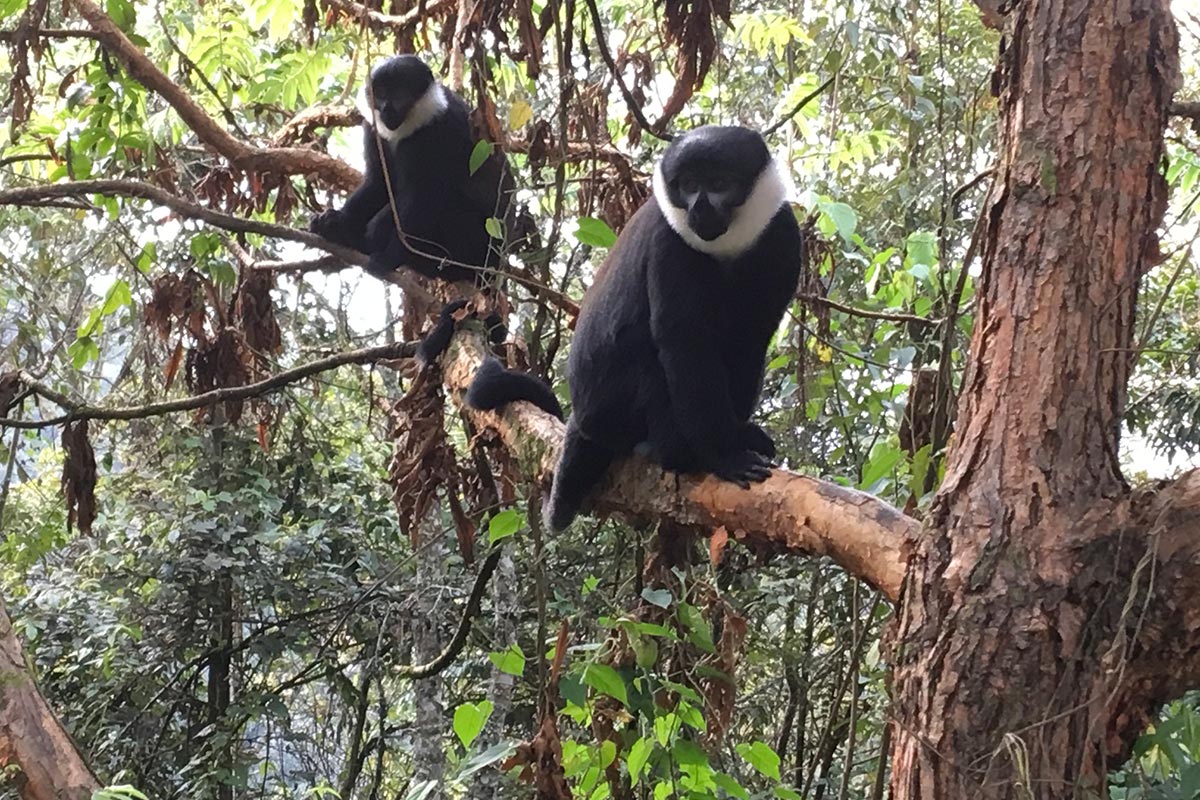
Semuliki wildlife is diverse, but expectations should match the habitat. Thick rainforest makes sightings less predictable than on an open savannah. Primates are among the most engaging possibilities, with several monkey species moving through the canopy and forest edges. Elephants, buffalo and other larger mammals occur in the wider ecosystem, yet they can be difficult to see in dense cover. The reward is a sense of exploration: guides read tracks, alarm calls, fruiting trees and movement rather than simply driving toward visible herds.
Visitors interested in primates can combine Semuliki National Park with Kibale Forest National Park, where chimpanzee trekking is a major structured activity. That combination works because the two forests offer different ecological characters. A chimpanzee trekking safari can supply the focused great-ape encounter, while Semuliki adds lowland forest, birds and geothermal features. Travelers seeking a wider mix can explore a Uganda primates and wildlife safari that also includes savannah habitats.
Can You See Chimpanzees in Semuliki National Park?
Chimpanzees occur in the wider Semuliki landscape, but tourists should not assume the experience is equivalent to a highly habituated chimpanzee trek in Kibale. If seeing chimpanzees at close range is a trip priority, build the itinerary around a destination with a well-established trekking program and use Semuliki National Park for its complementary strengths. This keeps expectations realistic and prevents a forest day from feeling unsuccessful simply because one charismatic species remains hidden.
The same principle applies to other Semuliki wildlife. Enjoy what the forest reveals rather than chasing a rigid checklist. Butterflies, unusual trees, primate calls, tracks, reptiles and birds can collectively make a richer day than a single distant mammal sighting.
4. Forest Walks and Trails in Semuliki National Park
Walking is central to the Semuliki National Park experience. Trails allow visitors to notice the forest at human speed: buttress roots, palms, lianas, insects, bird calls, monkey movement and changes between swampy and drier ground. Guided walking also creates opportunities to learn how local people have historically understood plants and landscapes. Conditions can be humid and muddy, so a moderate level of fitness and sensible footwear make the day more comfortable.
A short Sempaya walk suits most general tourists, while longer routes appeal to birders and hikers who want deeper immersion. Do not judge distance only in kilometers; tropical heat, humidity, mud and repeated birding stops can make a forest walk feel longer than a road walk of the same distance. Pack water, but keep your daypack compact so it does not become a burden.
Kirumia Trail, Red Monkey Trail or Sempaya Trail?
Choose according to your priority. Sempaya is the natural choice for a first visit because it combines forest walking with the springs. Kirumia is attractive to dedicated birders who want a longer forest session. The Red Monkey Trail is useful for visitors interested in primates, riverine scenery and a more extended nature walk. Current conditions should decide the final plan, so confirm with your guide or ranger shortly before setting out.
For travelers who want hiking to be a major part of the holiday, nearby Rwenzori Mountains National Park provides a completely different altitude, climate and physical challenge. Combining the hot lowland forest of Semuliki with the Rwenzori foothills is one of western Uganda’s strongest landscape contrasts.
Build a Western Uganda Route Around Semuliki
Share your travel month, number of days and whether hot springs, birding, primates or photography matter most. A practical route can then balance forest time with nearby parks.
5. Best Time to Visit Semuliki National Park
Semuliki National Park can be visited throughout the year, but rainfall affects trail comfort, road conditions and the overall pace of a visit. Drier periods are generally easier for walking and driving, while wetter periods make the forest intensely green and can be excellent for atmosphere, insects and some bird activity. Because this is a tropical lowland environment, a “dry season” does not mean rain is impossible. Visitors should always carry rain protection.
For a general tourist, the best time is the period that fits the rest of the Uganda route. If you are combining Semuliki National Park with chimpanzees, a savannah safari or the Rwenzori region, choose dates that work for the highest-priority activity and then fit Semuliki around them. The Uganda weather overview is useful for understanding broader seasonal patterns, but local conditions should still be checked close to departure.
Is the Rainy Season Bad for a Semuliki Safari?
Not necessarily. A rainy-season Semuliki safari can feel wonderfully atmospheric, with saturated foliage, mist, active amphibians and fewer visitors. The trade-off is practical: trails may be muddy, rain can interrupt photography, and travel times may become less predictable. Birders often accept these inconveniences because forest activity does not follow the simple dry-season logic of open savannah game viewing.
If mobility is limited or you strongly dislike mud, favor a relatively drier travel window and keep the schedule flexible. If photography is your priority, carry lens protection and microfiber cloths, and read the project’s Uganda safari for photographers advice before packing.
6. How to Get to Semuliki National Park from Kampala or Fort Portal
Most visitors approach Semuliki National Park through western Uganda, commonly using Fort Portal as the main service and accommodation hub before continuing toward Bundibugyo and the park. The road descends dramatically toward the Rift Valley floor, with impressive views when weather is clear. Travel time should be planned conservatively because road works, weather, traffic and stops can change a schedule.
From Kampala or Entebbe, a road journey to western Uganda is long enough that many travelers break the trip in or around Fort Portal. Before self-driving, review the Uganda driving guide and consider whether a 4×4 with an experienced driver-guide is more appropriate for your season and itinerary. Visitors arriving internationally can also use the Uganda airport guide to understand the Entebbe gateway and onward travel logic.
Can Semuliki National Park Be a Day Trip from Fort Portal?
Yes, a day trip can work well for travelers whose main goals are the Sempaya Hot Springs and a guided forest walk. Start early so the drive does not consume the best morning hours. A day trip becomes less suitable if Semuliki birding is a major priority, because specialist birders benefit from dawn activity, slower trails and the ability to return to productive locations.
If you have two days, one can focus on the springs and accessible forest, while the other can be dedicated to birding or a longer trail. That extra night also reduces the pressure to drive back immediately after a humid walking day.
7. Semuliki National Park Fees, Guides and Safari Costs
Park entry and activity charges can change, so treat any price found in an older blog post as provisional until it is confirmed for your travel dates. A Semuliki safari budget usually includes park entry, guide or ranger services, transport, accommodation, meals and any specialized activity charges. Birders may also want a specialist guide, which can add cost but significantly improve the experience.
When comparing packages, ask what is included rather than comparing only the headline total. A cheaper quote may exclude park fees, guiding or the vehicle needed to reach the park. Travelers looking for broader pricing context can compare Uganda safari deals and the planning principles in the Uganda travel guide. Always reconfirm current official charges before paying non-refundable costs.
How Much Should You Budget for a Semuliki Safari?
There is no single useful daily figure because costs depend heavily on whether Semuliki National Park is a day trip from Fort Portal, a private multi-day safari, a specialist birding expedition or part of a longer Uganda circuit. Group size changes vehicle cost per person, while lodge standard changes the overnight budget. Ask for an itemized quotation showing transport, accommodation, meals, park fees, guide services and any optional activities.
8. Where to Stay for Semuliki National Park
Accommodation strategy depends on how early you want to enter the park and what level of comfort you prefer. Fort Portal offers the broadest choice of hotels and lodges, restaurants, fuel and other services. Staying closer to the park can reduce morning transfer time and suit birders who want an early start, but choices may be simpler. Ask exactly how far a property is from the gate or trailhead rather than relying on a general “near Semuliki” description.
For a one-day visit, Fort Portal is often the easiest base. For a two-day Semuliki birding plan, a closer location can protect valuable dawn hours. Travelers continuing south toward Queen Elizabeth National Park or east toward Kibale should choose accommodation that does not create unnecessary backtracking.
9. How to Combine a Semuliki Safari with Western Uganda
A Semuliki safari becomes especially efficient when it is part of a western Uganda circuit. The most logical combinations are Fort Portal, Kibale, the crater-lake region, the Rwenzori area and Queen Elizabeth National Park. Each contributes something different: chimpanzees, highland scenery, crater landscapes or classic savannah wildlife. This contrast is more valuable than adding several destinations that offer similar game drives.
A seven-to-ten-day western route can begin with forest and primates, descend to Semuliki National Park for Sempaya Hot Springs and Semuliki birding, then continue to savannah and boat-based wildlife. Travelers with more time can expand into a broader Uganda adventure holidays plan or use the East Africa safari guide to connect Uganda with neighboring countries.

Sample 3-Day Semuliki National Park Itinerary
Day 1: Travel to Fort Portal, settle in, check weather and road conditions, and brief with your guide about the next morning. If time allows, enjoy a relaxed town or crater-area excursion rather than rushing into the park late in the day.
Day 2: Leave early for Semuliki National Park. Begin with birding or a forest walk while temperatures are cooler, continue to Sempaya Hot Springs, take time for interpretation and photography, then return slowly with additional bird and primate stops. A dedicated birder may substitute a longer trail and move the springs to the following morning.
Day 3: Choose a second Semuliki birding session, a longer nature trail or onward travel to Kibale, the Rwenzori region or Queen Elizabeth. This structure keeps the trip flexible and avoids turning the park into a rushed checklist.
What to Pack for Semuliki National Park
Pack for heat, humidity, rain and insects. Lightweight long trousers, breathable long sleeves, a hat, comfortable closed walking shoes, a compact rain jacket and a small daypack form a practical base. Add binoculars, insect repellent, sunscreen, drinking water and a waterproof pouch for documents and electronics. A walking stick can be useful on muddy sections if your guide recommends one.
Bird photographers should carry only the equipment they can manage comfortably in humid forest. Spare batteries, memory cards and a rain cover are more useful than an overloaded bag. Casual visitors should still bring binoculars because many Semuliki wildlife sightings occur high in the canopy. Review important travel information and the Uganda safety guide shortly before departure because health, road and administrative conditions can change.
Semuliki Wildlife, Culture and Responsible Travel
Responsible travel in Semuliki National Park starts with following ranger instructions and staying on designated routes. Geothermal areas are hazardous, forest wildlife should never be fed or chased, and bird playback should be used cautiously if at all. Keep voices low, carry out litter and avoid collecting plants, feathers or other natural objects. The forest is the attraction; minimizing disturbance protects the experience for the next visitor.
Cultural interpretation should be approached with the same care. Ask before photographing people, choose experiences where hosts have a clear role and benefit, and avoid reducing communities to labels or stereotypes. The Uganda culture guide can help travelers understand the country’s diversity before arrival, while the Uganda food guide offers useful context for everyday meals and regional flavors.
For cash and small purchases, understand local payment realities before leaving major towns; the Uganda currency guide is a useful starting point. Carry more than one payment method and keep emergency funds separate. Remote connectivity can be inconsistent, so save booking confirmations and key contacts offline.
Turn Semuliki Research Into a Practical Itinerary
Tell us whether your priority is Sempaya Hot Springs, Semuliki birding, forest photography, primates or a wider western Uganda safari. We can shape the route around realistic drive times.
Is Semuliki National Park Worth Visiting?
Semuliki National Park is worth visiting for travelers who want something more specialized than a standard savannah safari. It is particularly strong for birders, repeat Uganda visitors, nature photographers, geology enthusiasts and travelers who enjoy guided walking. The combination of Sempaya Hot Springs, lowland rainforest and Central African biological influence gives the park a clear identity that is difficult to replicate elsewhere in Uganda.
It may be less suitable for a first-time visitor with only a few days who cares mainly about lions, elephants and large open-country wildlife. In that case, a classic savannah destination may deserve priority. But if your itinerary already includes African safaris with open-plains game viewing, Semuliki National Park adds contrast rather than duplication. That is the strongest reason to include it.
What Makes the Semuliki Ecosystem Different?
The park sits at an ecological meeting point. Its low elevation, hot climate and connection to the Congo Basin distinguish it from Uganda’s better-known montane forests. This helps explain why visitors encounter a different botanical feel and why Semuliki birding is so specialized. The landscape also lies within the geologically active Albertine Rift, which is why Sempaya Hot Springs fit naturally into the same story as the forest rather than feeling like an unrelated attraction.
The Semliki River and associated wetlands add another layer. Rivers create corridors, feeding areas and edge habitats that support birds and mammals different from those in closed forest. From a tourist perspective, this means a single protected landscape can contain several micro-experiences. A knowledgeable guide can point out transitions that an unguided visitor might pass without noticing.
This ecological complexity is the best way to understand Semuliki wildlife. The park is not designed around one flagship animal. Its value comes from the web of species, habitats and geological processes. Travelers who arrive with that mindset tend to appreciate the destination more deeply than those measuring success only by the number of large mammals photographed.
Common Semuliki National Park Planning Mistakes to Avoid
The first mistake is arriving too late. Midday heat can make walking less comfortable, and bird activity may be quieter. The second is scheduling only enough time for a quick the geothermal springs photograph. The third is assuming a short distance on the map means a fast drive. Western Uganda roads, weather and escarpment terrain can all affect timing. Build a margin into the day.
Another mistake is packing as though every Uganda park has the same climate. A traveler coming from a cool highland lodge may be surprised by Semuliki National Park’s heat and humidity. Dress in breathable layers and carry rain protection. Likewise, do not expect Semuliki wildlife to behave like savannah wildlife. Forest observation is slower, quieter and more dependent on guide skill.
Finally, avoid trying to combine too many major activities in one day. the geothermal springs, a serious Semuliki birding session and a long onward road transfer can create an exhausting schedule. If the park matters enough to include, give it enough time to feel like a destination rather than a box checked between hotels.
20 Search Questions This Semuliki National Park Guide Answers
Travelers commonly search for the same practical decisions before booking: where Semuliki National Park is located; what it is famous for; how to reach it from Kampala; how to reach it from Fort Portal; whether it can be visited as a day trip; what to do in the park; how to visit the geothermal springs; the best time to visit; current park fees; where to stay; how many days are needed; what animals can be seen; whether chimpanzees are present; why Semuliki birding is special; which trails are best; what to pack; whether a 4×4 is needed; whether the park is suitable for children; how safe a visit is; and how to combine Semuliki with Kibale, the Rwenzori region and Queen Elizabeth. The sections above are organized around those real planning decisions so a traveler can move from inspiration to an itinerary without hunting through disconnected pages.
Semuliki National Park FAQs
What is Semuliki National Park famous for?
Semuliki National Park is famous for the the geothermal springs, exceptional lowland forest biodiversity, Central African bird species, primates, butterflies and its location on the Albertine Rift floor. For most general tourists, the springs are the headline attraction; for specialist birders, forest birding can be the primary reason for the trip.
How many days do you need in Semuliki National Park?
One full day works for the the geothermal springs and an accessible guided forest experience. Two days are better for forest birding, longer trails and a less rushed pace. Three days make sense for specialist naturalists or travelers using the park as a slow stop within a broader western Uganda route.
What animals can you see on a Semuliki safari?
A Semuliki safari can produce primates, forest antelope, squirrels, bats and signs of larger mammals, while riverine areas support additional wildlife. Sightings are less predictable than on open savannah because vegetation is dense. Semuliki wildlife should be approached as a forest ecology experience rather than a Big Five drive.
Is Semuliki National Park good for birding?
Yes. forest birding is one of the park’s defining experiences because the lowland forest supports many species associated with the Guinea-Congolian biome. Dedicated birders should use an experienced guide, start early and consider more than one session to improve the chance of finding localized forest species. Travelers with a specific target such as a shoebill experience should plan the appropriate wetland location separately rather than assuming every famous Uganda bird occurs on the same trail.
Can children visit Sempaya Hot Springs?
Families can visit, but adults must supervise children closely because geothermal water and ground can be dangerously hot. Follow the guide, remain on boardwalks and designated paths, and never allow children to touch or test the water. Ask the operator about walking distances and age suitability before booking.
Do you need a 4×4 for Semuliki National Park?
A suitable vehicle is strongly recommended, especially when rain has affected roads or when the park is part of a longer rural itinerary. Conditions change, so ask for current advice. Travelers who do not want to self-drive can arrange car hire in Uganda with a driver-guide.
Can you combine Semuliki with Kibale and Queen Elizabeth?
Yes. This is one of the most logical western Uganda combinations. Kibale adds structured primate trekking, Semuliki National Park adds lowland forest and the geothermal springs, and Queen Elizabeth adds savannah wildlife and waterways. Together they create more ecological variety than spending the same number of days repeating similar activities.
Is Semuliki National Park safe for tourists?
Tourists should use authorized guides, follow park instructions, avoid walking independently in restricted areas and check current official travel advice before departure. Conditions near international borders can change, so up-to-date guidance matters more than old blog assurances. A reputable operator should explain current routing and any relevant precautions.
What should photographers expect in Semuliki National Park?
Expect low light, high humidity, bright highlights around steam, fast-moving birds and foliage between the camera and wildlife. Protect equipment from rain and condensation, carry spare batteries and use binoculars to locate subjects before raising the camera. The most distinctive images often combine forest atmosphere, geothermal steam and human-scale walking rather than trying to imitate savannah photography.
How does Semuliki fit into a first Uganda safari?
If you have ten days or more and enjoy nature beyond the Big Five, Semuliki National Park can be a rewarding western extension. If time is very short, prioritize the experience you care about most and avoid overpacking the route. For broader planning, compare the safari inquiry options and Uganda wildlife encounters before fixing your nights.
Plan Your Semuliki National Park Safari
Start with your main reason for going. If it is the geothermal springs, one well-planned day may be enough. If it is forest birding, protect early mornings and consider two days. If it is Semuliki wildlife and forest ecology, choose a guide who enjoys natural history rather than focusing only on headline species. Then connect the park to the nearest destination that adds a genuinely different experience.
A well-paced Semuliki safari should feel exploratory, not rushed. Leave time for the road descent into the Rift Valley, for a hornbill that refuses to show itself immediately, for a monkey troop crossing the canopy and for steam drifting across the the geothermal springs. That slower rhythm is exactly what makes Semuliki National Park stand apart from Uganda’s busier safari circuits.

the park rewards travelers who leave enough time for guided interpretation of its lowland forest. the park rewards travelers who leave enough time for guided interpretation of its lowland forest. A Semuliki safari is strongest when it complements, rather than copies, a classic savannah itinerary. Semuliki wildlife is best appreciated through patient forest observation rather than a rigid checklist. Semuliki wildlife is best appreciated through patient forest observation rather than a rigid checklist. Semuliki wildlife is best appreciated through patient forest observation rather than a rigid checklist. Semuliki wildlife is best appreciated through patient forest observation rather than a rigid checklist.


