
Uganda Culture Guide: Discover the People, Traditions and Heritage of Uganda
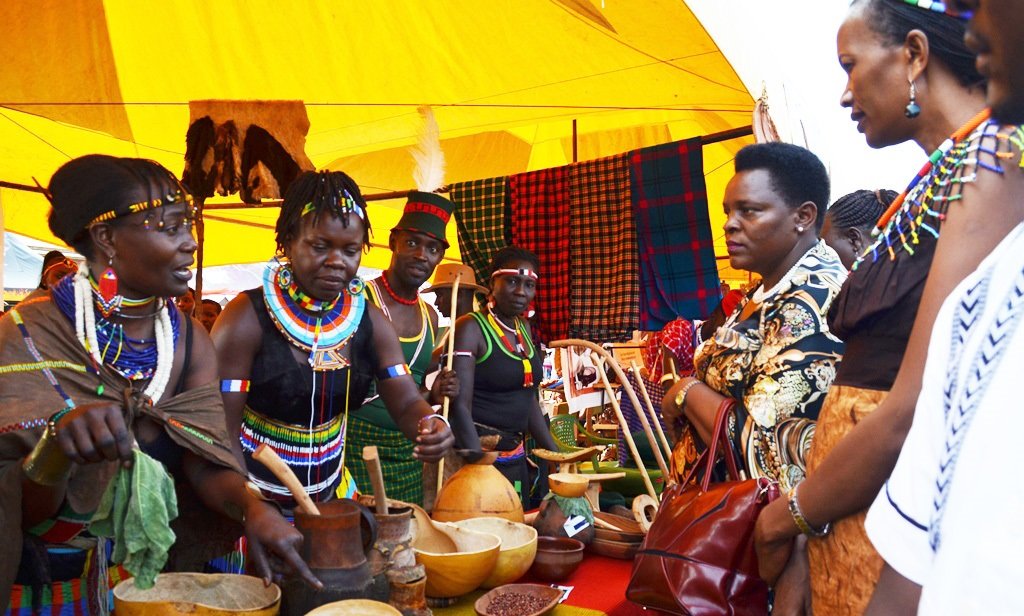
Discovering the diverse heritage, traditions, and people of Uganda.
Uganda is a country where culture is experienced in everyday life. From the languages spoken in homes and markets to traditional foods, music, dance, crafts, ceremonies and community relationships, Uganda culture is expressed in many different ways across the country. A journey through Uganda is therefore not only an opportunity to see wildlife and landscapes; it is also an opportunity to understand the people, histories and traditions that give different regions their distinctive character.
This Uganda Culture Guide provides a detailed introduction to the country’s cultural diversity and helps travelers understand what they may encounter when exploring Uganda. The guide looks beyond a single definition of culture because Uganda is home to many communities, languages, traditions and regional identities. What visitors experience in Kampala may differ considerably from what they encounter in western Uganda, the eastern region, northern Uganda or Karamoja.
Uganda at a glance: Uganda’s cultural richness is reflected in its languages, traditional institutions, oral traditions, performing arts, food, crafts, historical sites and living community practices. The country’s Constitution recognizes the importance of culture, language and cultural institutions and provides for their preservation and promotion.
A Country of Diverse Cultures
One of the defining characteristics of Uganda culture is diversity. Uganda’s population includes numerous ethnic communities, each with its own combinations of language, history, customs, food traditions, music, dance and social practices. Cultural identity may also be influenced by religion, location, family background, education, urbanization and contemporary life.
This diversity means that there is no single tradition that can accurately represent every Ugandan. A cultural practice associated with one community should not automatically be presented as a tradition shared throughout the country. Understanding this distinction is essential for travelers who want an accurate and respectful introduction to Uganda.
Uganda Culture Is Living Heritage
Uganda culture and traditions are not limited to historical objects displayed in museums. Culture continues to develop in homes, communities, places of worship, schools, markets, cultural institutions and public celebrations.
Traditional practices may also change as communities respond to modern education, technology, urban life, migration, religion and economic development. Seeing culture as living heritage gives travelers a more realistic understanding of Uganda and avoids presenting communities as though their traditions have remained unchanged over time.
Languages and Communication
Language is an important part of understanding Uganda culture. English is Uganda’s official language, while Swahili is recognized as the country’s second official language. Alongside these, numerous indigenous Ugandan languages continue to be spoken within different communities.
Travelers may hear Luganda in central Uganda, Lusoga in areas associated with Busoga, Runyankole and Rukiga in parts of western Uganda, Acholi in the Acholi region and many other languages across the country. The language a visitor encounters can therefore provide an interesting introduction to the identity and history of a particular community.
Traditional Music, Dance and Storytelling
Music, dance and storytelling are important expressions of Ugandan culture. Performances can communicate history, identity, social values and community experiences. Traditional instruments and songs can also differ between communities, giving each region distinctive cultural expressions.
Oral traditions are particularly valuable because stories, sayings and other forms of verbal heritage can transmit knowledge between generations. UNESCO’s intangible cultural heritage records for Uganda include traditions such as barkcloth making, Bigwala music and dance, Empaako naming and greeting practices, Koogere oral tradition, and Ma’di bowl lyre music and dance.
Food as Part of Uganda Culture
Food provides another way to understand Uganda culture. Staple foods and cooking traditions vary between communities and regions, while ingredients such as bananas, cassava, sweet potatoes, millet, maize, beans, groundnuts and other locally important foods feature in different Ugandan diets.
Trying local food can be more than a culinary experience. It can introduce travelers to agricultural traditions, family customs, regional differences and everyday hospitality.
Traditional Crafts and Cultural Heritage
Uganda has a variety of traditional crafts, including barkcloth, basketry, pottery, beadwork, textiles and woodwork. These crafts can have practical, artistic, economic and cultural significance.
Barkcloth is particularly significant in Uganda’s cultural heritage. UNESCO recognizes the barkcloth-making tradition of the Baganda of southern Uganda as intangible cultural heritage. Responsible travelers can support artisans by purchasing genuine locally produced crafts and learning about how they are made.
Kingdoms and Cultural Institutions
Traditional kingdoms and cultural institutions form an important part of Uganda’s history and cultural landscape. Buganda, Bunyoro, Tooro and Busoga are among the traditional institutions associated with Uganda’s historical kingdoms and cultural identities.
Cultural institutions provide another way to understand Uganda’s history, leadership traditions, heritage and regional identities. Visitors should approach such institutions respectfully and follow any rules concerning photography, clothing, access and behavior.
Cultural Heritage Sites in Uganda
Uganda’s cultural heritage can also be explored through historical and cultural sites. One internationally recognized example is the Tombs of Buganda Kings at Kasubi, which UNESCO lists as a World Heritage property. The site is associated with the cultural traditions of the Baganda and remains an important place of heritage.
Travelers can combine cultural attractions with wildlife, nature and adventure experiences, creating a broader understanding of the country than a safari itinerary alone can provide.
Why Experience Uganda Culture?
Experiencing Uganda culture allows travelers to understand the country beyond its famous landscapes and wildlife. Meeting local people, listening to stories, learning greetings, tasting traditional foods, visiting cultural sites and observing local arts can provide context for the places visited during a trip.
Cultural experiences can also create opportunities for local communities to participate in tourism and benefit economically from visitors. When organized responsibly, cultural tourism can encourage appreciation of heritage while giving communities greater opportunities to share their own histories and traditions.
A Respectful Approach to Uganda Culture
Visitors should approach Uganda culture and traditions with curiosity and respect. Cultural practices can vary considerably between communities, and travelers should avoid assuming that one custom represents everyone in Uganda.
Asking permission before taking photographs, respecting religious and sacred places, listening to local guides, following community rules and supporting legitimate local businesses are simple ways to make cultural encounters more respectful.
What You Will Discover in This Uganda Culture Guide
This comprehensive Uganda Culture Guide explores the country’s cultural diversity from multiple perspectives. The following sections examine languages and greetings, traditional kingdoms, music and dance, food, clothing, crafts, historical attractions, cultural experiences, community tourism and responsible travel.
Whether you are planning your first trip to Uganda, preparing for a cultural tour, combining cultural experiences with a wildlife safari, or simply researching Uganda culture and traditions, this guide is designed to give you a deeper and more balanced understanding of the country.
Explore Uganda beyond wildlife: Uganda’s culture is found in its languages, food, music, dance, crafts, historical sites, communities and everyday interactions. The most rewarding cultural experiences begin with respect, curiosity and a willingness to listen.
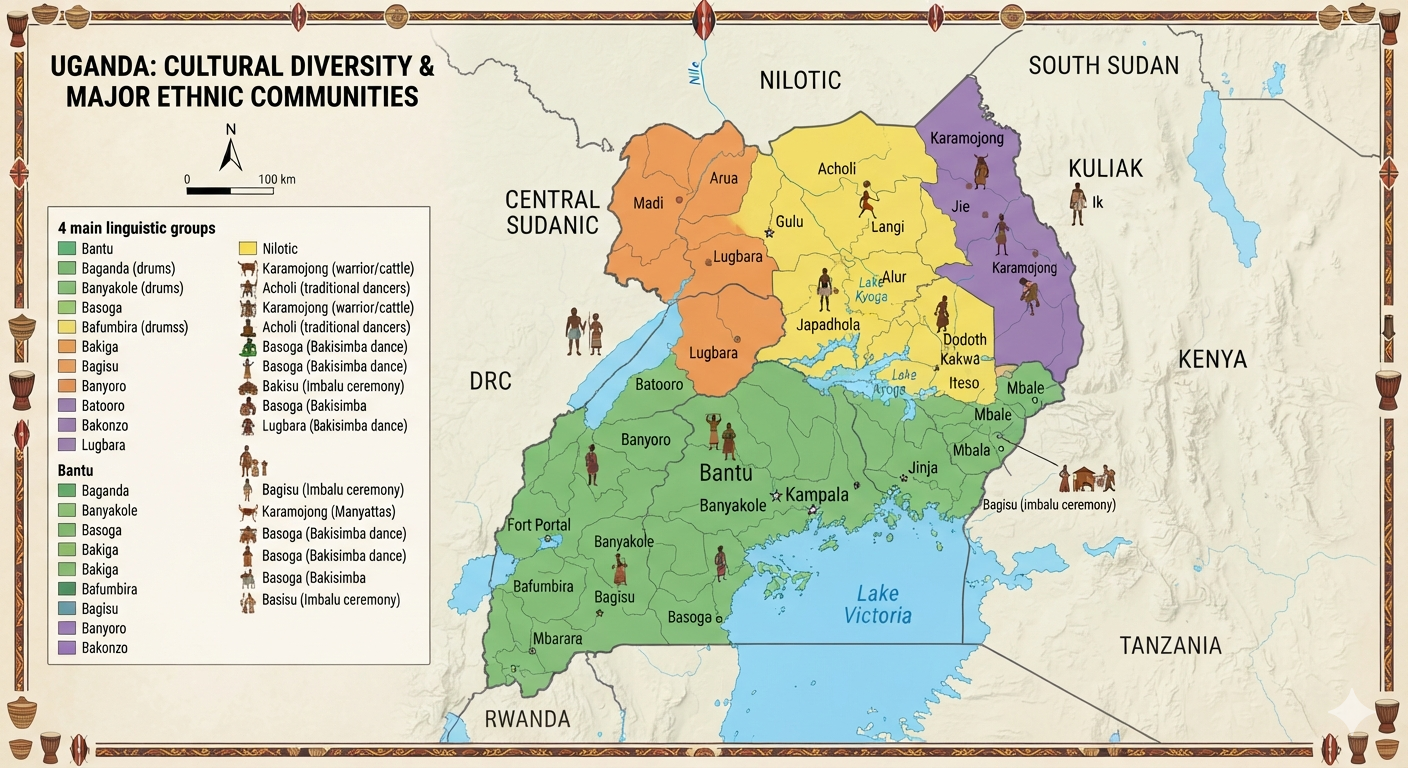
Uganda’s Cultural Diversity and Major Ethnic Communities
Cultural celebrations and traditional music performance by the Basoga people.
Uganda is a culturally diverse country where language, history, community identity, food, music, dance, storytelling, traditional knowledge and social customs vary across different parts of the country. Understanding this diversity is essential for anyone researching Uganda culture because there is no single tradition that can accurately represent every Ugandan community.
Uganda’s cultural landscape has developed through long histories of settlement, migration, interaction, agriculture, pastoralism, trade and traditional institutions. Today, these influences can be seen in rural communities as well as modern cities, particularly Kampala, where people from different parts of the country live and work together.
For travelers, this diversity means that moving between regions can reveal different languages, foods, music, dances, crafts, historical experiences and cultural identities. Exploring Uganda’s cultural sites can therefore add an important dimension to a safari or holiday.
What Cultural Diversity Means in Uganda
Cultural diversity in Uganda is expressed through many parts of everyday life. Language is one of the clearest examples, with numerous indigenous languages continuing to be spoken alongside English and Swahili. Music, dance, clothing, food, crafts, ceremonies, storytelling and traditional knowledge provide additional expressions of community identity.
Cultural differences can also reflect geography. Communities living around the Great Lakes, highlands, forests, savannahs and northeastern pastoral landscapes have developed different relationships with their environments. Agriculture, livestock keeping, fishing, trade and other livelihoods have influenced aspects of local culture over generations.
At the same time, Ugandan communities are not isolated from one another. Education, employment, migration, marriage, technology, religion and urbanization have created extensive interaction between people from different cultural backgrounds.
Living Traditions
Music, dance, storytelling, crafts, food traditions and ceremonies continue to form part of cultural life in many Ugandan communities.
Contemporary Culture
Modern education, cities, technology, employment and migration are continually shaping how cultural identities are expressed.
Uganda’s Major Ethnolinguistic Communities
Uganda contains numerous ethnic communities that can be discussed within broader linguistic and historical groupings. Bantu-speaking communities are particularly prominent in central, eastern and western Uganda, while Nilotic and Central Sudanic communities are especially important in northern and northeastern parts of the country.
These broad classifications are useful for understanding linguistic and historical relationships, but they should not be used to suggest that every community within a broad group has the same culture. Each community has its own history, language, customs and identity.
This distinction is particularly important for cultural tourism. A visitor should ask which community a particular tradition belongs to rather than assuming that a practice represents the entire country.
The Baganda and Buganda Cultural Heritage
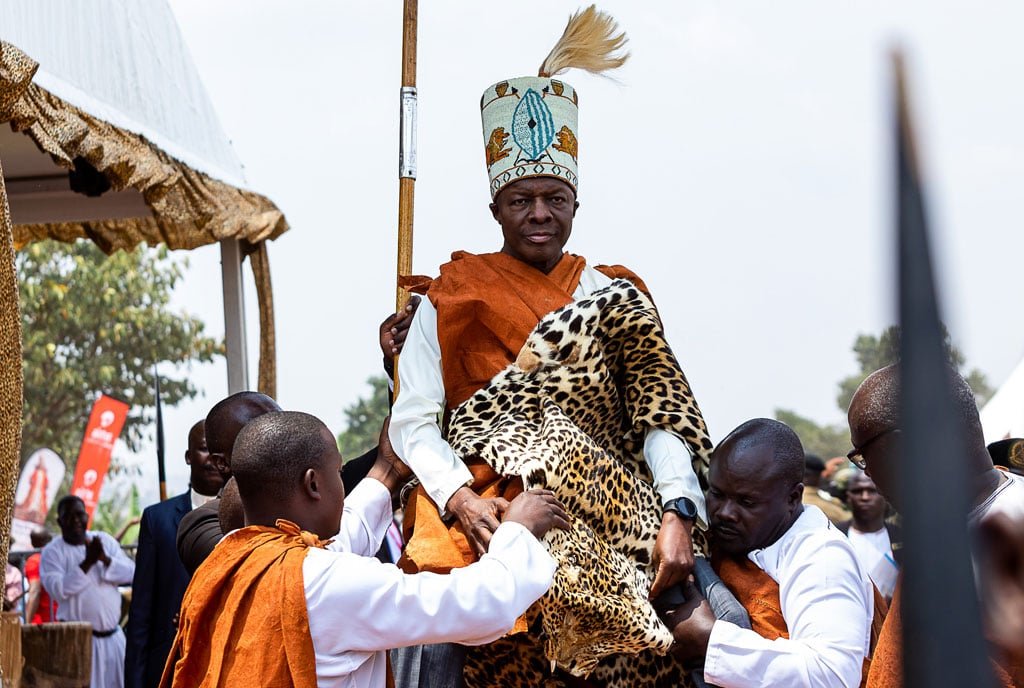
Kabaka Muwenda Mutebi II celebrates Buganda cultural heritage during a ceremony.
The Baganda are historically associated with Buganda in central Uganda. Luganda is widely spoken in Buganda and is also commonly heard in Kampala and surrounding areas.
Buganda has a distinctive historical and cultural institution, with traditions expressed through language, clan relationships, royal heritage, music, dance, architecture, storytelling and ceremonies. The Kabaka, or king, remains an important symbol of Buganda’s cultural identity.
The Kasubi Tombs are among the most important heritage sites associated with Buganda. The site is the burial place of Buganda kings and is recognized as a UNESCO World Heritage property.
Travelers interested in the wider historical landscape can also explore Buganda museums and cultural collections that help explain the history of central Uganda.
The Banyankole and Ankole Cultural Heritage
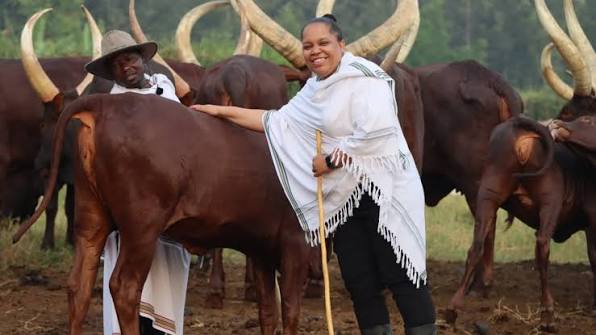
Celebrating the rich cultural heritage of the Banyankole and Ankole cows.
The Banyankole are historically associated with Ankole in southwestern Uganda. Runyankole is an important language in the region, although southwestern Uganda contains several communities and languages.
Cattle have historically held an important place in aspects of Ankole social and economic life. The long-horned Ankole cattle are particularly associated with the region and have become one of its recognizable cultural symbols.
Ankole cultural heritage is also expressed through music, dance, food, storytelling, crafts and community relationships. The Igongo Cultural Centre is one place where visitors can learn about aspects of Ankole history and heritage.
Ankole cattle are an important visual symbol associated with the cultural landscape of southwestern Uganda.
Cultural centers and museums can provide additional historical context for understanding regional traditions.
The Bakiga and Kigezi Cultural Heritage
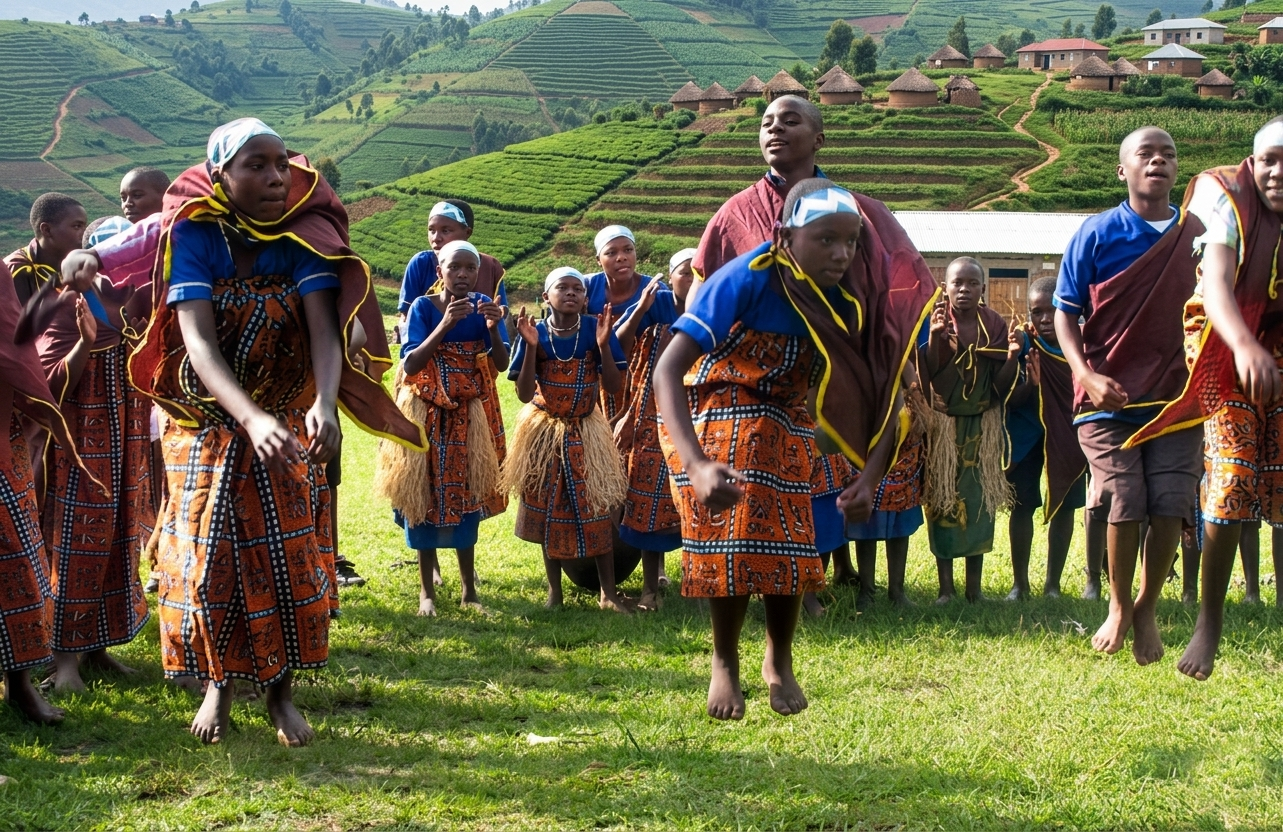
Celebrating the vibrant cultural heritage of the Bakiga in Kigezi.
The Bakiga are strongly associated with the Kigezi highlands of southwestern Uganda. Rukiga is an important language associated with the region, while the wider Kigezi area has a more complex cultural and linguistic landscape.
The mountainous environment has influenced agriculture, settlement and everyday life. The hills and valleys of Kigezi are closely connected with farming, local food production and community livelihoods.
Bakiga cultural expression includes music, dance, storytelling and food traditions. Travelers visiting southwestern Uganda can combine wildlife experiences with opportunities to learn about the communities surrounding major destinations.
The Batooro and Tooro Cultural Heritage
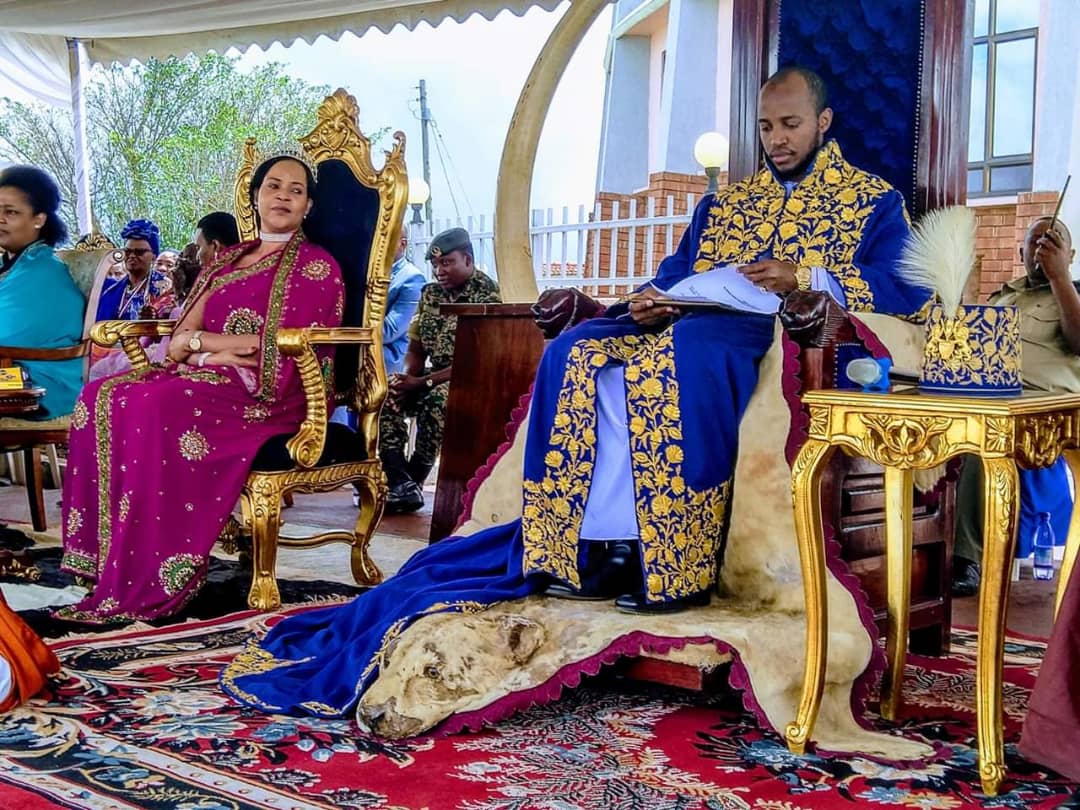
King Oyo Oyo Nyimba Kabamba Iguru Rukidi IV during a royal event
The Batooro are historically associated with the Tooro Kingdom in western Uganda. Rutooro is an important language in the region, while Tooro cultural identity includes royal traditions, music, dance, storytelling, food and community customs.
Fort Portal and the surrounding area provide opportunities to explore this cultural landscape alongside crater lakes, tea-growing areas, forests and other natural attractions.
The Tooro cultural landscape demonstrates how traditional institutions can remain part of contemporary community identity while people participate fully in modern Ugandan society.
The Banyoro and Bunyoro Cultural Heritage
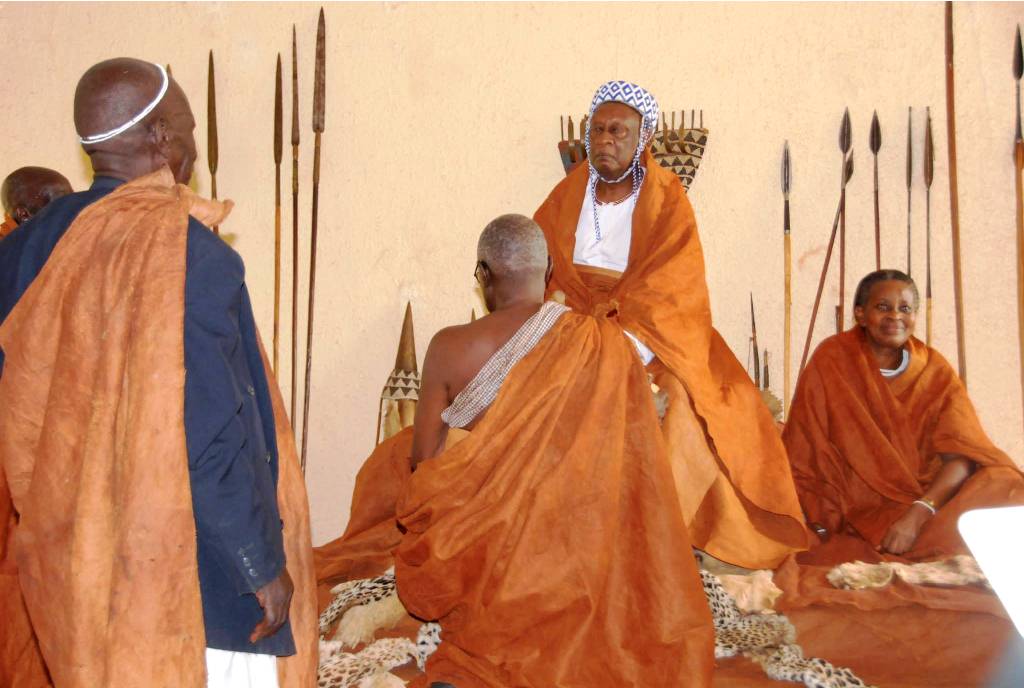
Banyoro elders and leaders gathered for a traditional cultural ceremony.
The Banyoro are historically associated with Bunyoro in western Uganda. Runyoro is an important language associated with the community, while the region’s heritage is closely connected with the Bunyoro-Kitara Kingdom.
Bunyoro’s cultural heritage includes royal traditions, oral history, traditional leadership, music, dance, agriculture, crafts and historical sites. Mparo Tombs near Hoima are among the historical sites associated with the region.
Visitors interested in this heritage can explore Hoima heritage and learn about the historical relationship between Bunyoro, its royal institution and the surrounding communities.
The Basoga and Busoga Cultural Heritage
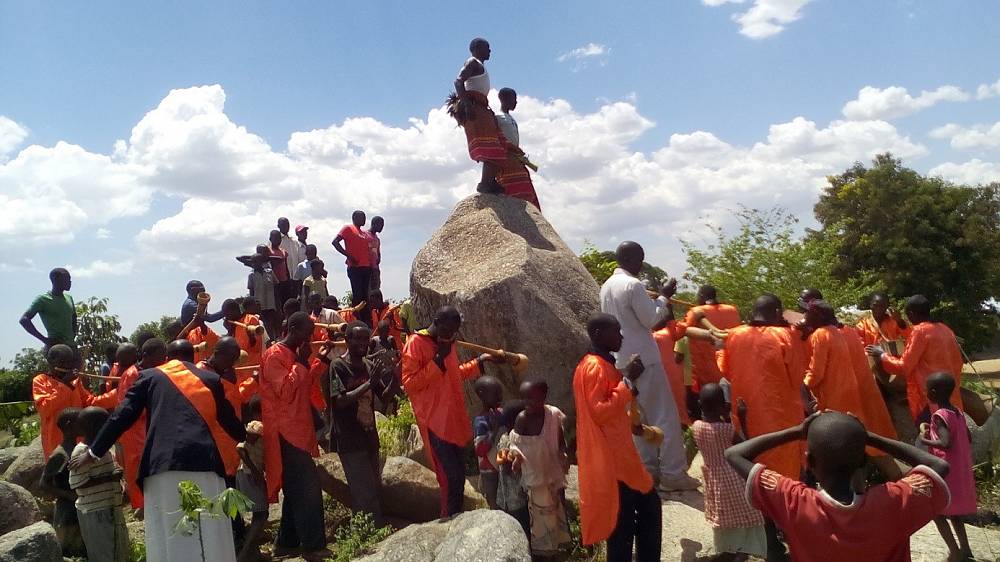
Cultural celebrations and traditional music performance by the Basoga people.
The Basoga are associated with Busoga in eastern Uganda, and Lusoga is an important language of the region. Busoga’s cultural identity has been shaped by agriculture, community traditions, historical institutions and its location around the Nile and Lake Victoria.
Jinja provides an accessible introduction to eastern Uganda’s cultural landscape. Markets, community experiences, food, music and local traditions can help travelers understand aspects of life in Busoga.
The Bagisu and Bugisu Cultural Heritage
The Bagisu are associated with the Mount Elgon region of eastern Uganda. Lumasaba is an important language associated with the community, whose cultural identity includes agriculture, music, dance, food and community traditions.
Imbalu is one of the best-known cultural traditions associated with the Bagisu. It has social and cultural significance within participating communities and is traditionally connected with initiation into adulthood.
Visitors encountering cultural ceremonies should follow local guidance concerning access, participation and photography. Cultural ceremonies should be approached as living community practices rather than simply as tourist performances.
The Acholi and Northern Uganda Cultural Heritage
The Acholi are one of the major communities associated with northern Uganda. Acholi is an important language within the community, while music, dance, storytelling and oral traditions remain significant expressions of cultural identity.
Traditional Acholi music and dance can communicate history, identity and social values. Visitors can encounter cultural performances and community experiences in parts of northern Uganda.
It is important, however, not to reduce contemporary Acholi identity to the region’s difficult recent history. Acholi communities today have diverse professions, lifestyles, aspirations and experiences.
The Lango Cultural Community
The Lango are associated with the Lango subregion of northern Uganda. Lango, also called Langi in some contexts, is an important language associated with the community.
Agriculture, family relationships, music, dance, storytelling and community organization are among the areas through which Lango cultural identity can be explored. As with other Ugandan communities, traditional practices coexist with contemporary life.
The Iteso and Teso Cultural Heritage
The Iteso are associated with the Teso region of eastern Uganda, and Ateso is the principal language associated with the community. Agriculture and community life are important parts of the region’s cultural identity.
Music, dance, food, storytelling and traditional knowledge provide additional expressions of Teso heritage. Learning about these traditions helps demonstrate how cultural identity develops through relationships between people, history and environment.
The Alur and West Nile Cultural Heritage
The Alur are one of the major communities associated with Uganda’s West Nile region. The Alur language is widely associated with the community, which has historical and cultural connections extending across the Uganda–Democratic Republic of the Congo border.
West Nile is culturally diverse, so Alur culture should not be presented as representative of every community in the region. Local guides are valuable for explaining the specific histories and traditions of the places visitors encounter.
The Karamojong and Karamoja Cultural Heritage
The Karamojong are one of the major communities associated with Karamoja in northeastern Uganda. Pastoralism has historically played an important role in Karamojong society, although contemporary livelihoods are diverse.
Karamoja has distinctive traditions involving beadwork, clothing, music, dance, livestock, storytelling and community relationships. Cultural encounters can provide valuable insight when they are organized with appropriate local participation and respect for community expectations.
Travelers should avoid presenting Karamoja or any other Ugandan region as frozen in the past. Communities continue to experience social, economic and environmental changes that shape contemporary life.
Beadwork and Dress
Beadwork and clothing can provide visual expressions of cultural identity, although styles and meanings should be explained within their community context.
Community Life
Contemporary Karamoja includes diverse livelihoods and experiences beyond traditional pastoral descriptions.
The Bakonzo and Rwenzori Cultural Heritage
The Bakonzo are strongly associated with the Rwenzori region of western Uganda, and Lukonzo is an important language associated with the community. The relationship between people, mountains, agriculture and local heritage is an important part of the region’s cultural landscape.
The Rwenzori region also includes other communities, meaning that the cultural identity of the area cannot be reduced to one group. Visitors can explore local heritage through museums, community activities and guided cultural experiences.
The Kiwa Heritage Site in Kasese, for example, includes a cultural museum presenting aspects of Bakonzo culture alongside other local experiences.
Traditional Kingdoms and Cultural Identity
Traditional kingdoms are an important part of Uganda’s historical and cultural landscape. Buganda, Bunyoro, Tooro and Busoga are among the traditional institutions associated with Uganda’s historical kingdoms.
These institutions provide important contexts for understanding royal heritage, traditional leadership, ceremonies, historical sites and regional identity. Their cultural significance should be distinguished from the functions of Uganda’s modern political government.
Cultural heritage sites associated with these institutions provide travelers with opportunities to explore Uganda’s history in greater depth.
Buganda
Buganda’s royal heritage is closely connected with central Uganda and the cultural identity of the Baganda.
Other Kingdoms
Bunyoro, Tooro and Busoga also contribute important elements to Uganda’s historical and cultural landscape.
Cultural Diversity in Kampala
Kampala provides one of the clearest examples of contemporary cultural interaction in Uganda. As the national capital, it attracts people from different regions and communities, creating a multilingual and multicultural urban environment.
Visitors can experience this diversity through markets, restaurants, museums, cultural centers, religious sites, music and community events. The city is therefore an important starting point for travelers wanting to understand both traditional and contemporary Uganda culture.
The Ndere Center is particularly relevant to cultural travelers because its performances bring together music, dance and other artistic expressions associated with different parts of Uganda.
Language as a Marker of Cultural Identity
Language is one of the strongest expressions of cultural identity in Uganda. English and Swahili have national importance, while indigenous languages remain central to many communities and households.
Visitors may hear Luganda in central Uganda, Lusoga in Busoga, Runyankole in Ankole, Rukiga in Kigezi, Rutooro in Tooro, Runyoro in Bunyoro, Ateso in Teso, Acholi in northern Uganda and many other languages throughout the country.
Learning a simple local greeting can be a positive way to show interest in a community. It also helps travelers recognize that language is more than a communication tool; it is an important part of cultural identity.
Food and Cultural Identity Across Uganda
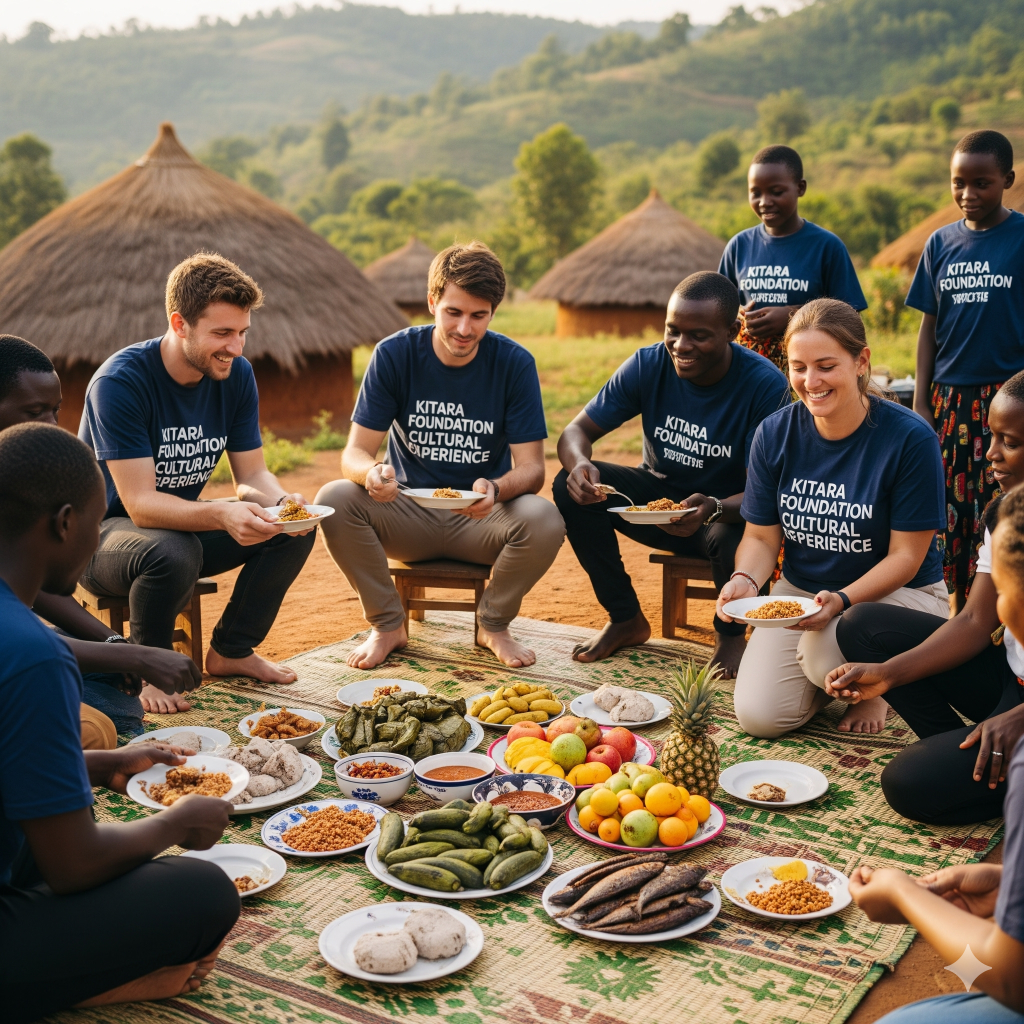
A community gathering celebrates Ugandan heritage through authentic local food.
Traditional Foods
Food traditions vary according to region, agriculture, available ingredients and community history.
Cooking Traditions
Cooking methods and the occasions associated with particular foods can provide insight into everyday cultural life.
Plantains, cassava, sweet potatoes, millet, maize, beans, groundnuts and other foods feature prominently in different Ugandan diets. Their importance varies between communities, and preparation methods can differ considerably.
Travelers can make food experiences more meaningful by asking local hosts about the origins of dishes and the occasions when particular foods are traditionally prepared.
Music, Dance and Oral Traditions
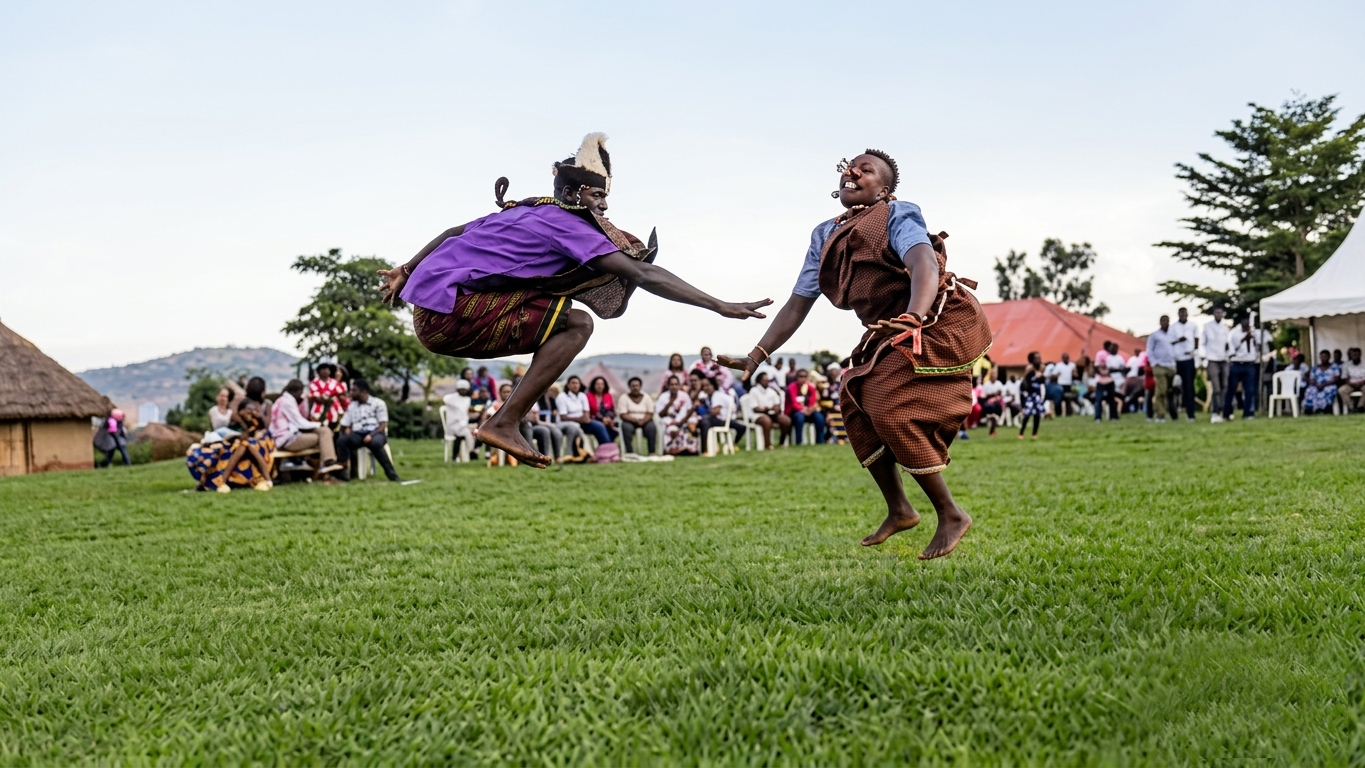
Preserving culture through traditional music, dance, and oral storytelling.
Music and dance are among the most visible forms of Uganda culture. Different communities have developed distinctive instruments, rhythms, songs and dances associated with celebrations, ceremonies, storytelling and social life.
Oral traditions are equally important because stories, proverbs, songs and spoken knowledge can transmit history and values between generations. Cultural performances can therefore provide travelers with an introduction to both artistic expression and community history.
The Nyege Nyege Festival is a contemporary example of Uganda’s wider creative and cultural scene, although it should not be confused with traditional cultural ceremonies.
Cultural Diversity and Community Tourism
Community tourism can provide opportunities for travelers to learn about local cultures while creating economic opportunities for communities. Depending on the destination, experiences may include village walks, traditional food preparation, craft demonstrations, storytelling, dance performances, farming activities and visits to heritage sites.
Responsible cultural tourism should involve local people in deciding how their heritage is presented. Travelers should understand who organizes an experience, how communities benefit and what cultural rules apply.
Cultural activities can also complement wildlife experiences. Around Bwindi, for example, travelers can combine gorilla trekking with community experiences that introduce local history, crafts, food and traditions. The Batwa Experience is one example of a cultural activity connected with the southwestern Uganda tourism landscape.
Religion and Cultural Diversity
Religion is an important part of contemporary Ugandan society. Christianity and Islam are widely practiced, while traditional beliefs and historical spiritual practices also form part of the country’s cultural heritage.
Religious and cultural identities can overlap, but they should not automatically be treated as identical. Individuals can participate in modern religious life while maintaining different aspects of community heritage.
Religious heritage sites can provide another perspective on Uganda’s history. Visitors should approach these locations respectfully and follow rules concerning clothing, photography, worship areas and visitor access.
Urbanization and the Changing Face of Uganda Culture
Contemporary Uganda demonstrates that culture is continually changing. Young Ugandans may use social media, study in cities, work internationally and enjoy contemporary music while maintaining connections to their home communities and languages.
Migration between regions has also increased cultural interaction. Marriages between people from different communities, movement for education and employment, and the growth of cities have contributed to increasingly interconnected communities.
This means travelers should avoid presenting traditional culture as something separate from modern Ugandan life. Traditional heritage and contemporary experiences are both part of today’s Uganda culture.
Why Travelers Should Learn About Uganda’s Ethnic Communities
Understanding Uganda’s ethnic communities helps travelers approach cultural encounters with greater accuracy and respect. It prevents common mistakes such as assuming that a tradition practiced by one community is practiced throughout Uganda.
It also makes travel more rewarding. Knowing something about a region’s history, language and cultural identity can make visits to markets, museums, cultural centers and historical sites more meaningful.
Most importantly, cultural tourism should give local communities an opportunity to tell their own stories. Travelers should listen to local guides, ask respectful questions and recognize that communities themselves are the best source for understanding living traditions.
How to Experience Uganda’s Cultural Diversity Respectfully
Responsible cultural travel begins with respect. Ask permission before photographing people, particularly during ceremonies or in culturally sensitive locations. Follow instructions from community guides and avoid entering restricted or sacred spaces without permission.
When purchasing crafts, food or other products, supporting local artisans and community businesses can help ensure that tourism contributes to the people whose heritage visitors are experiencing.
Travelers should also avoid outdated stereotypes. Uganda’s ethnic communities are living societies with diverse experiences, and their cultures continue to evolve.
Uganda’s Cultural Diversity as Part of the Complete Travel Experience
Uganda is internationally known for its wildlife, forests, mountains, lakes and rivers, but its people and cultural heritage add another essential dimension to the country’s identity. Exploring different communities can reveal stories and traditions that cannot be understood from wildlife experiences alone.
From Buganda and Busoga to Ankole, Tooro, Bunyoro, Kigezi, northern Uganda, West Nile and Karamoja, different regions contribute distinctive elements to the wider cultural landscape.
The result is a country where cultural diversity is not confined to museums or heritage sites. It can be encountered in languages spoken in markets, foods prepared in homes, songs performed at celebrations, crafts made by local artisans and stories shared between generations.
Uganda’s cultural diversity is regional, multilingual, historical and continuously evolving. The best way to understand Uganda culture is to approach individual communities on their own terms, learn from local people and recognize that no single ethnic tradition represents the entire country.
Uganda’s Languages, Greetings and Everyday Communication
Language is one of the clearest ways to understand Uganda culture. Uganda is a multilingual country where English, Kiswahili and numerous indigenous languages are used in different settings. The language a person speaks may reflect their community, region, family background, education, occupation or social environment. For visitors, understanding this linguistic diversity makes everyday interactions more meaningful and helps explain why communication in Uganda can sound very different from one region to another.
Uganda’s cultural diversity is reflected in its languages. Luganda is particularly prominent in central Uganda and Kampala, while languages such as Runyankole, Rukiga, Rutooro, Runyoro, Lusoga, Ateso, Acholi, Lugisu and Alur are important in different communities and regions. The country’s cultural attractions also demonstrate this diversity through music, dance, storytelling and traditional performances. For example, Kampala cultural experiences can introduce visitors to several languages and traditions within a single city.
Learning a few appropriate greetings before visiting Uganda is therefore more than a practical communication exercise. It is a simple way to show curiosity and respect for the people and communities a traveler encounters.
How Many Languages Are Spoken in Uganda?
Uganda has a highly diverse linguistic landscape, with many indigenous languages belonging to several major language families. The exact number reported can vary depending on how languages and dialects are classified, so it is better to describe Uganda as a country with numerous indigenous languages rather than rely on one supposedly definitive number.
This diversity corresponds closely with Uganda’s many ethnic communities. A language can serve as an important marker of identity, but language use is not always restricted to one ethnic group or one geographical area. Urbanization, education, intermarriage, employment and migration mean that Ugandans frequently speak more than one language.
Uganda’s Official Languages
English is Uganda’s official language and has an important role in government, formal education, business and many official communications. Kiswahili also has official-language status and is widely used in regional communication, although actual everyday use varies considerably between communities and individuals.
Indigenous languages remain extremely important in everyday communication. In many homes and communities, people use their local language naturally with family members, neighbors and other speakers of the same language.
English
English is widely used in formal education, government, professional settings, tourism and international communication.
Kiswahili
Kiswahili is an official language and an important regional language, particularly useful for communication across East Africa.
Luganda and Communication in Central Uganda
Luganda is one of Uganda’s most widely spoken indigenous languages and is especially prominent in Buganda and Kampala. Because Kampala attracts people from across the country, Luganda is commonly heard alongside English, Kiswahili and many other Ugandan languages.
Travelers spending time in Kampala may therefore hear Luganda in markets, shops, taxis, restaurants and informal conversations. Learning a few simple expressions can make everyday interactions more enjoyable, although English is also widely useful for visitors.
Common Luganda Greetings
Luganda greetings are useful for visitors spending time in central Uganda. Pronunciation and usage can vary according to context, relationship and region, so a local speaker or guide is the best person to confirm the most natural expression.
Oli otya?
A common informal Luganda greeting meaning approximately “How are you?”
Gyebale ko
A respectful greeting used to acknowledge someone’s effort or work and commonly heard in everyday Ugandan interaction.
Visitors should remember that greetings are influenced by age, familiarity, social position and context. A greeting that is appropriate between friends may not be the best choice when addressing an elder or someone in a formal situation.
Greetings in Other Ugandan Languages
Uganda’s linguistic diversity means that greetings differ considerably from one community to another. In western Uganda, for example, visitors may encounter Runyankole, Rukiga, Rutooro and Runyoro. In eastern and northern Uganda, languages such as Lusoga, Ateso and Acholi are important in their respective communities.
There is no single greeting that represents every Ugandan community. The most respectful approach is to ask a local guide, host or friend which greeting is appropriate in the particular place you are visiting.
Useful Runyankole and Rukiga Expressions
Runyankole is widely spoken in the Ankole region, while Rukiga is particularly associated with the Kigezi area. The two languages are closely related, but visitors should not assume that expressions, pronunciation or preferred forms are identical in every situation.
Travelers visiting Mbarara, Kabale, Kisoro and surrounding areas may encounter these languages frequently. A local guide can teach visitors simple greetings according to the specific community being visited.
Cultural destinations such as the Kiwa Heritage Site also demonstrate how language, traditional knowledge, music and community history can come together in a cultural experience.
Rutooro and Runyoro in Western Uganda
Rutooro is strongly associated with the Tooro region, while Runyoro is associated with Bunyoro. These languages belong to the wider Bantu linguistic environment of western Uganda.
Visitors traveling through Fort Portal, Hoima and surrounding areas may encounter these languages in homes, markets and local communities. English is useful in formal tourism settings, but hearing local languages provides an immediate reminder of the cultural diversity of western Uganda.
Lusoga and Communication in Busoga
Lusoga is an important language in Busoga in eastern Uganda. Jinja is one of the best-known urban centers in the region and has become highly multicultural, meaning visitors may hear Lusoga alongside English, Luganda, Kiswahili and other languages.
A cultural or city visit to Jinja can therefore provide an opportunity to experience language in an everyday setting rather than only through formal cultural performances. Markets, restaurants, craft shops and community interactions reveal how languages operate naturally in daily life.
The Jinja cultural experience can be especially useful for travelers who want to combine historical, cultural and community experiences.
Languages of Northern Uganda
Northern Uganda has a particularly rich linguistic landscape. Acholi is widely associated with the Acholi community, Ateso is important in Teso, and several other languages are spoken across the northern and northeastern regions.
Language can be especially useful for understanding regional identity. Visitors should avoid treating “northern Ugandan culture” as one uniform culture because the region contains numerous communities with different histories, languages and traditions.
Kiswahili in Everyday Ugandan Communication
Kiswahili is widely recognized across East Africa and has official status in Uganda. Its practical usefulness can vary depending on location and social setting. Travelers who already know some Kiswahili may find it useful, particularly when communicating across linguistic communities or with people who use it regularly.
However, visitors should not assume that every Ugandan speaks Kiswahili fluently. English and local languages may be more appropriate depending on the situation.
English and Tourism Communication
English is particularly useful for international visitors because it is widely used in tourism, education, government and professional communication. Safari guides, hotel staff and many tourism professionals commonly communicate with international visitors in English.
Even when English is being used, communication may include local expressions, pronunciation patterns or vocabulary that visitors are unfamiliar with. Asking politely for clarification is usually better than pretending to understand.
How Ugandans Commonly Use Multiple Languages
Multilingualism is an important part of everyday communication in Uganda. A person may use a local language at home, English at school or work, and another widely understood language when interacting with people from different communities.
Kampala provides an especially clear example. Because residents come from different parts of Uganda and neighboring countries, conversations can move between languages depending on who is participating and what is being discussed.
This flexibility is one reason Uganda culture cannot be understood through one language alone. Language choice often changes with location, relationship and purpose.
Greetings and Respect for Elders
Respect is an important element of social interaction in many Ugandan communities. The way a person greets an elder, community leader, guide or another respected person may differ from the way they greet a close friend.
Visitors do not need to master every cultural rule before arriving. A friendly greeting, patient listening and willingness to follow the lead of local people can go a long way.
When uncertain, visitors can simply ask, “How should I greet people here?” Local guides are often happy to explain the appropriate form.
Greetings During a Uganda Safari
Greetings are especially useful during community visits, village walks and cultural experiences. A simple greeting before asking a question or taking a photograph can make an interaction feel more respectful and natural.
Safari guides can also explain local customs when travelers visit communities near national parks. This is particularly valuable because appropriate behavior can vary from one cultural setting to another.
The cultural sensitivity guide provides additional guidance on respectful interactions, including the importance of asking permission before photographing people and learning basic local greetings.
Asking Permission Before Taking Photographs
Communication is particularly important when taking photographs of people. A visitor should ask permission rather than assuming that someone is comfortable being photographed.
This is especially important during cultural ceremonies, religious events, community visits and interactions with children. A respectful request can be made in English, Kiswahili or a local language with assistance from a guide.
Everyday Expressions Visitors Should Know
Visitors do not need an extensive vocabulary to communicate politely in Uganda. A small collection of expressions for greeting, thanking, apologizing, asking for help and saying goodbye can make everyday encounters easier.
Because Uganda has many languages, it is better to learn expressions that are appropriate for the specific region you are visiting. A phrase that is useful in Kampala may not be the most natural expression in Kabale, Jinja, Fort Portal or Moroto.
A Simple Communication Strategy
Start with a friendly greeting, speak clearly, listen carefully, and ask for clarification when necessary.
When visiting a particular community, ask your local guide to teach you the appropriate greeting rather than relying on a generic national phrase.
Language, Music and Cultural Performance
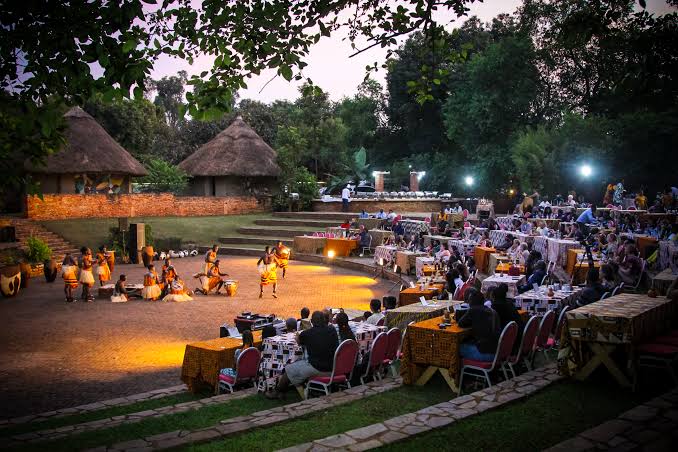
Ugandan cultural dances showcase linguistic and artistic diversity.
Language is closely connected with music, dance, storytelling and oral history. Cultural performances can therefore reveal linguistic diversity even when visitors do not understand every word being spoken or sung.
The Ndere Cultural Centre in Kampala is a useful example. Its performances bring together artistic traditions from different parts of Uganda and provide visitors with an opportunity to experience the country’s cultural diversity through music, dance and storytelling.
A visit to Ndere Cultural Centre can therefore complement a wider Uganda culture itinerary.
Language and Cultural Tourism
Cultural tourism becomes more meaningful when travelers understand the connection between language and community identity. A cultural tour should not simply present costumes, dances or food as entertainment; it should help visitors understand the people and histories behind those traditions.
Learning a few words from the community being visited can make this experience more personal. It signals that the traveler is interested in meeting people rather than simply passing through a destination.
Uganda’s cultural attractions, including heritage sites, museums and community experiences, provide many opportunities to explore these connections between language, history and identity.
Common Communication Mistakes to Avoid
One common mistake is assuming that all Ugandans speak the same language. Uganda’s linguistic diversity means that language preferences can change significantly between regions and communities.
Another mistake is assuming that knowing one local expression makes someone fluent in the language. Visitors should use greetings respectfully without exaggerating their knowledge.
It is also important not to laugh at unfamiliar accents or pronunciation. Language is closely connected with identity, and respectful communication requires patience from both visitors and hosts.
Best Way to Learn Local Greetings Before Traveling
The most practical approach is to identify the regions included in your itinerary and learn a few expressions from the languages you are likely to encounter. A trip covering Kampala, Jinja and western Uganda, for example, may expose you to different linguistic environments.
Your guide, accommodation staff or local hosts can then help you refine pronunciation and explain when particular expressions are appropriate. This is more reliable than treating a single list of translations as universally applicable.
Uganda’s Languages as a Window into Its Culture
Uganda’s languages reveal the country’s extraordinary cultural diversity. They connect families with their heritage, preserve oral traditions, support community identity and continue to evolve as Ugandans interact across regional and cultural boundaries.
For travelers, even a small effort to learn a greeting can change the character of an interaction. A simple word spoken respectfully can open a conversation, encourage cultural exchange and demonstrate appreciation for the community being visited.
Understanding Uganda culture therefore requires looking beyond the country’s wildlife and landscapes. Language is part of the country’s living heritage, and learning how Ugandans communicate provides a deeper understanding of everyday life across the Pearl of Africa.
Uganda is a multilingual country, and language use changes according to region, community, relationship and setting. English and Kiswahili are official languages, while indigenous languages such as Luganda, Runyankole, Rukiga, Rutooro, Runyoro, Lusoga, Acholi and Ateso remain important parts of everyday cultural life. For visitors, learning a few locally appropriate greetings and communicating respectfully is one of the simplest ways to connect with Uganda culture.
Traditional Kingdoms, Royal Heritage and Cultural Institutions
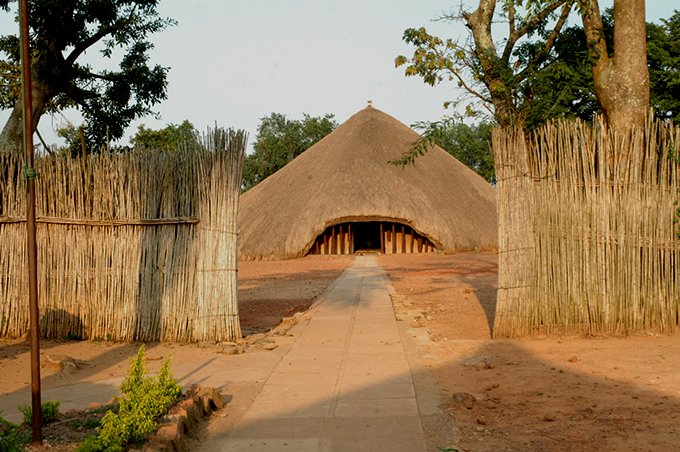
The historic Kasubi Tombs represent the rich royal heritage of Buganda.
Traditional kingdoms are an important part of Uganda culture and provide one of the clearest ways to understand the country’s history, identities, customs and systems of cultural leadership. Long before the modern Republic of Uganda was established, several organized kingdoms and chiefdoms developed across different parts of the territory. These institutions created systems of leadership, social organization, land administration, ceremonies, royal traditions, oral history and cultural preservation that continue to influence communities today.
Modern Uganda is a republic, and traditional cultural institutions do not exercise the executive and legislative powers of the national government. Their importance today is primarily cultural, historical and social. The Constitution provides for traditional or cultural leaders while limiting their role to cultural functions. This distinction is essential when discussing Uganda’s kingdoms because the modern role of a king is different from the political authority exercised by historical monarchs.
For travelers, royal heritage provides an opportunity to explore Uganda beyond wildlife. A visit to a palace, royal tomb, cultural institution or historic kingdom site can reveal stories about dynasties, clans, architecture, ceremonies, traditional authority and the relationship between communities and their heritage.
The Role of Traditional Kingdoms in Uganda Culture
Uganda’s traditional kingdoms developed as organized cultural and political societies with their own systems of leadership and administration. Among the best-known are Buganda, Bunyoro, Tooro and Busoga. Other traditional institutions and cultural leaders also exist among different communities across the country.
Their historical influence can still be seen in clan structures, royal ceremonies, traditional titles, oral traditions, cultural music, dance, architecture and sacred places. These institutions also contribute to cultural education and heritage preservation.
The distinction between historical kingdoms and modern cultural institutions is important. The restoration of traditional institutions in contemporary Uganda created a framework in which kings and other traditional leaders can preserve cultural heritage without functioning as elected political authorities.
Buganda Kingdom and Its Royal Heritage
Buganda is one of the most prominent traditional kingdoms in Uganda and has played a major role in the history of the Great Lakes region. Its cultural identity is closely connected with the Baganda people, the Kabaka institution, clan organization, royal ceremonies and a rich body of oral and written history.
The kingdom’s historical center is in the Kampala area, particularly around Mengo. This makes Buganda royal heritage especially accessible to visitors staying in Uganda’s capital.
Visitors interested in Buganda Kingdom heritage experiences can explore several locations connected with the kingdom’s history, including the Kabaka’s Palace, Bulange, the Royal Mile, Kasubi Tombs and other cultural sites.
Kabaka’s Palace at Mengo
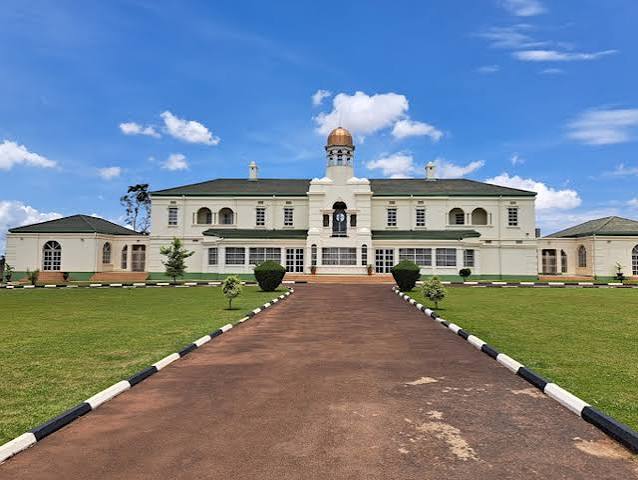
The historic Kabaka’s Palace, or Mengo Palace, in Kampala, Uganda.
Kabaka’s Palace, commonly known as Lubiri, is one of the most recognizable royal heritage landmarks in Kampala. It represents the continuing cultural importance of the Buganda monarchy and forms part of a larger historic landscape around Mengo.
The palace should be understood as more than an architectural attraction. It is connected to the history of Buganda’s monarchy, royal administration and the major political changes that affected Uganda during the twentieth century.
A visit can therefore be combined with Bulange and the Royal Mile to create a broader understanding of how the traditional kingdom was organized.
Bulange and the Royal Mile
Bulange is associated with the administrative and parliamentary traditions of Buganda. It stands near the Kabaka’s Palace and is connected to the palace by the Royal Mile, creating an important cultural and historical route in Mengo.
The Royal Mile is particularly significant because it connects important royal spaces while incorporating symbols associated with Buganda’s clans. For visitors, walking or touring this area provides an opportunity to understand how clan identity and royal administration have been represented within Buganda’s cultural landscape.
The Kampala Tourism Portal identifies the Kabaka’s Palace, Bulange and Royal Mile as a significant historical and cultural triangle in Kampala.
Kasubi Tombs and the Royal Burial Tradition
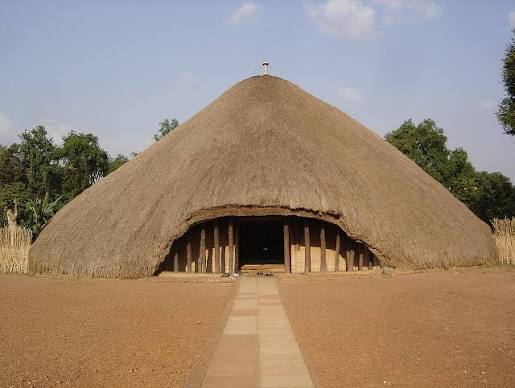
The Muzibu-Azaala-Mpanga, the main burial house at Kasubi Tombs.
The Kasubi Tombs are among Uganda’s most important cultural heritage sites. They are the burial grounds of four former Kabakas of Buganda and remain an important spiritual and cultural site for the Baganda.
The main structure, Muzibu Azaala Mpanga, is particularly significant because of its traditional construction and its connection with Buganda’s royal history. The site demonstrates how architecture, spirituality, royal lineage and cultural memory can exist together within one heritage landscape.
UNESCO inscribed the Tombs of Buganda Kings at Kasubi on the World Heritage List in 2001. The site therefore has significance not only for Buganda and Uganda but also within the international heritage community.
Travelers can read more about Uganda’s royal and cultural heritage sites when planning a wider cultural itinerary around Kampala.
Naggalabi Coronation Site
Naggalabi Buddo is associated with the coronation traditions of Buganda. The site provides an opportunity to understand the ceremonial dimension of the Kabaka institution and the importance of royal succession within Buganda culture.
Coronation sites are particularly valuable for cultural tourism because they help visitors understand that traditional leadership is supported by ceremonies, symbols, histories and community institutions rather than being defined only by the presence of a royal palace.
Bunyoro-Kitara Kingdom and Western Uganda
Bunyoro-Kitara is another major historical kingdom associated with western Uganda. The kingdom has a long and complex history, and its heritage is visible through royal sites, tombs, cultural traditions and historical landscapes.
Hoima is particularly important when exploring Bunyoro heritage. The city and surrounding areas contain sites connected with the kingdom and its former rulers.
Hoima heritage and cultural sites can be incorporated into a wider western Uganda itinerary, particularly for travelers interested in connecting historical tourism with visits to nearby natural attractions.
Mparo Tombs and the Legacy of Omukama Kabalega
Mparo Tombs near Hoima are closely associated with the history of Bunyoro and Omukama Kabalega. The site is an important place for understanding the royal history of Bunyoro and the legacy of one of the kingdom’s best-known historical rulers.
Royal tombs such as Mparo are valuable because they preserve historical memory through physical places. They allow visitors to connect written history with landscapes, oral traditions and cultural practices that remain meaningful to local communities.
Tooro Kingdom and the Cultural Heritage of Fort Portal
Tooro Kingdom is located in western Uganda and is strongly associated with the Batooro people and the town of Fort Portal. The kingdom’s cultural heritage includes royal traditions, family histories, ceremonies and distinctive forms of cultural expression.
The royal title of the Tooro king is Omukama. The current royal institution is part of Uganda’s contemporary cultural landscape and continues to contribute to cultural identity and heritage preservation.
Fort Portal makes a useful base for travelers combining cultural experiences with visits to crater lakes, tea-growing areas, Kibale Forest and other attractions in western Uganda.
Busoga Kingdom and the Kyabazinga Institution
Busoga provides another distinctive example of Uganda’s traditional institutions. Located in eastern Uganda, Busoga has a cultural institution associated with the Kyabazinga, the traditional king of the Basoga.
Busoga’s structure differs from Buganda’s hereditary model. The cultural institution developed around a union of principalities, making its traditional leadership structure particularly interesting for visitors studying the diversity of Ugandan kingdoms.
Jinja and Bugembe are useful locations for travelers interested in exploring Busoga’s cultural landscape, while the wider region offers opportunities to combine cultural experiences with the Nile, markets, historical sites and community activities.
Traditional Royal Institutions and Modern Uganda
Uganda’s traditional institutions have experienced major changes throughout the country’s modern history. The kingdoms were abolished in 1967, and traditional institutions were later restored in the early 1990s under a new constitutional framework.
Their contemporary role is primarily cultural. Kings and traditional leaders can serve as custodians of heritage, symbols of community identity and supporters of cultural and social initiatives, but they do not replace Uganda’s elected national and local government structures.
Understanding this modern context helps visitors discuss Uganda’s royal heritage accurately and respectfully.
Royal Heritage, Clans and Cultural Identity
Royal heritage cannot be separated from clan identity in many Ugandan societies. Clans can have their own histories, symbols, traditions and responsibilities, and these structures have historically interacted with systems of royal leadership.
In Buganda, for example, clan identity remains an important part of cultural life. Traditional clan symbols and oral histories can help visitors understand why royal heritage is connected to ordinary community life rather than existing only inside palaces and royal compounds.
Cultural Institutions Beyond the Kingdoms
Uganda’s cultural heritage is preserved by more than royal institutions. Museums, cultural centers, heritage organizations, traditional performers, community groups and religious institutions all contribute to the preservation and interpretation of the country’s history.
The Uganda Museum, for example, provides collections and exhibits relating to Uganda’s archaeological, ethnographic, historical and cultural heritage. Cultural performance organizations such as Ndere also introduce visitors to music, dance and traditions from different parts of the country.
These institutions are especially useful for visitors who want to place individual kingdoms within the larger story of Uganda’s cultural diversity.
Royal Heritage and Cultural Tourism
Royal heritage can become a powerful part of a Uganda cultural tour when sites are visited with appropriate historical and cultural context. A palace alone may tell only part of the story. Combining the palace with royal tombs, museums, cultural performances, craft centers and community experiences provides a much broader picture.
This approach also allows travelers to understand how traditions have changed over time. Uganda’s cultural institutions are living institutions, and their relevance today is connected to contemporary communities as much as to historical kingdoms.
Visitors looking for a broader overview can explore Uganda’s cultural heritage destinations and build an itinerary around the regions they intend to visit.
How to Visit Royal and Sacred Heritage Sites Respectfully
Royal tombs, palaces and sacred cultural sites should be treated differently from ordinary tourist attractions. Some areas may have restrictions on photography, clothing, movement or access, and visitors should follow instructions from guides and site custodians.
It is also important to listen when guides explain the cultural meaning of objects, ceremonies and locations. Sacred objects should not automatically be treated as photographic props, and visitors should ask permission before photographing people or participating in cultural activities.
The most rewarding royal heritage experiences are those in which travelers approach the sites as places of living cultural significance rather than simply as historical monuments.
Traditional Kingdoms as Living Heritage
Uganda’s traditional kingdoms are not simply remnants of a distant past. Their institutions, ceremonies, cultural programs, royal histories and community activities continue to contribute to the country’s cultural landscape.
From Buganda’s royal heritage around Kampala to Bunyoro’s historic sites around Hoima, Tooro’s cultural traditions in western Uganda and Busoga’s institutions around Jinja and Bugembe, royal heritage reveals the remarkable diversity of Uganda culture.
For anyone researching what to see in Uganda beyond wildlife, traditional kingdoms provide an essential cultural dimension. They connect architecture, history, language, food, music, dance, clan identity, spirituality and community memory into a much richer understanding of the Pearl of Africa.
Uganda’s traditional kingdoms and cultural institutions are central to understanding the country’s history and living cultural identity. Buganda, Bunyoro, Tooro and Busoga offer particularly important royal heritage experiences, while sites such as Kasubi Tombs, Kabaka’s Palace, Bulange, Naggalabi and Mparo Tombs connect travelers with different chapters of Uganda’s royal history. Visiting these places respectfully and with local cultural guidance provides a deeper experience than viewing them simply as tourist attractions.
Traditional Music, Dance, Storytelling and Performing Arts
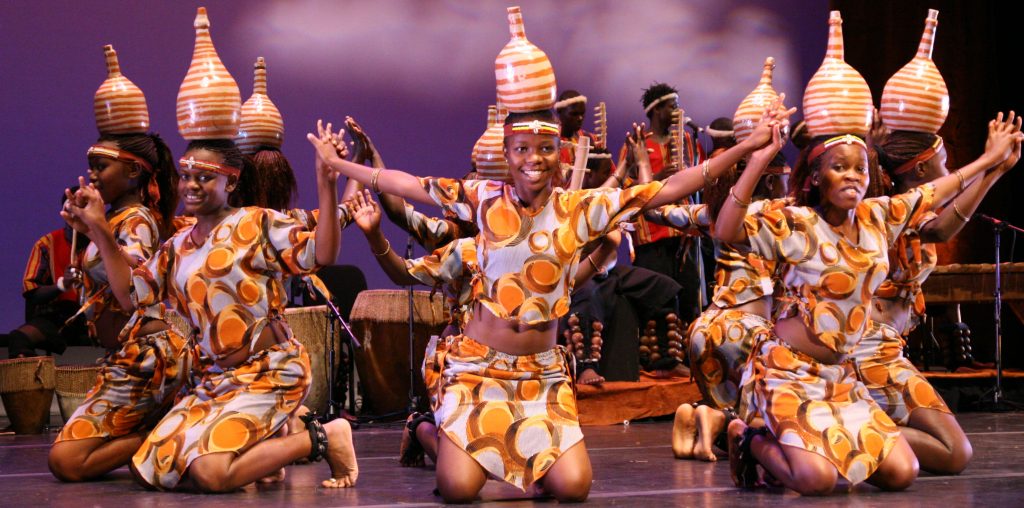
Performers celebrating cultural heritage through dance and storytelling.
Traditional music, dance, storytelling and performing arts are among the most powerful expressions of Uganda culture. Across the country’s many communities, performance has traditionally been used to preserve history, strengthen social relationships, celebrate important occasions and communicate knowledge between generations. Music and dance are therefore not simply entertainment; they can carry information about identity, community values, history and everyday life.
Uganda’s performing arts are exceptionally diverse because different communities have developed their own musical instruments, rhythms, songs, dances and storytelling traditions. The National Curriculum Development Centre notes that traditional musical knowledge has historically been transmitted orally from generation to generation.
For travelers, experiencing traditional music and dance offers a way to understand Uganda beyond its landscapes and wildlife. Cultural performances can introduce visitors to regional traditions while providing an opportunity to see how music, movement, language, costumes and storytelling work together.
Why Traditional Music Matters in Uganda Culture
Traditional music has historically served many purposes within Ugandan communities. Songs and instrumental performances can accompany ceremonies, celebrations, dances and other important social occasions. Music can also preserve memories, communicate ideas and reinforce community identity.
Because traditions differ between communities, there is no single style that can accurately be called “Ugandan traditional music.” Instead, Uganda has a collection of regional and community-based musical traditions that together form part of the country’s cultural heritage.
Traditional Musical Instruments of Uganda
Traditional instruments form an important part of Uganda’s musical heritage. Drums, xylophones, string instruments, flutes, horns and other locally made instruments can be used to create distinctive sounds associated with particular communities.
Instruments are not always used simply to provide background music. In many traditional performances, the instrument, rhythm and movement are closely connected. The result is a performance in which sound and physical movement communicate together.
Drums
Drums are important in many Ugandan musical traditions and can provide rhythm for songs, dances and ceremonial performances.
Xylophones and String Instruments
Xylophones and various string instruments contribute distinctive melodic textures to different regional musical traditions.
The diversity of instruments is one reason cultural performances can sound and look very different from one region of Uganda to another.
Traditional Dance as Cultural Expression
Traditional dance provides a visual language through which communities express identity, celebration, history and social values. Movements, formations, costumes and rhythms can differ considerably between cultural groups.
Dance is often closely connected to music. Drumming establishes rhythm while dancers respond through coordinated movements. Singing, clapping and instrumental accompaniment may add further layers to the performance.
Acholi Traditional Dance and Music
Northern Uganda has a rich tradition of music and dance among the Acholi and other communities. Acholi performance traditions include several dances associated with different social contexts and occasions.
Larakaraka is one of the best-known Acholi dances and is associated with courtship and cultural performance. Other Acholi dances demonstrate the diversity within the community’s performing arts rather than representing one single dance style.
Visitors interested in northern Uganda should therefore approach Acholi performing arts as a living cultural tradition rather than simply a staged tourist attraction.
Bigwala Music and Dance of Busoga
Bigwala is one of Uganda’s internationally recognized intangible cultural heritage traditions. It is a musical and dance tradition of the Basoga people of the Busoga Kingdom.
The performance uses a group of gourd trumpets played together to create a melody, accompanied by a specific dance. UNESCO inscribed Bigwala on the List of Intangible Cultural Heritage in Need of Urgent Safeguarding in 2012. :contentReference[oaicite:1]{index=1}
Historically, Bigwala was associated with royal occasions including coronations and funerals and has also been performed during social occasions in more recent times. :contentReference[oaicite:2]{index=2}
Music and Dance in Buganda
Buganda has its own extensive musical and dance traditions connected with the history and cultural identity of the Baganda people. Traditional instruments, royal musical traditions, drumming and dance form part of the broader cultural heritage of the kingdom.
The Buganda cultural environment demonstrates how performing arts can be connected with royal institutions, clan identity, ceremonies and community celebrations.
Travelers exploring Uganda cultural sites and traditional experiences can combine royal heritage visits with opportunities to learn about Buganda’s music and dance traditions.
Traditional Music in Western Uganda
Western Uganda contains several distinctive musical traditions associated with communities such as the Banyoro, Batooro, Banyankole and Bakiga. Instruments, vocal styles, rhythms and dance movements can differ between communities.
Cultural performances in western Uganda can therefore provide visitors with a more detailed understanding of regional identity. A performance in the Ankole region should not automatically be presented as representative of every community in western Uganda.
Storytelling as a Form of Cultural Education
Storytelling is another important part of Uganda’s cultural heritage. Oral traditions have historically been used to transmit knowledge, values, histories, warnings and lessons from one generation to another.
Traditional stories may involve animals, ancestors, historical figures, heroes, ordinary community members or supernatural characters. Their meanings vary between communities, and the same type of story may be interpreted differently according to local traditions.
Storytelling can also be interactive. A narrator may use voice, gestures, repetition, humor and audience participation to make a story memorable.
Folktales, Proverbs and Oral Tradition
Proverbs and folktales can communicate ideas about relationships, responsibility, courage, cooperation and appropriate social behavior. Oral traditions are particularly valuable because they preserve cultural knowledge that may not originally have been recorded in written form.
Storytelling also demonstrates the importance of language in Uganda culture. The choice of language, expressions, humor and local references can all influence how a story is understood.
This makes storytelling an important companion to the study of Uganda’s languages, especially when travelers want to understand how cultural knowledge is communicated within communities.
Music, Dance and Ceremonies
Music and dance can be associated with major events in community life. Depending on the cultural group, performances may appear during celebrations, ceremonies, community gatherings and other significant occasions.
This means that traditional music should always be understood within its cultural context. A dance performed during an important community ceremony may have a different meaning from the same movements presented as part of a tourism performance.
Ndere Troupe and Cultural Performance in Kampala
The Ndere Troupe is one of Uganda’s best-known performing arts organizations. Based at the Ndere Cultural Centre in Kampala, the troupe presents music, dance and storytelling representing traditions from different parts of Uganda.
The Kampala Tourism Portal describes the Ndere Troupe as a Ugandan performing arts organization founded in 1984 and notes that its performances showcase traditional songs, dances, storytelling and indigenous instruments. :contentReference[oaicite:3]{index=3}
For international visitors, a performance at the centre can be a convenient introduction to Uganda’s cultural diversity because traditions from different communities can be encountered within one cultural venue.
Uganda National Cultural Centre and Performing Arts
The Uganda National Cultural Centre in Kampala plays an important role in the country’s arts and cultural landscape. Its heritage programs include traditional music, folk tales, crafts, exhibitions and performances.
Theatre is also an important form of cultural storytelling. Plays can dramatize historical events, folktales and contemporary social issues, allowing cultural knowledge to be interpreted for modern audiences. :contentReference[oaicite:4]{index=4}
Traditional Performance and Modern Theatre
Uganda’s performing arts have not remained frozen in the past. Traditional music, dance and storytelling continue to interact with contemporary theatre, popular music and other modern forms of creative expression.
This relationship between tradition and modern creativity is important when discussing Uganda culture. Young performers can draw inspiration from traditional rhythms, instruments, stories and dance while developing new forms of performance for contemporary audiences.
The result is a cultural landscape where traditional and contemporary arts can exist alongside one another rather than being completely separate categories.
Traditional Performing Arts and Cultural Identity
Music and dance can provide a strong sense of belonging. They allow communities to express histories and identities while creating opportunities for younger generations to learn cultural practices.
This cultural function is particularly important at a time when urbanization, migration, education and global media are changing how Ugandans communicate and entertain themselves. Cultural institutions and performers provide spaces where traditional knowledge can continue to be practiced and interpreted.
UNESCO-Recognized Intangible Cultural Heritage in Uganda
Uganda has several elements inscribed on UNESCO’s Intangible Cultural Heritage lists. These include Bigwala, Ma’di bowl lyre music and dance, the Koogere oral tradition, Empaako tradition and other cultural practices. :contentReference[oaicite:5]{index=5}
These listings demonstrate that Uganda’s cultural heritage includes more than physical monuments. Music, dance, oral traditions, ceremonies and forms of cultural knowledge can also be recognized as intangible heritage requiring transmission and safeguarding.
UNESCO’s listing of Bigwala is particularly significant because the tradition was placed on the List of Intangible Cultural Heritage in Need of Urgent Safeguarding, highlighting the importance of supporting its continued transmission. :contentReference[oaicite:6]{index=6}
Cultural Performances for Visitors
Travelers can experience Uganda’s traditional performing arts through cultural centers, community visits, festivals and carefully organized cultural experiences. Kampala is particularly convenient because several cultural institutions and performance venues are located within the city.
Beyond Kampala, visitors can encounter regional music and dance traditions while traveling through western, eastern, northern and southwestern Uganda. The most valuable experiences are those that explain the community behind the performance and provide context about the meaning of the music, dance or story.
A well-designed Kampala cultural itinerary can include performing arts alongside museums, royal heritage sites and other cultural attractions.
Respectful Cultural Participation
Visitors should approach traditional performances with cultural sensitivity. A performance may represent a community’s history, identity or sacred traditions, so it should not automatically be treated as a spectacle without context.
Travelers should follow the instructions of performers and guides, ask before photographing people and avoid interrupting ceremonies. When a performance is part of a community event rather than a tourism show, additional restrictions may apply.
Respectful participation helps ensure that cultural tourism supports appreciation and learning rather than reducing complex traditions to stereotypes.
Traditional Music, Dance and the Future of Uganda Culture
The future of Uganda’s traditional performing arts depends partly on the ability of communities and cultural institutions to pass knowledge to younger generations. Schools, cultural centers, performers, families and heritage organizations all have roles to play in keeping these traditions active.
Documentation and performance can help preserve knowledge, but living traditions also need practitioners. Music and dance remain strongest when people continue learning, performing and adapting them within their communities.
For travelers, supporting responsible cultural tourism can contribute to the visibility and appreciation of these traditions while creating opportunities for performers and cultural institutions.
Why Performing Arts Belong in a Uganda Culture Guide
Traditional music, dance and storytelling provide a direct connection to Uganda’s living cultural heritage. They reveal how communities remember their past, celebrate important events, educate younger generations and express identity.
From Bigwala in Busoga to the diverse dance traditions of northern Uganda, royal musical traditions in Buganda and performances presented at cultural institutions in Kampala, Uganda’s performing arts demonstrate the country’s remarkable cultural variety.
Exploring these traditions alongside Uganda’s languages, kingdoms, crafts, food and community history creates a much richer understanding of the country. For a traveler, the rhythm of a drum, the movement of a traditional dance or the voice of a storyteller can communicate aspects of Uganda culture that cannot be captured by a conventional sightseeing itinerary alone.
Uganda’s traditional music, dance, storytelling and performing arts are living forms of cultural heritage. They preserve knowledge, express identity and connect generations. Experiencing them through responsible cultural centers, community encounters and heritage institutions gives travelers a deeper understanding of the many communities that make up Uganda.
Ugandan Food, Cuisine and Traditional Cooking
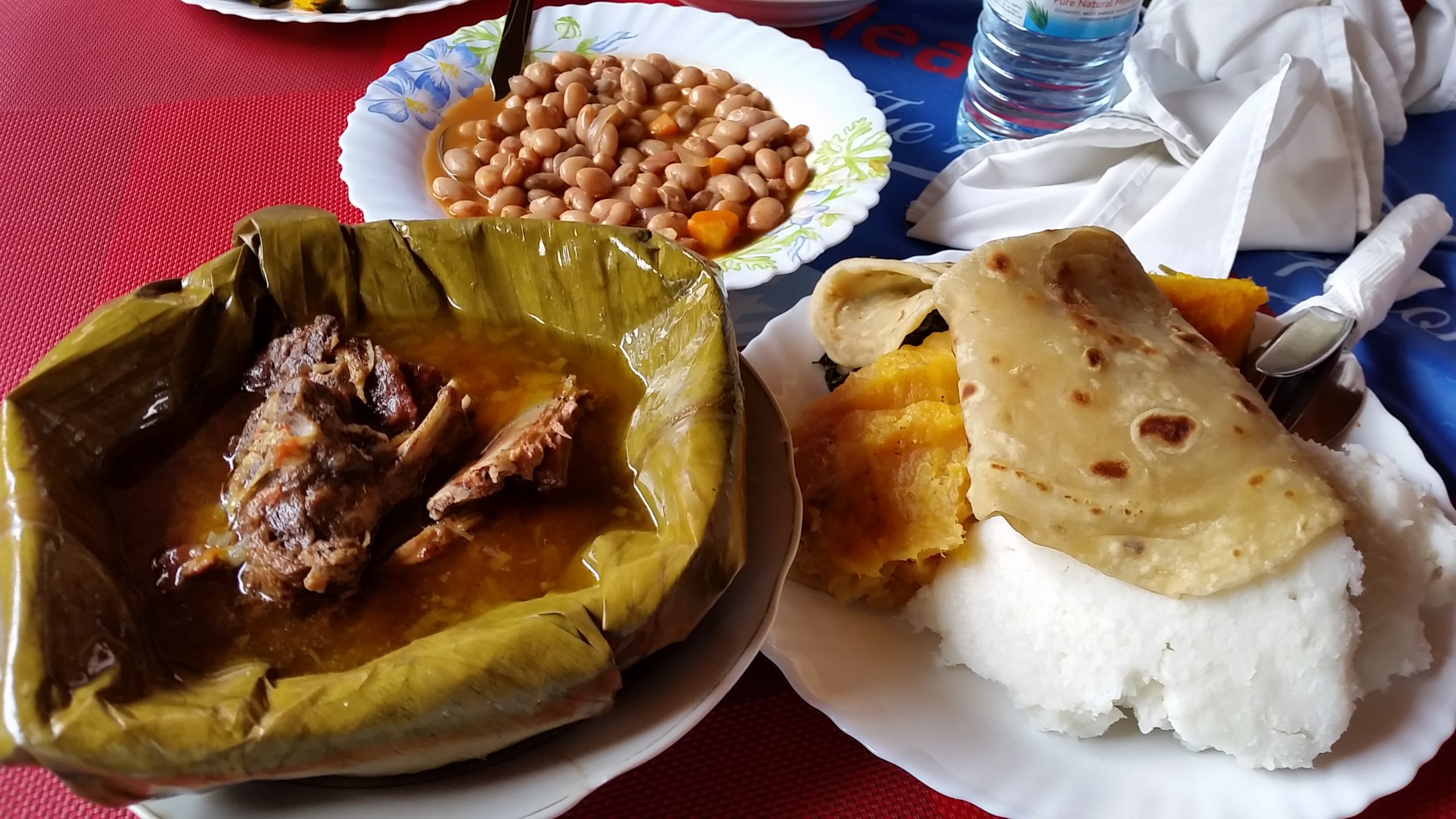
Authentic Ugandan cuisine featuring slow-cooked beef luwombo and traditional sides.
Ugandan food is an essential part of Uganda culture, reflecting the country’s agricultural heritage, regional diversity and the traditions of its many communities. Meals commonly feature locally available foods such as bananas, plantains, maize, cassava, sweet potatoes, millet, beans, groundnuts, vegetables, fish and meat. The exact combination varies considerably according to region, community, season and occasion.
Ugandan cuisine is not one single style of cooking. Instead, it is a collection of regional food traditions that have developed alongside different communities and agricultural environments. A meal in Kampala may differ from one served in western Uganda, northern Uganda, eastern Uganda or the Lake Victoria region.
For travelers, food provides one of the most accessible ways to experience everyday Uganda culture. Markets, local restaurants, community visits and cultural centers can introduce visitors to ingredients and cooking methods that are rarely experienced through conventional hotel dining.
The Importance of Food in Uganda Culture
Food in Uganda is closely connected with family, hospitality, agriculture and community life. Meals may be prepared for ordinary family occasions, celebrations, ceremonies and gatherings. Sharing food can also be an important expression of hospitality.
Traditional cooking is strongly influenced by the foods that communities can grow, harvest or obtain locally. This explains why bananas are particularly important in parts of central and western Uganda, while cassava, millet, sorghum, sweet potatoes, fish and other foods have different levels of importance across the country.
The country’s diverse food culture therefore reflects both environmental conditions and cultural history.
Matoke and the Importance of Green Bananas
Matoke, often referring to cooking bananas or plantains prepared as a staple food, is one of the foods most strongly associated with Ugandan cuisine. Green bananas can be peeled, wrapped in banana leaves and steamed until tender before being mashed or served with a sauce.
Matoke can be accompanied by beans, beef, chicken, groundnut sauce, vegetables or other sauces. Preparation methods vary between households and regions, so visitors should expect different textures and flavors depending on where the meal is served.
The prominence of bananas in Ugandan cuisine also reflects the importance of banana cultivation in several parts of the country. In many communities, bananas are not simply a restaurant ingredient but part of everyday agricultural life.
Travelers planning a cultural itinerary can combine food experiences with Uganda cultural sites and local experiences.
Posho and Maize-Based Foods
Posho, also known as ugali in many parts of East Africa, is a thick maize-based food prepared by mixing maize flour with hot water. It is commonly served with beans, meat, fish or vegetable sauces.
Posho is particularly familiar in institutional and everyday meals because maize flour is widely available. It is valued as a filling source of carbohydrates and can be combined with different sauces depending on local preferences.
The food illustrates an important characteristic of Ugandan cuisine: a relatively simple staple can become part of many different meals depending on the accompanying sauce.
Cassava, Sweet Potatoes and Other Root Crops
Cassava and sweet potatoes are important traditional foods in Uganda. They can be boiled, steamed, roasted or incorporated into other preparations. Their importance varies between communities and regions.
Cassava can also be processed into flour and used in different food preparations. Sweet potatoes are commonly eaten as a breakfast or accompanying food, while cassava can appear as a staple or snack.
Cassava
Cassava can be eaten as a staple food or processed into flour for different preparations.
Sweet Potatoes
Sweet potatoes are widely eaten in Uganda and can form part of breakfast or accompany other foods.
Groundnut Sauce in Ugandan Cooking
Groundnuts, commonly called g-nuts in Uganda, are used to prepare a thick sauce that accompanies several traditional staples. Groundnut sauce can be served with matoke, sweet potatoes, cassava, millet-based foods and other dishes.
Groundnut cooking demonstrates how locally available crops can become important components of traditional cuisine. The sauce provides a rich accompaniment to foods that may otherwise have a relatively mild flavor.
Luwombo: A Celebrated Ugandan Dish
Luwombo, also known as oluwombo, is one of the best-known dishes associated with Buganda cuisine. It is traditionally prepared by wrapping ingredients such as chicken, beef, fish or other foods in banana leaves and cooking them slowly.
The use of banana leaves is particularly important because they help contain the ingredients and contribute to the character of the cooking process. Luwombo is often associated with special occasions and traditional hospitality.
The dish is a good example of how cooking technique can be part of cultural identity. The preparation is not simply about combining ingredients; the method itself forms part of the culinary tradition.
Katogo and Everyday Breakfast Culture
Katogo is a popular Ugandan dish in which different ingredients are cooked together. Common combinations can include matoke, potatoes, meat, offal, vegetables or other locally available foods.
Katogo is often eaten for breakfast, although the dish is not restricted to one particular meal time. Its flexibility makes it a useful example of everyday Ugandan cooking, where households and restaurants can adapt meals according to available ingredients.
Visitors may encounter different versions of katogo depending on the region and establishment, making it worth asking what ingredients are included before ordering.
Rolex and Uganda’s Street Food Culture
The Rolex is one of Uganda’s most recognizable street foods. Despite its name, it has nothing to do with a wristwatch. A typical Rolex consists of an omelet wrapped inside a chapati, often with ingredients such as tomato, onion or cabbage.
Rolex is widely associated with roadside food culture and can be found in many towns and cities. It demonstrates how Ugandan food culture continues to evolve while remaining strongly connected to locally accessible ingredients.
The dish has become particularly recognizable among visitors because it is inexpensive, convenient and closely connected with everyday urban food culture.
For additional context, Kampala food and restaurant experiences provide an introduction to local cuisine alongside the city’s broader dining scene.
Muchomo and Roasted Meat
Muchomo generally refers to roasted or grilled meat and is a familiar part of Uganda’s food culture. Chicken, beef and goat are among the meats that may be prepared this way.
Muchomo can be found in informal roadside settings as well as restaurants. The preparation varies considerably, with different cooks using their own combinations of seasoning and serving styles.
Fish and the Culinary Traditions of Lake Regions
Uganda’s extensive lakes and rivers contribute fish to the country’s cuisine. Lake Victoria is particularly important for fisheries, while other lakes and water bodies support local fishing communities.
Nile perch and tilapia are among the fish commonly encountered in Uganda’s restaurants and local markets. Preparation methods can include frying, grilling or cooking fish in sauces.
Food therefore provides another connection between Uganda’s natural environment and cultural life. Fishing communities have developed food traditions around the resources available in their local environments.
Millet and Traditional Foods of Western and Northern Uganda
Millet has traditionally been important in several Ugandan communities, particularly in parts of western and northern Uganda. It can be milled into flour and used to prepare thick staple foods and beverages.
In some communities, millet-based foods are associated with ceremonies and special occasions as well as ordinary meals. The precise preparation and terminology differ between cultural groups.
This regional variation illustrates why Uganda cuisine should be explored through specific communities rather than presented as a single uniform national menu.
Eshabwe and Ankole Food Traditions
Eshabwe is a traditional sauce associated particularly with Banyankole food culture in western Uganda. It is traditionally prepared from ghee and other ingredients and is commonly associated with ceremonial and special meals.
The dish provides an example of how pastoral traditions have influenced food culture. Dairy products and ghee have an important historical relationship with communities whose livelihoods have included cattle keeping.
Ebbwanga and Local Cuisine in Kasese
Regional food traditions become especially visible outside Uganda’s major cities. At the Kiwa Heritage Site in Kasese, for example, local cuisine forms part of the cultural experience, with foods including Ebbwanga and Amatsayidongo identified among the local dishes served there.
Ebbwanga is described by the site as a bread-like preparation made from bananas and cassava, while Amatsayidongo is prepared from fresh maize. Such dishes demonstrate the importance of locally available crops in regional food traditions.
Visitors exploring western Uganda can therefore encounter culinary traditions that differ from the better-known Kampala dishes. Kiwa Heritage Site cuisine offers one example of this regional diversity.
Nsenene and Seasonal Food Traditions
Nsenene, the Luganda term commonly used for edible grasshoppers, is a seasonal food enjoyed in parts of Uganda. The insects are commonly fried and may be seasoned with ingredients such as onions.
Their availability is strongly influenced by season and weather conditions, which makes nsenene a good example of the relationship between food culture and the natural environment.
Travelers should approach unfamiliar foods with curiosity while also considering personal dietary needs and any food-safety advice provided by reputable guides or establishments.
Traditional Vegetables and Local Sauces
Vegetables are important components of many Ugandan meals. Leafy greens and other locally available vegetables can be cooked into sauces and served alongside staples such as matoke, posho, cassava, sweet potatoes or millet-based foods.
Local sauces can vary widely between households. Groundnuts, dairy products, meat, fish and vegetables may all form the basis of different accompaniments.
This combination of staple foods and sauces makes Ugandan cuisine adaptable and allows communities to use ingredients according to local agriculture and seasonal availability.
Traditional Cooking Methods
Traditional Ugandan cooking includes steaming, boiling, roasting, grilling and slow cooking. Banana leaves are particularly useful in some preparations because they can be used to wrap food during steaming or cooking.
Cooking over charcoal or fire remains familiar in many settings, while modern kitchens increasingly use gas and electric appliances. The coexistence of traditional techniques and modern equipment is typical of contemporary Ugandan food culture.
Cooking methods can also influence the final texture and aroma of food. Steaming food in leaves, for example, creates a very different result from frying or roasting the same ingredient.
Cooking with Banana Leaves
Banana leaves are used in several Ugandan food traditions. They can serve as wrappers during steaming, containers for serving food or practical materials around the cooking area.
Their use demonstrates the close relationship between agriculture and cooking. A crop can provide not only food but also useful materials for preparing and presenting meals.
Food Preparation as a Community Activity
Traditional cooking can involve several people working together. Preparing large quantities of food for celebrations, weddings or community gatherings may require washing, peeling, grinding, chopping, cooking and serving food as a coordinated activity.
This social dimension is important because food culture is not only about recipes. It also includes who prepares the food, when it is prepared, how it is served and who shares it.
Food and Hospitality in Ugandan Homes
Hospitality is an important part of social life in Uganda, and offering food or drinks to a guest can be an important gesture of welcome. Visitors who are invited to share a meal should approach the experience respectfully and follow the host’s guidance.
Meals shared with local families can offer a different perspective from eating in a hotel or restaurant because guests may see how ingredients are selected, prepared and served in an everyday household environment.
Travelers should always communicate dietary restrictions or allergies clearly before eating unfamiliar foods.
Ugandan Markets and the Food Experience
Markets provide an excellent introduction to the ingredients behind Ugandan cuisine. Fresh bananas, vegetables, fruits, cassava, sweet potatoes, groundnuts, fish and other foods can be seen in different markets around the country.
Nakasero Market in Kampala is one example of an important urban market where visitors can observe the movement of fresh produce and other goods. Markets can help travelers understand that Ugandan cuisine begins with agriculture and food supply long before ingredients reach a restaurant kitchen.
The Kampala city experience can be combined with a market visit to explore food as part of everyday urban culture.
Food at Ndere Cultural Centre
Cultural institutions can combine performing arts with food to create a broader cultural experience. Ndere Cultural Centre in Kampala is one example, with cultural performances accompanied by opportunities to experience traditional Ugandan dishes.
This combination is valuable because food and performing arts are closely connected to cultural identity. Visitors can experience music, dance, storytelling and cuisine within the same cultural environment.
The Ndere Cultural Centre experience is therefore relevant to travelers who want to explore both Ugandan performing arts and local food traditions.
Food and Regional Diversity
One of the most important things to understand about Ugandan cuisine is its regional diversity. Food traditions in Buganda are not identical to those in Ankole, Bunyoro, Busoga, Acholi, Kigezi, Teso or other cultural regions.
Even dishes with similar names can have different ingredients or preparation methods depending on the community. Visitors should therefore ask local guides or hosts about the history of a dish instead of assuming that one preparation represents the whole country.
This regional approach makes a Uganda food tour particularly rewarding because every destination can add another layer to the country’s culinary story.
Indian, Arab and Other Culinary Influences
Modern Ugandan cuisine has also been influenced by interactions with other communities and international culinary traditions. Indian, Arab, British and other influences can be seen particularly in urban areas.
Chapati is a particularly visible example of a food that has become deeply integrated into everyday Ugandan food culture despite its wider South Asian origins. The Ugandan Rolex developed from combining chapati with eggs and other ingredients to create a distinctive local street food.
This illustrates how food cultures evolve. Dishes can travel between communities and countries and eventually become part of a new local culinary identity.
Coffee and Uganda’s Food and Agricultural Heritage
Coffee is one of Uganda’s major agricultural products and is an important part of the country’s economic and cultural landscape. Coffee-growing regions provide opportunities for visitors to learn about cultivation, processing and preparation.
Coffee experiences can complement traditional food experiences because they demonstrate the connection between Ugandan agriculture and what reaches the table. In some destinations, visitors can meet farmers and learn how coffee moves from the plant to the finished drink.
The Sipi Falls and coffee-growing experience is one example of how agricultural tourism can be combined with broader cultural exploration.
Food as Part of a Uganda Cultural Tour
A strong Uganda cultural itinerary should not treat food as an afterthought. Meals can be incorporated into market visits, village experiences, cultural performances, cooking demonstrations, agricultural tours and community encounters.
Travelers can learn about ingredients before tasting them, observe traditional preparation techniques and then share a meal with local hosts. This creates a deeper connection between food and the people who produce and prepare it.
A food-focused experience can also complement wildlife travel. After spending time in a national park, travelers may appreciate learning how nearby communities grow crops, prepare meals and maintain culinary traditions.
How Visitors Can Experience Ugandan Cuisine Respectfully
Visitors should approach local cuisine with curiosity and respect. Asking what a dish contains, learning its local name and listening to the person preparing it can make the experience more meaningful.
When visiting a household or community, travelers should follow the host’s guidance regarding meal etiquette. In restaurants and food stalls, normal hygiene precautions and attention to food preparation are sensible.
Most importantly, travelers should avoid judging unfamiliar foods according to their own culinary traditions. A dish may have cultural significance that goes far beyond its ingredients.
The Future of Traditional Ugandan Food
Traditional Ugandan cuisine continues to change as lifestyles, agriculture, urbanization and international influences evolve. Modern restaurants may reinterpret traditional dishes, while families continue to prepare familiar staples at home.
Cultural centers, tourism businesses, food producers and local communities can all contribute to preserving traditional cooking knowledge. Documenting recipes, teaching younger generations and creating responsible culinary tourism experiences can help keep regional food traditions visible.
At the same time, preservation does not mean that cuisine must remain unchanged. Food traditions naturally evolve, and contemporary Ugandan cooking continues to incorporate new ingredients and techniques.
Why Ugandan Food Belongs in a Complete Culture Guide
Ugandan food provides a direct connection between agriculture, family life, regional identity and hospitality. Matoke, posho, cassava, sweet potatoes, groundnut sauces, luwombo, katogo, Rolex, muchomo, fish and many other foods demonstrate the variety of ingredients and cooking traditions found across the country.
The strongest Uganda food experiences go beyond simply listing dishes. They explain where foods come from, who prepares them, how cooking methods developed and why particular meals matter to different communities.
For travelers, tasting local cuisine can therefore become one of the most memorable parts of a Uganda cultural journey. A meal shared with local people can reveal aspects of Uganda culture that cannot be learned from sightseeing alone.
Ugandan cuisine is diverse, regional and deeply connected to agriculture and cultural identity. Traditional staples such as matoke, posho, cassava, sweet potatoes and millet are combined with sauces, vegetables, meat and fish in many different ways. Dishes such as luwombo, katogo, Rolex, muchomo and regional specialties demonstrate how Ugandan food continues to evolve while retaining strong connections to traditional cooking and community life.
Traditional Clothing, Crafts, Art and Cultural Symbols in Uganda
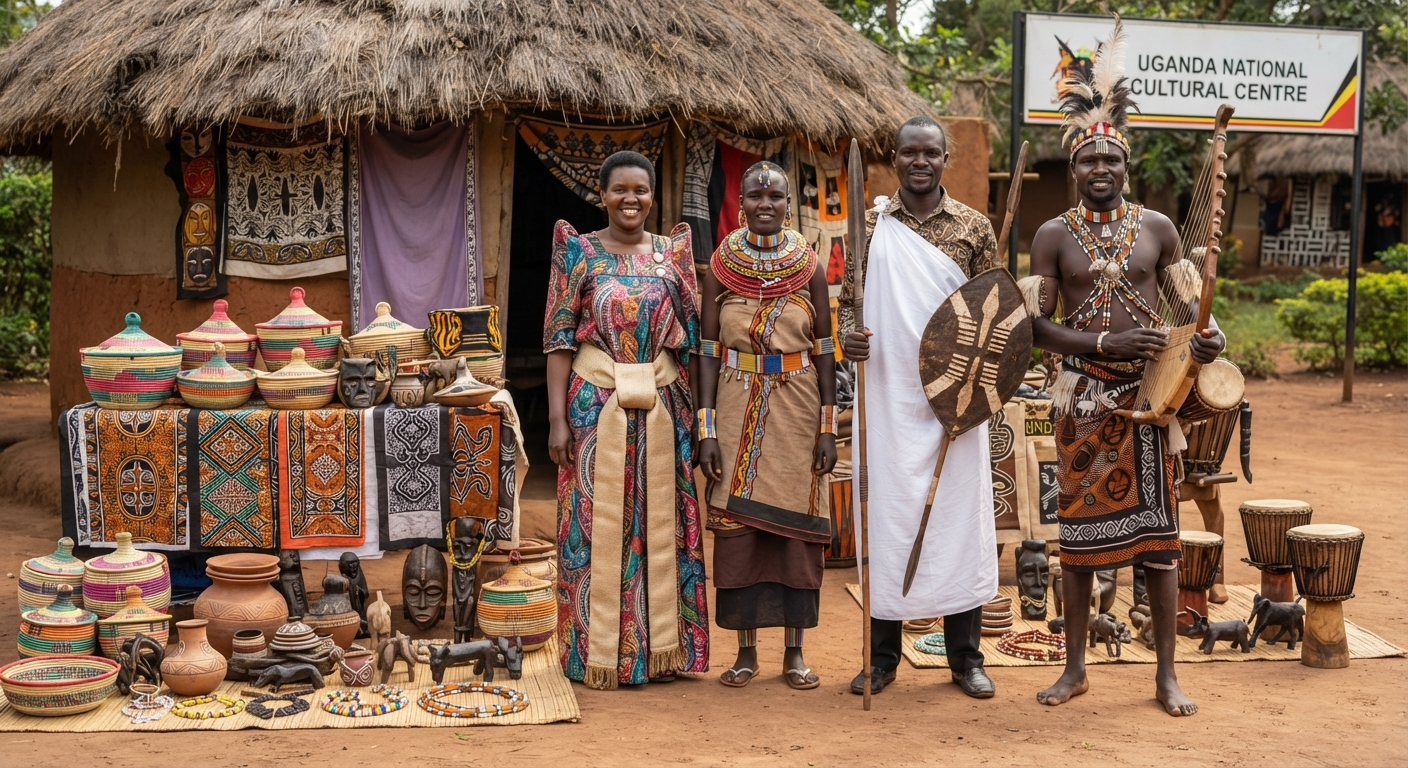
A vibrant showcase of Uganda’s rich traditional clothing and arts.
Traditional clothing, crafts, art and cultural symbols are important expressions of Uganda culture. They communicate identity, history, social status, community belonging, artistic creativity and connections between people and their environment. Across Uganda, different communities have developed their own approaches to clothing, weaving, pottery, carving, beadwork, bark cloth, musical instruments and decorative arts.
There is no single style that can accurately be described as traditional Ugandan clothing or traditional Ugandan art. Uganda has more than 50 indigenous ethnic groups, and cultural practices vary considerably between communities and regions. A cultural guide should therefore present Ugandan traditional clothing and crafts as a diverse collection of traditions rather than as one uniform national style.
For travelers, these traditions provide a practical way to understand Uganda beyond its landscapes and wildlife. A visit to a cultural center, museum, artisan workshop or craft market can reveal how materials are transformed into objects that have practical, artistic or cultural significance.
Traditional Clothing as an Expression of Cultural Identity
Clothing in Uganda has historically reflected community identity, environment, available materials, social circumstances and occasions. Traditional dress may be especially visible during cultural ceremonies, royal events, weddings, performances and other important gatherings.
Contemporary Ugandans commonly combine modern clothing with fabrics, colors, accessories and designs associated with African fashion. Consequently, traditional clothing should not be understood as something that exists only in the past. Cultural garments and fabrics continue to appear in celebrations, performances and contemporary fashion.
The exact appearance of traditional dress varies among Uganda’s communities. Travelers should avoid assuming that clothing worn by one cultural group represents every Ugandan community.
Buganda Traditional Clothing and the Gomesi
The gomesi is one of the most recognizable garments associated with Buganda and is widely worn by women in Uganda, particularly for formal and cultural occasions. It is a long dress characterized by its distinctive shape, sleeves, neckline and sash.
The gomesi has become an important part of formal Ugandan fashion while retaining a strong connection with Buganda cultural identity. It can be made from different fabrics and may be decorated in ways appropriate for particular occasions.
The kanzu is another important garment in Ugandan cultural life, particularly among men in central Uganda and in Muslim communities. It is commonly worn during formal, religious and cultural occasions.
Travelers interested in the historical background of Buganda can combine clothing experiences with Uganda cultural heritage sites.
Bark Cloth and Its Cultural Importance
Bark cloth is one of Uganda’s most distinctive traditional materials. It is produced from the inner bark of the mutuba tree, scientifically associated with Ficus natalensis. The traditional production of bark cloth is particularly associated with the Baganda people.
The process involves harvesting bark from suitable trees and repeatedly removing bark in a manner that allows the tree to continue producing new bark. The harvested material is beaten and processed into sheets of cloth.
Historically, bark cloth had important uses in Buganda society, including clothing and ceremonial contexts. Contemporary artisans also transform bark cloth into decorative and practical products such as wall hangings, bags, mats and other craft items.
Modern visitors can also find Ugandan handmade souvenirs and crafts that incorporate bark cloth and other locally produced materials.
Woven Baskets and the Art of Weaving
Basket weaving is practiced in different parts of Uganda using locally available grasses, reeds, fibers and other plant materials. The techniques and patterns vary according to the artisan and community.
Woven baskets can have both practical and decorative functions. They may be used for storage, carrying goods, serving food or decorating homes. Some are also produced specifically for the tourism and gift market.
The patterns found on baskets can demonstrate the skill and creativity of individual artisans. However, not every geometric pattern should automatically be interpreted as a specific cultural symbol; meanings can vary and should be confirmed with the artisan or community concerned.
Basket Patterns
Patterns, shapes and colors can demonstrate the creativity of individual weavers and may vary between regions and makers.
Basket Uses
Baskets can serve practical, decorative and commercial purposes while supporting the livelihoods of local artisans.
Beadwork and Handmade Jewelry
Beadwork is another visible component of Ugandan craft traditions. Artisans create necklaces, bracelets, earrings and other decorative pieces using beads, seeds, recycled paper, metal and other materials.
Paper-bead jewelry has become particularly associated with community-based craft enterprises and women’s groups in Uganda. Making beads from recycled paper can combine artistic creativity with income-generating activities.
Jewelry can also be part of contemporary Ugandan fashion. The use of locally inspired colors and patterns allows artisans to connect traditional aesthetics with modern consumer preferences.
Wood Carving and Sculpture
Wood carving is an important craft tradition in Uganda. Artisans create sculptures, masks, figurines, walking sticks, furniture, decorative objects and other products from wood.
Contemporary tourist markets frequently feature carvings depicting animals such as elephants, gorillas, lions and birds. Other pieces depict people, musicians, dancers and scenes inspired by African cultural life.
Visitors should distinguish between commercially produced souvenirs and objects made for specific cultural or ceremonial purposes. An artisan or cultural guide can explain the intended use and meaning of a particular object.
Visitors looking for locally made objects can explore Uganda craft markets and cultural attractions as part of a wider cultural itinerary.
Pottery and Traditional Ceramics
Pottery has a long history in Uganda and has traditionally served both practical and cultural purposes. Clay can be shaped into cooking vessels, storage containers, water pots and other objects.
Traditional pottery techniques can include preparing clay, shaping vessels by hand, drying them and firing them. The precise techniques differ among communities and individual potters.
Pottery also provides an opportunity to understand the relationship between local natural resources and traditional technology. Clay from the surrounding environment can become a useful household object through skilled craftsmanship.
Traditional Drums as Art and Cultural Objects
Drums occupy an important place in many Ugandan musical and ceremonial traditions. Different communities use different drums and playing techniques, and the instruments can vary in shape, size and construction.
Drums are therefore more than musical instruments. Their construction, decoration and use can form part of broader cultural traditions associated with ceremonies, dance, communication and entertainment.
At cultural performances, visitors may see traditional drums being played alongside xylophones, flutes, string instruments and other instruments associated with different communities.
Traditional Musical Instruments as Cultural Symbols
Uganda’s musical instruments also form part of its visual cultural heritage. Instruments such as the amadinda xylophone, adungu harp and different forms of drums are associated with particular musical traditions and communities.
The instruments are often constructed from natural materials, including wood, animal skins and plant materials. Their construction demonstrates knowledge of local resources as well as specialized craftsmanship.
Cultural performances provide one of the easiest ways for visitors to see these instruments in context rather than simply as museum objects.
Traditional Regalia and Royal Symbols
Uganda’s traditional kingdoms have their own histories of royal regalia and symbols. Items associated with kingship can include clothing, drums, spears, shields, stools, staffs and other objects whose significance is connected to particular institutions and histories.
These objects should not be treated simply as decorative souvenirs. Some have institutional, historical or ceremonial significance and are best understood through museums, royal institutions and knowledgeable cultural guides.
The diversity of royal traditions also reinforces an important point about Uganda culture: different kingdoms and communities have their own histories, symbols and cultural institutions.
Cultural Symbols and the Importance of Context
Cultural symbols can communicate ideas about identity, ancestry, authority, spirituality, community and social relationships. However, their meanings are not always universal.
A particular animal, color, object or pattern may have one meaning in one community and a different significance elsewhere. Responsible cultural interpretation therefore requires context rather than assigning a fixed meaning to every traditional design.
This is particularly important for travelers purchasing crafts. An artisan may be able to explain whether an object is a traditional design, a contemporary creation or a product made primarily for the tourist market.
Ankole Cultural Identity, Cow Horns and Decorative Arts
Cattle have a particularly strong historical and cultural association with Banyankole communities in southwestern Uganda. The long horns of Ankole cattle are visually distinctive and have become recognizable symbols associated with the region.
Cow horn can also be incorporated into contemporary craft products. Artisans may create decorative objects and accessories from horn, although visitors should purchase responsibly and ask about the origin and legality of animal-derived materials.
The broader Ankole cultural landscape can be explored through institutions such as the Igongo Cultural Centre, where visitors can learn about Banyankole history, household objects, agricultural practices and cultural traditions.
The museums and cultural centers of Uganda provide useful settings for understanding regional traditions and historical objects.
Kigezi Traditional Clothing and Cultural Heritage
Southwestern Uganda has its own distinctive cultural history. The Kabale Regional Museum provides an opportunity to explore traditions and history associated with the Kigezi region, including displays relating to traditional clothing, agricultural tools and historical photographs.
Such museum collections are valuable because they place traditional clothing and objects within their historical context. Instead of viewing a garment simply as an attractive item, visitors can learn about the community that used it and the environment in which the tradition developed.
Traditional Crafts at Cultural Centers
Cultural centers provide an important bridge between traditional arts and contemporary tourism. At Ndere Cultural Centre in Kampala, for example, local artists and artisans can demonstrate cultural skills while visitors encounter music, dance, crafts and other forms of heritage in one setting.
Cultural centers can also create economic opportunities for artisans. Purchasing an authentic handmade item directly from an artisan or responsible craft organization can help support the continuation of craft skills.
A visit to Ndere Cultural Centre can therefore complement a broader Uganda cultural itinerary by bringing traditional art, performance and craftsmanship together.
Batwa Cultural Arts and Forest Heritage
The Batwa communities of southwestern Uganda have distinctive cultural traditions connected historically with the forests of the Albertine Rift. Their cultural heritage includes music, storytelling, craft knowledge and traditions associated with forest life.
Cultural experiences involving Batwa communities should be approached with respect and should recognize that these are living communities rather than museum exhibits. Responsible tourism should prioritize community participation, dignity and meaningful economic benefit.
Travelers exploring southwestern Uganda can learn more through the Batwa cultural experience, where cultural heritage is presented through community-based experiences.
Craft Markets and the Contemporary Souvenir Industry
Uganda’s craft markets bring together traditional techniques and contemporary designs. Visitors can find woven baskets, wood carvings, jewelry, textiles, bags, pottery and decorative objects.
Buganda Road Craft Village in Kampala is one example of a place where visitors can meet artisans and purchase handmade products. Craft markets can provide direct income to artisans while giving travelers opportunities to take home locally produced objects.
The tourism market has also influenced what artisans produce. Some objects are designed specifically for visitors, meaning that not everything sold in a craft market should automatically be described as an ancient or purely traditional artifact.
How to Buy Ugandan Crafts Responsibly
Buying locally made crafts can be a positive way to support artisans, but travelers should make informed choices. Asking who made an item, what materials were used and where the product came from can help distinguish locally produced crafts from mass-produced imports.
Travelers should also be cautious about purchasing products made from wildlife parts or materials whose legal origin is unclear. Supporting crafts based on sustainable and legally obtained materials is a more responsible approach.
When purchasing handmade products, reasonable negotiation may be part of the market experience, but visitors should remember that extremely low prices can reduce the income received by the person who made the item.
Traditional Art in Modern Uganda
Ugandan artists increasingly combine traditional themes with contemporary painting, sculpture, fashion, photography and mixed-media art. This means that cultural expression is not limited to historical objects.
Contemporary artists may draw inspiration from traditional clothing, music, wildlife, landscapes, family life, spirituality and community history. Their work demonstrates how cultural identity can remain relevant while artistic methods change.
Kampala and other urban centers provide spaces where contemporary artists and traditional artisans can interact with local and international audiences.
Traditional Clothing, Crafts and Cultural Tourism
Cultural tourism can help preserve traditional skills when communities and artisans are meaningfully involved in tourism activities. Demonstrations, workshops, cultural performances, museums and responsible craft markets can create opportunities for visitors to learn while supporting local livelihoods.
A good cultural experience should explain the story behind an object rather than simply present it as something to buy. Visitors gain more when they understand the materials, techniques, history and community connected to a craft.
This approach transforms a souvenir into a cultural learning experience. A basket, piece of bark cloth, carved figure or item of jewelry can become a reminder of a particular artisan, community or cultural encounter.
Preserving Uganda’s Traditional Arts and Crafts
Traditional craftsmanship faces the same pressures experienced by many forms of intangible cultural heritage. Younger generations may have access to alternative employment, imported products can compete with handmade goods, and some traditional techniques require considerable time to master.
Cultural institutions, museums, community organizations, artisans and responsible tourism operators can contribute to preservation by documenting techniques, creating markets for handmade products and encouraging younger people to learn traditional skills.
Visitors can contribute by purchasing authentic locally made products, attending legitimate cultural experiences and treating cultural objects and traditions with respect.
Why Traditional Clothing and Crafts Matter to Uganda Culture
Traditional clothing, crafts, art and cultural symbols provide a visual record of Uganda’s diversity. Clothing communicates identity and occasion; baskets demonstrate weaving skills; bark cloth preserves an important material tradition; pottery reflects knowledge of local resources; jewelry demonstrates artistic creativity; and musical instruments connect craftsmanship with performance.
These traditions also show that culture is not static. Ugandan artisans continue to adapt traditional techniques to modern markets, contemporary fashion and changing lifestyles while maintaining connections with older forms of knowledge.
For anyone creating a comprehensive Uganda Culture Guide, traditional clothing and crafts deserve more than a short list of souvenirs. They are part of the country’s living cultural heritage and provide travelers with opportunities to meet artisans, understand communities and appreciate the creativity behind everyday and ceremonial objects.
Uganda’s traditional clothing, crafts, art and cultural symbols reflect the country’s exceptional cultural diversity. From the gomesi and kanzu to bark cloth, woven baskets, beadwork, pottery, wood carving, drums and royal regalia, these traditions connect material culture with identity, history and community life. The most meaningful way to experience them is through cultural institutions, museums, artisan workshops and responsible community-based tourism where local people can explain the significance of their own heritage.
Uganda’s Cultural and Historical Attractions
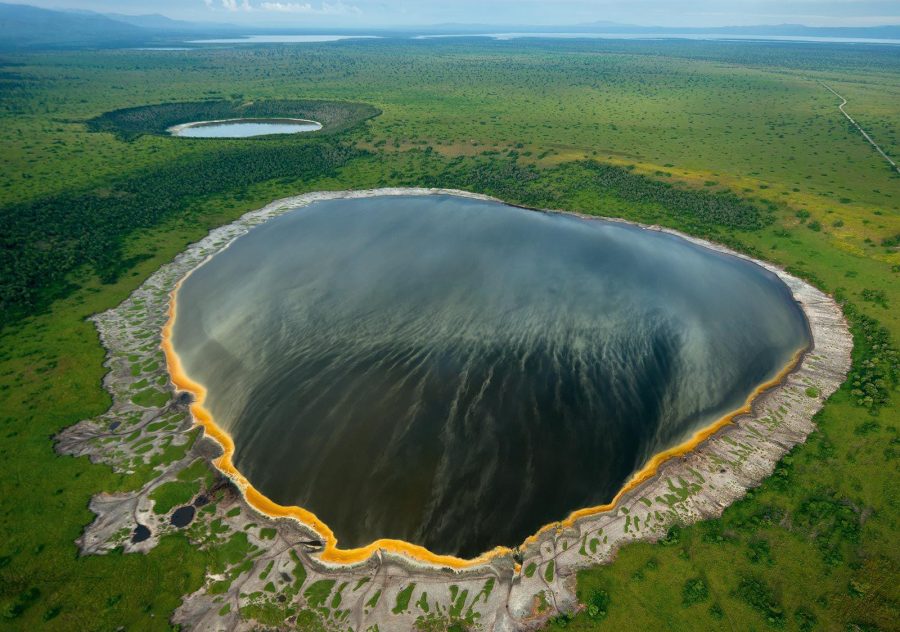
The dramatic volcanic crater lakes of western Uganda.
Uganda’s cultural and historical attractions offer a different way to understand the country beyond its national parks, lakes and wildlife. From royal tombs and ancient archaeological landscapes to museums, religious heritage sites, cultural centers and traditional kingdoms, these places reveal the people, events, beliefs and institutions that have shaped Uganda over generations.
A well-planned Uganda culture guide should therefore include time for cultural and historical attractions. The country has a particularly diverse heritage, with different communities maintaining their own languages, traditions, artistic practices, histories and institutions. Visiting these places allows travelers to connect the cultural experiences described throughout this guide with physical locations where that heritage is preserved and interpreted.
Among the most important sites are the Kasubi Tombs in Kampala, the Uganda National Museum, the Uganda Martyrs sites at Namugongo, royal and cultural institutions associated with kingdoms such as Buganda, Bunyoro and Tooro, regional museums, archaeological sites and community-based cultural attractions.
Kasubi Royal Tombs: A Major Symbol of Buganda Heritage
The Tombs of Buganda Kings at Kasubi are among Uganda’s most important cultural heritage sites. Located on Kasubi Hill in Kampala, the site contains the royal burial grounds of four Buganda kings, known as Kabakas. UNESCO recognizes the site for both its architectural importance and its continuing spiritual and cultural significance to the Baganda.
The principal structure, Muzibu Azaala Mpanga, is a remarkable example of traditional Ganda architecture using organic materials including wood, thatch, reed, wattle and daub. UNESCO describes the site as a major spiritual center where traditional and cultural practices have been preserved.
Kasubi was inscribed on the UNESCO World Heritage List in 2001. The site is especially valuable for travelers interested in understanding the history of the Buganda Kingdom because its significance goes beyond the physical buildings. It represents continuity, identity, spirituality and living cultural traditions.
The cultural sites to visit in Uganda guide provides additional context for travelers planning a cultural itinerary.
Uganda National Museum and the Country’s Heritage Collections
The Uganda National Museum in Kampala is an important starting point for understanding the country’s cultural and historical heritage. Established in 1908, it is widely recognized as Uganda’s oldest museum and holds collections relating to ethnography, archaeology, traditional life, music and natural history.
Museum collections can help visitors understand how Ugandan communities lived, worked, traveled, communicated and expressed themselves. Traditional musical instruments, household objects, tools, archaeological materials and other cultural objects provide a physical connection to periods of Uganda’s history that cannot always be understood through modern landscapes alone.
The current Uganda Museums website states that the Uganda National Museum is temporarily closed for renovations. Visitors should therefore confirm its current operating status before including it in an itinerary.
For additional planning information, travelers can consult the museums in Uganda guide.
Namugongo and Uganda’s Martyrs Heritage
Namugongo is one of Uganda’s most significant religious and historical destinations. The Uganda Martyrs sites commemorate Christians who were killed during the reign of Kabaka Mwanga II in the late nineteenth century. The history of the martyrs has become an important part of Uganda’s religious heritage and continues to attract pilgrims from Uganda and other countries.
Namugongo contains both Catholic and Anglican martyr heritage sites. The Catholic shrine is particularly prominent during Uganda Martyrs Day on June 3, when large numbers of pilgrims gather for religious commemorations.
The site is important not only for religious visitors. It also provides insight into the interaction between traditional Buganda political authority, Christianity and the social changes taking place in nineteenth-century Uganda.
Catholic Martyrs Shrine
The Catholic shrine commemorates the Catholic martyrs and forms an important pilgrimage and historical site at Namugongo.
Anglican Martyrs Heritage
The Anglican martyr site and associated museum preserve another important part of Uganda’s nineteenth-century religious history.
Visitors interested in this history can explore the Uganda Martyrs Trail and Namugongo as part of a wider historical itinerary.
Kabaka’s Palace and the Buganda Kingdom Heritage
The Buganda Kingdom has played a major role in the history of central Uganda, and Kampala contains several places associated with its royal and political heritage. The Kabaka’s Palace, commonly known as Lubiri, is one of the important landmarks associated with Buganda’s modern history.
Nearby Buganda institutions, including the kingdom’s administrative structures, provide additional context for understanding how the kingdom developed and how traditional institutions continue to function in contemporary Uganda.
Travelers should approach royal sites respectfully because they remain connected to living cultural institutions rather than being treated simply as historical monuments.
Uganda’s Traditional Kingdoms as Living Heritage
Uganda’s cultural heritage includes several traditional kingdoms and institutions. Buganda, Bunyoro-Kitara, Tooro and Busoga, among others, have distinct histories and cultural traditions. These institutions provide an important framework for understanding the country’s regional diversity.
Kingdom heritage can include royal regalia, traditional leadership structures, oral histories, music, dance, ceremonies, architectural traditions and collections of historical objects. These traditions should be understood as living heritage because cultural institutions continue to preserve and interpret them.
A cultural tour that visits more than one region can therefore reveal significant differences between communities rather than presenting Uganda culture as a single uniform tradition.
Bunyoro-Kitara Cultural Heritage in Western Uganda
The Bunyoro-Kitara Kingdom has a long and important history in western Uganda. Cultural sites associated with the kingdom provide opportunities to learn about royal traditions, historical leadership, traditional objects and the cultural identity of the Banyoro people.
Cultural collections may include objects such as bark cloth, spears, royal headwear and musical instruments. Visitors interested in the kingdom’s heritage should use knowledgeable local guides or official cultural institutions to understand the meaning and history of the objects displayed.
The Bunyoro region is especially useful for travelers who want to extend a cultural itinerary beyond Kampala and explore the historical landscapes of western Uganda.
Tooro Kingdom and Cultural Heritage in Fort Portal
The Tooro Kingdom is centered around Fort Portal in western Uganda. The region has a distinctive cultural identity and offers travelers opportunities to learn about the history and traditions of the Batooro people.
Cultural experiences in the Fort Portal area can be combined with visits to nearby natural attractions, making the region suitable for itineraries that bring together cultural heritage, landscapes and community experiences.
The most useful cultural experiences are those where local guides explain the history and significance of the traditions rather than simply presenting cultural objects without context.
Igongo Cultural Centre and Ankole Heritage
Igongo Cultural Centre near Mbarara provides an opportunity to explore aspects of Ankole cultural heritage. Its museum and cultural displays help visitors understand traditions associated with southwestern Uganda and the Banyankole.
The center is particularly useful for travelers who want to learn about traditional livelihoods, cattle culture, household objects, food and other aspects of community life in the Ankole region.
Cultural centers such as Igongo are valuable because they combine interpretation with direct exposure to regional heritage, making them useful additions to a broader Uganda cultural tour experience.
Kabale Regional Museum and Kigezi Heritage
Kabale Regional Museum provides a window into the history and traditions of the Kigezi region in southwestern Uganda. The museum has been described as a place where visitors can explore the relationship between people, their environment and traditional livelihoods.
Collections and displays can include traditional clothing, agricultural tools, historical photographs and information relating to the region’s natural and cultural heritage.
For travelers visiting Kabale, the museum can complement experiences around Lake Bunyonyi, Bwindi and other southwestern destinations by adding historical and cultural context to the journey.
Ndere Cultural Centre in Kampala
Ndere Cultural Centre is one of Kampala’s prominent venues for experiencing Ugandan music, dance and cultural performance. It presents traditions from different parts of Uganda and provides visitors with an accessible introduction to the country’s performing arts.
Although a cultural performance is different from visiting a historical monument, Ndere is valuable within a Uganda culture guide because it demonstrates how cultural traditions continue to be performed and interpreted in contemporary Uganda.
The Ndere Cultural Centre experience can be combined with museums, historical landmarks and other Kampala attractions.
Batwa Cultural Heritage in Southwestern Uganda
Southwestern Uganda is also home to cultural experiences connected with Batwa heritage. The Batwa have a long history associated with the forests of the Albertine Rift, and community-based experiences can introduce visitors to aspects of their traditional knowledge, music, storytelling and relationship with the forest environment.
These experiences should be approached as encounters with living communities rather than staged historical displays. Responsible tourism should respect community dignity and support local participation and economic benefit.
The Batwa cultural experience can be included alongside other southwestern Uganda cultural and natural attractions.
Nyero Rock Art and Uganda’s Archaeological Heritage
Uganda’s historical heritage extends far beyond kingdoms and more recent monuments. The Nyero rock art sites in eastern Uganda represent an important part of the country’s archaeological heritage. The sites contain geometric rock paintings associated with ancient hunter-gatherer traditions.
UNESCO lists Nyero and other hunter-gatherer geometric rock art sites in eastern Uganda on the country’s Tentative List for World Heritage consideration. This reflects the wider importance of Uganda’s archaeological landscapes.
Visiting archaeological sites requires particular care. Rock art should never be touched, altered or damaged, and visitors should follow local conservation instructions.
Bigo bya Mugenyi and Ancient Earthworks
Bigo bya Mugenyi is another important archaeological site in Uganda. It is recognized on Uganda’s UNESCO Tentative List and is associated with extensive archaeological earthworks in the western part of the country.
Archaeological landscapes such as Bigo bya Mugenyi demonstrate that Uganda’s history extends much further back than the colonial period or the modern political history of the country.
These sites are particularly valuable for travelers interested in archaeology, early settlement patterns and the long-term development of communities in the Great Lakes region.
Uganda’s Religious Heritage Sites
Religious buildings and pilgrimage sites form another important part of Uganda’s historical landscape. Churches, mosques and shrines provide evidence of the development of Christianity and Islam alongside older African religious and cultural traditions.
In Kampala, sites such as Namirembe Cathedral, Rubaga Cathedral and the Uganda National Mosque are important architectural and religious landmarks. Their histories also connect with wider stories about missionary activity, political change, urban development and the growth of different faith communities.
Religious sites should be visited respectfully. Travelers may need to observe appropriate dress, photography restrictions, prayer times and other visitor guidelines.
Uganda’s Historical Attractions and Colonial-Era Heritage
Uganda’s modern history was also shaped by the arrival of European colonial administration, missionaries, traders and the construction of infrastructure such as the railway. Historic buildings, railway heritage and older urban districts can therefore provide another layer of historical interpretation.
Understanding this period is important because contemporary Uganda developed through interactions between pre-existing African kingdoms and communities, colonial institutions, missionary organizations, economic changes and later nationalist movements.
Historical attractions are most meaningful when they are presented within this wider context rather than isolated as individual monuments.
Cultural and Historical Attractions in Kampala
Kampala is the easiest place to begin exploring Uganda’s cultural and historical attractions because several major sites are located within or around the capital. A carefully planned city itinerary can combine royal heritage, museums, religious landmarks, cultural performances and local markets.
Royal Heritage
Kasubi Tombs and other Buganda heritage sites provide insight into the history and continuing cultural importance of the Buganda Kingdom.
Museum Heritage
Museum collections help visitors understand Uganda’s archaeology, ethnography, traditional technologies and changing society.
Religious Heritage
Namugongo and Kampala’s historic religious landmarks reveal important chapters in Uganda’s religious and social history.
How to Experience Uganda’s Cultural and Historical Attractions
The best way to experience Uganda’s cultural and historical attractions is to allow enough time for interpretation. A monument can be visually impressive, but a knowledgeable guide can explain who built it, why it matters, how it has changed and what it means to the community today.
Travelers should also distinguish between historical monuments, museums, religious sites, cultural centers and living cultural institutions. Each offers a different type of experience, and combining several categories creates a more complete understanding of Uganda culture.
Photography should always follow the rules of the site. Some sacred spaces, ceremonies, museum objects and cultural activities may have restrictions, and visitors should ask before taking photographs of people or sensitive cultural objects.
Best Cultural and Historical Attractions to Include in a Uganda Itinerary
A short Kampala itinerary can focus on the Kasubi Tombs, Uganda National Museum, religious heritage sites and Ndere Cultural Centre. Travelers with more time can extend the journey toward Mbarara and Ankole, Fort Portal and Tooro, Hoima and Bunyoro, Kabale and Kigezi, or southwestern Uganda for community-based cultural experiences.
Travelers interested in archaeology can add sites such as Nyero, while those interested in religious history can follow the Uganda Martyrs trail. This makes it possible to design cultural itineraries according to a particular interest rather than attempting to visit every attraction.
The top Kampala attractions and city heritage sites can be especially useful for visitors beginning or ending a Uganda safari in the capital.
Why Cultural and Historical Attractions Matter to Uganda Culture
Uganda’s cultural and historical attractions demonstrate that the country’s heritage is much broader than wildlife tourism. Royal tombs preserve traditions of kingship, museums protect material evidence of everyday life, archaeological sites reveal much older histories, religious monuments document changing belief systems, and cultural centers keep music, dance and storytelling visible to new generations.
Together, these places create a richer picture of Uganda’s identity. They also provide opportunities for communities, guides, artisans, cultural institutions and heritage organizations to participate in tourism and share knowledge about the country’s past and present.
For travelers building a complete Uganda Culture Guide, these attractions should be treated as essential components rather than optional additions. Exploring them helps connect Uganda’s traditional clothing, food, languages, music, dance, crafts, kingdoms and social traditions to the physical places where those histories have developed and continue to live.
Uganda’s cultural and historical attractions range from UNESCO-listed royal tombs and museums to religious pilgrimage sites, traditional kingdoms, archaeological landscapes and community cultural centers. The strongest cultural itinerary combines several types of heritage so visitors can understand both Uganda’s historical development and the living traditions of its communities.
Cultural Experiences, Festivals and Community Tourism in Uganda
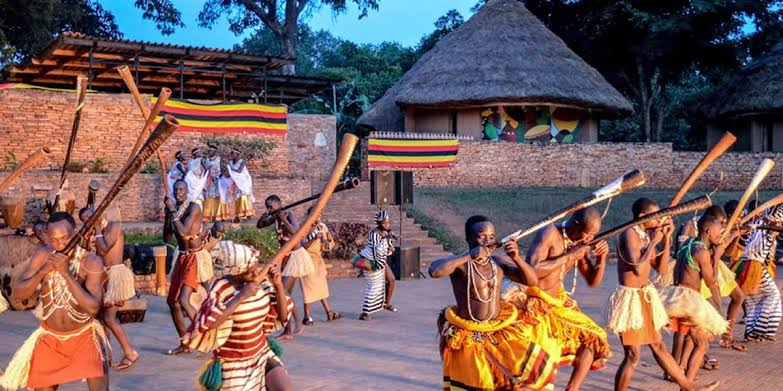
Cultural performers showcase traditional Ugandan music and dance.
Cultural experiences, festivals and community tourism provide some of the most direct ways to understand Uganda beyond its wildlife and landscapes. Uganda’s cultural diversity is expressed through traditional music, dance, food, clothing, crafts, languages, ceremonies, storytelling and everyday community life. The Uganda Tourism Board currently promotes cultural heritage tours that bring together traditional kingdoms, historical sites, culinary experiences and community encounters.
For travelers, community tourism can transform a conventional sightseeing trip into an opportunity to meet local people, learn traditional skills, visit markets, participate in cultural activities and understand how communities preserve their heritage while adapting to modern life.
Uganda’s festivals add another dimension. Some celebrate music and contemporary creativity, while others are connected to cultural heritage, religious traditions, food, community identity or historical events. The result is a cultural tourism landscape that changes throughout the year.
What Cultural Tourism Means in Uganda
Cultural tourism involves traveling to experience the heritage, traditions, lifestyles, arts and history of a destination. In Uganda, this can include visiting cultural institutions, meeting artisans, participating in community activities, attending performances, exploring local markets, learning traditional cooking techniques and visiting sites associated with kingdoms and historical communities.
Community tourism places local people at the center of that experience. Instead of simply observing a community from outside, visitors may engage directly with guides, farmers, craftspeople, performers, cooks and other residents.
The Uganda Tourism Board identifies community experiences and cultural heritage tours among Uganda’s tourism offerings, while the Ministry of Tourism, Wildlife and Antiquities includes cultural heritage conservation and tourism development within its mandate.
Meeting Local Communities During a Uganda Cultural Tour
Meeting local communities is one of the most valuable aspects of cultural tourism in Uganda. Depending on the destination, visitors may join guided village walks, visit homes or farms, learn about traditional crafts, observe food preparation, explore markets or attend cultural performances.
These experiences work best when local residents are active participants rather than simply subjects for visitors to observe. A community guide can explain local customs, introduce visitors to artisans and interpret practices that might otherwise be misunderstood.
Travelers should ask permission before photographing people, particularly during ceremonies or other culturally sensitive situations. Respectful interaction is more important than collecting photographs.
Visitors researching Uganda cultural experiences and community attractions can use cultural activities as a complement to wildlife-focused itineraries.
Traditional Dance and Music Experiences
Traditional music and dance are among the most accessible cultural experiences for visitors. Uganda’s communities have developed different musical styles, dances, instruments and performance traditions, making cultural performances an effective introduction to the country’s diversity.
Ndere Cultural Centre in Kampala is one established venue where visitors can experience performances representing different Ugandan communities. Uganda Tourism Board also highlighted Ndere Cultural Centre in 2026 when it hosted an international cultural gala featuring music, dance, costumes and traditions representing communities from across Uganda.
Visitors may also encounter traditional performances during community celebrations, cultural festivals and special events outside Kampala.
Traditional Drumming
Drums are important in many Ugandan musical traditions and frequently accompany dance, ceremonies and cultural performances.
Traditional Dance
Different communities have distinctive dances associated with celebrations, social occasions and cultural identity.
Travelers can learn more about Ndere Cultural Centre before incorporating a cultural performance into a Kampala itinerary.
Nyege Nyege Festival and Uganda’s Contemporary Cultural Scene
Nyege Nyege is one of Uganda’s best-known contemporary music and cultural festivals. The event developed in Uganda’s creative scene and has grown into an international festival bringing together music, performance, visual arts and cultural expression.
Uganda Tourism Board describes Nyege Nyege as an influential music and cultural festival that promotes African creativity, cultural diversity and the creative industries. Its significance within tourism demonstrates that Ugandan cultural tourism is not limited to historical traditions; contemporary music and arts are also part of the country’s cultural identity.
The festival can therefore be considered alongside traditional cultural experiences when building a broader understanding of modern Uganda.
For background on the event, see the verified Nyege Nyege Festival in Uganda resource.
Uganda Martyrs Day as a Major Cultural and Religious Event
Uganda Martyrs Day, observed on June 3, is one of the country’s major religious commemorations. It has particular importance at Namugongo, where Catholic and Anglican heritage sites commemorate the Christian martyrs associated with the reign of Kabaka Mwanga II in the nineteenth century.
The event attracts pilgrims and visitors and forms an important part of Uganda’s religious and historical heritage. It demonstrates how historical events can remain part of contemporary community life and national identity.
Visitors attending religious events should remember that these are genuine acts of worship and commemoration rather than performances arranged for tourists. Appropriate dress, respectful behavior and sensitivity toward worshippers are essential.
Imbalu and Cultural Celebrations in Eastern Uganda
Imbalu is a significant cultural tradition among the Bagisu of eastern Uganda. The celebrations are associated with cultural identity and community life and are accompanied by music, dance and other forms of communal participation.
Because some aspects of cultural ceremonies are private or sensitive, visitors should rely on local organizers and community guides to understand what may be observed or photographed.
Uganda Museums currently lists Imbalu-related exhibitions and cultural exchanges among its heritage programming, illustrating how major cultural traditions can also be interpreted through formal heritage institutions.
Community Tourism Around Bwindi and Mgahinga
Southwestern Uganda offers opportunities to combine wildlife tourism with community and cultural experiences. Around Bwindi Impenetrable National Park and Mgahinga Gorilla National Park, visitors can encounter community projects, local artisans, cultural performances and experiences connected with the area’s diverse communities.
Batwa cultural experiences are particularly important in this region. Community-based activities can introduce visitors to aspects of Batwa heritage, including traditional knowledge, storytelling, music and forest-related cultural practices.
The Batwa cultural experience is one example of a community-focused activity that can be incorporated into a southwestern Uganda itinerary.
Community Walks and Cultural Experiences in Buhoma
Buhoma, in the northern part of Bwindi Impenetrable National Park, provides opportunities to combine gorilla tourism with community experiences. Community walks can introduce visitors to local artisans, traditional knowledge and cultural performances.
Such experiences can broaden a gorilla-focused itinerary by allowing visitors to learn about the communities living around the forest and the relationship between tourism, livelihoods and conservation.
This is particularly relevant to community tourism because tourism revenue can create incentives for local participation in conservation and provide markets for locally produced crafts and services.
Community Tourism Around Lake Bunyonyi
Lake Bunyonyi and the surrounding highlands offer opportunities for travelers to experience rural life in southwestern Uganda. Village and market visits can introduce visitors to local commerce, crafts, agriculture and everyday community activities.
Market visits are particularly useful because they allow travelers to observe ordinary economic and social activity rather than experiencing culture only through formal performances.
The Lake Bunyonyi community experience can therefore complement cultural activities with local market visits and interactions.
Community Markets as Cultural Experiences
Local markets are among the simplest ways to experience everyday Ugandan culture. Markets bring together farmers, traders, craftspeople and consumers and provide an opportunity to observe local foods, clothing, household goods and handmade products.
Markets in Kampala provide a more urban experience, while rural markets can reveal regional differences in agricultural products and crafts. Travelers should remember that markets are working community spaces rather than tourist attractions, so respectful behavior is important.
Visitors can support local economies by purchasing appropriate locally made products directly from vendors while avoiding objects whose origin or legality is uncertain.
Traditional Cooking and Community Food Experiences
Food is one of the most accessible forms of cultural exchange. Community-based culinary experiences can introduce travelers to local ingredients, cooking techniques and food traditions that vary between regions and communities.
A cooking experience may involve preparing a traditional dish, visiting a local market to select ingredients or sharing a meal with a host family or community group. These activities can provide insights into agriculture, household traditions and social relationships.
Uganda Tourism Board currently identifies culinary experiences as part of the country’s cultural heritage tourism offering, making food an important component of a complete Uganda culture itinerary.
Craft Workshops and Artisan Experiences
Craft workshops allow travelers to move from simply buying souvenirs to understanding how handmade products are created. Depending on the location, visitors may observe basket weaving, pottery, beadwork, bark cloth production, wood carving or other traditional skills.
These workshops can be particularly valuable when artisans explain the materials, techniques and cultural background of their work. Purchasing directly from artisans can also provide a more direct economic connection between tourism and local livelihoods.
Craft-based tourism should nevertheless avoid treating cultural knowledge as a commodity without context. The artisan remains the most appropriate person to explain what a design or object means.
Cultural Homestays and Village Experiences
Where properly organized, homestays can provide a deeper understanding of everyday life. Staying with a local family may allow travelers to experience household routines, meals, farming activities and community interactions.
The quality and availability of homestays vary by destination, so travelers should use established community tourism organizations or reputable local operators. Information about specific homestay programs should be verified before travel rather than assumed to be available everywhere.
Information not found in current search results for a standardized national list of all operating cultural homestays in Uganda.
Festivals as a Window Into Uganda’s Cultural Diversity
Festivals bring together several dimensions of cultural identity at the same time. Music, dance, clothing, food, crafts, storytelling and community gatherings can all become part of a single event.
Some festivals have strong contemporary creative identities, while others are connected to historical, religious or community traditions. Travelers should therefore research the nature of a festival before attending so they understand whether it is primarily a public cultural celebration, a religious event, a commercial entertainment event or a community ceremony.
The Uganda Museums events calendar also demonstrates that heritage programming can include commemorations, exhibitions, workshops and cultural celebrations throughout the year.
Jinja and Cultural Experiences Along the Nile
Jinja combines natural attractions, history, local commerce and cultural experiences. Visitors can explore markets, craft shops, galleries and community spaces while learning about the Basoga cultural setting of the region.
A city experience can therefore complement outdoor activities along the Nile. Travelers can move from natural attractions into local markets and cultural spaces, creating a more balanced itinerary.
The Jinja cultural and community experience provides an example of how markets, cultural attractions and local life can be incorporated into a day visit.
Cultural Experiences in Kasese and the Rwenzori Region
Western Uganda also offers cultural experiences associated with the Bakonzo and other communities around the Rwenzori region. The Kiwa Heritage Site in Kasese, for example, combines a cultural museum with local food and activities connected to the surrounding community.
Its cultural museum presents aspects of Bakonzo heritage and includes traditional tools and musical instruments. The site demonstrates how community tourism can combine cultural interpretation with locally managed visitor experiences.
Travelers can learn more through the verified Kiwa Heritage Site cultural experience.
How Community Tourism Supports Local Livelihoods
Community tourism can create income opportunities through guiding, accommodation, transport, food preparation, craft production, cultural performances and other visitor services. When properly organized, tourism can therefore connect visitor spending with local economic activity.
The Uganda Tourism Board emphasizes inclusive socioeconomic development and sustainable tourism, while its tourism statistics identify village visits and cultural assets among Uganda’s tourism resources.
The economic impact depends on how tourism is organized. Travelers should favor legitimate community-based initiatives where local participants have a meaningful role in delivering and benefiting from the experience.
Responsible Cultural Tourism in Uganda
Responsible cultural tourism begins with respect. Travelers should recognize that communities have the right to decide how their traditions are presented, photographed and shared with visitors.
Visitors should ask permission before photographing people, avoid touching sacred objects, follow instructions at cultural and religious sites and avoid reducing complex traditions to stereotypes.
Purchasing locally made crafts, using local guides and participating in community-run activities can help ensure that cultural tourism produces benefits beyond the tourism operator.
How to Plan a Uganda Cultural Festival and Community Tourism Itinerary
A strong cultural itinerary should combine different types of experiences rather than relying entirely on performances. For example, a traveler could begin in Kampala with a museum or cultural center, continue to a community market, travel to a regional cultural attraction and finish with a village or artisan experience.
Travelers planning around a specific festival should confirm the official event dates, venue, admission requirements and current program before booking transportation or accommodation. Festival schedules can change from year to year.
For community visits, advance coordination is particularly important because many experiences depend on local guides, community organizations or scheduled activities rather than permanent daily opening hours.
Best Cultural Experiences for First-Time Visitors to Uganda
First-time visitors who want a broad introduction to Uganda culture can begin with a traditional music and dance performance, followed by a museum or historical attraction and a community-based activity.
Travelers interested in crafts can prioritize artisan workshops and local markets. Food enthusiasts can add traditional cooking experiences, while visitors interested in history can focus on royal sites, religious heritage and regional museums.
Those visiting southwestern Uganda for gorilla trekking can add a community walk or Batwa cultural experience to understand the human history and contemporary communities surrounding the forests.
Why Cultural Experiences and Community Tourism Matter
Cultural experiences, festivals and community tourism demonstrate that Uganda culture is a living and evolving part of the country rather than something confined to museums. Traditional performances continue alongside contemporary festivals, while communities adapt crafts, food traditions and cultural experiences to modern tourism.
For travelers, these experiences provide opportunities to understand Uganda from the perspective of its people. For communities, responsible tourism can create markets for cultural skills, local services and handmade products while supporting the preservation and presentation of heritage.
A complete Uganda Culture Guide should therefore place community tourism alongside languages, food, clothing, music, dance, traditional kingdoms and historical attractions. Together, these experiences provide a much fuller understanding of the country’s cultural diversity.
Cultural experiences, festivals and community tourism allow visitors to experience Uganda through its people, traditions and creative heritage. From Ndere Cultural Centre and community markets to Batwa experiences, regional cultural sites and major festivals, these activities can add depth to a Uganda safari while creating opportunities for local participation and economic benefit. The most valuable experiences are respectful, community-involved and focused on learning rather than simply observing.
Responsible Cultural Tourism and Practical Uganda Culture Travel Guide
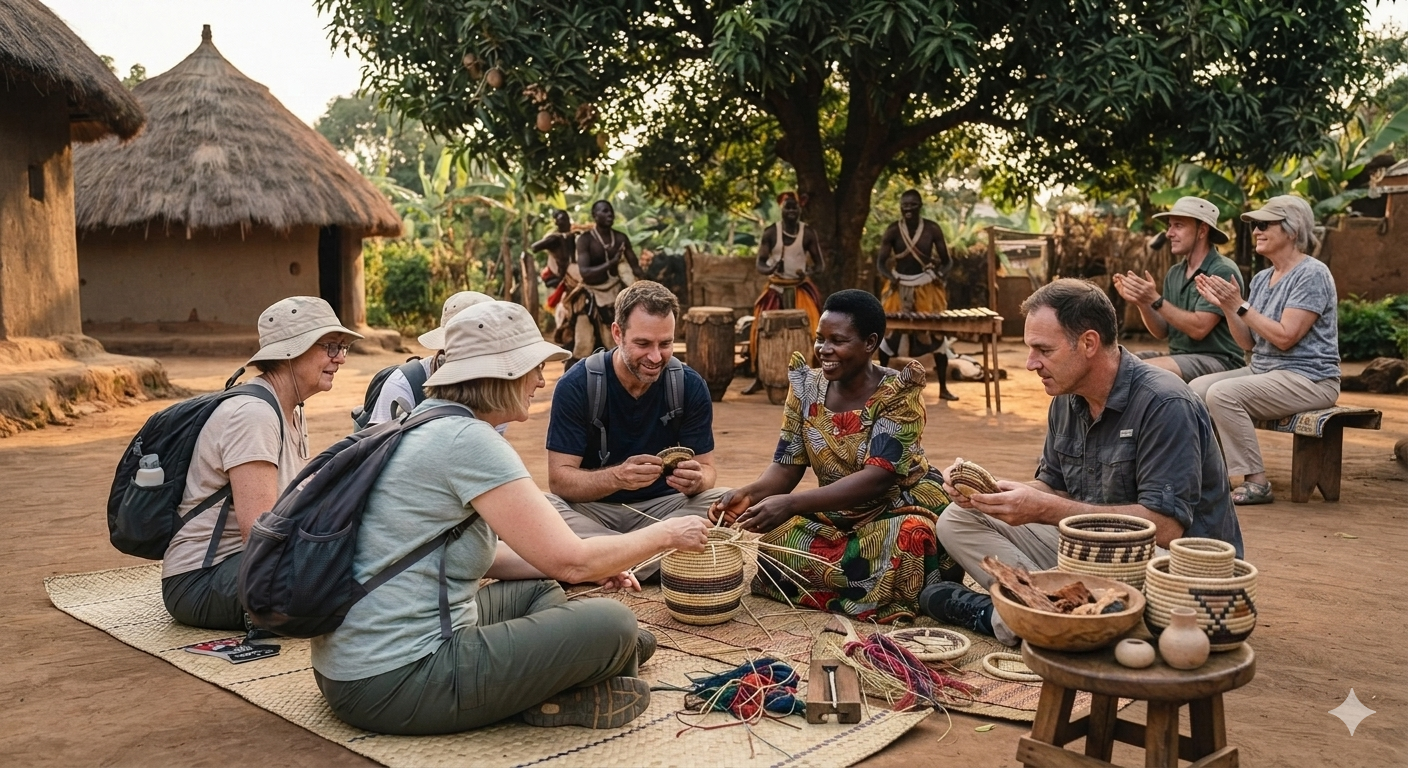
Supporting local livelihoods through hands-on community tourism experiences.
Responsible cultural tourism in Uganda is about experiencing the country’s traditions, heritage, communities, food, music, crafts and historical places while treating local people and their cultural identity with respect. Uganda’s cultural tourism landscape includes traditional kingdoms, historical sites, culinary experiences and community experiences, making cultural discovery an important part of the country’s tourism offering. :contentReference[oaicite:0]{index=0}
A responsible Uganda culture travel guide should therefore go beyond simply identifying places to visit. It should help travelers understand how to behave in communities, how to interact with cultural hosts, how to approach photography, how to support local businesses and how to choose professional tourism services.
Travelers planning responsible Uganda cultural tourism experiences can combine heritage sites, community visits, traditional performances, local food, craft experiences and cultural attractions within a carefully planned itinerary.
What Responsible Cultural Tourism Means in Uganda
Responsible cultural tourism means recognizing that Uganda’s culture is living heritage rather than something created exclusively for visitors. Languages, music, dance, food, traditional institutions, craftsmanship, beliefs and community practices continue to form part of everyday life.
The Uganda Tourism Board identifies sustainability and inclusive development among its core priorities. Its mandate includes sustainably promoting Uganda as a competitive tourism destination while supporting inclusive socioeconomic transformation. :contentReference[oaicite:1]{index=1}
For travelers, this means approaching cultural experiences with curiosity and humility. Visitors should listen to local explanations, follow the instructions of guides and hosts, and avoid assuming that every Ugandan community follows the same traditions.
Respect Uganda’s Cultural Diversity
Uganda has a highly diverse cultural landscape, with different communities having their own languages, traditions, foods, music, dances, histories and social practices. A responsible visitor should avoid presenting one community’s customs as representative of the entire country.
The best approach is to learn about the particular community or region being visited. Cultural information becomes more useful when it is connected to the people and place where the tradition exists.
Uganda’s cultural attractions range from the Buganda heritage of central Uganda to Ankole traditions in the west, Bunyoro heritage in the northwest, Basoga culture in the east and many other regional cultural traditions. A wider Uganda cultural attractions guide can help visitors identify experiences across different regions.
Ask Permission Before Taking Photographs
Photography can document an Uganda culture tour, but taking photographs of people should always be approached respectfully. Ask permission before photographing individuals, especially children, elders, religious figures, artisans and participants in ceremonies.
Permission should not be assumed simply because a person is in a public place. A visitor should be prepared to accept a refusal without argument or pressure.
Cultural ceremonies and sacred places may also have specific photography restrictions. When a guide, cultural leader or site manager says photography is not permitted, follow the instruction.
Dress Respectfully During Cultural Experiences
Clothing expectations vary according to the activity and location. Travelers visiting religious institutions, royal heritage sites, community ceremonies and culturally significant places should choose practical and respectful clothing and follow local instructions.
Visitors should also avoid treating traditional clothing as a costume. If a cultural experience includes an opportunity to wear traditional clothing, the host should explain its meaning and appropriate use.
Comfortable clothing is especially useful for cultural tours involving walking, village visits, markets, workshops and community activities.
Choose Registered and Professional Tourism Services
Choosing an established tourism provider can make cultural travel more organized and responsible. Uganda Tourism Board provides registration and licensing procedures for tourism businesses, including tour and travel companies and accommodation facilities. :contentReference[oaicite:2]{index=2}
Travelers should therefore ask who is operating a cultural experience, who provides the guiding and whether the service is appropriately registered where applicable.
The Ministry responsible for tourism, wildlife and heritage also has a mandate covering the development and promotion of tourism and cultural heritage resources, as well as regulation and quality assurance of tourism, wildlife and heritage programs and services. :contentReference[oaicite:3]{index=3}
Use Local Guides to Understand Cultural Heritage
A local guide can provide context that visitors may not obtain from a signboard or travel brochure. Historical places, traditional institutions, community projects and cultural performances often have meanings that are best explained by people familiar with the location.
Uganda Tourism Board’s tourism standards include professional requirements for tourism services, while its broader mandate includes developing and monitoring tourism standards. :contentReference[oaicite:4]{index=4}
A good guide should also explain appropriate visitor behavior rather than simply showing travelers where to go.
Support Local Communities and Businesses
One practical way travelers can support responsible cultural tourism in Uganda is by spending money with legitimate local businesses and community projects. This can include purchasing locally made crafts, eating at local establishments, hiring local guides and participating in community-run experiences.
Uganda Tourism Board currently describes authentic community experiences as part of the country’s cultural tourism offering and emphasizes sustainable tourism that benefits local communities. :contentReference[oaicite:5]{index=5}
Visitors interested in combining wildlife and community experiences can explore Uganda community and cultural attractions when building a wider itinerary.
Responsible Visits to Batwa Cultural Experiences
Cultural experiences involving the Batwa require particular sensitivity because their history is connected to displacement from forest areas that became protected national parks. Visitors should approach these experiences as opportunities to learn about history, heritage and contemporary community life rather than as entertainment based on stereotypes.
Organized Batwa cultural experiences can involve traditional knowledge, storytelling, music, dance, crafts and explanations of historical relationships with the forest. The specific activities vary by program and location.
The Batwa cultural experience guide provides additional background on organized Batwa experiences in southwestern Uganda.
Responsible visitors should listen carefully to community guides, ask questions respectfully and avoid reducing complex histories to simplified tourist narratives.
Respect Sacred and Religious Cultural Sites
Uganda’s cultural heritage includes important religious and sacred places. These locations may remain active places of worship or spiritual significance, so travelers should behave as guests rather than treating them simply as photo opportunities.
Follow instructions concerning clothing, photography, noise, movement and access to particular areas. If worship or a ceremony is taking place, visitors should avoid disrupting participants.
Travelers can explore Uganda’s cultural and historical sites to identify heritage locations suitable for their itinerary.
Responsible Cultural Experiences in Markets and Villages
Local markets offer an authentic window into everyday life. Travelers can see agricultural products, clothing, household goods, food and handmade crafts while observing how people buy and sell goods.
Visitors should remember that markets are workplaces. Avoid blocking vendors, disrupting transactions or photographing people without permission.
Village visits require similar consideration. Do not enter private homes or property without permission, and allow local guides or hosts to determine which areas are appropriate for visitors.
Buy Ugandan Crafts Responsibly
Traditional crafts are an important part of Uganda’s cultural identity and can provide visitors with meaningful souvenirs. Baskets, textiles, beadwork, carvings and other locally produced items can connect travelers with the skills and creativity of Ugandan artisans.
Whenever possible, purchase directly from artisans or reputable local craft organizations. Ask about the materials and origin of an item when relevant, particularly if you are unsure whether it can legally be transported across borders.
Travelers should avoid buying objects that may be culturally sensitive or subject to export restrictions unless their legality and appropriate authorization are clear.
The Uganda cultural attractions guide provides additional context for travelers interested in crafts and cultural heritage.
Experience Traditional Music, Dance and Storytelling Respectfully
Traditional music, dance and storytelling are among the most accessible ways to encounter Uganda’s cultural diversity. Performances can introduce visitors to regional traditions, instruments, costumes, stories and community history.
Visitors should follow the rules of the venue or cultural group. If participation is invited, take part respectfully rather than mocking movements, clothing or unfamiliar cultural practices.
Uganda Tourism Board continues to promote cultural heritage experiences as part of the country’s tourism offering. Its current tourism platform specifically highlights cultural heritage tours and authentic community experiences. :contentReference[oaicite:6]{index=6}
Travelers can also read about Ndere Cultural Centre experiences when considering cultural activities in Kampala.
Responsible Cultural Food Tourism in Uganda
Food provides another practical way to understand Uganda’s cultural diversity. Regional dishes, cooking methods and ingredients reflect local agriculture, history and community traditions.
Travelers should approach unfamiliar food with an open mind while communicating clearly about allergies or dietary restrictions. When eating in a community setting, follow the host’s guidance regarding meal etiquette.
Cultural food experiences should also benefit the people preparing and serving the food. Where possible, choose established local restaurants, cultural centers or community-run experiences rather than informal arrangements whose terms are unclear.
Responsible Cultural Tourism Around Bwindi
Bwindi is an important destination for travelers who want to combine wildlife tourism with cultural experiences. Community activities around the forest can provide opportunities to learn about local livelihoods, crafts, food, traditions and contemporary community life.
Travelers should remember that communities around protected areas are not simply extensions of the national park. They are homes and workplaces. Visitors should respect private spaces and follow local guidance during village and community activities.
A Uganda cultural travel itinerary can combine heritage experiences with gorilla trekking or other nature-based activities where appropriate.
Responsible Cultural Tourism Around Lake Bunyonyi
Lake Bunyonyi can be incorporated into a southwestern Uganda itinerary alongside wildlife and cultural activities. Travelers can use community-based experiences to learn about local livelihoods and cultural traditions.
As with other community visits, the most responsible approach is to allow local hosts to determine what they wish to share. Visitors should ask permission before entering private spaces or photographing individuals.
Travelers interested in combining Lake Bunyonyi with cultural experiences can explore Lake Bunyonyi cultural experiences when planning a southwestern Uganda trip.
How to Travel Responsibly With Children Present
Children may naturally be present during community tourism activities, but travelers should take extra care with photography and direct interaction. Ask the guide or responsible adult before taking photographs of children.
Visitors should not encourage children to perform, beg or pose for photographs simply because tourists are present. A responsible cultural experience allows children to continue their normal activities without pressure.
Travelers wishing to support education or community development should use established organizations and transparent programs rather than distributing money or gifts directly to children.
Responsible Tourism and the Environment
Cultural tourism and environmental responsibility are closely connected. Many cultural communities depend on agricultural land, forests, wetlands, lakes and other natural resources. Travelers should therefore avoid littering, damaging vegetation or disturbing local environments during cultural activities.
Follow designated routes where they exist and listen to guides when they explain environmental or community rules.
Uganda’s tourism institutions place sustainability and heritage conservation within the country’s tourism framework. The Ministry responsible for tourism, wildlife and heritage specifically identifies cultural heritage conservation and sustainable tourism as part of its mandate. :contentReference[oaicite:7]{index=7}
Practical Uganda Culture Travel Guide for First-Time Visitors
First-time visitors should research the cultural destination before arrival. Learn a few basic greetings, identify the community or region being visited, understand the type of experience being offered and ask the tour operator about appropriate behavior.
Travelers should also allow sufficient time for cultural experiences. A community visit should not be squeezed into an itinerary so tightly that there is no opportunity to listen, ask questions or appreciate the experience.
Comfortable walking shoes, weather-appropriate clothing, drinking water and a small camera can be useful, depending on the activity. Photography equipment should only be used where permitted.
For wider itinerary planning, visitors can review Uganda travel and cultural attractions before deciding which regions to include.
Questions to Ask Before Booking a Cultural Experience
Before booking a cultural experience, travelers should ask who operates the activity, who provides the guiding, what is included, whether photography is permitted and whether there are cultural rules visitors need to follow.
It is also useful to ask whether local community members are directly involved and how the experience is organized. Clear answers help travelers understand what they are booking and what kind of interaction to expect.
Travelers should be cautious about experiences that make exaggerated claims, encourage intrusive behavior or promise access to private ceremonies without clear authorization.
Combining Cultural Tourism With a Uganda Safari
Cultural tourism can be integrated naturally into a Uganda safari. A traveler can begin in Kampala with museums, historical attractions or traditional performances before continuing to western, northern, eastern or southwestern Uganda.
A southwestern itinerary, for example, can combine gorilla trekking with community experiences around Bwindi or Lake Bunyonyi. Western Uganda can also combine wildlife destinations with cultural heritage experiences in areas such as Bunyoro and Ankole.
The Kiwa Heritage Site cultural experience provides one example of a western Uganda destination where cultural and local experiences can complement a wider journey.
A Simple Responsible Uganda Culture Travel Checklist
Before Visiting
Research the community, confirm the meeting arrangements, understand photography rules and ask about appropriate clothing and behavior.
During the Visit
Listen carefully, ask permission before taking photographs, respect private spaces and follow the instructions of local hosts and guides.
After the Visit
Support legitimate local businesses where appropriate and describe the cultural experience accurately when sharing it with others.
Why Responsible Cultural Tourism Matters in Uganda
Responsible cultural tourism matters because Uganda’s cultural heritage belongs to living communities. Tourism can create opportunities for people to share their traditions, develop tourism businesses, preserve cultural knowledge and earn income from legitimate visitor experiences.
However, cultural tourism works best when communities are treated as participants rather than attractions. Visitors should recognize local knowledge, respect community decisions and understand that not every cultural practice is intended for public display.
Uganda’s official tourism institutions place sustainability, cultural heritage and inclusive socioeconomic development within the country’s tourism framework. :contentReference[oaicite:8]{index=8}
Final Advice for a Responsible Uganda Culture Experience
The best Uganda culture travel experiences are those that leave visitors with greater understanding rather than simply a collection of photographs. Research the destination, choose professional services, listen to local guides, ask permission before photographing people, respect sacred spaces, support legitimate local businesses and allow communities to explain their own heritage.
Uganda’s cultural diversity means there is no single formula for responsible cultural tourism. The most reliable approach is to remain respectful, observant and willing to learn. When travelers do this, cultural tourism can become a meaningful exchange that benefits visitors while supporting the people and heritage that make Uganda culturally distinctive.
Responsible cultural tourism in Uganda starts with respect. Learn about the community before visiting, use appropriate tourism services, ask permission before taking photographs, respect cultural and religious rules, support legitimate local businesses and listen to local people. A thoughtful approach makes the Uganda culture travel experience more meaningful while helping protect the country’s living cultural heritage.