
Uganda Safari for Bird Lovers: Introduction to One of Africa’s Great Birding Destinations
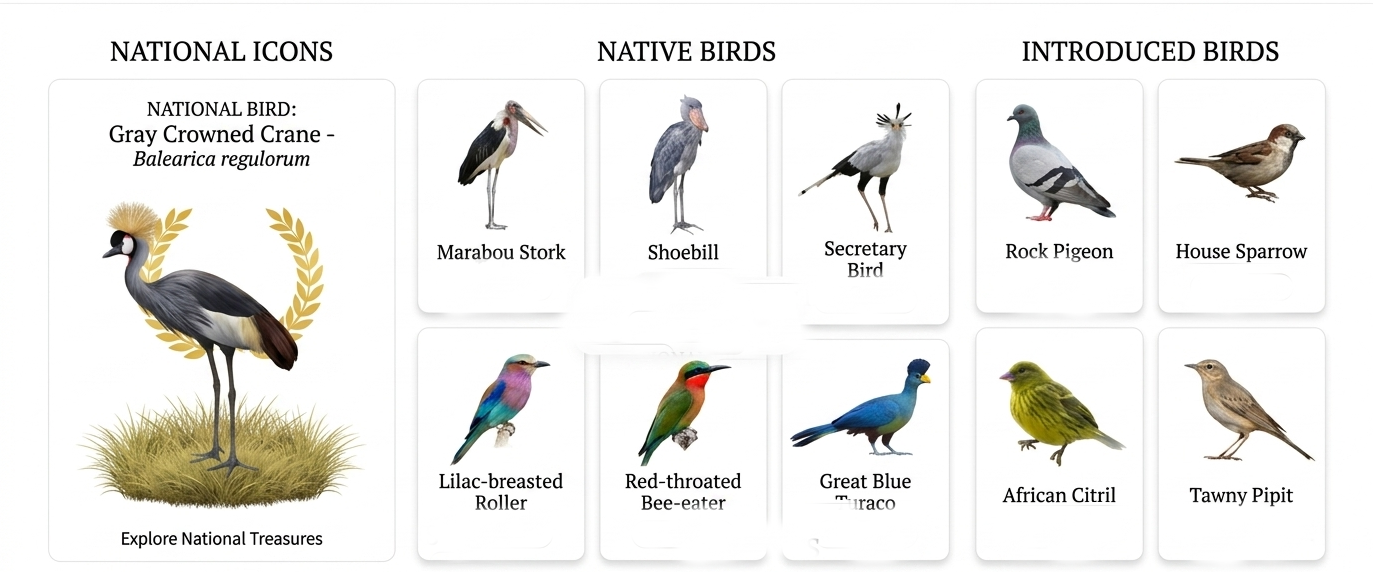
Diverse species for a Uganda birding safari.
A Uganda Safari for Bird Lovers offers an exceptional setting for travelers who want to experience Africa through birdwatching. Such a safari can combine tropical forests, wetlands, lakes, rivers, mountains, savannahs, papyrus swamps, and other habitats within one country. This remarkable ecological variety creates opportunities to observe forest specialists, wetland birds, savannah species, raptors, waterbirds, migrants, and sought-after birds such as the Shoebill.
For travelers planning a dedicated birding holiday, Uganda birding safari experiences can be structured around particular species, habitats, seasons, or regions. Rather than simply adding birdwatching to a conventional wildlife trip, a specialist itinerary can place birds at the center of the journey, making it a true Uganda Safari for Bird Lovers.
Why Uganda Is Suitable for a Uganda Safari for Bird Lovers
Uganda’s appeal to bird lovers comes largely from the country’s extraordinary variety of natural environments. Forests provide habitat for specialized species that are difficult to encounter in open landscapes, while wetlands support waterbirds and papyrus specialists. Savannahs provide opportunities for observing raptors, ground-feeding birds, hornbills, bee-eaters, cranes, and many other species. This habitat diversity means that a Uganda Safari for Bird Lovers does not have to focus on one type of bird. A carefully planned journey can move between very different environments and produce a broad and varied bird list.
Uganda Rwanda Safaris’ Uganda safari planning services include birdwatching among the safari experiences available to travelers, making birding possible as either a dedicated activity or part of a wider wildlife itinerary. This flexibility is key for any Uganda Safari for Bird Lovers.
A Country of Forests, Wetlands and Savannahs
Uganda’s birding landscape is particularly interesting because major habitats occur across different parts of the country. Forest destinations such as Bwindi, Kibale, Budongo, and other protected forests provide opportunities to search for forest specialists, a highlight of any Uganda Safari for Bird Lovers.
Wetlands offer a completely different experience. Mabamba Bay Wetland, for example, is particularly associated with the Shoebill and other wetland species. Current information identifies Mabamba as a major wetland birding destination and describes the wetland’s papyrus channels and canoe-based birdwatching experience, which is a must-do on a Uganda Safari for Bird Lovers.
Travelers interested in wetland birding can explore the Mabamba Bay birding experience as part of a wider Uganda Safari for Bird Lovers.
Uganda’s Forest Birding Opportunities
Forest birding is one of the most rewarding parts of a Uganda Safari for Bird Lovers. Dense vegetation creates challenging conditions, but it also provides habitat for birds that are unlikely to occur in open savannah.
Bwindi Impenetrable National Park is particularly important for birders interested in Albertine Rift species and forest specialists. Current information reports more than 350 bird species in Bwindi and identifies species such as the African Green Broadbill, Regal Sunbird, and Shelley’s Crimsonwing among the birds of interest, making it a premier destination for a Uganda Safari for Bird Lovers.
Birders planning a forest-focused itinerary can also consider Bwindi birdwatching opportunities alongside other forest destinations to enrich their Uganda Safari for Bird Lovers.
Budongo Forest and the Royal Mile
Budongo Forest Reserve is another important component of Uganda’s birding landscape. Current information identifies approximately 360 bird species in the forest and highlights the Royal Mile as an important birding area, a key stop on any Uganda Safari for Bird Lovers.
The forest provides opportunities to search for species including Dusky Long-tailed Cuckoo, Black-headed Paradise Flycatcher, Lemon-bellied Crombec, Puvel’s Illadopsis, Chocolate-backed Kingfisher, Cassin’s Hawk-Eagle, and other forest birds, adding incredible value to a Uganda Safari for Bird Lovers.
The Budongo Forest birding guide can therefore be useful when planning the forest component of a Uganda Safari for Bird Lovers.
Kibale and the Combination of Forest and Wetland Birding
Kibale National Park provides another strong option for bird lovers. Current information associated with Kibale identifies more than 350 bird species and highlights species including Great Blue Turaco, Black-and-White Casqued Hornbill, Olive Long-tailed Cuckoo, Western Tinkerbird, Papyrus Gonolek, White-winged Warbler, and Grey Parrot. This makes Kibale an essential part of a comprehensive Uganda Safari for Bird Lovers.
The surrounding wetlands provide an opportunity to combine forest birding with wetland observation, making the region particularly useful for travelers who want several habitat types within one itinerary. This versatility is what makes a Uganda Safari for Bird Lovers so unique.
A detailed Kibale birding and crater-lakes experience can add another dimension to a western Uganda birding itinerary for your Uganda Safari for Bird Lovers.
Bigodi Wetland Sanctuary
Bigodi Wetland Sanctuary demonstrates how wetland and community-based tourism can complement a Uganda Safari for Bird Lovers. Current information reports more than 200 bird species in the sanctuary and highlights species such as Great Blue Turaco, Papyrus Gonolek, and Yellow-throated Tinkerbird.
The sanctuary’s trails provide opportunities to explore wetland vegetation while observing birds at different levels, from species associated with the vegetation near the ground to canopy birds in surrounding forest. This diverse habitat is a gem for any Uganda Safari for Bird Lovers.
Travelers interested in combining primates and birds can consider Bigodi Wetland birding as part of a broader western Uganda itinerary, enhancing their Uganda Safari for Bird Lovers.
Wetlands and the Search for the Shoebill
The Shoebill is one of the birds that makes Uganda especially attractive to dedicated birders. The species is associated with wetlands, swamps, lakes, and riverine environments, and Mabamba Bay is one of the destinations considered for searching for it. For many, this is the highlight of a Uganda Safari for Bird Lovers.
For travelers whose primary objective is to see this remarkable species, the itinerary should allocate sufficient time to suitable wetland habitats rather than relying on an incidental sighting during a conventional game drive. A focused approach is crucial for a successful Uganda Safari for Bird Lovers.
The Shoebill birding guide provides destination information for travelers specifically interested in this iconic wetland species, a key component of any Uganda Safari for Bird Lovers.
Birding at Queen Elizabeth National Park
Queen Elizabeth National Park demonstrates why a Uganda Safari for Bird Lovers can combine birdwatching with conventional wildlife viewing. Current information identifies more than 600 bird species associated with the park and its varied ecosystems.
The park contains savannah, forests, wetlands, crater lakes, and riverine habitats. This combination creates opportunities to observe different bird communities without having to restrict the safari to one environment, making it a fantastic all-rounder for a Uganda Safari for Bird Lovers.
Travelers can explore the Queen Elizabeth birding experience when designing a western Uganda birding circuit for their Uganda Safari for Bird Lovers.
Birding Around Lake Bunyonyi
Lake Bunyonyi adds another type of landscape to a Uganda Safari for Bird Lovers. Current information identifies more than 200 bird species around the lake and notes that the nearby Nyombi swamp can be productive for birdwatching.
The lake environment also allows travelers to combine birding with canoeing and scenic exploration, creating a less conventional but highly enjoyable birding experience, a perfect way to relax during a Uganda Safari for Bird Lovers.
The Lake Bunyonyi birding guide provides information about bird species and birding opportunities around the lake for your Uganda Safari for Bird Lovers.
Birding on Mount Elgon and Around Sipi
Eastern Uganda also contributes to the country’s birding diversity. Current information for the Sipi Falls and Mount Elgon area identifies more than 274 bird species and notes that birding tours can be arranged in the area or incorporated into broader Mount Elgon experiences. This expands the possibilities for a Uganda Safari for Bird Lovers.
This makes eastern Uganda relevant for travelers who want to expand their itinerary beyond the more frequently visited western forests and wetlands, offering a unique twist to a Uganda Safari for Bird Lovers.
A Sipi and Mount Elgon birding experience can therefore complement a broader Uganda Safari for Bird Lovers.
Bird Migration Adds Seasonal Diversity
Uganda’s birding experience is not limited to resident species. Migratory birds add another layer of diversity during appropriate periods of the year. Travelers interested in migration should consider both the travel season and the habitats likely to support migratory species, enhancing the excitement of a Uganda Safari for Bird Lovers.
Migration can be especially interesting for experienced birders who want to compare Uganda’s resident birdlife with species that visit the region seasonally, adding a temporal dimension to a Uganda Safari for Bird Lovers.
The East Africa bird migration timeline can help place Uganda’s birding opportunities within the wider regional migration picture for your Uganda Safari for Bird Lovers.
Bwindi for Specialist Birding
Bwindi is also highlighted by Anthill Safaris as a birdwatching destination with more than 350 bird species. Its dense vegetation supports Albertine Rift endemics and other forest specialists, while birding trails provide access to different parts of the forest. This makes it a cornerstone for any Uganda Safari for Bird Lovers.
Birders can find additional information through Bwindi bird watching when comparing forest destinations for their Uganda Safari for Bird Lovers.
Wetland Birding With Anthill Safaris
Anthill Safaris also identifies Mabamba Bay Wetland as an important birding destination, particularly for travelers interested in the Shoebill. The company’s birding information describes canoe-based exploration of the papyrus wetland and the opportunity to search for other aquatic and wetland species. This is a quintessential experience for any Uganda Safari for Bird Lovers.
The Uganda bird watching experience provides another reference point when comparing birding activities and destinations for your Uganda Safari for Bird Lovers.
Birding Beyond the Big Five
A conventional African safari often emphasizes large mammals, but a Uganda Safari for Bird Lovers changes the focus. Elephants, lions, leopards, buffaloes, chimpanzees, and other wildlife can still be important parts of the journey, but birds become a central reason for exploring particular habitats.
This creates a different rhythm of travel. Instead of moving quickly between major wildlife sightings, birders may spend considerable time examining a tree canopy, listening to calls, following movement through dense vegetation, or waiting beside a wetland, which is the essence of a Uganda Safari for Bird Lovers.
Birding Is Suitable for Different Experience Levels
A Uganda Safari for Bird Lovers can accommodate both experienced birders and travelers who are developing an interest in birds. Beginners can learn basic identification skills, while experienced birdwatchers can concentrate on difficult forest species, regional specialists, migrants, and other target birds.
The experience becomes more productive when travelers communicate their interests before the safari. A guide can then understand whether the priority is species numbers, particular target birds, photography, habitat diversity, or a relaxed introduction to African birdwatching, customizing the Uganda Safari for Bird Lovers accordingly.
Why Habitat Diversity Matters to Bird Lovers
Habitat diversity is one of the strongest reasons to choose Uganda for birdwatching. Forests, wetlands, lakes, rivers, mountains, and savannahs each support different ecological communities, making every Uganda Safari for Bird Lovers an adventure.
This means a well-designed itinerary can provide substantially greater variety than a safari restricted to one habitat. The objective is not simply to visit as many places as possible but to select complementary environments that increase the likelihood of encountering different groups of birds.
Planning a Uganda Safari Around Birds
The strongest Uganda Safari for Bird Lovers begins with the birding objectives. Travelers should identify their target species, preferred habitats, desired trip length, photography requirements, and preferred balance between dedicated birdwatching and other wildlife activities.
Once these priorities are established, destinations can be selected logically. A forest specialist may prioritize Bwindi, Kibale, Budongo, or other suitable forests. A wetland specialist may emphasize Mabamba and other wetlands. A traveler seeking broad diversity can combine forests, wetlands, lakes, and savannah, creating the ultimate Uganda Safari for Bird Lovers.
What Makes Uganda Different for Bird Lovers
Uganda’s greatest advantage is not simply the number of birds recorded. It is the ability to experience very different birding environments within one country while also enjoying the wider wildlife and cultural experiences associated with an African safari, making a Uganda Safari for Bird Lovers truly unique.
A traveler can search for forest specialists in the morning, explore a wetland later, encounter waterbirds around a lake, and finish the day in a savannah environment. This ecological variety makes Uganda particularly suitable for a comprehensive birding holiday, the heart of a Uganda Safari for Bird Lovers.
Start Planning a Uganda Safari for Bird Lovers
A Uganda Safari for Bird Lovers can be designed as a dedicated birding expedition or as a wildlife safari with a strong birdwatching component. The most effective approach is to build the itinerary around habitats and target species, then select destinations and activities that support those objectives.
Whether the priority is the Shoebill, Albertine Rift specialists, forest birds, wetland species, migratory birds, raptors, or simply experiencing Uganda’s remarkable avian diversity, the country offers a broad foundation for a carefully planned birding journey. Start planning your Uganda Safari for Bird Lovers today.
For the best results, birders should allow adequate time in productive habitats, work with knowledgeable guides, use appropriate observation equipment, and remain flexible when weather and bird activity change. With those principles in place, Uganda provides an unusually rich setting for discovering African birdlife, ensuring an unforgettable Uganda Safari for Bird Lovers.
Why Uganda Is a Top Destination for a Uganda Safari for Bird Lovers
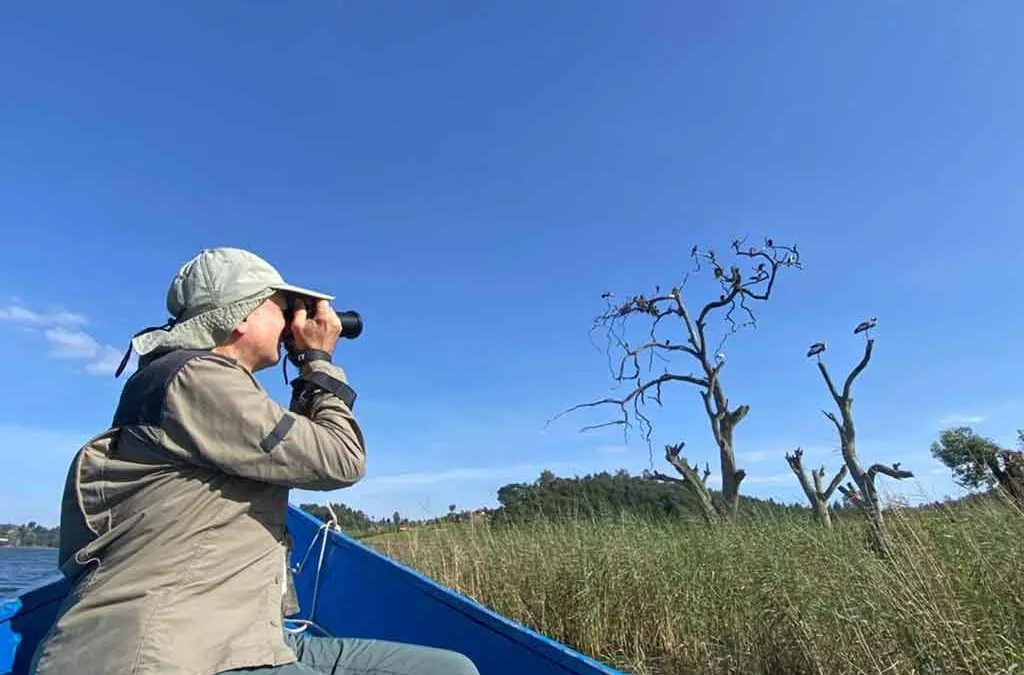
Bird enthusiast spotting rare species from a boat on Uganda’s scenic waters.
Uganda is an exceptionally diverse birding destination because its landscapes contain a remarkable range of habitats within a relatively compact East African country. A Uganda Safari for Bird Lovers can combine tropical forests, wetlands, lakes, rivers, mountains, savannah grasslands, papyrus swamps, and other ecosystems, giving birdwatchers opportunities to encounter very different bird communities during the same journey.
Uganda’s appeal is not based only on the number of species recorded. The country’s geographical position, habitat diversity, forest ecosystems, wetlands, and protected areas create opportunities for observing resident birds, migratory species, forest specialists, waterbirds, raptors, and sought-after species such as the Shoebill, cementing its status for a Uganda Safari for Bird Lovers.
Uganda’s Exceptional Habitat Diversity
One of the strongest reasons Uganda is suitable for bird lovers is the diversity of habitats available to explore. Current information from Uganda Rwanda Safaris describes Uganda as containing Afro-Alpine environments, montane forests, savannah, lowland forests, wetlands, and dry and semi-arid landscapes. These different environments support distinct bird communities, making it an ideal location for a Uganda Safari for Bird Lovers.
This habitat diversity allows a well-designed Uganda Safari for Bird Lovers to move from forest birding to wetland birding and then to open-country birdwatching without leaving the country.
Travelers can begin researching the country’s birdlife through the Uganda bird species guide, which highlights several of the country’s notable and sought-after birds for their Uganda Safari for Bird Lovers.
A Wide Range of Bird Species
Uganda has an extensive bird list, making it attractive to both specialist birders and travelers who simply enjoy observing wildlife. The diversity includes forest birds, wetland species, savannah birds, waterbirds, raptors, turacos, kingfishers, bee-eaters, sunbirds, barbets, hornbills, and many other groups, ensuring a rich experience on any Uganda Safari for Bird Lovers.
For birders, this means that the objective does not have to be limited to seeing one or two famous species. A carefully planned itinerary can produce a varied list representing several different ecological communities, maximizing the value of a Uganda Safari for Bird Lovers.
Resident Birds Make Uganda a Year-Round Birding Destination
Uganda’s resident birdlife provides a strong foundation for birdwatching throughout the year. Even when migratory species are not the principal focus, travelers can explore forests, wetlands, lakes, and savannahs in search of resident species, making a Uganda Safari for Bird Lovers a viable trip any time.
This makes a Uganda Safari for Bird Lovers suitable for travelers who want to experience Uganda’s natural bird communities without making migration the central objective of their trip.
Migratory Birds Add Another Dimension
Migratory birds add seasonal diversity to Uganda’s already extensive resident birdlife. Current information from Uganda Rwanda Safaris identifies Uganda’s wetlands, including areas around Lake Victoria and Mabamba, as important areas for migratory birds and highlights October to March as a peak migration period in the Lake Victoria Basin. This seasonal variety enhances a Uganda Safari for Bird Lovers.
Queen Elizabeth National Park also receives migratory visitors, with current information highlighting species such as European Bee-eaters and White-winged Terns, providing another reason to plan a Uganda Safari for Bird Lovers during these months.
Birders interested in seasonal movements can explore the East African bird migration guide when planning their travel dates for their Uganda Safari for Bird Lovers.
Uganda’s Forests Support Specialist Birds
Forest habitats are one of the major attractions for serious birdwatchers visiting Uganda. Dense tropical and montane forests support species that are difficult or impossible to find in open savannah environments, making them a key focus of any Uganda Safari for Bird Lovers.
Budongo Forest is an important example. Current information identifies approximately 360 bird species in the forest and highlights the Royal Mile as a particularly important birding area, a highlight of a Uganda Safari for Bird Lovers.
Birders can investigate the Budongo Forest birding destination when developing a western Uganda forest circuit for their Uganda Safari for Bird Lovers.
Bwindi Is Important for Albertine Rift Birding
Bwindi Impenetrable Forest is particularly significant for birders interested in Albertine Rift species. Current information identifies more than 350 bird species in Bwindi and highlights several endemic and specialist forest birds, making it a premier destination for a Uganda Safari for Bird Lovers.
The forest’s elevation, vegetation, and geographical position contribute to its distinctive bird community. This makes Bwindi particularly valuable for experienced birders who want to add forest specialists to their species lists, a core goal of a Uganda Safari for Bird Lovers.
Kibale Combines Forest and Wetland Opportunities
Kibale National Park and its surrounding areas provide another important birding environment. Current information identifies more than 350 bird species associated with Kibale and the surrounding crater-lake and forest habitats, offering a diverse birding experience for a Uganda Safari for Bird Lovers.
Birdwatchers can encounter species such as the Great Blue Turaco, Black-and-White Casqued Hornbill, Olive Long-tailed Cuckoo, Western Tinkerbird, Papyrus Gonolek, White-winged Warbler, and Grey Parrot, making it a must-visit on a Uganda Safari for Bird Lovers.
The Kibale crater-lakes birding experience demonstrates how forest and aquatic habitats can be incorporated into the same regional itinerary for a Uganda Safari for Bird Lovers.
Wetlands Create Exceptional Birding Opportunities
Uganda’s wetlands are particularly valuable for birdwatchers because they support waterbirds, papyrus specialists, waders, kingfishers, herons, egrets, and other wetland-dependent species, adding incredible variety to a Uganda Safari for Bird Lovers.
Mabamba Bay Wetland is one of the country’s best-known wetland birding destinations. Current information identifies the wetland as a Ramsar site and highlights its importance for the Shoebill and numerous other wetland species, a highlight of any Uganda Safari for Bird Lovers.
The Mabamba Bay Wetland birding guide provides additional information for travelers interested in exploring this habitat on their Uganda Safari for Bird Lovers.
The Shoebill Is a Major Attraction
The Shoebill is one of the most sought-after birds associated with Uganda. Its unusual appearance, large bill, behavior, and wetland habitat make it a priority species for many international birdwatchers, and often the star of a Uganda Safari for Bird Lovers.
Mabamba Bay provides an opportunity to search for Shoebills by canoe through papyrus channels. This type of specialized excursion demonstrates how a Uganda Safari for Bird Lovers can be built around specific target species rather than conventional game viewing alone.
Lake Bunyonyi Offers Rich Birdlife

Visitors explore Lake Bunyonyi’s rich birdlife by boat.
Lake Bunyonyi provides another example of Uganda’s birding diversity. Current information reports more than 200 bird species around the lake and identifies species including Pied Kingfisher, Malachite Kingfisher, Cinnamon-chested Bee-eater, Bronzy Sunbird, Grey-crowned Crane, Black Heron, Great Cormorant, and several weaver species. This makes it a rewarding stop on a Uganda Safari for Bird Lovers.
The surrounding hills, wetlands, islands, and lake environment provide different observation opportunities, making the area useful for travelers who want birding combined with scenic exploration during their Uganda Safari for Bird Lovers.
The Lake Bunyonyi birdwatching guide provides destination-specific information for planning this type of experience on a Uganda Safari for Bird Lovers.
Queen Elizabeth Offers More Than Big Game
Queen Elizabeth National Park is particularly useful for travelers who want to combine conventional wildlife viewing with serious birdwatching. Current information lists more than 600 bird species and describes a mixture of savannah, tropical forest, wetlands, and crater lakes, making it a fantastic component of a Uganda Safari for Bird Lovers.
This variety allows birders to search for different species during game drives, forest walks, and water-based activities, maximizing the value of a Uganda Safari for Bird Lovers.
The Queen Elizabeth birding guide provides information about the park’s major birding areas and habitats for your Uganda Safari for Bird Lovers.
Mabira Provides Accessible Forest Birding
Mabira Forest offers another opportunity to explore tropical forest birdlife. Current information reports more than 315 bird species and highlights birding trails such as the Grassland Trail, providing an accessible birding experience for a Uganda Safari for Bird Lovers.
The forest can be particularly useful for travelers who want to experience forest birding while incorporating central Uganda into their itinerary, adding convenience to a Uganda Safari for Bird Lovers.
The Mabira Forest birding experience provides additional information about the forest’s birdlife and trails for your Uganda Safari for Bird Lovers.
Bigodi Demonstrates the Importance of Wetland Conservation
Bigodi Wetland Sanctuary provides a strong example of how birdwatching can be connected with local conservation and community tourism. Current information identifies more than 200 bird species and highlights species such as Great Blue Turaco, Papyrus Gonolek, and Yellow-throated Tinkerbird, adding a community element to a Uganda Safari for Bird Lovers.
Boardwalk trails allow visitors to explore the wetland while minimizing direct disturbance to sensitive areas. This makes Bigodi particularly suitable for travelers interested in combining birdwatching with conservation-focused tourism, an ethical choice for a Uganda Safari for Bird Lovers.
The Bigodi birding experience can be incorporated into a broader Kibale itinerary for a Uganda Safari for Bird Lovers.
Lake Mburo Adds Savannah and Wetland Birds
Lake Mburo National Park adds another habitat type to a Uganda Safari for Bird Lovers. Current destination information identifies numerous bird species associated with the park’s acacia woodland, wetlands, and lake environment, offering a diverse birding experience.
Species of interest include African Finfoot, Papyrus Yellow Warbler, Saddle-billed Stork, White-winged Warbler, Red-faced Barbet, and other savannah and wetland birds, making it a valuable addition to a Uganda Safari for Bird Lovers.
Birding Can Be Combined With Wildlife Safaris
One advantage of Uganda is that birdwatching does not have to be separated from other safari experiences. Travelers can observe birds during game drives, boat excursions, forest walks, and nature walks, making a Uganda Safari for Bird Lovers a holistic experience.
This makes Uganda especially attractive to families and groups with different interests. One traveler can concentrate on birds while others enjoy mammals, landscapes, primates, or cultural experiences, all within the framework of a Uganda Safari for Bird Lovers.
Birding Makes Game Drives More Detailed
A game drive viewed from a birdwatcher’s perspective can become a much richer experience. Instead of focusing only on large mammals, travelers can watch raptors hunting, hornbills moving between trees, bee-eaters feeding, cranes displaying, and waterbirds gathering around wetlands, enhancing every game drive on a Uganda Safari for Bird Lovers.
This creates an additional layer of observation and encourages travelers to pay attention to the smaller details of Uganda’s ecosystems, a key part of a Uganda Safari for Bird Lovers.
Boat Safaris Are Valuable for Bird Lovers
Water-based safaris can be particularly productive for birdwatchers because rivers, lakes, and channels attract birds that may be difficult to observe from land, providing a unique perspective on a Uganda Safari for Bird Lovers.
The Kazinga Channel in Queen Elizabeth National Park and wetland canoe excursions around Mabamba provide different examples of how water can be used as a natural route for observing birds, essential activities on a Uganda Safari for Bird Lovers.
Uganda Offers Opportunities for Bird Photographers
The country’s diverse habitats and large range of species also make Uganda attractive to bird photographers. Forest birds, wetland species, waterbirds, raptors, and colorful savannah species provide different photographic challenges, making a Uganda Safari for Bird Lovers a dream for photographers.
Photography-focused travelers should allow sufficient time for observation because obtaining a good image can require considerably longer than simply identifying a bird, an important consideration for a Uganda Safari for Bird Lovers.
Uganda Works for Beginners and Experienced Birders
A Uganda Safari for Bird Lovers does not have to be designed exclusively for professional ornithologists. Beginners can learn to identify common birds, recognize calls, understand habitats, and gradually develop more advanced birding skills.
Experienced birders can instead focus on target species, specialist habitats, Albertine Rift endemics, migrants, and difficult forest birds, making a Uganda Safari for Bird Lovers suitable for all skill levels.
Birding Guides Improve the Experience
Bird identification can be challenging in dense forest or wetland vegetation. A knowledgeable local guide can recognize calls, understand bird behavior, know productive locations, and help visitors distinguish similar-looking species, significantly enhancing a Uganda Safari for Bird Lovers.
This expertise can make the difference between simply hearing a bird and actually locating and identifying it, a crucial advantage on a Uganda Safari for Bird Lovers.
Uganda’s Birding Diversity Supports Different Safari Styles
Travelers can choose between a dedicated birding expedition, a mixed bird-and-wildlife safari, a specialist forest trip, a wetland-focused excursion, or a broader itinerary covering several ecological zones, offering flexibility for a Uganda Safari for Bird Lovers.
The best option depends on the target species, available time, budget, preferred accommodation, and level of birding experience, allowing for a customized Uganda Safari for Bird Lovers.
Uganda Is Particularly Strong for Habitat-Based Birding
The country’s strength lies in the ability to connect bird species with their habitats. A birder interested in wetland specialists can focus on wetlands, while someone interested in forest species can spend more time in forest reserves and national parks, making a Uganda Safari for Bird Lovers a habitat-focused adventure.
This habitat-based approach is more effective than choosing destinations solely according to their popularity among general safari travelers.
Why Bird Lovers Should Plan Their Safari Carefully
Birdwatching rewards patience and preparation. Some species are easy to find, while others may require early starts, quiet walking, specialist knowledge, and repeated searches, so careful planning is essential for a Uganda Safari for Bird Lovers.
Travelers should therefore prepare a target list before departure and communicate their priorities to the safari operator and guide. This allows the route to be designed around the habitats most likely to support those species, maximizing the success of a Uganda Safari for Bird Lovers.
Uganda Provides a Strong Foundation for a Dedicated Birding Holiday
The combination of extensive bird diversity, varied habitats, resident species, migratory birds, forest specialists, wetlands, lakes, mountains, and savannah makes Uganda a strong destination for bird lovers, and the perfect setting for a Uganda Safari for Bird Lovers.
A well-planned Uganda Safari for Bird Lovers can go far beyond simply counting species. It can provide an opportunity to understand how birds interact with forests, wetlands, rivers, lakes, grasslands, and other ecosystems while experiencing Uganda’s wider wildlife and landscapes.
Why Uganda Should Be on a Bird Lover’s Safari List
Uganda offers the combination that serious birders look for: habitat diversity, specialist species, accessible birding locations, wetlands, forests, savannahs, and opportunities to combine birdwatching with broader wildlife experiences, making a Uganda Safari for Bird Lovers an essential journey.
For someone planning a first African birding holiday or an advanced birding expedition, Uganda provides enough ecological variety to support a carefully customized itinerary. The strongest approach is to identify the birds and habitats that matter most, select destinations accordingly, allow adequate observation time, and use experienced local guiding. With this approach, a Uganda Safari for Bird Lovers becomes more than a conventional wildlife trip. It becomes a journey through several of Uganda’s most important ecosystems, with birdlife providing the central thread connecting forests, wetlands, lakes, mountains, rivers, and savannah landscapes.
Best Birding Destinations in Uganda for a Uganda Safari for Bird Lovers

Bird lovers exploring Mabamba Swamp on a Uganda safari.
Choosing the best birding destinations in Uganda depends on the species you want to see, the habitats you want to explore, the length of your safari, and whether you are interested in specialist forest birds, wetland species, savannah birds, migrants, or a broad mixture of Uganda’s avian diversity. Because Uganda contains forests, wetlands, lakes, rivers, mountains, and savannah landscapes, a carefully designed Uganda Safari for Bird Lovers can combine several distinct birding environments within one journey.
Rather than visiting destinations simply because they are famous for conventional wildlife safaris, birders should select locations according to habitat and target species. Some destinations are particularly valuable for Albertine Rift endemics, others for wetland birds and the Shoebill, while others provide opportunities to combine forest, savannah, and riverine birding, offering a tailored experience on a Uganda Safari for Bird Lovers.
Bwindi Impenetrable National Park
Bwindi Impenetrable National Park is one of the most important birding destinations in Uganda, particularly for travelers interested in forest birds and Albertine Rift species. Current information identifies more than 350 bird species in the park, including numerous species associated with the Albertine Rift. This makes it a cornerstone for any Uganda Safari for Bird Lovers.
The park’s dense montane forest provides a very different birding environment from Uganda’s open savannah parks. Birders need to be prepared for species that may remain concealed within vegetation or may be detected through their calls before they are seen, a rewarding challenge on a Uganda Safari for Bird Lovers.
The Bwindi bird watching guide identifies Buhoma and Rushaga among important birding areas and highlights species including African Green Broadbill, Black-billed Turaco, Rwenzori Turaco, Grey Crowned Crane, Black Bee-eater, and several other forest birds for your Uganda Safari for Bird Lovers.
Bwindi’s Buhoma Sector
Buhoma is one of the most accessible birding areas within Bwindi and supports a rich variety of forest species. Current information highlights birds such as the Grey Crowned Crane, Black Bee-eater, Red-throated Alethe, African Emerald Cuckoo, Dusky Long-tailed Cuckoo, and Yellow-spotted Nicator, adding significant value to a Uganda Safari for Bird Lovers.
The forest environment around Buhoma rewards slow and attentive birding. A specialist guide can help birders interpret calls and locate birds moving through dense vegetation, an essential part of a Uganda Safari for Bird Lovers.
Bwindi’s Ruhija Sector
Ruhija is particularly important for birders searching for montane forest species and Albertine Rift specialists. The Mubwindi Swamp area is among the locations associated with specialist birding within this part of Bwindi, making it a must-visit on a Uganda Safari for Bird Lovers.
Current information from Anthill Safaris also identifies the Bamboo Trail toward Rwamunyonyi Peak as an important location for observing high-altitude species, adding another dimension to a Uganda Safari for Bird Lovers.
Bwindi’s Rushaga Sector
Rushaga provides another opportunity to explore Bwindi’s montane forest environment. Current birding information highlights species including Barred Long-tailed Cuckoo, Western Bronze-naped Pigeon, Mountain Wagtail, and White-starred Robin, offering a different birding experience on a Uganda Safari for Bird Lovers.
The sector can be particularly useful for travelers who want to combine specialist forest birding with other experiences in southwestern Uganda during their Uganda Safari for Bird Lovers.
Kibale National Park
Kibale National Park is one of western Uganda’s major forest destinations and an important location for a Uganda Safari for Bird Lovers. Current information identifies more than 350 bird species associated with Kibale and its surrounding habitats.
Among the birds of interest are Great Blue Turaco, Black-and-White Casqued Hornbill, Olive Long-tailed Cuckoo, Western Tinkerbird, Papyrus Gonolek, White-winged Warbler, and Grey Parrot, making Kibale a rich destination for a Uganda Safari for Bird Lovers.
Kibale is especially useful for itineraries that combine birdwatching with other forest experiences because several habitats can be explored within the broader Kibale region, enhancing the diversity of a Uganda Safari for Bird Lovers.
Bigodi Wetland Sanctuary
Bigodi Wetland Sanctuary complements Kibale’s forest birding with a wetland environment. Current information identifies more than 200 bird species within the sanctuary and highlights Great Blue Turaco, Papyrus Gonolek, and Yellow-throated Tinkerbird among the species that may be encountered, adding wetland variety to a Uganda Safari for Bird Lovers.
The sanctuary provides an opportunity to explore papyrus swamp, forest edges, and other wetland habitats while walking along established trails, a serene experience on a Uganda Safari for Bird Lovers.
Budongo Forest Reserve
Budongo Forest Reserve is another important destination for forest birding. Current information identifies approximately 360 bird species and describes the Royal Mile as the most important birding area within the forest, a premier spot on a Uganda Safari for Bird Lovers.
Birders can search for species including Dusky Long-tailed Cuckoo, Black-headed Paradise Flycatcher, Lemon-bellied Crombec, Puvel’s Illadopsis, Slender-billed Greenbul, Chestnut-crowned Eremomela, Little Green Sunbird, White-spotted Flufftail, Chocolate-backed Kingfisher, and Cassin’s Hawk-Eagle, making Budongo a fantastic stop for a Uganda Safari for Bird Lovers.
The Budongo Forest birding destination is therefore particularly relevant for travelers building a western Uganda forest circuit for their Uganda Safari for Bird Lovers.
The Royal Mile in Budongo
The Royal Mile is especially significant for dedicated birders because of the concentration and variety of forest species found along the route. The road and surrounding forest create opportunities to observe birds at different levels of the vegetation, making it a highlight of a Uganda Safari for Bird Lovers.
Birders should allow sufficient time here because forest birding can require patience. A slow pace and attentive listening can reveal species that might otherwise be missed, a key practice on a Uganda Safari for Bird Lovers.
Mabamba Bay Wetland
Mabamba Bay Wetland is one of Uganda’s best-known wetland birding destinations and is particularly famous for the Shoebill. Current information describes Mabamba as a Ramsar site on the shores of Lake Victoria and reports more than 300 documented bird species in the wetland. This makes it an essential component of a Uganda Safari for Bird Lovers.
The wetland consists of extensive papyrus channels that are explored by canoe. This provides access to habitats that cannot be reached as easily by road and creates excellent opportunities to observe waterbirds and wetland specialists, offering a unique perspective on a Uganda Safari for Bird Lovers.
The Mabamba Bay Wetland birding guide provides detailed information about the wetland, its birdlife, and the canoe-based birding experience for your Uganda Safari for Bird Lovers.
Mabamba for Shoebill Birding
The Shoebill is the principal attraction for many birders visiting Mabamba. The species is one of Africa’s most sought-after birds, and its unusual appearance makes it a priority target on many Uganda birding itineraries, and the highlight of a Uganda Safari for Bird Lovers.
Birders should allow adequate time for the search because wildlife sightings cannot be guaranteed. Local guides and boat operators can help visitors navigate the papyrus channels and search suitable areas, crucial for a successful Uganda Safari for Bird Lovers.
Queen Elizabeth National Park
Queen Elizabeth National Park is one of the strongest destinations for travelers who want to combine birdwatching with a conventional wildlife safari. Current information identifies more than 600 bird species associated with the park’s varied ecosystems, making it a top choice for a Uganda Safari for Bird Lovers.
The combination of savannah, wetlands, forests, crater lakes, and the Kazinga Channel creates opportunities to encounter several different bird communities during one visit, maximizing the diversity of a Uganda Safari for Bird Lovers.
The Queen Elizabeth birding guide is particularly useful when planning a western Uganda itinerary that combines birding and wildlife viewing for a Uganda Safari for Bird Lovers.
Kazinga Channel
The Kazinga Channel provides an excellent setting for water-based birdwatching within Queen Elizabeth National Park. Birds associated with water and shoreline habitats can often be observed from the channel, while the surrounding landscape provides opportunities for additional species, adding a water-based element to a Uganda Safari for Bird Lovers.
A boat excursion can therefore complement land-based birding and give travelers a different perspective on the park’s birdlife, a great addition to any Uganda Safari for Bird Lovers.
Murchison Falls National Park
Murchison Falls National Park is another important destination for bird lovers because it combines savannah, woodland, riverine, and wetland habitats. Current information from Anthill Safaris identifies the park as a birding destination where species associated with both the Nile and savannah can be encountered, making it a fantastic stop on a Uganda Safari for Bird Lovers.
The Nile supports birds such as Goliath Heron, African Skimmer, and Pied Kingfisher, while the savannah provides opportunities for species such as Abyssinian Ground Hornbill and Red-throated Bee-eater, offering incredible variety for a Uganda Safari for Bird Lovers.
Semuliki National Park
Semuliki National Park is particularly interesting for specialist birders because its lowland forest environment has strong ecological connections with the Congo Basin. This gives the park a bird community that differs from Uganda’s montane forests and savannah destinations, offering a unique birding experience on a Uganda Safari for Bird Lovers.
Current information from Anthill Safaris lists Semuliki among Uganda’s notable birding destinations and identifies it as a location where birders can encounter species associated with central African forest environments, a must for specialist birders on a Uganda Safari for Bird Lovers.
Lake Bunyonyi
Lake Bunyonyi provides a scenic combination of highland lake, hills, wetlands, and surrounding vegetation. Current information identifies more than 200 bird species around the lake, making it an attractive addition to a southwestern Uganda birding circuit and a relaxing stop on a Uganda Safari for Bird Lovers.
Birding around Lake Bunyonyi can complement a visit to Bwindi because the habitats are different. This allows travelers to expand their species list while remaining in the broader southwestern region, adding variety to a Uganda Safari for Bird Lovers.
Mabira Forest
Mabira Forest is a useful destination for travelers seeking forest birding in central Uganda. Current information identifies more than 315 bird species and several established birding trails, providing accessible forest birding for a Uganda Safari for Bird Lovers.
The forest can work particularly well as part of an itinerary that includes Kampala, Entebbe, Jinja, or other central and eastern destinations. Its accessibility makes it a practical option for shorter birding trips, or a convenient addition to a Uganda Safari for Bird Lovers.
Lake Mburo National Park
Lake Mburo National Park offers a combination of acacia woodland, savannah, wetlands, and lake habitats. This makes it useful for travelers who want to add open-country and wetland species to a forest-heavy itinerary, adding habitat diversity to a Uganda Safari for Bird Lovers.
The park can also be incorporated into routes connecting Kampala with southwestern Uganda, making it a practical stop for travelers who want to increase habitat diversity without creating a completely separate journey for their Uganda Safari for Bird Lovers.
Mgahinga Gorilla National Park
Mgahinga Gorilla National Park provides another opportunity for high-altitude forest birding in southwestern Uganda. Its location within the Virunga landscape makes it particularly relevant for birders interested in montane habitats and Albertine Rift species, adding high-altitude birding to a Uganda Safari for Bird Lovers.
Combining Mgahinga with Bwindi can provide a stronger southwestern birding itinerary for travelers whose primary interest is mountain and forest birdlife, a fantastic combination for a Uganda Safari for Bird Lovers.
Mount Elgon National Park
Mount Elgon offers a different birding environment in eastern Uganda. The mountain’s elevation gradient creates several ecological zones, providing opportunities to encounter birds associated with montane and highland environments, a unique addition to a Uganda Safari for Bird Lovers.
Birders can combine the mountain experience with other attractions around eastern Uganda, creating a broader itinerary rather than focusing exclusively on western Uganda for their Uganda Safari for Bird Lovers.
Kidepo Valley National Park
Kidepo Valley National Park provides a substantially different birding environment from Uganda’s tropical forests. Its semi-arid landscapes, open plains, rocky areas, and savannah habitats support species adapted to drier conditions, offering a unique contrast on a Uganda Safari for Bird Lovers.
For experienced birders with sufficient time, Kidepo can add a northern ecological component to a countrywide Uganda Safari for Bird Lovers.
Lake Victoria Basin
The Lake Victoria Basin is important for both resident and migratory birds. Wetlands around the lake provide feeding and resting habitats for different species, while locations such as Mabamba offer specialized wetland birding, making the basin a vital area for a Uganda Safari for Bird Lovers.
Current information on East African migration highlights the Lake Victoria Basin and Mabamba as important areas for migratory birds, particularly during the migration period, enhancing the seasonal value of a Uganda Safari for Bird Lovers.
The bird migration guide for East Africa provides additional information for travelers who want to include seasonal migrants in their Uganda itinerary for a Uganda Safari for Bird Lovers.
Why Destination Selection Should Follow Your Target List
The best birding destination in Uganda depends on what you want to see. A traveler searching for the Shoebill should prioritize wetlands such as Mabamba. Someone interested in Albertine Rift endemics should prioritize appropriate forest habitats such as Bwindi and Mgahinga. A birder seeking savannah species should include destinations such as Murchison Falls, Queen Elizabeth, Lake Mburo, or Kidepo. This targeted approach is the foundation of a successful Uganda Safari for Bird Lovers.
This target-species approach is more effective than trying to visit every famous safari destination. It also reduces unnecessary driving and gives travelers more time to concentrate on the habitats most relevant to their objectives, optimizing the experience of a Uganda Safari for Bird Lovers.
Choosing Destinations for a First Uganda Birding Safari
First-time birders may benefit from combining several accessible habitats rather than immediately attempting a highly specialized expedition. A route incorporating Mabamba, a forest destination such as Kibale or Bwindi, and a savannah or wetland destination can provide an excellent introduction to Uganda’s bird diversity, a great starting point for a Uganda Safari for Bird Lovers.
Travelers with more experience can build their itinerary around specific target species and specialist habitats for a more focused Uganda Safari for Bird Lovers.
Choosing Destinations for Experienced Birders
Experienced birders can benefit from a more specialized approach. Rather than focusing on general wildlife attractions, they can allocate additional time to locations known for forest specialists, Albertine Rift species, wetland birds, migrants, or other difficult targets, maximizing the reward of a Uganda Safari for Bird Lovers.
Bwindi, Budongo, Kibale, Semuliki, Mabamba, and other specialist destinations can be combined according to the target list and available travel time for a comprehensive Uganda Safari for Bird Lovers.
Combining Birding Destinations Efficiently
Geographical planning is important because Uganda’s birding destinations are spread across different parts of the country. A well-designed itinerary should group destinations that can be reached efficiently while still providing contrasting habitats, a key logistical consideration for a Uganda Safari for Bird Lovers.
For example, western Uganda can combine Kibale, Queen Elizabeth, Bwindi, and Lake Bunyonyi, while central Uganda can provide access to Mabamba and Mabira. Longer itineraries can extend toward Murchison Falls, Semuliki, Mount Elgon, or Kidepo, creating a comprehensive Uganda Safari for Bird Lovers.
Use Habitat Diversity to Maximize Bird Diversity
Visiting different habitats is one of the best ways to broaden a bird list. Forest, wetland, lake, river, mountain, and savannah environments each provide different opportunities, making habitat diversity the key to a successful Uganda Safari for Bird Lovers.
A Uganda Safari for Bird Lovers should therefore avoid spending the entire journey in one type of habitat unless the objective is specifically to target specialist forest or wetland species.
Allow Enough Time at Each Destination
Birding is not simply a matter of arriving at a location and immediately finding every target species. Some birds require patience, early starts, quiet observation, or repeated searches, so adequate time at each destination is crucial for a Uganda Safari for Bird Lovers.
Spending several hours or multiple days in an important habitat can therefore produce a better birding experience than visiting many destinations for only a short time, a principle that enhances any Uganda Safari for Bird Lovers.
Work With a Specialist Birding Guide
A knowledgeable local guide can significantly improve the experience at Uganda’s best birding destinations. Guides can recognize calls, understand local habitats, identify productive trails, and help distinguish species that may look similar, an invaluable asset on a Uganda Safari for Bird Lovers.
This becomes especially important in dense forests, where birds can remain hidden despite being very close to the trail, making a guide essential for a successful Uganda Safari for Bird Lovers.
Best Destinations for a Comprehensive Uganda Birding Safari
For a comprehensive Uganda Safari for Bird Lovers, a combination of habitats is more valuable than simply selecting destinations according to popularity. A route can include Mabamba for wetland birding, Kibale or Budongo for forest species, Queen Elizabeth or Murchison Falls for savannah and riverine birds, and Bwindi or Mgahinga for Albertine Rift specialists, offering a complete birding experience.
Travelers with additional time can extend the itinerary toward Semuliki, Lake Mburo, Mount Elgon, or Kidepo to add further ecological diversity to their Uganda Safari for Bird Lovers.
Final Guide to Uganda’s Best Birding Destinations
Uganda’s best birding destinations each offer something different. Bwindi and Mgahinga are particularly important for montane and Albertine Rift forest birds. Kibale, Budongo, and Semuliki provide specialist forest environments. Mabamba offers exceptional wetland birding and the opportunity to search for the Shoebill. Queen Elizabeth, Murchison Falls, and Lake Mburo combine birding with savannah and wildlife experiences, while Lake Bunyonyi and Mount Elgon add further habitat diversity.
The most effective Uganda Safari for Bird Lovers is therefore not necessarily the one with the longest list of destinations. It is the itinerary that selects the right destinations for the target species, allows adequate time for observation, minimizes unnecessary travel, and combines complementary habitats. With careful planning, Uganda’s forests, wetlands, lakes, mountains, rivers, and savannahs can become part of one comprehensive birding journey, making the country an exceptionally rewarding destination for both first-time birdwatchers and experienced birding enthusiasts on a Uganda Safari for Bird Lovers.
Birds to See on a Uganda Safari for Bird Lovers
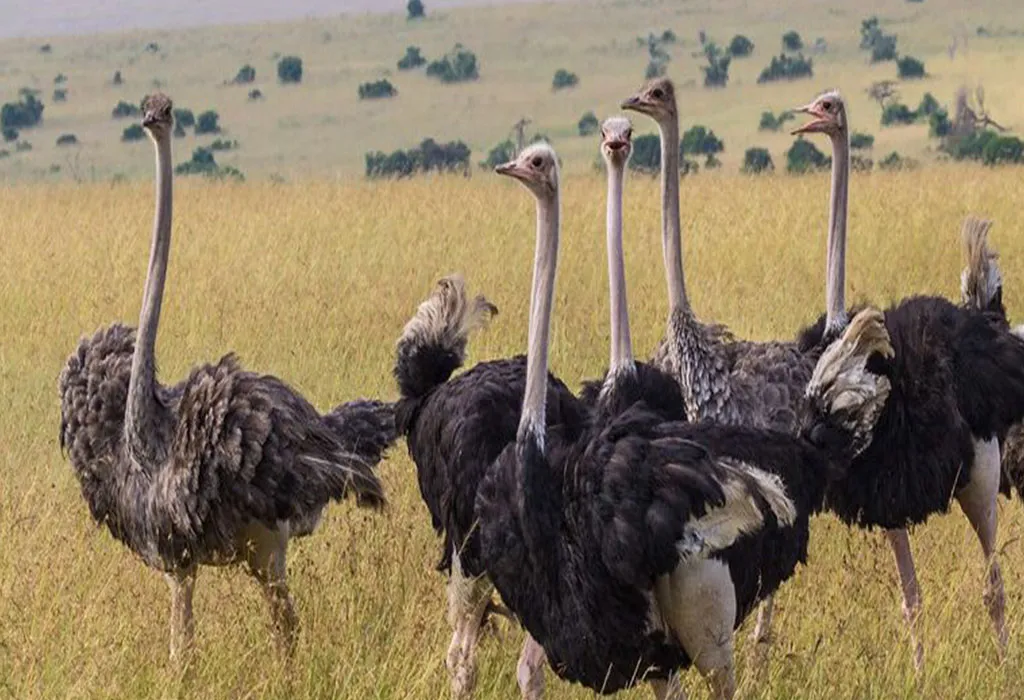 Uganda offers an exceptional variety of birds for travelers who want to make birdwatching a central part of their safari. The country’s forests, wetlands, lakes, rivers, mountains, and savannahs support very different bird communities, allowing a Uganda Safari for Bird Lovers to target everything from spectacular forest species and colorful turacos to wetland specialists, raptors, migratory birds, and the highly sought-after Shoebill.
One of the major advantages of birding in Uganda is that the experience can be tailored around particular species. Some travelers may want to search for the Shoebill, while others may prioritize Albertine Rift endemics, forest specialists, raptors, waterbirds, or a broad selection of Uganda’s resident and migratory species. The birds to spot on a Uganda safari provide a useful starting point for understanding some of the country’s most notable targets for your Uganda Safari for Bird Lovers.
The Shoebill
The Shoebill is arguably the most famous specialist bird target for many visitors planning a Uganda Safari for Bird Lovers. Its enormous shoe-shaped bill, tall stature, slow movements, and prehistoric appearance make it immediately recognizable.
In Uganda, Shoebills are associated with wetland habitats. Mabamba Bay on the shores of Lake Victoria is particularly well known for Shoebill searches, while other wetland environments provide additional opportunities, making it a must-see for any Uganda Safari for Bird Lovers.
Birders interested specifically in this species can consult the Uganda Shoebill birding guide when developing a target-species itinerary for their Uganda Safari for Bird Lovers.
Great Blue Turaco
The Great Blue Turaco is another highly attractive target for bird lovers. It is a large forest bird with striking coloration and is associated with tropical forest environments, making it a colorful highlight of a Uganda Safari for Bird Lovers.
Uganda’s forests provide important opportunities to search for this species. Kibale and other forest destinations can be particularly valuable for travelers who want to add large and colorful turacos to their bird lists, enriching their Uganda Safari for Bird Lovers.
African Green Broadbill
The African Green Broadbill is among the most sought-after forest birds in Uganda. Its distinctive green coloration and unusual shape make it a memorable target for experienced birders, a key species for a specialist Uganda Safari for Bird Lovers.
Bwindi is particularly important for travelers searching for this species. Forest birding requires patience because birds may remain concealed within vegetation, making a knowledgeable guide and careful listening particularly valuable, a crucial skill on a Uganda Safari for Bird Lovers.
Current birding information from Bwindi bird watching identifies the African Green Broadbill among the notable birds found in the forest, a top target for a Uganda Safari for Bird Lovers.
Grey Crowned Crane
The Grey Crowned Crane is Uganda’s national bird and is one of the most recognizable birds that travelers may encounter during a safari. Its crown of golden feathers and contrasting plumage make it particularly striking in open landscapes and wetland environments, a symbol of a Uganda Safari for Bird Lovers.
The species can be encountered in suitable grassland and wetland habitats, making it an excellent example of how birdwatching can be incorporated into a conventional wildlife safari, adding national pride to a Uganda Safari for Bird Lovers.
Bar-tailed Trogon
The Bar-tailed Trogon is a forest species of particular interest to birders exploring Uganda’s tropical forests. Its contrasting tail pattern and distinctive appearance make it an attractive target for forest birdwatching, a great find on a Uganda Safari for Bird Lovers.
Current information identifies forests including Semuliki, Kibale, Bwindi, and Mgahinga among locations associated with this species. Travelers interested in specialist forest birds can therefore include these environments in their itinerary for a Uganda Safari for Bird Lovers.
Green-breasted Pitta
The Green-breasted Pitta is another highly desirable target for birdwatchers visiting Uganda. It is associated with tropical forest habitats and can be challenging to locate, making a sighting particularly rewarding, a true prize on a Uganda Safari for Bird Lovers.
Current destination information associates the species with Kibale, Semuliki, Lake Bunyonyi, Bwindi, and Mgahinga. Birders targeting this species should therefore consider a forest-focused itinerary rather than relying on open savannah parks alone, a key strategy for a Uganda Safari for Bird Lovers.
Shelley’s Crimsonwing
Shelley’s Crimsonwing is an attractive forest finch and an important target for birders exploring Uganda’s highland forests. Its colorful plumage makes it especially appealing to photographers and birders developing specialist target lists, adding beauty to a Uganda Safari for Bird Lovers.
Bwindi is one of the destinations associated with this species. Searching for specialized forest birds such as Shelley’s Crimsonwing illustrates why Uganda’s montane forests are important components of a dedicated birding safari, a key part of a Uganda Safari for Bird Lovers.
Neumann’s Warbler
Neumann’s Warbler, also known as the Short-tailed Warbler, is a specialist forest bird associated with Bwindi. It is particularly interesting for experienced birders because it is usually encountered within dense forest vegetation rather than open habitats, a challenge for a Uganda Safari for Bird Lovers.
Birdwatchers searching for this species should be prepared for slow, attentive forest walks and should rely heavily on guide knowledge and bird calls, a crucial skill for a Uganda Safari for Bird Lovers.
Standard-winged Nightjar
The Standard-winged Nightjar is a distinctive nocturnal bird and an unusual target for travelers interested in expanding their Uganda bird list beyond daytime species, adding a nocturnal element to a Uganda Safari for Bird Lovers.
Current information associates this species with several Ugandan destinations, including Queen Elizabeth National Park, Semuliki, Bwindi, Lake Mburo, and Mgahinga. Its nocturnal behavior means that birders need a different approach from conventional daytime birdwatching, a unique experience on a Uganda Safari for Bird Lovers.
Doherty’s Bush-Shrike
Doherty’s Bush-Shrike is another attractive target for birders exploring Uganda. Its distinctive coloration and behavior make it a species worth including on a broader birding checklist, a rewarding find on a Uganda Safari for Bird Lovers.
Specialist birding guides can help travelers identify suitable habitats and distinguish this species from other bush-shrikes encountered during the safari, an important skill on a Uganda Safari for Bird Lovers.
African Fish Eagle
The African Fish Eagle is one of Uganda’s most recognizable raptors. It is strongly associated with lakes, rivers, wetlands, and other aquatic environments, a majestic sight on a Uganda Safari for Bird Lovers.
The species can be observed in several parts of Uganda, including around waterways where it searches for prey. Boat excursions provide particularly useful opportunities to observe birds of prey perched along watercourses, a fantastic experience on a Uganda Safari for Bird Lovers.
Martial Eagle
The Martial Eagle is one of the impressive raptors that birders may target in Uganda’s savannah environments. Its large size and powerful appearance make it an important species for raptor enthusiasts, a powerful sight on a Uganda Safari for Bird Lovers.
Queen Elizabeth National Park’s open landscapes provide opportunities to search for large raptors, while other savannah destinations can add further possibilities to a comprehensive birding itinerary for a Uganda Safari for Bird Lovers.
Bateleur
The Bateleur is another striking African raptor that can be encountered in Uganda’s open landscapes. Its characteristic flight pattern makes it an interesting species for travelers who enjoy identifying birds of prey while on game drives, a thrilling sight on a Uganda Safari for Bird Lovers.
Raptor watching can be integrated naturally into a Uganda Safari for Bird Lovers because many game-drive routes cross open habitats where birds of prey are easier to observe.
Verreaux’s Eagle-Owl
Verreaux’s Eagle-Owl is one of the largest owl species that birders may encounter in Uganda. It is a particularly attractive target for travelers interested in nocturnal birds and raptors, a magnificent creature on a Uganda Safari for Bird Lovers.
Queen Elizabeth National Park’s varied habitats provide opportunities to search for owls alongside other savannah and forest birds, adding nocturnal variety to a Uganda Safari for Bird Lovers.
African Skimmer
The African Skimmer is an unusual waterbird recognized for its specialized bill and distinctive feeding behavior. It is associated with suitable rivers and other aquatic environments, a fascinating bird to spot on a Uganda Safari for Bird Lovers.
Birders exploring Murchison Falls and other riverine landscapes may include the species among their potential targets. Water-based birding can be particularly valuable for observing species that spend much of their time around rivers and lakes, a key activity on a Uganda Safari for Bird Lovers.
Pied Kingfisher
The Pied Kingfisher is a familiar and attractive water-associated bird that can be observed around Uganda’s lakes, rivers, and wetlands. Its hovering behavior before diving for fish makes it particularly enjoyable to watch, a common but beautiful sight on a Uganda Safari for Bird Lovers.
Boat excursions provide an excellent way to observe kingfishers because waterways naturally bring birders into the habitats where these birds feed, enhancing any Uganda Safari for Bird Lovers.
Malachite Kingfisher
The Malachite Kingfisher is a small, brightly colored kingfisher associated with freshwater habitats. Its compact size and vivid coloration make it a rewarding species for photographers and birdwatchers, a splash of color on a Uganda Safari for Bird Lovers.
Wetlands, lakeshores, rivers, and channels can all provide opportunities to search for this species during a Uganda Safari for Bird Lovers.
Open-billed Stork
The Open-billed Stork is another water-associated species that birders can encounter around Uganda’s wetlands and waterways. Its specialized bill is adapted to feeding on aquatic prey, an interesting bird to observe on a Uganda Safari for Bird Lovers.
Waterbird concentrations can make boat safaris particularly productive because multiple species may gather in the same aquatic environment, adding to the abundance of a Uganda Safari for Bird Lovers.
Great Egret
The Great Egret is a large white wading bird found in suitable wetland and aquatic habitats. Its size makes it relatively easy to recognize, making it an approachable species for beginner birders, a graceful presence on a Uganda Safari for Bird Lovers.
Seeing common waterbirds such as egrets alongside specialist species is an important part of developing a broad Uganda bird checklist, a fundamental part of a Uganda Safari for Bird Lovers.
Pelicans
Uganda’s lakes and waterways can also support pelicans. Their large size and distinctive shape make them easy to recognize during boat excursions and wetland visits, a striking sight on a Uganda Safari for Bird Lovers.
Water-based birding is therefore useful not only for rare species but also for observing larger waterbirds in their natural habitats, a key activity on a Uganda Safari for Bird Lovers.
Papyrus Gonolek
The Papyrus Gonolek is a specialist associated with papyrus wetlands. Its habitat preference makes it an important target for birders visiting wetlands such as Mabamba and other papyrus ecosystems, a sought-after species on a Uganda Safari for Bird Lovers.
The species demonstrates why habitat selection is so important. Travelers who specifically want papyrus specialists should allocate time to suitable wetlands rather than focusing exclusively on forests and savannahs, a key strategy for a Uganda Safari for Bird Lovers.
Papyrus Yellow Warbler
The Papyrus Yellow Warbler is another wetland specialist that can be targeted by birders exploring papyrus habitats. Its association with wetlands makes it an important species for travelers who want to explore Uganda’s specialized aquatic ecosystems, a specialist target for a Uganda Safari for Bird Lovers.
Wetland birding also provides opportunities to observe several species within a relatively small area because water, reeds, papyrus, and surrounding vegetation attract different bird communities, making it a productive activity on a Uganda Safari for Bird Lovers.
Black Bee-eater
The Black Bee-eater is a striking species that can add considerable color and interest to a Uganda birding checklist. It is among the forest and woodland birds that specialist birders may target in suitable areas, a beautiful bird on a Uganda Safari for Bird Lovers.
Bwindi and other forest destinations provide opportunities to search for bee-eaters alongside turacos, hornbills, sunbirds, and other forest species, enriching the birding experience on a Uganda Safari for Bird Lovers.
Hornbills
Uganda supports several hornbill species, making these birds an important group for bird lovers. Their large bills, distinctive shapes, and often conspicuous movements make them easier to recognize than many small forest species, a charismatic group on a Uganda Safari for Bird Lovers.
Hornbills can occur across several habitat types, including forests, woodlands, and savannah environments, so they may be encountered during both dedicated birding excursions and conventional game drives, adding to the diversity of a Uganda Safari for Bird Lovers.
Turacos
Turacos are among Uganda’s most attractive forest birds. Their strong colors, unusual shapes, and characteristic calls make them a favorite group among birdwatchers, a colorful highlight of a Uganda Safari for Bird Lovers.
Species such as the Great Blue Turaco and Rwenzori Turaco can be important targets on forest-focused itineraries, particularly in western and southwestern Uganda, adding beauty to a Uganda Safari for Bird Lovers.
Sunbirds
Uganda’s forests, wetlands, gardens, and flowering vegetation provide habitat for numerous sunbirds. Their small size and rapid movements can make identification challenging, but their bright plumage and feeding behavior make them rewarding targets, a delightful challenge on a Uganda Safari for Bird Lovers.
Birders should pay attention to flowering plants because nectar-rich areas can attract several sunbird species, a key observation point on a Uganda Safari for Bird Lovers.
Bee-eaters
Bee-eaters are another colorful group that can be encountered during a Uganda Safari for Bird Lovers. Their aerial feeding behavior can make them particularly enjoyable to observe in open landscapes and forest edges, a vibrant presence on any safari.
Several Ugandan destinations provide opportunities to encounter different bee-eater species, depending on habitat and season, adding seasonal variety to a Uganda Safari for Bird Lovers.
Forest Birds of Bwindi
Bwindi deserves special attention because its forests support a large and diverse bird community. Current information from Anthill Safaris reports more than 350 bird species in the park and highlights Albertine Rift endemics and restricted-range species, making it a premier destination for a Uganda Safari for Bird Lovers.
Birders can potentially encounter African Green Broadbill, Western Green Tinkerbird, African Crowned Eagle, Black-throated Seedeater, Rwenzori Batis, Shelley’s Crimsonwing, Kivu Ground Thrush, Black-billed Turaco, and Rwenzori Turaco, a rich list for any Uganda Safari for Bird Lovers.
The Uganda bird watching experience can be considered when comparing birding activities for a broader Uganda safari for bird lovers.
Birds of Kibale Forest
Kibale is another important forest destination for bird lovers. Its forest ecosystem supports a wide variety of species, while nearby wetlands add further opportunities for specialist birding, making it a diverse stop on a Uganda Safari for Bird Lovers.
Travelers can combine birdwatching with other forest experiences while searching for turacos, hornbills, cuckoos, tinkerbirds, sunbirds, and other species, adding variety to a Uganda Safari for Bird Lovers.
Birds of Semuliki
Semuliki National Park is particularly valuable for birders interested in lowland forest species. Its geographical position gives the park a distinctive bird community that differs from Uganda’s highland forests, offering a unique birding experience on a Uganda Safari for Bird Lovers.
Species such as the Bar-tailed Trogon and Green-breasted Pitta are among the potential targets associated with the wider Semuliki forest environment, making it a must-visit for specialist birders on a Uganda Safari for Bird Lovers.
Birds of Queen Elizabeth National Park
Queen Elizabeth National Park provides an unusually broad birding experience because its ecosystems include savannah, wetlands, forests, crater lakes, and the Kazinga Channel, making it a top destination for a Uganda Safari for Bird Lovers.
Current information lists more than 600 bird species for the park and identifies birding areas including Kazinga Channel, Mweya Peninsula, Maramagambo Forest, Ishasha, Kasenyi Plains, Lake Kikorongo, Katwe, and other locations, offering a comprehensive birding experience.
The Queen Elizabeth birding guide can be used when developing a destination-specific birding itinerary for a Uganda Safari for Bird Lovers.
Birds of Lake Mburo
Lake Mburo National Park is particularly useful for travelers who want to combine savannah, woodland, and wetland birding. Current information lists species including African Finfoot, Saddle-billed Stork, Papyrus Yellow Warbler, White-winged Warbler, Red-faced Barbet, and other species associated with the park’s varied habitats, adding habitat diversity to a Uganda Safari for Bird Lovers.
The park’s combination of acacia woodland and wetlands means birders can target both open-country and aquatic species during the same visit, maximizing efficiency on a Uganda Safari for Bird Lovers.
Birds of Mabamba Wetland
Mabamba Bay is particularly important for wetland specialists. Current information reports more than 300 documented bird species in the wetland and highlights Papyrus Gonolek, Papyrus Yellow Warbler, Carruthers’s Cisticola, Northern Brown-throated Weaver, and the Shoebill, making it a wetland birding paradise on a Uganda Safari for Bird Lovers.
The Mabamba wetland birding experience is therefore particularly valuable for travelers whose target list includes papyrus specialists and the Shoebill, a key stop for a Uganda Safari for Bird Lovers.
Resident Birds and Migratory Birds
A Uganda Safari for Bird Lovers can include both resident and migratory species. Resident birds provide opportunities throughout the year, while migratory species can add additional diversity during their seasonal presence, making every season interesting.
Travelers interested in migration should plan their itinerary according to the habitats and periods most relevant to their target species. This is particularly important for birders who are trying to maximize their overall species list, a key consideration for a Uganda Safari for Bird Lovers.
Birding by Habitat
The most effective way to organize a bird target list is often by habitat. Forest birding can focus on turacos, broadbills, trogons, cuckoos, tinkerbirds, flycatchers, and other forest specialists. Wetland birding can target Shoebills, storks, herons, kingfishers, papyrus specialists, and other water-associated birds. This habitat-based approach is the foundation of a Uganda Safari for Bird Lovers.
Savannah birding adds raptors, bee-eaters, hornbills, cranes, bustards, larks, and other open-country species. Mountain environments can provide additional specialist and high-altitude birds, adding to the diversity of a Uganda Safari for Bird Lovers.
Birding by Region
Western Uganda is particularly useful for forest and Albertine Rift birding, with destinations such as Bwindi, Kibale, Queen Elizabeth, Semuliki, and Lake Mburo offering complementary habitats. This region is the heart of a Uganda Safari for Bird Lovers.
Central Uganda provides access to important wetland and forest environments, including Mabamba and Mabira. Northern Uganda provides extensive savannah and riverine habitats, while eastern Uganda adds mountain and highland environments, offering a complete countrywide experience for a Uganda Safari for Bird Lovers.
Birding by Target Species
Travelers should prepare their target list before beginning a Uganda Safari for Bird Lovers. Someone targeting the Shoebill should prioritize suitable wetlands. A birder interested in Albertine Rift endemics should dedicate more time to appropriate forest destinations. Raptor enthusiasts may want more time in savannah and open-country environments. This targeted approach is the most effective way to plan a Uganda Safari for Bird Lovers.
This approach allows the safari to be designed around the birds that matter most rather than simply following a generic wildlife itinerary, ensuring a personalized Uganda Safari for Bird Lovers.
Bird Photography Targets
Uganda also provides numerous opportunities for bird photography. Large species such as the Shoebill, Grey Crowned Crane, turacos, storks, kingfishers, bee-eaters, and raptors can provide visually distinctive subjects, making a Uganda Safari for Bird Lovers a photographer’s dream.
Forest photography can be more challenging because vegetation and low light may obstruct the subject. Wetland and open-country environments often provide different photographic conditions and may allow better views of birds in flight or feeding, adding variety for photographers on a Uganda Safari for Bird Lovers.
Why a Specialist Birding Guide Matters
Bird identification is not always straightforward. Several species can have similar plumage, while forest birds may be easier to identify by their calls than by sight, making a guide essential for a Uganda Safari for Bird Lovers.
An experienced birding guide can help locate birds, interpret calls, identify habitats, and organize the day around periods of peak activity. This can substantially improve the experience for both beginners and experienced birders on a Uganda Safari for Bird Lovers.
Building a Uganda Bird Target List
A useful target list should include the species that are most important to you rather than attempting to list every bird found in Uganda. Priority targets can then be grouped into forest birds, wetland birds, savannah birds, raptors, migrants, and regional specialists, making it easier to plan a focused Uganda Safari for Bird Lovers.
This makes it easier to determine which destinations deserve the most time and which species can realistically be combined on the same itinerary, optimizing your Uganda Safari for Bird Lovers.
What to Expect During Birding
Birding in Uganda requires patience. Some birds may appear immediately, while others may require quiet waiting, careful listening, or repeated visits to suitable habitat, a key part of the experience on a Uganda Safari for Bird Lovers.
Travelers should therefore avoid treating a birding safari like a checklist race. The quality of the observation, understanding of bird behavior, and experience of the habitat are just as important as the number of species recorded, a philosophy that enhances a Uganda Safari for Bird Lovers.
Making the Most of Uganda’s Bird Diversity
The strongest Uganda Safari for Bird Lovers combines different habitats and allows sufficient time for observation. Forest specialists should receive adequate forest time, wetland targets should receive dedicated wetland excursions, and savannah species should be pursued during suitable game drives or nature walks, maximizing the birding potential of your safari.
Boat excursions can further improve the experience by providing access to waterbirds and allowing close observation from aquatic environments. The Kazinga Channel boat birding experience is one example of how a boat excursion can complement land-based birdwatching on a Uganda Safari for Bird Lovers.
A Bird List That Goes Beyond the Famous Species
Although species such as the Shoebill, Great Blue Turaco, African Green Broadbill, and Grey Crowned Crane attract considerable attention, Uganda’s birding value extends far beyond a short list of famous birds, offering depth for a Uganda Safari for Bird Lovers.
Experienced birders can spend days exploring smaller forest birds, warblers, sunbirds, flycatchers, cisticolas, barbets, raptors, and other species that require more careful observation, a rewarding challenge on a Uganda Safari for Bird Lovers.
Final Perspective on Birds to See in Uganda
Uganda provides an unusually broad selection of birds for travelers who want to combine wildlife exploration with serious birdwatching. From the Shoebill-filled wetlands of Mabamba to the forests of Bwindi, Kibale, and Semuliki, and from Queen Elizabeth’s savannah and waterways to the habitats of Lake Mburo, each environment contributes different species to the overall birding experience, making a Uganda Safari for Bird Lovers an unparalleled adventure.
The best Uganda Safari for Bird Lovers should therefore be built around habitat diversity and a realistic target list. By combining forests, wetlands, lakes, rivers, mountains, and savannahs, travelers can experience a much broader representation of Uganda’s birdlife than would be possible in a single habitat. Whether the priority is a rare forest specialist, a spectacular raptor, a colorful turaco, a wetland specialist, a migratory visitor, or the iconic Shoebill, Uganda offers the ecological variety needed to create a highly rewarding birding safari.
Uganda’s Major Birding Habitats for a Uganda Safari for Bird Lovers
 A successful Uganda Safari for Bird Lovers begins with understanding the country’s habitats. Uganda’s exceptional bird diversity is closely connected to its wide range of ecosystems, including montane forests, lowland forests, wetlands, lakes, rivers, savannahs, papyrus swamps, and high-altitude environments. Each habitat supports its own community of birds, which means that travelers who explore several ecosystems can experience a much broader range of species than those who remain in one environment.
Uganda’s habitat diversity is one of the main reasons the country is attractive to birdwatchers. Current information from Uganda Rwanda Safaris describes habitats ranging from Afro-Alpine and montane forest environments to savannah, lowland forest, wetlands, and dry or semi-arid landscapes. These different ecological zones provide the foundation for Uganda’s extensive birdlife and a rich Uganda Safari for Bird Lovers.
The Uganda birding species guide provides a useful introduction to the range of birds that can be encountered across these different environments during a Uganda Safari for Bird Lovers.
Montane Forest Habitats
Montane forests are among the most important habitats for specialist birdwatchers in Uganda. These forests occur at higher elevations and support bird communities adapted to cooler, wetter, and densely vegetated environments, providing a unique birding experience on a Uganda Safari for Bird Lovers.
Bwindi Impenetrable National Park is particularly important because its montane forest supports numerous Albertine Rift species and other forest specialists. The dense vegetation can make birding challenging, but this same complexity creates habitat for species that are rarely encountered in open landscapes, a key challenge for a Uganda Safari for Bird Lovers.
Birders visiting Bwindi can explore the Bwindi forest birding experience as part of a specialist forest itinerary for a Uganda Safari for Bird Lovers.
Lowland Forests
Lowland forests provide another important birding habitat and differ ecologically from Uganda’s higher montane forests. These forests can contain species associated with Central African and Congo Basin ecosystems, particularly in western Uganda, adding to the diversity of a Uganda Safari for Bird Lovers.
Semuliki is especially interesting because of its geographical position and ecological relationship with the Congo Basin. For experienced birders, lowland forest birding can produce species that are not normally encountered in Uganda’s high-altitude forests, a unique experience on a Uganda Safari for Bird Lovers.
The diversity of forest types means that a comprehensive Uganda Safari for Bird Lovers should not automatically treat every forest as identical. Montane forests and lowland forests can produce significantly different birding experiences.
Budongo Forest Habitat
Budongo Forest Reserve provides another important lowland forest environment. Current information identifies approximately 360 bird species in Budongo and highlights the Royal Mile as a particularly important birding area, a premier forest birding spot on a Uganda Safari for Bird Lovers.
The forest supports species including Dusky Long-tailed Cuckoo, Black-headed Paradise Flycatcher, Lemon-bellied Crombec, Puvel’s Illadopsis, Slender-billed Greenbul, Chestnut-crowned Eremomela, Little Green Sunbird, White-spotted Flufftail, Chocolate-backed Kingfisher, and Cassin’s Hawk-Eagle, adding a rich variety to a Uganda Safari for Bird Lovers.
The Budongo Forest birding destination is therefore particularly useful for travelers interested in forest specialists on a Uganda Safari for Bird Lovers.
Forest Canopy Habitat
The forest canopy creates a specialized vertical habitat for birds that spend much of their lives high above the ground. Turacos, hornbills, parrots, flycatchers, sunbirds, and other species can use different levels of the forest structure, offering a unique perspective on a Uganda Safari for Bird Lovers.
Canopy birding requires patience because birds may remain partly concealed by leaves and branches. Experienced guides can help birders locate birds through their calls, movements, feeding behavior, and preferred vegetation, a key skill on a Uganda Safari for Bird Lovers.
Forest Understory Habitat
The understory is another important birding zone within tropical forests. It contains dense vegetation, shrubs, fallen vegetation, vines, and lower branches that provide food and shelter for smaller and more secretive species, adding to the biodiversity of a Uganda Safari for Bird Lovers.
Birders searching the understory may encounter species that rarely move into the open canopy. Quiet walking and careful observation are particularly important in this habitat because sudden movement can cause small birds to disappear into dense vegetation, a rewarding challenge on a Uganda Safari for Bird Lovers.
Wetland Habitats
Wetlands are among the most productive habitats for a Uganda Safari for Bird Lovers. Uganda’s wetlands support waterbirds, waders, kingfishers, herons, egrets, storks, papyrus specialists, and other species that depend on aquatic ecosystems, offering a rich birding experience.
Wetlands can also provide important seasonal habitat for migratory birds. Their combination of shallow water, vegetation, mudflats, open channels, and surrounding grassland creates feeding and resting opportunities for many different species, enhancing the value of a Uganda Safari for Bird Lovers.
The Uganda wetland birding guide provides information about important wetland environments, including Mabamba Bay, Bigodi, Semuliki, and Nabajjuzi for a Uganda Safari for Bird Lovers.
Papyrus Swamps
Papyrus swamps are among Uganda’s most distinctive birding habitats. Dense stands of papyrus provide specialized ecological conditions for birds that are closely associated with wetland vegetation, offering a unique birding experience on a Uganda Safari for Bird Lovers.
Species such as Papyrus Gonolek and Papyrus Yellow Warbler are particularly associated with papyrus habitats, while other waterbirds use the channels, open water, and wetland margins, adding specialist targets to a Uganda Safari for Bird Lovers.
Birders who specifically want papyrus specialists should therefore include suitable swamp habitats in their itinerary rather than relying only on conventional forest and savannah destinations, a key strategy for a Uganda Safari for Bird Lovers.
Mabamba Bay Wetland
Mabamba Bay Wetland is one of Uganda’s most important wetland birding environments. Current information describes it as a Ramsar site on the shores of Lake Victoria and identifies it as a major destination for birdwatchers, particularly those searching for the Shoebill, making it a must-visit for a Uganda Safari for Bird Lovers.
The wetland’s papyrus channels are normally explored by canoe, allowing visitors to enter areas that would be difficult to reach by road. The aquatic environment supports a range of waterbirds and wetland specialists, offering a serene and productive birding experience.
The Mabamba Bay birding experience is therefore particularly relevant to a wetland-focused Uganda Safari for Bird Lovers.
Bigodi Wetland Habitat
Bigodi Wetland Sanctuary provides an excellent example of a wetland environment connected to forest habitat. Current information reports more than 200 bird species in the sanctuary and highlights species such as Great Blue Turaco, Papyrus Gonolek, and Yellow-throated Tinkerbird, adding to the diversity of a Uganda Safari for Bird Lovers.
The sanctuary’s trails allow birders to explore wetland vegetation, forest edges, and surrounding habitats. This combination makes Bigodi especially useful for travelers who want to experience more than one habitat during a single excursion, a great addition to a Uganda Safari for Bird Lovers.
The Bigodi wetland birding experience can be incorporated into a wider Kibale itinerary for a Uganda Safari for Bird Lovers.
Nabajjuzi Wetland
Nabajjuzi Wetland provides another important wetland environment in south-central Uganda. Current information identifies the area as a Ramsar-designated wetland and highlights its Shoebill population and other papyrus-dependent species, adding another wetland option for a Uganda Safari for Bird Lovers.
Birders can encounter wetland species such as Grey Crowned Crane and Papyrus Yellow Warbler while exploring the area’s aquatic vegetation, enriching their Uganda Safari for Bird Lovers.
Lake and Open-Water Habitats
Uganda’s lakes provide another important birding environment. Large bodies of water create habitat for fish-eating birds, waders, ducks, cormorants, kingfishers, and other water-associated species, offering a different birding experience on a Uganda Safari for Bird Lovers.
Lake Victoria, Lake Bunyonyi, Lake George, Lake Edward, and other lakes can contribute different species to a birding itinerary depending on their surrounding vegetation, elevation, and ecological conditions, adding to the diversity of a Uganda Safari for Bird Lovers.
Lake Bunyonyi
Lake Bunyonyi is an excellent example of how lake, wetland, and highland habitats can occur together. Current information identifies more than 200 bird species around the lake, including Pied Kingfisher, Malachite Kingfisher, Cinnamon-chested Bee-eater, Bronzy Sunbird, Black Heron, Great Cormorant, and several weaver species, making it a scenic and productive stop on a Uganda Safari for Bird Lovers.
The combination of water, islands, hills, wetlands, and surrounding vegetation creates several different observation environments within the same destination, adding variety to a Uganda Safari for Bird Lovers.
The Lake Bunyonyi birdwatching guide provides further information about the area’s bird habitats and species for your Uganda Safari for Bird Lovers.
Riverine Habitats
Rivers create important corridors for birds because they connect aquatic environments with forests, woodland, grassland, and other habitats. Riverbanks can provide feeding areas, nesting sites, perches, and access to water, adding a dynamic element to a Uganda Safari for Bird Lovers.
The Nile in Murchison Falls National Park is a particularly important example. Riverine habitats support species such as Goliath Heron, African Skimmer, Pied Kingfisher, and other water-associated birds, making river birding a key activity on a Uganda Safari for Bird Lovers.
The Nile River Habitat
The Nile creates a distinctive combination of river, wetland, woodland, and savannah habitats in northern Uganda. Birders can therefore encounter aquatic species along the river while also searching for birds in the surrounding terrestrial environment, offering a diverse birding experience on a Uganda Safari for Bird Lovers.
Boat-based birding can be particularly useful because the river provides access to shorelines and sandbanks that can be difficult to observe from land, a fantastic activity for a Uganda Safari for Bird Lovers.
Savannah Habitats
Savannah is one of Uganda’s most important open-country birding habitats. Unlike dense forests, savannah provides broad visibility and supports birds adapted to grasslands, scattered trees, shrubs, and open woodland, offering a different birding perspective on a Uganda Safari for Bird Lovers.
Savannah birding can be particularly productive for raptors, bee-eaters, hornbills, cranes, storks, larks, weavers, and other species that prefer open landscapes, adding to the species list of a Uganda Safari for Bird Lovers.
Queen Elizabeth National Park’s Savannah
Queen Elizabeth National Park contains extensive savannah alongside wetlands, forests, crater lakes, and waterways. Current information identifies more than 600 bird species associated with the park, making it a top destination for a Uganda Safari for Bird Lovers.
The combination of ecosystems means birders can move between open-country birding and aquatic or forest habitats without leaving the park, maximizing birding efficiency on a Uganda Safari for Bird Lovers.
The Queen Elizabeth birding destination is therefore particularly valuable for travelers seeking habitat diversity on their Uganda Safari for Bird Lovers.
Lake Mburo’s Savannah and Woodland
Lake Mburo National Park combines savannah woodland, wetlands, acacia vegetation, and lake environments. Current information identifies more than 315 recorded bird species in the park, offering a compact and diverse birding experience for a Uganda Safari for Bird Lovers.
Species associated with the area include African Fish Eagle, Red-faced Barbet, Papyrus Yellow Warbler, African Finfoot, Saddle-billed Stork, and other wetland and woodland birds, making it a valuable stop on a Uganda Safari for Bird Lovers.
This mixture makes Lake Mburo useful for birders who want to explore open habitats while still having access to wetlands, a great combination for a Uganda Safari for Bird Lovers.
Acacia Woodland
Acacia woodland creates a transitional habitat between completely open grassland and denser forest. Its scattered trees provide nesting, feeding, and perching opportunities for numerous bird species, adding to the variety of a Uganda Safari for Bird Lovers.
Raptors can use tall trees as observation posts, while barbets, woodpeckers, hornbills, sunbirds, and other species may exploit flowers, fruits, insects, and tree cavities, enriching the birding experience on a Uganda Safari for Bird Lovers.
Grassland Habitat
Open grasslands support a different community of birds from forests and wetlands. Ground-feeding species, larks, pipits, storks, cranes, bustards, and raptors can use grassland areas for feeding and breeding, adding another habitat to a Uganda Safari for Bird Lovers.
The wide visibility of grassland can make certain birds easier to observe than forest species, although some ground-dwelling species can remain surprisingly difficult to detect, a key skill on a Uganda Safari for Bird Lovers.
Crater Lake Habitats
Crater lakes add another ecological layer to Uganda’s birding landscape. Their surrounding vegetation can include forest, grassland, wetland, and cultivated landscapes, creating several habitats around a single water body, adding to the diversity of a Uganda Safari for Bird Lovers.
The Kibale region is particularly useful because its crater lakes complement the surrounding tropical forest and wetlands, making it a rich area for a Uganda Safari for Bird Lovers.
Mountain Habitats
Mountain environments provide elevation-related changes in vegetation and bird communities. As altitude increases, forests may transition into bamboo, montane vegetation, heathland, and eventually Afro-Alpine environments on the highest peaks, offering a unique birding experience on a Uganda Safari for Bird Lovers.
These changes create opportunities for birders interested in high-altitude and montane specialists, adding a vertical dimension to a Uganda Safari for Bird Lovers.
Afro-Alpine Environments
Afro-Alpine environments represent some of Uganda’s highest and most specialized ecological zones. These habitats occur at high elevations and support species adapted to cold temperatures, strong winds, and specialized vegetation, a challenging but rewarding environment for a Uganda Safari for Bird Lovers.
Birders interested in high-altitude species may consider Uganda’s major mountain ecosystems as part of a specialist itinerary for a Uganda Safari for Bird Lovers.
Bamboo Habitats
Bamboo zones occur within some of Uganda’s mountain and forest environments. They create a transition between lower forest habitats and higher elevations and can support species that use bamboo and adjacent vegetation, adding another habitat to a Uganda Safari for Bird Lovers.
Birding in these areas requires careful habitat observation because species can be distributed differently according to elevation and vegetation type, a key skill on a Uganda Safari for Bird Lovers.
Forest Edge Habitats
Forest edges are particularly productive because they combine characteristics of forest and open habitats. Birds from both environments can occur within a relatively small area, making them a hotspot for birding on a Uganda Safari for Bird Lovers.
Sunbirds may use flowering plants at the edge, while forest birds move between trees and surrounding vegetation. Raptors and other open-country species can also use nearby clearings, adding to the birding potential of a Uganda Safari for Bird Lovers.
Wetland and Forest Transitions
Areas where wetlands meet forests can be especially productive for birdwatching. Such transition zones offer food and shelter from both ecosystems, increasing the range of species that may be observed, a prime birding location on a Uganda Safari for Bird Lovers.
Bigodi is an excellent example because its wetland environment occurs alongside forest habitat. This allows birders to encounter species associated with both ecological systems during one walk, a key highlight of a Uganda Safari for Bird Lovers.
River and Forest Transitions
Riverine forests provide another productive transition habitat. The combination of water, trees, exposed banks, and vegetation attracts aquatic species as well as forest birds, adding to the diversity of a Uganda Safari for Bird Lovers.
Murchison Falls is particularly relevant because the Nile creates a continuous aquatic corridor through a predominantly savannah environment, a unique birding environment for a Uganda Safari for Bird Lovers.
Wetland Margins
The edges of wetlands can be just as important as the open water itself. Wading birds often feed in shallow areas, while smaller birds use reeds, papyrus, shrubs, and surrounding vegetation, adding to the birding opportunities on a Uganda Safari for Bird Lovers.
For this reason, birders should not focus exclusively on the center of a wetland. Careful observation of the margins can reveal species that would otherwise be overlooked, a key skill on a Uganda Safari for Bird Lovers.
Woodland and Wetland Combinations
Some of Uganda’s most productive birding destinations contain woodland immediately beside wetlands. Lake Mburo is an example where acacia woodland, grassland, lake habitats, and wetlands occur within the same protected landscape, offering a diverse birding experience on a Uganda Safari for Bird Lovers.
This ecological combination allows birders to move between habitat types and potentially increase the diversity of species observed during a relatively short period, maximizing the efficiency of a Uganda Safari for Bird Lovers.
Why Habitat Diversity Matters for Bird Lists
Habitat diversity directly influences the number and variety of birds a traveler can encounter. A forest specialist is unlikely to be found in open savannah, while many wetland birds depend on aquatic vegetation that does not occur in montane forest, making habitat diversity the cornerstone of a Uganda Safari for Bird Lovers.
Therefore, a Uganda Safari for Bird Lovers should normally include complementary habitats when the objective is to build a broad species list.
Habitat-Based Birding Is Better Than Random Destination Selection
Choosing destinations according to habitats provides a more logical way to design a birding safari. Travelers should first identify the types of birds they want to see and then determine which habitats support those species, a key principle for a Uganda Safari for Bird Lovers.
For example, a Shoebill-focused itinerary should emphasize wetlands, while an Albertine Rift specialist itinerary should emphasize appropriate montane forests, ensuring a targeted Uganda Safari for Bird Lovers.
How Forest Birding Differs From Savannah Birding
Forest birding is often based on sound, movement, and careful scanning through vegetation. Birds may remain concealed, and visibility can be limited by leaves and branches, offering a different challenge on a Uganda Safari for Bird Lovers.
Savannah birding generally offers greater visibility because the landscape is more open. However, birds can be spread across large areas, meaning that patience and careful scanning are still essential, adding a different skill set to a Uganda Safari for Bird Lovers.
How Wetland Birding Differs From Forest Birding
Wetland birding often provides opportunities to observe birds in open water, along shorelines, within papyrus, or around shallow pools. Some species are conspicuous, while others are hidden within dense wetland vegetation, offering a different birding experience on a Uganda Safari for Bird Lovers.
Boat excursions can improve access to wetland habitats by allowing birders to move quietly through channels and approach areas that are difficult to reach on foot, a key activity on a Uganda Safari for Bird Lovers.
Habitat Diversity and Bird Photography
Different habitats also provide different photographic conditions. Open savannahs can provide clearer backgrounds and greater visibility, while wetlands can offer reflections and unobstructed views of waterbirds, adding variety for photographers on a Uganda Safari for Bird Lovers.
Forests can be more challenging because low light and vegetation may obstruct the subject, but they can also produce photographs of species that are difficult to encounter elsewhere, a rewarding challenge for photographers on a Uganda Safari for Bird Lovers.
Habitat Diversity and Migratory Birds
Migratory birds use different habitats depending on their feeding and resting requirements. Uganda’s wetlands, forests, lakes, and open landscapes can therefore become important parts of a seasonal birding itinerary, adding a seasonal dimension to a Uganda Safari for Bird Lovers.
Current information identifies the Lake Victoria Basin and Mabamba among important areas for migratory birds, with October to March highlighted as a peak migration period in one current Uganda birding source, enhancing the planning for a Uganda Safari for Bird Lovers.
Habitat Diversity Around Lake Victoria
Lake Victoria and its surrounding wetlands create an extensive aquatic landscape that supports resident and migratory birdlife. Mabamba Bay is one of the most important birding sites within this broader environment, a key location for a Uganda Safari for Bird Lovers.
The lake, papyrus wetlands, open water, and surrounding terrestrial habitats create a variety of ecological niches that support different bird groups, adding to the diversity of a Uganda Safari for Bird Lovers.
Habitats of Murchison Falls
Murchison Falls National Park demonstrates how several habitats can occur within one destination. The park combines extensive savannah with the Nile River, riverine vegetation, wetlands, and woodland, offering a comprehensive birding experience on a Uganda Safari for Bird Lovers.
This combination is particularly useful for birders who want to observe both water-associated species and open-country birds without moving between distant destinations, maximizing birding time on a Uganda Safari for Bird Lovers.
Habitats of Queen Elizabeth National Park
Queen Elizabeth National Park contains savannah, forests, wetlands, crater lakes, and major water bodies. Current information identifies more than 600 bird species associated with these ecosystems, making it a premier destination for a Uganda Safari for Bird Lovers.
This makes the park particularly useful for a Uganda Safari for Bird Lovers that aims to maximize habitat diversity within a single destination.
Habitats of Bwindi
Bwindi’s primary value is its forest habitat. Its dense montane environment provides opportunities for Albertine Rift species, forest specialists, and other birds associated with highland ecosystems, making it a cornerstone of a Uganda Safari for Bird Lovers.
Birders should approach Bwindi differently from a savannah park. Quiet walking, listening for calls, and careful scanning of the canopy and understory are more important than simply covering large distances, a key skill for a Uganda Safari for Bird Lovers.
Habitats of Kibale
Kibale provides a combination of tropical forest and surrounding wetland and crater-lake environments. This makes the region especially useful for travelers who want to combine forest birding with aquatic and wetland species, a key part of a Uganda Safari for Bird Lovers.
The region can therefore contribute significantly to a multi-habitat Uganda Safari for Bird Lovers.
Habitats of Lake Bunyonyi
Lake Bunyonyi combines highland lake environments with surrounding hills, wetlands, islands, and vegetation. This creates a visually dramatic landscape while also providing habitat for more than 200 recorded bird species according to current destination information, adding a scenic element to a Uganda Safari for Bird Lovers.
Its location also makes it practical to combine with other southwestern Uganda destinations, a great addition to a Uganda Safari for Bird Lovers.
Choosing Habitats According to Your Birding Goals
Birders should identify whether their priority is forest specialists, wetland birds, savannah species, waterbirds, raptors, migrants, or high-altitude birds before finalizing a safari route, a key planning step for a Uganda Safari for Bird Lovers.
Once the target group has been established, destinations can be selected according to their habitat characteristics. This approach creates a more efficient and productive Uganda Safari for Bird Lovers.
Creating a Multi-Habitat Uganda Birding Safari
A comprehensive itinerary can combine several ecosystems. A traveler might begin with wetland birding around Mabamba, continue to forest birding in Kibale, explore savannah and water-associated habitats in Queen Elizabeth, and finish with montane forest birding in Bwindi, creating a well-rounded Uganda Safari for Bird Lovers.
Longer itineraries can add Budongo, Semuliki, Lake Mburo, Mount Elgon, or other specialist environments depending on the target list, offering a comprehensive Uganda Safari for Bird Lovers.
Why Uganda’s Habitats Make Birding So Rewarding
The real strength of Uganda’s birding experience lies in the relationship between habitat and species. Forests produce specialist forest birds, wetlands support aquatic and papyrus species, lakes and rivers attract waterbirds, savannahs support open-country species, and mountains create specialized high-altitude environments. This ecological variety allows travelers to experience substantially different bird communities during one countrywide safari, making a Uganda Safari for Bird Lovers an unparalleled experience.
Final Guide to Uganda’s Major Birding Habitats
Uganda’s major birding habitats include montane forests, lowland forests, wetlands, papyrus swamps, lakes, rivers, savannahs, woodlands, grasslands, mountains, and Afro-Alpine environments. Each habitat contributes different species and therefore deserves consideration when designing a bird-focused itinerary for a Uganda Safari for Bird Lovers.
The best Uganda Safari for Bird Lovers should be planned around these ecological differences. Instead of simply collecting destinations, travelers should identify their target species, understand the habitats those birds depend on, and then construct an itinerary that provides sufficient time in each relevant environment. From the papyrus channels of Mabamba to the forests of Bwindi and Budongo, the wetlands of Bigodi, the lake environment of Bunyonyi, and the savannah and riverine habitats of Queen Elizabeth and Murchison Falls, Uganda offers an un usually broad range of birding environments. For bird lovers, exploring these habitats is ultimately what transforms a conventional wildlife journey into a comprehensive Uganda Safari for Bird Lovers, with every forest, wetland, lake, river, mountain, and savannah providing a different opportunity to understand and experience Uganda’s remarkable avian diversity.
Uganda Bird Species and What Makes Them Special for a Uganda Safari for Bird Lovers

Lake Mburo National Park offers rewarding birdwatching across its wetlands, savannah, woodland and lakeshore habitats.
Uganda’s birdlife is one of the strongest reasons to choose the country for a dedicated birding safari. The country’s combination of forests, wetlands, lakes, rivers, mountains, savannahs, and other habitats supports a remarkably varied bird community. For bird lovers, this means a Uganda Safari for Bird Lovers can include spectacular large birds, colorful forest species, waterbirds, raptors, migratory species, and highly localized birds that require specialist knowledge to find.
Current birding information from Uganda Rwanda Safaris describes Uganda as having a very high level of bird diversity across its different habitats. The exact number of species can vary between sources and taxonomic treatments, so figures should be treated according to the particular checklist or source being used rather than presented as an absolute fixed number, but the diversity is undeniable for a Uganda Safari for Bird Lovers.
The Uganda bird species guide highlights several of the country’s notable targets, including the Shoebill, Great Blue Turaco, Shelley’s Crimsonwing, Short-tailed Warbler, Standard-winged Nightjar, and Doherty’s Bush-Shrike, all must-sees on a Uganda Safari for Bird Lovers.
Why Uganda Has Such Diverse Birdlife
Uganda’s bird diversity is closely connected to its geographical position and habitat variety. The country contains ecosystems ranging from lowland forests and wetlands to montane forests, savannahs, lakes, rivers, and high-altitude environments, making it ideal for a Uganda Safari for Bird Lovers.
Each ecosystem provides different food sources, nesting opportunities, shelter, and climatic conditions. As a result, species that specialize in forests can coexist within the same country with birds adapted to wetlands, grasslands, open woodland, and mountains, offering a rich birding experience.
Bird Species Diversity Across Different Habitats
Birders should think of Uganda’s bird species in relation to habitat. Forests are especially important for turacos, broadbills, tinkerbirds, flycatchers, cuckoos, sunbirds, and other forest specialists. Wetlands support storks, herons, egrets, kingfishers, papyrus specialists, and other water-associated birds. This habitat-based diversity is the foundation of a Uganda Safari for Bird Lovers.
Savannah environments support raptors, hornbills, bee-eaters, cranes, larks, storks, and numerous open-country species. Mountain ecosystems add another layer of specialization, particularly at higher elevations, adding to the depth of a Uganda Safari for Bird Lovers.
Albertine Rift Endemic Birds
One of the most important features of Uganda’s birdlife is its connection with the Albertine Rift. This region contains species with restricted geographical ranges, making them particularly valuable targets for specialist birders on a Uganda Safari for Bird Lovers.
Bwindi is especially significant for this reason. Current information from Anthill Safaris reports more than 348 bird species in the park and identifies up to 25 Albertine Rift endemics in the area, including species such as Grauer’s Broadbill, Shelley’s Crimsonwing, and Kivu Ground Thrush, making it a premier destination for a Uganda Safari for Bird Lovers.
The Bwindi birdwatching guide provides further information about these specialist forest birds for a Uganda Safari for Bird Lovers.
The Shoebill as a Signature Uganda Bird
The Shoebill is one of Uganda’s most sought-after bird species. Its enormous bill, tall stature, distinctive appearance, and specialized wetland habitat make it an especially memorable target, and often the highlight of a Uganda Safari for Bird Lovers.
Current information identifies Mabamba Bay, along the shores of Lake Victoria, and Murchison Falls among places where Shoebills may be encountered. A dedicated wetland excursion can therefore be an important component of a bird-focused itinerary when the species is a priority for a Uganda Safari for Bird Lovers.
The Great Blue Turaco
The Great Blue Turaco is one of Uganda’s most visually impressive forest birds. It is large, colorful, and strongly associated with forest environments, adding a splash of color to any Uganda Safari for Bird Lovers.
Its size makes it easier to recognize than many small forest species, although dense vegetation can still make observation challenging. The species is an excellent example of why forest birding rewards patience and careful scanning on a Uganda Safari for Bird Lovers.
Shelley’s Crimsonwing
Shelley’s Crimsonwing is a highly attractive finch and an important target for birders exploring Uganda’s highland forests. Its restricted habitat preferences make it more significant to specialist birders than a common generalist species, a prized find on a Uganda Safari for Bird Lovers.
Current information from Uganda Rwanda Safaris describes the species as a distinctive member of the finch family and identifies it among notable birds to seek in Uganda, a key target for a Uganda Safari for Bird Lovers.
Neumann’s Warbler
Neumann’s Warbler, also known as the Short-tailed Warbler, is a forest specialist associated with Bwindi. Its behavior and habitat make it a very different birding target from conspicuous wetland or savannah birds, a challenge for experienced birders on a Uganda Safari for Bird Lovers.
The species can be difficult to locate because it moves through forest vegetation and may spend time close to the ground. This makes an experienced guide particularly useful when searching for it on a Uganda Safari for Bird Lovers.
Standard-winged Nightjar
The Standard-winged Nightjar is an unusual target because it represents Uganda’s nocturnal birdlife. It is associated with several Ugandan destinations, including Queen Elizabeth, Semuliki, Bwindi, Lake Mburo, and Mgahinga according to current destination information, adding a nocturnal element to a Uganda Safari for Bird Lovers.
Searching for nocturnal species requires a different approach from daytime forest and wetland birding. Birders should therefore treat nightbird targets as a specialized part of their itinerary for a Uganda Safari for Bird Lovers.
Doherty’s Bush-Shrike
Doherty’s Bush-Shrike is another attractive species included among Uganda’s notable birding targets. Its distinctive appearance makes it a rewarding addition to a birdwatcher’s checklist, a great find on a Uganda Safari for Bird Lovers.
Bush-shrikes also demonstrate why learning bird calls and behavior is important. Visual identification is not always possible immediately, particularly when birds remain within dense vegetation, a key skill on a Uganda Safari for Bird Lovers.
Forest Bird Specialists
Uganda’s forests support some of the country’s most interesting specialist birds. These include broadbills, turacos, trogons, tinkerbirds, flycatchers, cuckoos, sunbirds, barbets, and numerous other forest species, making forests a key habitat for a Uganda Safari for Bird Lovers.
Forest birding is different from watching birds in open landscapes because visibility can be limited. A bird may be nearby but hidden by leaves, branches, vines, or dense understory, a rewarding challenge on a Uganda Safari for Bird Lovers.
The African Green Broadbill
The African Green Broadbill is among the specialist forest birds that can make a Uganda birding safari particularly rewarding. It is associated with forest habitat and is considered a major target in Bwindi, a must-see for a Uganda Safari for Bird Lovers.
Current information from Anthill Safaris specifically identifies the Mubwindi Swamp Trail as a notable area for sightings of the localized Green Broadbill, a key location for a Uganda Safari for Bird Lovers.
Kivu Ground Thrush
Kivu Ground Thrush is another Albertine Rift-associated bird that adds value to Uganda’s highland forest birding. It is a specialist target rather than a species that visitors should expect to encounter casually on every safari, a prized find for experienced birders on a Uganda Safari for Bird Lovers.
Birders interested in such restricted-range species should dedicate adequate time to the appropriate forests and work with guides who understand local bird behavior and habitat preferences, a key strategy for a Uganda Safari for Bird Lovers.
Rwenzori Turaco
The Rwenzori Turaco is another important forest bird for specialist birders. Its association with the highland forests of western Uganda makes it especially relevant to itineraries that include the Albertine Rift, a colorful highlight of a Uganda Safari for Bird Lovers.
Turacos are generally among the most appealing birds for photographers because of their striking shapes and colors, although forest conditions can make photography challenging, a rewarding challenge for photographers on a Uganda Safari for Bird Lovers.
Black-billed Turaco
The Black-billed Turaco is another forest species that birders may encounter in Uganda. Its presence illustrates the diversity of turacos available to visitors who explore different forest ecosystems, adding to the richness of a Uganda Safari for Bird Lovers.
Rather than concentrating on one famous bird, experienced birders can build a broader target list around the different turaco species encountered across Uganda’s forests, a great strategy for a Uganda Safari for Bird Lovers.
Waterbirds
Uganda’s lakes, rivers, wetlands, and swamps support a large variety of water-associated birds. These include kingfishers, herons, egrets, storks, cormorants, pelicans, darters, jacanas, and other aquatic species, offering a different birding experience on a Uganda Safari for Bird Lovers.
Waterbirds are often easier to observe than secretive forest species because they may gather around open water, exposed shorelines, mudflats, or wetland vegetation, making them great targets for birders on a Uganda Safari for Bird Lovers.
The African Fish Eagle
The African Fish Eagle is one of Uganda’s most recognizable raptors. Its association with lakes and rivers makes it a regular target during aquatic birding excursions, a majestic sight on a Uganda Safari for Bird Lovers.
Its large size and conspicuous behavior can make it approachable for beginner birders while still being rewarding for experienced photographers, a great bird for all skill levels on a Uganda Safari for Bird Lovers.
Kingfishers
Uganda supports several kingfisher species, including Pied Kingfisher and Malachite Kingfisher. Their relationship with freshwater environments makes rivers, lakes, channels, and wetlands important places to search for them, adding vibrant colors to a Uganda Safari for Bird Lovers.
Their feeding behavior can also make them interesting to observe because some species perch near water before diving or pursuing aquatic prey, a fascinating sight on a Uganda Safari for Bird Lovers.
Papyrus Specialists
Papyrus wetlands support birds that depend heavily on this specialized vegetation. Papyrus Gonolek and Papyrus Yellow Warbler are examples of species that make wetland birding particularly interesting, a unique target for a Uganda Safari for Bird Lovers.
These birds demonstrate why habitat-specific birding is important. A traveler seeking papyrus specialists must deliberately include suitable wetland habitats in the itinerary for a Uganda Safari for Bird Lovers.
Savannah Birds
Uganda’s savannah ecosystems support a completely different group of bird species. Open grassland and woodland provide habitat for raptors, hornbills, bee-eaters, cranes, storks, larks, weavers, and many other birds, adding to the diversity of a Uganda Safari for Bird Lovers.
Game drives can therefore become productive birding sessions when travelers pay attention to trees, grasslands, roadside vegetation, waterholes, and the sky above the savannah, a key activity on a Uganda Safari for Bird Lovers.
Raptors
Uganda offers opportunities to observe a wide range of birds of prey. These include large eagles, fish eagles, hawks, kites, and other raptors occupying different ecological niches, a thrilling sight on a Uganda Safari for Bird Lovers.
Raptor watching can be particularly productive in open habitats because large birds often use prominent trees or thermals to search for prey and move across the landscape, a key activity on a Uganda Safari for Bird Lovers.
The Martial Eagle
The Martial Eagle is one of the impressive large raptors that birders may target in Uganda’s savannah environments. Its size and hunting ability make it an important species for raptor enthusiasts, a powerful sight on a Uganda Safari for Bird Lovers.
Finding large raptors requires careful scanning of open skies and prominent trees. Early morning and other periods of active bird movement can be particularly useful for systematic raptor observation on a Uganda Safari for Bird Lovers.
The Bateleur
The Bateleur is another distinctive raptor that can add considerable interest to a savannah birding list. Its characteristic shape and flight behavior can make identification possible even when the bird is viewed from a distance, a fascinating bird to spot on a Uganda Safari for Bird Lovers.
Birders should learn the silhouettes and flight patterns of common African raptors because many sightings occur before a bird comes close enough for detailed plumage identification, a key skill on a Uganda Safari for Bird Lovers.
Birds of Budongo Forest
Budongo Forest is an important destination for bird species associated with lowland forest. Current information from Uganda Rwanda Safaris lists about 360 bird species and identifies the Royal Mile as an important birding area, a key forest destination for a Uganda Safari for Bird Lovers.
Species highlighted for Budongo include Dusky Long-tailed Cuckoo, Black-headed Paradise Flycatcher, Lemon-bellied Crombec, Puvel’s Illadopsis, Slender-billed Greenbul, Chestnut-crowned Eremomela, Little Green Sunbird, White-spotted Flufftail, Chocolate-backed Kingfisher, and Cassin’s Hawk-Eagle, adding a rich variety to a Uganda Safari for Bird Lovers.
The Budongo Forest birding destination is therefore valuable for travelers interested in lowland forest species on a Uganda Safari for Bird Lovers.
Birds of Kibale
Kibale provides an important combination of tropical forest and surrounding aquatic habitats. Current information from Uganda Rwanda Safaris reports more than 350 bird species in the Kibale region, making it a diverse stop on a Uganda Safari for Bird Lovers.
Species associated with the wider area include Great Blue Turaco, Black-and-White Casqued Hornbill, Olive Long-tailed Cuckoo, Western Tinkerbird, Papyrus Gonolek, White-winged Warbler, and Grey Parrot, a fantastic list for a Uganda Safari for Bird Lovers.
Birds of Semuliki
Semuliki is particularly important for birders interested in lowland forest and species associated with the Congo Basin influence. Current information from Anthill Safaris describes more than 400 bird species in the park, making it a unique stop for a Uganda Safari for Bird Lovers.
Species highlighted include Congo Serpent Eagle, Long-tailed Hawk, and Lyre-tailed Honeyguide. The park therefore offers a birding experience that differs from the highland forests of southwestern Uganda, adding a unique dimension to a Uganda Safari for Bird Lovers.
Birds of Murchison Falls
Murchison Falls National Park combines savannah and riverine habitats, making it useful for both terrestrial and water-associated bird species. Current information from Anthill Safaris reports more than 450 bird species, offering a comprehensive birding experience on a Uganda Safari for Bird Lovers.
Birding highlights include African Fish Eagle, kingfishers, herons, Shoebill, Abyssinian Ground Hornbill, Giant Kingfisher, Black-headed Lapwing, Secretary Bird, and Grey Crowned Crane, making it a top destination for a Uganda Safari for Bird Lovers.
The Murchison Falls birding destination is therefore useful for combining river and savannah birding for a Uganda Safari for Bird Lovers.
Birds of Lake Mburo
Lake Mburo provides an interesting combination of wetlands, acacia woodland, grassland, and lake habitats. Current information from Uganda Rwanda Safaris lists approximately 315 bird species in the park, while other current sources give higher figures depending on the checklist used, offering a compact and diverse birding experience for a Uganda Safari for Bird Lovers.
Notable species include Red-faced Barbet, African Finfoot, Papyrus Yellow Warbler, Saddle-billed Stork, White-winged Warbler, African Fish Eagle, and other woodland and wetland species, adding great variety to a Uganda Safari for Bird Lovers.
Birds of Mabamba
Mabamba is particularly valuable for wetland birders. Its papyrus channels and shallow-water environment provide habitat for the Shoebill and other aquatic species, making it a must-visit for a Uganda Safari for Bird Lovers.
Current information from Anthill Safaris also highlights African Fish Eagles, Malachite Kingfishers, Pied Kingfishers, herons, egrets, and other wetland birds in the area, adding to the richness of a Uganda Safari for Bird Lovers.
Birds of Lake Bunyonyi
Lake Bunyonyi supports a diverse bird community associated with its lake, wetland, hillside, and surrounding vegetation. Current information lists more than 200 species in the area, making it a scenic and productive stop on a Uganda Safari for Bird Lovers.
Species mentioned include Pied Kingfisher, Malachite Kingfisher, Cinnamon-chested Bee-eater, Bronzy Sunbird, Black Heron, Great Cormorant, Hadada Ibis, Grey Crowned Crane, weavers, and other species, adding a beautiful setting to a Uganda Safari for Bird Lovers.
The Lake Bunyonyi birdwatching guide provides further information about its bird community for your Uganda Safari for Bird Lovers.
Birds of Mabira Forest
Mabira Forest provides another opportunity to explore lowland forest birdlife relatively close to central Uganda. Current information reports more than 315 bird species in the forest, offering accessible forest birding for a Uganda Safari for Bird Lovers.
Notable species include Afep Pigeon, African Dwarf Kingfisher, and Grey Parrot. The forest’s trails also provide opportunities to identify birds through calls and movements, a great stop for a Uganda Safari for Bird Lovers.
Birds of Kidepo Valley
Kidepo Valley National Park provides a very different birding environment from the forests of western Uganda. Current information from Anthill Safaris reports more than 475 bird species and highlights Ostrich, Secretary Bird, Kori Bustard, and Abyssinian Ground Hornbill, adding a unique northern dimension to a Uganda Safari for Bird Lovers.
The Narus Valley, Kidepo Valley, open savannahs, and seasonal wetlands provide varied habitat for birders who want to add northern Uganda species to their checklist, a great addition for experienced birders on a Uganda Safari for Bird Lovers.
Bird Identification in Forests
Forest bird identification often requires more than simply looking at plumage. Calls, habitat, behavior, feeding patterns, movement, size, and location can all help distinguish species, a key skill on a Uganda Safari for Bird Lovers.
A bird may only be visible for a few seconds before moving behind vegetation. Learning to recognize calls can therefore significantly improve the chances of identifying forest species correctly, a crucial skill for a Uganda Safari for Bird Lovers.
Bird Identification in Wetlands
Wetland species can often be identified using shape, bill structure, leg length, feeding behavior, and habitat. Storks, herons, egrets, kingfishers, and other waterbirds have distinctive physical adaptations that can assist identification, a key skill on a Uganda Safari for Bird Lovers.
However, several waterbirds can look similar at a distance, so careful observation and reference material remain important, adding to the challenge on a Uganda Safari for Bird Lovers.
Bird Identification in Savannahs
Savannah bird identification often benefits from learning silhouettes and flight patterns. Raptors may be observed at considerable distances, while ground birds can be partially hidden by grass, a key skill on a Uganda Safari for Bird Lovers.
Understanding the habitat also helps narrow identification. A bird observed around open water is likely to have a different ecological association from one found high in an acacia tree or feeding on open grassland, a useful skill for a Uganda Safari for Bird Lovers.
Why Bird Calls Matter
Bird calls are especially important in Uganda’s forests. Some species can be heard long before they are seen, and experienced guides often use calls to determine where birds are located, a key skill on a Uganda Safari for Bird Lovers.
Learning a small number of distinctive calls before the safari can therefore make the experience more productive. It also encourages birders to observe behavior rather than depending exclusively on photographs, enhancing the overall experience of a Uganda Safari for Bird Lovers.
Why Bird Behavior Matters
Behavior provides valuable identification information. A bird hovering over water, climbing a tree trunk, feeding on fruit, diving into water, hunting from a perch, or moving through dense understory is providing clues about its identity, a key observation point on a Uganda Safari for Bird Lovers.
Understanding behavior also improves the quality of a birding experience because it helps travelers appreciate how individual species interact with their habitats, adding depth to a Uganda Safari for Bird Lovers.
Bird Species and Seasonal Variation
Uganda’s bird community changes seasonally as migratory species arrive and depart. Resident birds can be encountered throughout the year, while migratory birds increase the diversity available during their seasonal presence, adding a temporal dimension to a Uganda Safari for Bird Lovers.
Birders with specific targets should therefore consider season when developing their itinerary. A safari designed around resident forest specialists may require different planning from one designed to maximize migratory species, a key planning consideration for a Uganda Safari for Bird Lovers.
Resident Species Versus Migratory Species
Resident species are birds that maintain populations in Uganda throughout the year. Migratory species visit seasonally, often traveling long distances between breeding and non-breeding areas, adding to the diversity of a Uganda Safari for Bird Lovers.
A strong Uganda birding itinerary can include both categories. This provides travelers with opportunities to observe Uganda’s permanent avian community while also benefiting from seasonal additions to the bird list, creating a comprehensive Uganda Safari for Bird Lovers.
Rare Birds and Realistic Expectations
Rare or highly localized birds should always be treated as targets rather than guaranteed sightings. Even when a species occurs in a particular habitat, weather, season, food availability, behavior, and simple chance can affect whether it is observed, a key mindset for a Uganda Safari for Bird Lovers.
This is particularly important for forest specialists. A bird can be present without becoming visible during a particular walk, a reality of birding on a Uganda Safari for Bird Lovers.
Common Birds Are Also Valuable
A birding safari should not focus exclusively on rare species. Common birds provide opportunities to learn identification skills, understand bird behavior, and appreciate the ecological relationships within each habitat, a key part of a Uganda Safari for Bird Lovers.
For beginner birders, familiar species can also provide useful practice before moving on to more difficult forest specialists, making a Uganda Safari for Bird Lovers accessible to all.
Building a Balanced Uganda Bird List
A balanced checklist can include signature species such as the Shoebill, Albertine Rift specialists, forest birds, wetland species, raptors, savannah birds, and common species encountered along the route, creating a well-rounded Uganda Safari for Bird Lovers.
This approach produces a more meaningful record of the safari than concentrating exclusively on a small number of famous birds, a great way to document a Uganda Safari for Bird Lovers.
What Makes Uganda’s Bird Species Special
Uganda’s bird species are special because the country brings together several major ecological communities within a relatively accessible safari destination. Birders can move from wetlands to forests, from lakes to savannahs, and from lowland environments to high-altitude habitats, making a Uganda Safari for Bird Lovers an unparalleled experience.
This ecological range means that a single Uganda Safari for Bird Lovers can expose travelers to species with dramatically different behaviors, appearances, habitats, and ecological roles.
Final Perspective on Uganda’s Bird Species
Uganda’s birdlife extends far beyond a checklist of famous species. Its real strength lies in the combination of specialist birds, Albertine Rift endemics, wetland species, forest birds, raptors, migratory visitors, and widespread species that can be encountered across different ecosystems, offering depth for a Uganda Safari for Bird Lovers.
For travelers planning a Uganda Safari for Bird Lovers, the most effective strategy is to build the itinerary around habitats and target species rather than simply collecting destinations. Bwindi can provide access to specialist Albertine Rift forest birds, Budongo and Semuliki add lowland forest diversity, wetlands such as Mabamba provide opportunities for the Shoebill and other waterbirds, while Murchison Falls, Queen Elizabeth, Lake Mburo, and Kidepo add savannah and riverine species. The result is a birding experience in which every destination contributes something different. With realistic expectations, careful identification, adequate time, and knowledgeable guiding, Uganda’s bird species can become the central focus of an exceptionally diverse safari.
Birding Regions and Safari Circuits for a Uganda Safari for Bird Lovers

Exploring Uganda’s premier birding regions during a golden sunset game drive.
Planning a successful Uganda Safari for Bird Lovers requires more than selecting a list of national parks. Uganda’s birding destinations are spread across different ecological regions, and each region offers a distinct combination of forest, wetland, savannah, riverine, mountain, and lake habitats. Organizing these destinations into practical birding circuits allows travelers to spend more time observing birds and less time making unnecessary journeys between widely separated locations, a key logistical consideration for a Uganda Safari for Bird Lovers.
A well-designed birding circuit should therefore consider target species, habitat diversity, geographical position, available birding activities, and the amount of time available. Birders concentrating on Albertine Rift specialists will need a different route from travelers whose main goal is to see the Shoebill, while those seeking a broad Uganda bird list should combine several ecological regions, a key planning step for a Uganda Safari for Bird Lovers.
The Uganda safari circuit can be adapted around birding priorities by combining destinations with complementary habitats rather than simply following a conventional wildlife route, ensuring a tailored Uganda Safari for Bird Lovers.
Understanding Uganda’s Main Birding Regions
Uganda can be approached as several broad birding regions. These include the central Lake Victoria and wetland region, the western forest and Albertine Rift region, the northern savannah and Nile region, the southwestern highlands, and the eastern mountain region, offering a comprehensive framework for a Uganda Safari for Bird Lovers.
These regions should not be treated as rigid administrative divisions. They are useful planning categories that help birders understand which destinations can reasonably be combined and what type of birding each area provides, a key planning tool for a Uganda Safari for Bird Lovers.
Central Uganda and Lake Victoria Birding Circuit
Central Uganda is an important starting point for many birding safaris because it provides access to Lake Victoria and several wetland environments. Mabamba Bay is particularly important for birders whose target list includes the Shoebill, making it a key starting point for a Uganda Safari for Bird Lovers.
Mabamba’s papyrus channels are explored by canoe, creating an opportunity to search quietly through wetland habitat. The area also supports other aquatic and papyrus-associated birds, making it valuable even when the Shoebill is not the only objective, a great start to a Uganda Safari for Bird Lovers.
The wetland birding circuit can therefore provide an effective introduction to Uganda’s aquatic bird habitats before a traveler continues toward western Uganda, a classic beginning for a Uganda Safari for Bird Lovers.
Mabamba Bay as a Gateway Birding Stop
Mabamba Bay works particularly well at the beginning or end of an itinerary because of its relationship with the Lake Victoria region. A traveler arriving through Entebbe can potentially incorporate wetland birding before continuing toward other parts of the country, making it a convenient start or end for a Uganda Safari for Bird Lovers.
The main attraction is the opportunity to search for the Shoebill, but the wetland also provides opportunities to observe kingfishers, herons, egrets, jacanas, and papyrus specialists, adding to the richness of a Uganda Safari for Bird Lovers.
Central Wetland Circuit Planning
A central wetland circuit should allow enough time for an early morning excursion rather than treating Mabamba as a rushed stop between unrelated activities. Birding is most effective when travelers have time to move slowly, listen for calls, and scan the wetland carefully, a key practice on a Uganda Safari for Bird Lovers.
Where the itinerary allows, birders can combine a Lake Victoria wetland experience with other central or southwestern destinations before entering the Albertine Rift, creating a well-rounded Uganda Safari for Bird Lovers.
Western Uganda Birding Region
Western Uganda is arguably the most important broad region for travelers seeking a combination of forest, wetland, lake, and Albertine Rift birding. The region includes destinations such as Kibale, Bigodi, Queen Elizabeth, Semuliki, and Bwindi, making it the heart of a Uganda Safari for Bird Lovers.
Its major advantage is ecological variety. A traveler can move from lowland forest and wetland environments to montane forest and then into savannah and aquatic habitats, offering a comprehensive birding experience on a Uganda Safari for Bird Lovers.
Kibale and Bigodi Birding Circuit
Kibale National Park and Bigodi Wetland Sanctuary form one of the most useful combinations for birders interested in forest and wetland species. Kibale’s tropical forest supports numerous forest birds, while Bigodi adds wetland and forest-edge species, making it a top combination for a Uganda Safari for Bird Lovers.
Current information identifies more than 350 bird species in the Kibale region and highlights species including Great Blue Turaco, Black-and-White Casqued Hornbill, Olive Long-tailed Cuckoo, Western Tinkerbird, Papyrus Gonolek, White-winged Warbler, and Grey Parrot, a fantastic list for a Uganda Safari for Bird Lovers.
The Kibale birding itinerary can be useful when planning a longer stay around the forest and its surrounding habitats for a Uganda Safari for Bird Lovers.
Why Kibale and Bigodi Work Well Together
Kibale and Bigodi complement each other because they provide different ecological conditions within the same general region. Forest trails allow birders to search the canopy and understory, while Bigodi provides wetland, papyrus, forest-edge, and open-water environments, offering a diverse birding experience on a Uganda Safari for Bird Lovers.
This combination is particularly useful for travelers who want to increase habitat diversity without adding another long-distance transfer to their itinerary, a key efficiency for a Uganda Safari for Bird Lovers.
Semuliki Birding Circuit
Semuliki should be considered separately when designing a specialist western Uganda circuit. Its lowland forest environment has strong ecological connections with the Congo Basin, making it particularly interesting for birders searching for species that are less typical of Uganda’s highland forests, a unique addition to a Uganda Safari for Bird Lovers.
Current information identifies more than 400 bird species in Semuliki and highlights species such as Congo Serpent Eagle, Long-tailed Hawk, and Lyre-tailed Honeyguide, making it a specialist stop for a Uganda Safari for Bird Lovers.
The Semuliki birding region is particularly valuable for experienced birders with specialist target lists on a Uganda Safari for Bird Lovers.
Semuliki and Kibale Combination
Combining Semuliki with Kibale can create a strong forest-focused circuit. The two destinations offer different ecological conditions, allowing birders to search for both species associated with Kibale’s tropical forest and species associated with Semuliki’s lowland environment, a great combination for a Uganda Safari for Bird Lovers.
This circuit is especially appropriate for travelers who place greater emphasis on bird diversity than on covering the maximum number of conventional wildlife parks, a key strategy for a Uganda Safari for Bird Lovers.
Queen Elizabeth Birding Region
Queen Elizabeth National Park is strategically positioned between several western Uganda birding destinations. Its combination of savannah, wetlands, forests, crater lakes, and the Kazinga Channel provides a very different experience from the forest environments of Kibale and Bwindi, adding savannah variety to a Uganda Safari for Bird Lovers.
Current information identifies more than 600 bird species associated with the park, making it one of the strongest additions to a multi-habitat birding circuit for a Uganda Safari for Bird Lovers.
The Queen Elizabeth birding circuit can therefore bridge western forest birding with southern and southwestern safari routes for a Uganda Safari for Bird Lovers.
Kibale to Queen Elizabeth Circuit
Kibale and Queen Elizabeth are particularly logical to combine because of their geographical proximity and contrasting habitats. A traveler can spend time searching for forest birds in Kibale before moving into Queen Elizabeth’s savannah, wetland, and riverine environments, a fantastic transition for a Uganda Safari for Bird Lovers.
This creates an immediate change in the bird community and increases the potential range of species encountered without requiring a major cross-country transfer, a key efficiency for a Uganda Safari for Bird Lovers.
Queen Elizabeth and Bwindi Circuit
Queen Elizabeth can also be combined with Bwindi to create one of Uganda’s strongest forest-and-savannah birding circuits. Queen Elizabeth contributes open habitats and aquatic environments, while Bwindi provides montane forest and Albertine Rift specialists, a premier combination for a Uganda Safari for Bird Lovers.
The circuit is especially attractive to travelers who want to combine general bird diversity with a focused search for highland forest species, a great way to maximize birding on a Uganda Safari for Bird Lovers.
Bwindi Birding Region
Bwindi is one of the most important destinations for specialist birders because of its montane forest and Albertine Rift bird community. Current information identifies more than 350 bird species in the park and highlights numerous restricted-range species, making it a cornerstone of a Uganda Safari for Bird Lovers.
Important birding areas include Buhoma, Ruhija, Rushaga, and trails leading into the forest. The different trailheads provide access to different parts of the park and should be considered when planning accommodation and birding activities, a key planning consideration for a Uganda Safari for Bird Lovers.
The Bwindi birding circuit is particularly relevant for travelers targeting Albertine Rift species on a Uganda Safari for Bird Lovers.
Bwindi Trailhead Planning
Bwindi is divided into several tourism sectors, and birders should consider their chosen sector when planning the safari. The Buhoma area provides access to forest trails, while Ruhija is particularly important for specialist birding and high-altitude habitats, a key planning step for a Uganda Safari for Bird Lovers.
Current information identifies the Mubwindi Swamp Trail as a notable area for the Green Broadbill and highlights the Bamboo Trail toward Rwamunyonyi Peak as an area for high-altitude species, a key location for a Uganda Safari for Bird Lovers.
Bwindi and Lake Bunyonyi Circuit
Bwindi and Lake Bunyonyi form a practical southwestern combination. After intensive forest birding in Bwindi, travelers can explore the lake environment and its surrounding hills and wetlands, a scenic addition to a Uganda Safari for Bird Lovers.
Current information identifies more than 200 bird species around Lake Bunyonyi, including Pied Kingfisher, Malachite Kingfisher, Cinnamon-chested Bee-eater, Bronzy Sunbird, Black Heron, Great Cormorant, and other species, adding to the richness of a Uganda Safari for Bird Lovers.
The Lake Bunyonyi birding circuit therefore complements a Bwindi forest itinerary for a Uganda Safari for Bird Lovers.
Lake Bunyonyi as a Birding Extension
Lake Bunyonyi is particularly useful as an extension rather than necessarily as the central destination of a specialist birding safari. Its lake, islands, hills, wetlands, and surrounding vegetation create opportunities for a different group of species after forest birding, a great addition to a Uganda Safari for Bird Lovers.
The combination can also provide a change in pace after several days of walking through montane forest, a welcome respite on a Uganda Safari for Bird Lovers.
Lake Mburo Birding Region
Lake Mburo National Park provides an important southern Uganda birding stop. Its combination of acacia woodland, grassland, wetlands, and lake habitats creates opportunities to search for both woodland and wetland specialists, adding habitat diversity to a Uganda Safari for Bird Lovers.
Current information identifies around 315 bird species in the park, including Papyrus Yellow Warbler, African Finfoot, Saddle-billed Stork, Red-faced Barbet, and other species, a great stop for a Uganda Safari for Bird Lovers.
The Lake Mburo birding stop is particularly convenient when building a southwestern circuit for a Uganda Safari for Bird Lovers.
Lake Mburo and Bwindi Circuit
Lake Mburo and Bwindi can provide a strong contrast between open-country and montane forest birding. Lake Mburo contributes acacia woodland, grassland, wetlands, and lake species, while Bwindi provides dense forest and Albertine Rift specialists, a great combination for a Uganda Safari for Bird Lovers.
This combination is useful when a traveler wants both broad bird diversity and specialist forest birding, a key strategy for a Uganda Safari for Bird Lovers.
Budongo and Murchison Falls Birding Region
Northern and northwestern Uganda provide another important birding circuit based around Budongo Forest and Murchison Falls National Park. The combination is particularly valuable because it connects lowland forest birding with savannah and riverine birding, adding a northern dimension to a Uganda Safari for Bird Lovers.
Budongo supports approximately 360 recorded bird species according to current destination information, with the Royal Mile identified as an important birding area. Murchison Falls supports more than 450 species according to current Anthill Safaris information, offering a comprehensive birding experience for a Uganda Safari for Bird Lovers.
The Budongo birding circuit is therefore a strong option for travelers seeking lowland forest specialists on a Uganda Safari for Bird Lovers.
Budongo Forest as a Specialist Stop
Budongo should receive more than a brief visit when forest birds are a major priority. The Royal Mile is particularly important and supports species such as Dusky Long-tailed Cuckoo, Black-headed Paradise Flycatcher, Lemon-bellied Crombec, Puvel’s Illadopsis, Slender-billed Greenbul, Chestnut-crowned Eremomela, and Little Green Sunbird, a key stop for a Uganda Safari for Bird Lovers.
The forest also provides an important ecological contrast to the savannah environments encountered elsewhere in the northern circuit, adding to the diversity of a Uganda Safari for Bird Lovers.
Murchison Falls Birding Circuit
Murchison Falls National Park combines the Nile River with extensive savannah and woodland habitats. This makes it particularly valuable for birders who want to combine waterbirds and open-country species, a top destination for a Uganda Safari for Bird Lovers.
Current information identifies more than 450 bird species and highlights the boat cruise to the falls as a productive opportunity for observing African Fish Eagles, kingfishers, herons, and other water-associated species, a key activity on a Uganda Safari for Bird Lovers.
The Murchison river birding circuit can be integrated with game-drive birding across the surrounding savannah for a Uganda Safari for Bird Lovers.
Murchison Falls and Budongo Combination
Budongo and Murchison Falls are particularly complementary because the two destinations offer substantially different habitats. A morning in the forest can target small and secretive forest birds, while a later game drive or river excursion can focus on large waterbirds, raptors, hornbills, and savannah species, a fantastic combination for a Uganda Safari for Bird Lovers.
This combination can significantly increase habitat diversity without requiring a completely separate regional journey, a key efficiency for a Uganda Safari for Bird Lovers.
Kidepo Valley Birding Region
Kidepo Valley National Park represents a different birding region in northeastern Uganda. Its open savannahs, valleys, seasonal water sources, and semi-arid landscapes support birds that differ from those found in the wetter forests and wetlands of western Uganda, offering a unique addition to a Uganda Safari for Bird Lovers.
Current information identifies species such as Ostrich, Secretary Bird, Kori Bustard, and Abyssinian Ground Hornbill among the important birding attractions of the region, a must-see for experienced birders on a Uganda Safari for Bird Lovers.
The Kidepo birding region is best suited to travelers with sufficient time for northern Uganda or those with specific northeastern targets for a Uganda Safari for Bird Lovers.
Why Kidepo Should Usually Be Planned Separately
Kidepo is geographically distant from Uganda’s principal western birding destinations. Consequently, adding it to a short birding itinerary can result in considerable travel time, a key logistical consideration for a Uganda Safari for Bird Lovers.
For this reason, Kidepo works best as a dedicated northern circuit or as part of a longer Uganda birding safari rather than being inserted into a short western route without sufficient time, a key planning principle for a Uganda Safari for Bird Lovers.
Eastern Uganda and Mount Elgon Birding Circuit
Eastern Uganda provides another birding option centered on Mount Elgon and the surrounding highland environment. The elevation gradient creates different vegetation zones and supports a range of mountain and restricted-range species, adding an eastern dimension to a Uganda Safari for Bird Lovers.
Current information from Uganda Rwanda Safaris reports more than 296 bird species around Mount Elgon and identifies numerous restricted-range birds, making it a unique stop for a Uganda Safari for Bird Lovers.
The Mount Elgon birding region can therefore be considered by travelers who want to add eastern Uganda’s mountain habitats to their itinerary for a Uganda Safari for Bird Lovers.
Eastern Versus Western Birding Circuits
The western circuit is particularly strong for Albertine Rift species, lowland forest, wetland, lake, and savannah combinations. The eastern circuit provides a different experience through Mount Elgon and its highland habitats, offering a choice for a Uganda Safari for Bird Lovers.
Birders with limited time should normally choose a region according to their target species instead of trying to cover every part of Uganda, a key planning principle for a Uganda Safari for Bird Lovers.
Short Uganda Birding Circuit
A short birding safari should prioritize destinations that provide several habitats without excessive travel. A practical structure can combine a central wetland experience with western Uganda, depending on the traveler’s entry point and target list, a great option for a short Uganda Safari for Bird Lovers.
For a Shoebill-focused trip, Mabamba can be given priority. For forest specialists, Kibale or Bwindi may deserve more time. For a general birding experience, combining wetland, forest, and savannah habitats provides greater ecological variety, a key strategy for a Uganda Safari for Bird Lovers.
One-Week Birding Circuit
A one-week itinerary should avoid trying to visit too many distant destinations. A more effective approach is to select two or three complementary areas and allocate sufficient birding time to each, a key principle for a one-week Uganda Safari for Bird Lovers.
For example, a western circuit could combine Kibale and Bigodi with Queen Elizabeth, while a specialist forest itinerary could concentrate on Kibale and Bwindi or focus more deeply on Bwindi’s birding sectors, a great option for a Uganda Safari for Bird Lovers.
Ten-Day Birding Circuit
Ten days allow greater flexibility and can support a circuit combining central wetlands, western forests, savannah, and southwestern highlands. This length is more suitable for travelers who want both target species and a broad overall bird list, a great option for a Uganda Safari for Bird Lovers.
A possible structure could include Mabamba, Kibale, Queen Elizabeth, and Bwindi, with the exact number of nights adjusted according to the species priorities of the traveler, a comprehensive itinerary for a Uganda Safari for Bird Lovers.
Two-Week Uganda Birding Circuit
A two-week birding safari can incorporate a much broader range of habitats. Depending on the target list, travelers could consider Mabamba, Kibale, Semuliki, Queen Elizabeth, Bwindi, Lake Mburo, or Murchison Falls and Budongo, offering a comprehensive Uganda Safari for Bird Lovers.
Trying to include all of these destinations at once can still create a rushed itinerary, so the final selection should be based on target species rather than simply the number of parks visited, a key planning principle for a Uganda Safari for Bird Lovers.
Specialist Albertine Rift Circuit
Birders primarily interested in Albertine Rift species should concentrate on western and southwestern Uganda. Bwindi is particularly important, while other forest environments can complement the itinerary, making it a premier route for a Uganda Safari for Bird Lovers.
A specialist route should allocate multiple birding sessions rather than relying on one short forest walk. Restricted-range species may require repeated searches and careful attention to calls and habitat, a key practice for a Uganda Safari for Bird Lovers.
Wetland Specialist Circuit
A wetland-focused circuit should prioritize Mabamba and other suitable wetlands, potentially adding Bigodi, Nabajjuzi, Lake Mburo, or wetland environments around Queen Elizabeth depending on the target species, a great option for a Uganda Safari for Bird Lovers.
This type of safari is particularly appropriate for birders interested in Shoebill, papyrus specialists, waders, kingfishers, herons, storks, and other aquatic species, a key focus for a Uganda Safari for Bird Lovers.
Forest Specialist Circuit
A forest-focused circuit can combine several forest types rather than visiting only one forest. Kibale provides tropical forest birding, Budongo provides lowland forest, Semuliki adds Congo Basin-influenced lowland habitat, and Bwindi provides montane Albertine Rift forest, offering a comprehensive forest birding experience for a Uganda Safari for Bird Lovers.
This is one of the most productive approaches for serious birders who want to maximize the variety of forest species, a key strategy for a Uganda Safari for Bird Lovers.
Savannah Birding Circuit
Travelers interested in raptors, hornbills, cranes, bustards, bee-eaters, and other open-country species can emphasize Murchison Falls, Queen Elizabeth, Lake Mburo, and Kidepo Valley, adding a savannah focus to a Uganda Safari for Bird Lovers.
These destinations differ significantly in ecology, so a longer safari can reveal substantial variation even when the focus remains on savannah birds, a great way to experience the diversity of a Uganda Safari for Bird Lovers.
Mixed Wildlife and Birding Circuit
Not every traveler wants a birding-only safari. Uganda also allows birders to combine birdwatching with gorilla trekking, chimpanzee trekking, game drives, boat excursions, and other wildlife experiences, creating a well-rounded Uganda Safari for Bird Lovers.
A mixed itinerary can still be highly productive for birding if the traveler communicates their birding priorities before the safari and ensures that sufficient time is reserved for dedicated birdwatching, a key strategy for a Uganda Safari for Bird Lovers.
How to Choose Between Circuits
The best circuit depends on three main factors: target species, available time, and desired habitat diversity. A birder searching for the Shoebill should prioritize wetlands, while someone pursuing Albertine Rift specialists should prioritize western montane forests, a key planning step for a Uganda Safari for Bird Lovers.
Travelers with broad interests should combine contrasting ecosystems. Travelers with highly specific target lists should spend more time in fewer destinations where those birds are most likely to occur, a key principle for a Uganda Safari for Bird Lovers.
Why Travel Time Matters in Birding
Long transfers reduce the amount of time available for actual observation. This is particularly important because birding is often most productive during the early morning and other periods of high bird activity, a key consideration for a Uganda Safari for Bird Lovers.
A circuit should therefore balance geographical coverage with birding hours. Visiting fewer destinations with meaningful time at each can produce a stronger birding experience than visiting many destinations briefly, a key principle for a Uganda Safari for Bird Lovers.
How to Build an Efficient Birding Route
Start by identifying the highest-priority birds. Next, group those species according to habitat and geographical region. Then select destinations that overlap in both habitat and location, a key planning method for a Uganda Safari for Bird Lovers.
This method avoids unnecessary backtracking and makes it easier to create a logical route. It also provides more opportunities to revisit productive habitats if weather or bird behavior affects the first attempt, a key practice for a Uganda Safari for Bird Lovers.
Use Target Species to Determine the Route
A target list should guide the circuit rather than being created after the route has already been chosen. For example, a birder targeting the Green Broadbill should place Bwindi high on the itinerary, while a Shoebill target should make appropriate wetland habitats a priority, a key strategy for a Uganda Safari for Bird Lovers.
This approach is particularly important for specialist species because not every major Ugandan safari destination is equally suitable for every bird, a key planning principle for a Uganda Safari for Bird Lovers.
Use Habitat Diversity to Increase the Species List
Birders who want a large and varied checklist should deliberately combine habitats. Forest, wetland, lake, river, savannah, and mountain environments each contribute different species, a key principle for a Uganda Safari for Bird Lovers.
A well-designed circuit can therefore increase bird diversity without requiring every destination in Uganda to be visited, a key efficiency for a Uganda Safari for Bird Lovers.
Regional Circuits for Repeat Visitors
Repeat visitors can explore different regions on separate safaris rather than attempting to see everything during one trip. A first safari might focus on western Uganda, while a later trip can concentrate on Murchison Falls and Budongo, Kidepo, or Mount Elgon, a great strategy for a Uganda Safari for Bird Lovers.
This approach allows each journey to have a clear birding objective and reduces the pressure to cover excessive distances, a key principle for a Uganda Safari for Bird Lovers.
Planning Around Birding Seasons
Seasonal conditions should also influence circuit selection. Resident birds can be sought throughout the year, while migratory birds add seasonal opportunities. Current information identifies October to March as an important period for migratory birding in Uganda and East Africa, adding a temporal dimension to a Uganda Safari for Bird Lovers.
Birders targeting migrants should therefore consider the timing of their trip alongside the geographical route, a key planning step for a Uganda Safari for Bird Lovers.
Early Morning Birding Across the Circuits
Regardless of the selected region, early morning is an important period for birding. Birds are often active as they begin feeding, calling, and moving through their habitats, a key practice for a Uganda Safari for Bird Lovers.
It is therefore worth protecting the early morning hours from unnecessary travel whenever possible. A circuit that allows travelers to remain near productive habitat overnight can be more effective than one that requires long early-morning transfers, a key efficiency for a Uganda Safari for Bird Lovers.
Combining Boat Birding With Land Birding
Boat excursions can add a different perspective to a regional circuit. Mabamba provides canoe-based wetland birding, while the Nile at Murchison Falls and the Kazinga Channel in Queen Elizabeth provide opportunities to observe water-associated birds from the water, adding a unique perspective to a Uganda Safari for Bird Lovers.
Combining boat and land-based birding can expand the range of habitats explored and improve opportunities to observe species that remain difficult to see from roads or walking trails, a key strategy for a Uganda Safari for Bird Lovers.
Combining Forest Walks With Game Drives
Forest walks and game drives provide complementary birding experiences. Forest walks are particularly useful for small, secretive, and canopy-associated species, while game drives provide broad access to open habitats and raptors, a great combination for a Uganda Safari for Bird Lovers.
Queen Elizabeth and Murchison Falls are especially useful for this mixed approach because their landscapes contain extensive open habitats alongside aquatic and wooded environments, a top destination for a Uganda Safari for Bird Lovers.
Planning a Uganda Birding Circuit Around Priority Birds
The most efficient Uganda Safari for Bird Lovers is one in which every major destination has a purpose. A forest destination should contribute forest specialists, a wetland should contribute aquatic or papyrus species, and a savannah park should contribute open-country birds, a key principle for a Uganda Safari for Bird Lovers.
When destinations are selected in this way, the safari becomes a connected birding journey rather than a collection of unrelated attractions, a key strategy for a Uganda Safari for Bird Lovers.
Final Guide to Uganda Birding Regions and Safari Circuits
Uganda’s birding regions offer complementary experiences. Central Uganda provides access to Lake Victoria and important wetlands. Western Uganda combines Kibale, Bigodi, Queen Elizabeth, Semuliki, and Bwindi, creating one of the country’s richest multi-habitat birding areas. The northern circuit links Budongo and Murchison Falls, while Kidepo provides a distinctive northeastern experience. Eastern Uganda adds Mount Elgon and its highland habitats. The best circuit depends on the birder’s priorities. Shoebill enthusiasts should emphasize wetlands, Albertine Rift specialists should prioritize appropriate western forests, forest enthusiasts can combine Kibale, Budongo, Semuliki, and Bwindi, while travelers seeking broad savannah diversity can consider Murchison Falls, Queen Elizabeth, Lake Mburo, and Kidepo. Ultimately, a successful Uganda Safari for Bird Lovers should minimize unnecessary travel, maximize time in productive habitats, and match each destination to a clear birding objective. With careful regional planning, Uganda’s forests, wetlands, lakes, rivers, mountains, and savannahs can be combined into a highly productive birding circuit tailored to the species and habitats that matter most to each traveler.
Uganda Birding Safari Itineraries
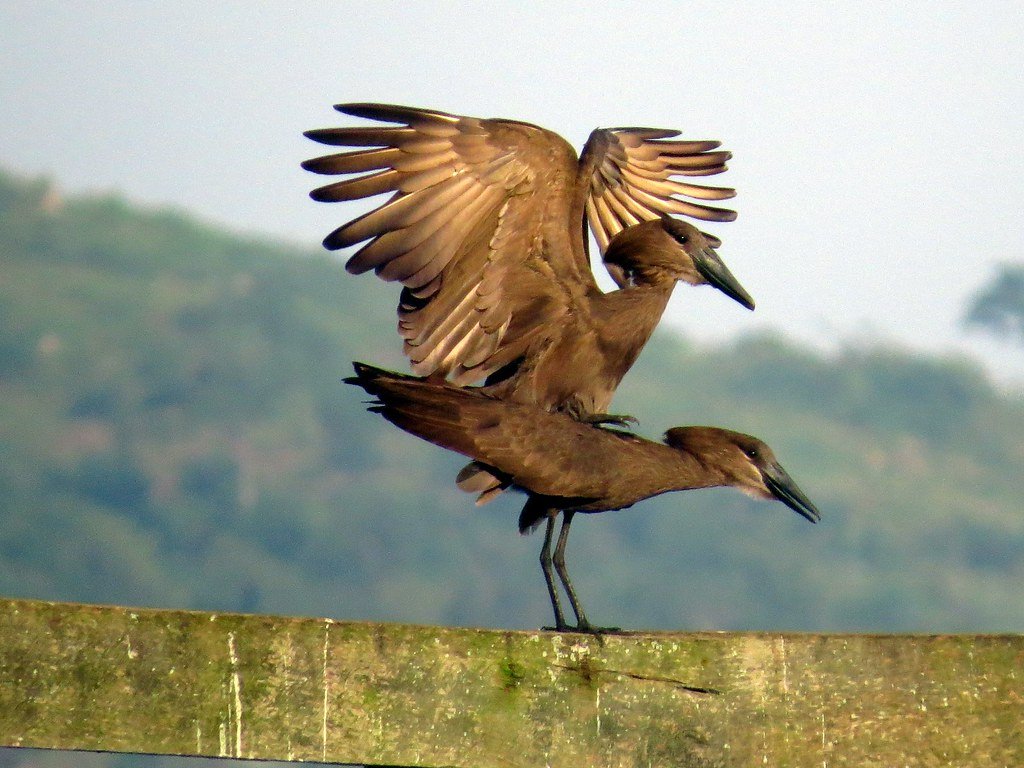
Birds To Spot On Safari in Uganda
A well-planned Uganda birding safari itinerary should be built around the habitats, bird species, and regions that matter most to the traveler. Uganda’s combination of forests, wetlands, lakes, rivers, savannahs, mountains, and Albertine Rift habitats makes it possible to create short birding trips as well as extended specialist expeditions. The key is to give each destination enough time for meaningful bird observation rather than trying to visit too many locations in a rushed journey, a key principle for a Uganda Safari for Bird Lovers.
A Uganda birding safari can be designed for first-time birdwatchers, experienced birders, photographers, specialist listers, or travelers who want to combine birding with gorilla trekking, chimpanzee tracking, wildlife viewing, and other experiences. The itinerary should therefore begin with the traveler’s birding objectives before destinations and daily activities are selected, a key planning step for a Uganda Safari for Bird Lovers.
The birding species guide is a useful starting point for identifying priority species before building the route for a Uganda Safari for Bird Lovers.
How to Design a Uganda Birding Safari Itinerary
The first step is to establish the purpose of the trip. A traveler interested in seeing as many species as possible will need a broader habitat-based route, while someone targeting Albertine Rift specialists should dedicate more time to western and southwestern forests, a key distinction for a Uganda Safari for Bird Lovers.
Travelers specifically interested in the Shoebill should prioritize wetlands, while birders interested in forest specialists should allocate substantial time to destinations such as Bwindi, Kibale, Budongo, or Semuliki, a key strategy for a Uganda Safari for Bird Lovers.
Start With a Birding Target List
A target list helps determine where the safari should go. Rather than selecting parks first and hoping that the desired birds appear, birders can identify priority species and then select the habitats where those species are documented, a key principle for a Uganda Safari for Bird Lovers.
Targets can include the Shoebill, Great Blue Turaco, African Green Broadbill, Shelley’s Crimsonwing, Short-tailed Warbler, Rwenzori Turaco, papyrus specialists, forest birds, raptors, migratory species, or a broad selection of Uganda’s birdlife, a great list for a Uganda Safari for Bird Lovers.
Short Uganda Birding Safari Itinerary
A short Uganda birding safari should concentrate on destinations that provide substantial bird diversity without creating excessive travel time. A three- to five-day trip can work particularly well when the traveler chooses one geographical region and explores several complementary habitats within it, a great option for a short Uganda Safari for Bird Lovers.
For travelers arriving through Entebbe, a wetland excursion to Mabamba can provide an efficient introduction to Uganda’s birdlife. The papyrus channels provide opportunities to search for the Shoebill and other wetland species, a classic start for a Uganda Safari for Bird Lovers.
The Mabamba wetland experience can be used as the foundation of a short birding itinerary for a Uganda Safari for Bird Lovers.
Three-Day Birding Safari Structure
A three-day itinerary should avoid long cross-country transfers. A practical structure is to dedicate the first day to arrival and nearby birding, the second day to intensive habitat exploration, and the third day to another birding session followed by departure, a great option for a short Uganda Safari for Bird Lovers.
This type of itinerary works particularly well for birders who have one or two priority species rather than a long national checklist, a key efficiency for a Uganda Safari for Bird Lovers.
Four-Day Birding Safari Structure
Four days provide slightly more flexibility. Travelers can combine a wetland experience with a forest or woodland environment, allowing the bird list to include species from contrasting habitats, a great option for a Uganda Safari for Bird Lovers.
For example, Mabamba can provide wetland birding while another destination can provide forest-edge or woodland species. The precise combination should depend on the traveler’s entry point and priority birds, a key consideration for a Uganda Safari for Bird Lovers.
Five-Day Birding Safari Itinerary
A five-day Uganda birding safari can begin to provide a broader habitat experience. A traveler may combine central wetlands with a western forest destination or concentrate on Kibale and Bigodi for forest and wetland birding, a great option for a Uganda Safari for Bird Lovers.
The Bigodi birding experience can be particularly useful for combining forest and wetland interests for a Uganda Safari for Bird Lovers.
One-Week Uganda Birding Safari
A seven-day itinerary is long enough to create a meaningful regional birding circuit. The route should still be kept geographically logical so that most of the day is spent birding rather than traveling, a key principle for a one-week Uganda Safari for Bird Lovers.
A western Uganda itinerary can combine Kibale, Bigodi, and Queen Elizabeth, while a specialist forest itinerary can concentrate more heavily on Bwindi. A wetland-focused itinerary can instead prioritize Mabamba and other suitable wetland habitats, a great option for a Uganda Safari for Bird Lovers.
Seven-Day Western Uganda Birding Itinerary
A seven-day western itinerary can combine tropical forest, wetland, savannah, and aquatic habitats. Kibale and Bigodi provide forest and wetland birding, while Queen Elizabeth adds savannah, crater lakes, and riverine environments, a classic itinerary for a Uganda Safari for Bird Lovers.
Current information describes Queen Elizabeth as supporting more than 600 bird species across diverse ecosystems, making it a strong destination for increasing habitat diversity for a Uganda Safari for Bird Lovers.
The Queen Elizabeth birding guide can help travelers understand the birding opportunities available within the park for a Uganda Safari for Bird Lovers.
Seven-Day Bwindi Birding Itinerary
A week centered on Bwindi can be particularly appropriate for specialist birders. Rather than treating the forest as a single short activity, travelers can dedicate multiple mornings to different trails and sectors, a key strategy for a Uganda Safari for Bird Lovers.
Bwindi’s montane forest supports numerous Albertine Rift species, making it especially valuable for birders with specialist target lists. Early starts are important because forest birds can be most active during the cooler morning period, a key practice for a Uganda Safari for Bird Lovers.
The Bwindi itinerary information can help travelers combine birding with other experiences in the area for a Uganda Safari for Bird Lovers.
Seven-Day Murchison and Budongo Birding Itinerary
Murchison Falls and Budongo create another strong seven-day combination. Budongo provides lowland forest birding, while Murchison Falls adds savannah, riverine, wetland, and open-country environments, a great combination for a Uganda Safari for Bird Lovers.
Current information reports approximately 360 bird species in Budongo and more than 450 species in Murchison Falls, although species totals can differ between sources and taxonomic treatments, offering a comprehensive birding experience for a Uganda Safari for Bird Lovers.
The Budongo forest destination is particularly useful for travelers targeting forest species on a Uganda Safari for Bird Lovers.
Ten-Day Uganda Birding Safari
Ten days allow a more comprehensive Uganda birding safari itinerary. Travelers can begin with central wetlands, move into western forests, continue through savannah habitats, and finish in southwestern Uganda, a great option for a longer Uganda Safari for Bird Lovers.
A ten-day itinerary should still avoid excessive destination switching. Two or three major birding bases with several full birding sessions can be more productive than staying one night at many different locations, a key principle for a Uganda Safari for Bird Lovers.
Ten-Day Western Uganda Birding Circuit
A western circuit of approximately ten days can combine Kibale, Bigodi, Queen Elizabeth, and Bwindi. This route offers tropical forest, wetland, savannah, lake, riverine, and montane forest habitats, a comprehensive itinerary for a Uganda Safari for Bird Lovers.
The major advantage is habitat diversity. Each destination contributes a different group of birds, giving travelers opportunities to expand their checklist while maintaining a logical geographical route, a key benefit of a Uganda Safari for Bird Lovers.
Two-Week Uganda Birding Safari
A two-week itinerary provides enough time to create a substantially broader birding experience. Travelers can consider adding Semuliki, Budongo, Murchison Falls, Lake Mburo, or another specialist destination to a western Uganda circuit, a great option for an extended Uganda Safari for Bird Lovers.
The route should be based on target species rather than simply the desire to visit as many parks as possible. Every additional destination should contribute a meaningful habitat or species group, a key principle for a Uganda Safari for Bird Lovers.
Two-Week Specialist Birding Itinerary
A specialist two-week safari can focus heavily on forests and restricted-range birds. One possible structure is to combine Kibale, Semuliki, Bwindi, and another forest environment, a great option for specialist birders on a Uganda Safari for Bird Lovers.
This allows travelers to experience different forest ecosystems, including tropical, lowland, and montane environments, while increasing their chances of encountering specialist species, a key strategy for a Uganda Safari for Bird Lovers.
Two-Week Mixed Habitat Itinerary
A mixed-habitat itinerary can include Mabamba, Kibale, Queen Elizabeth, Bwindi, and Lake Mburo. This provides wetland, forest, savannah, lake, woodland, and montane habitats, a comprehensive itinerary for a Uganda Safari for Bird Lovers.
This approach is particularly suitable for birders who want a broad representation of Uganda’s birdlife rather than a narrowly focused specialist list, a great option for a Uganda Safari for Bird Lovers.
Three-Week Uganda Birding Safari
A three-week itinerary provides considerably more flexibility and can include several of Uganda’s principal birding regions. Travelers can combine central wetlands, western forests, northern savannah, Murchison Falls, Budongo, and southwestern highlands, a comprehensive itinerary for a Uganda Safari for Bird Lovers.
At this length, the itinerary can also allow contingency time. This is useful because bird sightings cannot be guaranteed, and additional time in productive habitats can help compensate for poor weather or missed target species, a key advantage of a longer Uganda Safari for Bird Lovers.
Birding Safari for Shoebill Enthusiasts
Travelers whose principal objective is seeing the Shoebill should structure the itinerary around suitable wetland environments. Mabamba Bay is one of the best-known locations, while Murchison Falls and other wetlands can provide additional opportunities, a key focus for a Uganda Safari for Bird Lovers.
The Shoebill safari guide provides information about several locations where travelers can search for this distinctive wetland bird on a Uganda Safari for Bird Lovers.
Birding Safari for Albertine Rift Specialists
An Albertine Rift-focused itinerary should emphasize appropriate montane forest habitats. Bwindi is one of the most important destinations, with other western forest environments providing complementary opportunities, a key focus for a Uganda Safari for Bird Lovers.
Travelers should plan several forest birding sessions because restricted-range species are not guaranteed on a single walk. A specialist guide can also help locate birds through calls and habitat knowledge, a key practice for a Uganda Safari for Bird Lovers.
Birding Safari for Forest Birds
Forest-focused travelers can combine several forest environments rather than spending the entire safari in one park. Kibale provides tropical forest, Budongo provides lowland forest, Semuliki provides Congo Basin-influenced lowland habitat, and Bwindi provides montane forest, a comprehensive forest itinerary for a Uganda Safari for Bird Lovers.
This approach is especially useful for experienced birders who want to compare different forest bird communities, a key strategy for a Uganda Safari for Bird Lovers.
Birding Safari for Wetland Birds
A wetland-focused itinerary can combine Mabamba, Bigodi, Nabajjuzi, Lake Mburo, and suitable wetlands around other national parks. The exact combination should be selected according to target species and geographical efficiency, a key strategy for a Uganda Safari for Bird Lovers.
Wetland birding can be particularly rewarding because it may combine large visible species such as storks and herons with secretive papyrus specialists, a great experience on a Uganda Safari for Bird Lovers.
Birding Safari for Savannah Birds
A savannah-focused itinerary can include Murchison Falls, Queen Elizabeth, Lake Mburo, or Kidepo Valley. These parks provide opportunities to observe raptors, hornbills, bee-eaters, cranes, bustards, larks, and other open-country birds, a great focus for a Uganda Safari for Bird Lovers.
Game drives can be used as birding sessions when the guide understands the traveler’s priorities and allows sufficient time to stop for interesting species, a key activity on a Uganda Safari for Bird Lovers.
Bird Photography Safari Itinerary
Bird photographers should design their itinerary around light, habitat, access, and time rather than simply the number of species. Early mornings can provide favorable light and high bird activity, while wetlands and open habitats can sometimes provide clearer views than dense forests, a key consideration for a Uganda Safari for Bird Lovers.
A photographer should also allow enough time at productive locations to wait for favorable behavior rather than constantly moving between destinations, a key practice for a Uganda Safari for Bird Lovers.
Birding and Gorilla Trekking Itinerary
Birders who also want to experience gorilla trekking can build a western or southwestern itinerary around Bwindi. Birding sessions can be scheduled before or after the trekking activity, with additional forest walks included where time permits, a great combination for a Uganda Safari for Bird Lovers.
Because gorilla trekking and birding require different schedules and energy levels, the itinerary should avoid placing the most demanding activities back-to-back without adequate recovery time, a key planning consideration for a Uganda Safari for Bird Lovers.
Birding and Chimpanzee Tracking Itinerary
Kibale and Bigodi are particularly useful for travelers interested in combining chimpanzee tracking with birding. The forest provides opportunities for bird species while Bigodi adds wetland and forest-edge habitats, a great combination for a Uganda Safari for Bird Lovers.
The combination creates a balanced itinerary for travelers who want both primate and bird experiences, a great option for a Uganda Safari for Bird Lovers.
Birding and Wildlife Safari Itinerary
Travelers who want conventional wildlife viewing alongside birding can combine birding sessions with game drives in Queen Elizabeth, Murchison Falls, or Lake Mburo, a great way to diversify a Uganda Safari for Bird Lovers.
The key is to communicate birding priorities clearly. A game drive designed purely around large mammals can pass many interesting birds without stopping, while a birding-oriented game drive can turn the same route into a productive birdwatching session, a key practice for a Uganda Safari for Bird Lovers.
Birding Safari With Boat Excursions
Boat excursions can add substantial value to a birding itinerary. Mabamba provides canoe-based wetland exploration, while the Kazinga Channel and Nile River provide opportunities to observe water-associated species from the water, a fantastic activity for a Uganda Safari for Bird Lovers.
The Kazinga Channel cruise information notes opportunities to observe birds such as pelicans, storks, cormorants, darters, jacanas, bee-eaters, and kingfishers, a key activity on a Uganda Safari for Bird Lovers.
Birding Safari During Migration Season
Travelers interested in migratory birds should consider the seasonal timing of their itinerary. Current birding information identifies October to March as an important period for migration in the Lake Victoria Basin and other Ugandan habitats, adding a seasonal dimension to a Uganda Safari for Bird Lovers.
Migration-focused travelers should therefore combine wetlands and other habitats where migratory species may occur rather than concentrating exclusively on resident forest birds, a key strategy for a Uganda Safari for Bird Lovers.
Early Morning Birding Sessions
Every serious Uganda birding safari itinerary should protect early morning hours for birdwatching whenever possible. Birds can be particularly active during the cooler part of the day, and forest environments can become more challenging as the day progresses, a key practice for a Uganda Safari for Bird Lovers.
An itinerary that requires a long road transfer at dawn may therefore sacrifice some of the most valuable birding hours. Overnight locations should be selected with this consideration in mind, a key planning principle for a Uganda Safari for Bird Lovers.
Afternoon Birding Sessions
Afternoons can still provide productive birding, especially around wetlands, water sources, forest edges, and open habitats. They can also be useful for reviewing the morning’s observations and targeting species missed earlier, a key part of a Uganda Safari for Bird Lovers.
However, travelers should avoid assuming that every hour of the day will produce equal bird activity. The schedule should prioritize the most productive periods while leaving flexibility for weather and local conditions, a key practice for a Uganda Safari for Bird Lovers.
Evening Birding and Nocturnal Targets
Travelers interested in nightjars and other nocturnal species can add evening sessions to the itinerary where permitted and appropriately guided. This creates a different birding experience from daytime forest and savannah excursions, adding a nocturnal element to a Uganda Safari for Bird Lovers.
Nocturnal birding should always follow the rules and guidance of the relevant protected area and experienced guides, a key safety and ethical consideration for a Uganda Safari for Bird Lovers.
Flexible Birding Days
Birding itineraries should not be planned so tightly that every hour is committed to a fixed activity. Flexible periods allow guides to return to productive locations, spend longer with difficult species, or adjust the route when weather affects visibility, a key advantage of a private Uganda Safari for Bird Lovers.
This flexibility can be particularly valuable for specialist birders because a missed target species may justify returning to a suitable habitat, a key strategy for a Uganda Safari for Bird Lovers.
How Many Nights Should Be Spent in Each Destination?
The number of nights depends on the importance of the destination to the target list. A major specialist destination deserves more time than a stop included simply for general bird diversity, a key planning principle for a Uganda Safari for Bird Lovers.
Travelers should consider the number of habitats available, the length of trails, the likelihood of specialist species, and the amount of travel required before deciding how many nights to allocate, a key planning step for a Uganda Safari for Bird Lovers.
Why Longer Stays Can Improve Birding Results
Longer stays increase the number of opportunities to encounter difficult species. Weather changes, bird movement, and visibility can all influence a single birding session, a key practice for a Uganda Safari for Bird Lovers.
Spending multiple mornings in a forest or wetland gives travelers more opportunities to hear calls, revisit productive locations, and improve identification confidence, a key benefit of a Uganda Safari for Bird Lovers.
Balancing Birding and Travel Time
Road transfers are unavoidable on a countrywide safari, but they should be planned carefully. Excessive movement can reduce the number of hours available for actual birdwatching, a key consideration for a Uganda Safari for Bird Lovers.
A logical regional circuit is therefore usually more productive than repeatedly crossing the country between distant destinations, a key principle for a Uganda Safari for Bird Lovers.
Using Regional Bases
Regional bases can simplify an itinerary. Travelers can stay several nights near a productive habitat and use the surrounding area for different birding sessions instead of changing accommodation every night, a key efficiency for a Uganda Safari for Bird Lovers.
This approach can also make early morning starts easier and reduce fatigue during a long birding safari, a key benefit of a well-planned Uganda Safari for Bird Lovers.
Sample Seven-Day General Birding Structure
A general seven-day itinerary can begin with a central wetland excursion, continue to Kibale and Bigodi, then move toward Queen Elizabeth before concluding with another productive birding session, a great itinerary for a Uganda Safari for Bird Lovers.
The objective is not to guarantee particular species but to expose the traveler to several contrasting habitats within a manageable geographical circuit, a key principle for a Uganda Safari for Bird Lovers.
Sample Ten-Day Forest and Wetland Structure
A ten-day forest-and-wetland itinerary can combine Mabamba, Kibale, Bigodi, Semuliki, and another western forest environment. The emphasis is on maximizing ecological variety while allowing several dedicated birding mornings, a comprehensive itinerary for a Uganda Safari for Bird Lovers.
This structure is particularly suitable for experienced birders who are interested in forest specialists and wetland species, a great option for a Uganda Safari for Bird Lovers.
Sample Fourteen-Day Comprehensive Structure
A fourteen-day itinerary can combine central wetlands, western forests, Queen Elizabeth, Bwindi, and Lake Mburo. Depending on target species, Semuliki or another specialist destination can replace one of the general wildlife stops, a comprehensive itinerary for a Uganda Safari for Bird Lovers.
This route provides a broad introduction to Uganda’s birding habitats without attempting to visit every major birding destination, a great way to experience a Uganda Safari for Bird Lovers.
Sample Specialist Forest Structure
A specialist forest itinerary can focus on Kibale, Semuliki, Budongo, and Bwindi. Each destination provides a different forest environment, increasing the potential range of forest-associated species, a great itinerary for a specialist Uganda Safari for Bird Lovers.
Such an itinerary should prioritize early morning walks, experienced guides, and sufficient time at each destination, a key practice for a Uganda Safari for Bird Lovers.
Sample Wetland Specialist Structure
A wetland specialist itinerary can begin around Lake Victoria and Mabamba, continue to Bigodi, and add Nabajjuzi or Lake Mburo according to the target list, a great itinerary for a wetland-focused Uganda Safari for Bird Lovers.
The itinerary should include canoe or boat experiences where appropriate and sufficient time to explore papyrus margins and other wetland habitats, a key activity on a Uganda Safari for Bird Lovers.
Sample Savannah Specialist Structure
A savannah-focused itinerary can combine Murchison Falls, Queen Elizabeth, Lake Mburo, and potentially Kidepo Valley on a longer journey, a great itinerary for a savannah-focused Uganda Safari for Bird Lovers.
Travelers should be aware that Kidepo requires substantially more travel time from the main western circuit, so it is more appropriate for an extended safari, a key planning consideration for a Uganda Safari for Bird Lovers.
Planning a Birding Safari Around Accommodation
Accommodation location can directly affect birding productivity. Staying closer to the primary birding area can make early starts easier and reduce time spent traveling to trails or wetlands, a key consideration for a Uganda Safari for Bird Lovers.
For specialist birders, proximity to the habitat can be more valuable than selecting accommodation solely according to luxury level, a key principle for a Uganda Safari for Bird Lovers.
Planning With a Specialist Bird Guide
A knowledgeable birding guide can significantly improve an itinerary by adjusting daily activities according to weather, bird activity, target species, and recent sightings. Guides can also help distinguish similar species and recognize calls that visitors may overlook, a key asset on a Uganda Safari for Bird Lovers.
When booking a Uganda birding safari, travelers should communicate their target list in advance so the route and daily schedule can be designed around those priorities, a key practice for a Uganda Safari for Bird Lovers.
Using Birding Checklists During the Safari
A checklist helps travelers monitor progress and identify gaps in their observations. It can also help guides understand which species remain priorities as the safari progresses, a key tool for a Uganda Safari for Bird Lovers.
However, the checklist should support the experience rather than turn every observation into a race to collect species. Time spent understanding behavior and habitat can be just as valuable as adding another name, a key philosophy for a Uganda Safari for Bird Lovers.
Adapting the Itinerary During the Safari
One of the advantages of a private or specialist birding safari is the ability to adjust the itinerary. If a particular habitat is proving productive, additional time can be allocated there, a key benefit of a flexible Uganda Safari for Bird Lovers.
Likewise, if rain makes a trail temporarily unsuitable, the guide can recommend an alternative activity or habitat where birding conditions are better, a key practice for a Uganda Safari for Bird Lovers.
Final Guide to Uganda Birding Safari Itineraries
The best Uganda birding safari itinerary is not necessarily the one that visits the greatest number of destinations. It is the one that provides enough time in the right habitats for the traveler’s target species. Short trips should concentrate on one region or a small number of complementary habitats. Seven-day itineraries can explore a strong regional circuit, while ten- to fourteen-day journeys can combine forests, wetlands, lakes, rivers, and savannahs. Longer specialist expeditions can add Semuliki, Budongo, Murchison Falls, Kidepo, Mount Elgon, or other destinations according to the target list. Uganda’s birding strength lies in its ecological diversity. A carefully planned itinerary can move from the papyrus wetlands of Mabamba to the forests of Kibale, the savannah and waterways of Queen Elizabeth, the lowland forest of Budongo, and the montane forests of Bwindi, creating a rich sequence of birding experiences. For travelers planning a Uganda birding safari, the most important principles are to identify priority species, match them with appropriate habitats, minimize unnecessary travel, protect early morning birding time, allow flexibility, and work with knowledgeable guides. With these principles in place, a Uganda birding safari itinerary can be structured for beginners, experienced birders, photographers, specialists, or travelers seeking a balanced combination of birding and wildlife experiences, all of which contribute to a memorable Uganda Safari for Bird Lovers.
Birdwatching Activities in Uganda for a Uganda Safari for Bird Lovers
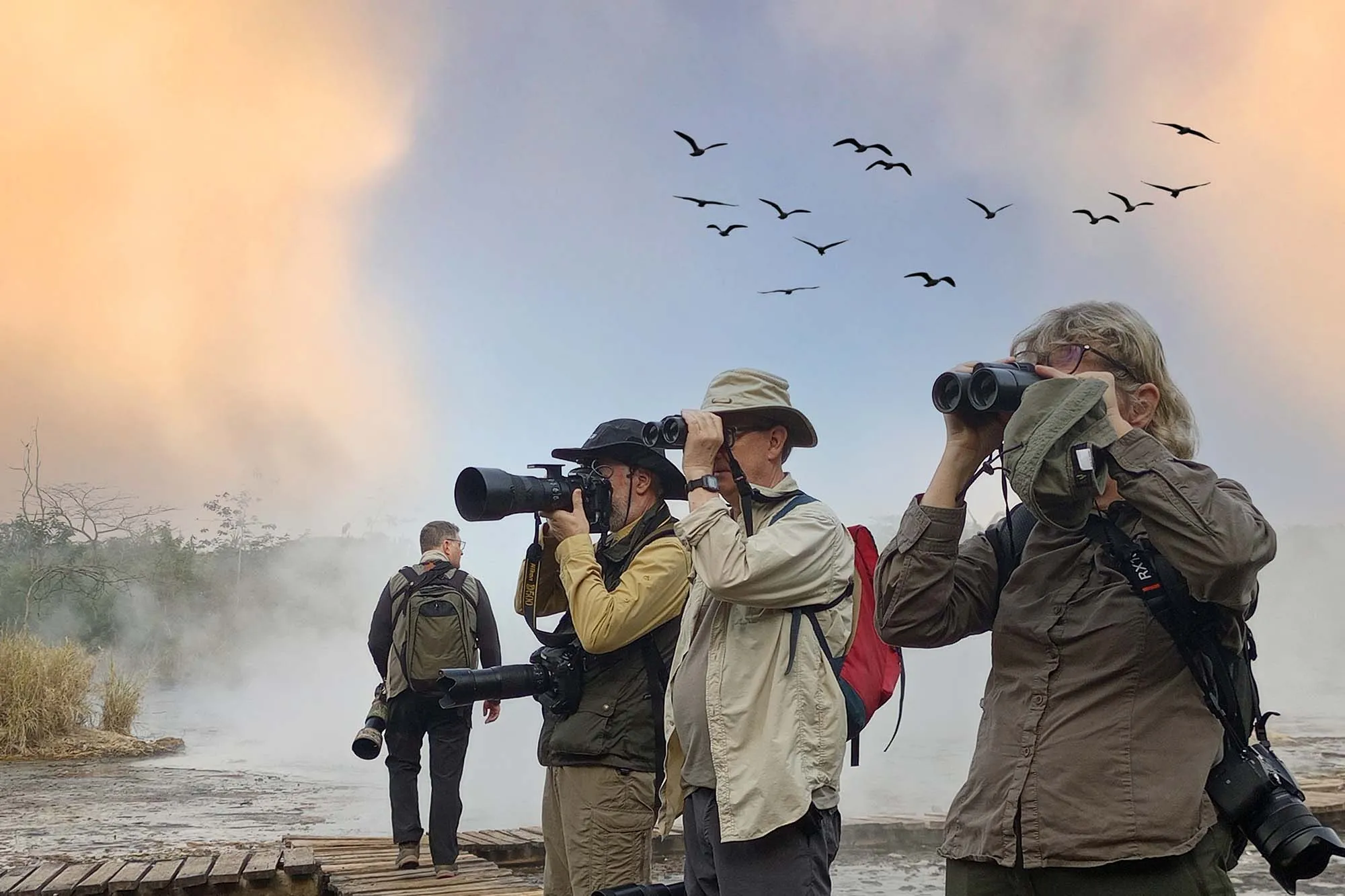
Visitors explore Lake Bunyonyi’s rich birdlife by boat.
A Uganda Safari for Bird Lovers becomes much more rewarding when the itinerary includes different ways of observing birds rather than relying on one activity. Uganda’s forests, wetlands, lakes, rivers, savannahs, and mountain environments allow birders to explore habitats on foot, by boat, during game drives, and through guided nature walks, offering a multi-faceted birding experience.
The best activity depends on the habitat and the species being targeted. Forest birds are often best approached through quiet walking trails, while waterbirds can be especially accessible from boats. Savannah birding can be combined with game drives, and wetland walks can reveal species associated with papyrus and other aquatic vegetation, a key principle for a Uganda Safari for Bird Lovers.
Forest Birding Walks
Forest walks are among the most important activities for a Uganda Safari for Bird Lovers. Walking slowly through forest habitat allows birders to search the canopy, understory, forest floor, streams, and forest edges while listening for calls, a key activity on a Uganda Safari for Bird Lovers.
Budongo Forest, Kibale, Bwindi, Semuliki, and other forest environments offer different bird communities. Budongo, for example, is reported to support about 360 bird species, with the Royal Mile recognized as an important birding area. Budongo birding can therefore be particularly useful for travelers interested in lowland forest species on a Uganda Safari for Bird Lovers.
Birding in Bwindi Forest
Bwindi is especially valuable for birders interested in Albertine Rift species. Guided forest walks can provide opportunities to search for species including African Green Broadbill, Shelley’s Crimsonwing, Rwenzori Batis, and other forest specialists, a key activity on a Uganda Safari for Bird Lovers.
The Bwindi birding experience can also be combined with other activities in the region, allowing travelers to create a broader southwestern Uganda itinerary, a great addition to a Uganda Safari for Bird Lovers.
Wetland Birding
Wetland birding is one of the most distinctive activities available on a Uganda Safari for Bird Lovers. Papyrus marshes, shallow water, channels, and wet grasslands attract a different collection of birds from forests and savannahs, offering a unique birding experience.
Mabamba Bay is particularly important for birders searching for the Shoebill. The wetland is located on the shores of Lake Victoria and is explored through narrow waterways, providing a specialized birding experience, a key activity on a Uganda Safari for Bird Lovers.
The Mabamba wetland experience is therefore an important activity for a Shoebill-focused itinerary on a Uganda Safari for Bird Lovers.
Canoe Birding at Mabamba Bay
Boat-based birding at Mabamba Bay allows visitors to move through papyrus channels while searching for wetland species. Quiet movement is particularly valuable because sudden noise or movement can disturb birds, a key practice on a Uganda Safari for Bird Lovers.
Early morning excursions can be especially useful because bird activity is often high during the cooler hours of the day. Birders should allow sufficient time rather than treating the excursion as a quick transfer between other attractions, a key principle for a Uganda Safari for Bird Lovers.
Boat Birding on the Kazinga Channel
The Kazinga Channel provides another important boat-based birding opportunity. The waterway connects Lake Edward and Lake George within Queen Elizabeth National Park and attracts numerous water-associated species, a fantastic activity for a Uganda Safari for Bird Lovers.
Birders may encounter African Fish Eagles, kingfishers, herons, storks, cormorants, darters, jacanas, and other species. The boat provides a different viewing angle from a vehicle or walking trail, a great perspective for a Uganda Safari for Bird Lovers.
The Kazinga Channel cruise can therefore be incorporated into a broader Uganda Safari for Bird Lovers.
Birding During a Murchison Falls Boat Cruise
Murchison Falls also provides boat-based birding along the Nile. The river environment creates opportunities to observe waterbirds and species associated with riverine vegetation, a fantastic activity for a Uganda Safari for Bird Lovers.
Current destination information identifies more than 450 bird species in Murchison Falls National Park and notes that the boat cruise provides opportunities to observe resident and migratory waterbirds, including African Fish Eagles, kingfishers, and herons, a great experience on a Uganda Safari for Bird Lovers.
The Murchison birding experience can complement forest birding at nearby Budongo for a Uganda Safari for Bird Lovers.
Game-Drive Birding
Game drives are not only for large mammals. They can become productive birding activities when the driver and guide understand that birds are a major priority, a key activity on a Uganda Safari for Bird Lovers.
Open savannahs provide excellent visibility for raptors, hornbills, bee-eaters, weavers, storks, cranes, and other species that may be more difficult to observe in dense forest, a great way to bird on a Uganda Safari for Bird Lovers.
Birding in Queen Elizabeth National Park
Queen Elizabeth National Park provides a particularly strong environment for combining game drives with birdwatching because the park contains savannah, wetlands, forests, crater lakes, and the Kazinga Channel, a top destination for a Uganda Safari for Bird Lovers.
Current information reports a checklist of more than 600 bird species for the park. Queen Elizabeth birding can therefore form an important component of a mixed-habitat safari for a Uganda Safari for Bird Lovers.
Birding Around Lake Mburo
Lake Mburo provides opportunities to observe birds in wetland, acacia woodland, grassland, and lakeshore environments. Current information from Safari Vacations & Travel Services reports more than 315 bird species in the park, a great stop for a Uganda Safari for Bird Lovers.
Birders can combine game drives with other appropriate activities to explore different habitats. Species associated with papyrus and acacia woodland are among the potential targets, adding to the diversity of a Uganda Safari for Bird Lovers.
Nature Walks for Bird Lovers
Guided nature walks provide a slower alternative to vehicle-based safari activities. Walking allows birders to examine vegetation closely and listen for calls that may be missed from a moving vehicle, a key activity on a Uganda Safari for Bird Lovers.
Mabira Forest is one example where guided nature walks provide opportunities to experience forest sounds, plants, butterflies, mammals, and birds. Mabira nature walks can therefore complement more specialized forest destinations for a Uganda Safari for Bird Lovers.
Birding Along Forest Edges
Forest edges can be productive because they combine characteristics of forest and open habitats. Birds that feed in clearings, woodland margins, gardens, or transitional vegetation can sometimes be easier to observe here than deep inside the forest, a key practice on a Uganda Safari for Bird Lovers.
Birders should therefore avoid concentrating exclusively on the interior forest. A good guide can identify productive edges and clearings according to local conditions, a key strategy for a Uganda Safari for Bird Lovers.
Birding Around Crater Lakes
Crater lakes provide another activity option in western Uganda. Water bodies surrounded by forest and vegetation can attract both aquatic birds and species associated with nearby woodland, a great experience on a Uganda Safari for Bird Lovers.
Current information on the Kibale crater lakes reports opportunities to observe birds including Great Blue Turaco, Black-and-White Casqued Hornbill, Olive Long-tailed Cuckoo, Western Tinkerbird, Papyrus Gonolek, White-winged Warbler, and Grey Parrot, a key activity for a Uganda Safari for Bird Lovers.
The Kibale crater-lake birding experience can therefore add habitat variety to a western Uganda itinerary for a Uganda Safari for Bird Lovers.
Birding at Bigodi Wetland Sanctuary
Bigodi Wetland Sanctuary is particularly suitable for travelers who want a combination of wetland and forest-edge birding. Guided walking trails pass through papyrus, forest patches, and open wetland environments, a great activity for a Uganda Safari for Bird Lovers.
Current information reports more than 200 bird species at Bigodi and highlights species such as Great Blue Turaco, Papyrus Gonolek, and Yellow-throated Tinkerbird, a key stop for a Uganda Safari for Bird Lovers.
The Bigodi birding walk can be combined with other activities in the Kibale area for a Uganda Safari for Bird Lovers.
Birding in Semuliki
Semuliki provides an important activity for experienced birders interested in lowland forest and species influenced by the Congo Basin ecosystem. The region’s ecological position makes it different from Uganda’s higher-elevation forests, a unique experience for a Uganda Safari for Bird Lovers.
Birding here is best approached patiently, with guides helping visitors identify birds through both visual observation and calls, a key practice for a Uganda Safari for Bird Lovers.
Birding at Lake Bunyonyi
Lake Bunyonyi provides opportunities for birding around open water, wetlands, hillsides, and surrounding vegetation. Current information reports more than 200 bird species in the area and identifies Nyombi Swamp as a productive birding location, a scenic and productive stop for a Uganda Safari for Bird Lovers.
The Lake Bunyonyi birding experience can complement a Bwindi-focused safari for a Uganda Safari for Bird Lovers.
Bird Photography Activities
Uganda’s variety of habitats provides opportunities for bird photography, but the activity should be approached with patience and respect for wildlife. Photographers should avoid chasing birds, disturbing nests, or changing normal bird behavior for a photograph, a key ethical practice for a Uganda Safari for Bird Lovers.
Wetlands can provide open views, while forest photography often requires greater patience because vegetation can obscure birds. A specialist guide can help photographers position themselves without unnecessarily disturbing wildlife, a key strategy for a Uganda Safari for Bird Lovers.
Listening for Bird Calls
Birding in Uganda should not depend entirely on visual identification. Many forest species are easier to locate through their calls before they become visible, a key skill on a Uganda Safari for Bird Lovers.
A quiet walking approach allows birders to pause at listening points and determine the direction of calls. This is especially useful in dense forests where foliage can make direct visual searches difficult, a key practice for a Uganda Safari for Bird Lovers.
Birding From Observation Points
Observation points, clearings, forest edges, wetlands, and lakeshores can provide useful locations for stationary birding. Instead of constantly walking, birders can sometimes increase their observations by remaining quietly in one productive area, a key strategy for a Uganda Safari for Bird Lovers.
This approach is particularly useful for species that move through a regular feeding or watering area, a great technique on a Uganda Safari for Bird Lovers.
Birding Around Water Sources
Water attracts many species, especially during periods when birds need to drink or feed around aquatic habitats. Lakes, rivers, channels, swamps, and small streams can therefore be productive locations, a great place to bird on a Uganda Safari for Bird Lovers.
Water sources should be observed from an appropriate distance so birds can continue normal behavior without disturbance, a key ethical practice for a Uganda Safari for Bird Lovers.
Birding Along the Nile
The Nile provides several opportunities for riverine birding, particularly around Murchison Falls. Riverbanks can attract kingfishers, herons, fish eagles, storks, and other water-associated species, a fantastic activity on a Uganda Safari for Bird Lovers.
Combining a river excursion with savannah game drives provides a broader range of habitats within one national park, a key strategy for a Uganda Safari for Bird Lovers.
Birding During Wildlife Game Drives
A game drive can become a serious birding activity when the guide understands the difference between mammal-focused and bird-focused safari objectives. Birders may ask the guide to slow down when a raptor is perched, stop when a flock is spotted, or spend additional time around productive habitats, a key activity on a Uganda Safari for Bird Lovers.
This approach is particularly useful in Queen Elizabeth, Murchison Falls, Lake Mburo, and Kidepo Valley, a great way to bird on a Uganda Safari for Bird Lovers.
Birding on Mountain and Highland Walks
Mountain environments introduce changes in vegetation and altitude that can produce different bird communities. Mount Elgon and southwestern Uganda provide opportunities for travelers interested in highland habitats, adding a mountain dimension to a Uganda Safari for Bird Lovers.
The Mount Elgon birding experience can be considered by travelers who want to extend their safari beyond Uganda’s western lowland and forest circuits for a Uganda Safari for Bird Lovers.
Birding at Mabira Forest
Mabira Forest offers an accessible forest birding experience for travelers who want to explore a forest environment without necessarily traveling deep into western Uganda, a convenient stop for a Uganda Safari for Bird Lovers.
Guided walks can provide opportunities to observe birds alongside butterflies, plants, and other forest wildlife. This can work particularly well as an introductory activity or as part of a broader itinerary from central Uganda for a Uganda Safari for Bird Lovers.
Combining Several Birding Activities
The strongest Uganda Safari for Bird Lovers usually combines several observation methods. A traveler might begin with wetland canoe birding at Mabamba, continue with forest walks in Kibale, take a boat excursion along the Kazinga Channel, and use game drives in Queen Elizabeth, offering a comprehensive birding experience.
This combination changes both the habitat and the viewing perspective, increasing the range of birding experiences available during the safari, a key principle for a Uganda Safari for Bird Lovers.
Birding Activities for Beginners
Beginners can start with activities that provide relatively accessible viewing opportunities. Wetlands, lakeshores, open savannah, and boat excursions can be easier for new birders because birds may be more visible than in dense forest, a great way to start a Uganda Safari for Bird Lovers.
As confidence increases, travelers can add forest walks where identification may depend more heavily on calls, behavior, and habitat knowledge, a key progression on a Uganda Safari for Bird Lovers.
Birding Activities for Experienced Birders
Experienced birders can focus on specialist forest walks, difficult species, restricted-range birds, nocturnal targets, and longer observation sessions. Destinations such as Bwindi, Semuliki, Budongo, and Kibale can be particularly valuable for this style of birding, a great focus for a Uganda Safari for Bird Lovers.
A detailed target list should be shared with the guide before the safari so that daily activities can be planned around the highest-priority species, a key practice for a Uganda Safari for Bird Lovers.
Birding Activities for Photographers
Photographers should select activities according to visibility and habitat. Boat birding can provide open views of waterbirds, while savannah game drives can provide opportunities for larger birds and raptors, a great strategy for photographers on a Uganda Safari for Bird Lovers.
Forest photography can be more challenging because birds may remain high in the canopy or partially concealed by foliage. Patience and careful positioning are therefore particularly important, a key practice for a Uganda Safari for Bird Lovers.
Birding Activities During Migration
Migratory periods can add another dimension to Uganda’s birding activities. Wetlands, lakes, grasslands, and other suitable habitats can provide opportunities to encounter seasonal visitors alongside resident species, adding a seasonal element to a Uganda Safari for Bird Lovers.
Travelers planning specifically around migrants should confirm current seasonal conditions and target species with a knowledgeable birding guide before finalizing the itinerary, a key planning step for a Uganda Safari for Bird Lovers.
Combining Birding With Chimpanzee Tracking
Birding can be combined with chimpanzee tracking in destinations such as Kibale and Budongo. Forest walks undertaken for primates also pass through habitats where birds may be encountered, a great way to combine activities on a Uganda Safari for Bird Lovers.
Dedicated birding sessions should still be included if birds are a major objective because primate activities and specialist birding follow different priorities, a key principle for a Uganda Safari for Bird Lovers.
Combining Birding With Gorilla Trekking
Bwindi allows travelers to combine birdwatching with gorilla trekking and other forest activities. Birders should schedule separate birding walks where possible because trekking schedules are primarily designed around gorilla activity rather than specific bird targets, a key consideration for a Uganda Safari for Bird Lovers.
This combination is particularly suitable for travelers who want a broader wildlife experience while maintaining a strong interest in birds, a great option for a Uganda Safari for Bird Lovers.
Combining Birding With Cultural Experiences
Some birding destinations are surrounded by communities whose livelihoods are connected to the landscape. Combining birding with appropriate community experiences can provide a broader understanding of the relationship between conservation, tourism, and local livelihoods, adding a cultural dimension to a Uganda Safari for Bird Lovers.
Bigodi is a useful example because its wetland tourism model connects visitor experiences with community participation and conservation, a great example for a Uganda Safari for Bird Lovers.
Birding and Conservation Activities
Birding itself can contribute to conservation when visitors follow responsible practices and support protected areas and local conservation initiatives. Guides can also explain how wetlands, forests, and other habitats are managed and why they are important for biodiversity, a key aspect of a Uganda Safari for Bird Lovers.
Travelers should choose activities that minimize disturbance and respect the rules of the relevant protected area, a key ethical practice for a Uganda Safari for Bird Lovers.
Choosing the Right Birding Activity
The right activity should be determined by the target species and habitat. Wetland specialists may benefit most from canoe or boat excursions, forest specialists from guided walks, savannah birders from game drives, and photographers from activities that provide stable viewing opportunities, a key principle for a Uganda Safari for Bird Lovers.
A mixed itinerary is usually the best choice for travelers who want a broad introduction to Uganda’s birdlife, a great way to experience a Uganda Safari for Bird Lovers.
Planning Birding Activities Around the Time of Day
Time of day should be considered when planning every activity. Early morning is particularly valuable for forest and general birding, while boat excursions can also be productive during morning periods, a key consideration for a Uganda Safari for Bird Lovers.
Afternoon sessions can be used for wetlands, open habitats, or revisiting productive locations, while evening activities can be considered for appropriate nocturnal species where permitted, adding flexibility to a Uganda Safari for Bird Lovers.
Allowing Time for Repeated Searches
Birding activities should allow room for repeated searches. A missed target should not automatically mean that the destination has failed. Birds move, weather changes, and visibility varies, a key reality of a Uganda Safari for Bird Lovers.
Returning to a productive trail, wetland, or forest edge can sometimes produce species that were missed during the first visit, a key practice for a Uganda Safari for Bird Lovers.
Final Guide to Birdwatching Activities in Uganda
Uganda offers an unusually broad range of birdwatching activities. Forest walks provide access to specialist forest species, wetland excursions reveal aquatic and papyrus-associated birds, boat cruises provide excellent views of waterbirds, game drives open access to savannah species, and guided nature walks allow travelers to experience birds alongside the wider ecosystem. A strong Uganda Safari for Bird Lovers should combine activities according to the traveler’s target list. Mabamba is especially useful for wetland birding and the search for the Shoebill, Kibale and Bigodi combine forest and wetland experiences, Bwindi provides important montane forest birding, Budongo offers lowland forest opportunities, while Queen Elizabeth and Murchison Falls provide strong combinations of savannah, river, wetland, and boat-based birding. The most productive approach is to avoid treating birdwatching as something that happens only during a traditional safari game drive. Uganda’s bird diversity is best experienced by deliberately combining walking, boating, forest exploration, wetland excursions, observation points, and habitat-focused game drives. With appropriate planning and knowledgeable guides, these activities can transform a conventional wildlife trip into a comprehensive Uganda birding safari.
Uganda Birding Safari Costs and Budget Planning for a Uganda Safari for Bird Lovers
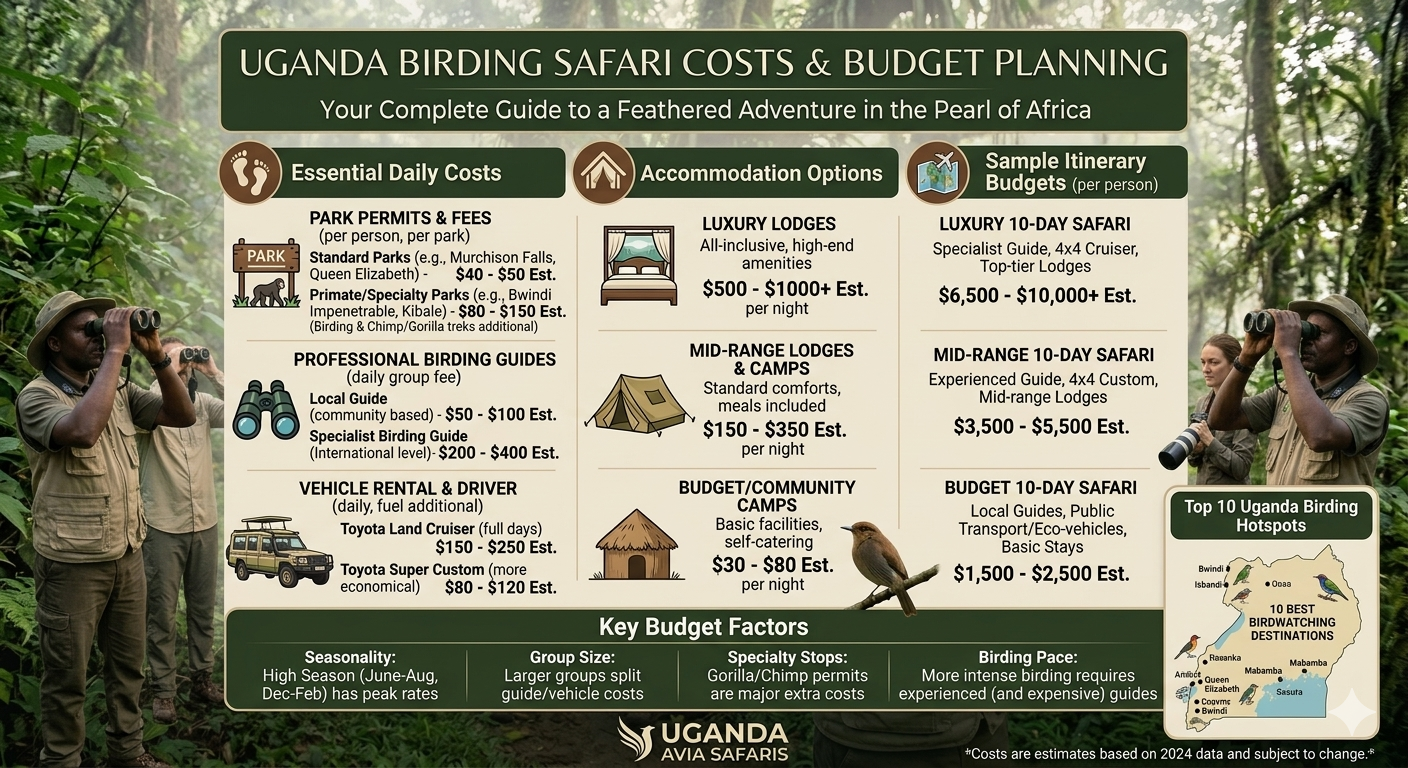
Comprehensive budget guide for planning a Uganda birding safari.
The cost of a Uganda Safari for Bird Lovers depends on several factors rather than one fixed price. Accommodation category, number of travelers, safari duration, transportation, guide services, activities, park and conservation fees, season, and the number of destinations included can all affect the final amount, making careful budget planning essential for a Uganda Safari for Bird Lovers.
A birding safari also differs from a conventional wildlife safari because birders often require more time in the field, specialist guiding, additional forest walks, wetland excursions, boat trips, and carefully selected routes. The best budget should therefore be built around the type of birding experience required rather than simply choosing the cheapest available safari package, a key principle for a Uganda Safari for Bird Lovers.
Published safari information shows that Uganda has a broad range of accommodation and safari styles. One current Uganda safari cost guide places budget accommodation at approximately USD 60–90 per person per day, mid-range accommodation at about USD 100–180 per person per night, and luxury accommodation from approximately USD 200 to USD 2,500 per person per night. These are published accommodation ranges rather than a universal price list for every Uganda birding safari. Uganda safari costs should therefore be treated as planning benchmarks rather than guaranteed quotations for a Uganda Safari for Bird Lovers. :contentReference[oaicite:0]{index=0}
What Determines the Cost of a Uganda Birding Safari?
The most important cost factor is the overall structure of the itinerary. A three-day birding trip around one region will normally have a very different cost from a two-week specialist safari covering several distant birding destinations, a key consideration for a Uganda Safari for Bird Lovers.
Transportation is another major factor. A private safari vehicle, driver-guide, fuel, and the distance covered can represent a significant part of the total safari price. The longer the route and the more destinations included, the greater the transportation component can become, a key cost driver for a Uganda Safari for Bird Lovers.
Accommodation also has a major effect. Travelers can choose from basic budget properties, comfortable mid-range lodges, and higher-end luxury accommodation. Birders should not automatically select the most expensive lodge, because proximity to the birding habitat can sometimes be more valuable than luxury facilities, a key principle for a Uganda Safari for Bird Lovers.
Is There a Fixed Price for a Uganda Birding Safari?
There is no single fixed price that applies to every Uganda birding safari. Specialist birding itineraries are often customized according to the number of days, target species, destinations, accommodation, transportation arrangements, and guide requirements, making each Uganda Safari for Bird Lovers unique in cost.
Information not found in current search results: a verified universal 2026 price covering a standard Uganda birding safari package for all operators. Published operator figures vary according to itinerary and service level, so a specific quotation should be requested for the exact route for a Uganda Safari for Bird Lovers.
This is particularly important for serious birders because an itinerary designed around Albertine Rift endemics may have a very different structure from a short Shoebill-focused excursion, a key distinction for a Uganda Safari for Bird Lovers.
Budget Uganda Birding Safari
A budget Uganda birding safari focuses on controlling accommodation and transportation costs while retaining sufficient time for birdwatching. Basic accommodation can reduce the overall price substantially, particularly when the itinerary is longer, a great option for a budget-conscious Uganda Safari for Bird Lovers.
Published Uganda safari information places budget accommodation at roughly USD 60–90 per person per day in some safari contexts. This should not be interpreted as the complete cost of a birding safari because transport, guiding, activities, meals, park charges, and other services may be additional depending on the package, a key consideration for a Uganda Safari for Bird Lovers. :contentReference[oaicite:1]{index=1}
A budget birding itinerary can work particularly well when travelers choose one geographical region rather than attempting to cover the whole country, a key strategy for a Uganda Safari for Bird Lovers.
Mid-Range Uganda Birding Safari
A mid-range Uganda birding safari provides a balance between accommodation comfort, transportation quality, guiding, and overall cost. Published safari information from Uganda places mid-range accommodation around USD 100–180 per person per night, while another current Uganda safari source describes complete mid-range safari experiences at approximately USD 200–400 per person per day depending on the itinerary and inclusions. These figures are not dedicated birding-safari tariffs and should therefore be used only as planning references for a Uganda Safari for Bird Lovers. :contentReference[oaicite:2]{index=2}
For many travelers, mid-range arrangements can provide a practical balance because they allow money to be allocated toward good guiding and a well-designed route without requiring the highest accommodation category, a great option for a Uganda Safari for Bird Lovers.
Luxury Uganda Birding Safari
A luxury Uganda birding safari can involve premium lodges, private transportation, personalized guiding, high-quality meals, and carefully selected locations close to major birding habitats, a premium option for a Uganda Safari for Bird Lovers.
Published Uganda safari accommodation information gives a very broad luxury range, from approximately USD 200 to as much as USD 2,500 per person per night. The large difference reflects the fact that luxury accommodation varies considerably by property, location, facilities, and season, a key consideration for a Uganda Safari for Bird Lovers. :contentReference[oaicite:3]{index=3}
For birders, luxury does not necessarily mean maximizing accommodation expenditure. A carefully selected premium lodge close to a productive forest or wetland can be more useful than an expensive property that requires long daily transfers, a key principle for a Uganda Safari for Bird Lovers.
How Group Size Affects Birding Safari Costs
Group size has a direct effect on the cost per person. Transportation and some guide-related expenses can be distributed among several travelers, potentially lowering the individual cost when more people share the safari, a key cost consideration for a Uganda Safari for Bird Lovers.
A private safari for one or two people can provide greater flexibility but generally has fewer travelers sharing vehicle and guiding costs. Larger groups can reduce some per-person expenses, although birding itself can become less flexible if the group has different interests, a key trade-off for a Uganda Safari for Bird Lovers.
For serious birders, a smaller group can be valuable because the guide can stop frequently, spend more time identifying calls, and adjust the pace according to the target list, a key benefit for a Uganda Safari for Bird Lovers.
Private Versus Shared Birding Safari Costs
A private birding safari normally provides greater control over departure times, stops, route changes, and the amount of time spent at productive birding locations. This can be particularly useful for specialist birders, a key advantage of a private Uganda Safari for Bird Lovers.
A shared safari can reduce individual transportation costs, but travelers may need to follow a schedule designed around the wider group’s interests. A bird lover who wants extensive birdwatching may therefore find a private itinerary more suitable even if the initial price is higher, a key consideration for a Uganda Safari for Bird Lovers.
Transportation Costs on a Uganda Birding Safari
Transportation is one of the major components of safari pricing. Published Uganda safari information notes that transportation costs can include the vehicle, fuel, and driver-guide. Safari vehicles with pop-up roofs are also used for wildlife and birding game drives, a key component of a Uganda Safari for Bird Lovers. :contentReference[oaicite:4]{index=4}
Another current Uganda safari source places typical 4×4 vehicle costs at approximately USD 150–250 per day plus fuel costs for some mid-range safari arrangements. These figures are operator-published estimates and can vary according to vehicle type, route, duration, and package structure, a key cost driver for a Uganda Safari for Bird Lovers. :contentReference[oaicite:5]{index=5}
For birders, vehicle quality matters because a comfortable vehicle can make long transfers easier and a suitable safari vehicle can provide better viewing opportunities during open-country birding, a key consideration for a Uganda Safari for Bird Lovers.
Fuel and Distance
Long-distance birding circuits require more fuel than short regional trips. A route connecting central Uganda, western forests, southwestern Uganda, and northern parks can therefore have a substantially higher transportation component than a safari concentrated around one region, a key cost driver for a Uganda Safari for Bird Lovers.
Reducing unnecessary backtracking is one of the simplest ways to make a long birding safari more efficient. A route should ideally move logically between neighboring destinations, a key principle for a Uganda Safari for Bird Lovers.
Driver-Guide Costs
A professional driver-guide is an important component of a Uganda birding safari. Birding requires more than simply driving between parks because the guide needs to understand habitat, bird behavior, calls, and the traveler’s target species, a key investment for a Uganda Safari for Bird Lovers.
For specialist birders, a guide with strong bird identification skills can provide considerably more value than a general driver who primarily focuses on large mammals, a key principle for a Uganda Safari for Bird Lovers.
Specialist Birding Guide Costs
Information not found in current search results: a reliable, standardized 2026 national daily rate for specialist birding guides in Uganda. Published safari prices generally package guiding together with transportation and other services rather than presenting a universal standalone birding-guide tariff, a key cost consideration for a Uganda Safari for Bird Lovers.
When requesting a quotation, travelers should ask whether the quoted guide is specifically experienced in birding and whether the guide will remain with the group throughout the itinerary, a key question for a Uganda Safari for Bird Lovers.
Accommodation Costs for Birders
Accommodation prices vary substantially according to location and service level. Budget properties can reduce the total safari cost, while mid-range and luxury lodges provide additional comfort and facilities, a key choice for a Uganda Safari for Bird Lovers.
Birders should consider another factor: location. An inexpensive lodge that requires a long transfer to reach the birding trail can ultimately make the safari less efficient than a slightly more expensive property located close to the habitat, a key principle for a Uganda Safari for Bird Lovers.
Why Location Can Be More Important Than Luxury
Birding often starts early. If a birding trail opens or becomes productive at dawn, staying nearby can save valuable time and reduce the need for a long pre-dawn transfer, a key efficiency for a Uganda Safari for Bird Lovers.
This is particularly important in destinations such as Bwindi, Kibale, Semuliki, Budongo, and wetland areas where early starts can make a meaningful difference to the quality of the birding experience, a key consideration for a Uganda Safari for Bird Lovers.
Meals and Food Costs
Meals may be included in safari packages, particularly when accommodation is booked on a full-board basis. Other packages may include breakfast and dinner while travelers purchase lunch separately, a key cost consideration for a Uganda Safari for Bird Lovers.
When comparing quotations, travelers should check exactly which meals are included. A lower headline price may not represent a lower total cost if several meals must be purchased separately each day, a key principle for a Uganda Safari for Bird Lovers.
Park and Protected-Area Fees
Protected-area fees can form part of the safari cost. The exact charges depend on the destination, activity, visitor category, and current regulations, a key cost driver for a Uganda Safari for Bird Lovers.
Because fees can change, travelers should ask for a quotation that clearly identifies which park or conservation charges are included rather than assuming that every entrance fee is automatically covered, a key practice for a Uganda Safari for Bird Lovers.
Boat Excursion Costs
Boat-based birding can add an activity cost to the itinerary. Mabamba Bay, the Kazinga Channel, and the Nile at Murchison Falls are examples of destinations where boat excursions can form part of a birding safari, a key activity cost for a Uganda Safari for Bird Lovers.
These excursions can be valuable because they provide access to waterbirds and wetland habitats that may be difficult to explore effectively by vehicle, a key value-add for a Uganda Safari for Bird Lovers.
Mabamba Birding Costs
Mabamba Bay is particularly relevant for travelers targeting the Shoebill. Current information describes Mabamba as a major wetland birding destination and notes that the area can be reached relatively conveniently from Entebbe and Kampala, a key stop for a Uganda Safari for Bird Lovers.
The Mabamba birding experience can therefore be incorporated into either a short birding excursion or a longer Uganda birding safari, offering flexibility for a Uganda Safari for Bird Lovers.
Information not found in current search results: a sufficiently current, independently verified 2026 standard Mabamba birding fee that can be presented as a universal price for all visitors, a key cost uncertainty for a Uganda Safari for Bird Lovers.
Ziwa Rhino Birding Costs
Ziwa Rhino and Wildlife Ranch provides another birding option for travelers who want to combine woodland, swamp, and savannah habitats. Current information published by Anthill Safaris lists birding tours at USD 20 per adult and USD 10 per child for foreign visitors, while East African citizens are listed at UGX 20,000 per adult and UGX 10,000 per child, a specific cost for a Uganda Safari for Bird Lovers. :contentReference[oaicite:6]{index=6}
These are published prices for the specific Ziwa birding activity and should not be generalized to other Ugandan birding destinations, a key distinction for a Uganda Safari for Bird Lovers.
Cost of a Shoebill-Focused Safari
A Shoebill-focused itinerary can potentially be shorter than a countrywide birding expedition because the route can concentrate on wetlands known for the species, a cost-effective option for a Uganda Safari for Bird Lovers.
Mabamba and other wetland areas can be considered according to the traveler’s starting point and target list. The final cost will depend heavily on transportation, accommodation, guide arrangements, and whether other birding destinations are added, a key cost driver for a Uganda Safari for Bird Lovers.
The Shoebill safari information can help travelers identify the type of route needed before requesting a quotation for a Uganda Safari for Bird Lovers.
Cost of a Forest Birding Safari
Forest-focused birding can require longer stays because many specialist birds are difficult to locate and may require repeated walks. A forest safari centered on Bwindi, Kibale, Budongo, or Semuliki can therefore have higher guiding and accommodation costs simply because more field days are needed, a key cost driver for a Uganda Safari for Bird Lovers.
However, staying longer in one forest can sometimes be more cost-efficient than constantly moving between distant destinations, a key efficiency for a Uganda Safari for Bird Lovers.
Cost of an Albertine Rift Birding Safari
An Albertine Rift specialist itinerary generally emphasizes southwestern and western Uganda. Bwindi is particularly important for birders interested in restricted-range species, while other forest destinations can provide complementary habitats, a key cost driver for a Uganda Safari for Bird Lovers.
The cost depends on the number of forest days, accommodation category, vehicle arrangement, guide expertise, and whether the safari includes gorilla trekking or other activities, a key consideration for a Uganda Safari for Bird Lovers.
Cost of a Wetland Birding Safari
Wetland birding can be comparatively efficient when several sites are accessible from the same regional base. Mabamba, Bigodi, Lake Mburo, and other wetlands can be incorporated according to the target species, a cost-effective option for a Uganda Safari for Bird Lovers.
A wetland-focused safari can also reduce the need for extensive trekking, although some wetlands require boat excursions or guided walking activities, a key activity cost for a Uganda Safari for Bird Lovers.
Cost of a Savannah Birding Safari
Savannah birding can often be combined with conventional game drives. This allows the same vehicle and guide arrangement to serve both wildlife and birdwatching purposes, a cost-effective option for a Uganda Safari for Bird Lovers.
Murchison Falls, Queen Elizabeth, Lake Mburo, and Kidepo Valley provide different savannah environments. Kidepo generally requires a more extensive itinerary because of its geographical position in northeastern Uganda, a key cost driver for a Uganda Safari for Bird Lovers.
Seasonal Effects on Uganda Birding Safari Costs
Season can influence accommodation availability, demand, road conditions, and overall safari pricing. Current birding information identifies December to February and June to September as Uganda’s principal dry-season periods, while March to May and October to November are wetter periods, a key cost consideration for a Uganda Safari for Bird Lovers. :contentReference[oaicite:7]{index=7}
The same source notes that birding is possible throughout the year and that the best timing depends partly on the traveler’s target species, adding a temporal dimension to a Uganda Safari for Bird Lovers. :contentReference[oaicite:8]{index=8}
Travelers should therefore compare both price and birding objectives before deciding when to travel, a key principle for a Uganda Safari for Bird Lovers.
Dry-Season Birding Safari Budget
Dry-season travel can be attractive because roads and trails may be easier to navigate in many areas. However, demand can also affect accommodation availability and prices, a key cost consideration for a Uganda Safari for Bird Lovers.
For travelers working with a fixed budget, early booking can help secure the preferred accommodation category and avoid having to accept a more expensive alternative when lower-priced properties become unavailable, a key practice for a Uganda Safari for Bird Lovers.
Wet-Season Birding Safari Budget
Wet-season travel can provide a different balance. Some travelers may encounter fewer tourists, while vegetation is often lush and conditions can be attractive for photography, a great option for a budget-conscious Uganda Safari for Bird Lovers.
However, rain can affect road conditions and walking schedules. A budget should therefore allow some flexibility rather than assuming that every planned activity will operate under identical conditions each day, a key consideration for a Uganda Safari for Bird Lovers.
Migratory Birding and Seasonal Budget Planning
Travelers interested in migratory birds should prioritize the period when their target species are expected rather than choosing a travel date solely because it is cheaper, a key principle for a Uganda Safari for Bird Lovers.
The objective of a specialist birding safari is not simply to minimize the price. It is to maximize the likelihood of achieving the target list within a realistic budget, a key philosophy for a Uganda Safari for Bird Lovers.
How Safari Duration Changes the Cost
Longer safaris naturally add accommodation, meals, guiding, transportation, and activity costs. However, the average daily cost does not necessarily increase in direct proportion to the number of days, a key cost consideration for a Uganda Safari for Bird Lovers.
A longer itinerary can sometimes distribute fixed transportation expenses across more days. This is another reason why travelers should compare the total quotation and the per-person daily cost rather than looking at only one number, a key practice for a Uganda Safari for Bird Lovers.
Three-Day Birding Safari Budget
A three-day safari is appropriate for travelers with a small target list or limited time. The route should remain geographically compact to avoid spending most of the trip on the road, a great option for a short Uganda Safari for Bird Lovers.
A central wetland-focused trip can be particularly practical for a short visit, especially when the traveler wants to search for the Shoebill and other wetland species, a key strategy for a Uganda Safari for Bird Lovers.
Five-Day Birding Safari Budget
Five days allow travelers to combine more than one habitat. A central wetland can be combined with forest or woodland birding, depending on the chosen route, a great option for a Uganda Safari for Bird Lovers.
Because the itinerary remains relatively short, travelers should avoid adding destinations that require long transfers unless the target species makes the journey worthwhile, a key principle for a Uganda Safari for Bird Lovers.
Seven-Day Birding Safari Budget
A seven-day safari provides enough time for a strong regional birding circuit. Kibale and Bigodi, Queen Elizabeth, Bwindi, Murchison Falls and Budongo are examples of combinations that can be considered depending on the starting point and target list, a great option for a Uganda Safari for Bird Lovers.
The budget should include sufficient time for dedicated birding rather than treating every day as a conventional wildlife game-drive day, a key principle for a Uganda Safari for Bird Lovers.
Ten-Day Birding Safari Budget
Ten days can support a more comprehensive itinerary with several habitats. Travelers can consider combining wetlands, forests, savannah, and lakes, a great option for an extended Uganda Safari for Bird Lovers.
At this duration, route efficiency becomes increasingly important. Unnecessary backtracking can increase fuel and vehicle costs without adding meaningful birding value, a key cost consideration for a Uganda Safari for Bird Lovers.
Fourteen-Day Birding Safari Budget
A fourteen-day safari provides substantial flexibility for specialist birders. It can accommodate multiple forest destinations, wetland sites, savannah parks, and additional birding sessions, a comprehensive itinerary for a Uganda Safari for Bird Lovers.
A longer trip should include rest periods where appropriate because continuous early starts and long walks can become tiring, a key health consideration for a Uganda Safari for Bird Lovers.
How to Reduce Birding Safari Costs Without Sacrificing Birding Quality
The most effective way to reduce cost is not necessarily to choose the cheapest possible accommodation. Instead, travelers can reduce unnecessary transportation, select a logical regional route, travel with a suitable number of people, and spend enough time in each destination to avoid repeated transfers, a key strategy for a Uganda Safari for Bird Lovers.
Choosing a mid-range property close to the birding habitat can also provide a better overall value than selecting a cheaper property that requires lengthy daily transportation, a key principle for a Uganda Safari for Bird Lovers.
Choose a Regional Birding Circuit
Concentrating on one region can reduce vehicle mileage and make the safari more efficient. Western Uganda, for example, can provide forest, wetland, savannah, and lake habitats within a relatively coherent itinerary, a key strategy for a Uganda Safari for Bird Lovers.
This approach is especially useful for first-time visitors who want a broad experience without paying for extensive cross-country transfers, a great option for a Uganda Safari for Bird Lovers.
Share Transportation When Appropriate
Travelers who are comfortable with a shared safari can potentially reduce transportation costs because vehicle expenses are distributed among participants, a key cost-saving strategy for a Uganda Safari for Bird Lovers.
However, specialist birders should consider whether a shared schedule will allow sufficient time for their target species. A lower price is not necessarily better value if the itinerary prevents the traveler from spending enough time at productive birding locations, a key principle for a Uganda Safari for Bird Lovers.
Choose Accommodation Near Birding Sites
Staying close to the birding habitat can save both time and fuel. It can also allow earlier departures, which are particularly valuable for forest and wetland birding, a key efficiency for a Uganda Safari for Bird Lovers.
This is one of the simplest ways to improve the relationship between cost and birding time, a key principle for a Uganda Safari for Bird Lovers.
Prioritize Your Target Species
A target list prevents unnecessary additions to the itinerary. If a destination does not contribute meaningful species or habitat value to the trip, it may not justify the additional accommodation and transportation cost, a key cost-saving strategy for a Uganda Safari for Bird Lovers.
A specialist birding safari should therefore be designed from the target list outward rather than from a generic park list inward, a key principle for a Uganda Safari for Bird Lovers.
Budget for a Specialist Guide
Cutting guide quality may appear to reduce the cost, but it can reduce the value of the entire birding safari. Specialist birders often benefit substantially from guides who can identify calls, understand habitat preferences, and locate difficult species, a key investment for a Uganda Safari for Bird Lovers.
A good guide can also help the group avoid wasting time on unproductive locations, a key efficiency for a Uganda Safari for Bird Lovers.
Compare Safari Quotations Correctly
Travelers should compare quotations based on inclusions rather than headline prices. Two apparently similar prices may differ substantially in what they cover, a key practice for a Uganda Safari for Bird Lovers.
Important questions include whether transportation, fuel, driver-guide services, accommodation, meals, park fees, boat trips, birding walks, airport transfers, and other activities are included, a key consideration for a Uganda Safari for Bird Lovers.
Ask Whether Birding Is Included in the Safari
A conventional wildlife safari may include incidental birdwatching without being designed as a dedicated birding safari. A serious birder should therefore confirm that birdwatching is a principal objective of the itinerary, a key question for a Uganda Safari for Bird Lovers.
The traveler should also communicate the target species before the safari so that the guide and operator can plan accordingly, a key practice for a Uganda Safari for Bird Lovers.
Hidden Costs to Check Before Booking
Potential additional expenses can include international flights, visas, travel insurance, personal purchases, tips, drinks, optional activities, and meals that are not included in the package, a key cost consideration for a Uganda Safari for Bird Lovers.
Some activities may also have separate fees. Travelers should ask for a complete breakdown before making a final decision, a key practice for a Uganda Safari for Bird Lovers.
International Flights and the Birding Budget
International airfare is normally separate from the safari package and can vary significantly depending on the traveler’s country of origin, airline, booking date, and travel season, a key cost consideration for a Uganda Safari for Bird Lovers.
It should therefore be treated as a separate budget category rather than being mixed into the daily safari cost, a key practice for a Uganda Safari for Bird Lovers.
Visa and Travel Documentation Costs
Travelers should also budget separately for applicable visa and travel-document expenses. These costs depend on nationality and current entry requirements, a key cost consideration for a Uganda Safari for Bird Lovers.
Because entry regulations can change, travelers should verify the current requirements applicable to their nationality before booking, a key practice for a Uganda Safari for Bird Lovers.
Travel Insurance
Travel insurance is another separate budget consideration. Birding safaris can involve forest walks, boat excursions, uneven terrain, and long-distance road travel, a key safety consideration for a Uganda Safari for Bird Lovers.
The appropriate policy should reflect the activities included in the itinerary and the traveler’s individual circumstances, a key practice for a Uganda Safari for Bird Lovers.
Tips and Gratuities
Tips are generally a discretionary expense and should not be confused with mandatory safari charges. Travelers who are satisfied with the service may wish to budget separately for guides, drivers, lodge staff, and other service providers, a key cost consideration for a Uganda Safari for Bird Lovers.
The amount should be based on service quality and the traveler’s own budget rather than treated as a compulsory fixed percentage, a key practice for a Uganda Safari for Bird Lovers.
Equipment Costs for Birders
Birders should also consider personal equipment costs. Binoculars, spotting scopes, cameras, telephoto lenses, field guides, waterproof bags, clothing, and suitable footwear can represent a significant additional investment, a key cost consideration for a Uganda Safari for Bird Lovers.
Travelers who already own quality equipment do not need to include these purchases in the safari quotation, but first-time birders should consider them when calculating their complete trip budget, a key planning step for a Uganda Safari for Bird Lovers.
Should You Rent Birding Equipment?
Information not found in current search results: a verified standardized 2026 national rental tariff for binoculars or spotting scopes across Uganda’s birding operators, a key cost uncertainty for a Uganda Safari for Bird Lovers.
Travelers who do not own specialist equipment should ask the operator whether binoculars or spotting scopes are supplied as part of the safari package before purchasing or renting equipment independently, a key question for a Uganda Safari for Bird Lovers.
Photography Costs
Photography can increase the total cost of a birding safari if travelers need specialist camera bodies, lenses, memory cards, batteries, or other equipment. However, photography does not have to make the safari expensive if the traveler already owns suitable equipment, a key cost consideration for a Uganda Safari for Bird Lovers.
Bird photographers should prioritize itinerary quality and access to productive habitats rather than assuming that the most expensive equipment automatically produces better results, a key principle for a Uganda Safari for Bird Lovers.
Birding Safari Cost Versus Species Diversity
A higher safari price does not automatically mean a higher bird count. Species diversity depends on habitat selection, timing, guide expertise, weather, and time spent in the field, a key principle for a Uganda Safari for Bird Lovers.
A well-designed mid-range safari can therefore provide excellent birding value when the route and guide are appropriate, a great option for a Uganda Safari for Bird Lovers.
Cost Per Birding Day
One useful way to compare itineraries is to calculate the approximate total safari cost divided by the number of dedicated birding days. This can reveal whether a seemingly inexpensive safari actually provides enough birding time, a key practice for a Uganda Safari for Bird Lovers.
A package with fewer dedicated birding hours may have a lower total price but offer less value to someone whose primary purpose is birdwatching, a key consideration for a Uganda Safari for Bird Lovers.
Cost Per Destination
Another useful comparison is to identify what each destination contributes. A forest destination may provide access to specialist birds, while a wetland provides aquatic species and a savannah park adds raptors and open-country birds, a key principle for a Uganda Safari for Bird Lovers.
Destinations should therefore be judged by their contribution to the target list rather than by their popularity alone, a key strategy for a Uganda Safari for Bird Lovers.
Budgeting for Weather Delays
Weather can influence road travel, walking conditions, and activity schedules. Travelers should avoid building an itinerary with no flexibility between major international flights and safari activities, a key consideration for a Uganda Safari for Bird Lovers.
Allowing some contingency can reduce the risk of additional unexpected expenses if a transfer or activity has to be adjusted, a key practice for a Uganda Safari for Bird Lovers.
Budgeting for Longer Forest Walks
Specialist forest birding can involve long walks and early starts. Travelers should budget not only financially but also in terms of time and energy, a key consideration for a Uganda Safari for Bird Lovers.
Spending additional nights near the forest can sometimes be more effective than attempting to cover several distant forests in a short period, a key strategy for a Uganda Safari for Bird Lovers.
Birding Safari Budget for First-Time Visitors
First-time visitors should generally prioritize a balanced itinerary rather than attempting to see every major birding destination. A combination of wetland, forest, and savannah habitats can provide a strong introduction to Uganda’s birdlife, a great option for a first Uganda Safari for Bird Lovers.
A seven- to ten-day regional itinerary can be a practical starting point, while more specialized travelers may benefit from a longer journey, a key planning step for a Uganda Safari for Bird Lovers.
Birding Safari Budget for Experienced Birders
Experienced birders may prefer to allocate more of their budget toward specialist guiding and additional field days rather than luxury accommodation, a key strategy for a Uganda Safari for Bird Lovers.
This is particularly relevant when the target list contains difficult forest or Albertine Rift species that require repeated searches, a key consideration for a Uganda Safari for Bird Lovers.
Birding Safari Budget for Photographers
Photographers should prioritize locations that provide good viewing opportunities, suitable light, and enough time for stationary observation. A slower itinerary can be more valuable than a longer list of destinations, a key strategy for a Uganda Safari for Bird Lovers.
Budgeting should include adequate accommodation near productive habitats and sufficient field time rather than focusing solely on vehicle mileage, a key principle for a Uganda Safari for Bird Lovers.
Birding Safari Budget for Families
Families may need to consider room configurations, child rates, meal arrangements, vehicle space, and the pace of the itinerary. A family birding safari should include activities that accommodate different levels of interest and stamina, a key consideration for a Uganda Safari for Bird Lovers.
Information not found in current search results: a standardized 2026 family birding safari tariff applicable to all Uganda operators, a key cost uncertainty for a Uganda Safari for Bird Lovers.
Birding Safari Budget for Solo Travelers
Solo travelers may face higher per-person transportation costs because there are fewer travelers sharing the vehicle and guide expenses, a key cost consideration for a Uganda Safari for Bird Lovers.
A solo traveler can reduce some costs by selecting a suitable shared safari, but this should be balanced against the flexibility required for specialist birding, a key trade-off for a Uganda Safari for Bird Lovers.
Why Two Travelers Can Improve Value
Traveling as a pair can make private safari transportation more economical on a per-person basis because the vehicle and driver-guide costs are distributed between two people, a key cost-saving strategy for a Uganda Safari for Bird Lovers.
This can provide a useful balance between privacy and cost, particularly for couples or friends with similar birding interests, a great option for a Uganda Safari for Bird Lovers.
Cost of Combining Birding With Gorilla Trekking
Adding gorilla trekking changes the safari budget substantially because the gorilla permit becomes a significant additional cost. Current Uganda information lists the foreign non-resident gorilla trekking permit at USD 800 for the period covered by its published 2024–2026 pricing information, a key cost driver for a Uganda Safari for Bird Lovers. :contentReference[oaicite:9]{index=9}
Travelers should verify the current permit price for their travel dates before making a final budget because conservation fees and promotional categories can change, a key practice for a Uganda Safari for Bird Lovers.
The gorilla permit information can help birders understand why adding gorilla trekking changes the overall cost of a southwestern Uganda itinerary for a Uganda Safari for Bird Lovers.
Cost of Combining Birding With Chimpanzee Tracking
Chimpanzee tracking can also be added to a birding safari. The additional cost depends on the destination, current permit charges, accommodation, transportation, and the number of tracking activities included, a key cost driver for a Uganda Safari for Bird Lovers.
Kibale is particularly useful because travelers can combine chimpanzee experiences with forest and Bigodi Wetland birding, potentially making the overall itinerary more efficient, a great option for a Uganda Safari for Bird Lovers.
Cost of Combining Birding With Wildlife Safaris
Birding can be combined with conventional wildlife safaris in Queen Elizabeth, Murchison Falls, Lake Mburo, or Kidepo. This can provide additional value because game drives can also be used for birdwatching, a cost-effective option for a Uganda Safari for Bird Lovers.
However, travelers should tell the guide that birds are a priority. Otherwise, a conventional game drive may concentrate almost entirely on large mammals, a key practice for a Uganda Safari for Bird Lovers.
Birding Safari Costs in Murchison Falls
Murchison Falls can provide a strong combination of game drives, river birding, and forest birding when Budongo is included in the route. Current information reports more than 450 bird species in Murchison Falls National Park, a top destination for a Uganda Safari for Bird Lovers. :contentReference[oaicite:10]{index=10}
The Murchison river experience can therefore be incorporated into a broader birding itinerary where water-associated species are a priority for a Uganda Safari for Bird Lovers.
Birding Safari Costs in Kibale
Kibale can be particularly valuable for travelers interested in forest birds because it can be combined with Bigodi Wetland Sanctuary and other nearby habitats, a top destination for a Uganda Safari for Bird Lovers.
The overall cost will depend on the number of nights, accommodation category, transportation, guiding, and whether chimpanzee activities are added, a key cost driver for a Uganda Safari for Bird Lovers.
Birding Safari Costs in Bwindi
Bwindi costs can vary significantly according to the sector, accommodation category, length of stay, transportation, and whether gorilla trekking is included, a key cost driver for a Uganda Safari for Bird Lovers.
Published information for Bwindi gives broad accommodation ranges, with budget properties listed at approximately USD 70–100 per person per night, mid-range properties at approximately USD 150–300, and luxury accommodation around USD 400–1,000 per person per night. These are published operator ranges and should be confirmed for the specific lodge and travel date, a key cost consideration for a Uganda Safari for Bird Lovers. :contentReference[oaicite:11]{index=11}
The Bwindi safari planning information can help travelers understand the wider logistics of staying in the region for a Uganda Safari for Bird Lovers.
Birding Safari Costs in Lake Mburo
Lake Mburo can be useful for travelers seeking a compact combination of wetland, woodland, grassland, and lake habitats. Because it is relatively accessible compared with some remote safari destinations, it can also be incorporated into shorter itineraries, a great option for a Uganda Safari for Bird Lovers.
The final cost will depend on accommodation, vehicle arrangements, guiding, game drives, and any boat activities included, a key cost driver for a Uganda Safari for Bird Lovers.
Birding Safari Costs in Kidepo Valley
Kidepo Valley can provide access to a distinctive semi-arid birding environment and species that are less typical of western Uganda, a unique addition to a Uganda Safari for Bird Lovers.
Its main budget consideration is the geographical distance. A Kidepo itinerary normally requires more transportation time than a compact western Uganda circuit, so the traveler should assess whether the target species justify the additional travel cost, a key cost consideration for a Uganda Safari for Bird Lovers.
Birding Safari Costs in Semuliki
Semuliki is particularly valuable for specialist birders interested in lowland forest and Congo Basin-associated species. Because the destination is more remote, transportation and additional travel time should be considered when preparing the budget, a key cost driver for a Uganda Safari for Bird Lovers.
For a specialist birder, the additional cost may be justified if Semuliki contains several priority species on the target list, a key consideration for a Uganda Safari for Bird Lovers.
Building a Realistic Uganda Birding Safari Budget
A useful budget should separate fixed and variable expenses. Fixed expenses may include some transportation and guide costs, while variable expenses can include accommodation category, number of nights, optional activities, and personal spending, a key practice for a Uganda Safari for Bird Lovers.
The traveler should then compare the complete package rather than simply comparing the accommodation price, a key principle for a Uganda Safari for Bird Lovers.
Suggested Budget Categories
A complete planning worksheet should contain international flights, visa or entry expenses where applicable, safari transportation, driver-guide services, accommodation, meals, protected-area fees, birding activities, boat excursions, optional wildlife activities, tips, travel insurance, and personal expenses, a key tool for a Uganda Safari for Bird Lovers.
This structure makes it easier to identify where the budget is being spent and where adjustments can be made without reducing the quality of the birding experience, a key practice for a Uganda Safari for Bird Lovers.
How to Get Better Value From Your Birding Budget
The strongest value comes from matching expenditure with the purpose of the safari. If birds are the main objective, investing in knowledgeable guiding and sufficient field time is often more important than upgrading every accommodation, a key principle for a Uganda Safari for Bird Lovers.
Likewise, spending additional money on a distant destination makes sense only when it adds meaningful target species or habitats to the itinerary, a key strategy for a Uganda Safari for Bird Lovers.
When a Higher Budget Makes Sense
A higher budget can be justified when the traveler requires specialist guiding, private transportation, premium accommodation, multiple remote destinations, or a highly customized target-species itinerary, a key consideration for a Uganda Safari for Bird Lovers.
It can also make sense when time is limited and the traveler wants the itinerary optimized around a specific target list, a key value-add for a Uganda Safari for Bird Lovers.
When a Lower Budget Makes Sense
A lower budget can work well when the traveler is flexible about accommodation, travels with other people, chooses a compact regional route, and focuses on a smaller number of target species, a great option for a budget-conscious Uganda Safari for Bird Lovers.
Birdwatching itself does not require luxury accommodation. The quality of the habitat, guide, timing, and itinerary can be more important than the price of the room, a key principle for a Uganda Safari for Bird Lovers.
How to Request a Birding Safari Quotation
A useful quotation request should state the number of travelers, preferred travel dates, trip duration, accommodation category, target bird species, desired destinations, whether the safari is private or shared, and whether other activities such as gorilla trekking or chimpanzee tracking should be included, a key practice for a Uganda Safari for Bird Lovers.
Providing these details allows an operator to prepare a more meaningful quotation instead of sending a generic wildlife-safari price, a key step for a Uganda Safari for Bird Lovers.
Questions to Ask Before Paying for a Birding Safari
Travelers should confirm what is included in the quotation, whether the guide is experienced in birding, what vehicle will be used, which accommodation properties are proposed, whether park and activity fees are included, whether meals are included, and whether there are additional charges for specialist activities, a key practice for a Uganda Safari for Bird Lovers.
They should also ask whether the itinerary can be adjusted if a priority species is missed or if weather affects a planned birding session, a key question for a Uganda Safari for Bird Lovers.
Comparing Two Uganda Birding Safari Quotes
The cheapest quotation should not automatically be selected. One operator may quote accommodation and transportation separately while another includes more services in the headline price, a key principle for a Uganda Safari for Bird Lovers.
Compare the total number of birding days, accommodation standard, vehicle arrangements, guide expertise, included activities, meals, park fees, and airport transfers before deciding which quotation offers the better value, a key practice for a Uganda Safari for Bird Lovers.
Current Published Cost Benchmarks
Current published operator information provides useful planning benchmarks but should not be treated as a universal Uganda birding safari price list. One Uganda operator currently publishes budget accommodation at approximately USD 60–90 per person per day, mid-range accommodation at approximately USD 100–180 per person per night, and luxury accommodation from about USD 200 to USD 2,500 per person per night, a key benchmark for a Uganda Safari for Bird Lovers. :contentReference[oaicite:12]{index=12}
Another current Uganda safari source describes mid-range safari experiences at approximately USD 200–400 per person per day and a seven- to ten-day mid-range safari at approximately USD 2,500–4,000 per person excluding international flights. These figures are for broader Uganda safari products rather than a standardized birding-specific package, a key distinction for a Uganda Safari for Bird Lovers. :contentReference[oaicite:13]{index=13}
Anthill Safaris currently publishes broader Uganda safari guidance indicating budget camping from approximately USD 150–200 per person per day, mid-range safaris around USD 300–500 per person per day, and ultra-luxury experiences exceeding USD 1,000 per person per day. These figures demonstrate why the exact inclusions and itinerary should always be checked before comparing quotations, a key practice for a Uganda Safari for Bird Lovers. :contentReference[oaicite:14]{index=14}
The mid-range safari guide provides additional context on how accommodation and transportation choices influence the final safari cost for a Uganda Safari for Bird Lovers.
Why Published Prices Can Differ
Different operators may calculate safari costs differently. One may present an accommodation-only figure, another may present a complete package, while another may calculate a daily per-person rate, a key consideration for a Uganda Safari for Bird Lovers.
Season, group size, accommodation availability, vehicle type, route length, and included activities can all change the final quotation, a key cost driver for a Uganda Safari for Bird Lovers.
Information Not Found in Current Search Results
Information not found in current search results: a single verified 2026 nationwide price for a standard Uganda birding safari, a key cost uncertainty for a Uganda Safari for Bird Lovers.
Information not found in current search results: a universal 2026 daily rate for specialist birding guides across all Ugandan operators, a key cost uncertainty for a Uganda Safari for Bird Lovers.
Information not found in current search results: a universal 2026 price covering every birding destination, park fee, boat excursion, accommodation category, and transport option, a key cost uncertainty for a Uganda Safari for Bird Lovers.
For those items, the appropriate approach is to request a destination-specific quotation based on the actual travel dates and target species rather than inserting an unverified figure, a key practice for a Uganda Safari for Bird Lovers.
Planning the Best Value Uganda Safari for Bird Lovers
The best-value Uganda Safari for Bird Lovers is one that allocates money toward the parts of the trip that directly improve birding results. A strong guide, logical route, suitable accommodation location, and sufficient time in productive habitats can be more valuable than an expensive lodge or a very long list of destinations, a key principle for a Uganda Safari for Bird Lovers.
Travelers should therefore begin with their target list and preferred habitats. Once these are known, the operator can build a route and calculate transportation, accommodation, guiding, and activity costs around those priorities, a key practice for a Uganda Safari for Bird Lovers.
Final Guide to Uganda Birding Safari Costs and Budget Planning
Uganda birding safari costs vary because no two birding itineraries are identical. A short wetland-focused excursion, a seven-day western Uganda birding circuit, and a three-week Albertine Rift specialist expedition will have very different budgets, a key consideration for a Uganda Safari for Bird Lovers.
The main cost drivers are accommodation, transportation, guide services, safari duration, group size, protected-area charges, boat excursions, and additional wildlife activities. Travelers can control costs by choosing a suitable accommodation level, traveling with an appropriate group size, reducing unnecessary transfers, selecting a logical regional circuit, and focusing the itinerary on priority species, a key strategy for a Uganda Safari for Bird Lovers.
Published safari information provides useful benchmarks, but dedicated birding prices should not be invented where no verified standardized tariff exists. Current published figures show that Uganda accommodates budget, mid-range, and luxury safari styles, while specific activities such as birding at Ziwa Rhino Sanctuary have their own published rates, a key benchmark for a Uganda Safari for Bird Lovers. :contentReference[oaicite:15]{index=15}
For travelers planning a Uganda Safari for Bird Lovers, the most reliable budgeting method is to prepare a target-species list, select the required habitats, determine the number of birding days, choose the preferred accommodation category, and request a detailed quotation showing exactly what is included. This approach produces a much more realistic budget than relying on a generic headline safari price.
Uganda Birding Safari Guides and Tour Planning for a Uganda Safari for Bird Lovers
Planning a successful Uganda birding safari requires more than choosing several national parks and hoping to see as many birds as possible. Uganda contains a remarkable variety of forests, wetlands, lakes, rivers, mountains, savannahs, papyrus swamps, and other habitats, so the quality of the itinerary depends heavily on matching the right destinations, seasons, guides, and amount of time with the birds you want to find, a key principle for a Uganda Safari for Bird Lovers.
A well-planned Uganda birding safari begins with a clear understanding of your birding objectives. Some travelers want to see as many species as possible, while others have specific targets such as the Shoebill, African Green Broadbill, Great Blue Turaco, Rwenzori Turaco, Handsome Francolin, or Albertine Rift species. The itinerary should be designed around those priorities rather than simply following a conventional wildlife-safari route, a key practice for a Uganda Safari for Bird Lovers.
Current birding information from Uganda safari sources identifies numerous destinations across the country, including Bwindi, Kibale, Semuliki, Murchison Falls, Queen Elizabeth, Lake Mburo, Mabamba, Mabira, Kidepo, Mgahinga, Lake Bunyonyi, and other birding areas. The best route depends on the species and habitats being targeted, a key consideration for a Uganda Safari for Bird Lovers.
Why Specialist Birding Guides Matter
A specialist birding guide can make a major difference to the quality of a Uganda birding safari. Birds are often easier to hear than see, many forest species remain high in the canopy, and some specialist birds are secretive or occur only in particular habitats, making a guide essential for a Uganda Safari for Bird Lovers.
A knowledgeable guide can help interpret calls, recognize movement in vegetation, identify habitat preferences, distinguish similar species, and determine where it is worthwhile to spend additional time. This is especially important for forest birding, where simply walking through a forest without understanding bird calls and behavior may result in many missed species, a key value-add for a Uganda Safari for Bird Lovers.
For serious birders, guide selection should therefore be considered one of the most important decisions in planning the safari. The quality of the guide can influence how efficiently the available hours are used and how well the itinerary responds to changing bird activity, a key principle for a Uganda Safari for Bird Lovers.
Choosing a Guide for Your Uganda Birding Safari
When choosing a guide, travelers should communicate that birdwatching is the primary purpose of the trip. A general wildlife guide may have good knowledge of mammals and national parks but may not have the specialist birding skills required for a demanding target list, a key consideration for a Uganda Safari for Bird Lovers.
Ask about the guide’s experience with bird identification, forest birding, wetland birding, bird calls, photography, and difficult-to-find species. It is also useful to explain whether the trip is intended for a beginner, an experienced birder, or a serious lister, a key practice for a Uganda Safari for Bird Lovers.
The guide should understand that birding often requires patience. A productive location may deserve considerably more time than a place where birds are scarce, and the itinerary should allow the guide to respond to what is actually happening in the field, a key principle for a Uganda Safari for Bird Lovers.
Start Planning With a Bird Target List
The most effective way to plan a Uganda birding safari is to begin with a target list. Write down the species you most want to see and separate them into high-priority, medium-priority, and general-interest species, a key practice for a Uganda Safari for Bird Lovers.
This makes route planning much more precise. If the priority species are forest specialists, the itinerary should emphasize appropriate forests. If the priority is the Shoebill, wetlands should receive greater attention. If the objective is a high overall species count, a combination of habitats may be more suitable, a key strategy for a Uganda Safari for Bird Lovers.
Uganda’s bird diversity makes this approach particularly useful because trying to visit every major birding destination on one trip can result in excessive travel time and insufficient time in productive habitats, a key principle for a Uganda Safari for Bird Lovers.
Plan the Route Around Habitats
Birding routes should be planned around habitat rather than simply around famous tourist attractions. Forests, wetlands, lakeshores, papyrus swamps, savannahs, and montane environments support different bird communities, a key principle for a Uganda Safari for Bird Lovers.
A route combining several habitats can significantly increase the variety of species encountered. For example, forest birding can be combined with wetland birding, while savannah parks can add raptors, grassland species, and waterbirds, a key strategy for a Uganda Safari for Bird Lovers.
Budongo Forest is one example of a destination where habitat-specific planning is valuable. Current information from Safari Vacations & Travel Services describes the forest as supporting about 360 bird species and identifies the Royal Mile as an important birding area, a key stop for a Uganda Safari for Bird Lovers.
Plan Enough Time for Each Birding Destination
One of the most common planning mistakes is trying to cover too many destinations in too few days. A birding safari is not simply a sightseeing trip in which travelers move from one attraction to another, a key principle for a Uganda Safari for Bird Lovers.
Bird activity varies throughout the day, and difficult species may require repeated searches. Forest birding in particular can reward patience, while wetlands may require careful scanning from boats or observation points, a key practice for a Uganda Safari for Bird Lovers.
Spending additional time in a productive habitat can therefore produce better results than adding another destination and losing several hours to road travel, a key principle for a Uganda Safari for Bird Lovers.
Use Early Mornings Effectively
Early morning is particularly important for birding. Current Uganda birding guidance recommends starting early because many birds are active around their overnight locations before dispersing to feed, a key practice for a Uganda Safari for Bird Lovers.
A carefully designed Uganda birding safari should therefore avoid unnecessary late starts. Staying close to the birding site can be valuable because it reduces transfer time and allows the group to reach the habitat when bird activity is high, a key efficiency for a Uganda Safari for Bird Lovers.
Allow Time for Bird Calls
Visual identification is only one part of birding. Many species are first detected through their calls, especially in dense forest environments, a key skill for a Uganda Safari for Bird Lovers.
A good guide should be able to stop and investigate when a particular call is heard. The itinerary should provide enough flexibility for these unexpected opportunities instead of requiring the group to follow a rigid timetable, a key practice for a Uganda Safari for Bird Lovers.
Planning a Shoebill-Focused Birding Safari
The Shoebill is one of the most important targets for many visitors to Uganda. Current Uganda birding information identifies Mabamba Bay, along the shores of Lake Victoria, among the country’s important locations for finding this species, a key focus for a Uganda Safari for Bird Lovers.
The Shoebill birding guide can be used when building an itinerary around this specialist target for a Uganda Safari for Bird Lovers.
A Shoebill-focused trip should allow sufficient time for wetland exploration and should not assume that a quick visit will automatically produce a sighting. The presence and behavior of wild birds can vary, so responsible guides should avoid guaranteeing sightings, a key ethical principle for a Uganda Safari for Bird Lovers.
Planning a Mabamba Bay Birding Experience
Mabamba Bay is particularly suited to travelers who want to include wetland birding in their itinerary. Current information describes the site as a major wetland birding destination on Lake Victoria, with boat-based exploration through papyrus channels, a key stop for a Uganda Safari for Bird Lovers.
The Mabamba birding experience can therefore be incorporated into either a short birding excursion or a longer Uganda birding safari, offering flexibility for a Uganda Safari for Bird Lovers.
Boat birding provides a different perspective from vehicle-based birding because the route follows waterways and wetland channels. The quiet movement of a boat can also provide opportunities to observe water-associated species without relying entirely on land-based observation, a key activity for a Uganda Safari for Bird Lovers.
Planning Birding in Bwindi
Bwindi is one of Uganda’s most important forest birding destinations and is particularly relevant to birders interested in Albertine Rift species. Current birding information from Anthill Safaris identifies Bwindi as supporting more than 350 bird species, including numerous Albertine Rift endemics, a cornerstone of a Uganda Safari for Bird Lovers.
Birding in Bwindi should be planned around the specific sector being visited. Different areas can provide different access arrangements and birding opportunities, so travelers should not treat the entire forest as a single interchangeable birding site, a key planning consideration for a Uganda Safari for Bird Lovers.
Early starts and sufficient walking time are especially important for forest birding. A guide familiar with the sector can help identify promising trails and respond to calls from difficult species, a key practice for a Uganda Safari for Bird Lovers.
Planning Birding in Kibale
Kibale provides an opportunity to combine forest birding with wetland habitats around the wider Kibale area. Current Uganda safari information reports more than 350 bird species associated with Kibale and its surrounding environments, a key destination for a Uganda Safari for Bird Lovers.
Bigodi Wetland Sanctuary can complement forest birding by providing access to wetland and papyrus-associated species. Current information from Safari Vacations & Travel Services reports more than 200 bird species at Bigodi, a great addition to a Uganda Safari for Bird Lovers.
The Kibale birding experience can therefore be structured to combine forest and wetland habitats without requiring a completely separate long-distance transfer, a key efficiency for a Uganda Safari for Bird Lovers.
Planning Birding in Budongo Forest
Budongo is particularly valuable for birders interested in forest species. The Royal Mile is identified as one of the key birding areas within the forest, a key stop for a Uganda Safari for Bird Lovers.
Forest birding here should be approached with patience. Rather than simply counting visible birds, the guide can help identify species through calls, movement, feeding behavior, and habitat associations, a key practice for a Uganda Safari for Bird Lovers.
Budongo can also be incorporated into a wider Murchison Falls itinerary, allowing birders to combine forest species with savannah and river-associated birds, a great combination for a Uganda Safari for Bird Lovers.
Planning Birding in Murchison Falls
Murchison Falls National Park provides a combination of savannah, woodland, river, and wetland habitats. Current information from Anthill Safaris reports more than 450 bird species in the park and highlights boat-based birding opportunities, a top destination for a Uganda Safari for Bird Lovers.
The Murchison birding route can be particularly useful for travelers who want to combine large wildlife with birdwatching for a Uganda Safari for Bird Lovers.
A boat excursion can add waterbirds and species associated with the Nile, while game drives can provide access to savannah and woodland species. Adding Budongo can further diversify the habitat coverage, a great strategy for a Uganda Safari for Bird Lovers.
Planning Birding in Queen Elizabeth National Park
Queen Elizabeth National Park provides a broad mixture of savannah, wetlands, forests, lakes, and the Kazinga Channel. Current Uganda safari information describes the park as supporting more than 600 bird species, a top destination for a Uganda Safari for Bird Lovers.
The Kazinga Channel is especially valuable for waterbird observation. A boat trip can be incorporated into a wider itinerary to provide a different birding environment from game drives and forest walks, a key activity for a Uganda Safari for Bird Lovers.
Birders should tell the guide that birds are a priority so that game drives can include time for bird identification rather than focusing exclusively on large mammals, a key practice for a Uganda Safari for Bird Lovers.
Planning Birding in Semuliki
Semuliki is particularly important for specialist birders because of its ecological relationship with the Congo Basin. Its location creates opportunities to find species associated with Central African forest environments, a unique addition to a Uganda Safari for Bird Lovers.
A Semuliki itinerary should allow adequate time because specialist forest species may be difficult to locate. Travelers whose primary objective is a particular regional species should communicate those targets before arrival, a key practice for a Uganda Safari for Bird Lovers.
Planning Birding in Lake Mburo
Lake Mburo provides a different birding environment from the large western forests. Its combination of wetland, woodland, grassland, and lakeshore habitats makes it useful for travelers seeking habitat diversity, a great stop for a Uganda Safari for Bird Lovers.
The park can also work well as part of a shorter itinerary because of its location relative to Kampala and southwestern Uganda. This can make it practical for travelers who want birding without committing to a very long safari, a great option for a Uganda Safari for Bird Lovers.
Planning Birding Around Lake Bunyonyi
Lake Bunyonyi provides another opportunity to include lakeshore and wetland birding in a southwestern Uganda itinerary. Current Uganda safari information reports more than 200 bird species around the lake and identifies Nyombi Swamp as a productive birding area, a scenic and productive stop for a Uganda Safari for Bird Lovers.
The destination can be particularly useful when combined with other southwestern birding locations, allowing travelers to experience a different habitat while moving through the region, a great addition to a Uganda Safari for Bird Lovers.
Combining Birding With Wildlife Safaris
A birding safari does not have to exclude conventional wildlife viewing. Uganda’s national parks can support both objectives, provided the itinerary is designed with enough time for birding, a great option for a Uganda Safari for Bird Lovers.
Game drives can become productive birding sessions when the guide understands that the traveler wants to stop for raptors, rollers, kingfishers, hornbills, cranes, storks, and other species, a key activity on a Uganda Safari for Bird Lovers.
However, a serious birder should avoid assuming that every conventional wildlife safari will automatically provide specialist birding. The birding objective should be communicated before booking, a key practice for a Uganda Safari for Bird Lovers.
Combining Birding With Chimpanzee Tracking
Kibale offers a particularly useful combination of primate and birding experiences. Travelers can schedule chimpanzee activities alongside dedicated birding sessions in the forest and surrounding wetlands, a great combination for a Uganda Safari for Bird Lovers.
This approach can provide greater value from the same regional itinerary because travelers do not need to create a completely separate safari for every activity, a key efficiency for a Uganda Safari for Bird Lovers.
Combining Birding With Gorilla Trekking
Birders traveling to southwestern Uganda may choose to combine birdwatching with gorilla trekking. This can be an efficient option for travelers who want to experience both primates and Albertine Rift birdlife, a great combination for a Uganda Safari for Bird Lovers.
However, gorilla trekking has its own permit requirements and should be planned separately from the birding schedule. The birding itinerary should still include dedicated time for forest walks rather than assuming that a gorilla trek will provide sufficient birdwatching opportunities, a key practice for a Uganda Safari for Bird Lovers.
Planning a Birding Safari Around Migration
Uganda supports both resident and migratory birds. Travelers interested in migrants should communicate this objective when planning the safari so that the itinerary can prioritize appropriate habitats and travel periods, a key planning step for a Uganda Safari for Bird Lovers.
Current birding guidance indicates that birding is possible throughout the year, while the preferred season depends on the traveler’s target species and desired conditions, a key principle for a Uganda Safari for Bird Lovers.
Planning Around the Dry and Wet Seasons
Current birding information identifies December to February and June to September as major dry-season periods, while March to May and October to November are wetter periods, a key consideration for a Uganda Safari for Bird Lovers.
The best season should not be selected solely on weather. Birders should consider migration, breeding activity, target species, road conditions, forest conditions, and personal preferences when choosing travel dates, a key principle for a Uganda Safari for Bird Lovers.
Birding timing can be especially important when the trip is designed around a specific group of species for a Uganda Safari for Bird Lovers.
Planning Bird Photography Into the Safari
Bird photographers require a slightly different itinerary from travelers who are primarily interested in maintaining a species list. Photography often requires more time at a single location and may require waiting for suitable light or favorable behavior, a key consideration for a Uganda Safari for Bird Lovers.
Photographers should tell the guide about this priority before the safari begins. This allows the itinerary to provide sufficient time for stationary observation and reduces unnecessary rushing between destinations, a key practice for a Uganda Safari for Bird Lovers.
Allow Flexibility in the Birding Itinerary
Flexibility is one of the most valuable features of a specialist birding safari. Wild birds do not follow a fixed timetable, and a guide may discover that one location is exceptionally productive on a particular morning, a key advantage for a Uganda Safari for Bird Lovers.
A rigid schedule can force the group to leave precisely when bird activity is improving. A flexible schedule allows the guide to respond to real field conditions, a key principle for a Uganda Safari for Bird Lovers.
Plan for Unexpected Birding Opportunities
Some of the best sightings can occur outside the originally planned location. A roadside wetland, forest edge, cultivated area, or lake shore may produce an unexpected species, a key excitement of a Uganda Safari for Bird Lovers.
The guide should therefore maintain some flexibility during transfers. However, roadside stops should always be made in safe and appropriate locations without obstructing traffic or creating unnecessary disturbance, a key safety and ethical practice for a Uganda Safari for Bird Lovers.
How Many Birding Days Do You Need?
The ideal number of days depends on the target list. A traveler seeking a small selection of common and iconic species may be satisfied with a short itinerary, while a specialist birder seeking difficult forest species will need substantially more time, a key consideration for a Uganda Safari for Bird Lovers.
As a general planning principle, adding days in productive habitats is often more valuable than adding numerous destinations with only brief visits, a key principle for a Uganda Safari for Bird Lovers.
Planning a Short Uganda Birding Safari
A short itinerary should concentrate on destinations that are relatively close together. Wetlands around the Kampala and Entebbe area can provide an accessible introduction, while longer trips can move toward western Uganda, a great option for a short Uganda Safari for Bird Lovers.
The primary objective should be to maximize birding time and minimize unnecessary road transfers, a key principle for a Uganda Safari for Bird Lovers.
Planning a One-Week Birding Safari
A one-week safari can provide a useful introduction to several habitats if the route is carefully designed. Travelers might combine wetland birding with forest or savannah habitats depending on their target list, a great itinerary for a Uganda Safari for Bird Lovers.
A specialist guide should prioritize the highest-value destinations rather than attempting to include every famous birding site in the country, a key principle for a Uganda Safari for Bird Lovers.
Planning a Two-Week Birding Safari
Two weeks provide considerably more flexibility and can support a broader regional circuit. Travelers can consider combining several forests, wetlands, lakes, and savannah environments, a comprehensive itinerary for a Uganda Safari for Bird Lovers.
At this duration, it becomes especially important to build a logical route that minimizes backtracking and preserves time for actual birding, a key principle for a Uganda Safari for Bird Lovers.
Planning a Specialist Albertine Rift Birding Safari
Travelers targeting Albertine Rift species should place greater emphasis on southwestern and western forest habitats. Bwindi and Mgahinga can be particularly relevant, while other forest destinations can complement the itinerary, a key focus for a Uganda Safari for Bird Lovers.
The guide should understand the difference between a general forest birding trip and a specialist Albertine Rift expedition because the latter requires more precise target planning, a key practice for a Uganda Safari for Bird Lovers.
Planning a General Birding Safari
A general Uganda birding safari should include multiple habitat types. Forests can provide turacos, barbets, flycatchers, cuckoos, broadbills, and other forest species, while wetlands can add storks, kingfishers, herons, egrets, cranes, and papyrus specialists, a great itinerary for a Uganda Safari for Bird Lovers.
Savannah environments can contribute raptors, rollers, bee-eaters, hornbills, bustards, and other open-country birds, adding to the diversity of a Uganda Safari for Bird Lovers.
Planning for Birders With Different Skill Levels
A group containing beginners and experienced birders requires careful communication. Beginners may need more time with field marks and identification, while experienced birders may want to move quickly through familiar species in search of difficult targets, a key consideration for a Uganda Safari for Bird Lovers.
The guide can balance these interests by establishing the group’s priority species and maintaining a shared list, a key practice for a Uganda Safari for Bird Lovers.
Use a Shared Bird List
A shared bird list can make the safari more organized and help the guide understand what has already been seen. It also reduces repeated effort and allows the group to focus on species that remain outstanding, a key tool for a Uganda Safari for Bird Lovers.
For serious birders, the list can be divided by habitat or destination, making it easier to identify gaps before the safari ends, a key practice for a Uganda Safari for Bird Lovers.
Use Field Guides and Birding Apps Responsibly
Field guides and digital identification tools can support the learning process, but they should complement rather than replace field observation. A guide can help explain why a particular identification is likely and distinguish similar species, a key practice for a Uganda Safari for Bird Lovers.
Travelers should avoid relying entirely on a photograph or sound recording without considering habitat, range, behavior, and other identification features, a key skill for a Uganda Safari for Bird Lovers.
Plan Birding Around Habitat Transitions
Edges between habitats can be particularly productive because birds from different environments may occur in the same general area. Forest edges, wetland margins, woodland boundaries, and lake shores can therefore deserve dedicated attention, a key strategy for a Uganda Safari for Bird Lovers.
These locations should be incorporated into the route when they contribute to the target list, a key practice for a Uganda Safari for Bird Lovers.
Planning Boat Birding
Boat excursions can provide access to birds that are difficult to observe from land. The Kazinga Channel and Mabamba Bay are examples of locations where boat-based birding can form an important part of the itinerary, a key activity for a Uganda Safari for Bird Lovers.
The guide and boat crew should understand that the purpose is wildlife observation and should maintain responsible distances while avoiding unnecessary disturbance, a key ethical practice for a Uganda Safari for Bird Lovers.
Planning Forest Walks
Forest walks should be planned according to the physical demands of the trail and the birding objectives. Early starts can increase bird activity, while longer walks can improve opportunities for locating specialist species, a key activity for a Uganda Safari for Bird Lovers.
Travelers should wear appropriate footwear and follow the instructions of their guide, particularly on wet, steep, or uneven trails, a key safety practice for a Uganda Safari for Bird Lovers.
Planning Game-Drive Birding
Game drives can be adapted for birdwatching by allowing time for identification, photography, and observation. A guide who knows the bird species of the park can turn an ordinary wildlife drive into a productive mixed safari, a key activity for a Uganda Safari for Bird Lovers.
Birders should communicate their priorities clearly so the driver does not assume that every stop should be based exclusively on large mammals, a key practice for a Uganda Safari for Bird Lovers.
Planning Around the Shoebill Without Ignoring Other Birds
The Shoebill may be the primary target for many travelers, but a wetland itinerary should not be reduced to one species. A productive guide can identify additional waterbirds, papyrus specialists, raptors, kingfishers, herons, storks, and other species during the same excursion, a key principle for a Uganda Safari for Bird Lovers.
This creates a more complete birding experience and ensures that the trip remains rewarding even when a particular target species is not encountered, a key strategy for a Uganda Safari for Bird Lovers.
How to Communicate Your Expectations to a Tour Operator
Before booking, provide the operator with your target species, preferred habitats, travel dates, number of travelers, experience level, photography requirements, accommodation preference, and desired safari duration, a key practice for a Uganda Safari for Bird Lovers.
Be clear about whether birding is the primary purpose of the trip or whether you want an equal combination of birds, primates, and large mammals, a key question for a Uganda Safari for Bird Lovers.
What a Good Birding Itinerary Should Include
A strong itinerary should identify the major destinations, habitats, number of nights, planned birding activities, transportation arrangements, and approximate daily schedule, a key feature of a well-planned Uganda Safari for Bird Lovers.
It should also provide enough flexibility for unexpected sightings and difficult target species, a key quality of a Uganda Safari for Bird Lovers.
What a Poor Birding Itinerary Looks Like
A weak itinerary usually attempts to cover too many destinations while allocating very little time to each one. Excessive road travel can leave the traveler tired and reduce the number of productive field hours, a key pitfall to avoid for a Uganda Safari for Bird Lovers.
Another warning sign is an itinerary that describes itself as a birding safari but provides no information about target species, habitats, specialist guiding, or dedicated birding activities, a key red flag for a Uganda Safari for Bird Lovers.
How to Evaluate a Birding Safari Operator
Look for evidence that the operator understands birding rather than simply using the term as a marketing label. Relevant published birding content, detailed destination information, knowledgeable guides, and clearly structured itineraries can help demonstrate specialization, a key practice for a Uganda Safari for Bird Lovers.
Travelers should also ask direct questions about the guide’s experience and whether the itinerary can be adjusted according to birding priorities, a key step for a Uganda Safari for Bird Lovers.
Planning the Safari From Entebbe
Entebbe is a practical starting point for many Uganda birding itineraries because travelers can access nearby wetlands and botanical environments before continuing toward western or northern destinations, a convenient start for a Uganda Safari for Bird Lovers.
This can be particularly useful for short trips or for travelers who want to begin birding immediately after arrival, a great option for a Uganda Safari for Bird Lovers.
Build the Itinerary Around Geographic Efficiency
Geographic efficiency is essential for controlling both cost and fatigue. Destinations should be arranged in a logical sequence whenever possible, a key principle for a Uganda Safari for Bird Lovers.
A route that repeatedly returns to the same city can waste valuable birding hours. A well-designed circuit allows travelers to move progressively between habitats while maintaining sufficient field time, a key efficiency for a Uganda Safari for Bird Lovers.
Plan Rest and Recovery Time
Birding often involves early mornings, long walks, concentration, and extended periods of observation. A demanding itinerary can become tiring if every day begins before dawn and ends late, a key health consideration for a Uganda Safari for Bird Lovers.
Including occasional slower periods can improve the overall experience and help travelers remain attentive during difficult birding sessions, a key practice for a Uganda Safari for Bird Lovers.
Final Planning Checklist for a Uganda Birding Safari
Before confirming the safari, make sure the target species have been identified, the required habitats are represented, the guide understands that birding is the main objective, and sufficient time has been allocated to each important destination, a key checklist for a Uganda Safari for Bird Lovers.
Confirm the accommodation category, transportation arrangements, included activities, park or conservation fees, boat excursions, meals, and any other major costs, a key practice for a Uganda Safari for Bird Lovers.
Finally, ensure that the itinerary leaves room for real field conditions. Birding is unpredictable by nature, and the best Uganda birding safari is one that combines careful preparation with enough flexibility to take advantage of unexpected opportunities, a key principle for a Uganda Safari for Bird Lovers.
Final Thoughts on Uganda Birding Safari Guides and Tour Planning
Planning a Uganda birding safari should begin with birds rather than simply with destinations. Once the target list is established, the appropriate habitats can be identified, the most productive regions selected, and the itinerary arranged around the time required to find the species, a key principle for a Uganda Safari for Bird Lovers.
A specialist guide, realistic pacing, early starts, habitat diversity, and geographic efficiency are among the most important elements of successful planning. Whether the objective is a Shoebill, Albertine Rift endemics, forest specialists, wetland birds, or a broad national species list, the itinerary should be customized around the birder’s actual priorities, a key practice for a Uganda Safari for Bird Lovers.
Uganda offers enough habitat diversity to support both short introductory birding trips and extensive specialist expeditions. The strongest approach is therefore not to ask how many destinations can be visited, but how effectively each destination contributes to the target list and overall birding experience, a key philosophy for a Uganda Safari for Bird Lovers.
Best Time to Visit Uganda for Bird Lovers
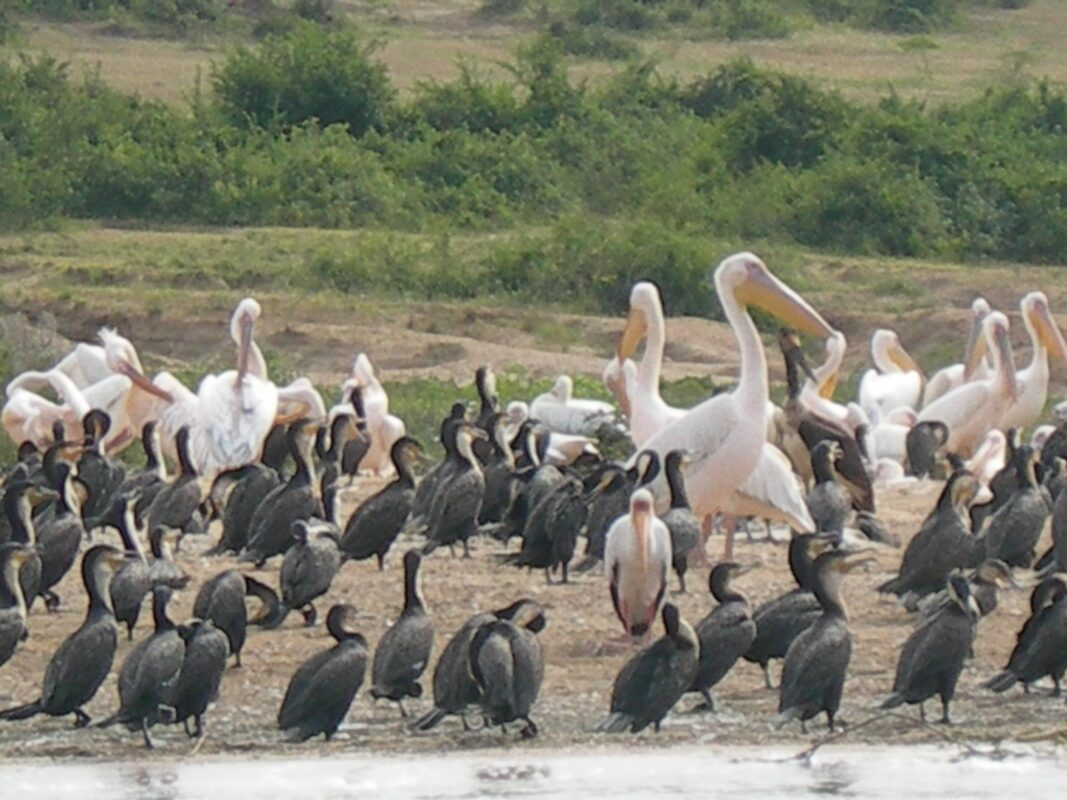
Diverse bird species gather during Uganda’s peak birding season.
Uganda is a year-round birding destination, but the best time to visit depends on the species you want to see, the habitats you plan to explore, your tolerance for rain, and whether resident or migratory birds are your priority. Uganda’s combination of forests, wetlands, lakes, savannahs, mountains, and river systems means that different seasons can offer different birding opportunities, a key consideration for a Uganda Safari for Bird Lovers.
For travelers planning a dedicated Uganda birding safari, the two broad dry-season periods are generally December to February and June to September, while wetter periods generally occur from March to May and October to November. However, seasonality should be considered alongside the target species and destination rather than treated as a simple rule that one season is always better, a key principle for a Uganda Safari for Bird Lovers.
Uganda can be visited throughout the year for birdwatching. Resident birds remain present across the seasons, while migratory birds add another important dimension during parts of the year. Current birding information also indicates that early mornings are particularly productive because many birds are active near their overnight locations before dispersing to feed, a key practice for a Uganda Safari for Bird Lovers.
Uganda Birding in the Dry Season
The dry seasons generally provide more comfortable conditions for many travelers. December to February and June to September are commonly identified as Uganda’s principal dry periods. Lower rainfall can make forest trails, roads, and outdoor birding activities easier to manage, a key consideration for a Uganda Safari for Bird Lovers.
Reduced rainfall can also make it easier for birders to spend longer periods outdoors. In some habitats, less dense vegetation can improve visibility, although this varies considerably between locations and species, a key advantage of a dry-season Uganda Safari for Bird Lovers.
The Uganda safari seasons can therefore be considered when deciding between a general wildlife-and-birding itinerary and a more specialized birding trip for a Uganda Safari for Bird Lovers.
December to February Birding in Uganda
December to February forms Uganda’s shorter dry-season period. These months can provide comfortable conditions for combining birdwatching with other safari activities, a great time for a Uganda Safari for Bird Lovers.
They can also be relevant to travelers interested in migratory birds. Current Uganda birding sources report that migratory species are present during parts of this period, adding to the resident bird population, a key advantage for a Uganda Safari for Bird Lovers.
February can be particularly attractive for travelers who want to combine birding with broader wildlife experiences. Current tourism information describes February and March as favorable months for birdwatchers because migratory birds can still be present alongside Uganda’s resident species, a great time for a Uganda Safari for Bird Lovers.
June to September Birding in Uganda
June to September represents the longer dry-season period. These months can be attractive for travelers who prefer relatively drier conditions for outdoor activities and forest walks, a great time for a Uganda Safari for Bird Lovers.
For birders visiting destinations such as Bwindi, Kibale, Murchison Falls, Queen Elizabeth, Lake Mburo, and other protected areas, drier conditions can make some trails and roads easier to navigate, a key advantage of a dry-season Uganda Safari for Bird Lovers.
However, birders should still choose these months according to their target species. A dry-season trip designed around forest endemics may have different priorities from a trip focused on migratory waterbirds, a key consideration for a Uganda Safari for Bird Lovers.
Uganda Birding During the Wet Season
The wetter periods generally occur from March to May and October to November. Rain does not prevent birdwatching, and these periods can provide important advantages for certain birders, a great time for a Uganda Safari for Bird Lovers.
Rain supports lush vegetation and can coincide with increased breeding activity among resident birds. Migratory species may also be present during parts of the wet-season periods, a key advantage for a Uganda Safari for Bird Lovers.
The main consideration is flexibility. Rain can interrupt outdoor activities and make some trails muddy, so travelers should allow additional time and remain prepared for changing conditions, a key consideration for a Uganda Safari for Bird Lovers.
March to May Birding in Uganda
March to May is part of Uganda’s wetter season. Although rainfall can make some trails more difficult, the period can be rewarding for travelers interested in breeding activity, lush landscapes, and seasonal bird diversity, a great time for a Uganda Safari for Bird Lovers.
Birders should expect changing weather and should plan their daily activities with flexibility. Early morning birding remains useful, while later weather conditions can influence whether a planned activity needs to be adjusted, a key practice for a Uganda Safari for Bird Lovers.
October to November Birding in Uganda
October to November is another wetter period. It can be an interesting time for birders because seasonal changes in bird populations can add variety to the resident species, a great time for a Uganda Safari for Bird Lovers.
Travelers visiting wetlands and forest habitats should be prepared for rain and potentially muddy conditions. The advantage is that many locations can be less busy than during the most popular travel periods, a key advantage for a Uganda Safari for Bird Lovers.
When Is the Best Time for Migratory Birds?
Migratory birds are an important consideration when choosing when to visit Uganda. Uganda receives migratory species in addition to its large resident bird population, so travelers interested specifically in migrants should plan their dates around the migration period relevant to their target species, a key consideration for a Uganda Safari for Bird Lovers.
Current Uganda bird migration information describes East Africa as an important region for birds moving between Africa, Europe, Asia, and other parts of the continent, adding a global dimension to a Uganda Safari for Bird Lovers.
Because migration timing can vary between species and locations, travelers targeting particular migrants should discuss their target list with a knowledgeable birding guide rather than relying solely on a general seasonal label, a key practice for a Uganda Safari for Bird Lovers.
Best Time for Albertine Rift Endemic Birds
Birders targeting Albertine Rift species should consider southwestern Uganda and destinations such as Bwindi and Mgahinga. Current birding information identifies Bwindi as an important habitat for Albertine Rift endemics, a key focus for a Uganda Safari for Bird Lovers.
The timing of breeding and nesting activity can also influence observations. Current birding information notes May and June as an important nesting period for Albertine Rift endemics in Bwindi and Mgahinga, a key consideration for a Uganda Safari for Bird Lovers.
For specialist birders, therefore, the best time to visit should be based on the exact species being targeted rather than simply choosing the driest months, a key principle for a Uganda Safari for Bird Lovers.
Best Time for Shoebill Birding
The Shoebill is one of Uganda’s most sought-after birds, and wetland destinations such as Mabamba Bay are particularly important for travelers who want to search for this species, a key focus for a Uganda Safari for Bird Lovers.
Dedicated Shoebill excursions often begin early in the morning. Current information from Ziwa Rhino Sanctuary, for example, recommends an early start for Shoebill tracking because the species can be searched for around wetland habitats during the morning, a key practice for a Uganda Safari for Bird Lovers.
Travelers should remember that wild-bird sightings cannot be guaranteed. The most effective approach is to use an experienced guide, allocate sufficient time, and explore suitable habitat responsibly, a key principle for a Uganda Safari for Bird Lovers.
Best Time for Bird Photography
Bird photography can be undertaken throughout the year, but the preferred season depends on the photographer’s priorities. Drier weather can make outdoor photography more comfortable, while wetter periods can provide lush vegetation and changing environmental conditions, a key consideration for a Uganda Safari for Bird Lovers.
Photographers should also consider light, bird behavior, habitat access, and the amount of time available at each location. A photography-focused itinerary should be less rushed than a route designed simply to visit as many destinations as possible, a key principle for a Uganda Safari for Bird Lovers.
Best Time for Forest Birding
Forest birding is possible throughout the year in Uganda. Dry periods can provide easier trail conditions, while wetter periods can produce lush vegetation and active birdlife, a key consideration for a Uganda Safari for Bird Lovers.
Destinations such as Bwindi, Kibale, Budongo, Mabira, and Semuliki require patience because many forest species remain concealed within vegetation or high in the canopy, a key practice for a Uganda Safari for Bird Lovers.
Regardless of season, early morning is particularly valuable for forest birding because birds are often active during the first hours of daylight, a key practice for a Uganda Safari for Bird Lovers.
Best Time for Wetland Birding
Wetlands can be productive throughout the year, although water levels, vegetation, rainfall, and migratory movements can influence what is observed, a key consideration for a Uganda Safari for Bird Lovers.
Mabamba Bay, Lake Mburo, Queen Elizabeth, and other wetland environments can be incorporated into a birding itinerary according to the target species, a key strategy for a Uganda Safari for Bird Lovers.
Travelers should select their dates according to whether their priority is resident wetland species, migratory birds, photography, or a broader species list, a key principle for a Uganda Safari for Bird Lovers.
Best Time for Savannah Birding
Savannah environments provide opportunities to observe raptors, hornbills, rollers, bee-eaters, bustards, weavers, and numerous other species. Dry conditions can make some roads easier to navigate and may improve visibility in certain areas, a key consideration for a Uganda Safari for Bird Lovers.
Murchison Falls, Queen Elizabeth, Lake Mburo, and Kidepo Valley offer different savannah birding experiences. The most appropriate destination depends on the species and regional itinerary, a key strategy for a Uganda Safari for Bird Lovers.
Best Time to Visit Bwindi for Bird Lovers
Bwindi is an important destination for forest birders, particularly those interested in Albertine Rift species. The park supports a large number of bird species and offers several birding areas, a cornerstone of a Uganda Safari for Bird Lovers.
Travelers should consider both trail conditions and target species when selecting travel dates. A specialist birding itinerary may prioritize a particular season because of breeding activity or species behavior, while general birders may prefer the more comfortable dry periods, a key consideration for a Uganda Safari for Bird Lovers.
Best Time to Visit Kibale for Bird Lovers
Kibale can be visited for birding throughout the year. The dry periods generally make forest walking more comfortable, while wetter periods can bring lush vegetation and seasonal birding opportunities, a key consideration for a Uganda Safari for Bird Lovers.
Travelers combining Kibale forest birding with Bigodi Wetland Sanctuary can experience more than one habitat within the same regional itinerary, a great strategy for a Uganda Safari for Bird Lovers.
Best Time to Visit Queen Elizabeth National Park for Birding
Queen Elizabeth National Park contains a wide variety of habitats, including savannah, wetlands, forests, crater lakes, and the Kazinga Channel, a top destination for a Uganda Safari for Bird Lovers.
Current information identifies June to October as a traditionally favorable period for birding because reduced vegetation growth can improve visibility and drier conditions can make access easier. The wetter months can also be valuable, particularly for travelers interested in migratory birds, a key consideration for a Uganda Safari for Bird Lovers.
For a detailed destination-specific plan, the Queen Elizabeth birding guide provides additional information about habitats and seasonal considerations for a Uganda Safari for Bird Lovers.
Best Time to Visit Lake Mburo for Birding
Lake Mburo can be visited throughout the year and offers a mixture of woodland, acacia savannah, aquatic habitats, and other environments, a great stop for a Uganda Safari for Bird Lovers.
Dry periods can make general wildlife viewing easier, while wet periods create greener landscapes and different birding conditions. The appropriate timing therefore depends on whether birding is the main purpose of the visit or part of a broader wildlife safari, a key consideration for a Uganda Safari for Bird Lovers.
Best Time to Visit Murchison Falls for Birding
Murchison Falls provides forest, savannah, river, and wetland habitats. This diversity makes the destination useful across different seasons, a top destination for a Uganda Safari for Bird Lovers.
Travelers searching for waterbirds can consider boat-based birding along the Nile, while forest birding in areas such as Budongo and Kaniyo Pabidi can add specialist forest species, a key strategy for a Uganda Safari for Bird Lovers.
The timing should therefore be matched to the target list rather than determined solely by whether the trip falls within a dry or wet season, a key principle for a Uganda Safari for Bird Lovers.
Best Time to Visit Semuliki for Birding
Semuliki is particularly important for birders interested in species associated with Central African forest habitats. Its ecological setting makes it valuable for specialist birding, a unique addition to a Uganda Safari for Bird Lovers.
Because forest conditions can remain wet, travelers should be prepared for changing trail conditions even outside the main rainy periods. A specialist guide can help determine the most appropriate timing for specific targets, a key practice for a Uganda Safari for Bird Lovers.
Best Time to Visit Kidepo Valley for Birding
Kidepo Valley provides a very different birding environment from Uganda’s humid western forests. Its semi-arid landscape supports species adapted to open country and dry habitats, a unique addition to a Uganda Safari for Bird Lovers.
The park can be included in a specialist itinerary for travelers interested in northern Ugandan species and birds associated with the Karamoja region, a great stop for a Uganda Safari for Bird Lovers.
Should You Visit Uganda During Peak Season?
Peak travel periods can provide comfortable conditions but may also bring greater demand for accommodation and other safari services. Birders should not automatically assume that the busiest safari season is the best birding season, a key consideration for a Uganda Safari for Bird Lovers.
If your main objective is a particular species, the timing should be determined by that species’ habitat, seasonal behavior, and migration pattern, a key principle for a Uganda Safari for Bird Lovers.
Should Bird Lovers Visit During the Green Season?
Yes. The green season can be worthwhile for birders who value lush landscapes, breeding activity, fewer tourists, and seasonal bird diversity, a great time for a Uganda Safari for Bird Lovers.
The main trade-off is that rain can make some roads and trails more difficult. Travelers should therefore choose appropriate accommodation, footwear, clothing, and transportation and allow flexibility in the daily schedule, a key consideration for a Uganda Safari for Bird Lovers.
How Early Should Birders Start Each Day?
Early starts are strongly recommended for dedicated birding. Current Uganda birding information notes that birds are often closer to their overnight locations during the early morning before dispersing to feed, a key practice for a Uganda Safari for Bird Lovers.
This makes dawn and the first hours of daylight particularly valuable for forest walks, wetland excursions, and many game-drive birding sessions, a key practice for a Uganda Safari for Bird Lovers.
Does Rain Stop Birding in Uganda?
Rain does not automatically stop a birding safari. However, heavy rainfall can temporarily reduce visibility and make some trails or roads difficult, a key consideration for a Uganda Safari for Bird Lovers.
A flexible itinerary allows the guide to adjust the timing of activities and take advantage of periods when weather conditions improve, a key practice for a Uganda Safari for Bird Lovers.
How to Choose Your Birding Season
The best approach is to start with your target species. If you are primarily interested in resident birds, Uganda can be visited throughout the year. If migrants are a major priority, consider the periods when your target species are expected in the country, a key principle for a Uganda Safari for Bird Lovers.
If trail accessibility and comfortable outdoor conditions are your main concerns, the dry periods may be more suitable. If you prefer fewer visitors, greener landscapes, and seasonal bird activity, the wetter periods may be attractive, a key consideration for a Uganda Safari for Bird Lovers.
Best Time for a First Uganda Birding Safari
First-time birders may prefer a period offering relatively comfortable travel conditions while still providing access to Uganda’s major habitats. The dry seasons are commonly favored for general safari travel because of easier access and lower rainfall, a great time for a first Uganda Safari for Bird Lovers.
However, there is no single universally best month. The itinerary, target species, destinations, and personal priorities should determine the final travel dates, a key principle for a Uganda Safari for Bird Lovers.
Best Time for Serious Birders and Listers
Experienced birders should plan more precisely. A serious species-list expedition should identify target species first and then determine which destinations and seasons provide the strongest opportunity to encounter them, a key practice for a Uganda Safari for Bird Lovers.
This approach may result in a travel period that differs from the conventional peak safari season. Specialist birders should therefore prioritize their target list over generic recommendations about the best time to visit Uganda, a key principle for a Uganda Safari for Bird Lovers.
Best Time for a Combined Birding and Wildlife Safari
Travelers combining birds with gorillas, chimpanzees, elephants, lions, tree-climbing lions, buffaloes, or other wildlife may prefer a season that balances birding conditions with the requirements of the other activities, a key consideration for a Uganda Safari for Bird Lovers.
Dry-season travel can be convenient for combining multiple outdoor activities, but wet-season travel can provide greener landscapes and fewer tourists. The right choice depends on which experience has the highest priority, a key principle for a Uganda Safari for Bird Lovers.
Planning Your Travel Dates Around Your Target Species
The most important principle is to avoid choosing dates before deciding what you want to see. A target list can reveal whether you need forest, wetland, mountain, savannah, or multiple habitats, a key principle for a Uganda Safari for Bird Lovers.
Once those habitats are identified, the guide can recommend a route and travel period that gives the trip a realistic chance of achieving its objectives, a key practice for a Uganda Safari for Bird Lovers.
Final Advice on the Best Time for Uganda Bird Lovers
Uganda is suitable for birding throughout the year, but the experience changes with the seasons. The dry periods of December to February and June to September generally offer easier conditions for many outdoor activities, while the wetter periods of March to May and October to November can provide lush landscapes, breeding activity, seasonal bird diversity, and opportunities to encounter migratory species, a key consideration for a Uganda Safari for Bird Lovers.
For bird lovers, the best time to visit Uganda is ultimately the period that matches the species and habitats you most want to experience. A carefully planned itinerary should consider migration, resident birds, breeding activity, forest conditions, wetland conditions, photography requirements, road accessibility, and the amount of time available, a key principle for a Uganda Safari for Bird Lovers.
Rather than choosing a month simply because it is labeled the “best” season, build the safari around your target species and allow enough time for early-morning birding, specialist habitats, and flexible field observations. This approach produces a more useful and realistic Uganda birding safari than relying on a single seasonal recommendation, a key principle for a Uganda Safari for Bird Lovers.
Planning a Uganda Safari for Bird Lovers With the Right Guide
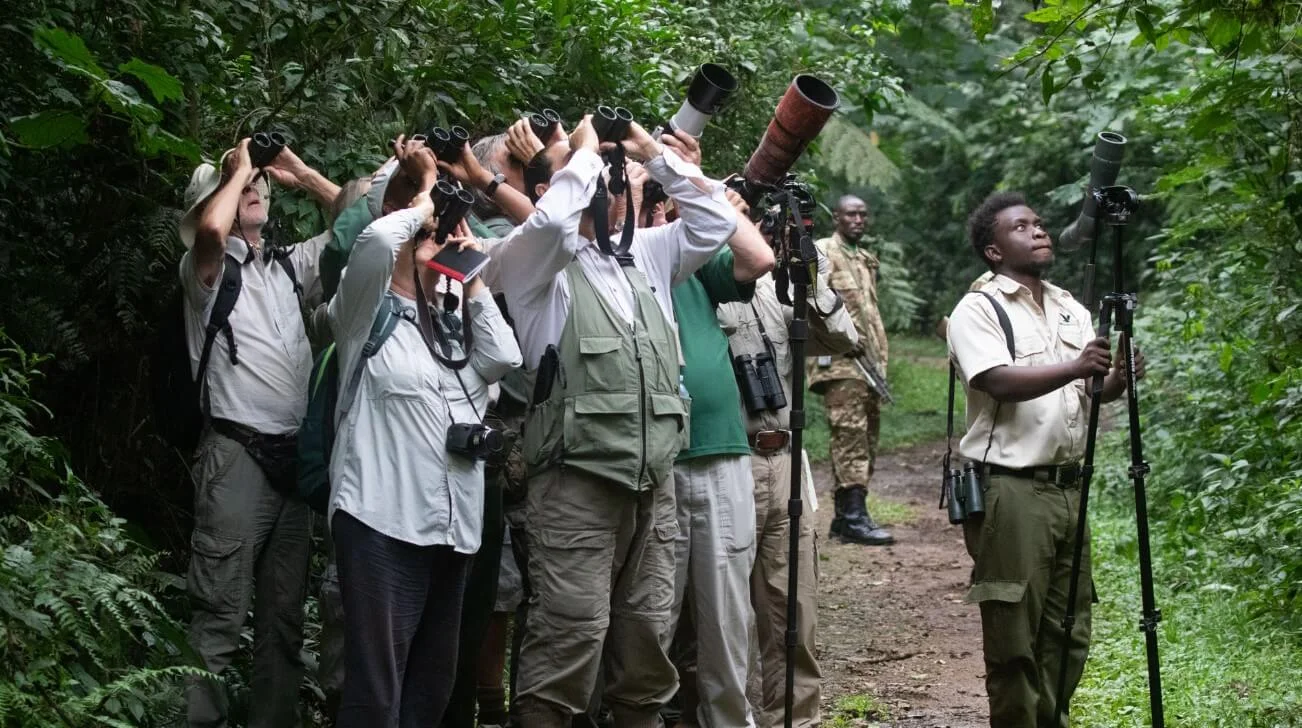
Bird lovers tracking rare species with local guides on a Uganda safari
Planning a Uganda Safari for Bird Lovers requires a different approach from planning a conventional wildlife holiday. Uganda offers an exceptional range of bird habitats, from tropical forests and montane environments to wetlands, lakeshores, savannahs, rivers, and papyrus swamps. The right guide helps transform this diversity into a practical birding itinerary based on the species, habitats, season, and experience level of the traveler, a key principle for a Uganda Safari for Bird Lovers.
A successful Uganda birding safari should begin with the traveler’s objectives. Some birders want to see a large number of species, while others have specific targets such as the Shoebill, African Green Broadbill, Rwenzori Turaco, Handsome Francolin, Shelley’s Crimsonwing, or other forest and wetland specialists. The guide should understand these priorities before the route is finalized, a key practice for a Uganda Safari for Bird Lovers.
Why the Right Birding Guide Matters
Birdwatching in Uganda can involve much more than simply looking for birds in open landscapes. Many forest species remain high in the canopy or hidden within dense vegetation. Others are detected by their calls before they become visible. A knowledgeable guide can recognize these sounds, understand habitat preferences, and determine when it is worth stopping to investigate, a key value-add for a Uganda Safari for Bird Lovers.
A guide also helps organize the day around bird activity. Early mornings are particularly important because many birds are active around their overnight locations before dispersing to feed. This makes an early start a valuable part of a dedicated birding itinerary, a key practice for a Uganda Safari for Bird Lovers.
Choose a Guide With Birding Experience
Travelers should distinguish between a general safari guide and a guide with substantial birding experience. A general guide may be highly knowledgeable about mammals, landscapes, and park history, but specialist birding often requires additional skills, a key consideration for a Uganda Safari for Bird Lovers.
When selecting a guide, ask about experience identifying birds by sight and sound, knowledge of forest birding, wetland experience, familiarity with specialist species, and experience working with serious birders and photographers, a key practice for a Uganda Safari for Bird Lovers.
The guide should also understand that birdwatchers may want to spend considerably longer at one location than conventional safari visitors, a key principle for a Uganda Safari for Bird Lovers.
Tell the Guide Your Target Species
One of the most important steps is providing a target list before the safari begins. This list allows the guide to identify which habitats and destinations are most relevant, a key practice for a Uganda Safari for Bird Lovers.
For example, a birder interested in Albertine Rift species will require a different route from someone primarily interested in waterbirds. A traveler targeting the Shoebill will need wetland time, while someone interested in Central African forest species may need to prioritize Semuliki, a key strategy for a Uganda Safari for Bird Lovers.
Uganda’s extensive bird diversity makes a target list especially useful because attempting to cover every important birding location in one trip can result in excessive travel and insufficient time in productive habitats, a key principle for a Uganda Safari for Bird Lovers.
Match the Guide to Your Birding Experience
Not every birder has the same level of experience. Beginners may need assistance learning field marks, calls, behavior, and habitat associations, while experienced birders may want to concentrate on difficult species and maintain a detailed checklist, a key consideration for a Uganda Safari for Bird Lovers.
The guide should know the group’s experience level before the safari begins. This allows the pace and explanations to be adjusted accordingly, a key practice for a Uganda Safari for Bird Lovers.
Plan the Route Around Bird Habitats
A good birding guide does not simply select destinations because they are famous. The route should be based on the habitats required by the target species, a key principle for a Uganda Safari for Bird Lovers.
Forests can produce specialist forest birds, wetlands can provide waterbirds and papyrus specialists, while savannahs can add raptors, hornbills, rollers, bee-eaters, bustards, and other open-country species, a key strategy for a Uganda Safari for Bird Lovers.
Combining several habitat types can substantially increase the range of species encountered during a Uganda birding safari, a key principle for a Uganda Safari for Bird Lovers.
Use Bwindi for Specialist Forest Birding
Bwindi is particularly important for birders interested in Albertine Rift species. Current birding information identifies the forest as supporting more than 350 bird species and numerous Albertine Rift endemics, a cornerstone of a Uganda Safari for Bird Lovers.
Ruhija and the Mubwindi Swamp area are among the locations identified for birding within Bwindi. A specialist guide can help determine which trails are most appropriate for the species on the target list, a key practice for a Uganda Safari for Bird Lovers.
Use Semuliki for Central African Forest Species
Semuliki occupies a particularly important ecological position in western Uganda. Its forest environment supports species associated with the Congo Basin and makes the destination valuable for specialist birders, a unique addition to a Uganda Safari for Bird Lovers.
Current information from Anthill Safaris describes Semuliki as supporting more than 400 bird species and highlights its importance for rare species, a key stop for a Uganda Safari for Bird Lovers.
The Semuliki birding destination can therefore be considered when the target list includes Central African forest-associated birds for a Uganda Safari for Bird Lovers.
Use Murchison Falls for Mixed Habitat Birding
Murchison Falls National Park provides opportunities across savannah, riverine, woodland, and forest habitats. Current information records more than 450 bird species in the park, a top destination for a Uganda Safari for Bird Lovers.
The Nile corridor provides opportunities for waterbirds, while game drives can produce grassland and woodland species. Budongo and Kaniyo Pabidi provide additional forest birding opportunities, a great combination for a Uganda Safari for Bird Lovers.
A guide who understands these habitat differences can structure the day to cover several bird communities instead of treating the entire park as one uniform birding environment, a key practice for a Uganda Safari for Bird Lovers.
Use Queen Elizabeth for Habitat Diversity
Queen Elizabeth National Park is another valuable destination for bird lovers because it combines savannah, wetlands, forests, crater lakes, and the Kazinga Channel, a top destination for a Uganda Safari for Bird Lovers.
Current information identifies more than 600 bird species in the park. Boat birding along the Kazinga Channel can complement game drives and forest activities, a key activity for a Uganda Safari for Bird Lovers.
The Queen Elizabeth birding route can therefore be incorporated into a wider itinerary where habitat diversity is a major objective for a Uganda Safari for Bird Lovers.
Use Kibale and Bigodi Together
Kibale provides an opportunity to combine tropical forest birding with wetland birding around Bigodi. Current information identifies more than 350 bird species associated with Kibale and its surrounding environments, a key destination for a Uganda Safari for Bird Lovers.
Bigodi Wetland Sanctuary adds another habitat and provides guided walking opportunities through wetland vegetation. Current information reports more than 200 bird species in the sanctuary, a great addition to a Uganda Safari for Bird Lovers.
This combination can be particularly useful for travelers who want to maximize bird diversity without constantly changing regions, a key efficiency for a Uganda Safari for Bird Lovers.
Use Mabamba for Shoebill-Focused Birding
Mabamba Bay is one of Uganda’s most important wetland birding destinations and is particularly associated with the Shoebill. The wetland lies on the shores of Lake Victoria and is explored by boat through papyrus channels, a key stop for a Uganda Safari for Bird Lovers.
Current information describes Mabamba as a major destination for travelers searching for the Shoebill and other wetland species, a key focus for a Uganda Safari for Bird Lovers.
The Mabamba wetland experience can therefore form an important component of an itinerary focused on specialist wetland birds for a Uganda Safari for Bird Lovers.
Consider Lake Mburo for a Different Birding Environment
Lake Mburo National Park offers a combination of acacia woodland, savannah, wetlands, and aquatic environments. This makes it useful for birders who want to move beyond the tropical forests of western Uganda, a great stop for a Uganda Safari for Bird Lovers.
Current birding information identifies approximately 315 bird species in the park, including species associated with its varied habitats, a great addition to a Uganda Safari for Bird Lovers.
A guide can integrate game drives, wetland areas, and boat activities depending on the target species, a key practice for a Uganda Safari for Bird Lovers.
Consider Kidepo for Northern Uganda Birding
Kidepo Valley National Park provides a markedly different environment from the forests and wetlands of southwestern Uganda. Its semi-arid landscapes support bird species adapted to dry-country conditions, a unique addition to a Uganda Safari for Bird Lovers.
Current information identifies approximately 463 bird species in the park, including species such as ostriches, Abyssinian Ground Hornbill, Kori Bustard, Secretary Bird, Karamoja Apalis, and Pygmy Falcon, a great stop for a Uganda Safari for Bird Lovers.
Kidepo can therefore be valuable for experienced birders seeking a broader representation of Uganda’s avifauna, a great addition to a Uganda Safari for Bird Lovers.
Plan Early Morning Birding
The first hours of daylight should be protected for birding whenever possible. Birds are generally more active during the early morning, and forest environments can be particularly productive at this time, a key practice for a Uganda Safari for Bird Lovers.
A guide should therefore avoid scheduling unnecessary long-distance transfers during the most productive morning hours, a key principle for a Uganda Safari for Bird Lovers.
Allow the Guide to Adjust the Schedule
A rigid timetable can be counterproductive during a birding safari. If a guide locates a difficult or important target species, the group may need additional time at the location, a key practice for a Uganda Safari for Bird Lovers.
Likewise, an unexpected sighting can justify changing the order of activities. A flexible itinerary allows travelers to take advantage of these opportunities, a key advantage of a private Uganda Safari for Bird Lovers.
Build the Safari Around the Target List
The target list should influence almost every major planning decision. If the list contains forest specialists, more time should be allocated to forests. If it contains wetland birds, the itinerary should include appropriate wetlands, a key principle for a Uganda Safari for Bird Lovers.
This approach prevents travelers from spending too much time in destinations that have little relevance to their primary objectives, a key efficiency for a Uganda Safari for Bird Lovers.
Plan for Resident and Migratory Birds
Uganda supports a substantial resident bird population as well as migratory species. The guide should understand whether migrants are a major objective when recommending travel dates, a key consideration for a Uganda Safari for Bird Lovers.
Migration timing can vary between species, so birders with specific migrant targets should provide those names in advance, a key practice for a Uganda Safari for Bird Lovers.
Plan for Albertine Rift Endemics
Birders targeting Albertine Rift endemics should prioritize appropriate montane and forest habitats. Bwindi and Mgahinga are particularly relevant destinations, a key focus for a Uganda Safari for Bird Lovers.
Current birding information identifies numerous Albertine Rift species in these forests. The precise route should depend on the species being targeted and the amount of time available, a key strategy for a Uganda Safari for Bird Lovers.
Plan for Bird Photography
Photographers should tell their guide that photography is a priority. Photographing birds can require considerably more time than simply identifying them, a key consideration for a Uganda Safari for Bird Lovers.
A photographer may need to wait for a bird to emerge from vegetation, obtain suitable light, or repeat an observation. The itinerary should therefore avoid excessive rushing, a key practice for a Uganda Safari for Bird Lovers.
Use a Birding Checklist
A checklist helps both the traveler and guide monitor progress. It can show which species have already been identified and which targets remain outstanding, a key tool for a Uganda Safari for Bird Lovers.
For experienced birders, the checklist can also be divided by destination and habitat, making it easier to identify where additional effort is most useful, a key practice for a Uganda Safari for Bird Lovers.
Choose Accommodation Strategically
Accommodation should be selected partly according to its location relative to the main birding areas. Staying closer to the habitat can reduce morning transfer time and allow earlier starts, a key efficiency for a Uganda Safari for Bird Lovers.
For specialist birding, a slightly longer stay at a strategically located lodge may be more valuable than changing accommodation every night, a key principle for a Uganda Safari for Bird Lovers.
Plan Transportation Around Birding Priorities
Road transfers can consume significant amounts of time on a multi-destination Uganda safari. The guide and tour operator should therefore design a geographically logical route, a key efficiency for a Uganda Safari for Bird Lovers.
Where appropriate, a combination of road and other transport options may help reduce travel time, but the choice should depend on the overall itinerary and available budget, a key consideration for a Uganda Safari for Bird Lovers.
Allow Time for Wetland Boat Birding
Boat birding provides opportunities that may not be available from vehicles or walking trails. Mabamba Bay and the Kazinga Channel are examples of locations where boats can provide access to water-associated species, a key activity for a Uganda Safari for Bird Lovers.
The guide should coordinate with boat operators so that the excursion remains focused on wildlife observation rather than simply transportation, a key practice for a Uganda Safari for Bird Lovers.
Ask About Bird Identification Skills
Before booking, ask whether the guide identifies birds by calls as well as appearance. This is particularly important in dense forest habitats, a key question for a Uganda Safari for Bird Lovers.
Also ask whether the guide is familiar with similar-looking species and difficult identification groups. These skills can be particularly valuable to experienced birders, a key practice for a Uganda Safari for Bird Lovers.
Ask About Previous Birding Safaris
It is reasonable to ask an operator about the types of birding trips its guides have previously led. A guide who regularly works with birders may understand the different expectations of beginners, photographers, and experienced listers, a key practice for a Uganda Safari for Bird Lovers.
The objective should be to find a guide whose experience matches the style of safari you want to undertake, a key principle for a Uganda Safari for Bird Lovers.
Communicate the Desired Pace
Some travelers prefer a relaxed birding experience with plenty of time for photography and observation. Others want to maximize the number of species recorded each day, a key consideration for a Uganda Safari for Bird Lovers.
These preferences should be communicated before departure so the guide can design an appropriate daily rhythm, a key practice for a Uganda Safari for Bird Lovers.
Plan for Weather Changes
Uganda’s weather can change during the day, particularly in forest and mountainous areas. Rain should not automatically be considered a reason to cancel a birding safari, a key principle for a Uganda Safari for Bird Lovers.
A flexible guide can adjust the timing of activities when conditions become unfavorable and resume birding when visibility and safety improve, a key practice for a Uganda Safari for Bird Lovers.
Do Not Expect Every Target Species
Even a highly experienced guide cannot guarantee that every target species will be seen. Wild birds move freely, weather changes, and some species are naturally difficult to locate, a key reality of a Uganda Safari for Bird Lovers.
A realistic target list should distinguish between priority species and desirable additional species. This makes the safari more rewarding and avoids unrealistic expectations, a key principle for a Uganda Safari for Bird Lovers.
Choose a Guide Who Understands Responsible Birding
Birding should be conducted without unnecessary disturbance. A good guide should understand appropriate distances, avoid damaging vegetation, and discourage behavior that could disrupt nesting or feeding birds, a key ethical practice for a Uganda Safari for Bird Lovers.
Playback and other techniques should be used cautiously and only when appropriate. The welfare of the birds should always take priority over obtaining a photograph or adding a species to a checklist, a key principle for a Uganda Safari for Bird Lovers.
Combine Birding With Other Wildlife Experiences
Uganda makes it possible to combine specialist birding with chimpanzee tracking, gorilla trekking, game drives, boat safaris, and nature walks, a great way to diversify a Uganda Safari for Bird Lovers.
However, the schedule should clearly separate dedicated birding periods from other activities. A traveler who wants serious birding should not assume that a general wildlife excursion will provide the same results as a dedicated birding session, a key practice for a Uganda Safari for Bird Lovers.
Plan a Short Birding Safari
A short trip should focus on a small number of habitats that can be reached efficiently. Wetland birding around Entebbe and Mabamba can provide an accessible introduction, while travelers with additional days can move toward western Uganda, a great option for a short Uganda Safari for Bird Lovers.
The fewer the days available, the more important geographic efficiency becomes, a key principle for a Uganda Safari for Bird Lovers.
Plan a Longer Birding Expedition
Longer trips can combine western forests, wetlands, savannahs, mountains, and northern habitats. This allows birders to pursue a broader target list, a comprehensive itinerary for a Uganda Safari for Bird Lovers.
A longer itinerary also provides more opportunities to revisit productive locations when difficult species are missed on the first attempt, a key advantage of a longer Uganda Safari for Bird Lovers.
Plan With the Guide Before Arrival
Ideally, travelers should communicate with their guide or tour operator before reaching Uganda. Share the target list, dates, experience level, photography requirements, accommodation expectations, and preferred habitats, a key practice for a Uganda Safari for Bird Lovers.
This preparation allows the itinerary to be designed around actual birding objectives rather than being modified after arrival, a key efficiency for a Uganda Safari for Bird Lovers.
What Makes an Effective Uganda Birding Guide
An effective guide combines bird identification skills, knowledge of habitats, understanding of bird behavior, local destination knowledge, patience, communication skills, and responsible wildlife practices, a key asset for a Uganda Safari for Bird Lovers.
The guide should also be willing to explain what is being observed rather than simply naming species. Understanding why a bird occurs in a particular habitat makes the safari more educational and memorable, a key quality of a great Uganda Safari for Bird Lovers.
Final Planning Advice for Bird Lovers
The right guide can significantly improve a Uganda birding safari because the country’s bird diversity is spread across many different ecosystems. The strongest itinerary begins with the species the traveler wants to see and then works backward to identify the habitats, destinations, seasons, and amount of time required, a key principle for a Uganda Safari for Bird Lovers.
Whether the goal is to search for the Shoebill in wetlands, Albertine Rift endemics in southwestern forests, Central African species in Semuliki, savannah birds in Murchison Falls and Kidepo, or a broad national species list, specialist planning is essential, a key strategy for a Uganda Safari for Bird Lovers.
Choose a guide with appropriate birding experience, communicate your target list early, protect the most productive morning hours, allow flexibility, and avoid trying to cover too much ground in too little time. With those principles in place, Uganda can provide a highly productive and rewarding safari for both specialist birders and travelers discovering birdwatching for the first time, a key takeaway for a Uganda Safari for Bird Lovers.
Birding Safety, Ethics and Conservation in Uganda for a Uganda Safari for Bird Lovers

Birds To Spot On Safari in Uganda
Responsible birdwatching is an essential part of planning a Uganda Safari for Bird Lovers. Uganda’s forests, wetlands, savannahs, lakes, rivers, and mountain ecosystems support an exceptional range of birdlife, but these habitats require careful protection. A responsible birder should aim not only to see and photograph birds but also to minimize disturbance, respect protected areas, support conservation, and contribute positively to communities living around important bird habitats, a key ethical principle for a Uganda Safari for Bird Lovers.
A responsible Uganda birding safari should therefore combine excellent wildlife observation with good field ethics. This means following guide instructions, keeping appropriate distances from wildlife, avoiding unnecessary disturbance, respecting nesting areas, managing waste properly, and supporting conservation initiatives, a key practice for a Uganda Safari for Bird Lovers.
Why Responsible Birding Matters in Uganda
Birds depend on functioning ecosystems. Wetlands provide feeding and breeding areas for waterbirds, forests provide food and nesting sites for forest specialists, while savannahs and grasslands support raptors, ground birds, insectivores, and many other species, a key principle for a Uganda Safari for Bird Lovers.
Some bird species are particularly sensitive to habitat disturbance. Repeatedly approaching nesting birds, entering sensitive vegetation, or creating excessive noise can interfere with natural behavior. Responsible birding helps ensure that visitors enjoy wildlife without unnecessarily affecting it, a key ethical principle for a Uganda Safari for Bird Lovers.
Keep a Respectful Distance From Birds
Birders should avoid approaching birds simply to obtain a closer photograph or better view. If a bird changes its behavior because of your presence, the appropriate response is to increase the distance and allow it to settle, a key practice for a Uganda Safari for Bird Lovers.
This is particularly important around feeding, nesting, roosting, and breeding sites. A good guide should help determine when observation is appropriate and when the group should move away, a key practice for a Uganda Safari for Bird Lovers.
Never Disturb Nesting Birds
Nesting birds require particular care. Birders should avoid approaching nests, touching vegetation around nests, or remaining close to a nest for extended periods, a key ethical principle for a Uganda Safari for Bird Lovers.
Even when a nest appears unattended, the adult bird may be nearby. Excessive human presence can create unnecessary stress and may attract attention to the nesting location, a key concern for a Uganda Safari for Bird Lovers.
Responsible birders should prioritize the welfare of the birds over obtaining a photograph, recording, or unusually close observation, a key principle for a Uganda Safari for Bird Lovers.
Avoid Blocking Feeding and Movement Routes
Birds need to move freely between feeding, drinking, nesting, and resting areas. When a bird is using a narrow trail, shoreline, branch, or wetland channel, observers should avoid positioning themselves in a way that prevents normal movement, a key practice for a Uganda Safari for Bird Lovers.
Boat-based birding requires similar consideration. Boats should move carefully through sensitive wetland environments and avoid unnecessarily chasing birds, a key ethical practice for a Uganda Safari for Bird Lovers.
Use Bird Calls and Playback Responsibly
Bird calls can be useful for identification, but artificial playback should never become more important than the welfare of the bird. Repeatedly playing calls to force a bird into view can cause unnecessary disturbance, particularly during breeding or nesting periods, a key ethical principle for a Uganda Safari for Bird Lovers.
Birders should follow the guidance of experienced local guides and avoid excessive playback. The objective should be observation and identification rather than forcing a response, a key practice for a Uganda Safari for Bird Lovers.
Do Not Chase Birds for Photographs
Photography should be conducted without repeatedly pursuing birds. A photograph is not worth disturbing a bird or damaging its habitat, a key ethical principle for a Uganda Safari for Bird Lovers.
Long lenses and spotting scopes can help observers maintain a greater distance while still enjoying detailed views. Photographers should also avoid entering sensitive vegetation simply to obtain a particular composition, a key practice for a Uganda Safari for Bird Lovers.
Respect Wildlife During Boat Birding
Boat birding is an important part of Uganda’s wetland experiences, particularly at locations such as Mabamba Bay and along the Kazinga Channel. Boats should move quietly and avoid unnecessary pursuit of birds, a key ethical practice for a Uganda Safari for Bird Lovers.
The Mabamba Bay wetland is particularly sensitive because its papyrus environment supports specialist wetland species. Visitors should follow the instructions of local boat operators and guides throughout the excursion, a key practice for a Uganda Safari for Bird Lovers.
Protect Papyrus Wetlands
Papyrus wetlands are important habitats for specialized birds. Mabamba Bay, Bigodi, and other Ugandan wetlands support species that depend on aquatic and papyrus environments, a key habitat for a Uganda Safari for Bird Lovers.
Visitors should remain on designated trails or use approved boats and should never cut, break, or remove vegetation simply to improve visibility, a key ethical practice for a Uganda Safari for Bird Lovers.
Stay on Designated Trails
Remaining on established trails is one of the simplest ways to reduce environmental impact. Walking off-trail can damage vegetation, disturb insects and other wildlife, and potentially interfere with nesting or feeding areas, a key ethical principle for a Uganda Safari for Bird Lovers.
In forests and wetlands, designated trails also provide safer and more predictable routes for visitors while concentrating tourism activity in areas that guides and conservation managers can monitor, a key safety and ethical practice for a Uganda Safari for Bird Lovers.
Follow Park and Conservation Rules
Uganda’s national parks, forests, wetlands, and other protected areas operate under specific regulations. Visitors should follow the instructions provided by park authorities, guides, rangers, boat operators, and conservation staff, a key practice for a Uganda Safari for Bird Lovers.
Rules relating to access, photography, wildlife distance, trails, waste, and other visitor activities exist to protect both people and wildlife, a key principle for a Uganda Safari for Bird Lovers.
Respect Uganda’s Protected Areas
Protected areas such as Bwindi, Kibale, Queen Elizabeth, Murchison Falls, Semuliki, Lake Mburo, and Kidepo contain habitats that support large and diverse bird populations, a key destination for a Uganda Safari for Bird Lovers.
Birders should recognize that these areas are not simply sightseeing locations. They are functioning ecosystems that require protection from excessive disturbance, habitat degradation, pollution, and irresponsible tourism, a key ethical principle for a Uganda Safari for Bird Lovers.
Support Community Conservation
Conservation is closely connected to local communities. Tourism can provide economic opportunities that encourage communities to value and protect surrounding natural environments, a key principle for a Uganda Safari for Bird Lovers.
Bigodi Wetland Sanctuary is a useful example of community involvement in conservation and tourism. Current information describes the sanctuary as a community-managed wetland where tourism revenue contributes to conservation and local development, a great example for a Uganda Safari for Bird Lovers.
The Bigodi Wetland experience demonstrates how birding can be connected with community-based conservation when visitors use responsible tourism services, a key practice for a Uganda Safari for Bird Lovers.
Choose Responsible Tourism Operators
Birders should consider how their safari operator approaches conservation. Operators that work with local guides, support communities, respect protected-area regulations, and promote responsible wildlife observation can help ensure tourism contributes positively to conservation, a key practice for a Uganda Safari for Bird Lovers.
Current information from Uganda safari providers emphasizes the relationship between sustainable tourism, local communities, and habitat protection, particularly around important wetland destinations, a key principle for a Uganda Safari for Bird Lovers.
Do Not Remove Birds or Natural Materials
Birders should never collect birds, eggs, feathers, nests, plants, or other natural materials from protected areas or wildlife habitats. These materials belong within the ecosystem and may have ecological or legal significance, a key ethical principle for a Uganda Safari for Bird Lovers.
Photography, field notes, and responsible observation provide ways to document the experience without removing anything from the environment, a key practice for a Uganda Safari for Bird Lovers.
Do Not Feed Wild Birds
Feeding wild birds can alter natural behavior and may encourage birds to associate people with food. It can also create unhealthy concentrations of birds around visitor areas, a key ethical principle for a Uganda Safari for Bird Lovers.
Birds should be observed under natural conditions, allowing them to find their own food and maintain normal behavior, a key practice for a Uganda Safari for Bird Lovers.
Keep Noise Levels Low
Quiet observation is particularly important during forest birding. Loud conversations, music, shouting, and unnecessary vehicle noise can make birds more difficult to observe and may disturb wildlife, a key practice for a Uganda Safari for Bird Lovers.
Birders should keep voices low and allow periods of silence so that natural calls can be heard. This is also one of the best ways to improve the quality of a birding experience, a key principle for a Uganda Safari for Bird Lovers.
Manage Waste Responsibly
Everything brought into a birding environment should be taken out unless there is an appropriate waste-disposal facility. Plastic, food packaging, batteries, tissues, and other waste should never be left in forests, wetlands, parks, or along roads, a key ethical principle for a Uganda Safari for Bird Lovers.
Even small amounts of litter can become an environmental problem when accumulated across heavily visited locations, a key concern for a Uganda Safari for Bird Lovers.
Avoid Single-Use Plastic Where Practical
Reducing unnecessary plastic can help minimize waste during a safari. Travelers can use reusable water bottles and appropriate reusable containers where practical, a key ethical practice for a Uganda Safari for Bird Lovers.
Waste reduction is especially important around wetlands and waterways because discarded materials can eventually enter aquatic ecosystems, a key concern for a Uganda Safari for Bird Lovers.
Be Careful Around Wetlands and Waterways
Wetlands are sensitive environments and should be approached carefully. Visitors should use designated access points, approved boats, boardwalks, and trails, a key safety and ethical practice for a Uganda Safari for Bird Lovers.
Birders should never throw objects into water to make birds move or reveal themselves. Such behavior can disturb wildlife and degrade the quality of the observation, a key ethical principle for a Uganda Safari for Bird Lovers.
Respect Forest Habitats
Uganda’s forests contain many specialist birds that are sensitive to habitat changes. Bwindi, Kibale, Budongo, Mabira, Semuliki, and other forest areas should therefore be explored with minimal disturbance, a key ethical principle for a Uganda Safari for Bird Lovers.
Birders should avoid breaking branches, clearing vegetation, or creating unofficial paths. A forest birding experience should leave the habitat looking exactly as it was before the group arrived, a key practice for a Uganda Safari for Bird Lovers.
Respect Mountain Birding Environments
Mountain forests require additional care because their ecosystems can be fragile. Travelers visiting Bwindi, Mgahinga, or other highland environments should remain on approved trails and follow guide instructions, a key safety and ethical practice for a Uganda Safari for Bird Lovers.
Weather can also change quickly in mountainous areas, so safety and conservation considerations should always be combined when planning walks, a key consideration for a Uganda Safari for Bird Lovers.
Birding Ethics for Beginners
Beginners do not need specialist knowledge to practice responsible birding. The basic principles are simple: observe quietly, maintain distance, avoid disturbing nests, follow the guide, remain on designated trails, take all waste away, and leave wildlife where you found it, a key practice for a Uganda Safari for Bird Lovers.
Following these principles from the beginning creates good habits that remain useful throughout a birder’s life, a key benefit of a Uganda Safari for Bird Lovers.
Birding Ethics for Experienced Birders
Experienced birders have an important responsibility because their behavior can influence less experienced visitors. A skilled birder should demonstrate good field ethics and discourage practices that prioritize a checklist or photograph over wildlife welfare, a key ethical principle for a Uganda Safari for Bird Lovers.
Experienced birders should also be cautious when sharing exact locations of sensitive species. Publicizing the location of a vulnerable nesting bird, for example, can attract excessive attention and increase disturbance, a key ethical consideration for a Uganda Safari for Bird Lovers.
Be Careful When Sharing Bird Locations
Digital birding platforms, social media, photographs, and trip reports can make valuable information widely available. However, not every location should be shared in precise detail, a key ethical consideration for a Uganda Safari for Bird Lovers.
When dealing with sensitive species or nesting sites, birders should consider whether publishing an exact location could lead to increased disturbance, unauthorized access, or collection, a key ethical practice for a Uganda Safari for Bird Lovers.
Responsible Bird Photography
Responsible bird photography means allowing the bird to behave naturally. Photographers should avoid chasing, cornering, flushing, or repeatedly calling birds simply to create a better photograph, a key ethical principle for a Uganda Safari for Bird Lovers.
Photographers should also avoid damaging vegetation or entering restricted areas. A technically excellent photograph is never more important than the welfare of the subject, a key ethical practice for a Uganda Safari for Bird Lovers.
Responsible Use of Binoculars and Spotting Scopes
Optical equipment allows birders to observe birds without approaching too closely. Binoculars and spotting scopes are therefore valuable tools for responsible birding, a key practice for a Uganda Safari for Bird Lovers.
Using optics effectively can reduce the temptation to move closer to birds and can provide excellent views while maintaining a respectful distance, a key principle for a Uganda Safari for Bird Lovers.
Do Not Encourage Crowding Around Rare Birds
Rare sightings can attract several birders at once. When this happens, visitors should cooperate by keeping movement controlled, minimizing noise, and avoiding crowding the bird, a key ethical practice for a Uganda Safari for Bird Lovers.
Everyone should have an opportunity to observe without creating unnecessary pressure on the animal, a key principle for a Uganda Safari for Bird Lovers.
Respect Other Birders
Responsible birding also includes consideration for other visitors. Avoid blocking trails, shouting species names unnecessarily, or moving aggressively toward a bird while others are observing, a key ethical practice for a Uganda Safari for Bird Lovers.
Quiet communication and cooperation create better experiences for everyone and reduce unnecessary movement around wildlife, a key principle for a Uganda Safari for Bird Lovers.
Respect Local Communities
Many important birding areas are located near communities whose livelihoods are connected to the surrounding landscape. Visitors should respect local residents, private property, cultural practices, and community regulations, a key ethical principle for a Uganda Safari for Bird Lovers.
Hiring local guides, purchasing appropriate local services, and using community-managed tourism experiences can help ensure that tourism provides benefits beyond the protected area itself, a key practice for a Uganda Safari for Bird Lovers.
Support Community-Based Birding
Community-based birding can provide economic incentives for protecting habitats outside formal national parks. Bigodi Wetland Sanctuary provides an example where local participation and tourism are connected to conservation and development, a great example for a Uganda Safari for Bird Lovers.
When visitors choose responsible community experiences, their spending can help demonstrate that intact natural habitats have economic as well as ecological value, a key principle for a Uganda Safari for Bird Lovers.
Understand the Link Between Birding and Conservation
Birdwatching can contribute to conservation by creating economic value for protected habitats and increasing public appreciation of biodiversity. A visitor who travels specifically to see birds creates demand for guides, accommodation, transport, conservation services, and community tourism, a key principle for a Uganda Safari for Bird Lovers.
Responsible tourism can therefore become part of a broader conservation system when the benefits are managed appropriately, a key practice for a Uganda Safari for Bird Lovers.
Why Wetland Conservation Matters for Birders
Wetlands are among the most important bird habitats in Uganda. Mabamba Bay, for example, supports a large variety of waterbirds and specialist papyrus species, a key habitat for a Uganda Safari for Bird Lovers.
Wetland conservation is therefore directly connected to the future of birding. Protecting water quality, papyrus vegetation, breeding areas, and wetland integrity helps maintain the bird populations that attract visitors, a key principle for a Uganda Safari for Bird Lovers.
Why Forest Conservation Matters for Birders
Forest ecosystems support many of Uganda’s most specialized bird species. Albertine Rift forests are particularly important for species with restricted distributions, a key habitat for a Uganda Safari for Bird Lovers.
Responsible forest tourism can help demonstrate the value of these habitats while minimizing the disturbance associated with visitation, a key ethical practice for a Uganda Safari for Bird Lovers.
Birding and Conservation Education
Birding safaris provide opportunities to learn about habitat protection, ecological relationships, migration, threatened species, and the importance of protected areas, a key educational benefit of a Uganda Safari for Bird Lovers.
Guides can make these experiences more meaningful by explaining how individual species depend on particular habitats and why conservation measures are necessary, a key practice for a Uganda Safari for Bird Lovers.
Learn From Local Guides
Local guides often possess detailed knowledge of bird habitats, seasonal movements, local conservation challenges, and appropriate visitor behavior, a key asset for a Uganda Safari for Bird Lovers.
Listening to guides is particularly important in sensitive environments because they can identify areas where visitors should slow down, maintain distance, remain on trails, or avoid approaching wildlife, a key practice for a Uganda Safari for Bird Lovers.
Responsible Birding at Mabamba Bay
Mabamba Bay requires particular care because it is a wetland habitat supporting the Shoebill and many other waterbirds. Boat operators and guides should approach birds quietly and avoid unnecessary pursuit, a key ethical practice for a Uganda Safari for Bird Lovers.
Visitors should remain in the boat unless authorized to leave, avoid damaging papyrus, and follow local guidance throughout the excursion, a key practice for a Uganda Safari for Bird Lovers.
Responsible Birding at Bigodi Wetland Sanctuary
Bigodi demonstrates how tourism and community conservation can work together. Visitors should use the established walking routes and listen to the guides who manage the experience, a key ethical practice for a Uganda Safari for Bird Lovers.
The sanctuary’s boardwalk trails provide access to wetland habitats while helping limit direct visitor impact on sensitive areas, a key practice for a Uganda Safari for Bird Lovers.
Responsible Birding in Bwindi
Bwindi’s forest habitat requires careful trail use and controlled visitor behavior. Birders should remain with their guides, avoid approaching nesting sites, and minimize noise, a key ethical practice for a Uganda Safari for Bird Lovers.
Because the forest supports specialist species, responsible behavior helps protect the same biodiversity that makes the destination valuable to birdwatchers, a key principle for a Uganda Safari for Bird Lovers.
Responsible Birding in Queen Elizabeth National Park
Queen Elizabeth contains a mixture of wetlands, savannahs, forests, and waterways. Birders should follow park rules during game drives, nature walks, and boat excursions, a key ethical practice for a Uganda Safari for Bird Lovers.
The park’s bird diversity makes it particularly important that visitors avoid disturbing wildlife while moving between different habitats, a key principle for a Uganda Safari for Bird Lovers.
Responsible Birding in Murchison Falls
Murchison Falls combines river, woodland, forest, and savannah habitats. Birders should remain within permitted areas and follow the instructions of guides and park authorities, a key ethical practice for a Uganda Safari for Bird Lovers.
Boat-based birding along the Nile should be conducted without chasing birds or causing unnecessary disturbance to water-dependent wildlife, a key ethical practice for a Uganda Safari for Bird Lovers.
What Responsible Birding Should Leave Behind
The best birding visit leaves little evidence that the group was present. Trails should remain intact, vegetation should not be damaged, waste should be removed, and birds should be allowed to continue their normal activities, a key ethical principle for a Uganda Safari for Bird Lovers.
This simple principle can guide decisions throughout a safari, a key practice for a Uganda Safari for Bird Lovers.
How Birders Can Contribute to Conservation
Birders can support conservation by choosing responsible operators, using local guides, respecting protected areas, supporting community tourism, following park regulations, and sharing accurate conservation information, a key practice for a Uganda Safari for Bird Lovers.
Travelers can also encourage other visitors to practice responsible birding. Conservation becomes stronger when responsible behavior becomes the normal expectation rather than an optional extra, a key principle for a Uganda Safari for Bird Lovers.
The Role of Sustainable Tourism
Sustainable tourism aims to balance visitor experiences with the long-term protection of natural and cultural resources. For birding, this means ensuring that tourism does not undermine the habitats that attract visitors, a key principle for a Uganda Safari for Bird Lovers.
Choosing responsible services and following conservation principles allows bird tourism to contribute to the continued protection of Uganda’s bird habitats, a key practice for a Uganda Safari for Bird Lovers.
Final Thoughts on Birding Safety, Ethics and Conservation
Responsible birding is fundamental to a successful Uganda Safari for Bird Lovers. The country’s remarkable bird diversity depends on healthy forests, wetlands, rivers, lakes, mountains, and savannahs, and every visitor has a role in protecting those environments, a key ethical principle for a Uganda Safari for Bird Lovers.
The most important principles are straightforward: keep a respectful distance, avoid disturbing nests, use playback cautiously, never chase birds for photographs, remain on designated trails, manage waste responsibly, follow protected-area regulations, respect local communities, and listen to experienced guides, a key practice for a Uganda Safari for Bird Lovers.
Birding should ultimately be about observing wildlife without compromising its welfare. When travelers combine careful planning with ethical field practices, birdwatching becomes more than a tourism activity. It becomes a practical way of appreciating Uganda’s biodiversity while supporting the conservation of the habitats and communities that make these experiences possible, a key principle for a Uganda Safari for Bird Lovers.
Responsible tourism also helps ensure that future birders can experience the same forests, wetlands, savannahs, and waterways. Protecting the places where Uganda’s birds live is therefore inseparable from protecting the future of Uganda birding itself, a key takeaway for a Uganda Safari for Bird Lovers.
Conclusion: Planning the Ultimate Uganda Safari for Bird Lovers
Uganda offers an exceptional birding experience because its diverse landscapes bring together an extraordinary range of habitats within one country. From tropical forests and Albertine Rift mountains to wetlands, lakes, rivers, papyrus swamps, and open savannahs, Uganda provides bird lovers with opportunities to encounter an impressive variety of resident and migratory species, making it the ideal destination for a Uganda Safari for Bird Lovers.
A successful Uganda birding safari should be planned around the birds and habitats you most want to experience rather than simply following a conventional wildlife itinerary. The species on your target list should influence your choice of destinations, travel dates, guide, accommodation, activities, and the amount of time allocated to each location, a key principle for a Uganda Safari for Bird Lovers.
Choose the Right Birding Destinations
Uganda’s birding destinations each offer different opportunities. Bwindi and Mgahinga are particularly important for birders interested in Albertine Rift species, while Semuliki provides access to forest habitats associated with the Congo Basin. Kibale and Bigodi combine forest and wetland birding, while Murchison Falls and Queen Elizabeth provide opportunities across savannah, woodland, river, and wetland habitats, a key strategy for a Uganda Safari for Bird Lovers.
Wetland specialists should consider destinations such as Mabamba Bay, particularly when the Shoebill is a priority. Current information identifies Mabamba Bay as a major wetland birding destination and an important location for searching for the Shoebill, a key stop for a Uganda Safari for Bird Lovers.
The Mabamba birding experience can therefore form an important part of a broader Uganda birding itinerary for a Uganda Safari for Bird Lovers.
Plan Your Safari Around Your Target Species
The most effective way to design a Uganda Safari for Bird Lovers is to establish a target list before choosing the route. A birder interested in forest specialists will need a different itinerary from someone focused on wetland birds, migratory species, savannah birds, or a combination of habitats, a key principle for a Uganda Safari for Bird Lovers.
Uganda’s bird diversity makes this approach particularly valuable. Trying to visit too many destinations without allowing sufficient time for actual birding can reduce the quality of the safari, a key consideration for a Uganda Safari for Bird Lovers.
Choose the Right Season
Uganda can be visited for birding throughout the year. The dry periods, generally December to February and June to September, can offer easier conditions for many outdoor activities, while wetter periods can provide lush landscapes, seasonal birding opportunities, and periods when migratory species may be encountered, a key consideration for a Uganda Safari for Bird Lovers.
There is therefore no single month that is automatically the best for every birder. The right travel period depends on the species being targeted, the habitats being visited, weather preferences, photography requirements, and the overall purpose of the safari, a key principle for a Uganda Safari for Bird Lovers.
The best birding season should ultimately be selected according to your specific target species and itinerary for a Uganda Safari for Bird Lovers.
Work With an Experienced Birding Guide
A knowledgeable birding guide can make a major difference to the safari. Many birds are easier to detect by sound than sight, particularly in dense forest environments. An experienced guide can recognize calls, understand habitat preferences, locate productive areas, and help distinguish between similar species, a key asset for a Uganda Safari for Bird Lovers.
The guide should also understand the priorities of the traveler. Beginners may need more explanation about identification and bird behavior, while experienced birders may want to concentrate on difficult targets and maximize the number of species recorded, a key practice for a Uganda Safari for Bird Lovers.
Give Yourself Enough Time
Birding rewards patience. A successful Uganda birding safari should not be built around rushing from one destination to another simply to increase the number of places visited, a key principle for a Uganda Safari for Bird Lovers.
Early mornings should be protected for birding whenever possible. Additional time in productive forests, wetlands, or savannah habitats can often be more valuable than adding another destination to an already crowded itinerary, a key practice for a Uganda Safari for Bird Lovers.
Combine Different Habitats
One of Uganda’s greatest advantages for bird lovers is habitat diversity. Combining forests, wetlands, lakeshores, savannahs, and other ecosystems can produce a much broader species list than concentrating on a single habitat, a key principle for a Uganda Safari for Bird Lovers.
For example, a traveler can combine forest birding in Kibale or Bwindi with wetland birding around Bigodi or Mabamba and savannah birding in Queen Elizabeth or Murchison Falls, a great strategy for a Uganda Safari for Bird Lovers.
The Queen Elizabeth birding experience is particularly useful for travelers seeking a mixture of savannah, wetland, forest, and aquatic habitats for a Uganda Safari for Bird Lovers.
Make Conservation Part of the Experience
Birding should always be conducted responsibly. Travelers should maintain appropriate distances from birds, avoid disturbing nests, minimize noise, use playback cautiously, remain on designated trails, manage waste properly, and follow the instructions of guides and protected-area authorities, a key ethical practice for a Uganda Safari for Bird Lovers.
Supporting responsible tourism and community-based conservation can also help ensure that the habitats supporting Uganda’s birdlife continue to receive economic and conservation value from tourism, a key principle for a Uganda Safari for Bird Lovers.
Birding Can Be Combined With Other Safari Experiences
A Uganda Safari for Bird Lovers does not have to focus exclusively on birds. Depending on the itinerary, travelers can combine birdwatching with chimpanzee tracking, gorilla trekking, game drives, boat excursions, nature walks, and cultural experiences, a great way to diversify a Uganda Safari for Bird Lovers.
However, dedicated birding time should remain in the itinerary when birdwatching is the primary objective. A conventional wildlife activity should not automatically be considered a substitute for specialist birding, a key practice for a Uganda Safari for Bird Lovers.
Start Planning Your Uganda Birding Safari
The best Uganda Safari for Bird Lovers is one that is designed around your own interests. Begin with your target species, identify the habitats where those species occur, select destinations that create an efficient route, choose an experienced birding guide, and select travel dates that match your objectives, a key practice for a Uganda Safari for Bird Lovers.
Whether your dream is to search for the Shoebill in a papyrus wetland, find Albertine Rift endemics in the forests of southwestern Uganda, explore the bird-rich ecosystems of Kibale and Budongo, or build a broad national species list, Uganda provides the habitat diversity needed for an exceptional birding adventure, a key takeaway for a Uganda Safari for Bird Lovers.
With thoughtful planning, sufficient time, responsible field practices, and the right guide, a Uganda birding safari can become much more than a checklist exercise. It can provide an immersive experience of Uganda’s forests, wetlands, mountains, rivers, and savannahs while supporting the conservation of the landscapes and communities that make the country’s birdlife possible, a key principle for a Uganda Safari for Bird Lovers.
For travelers ready to turn this guide into a practical itinerary, the next step is to create a target-species list and match it with the most appropriate Uganda birding destinations, season, route, and number of days. That approach provides the strongest foundation for a rewarding and well-organized Uganda Safari for Bird Lovers, a key final thought for this comprehensive guide.