
Understanding Uganda’s Climate and Weather Patterns
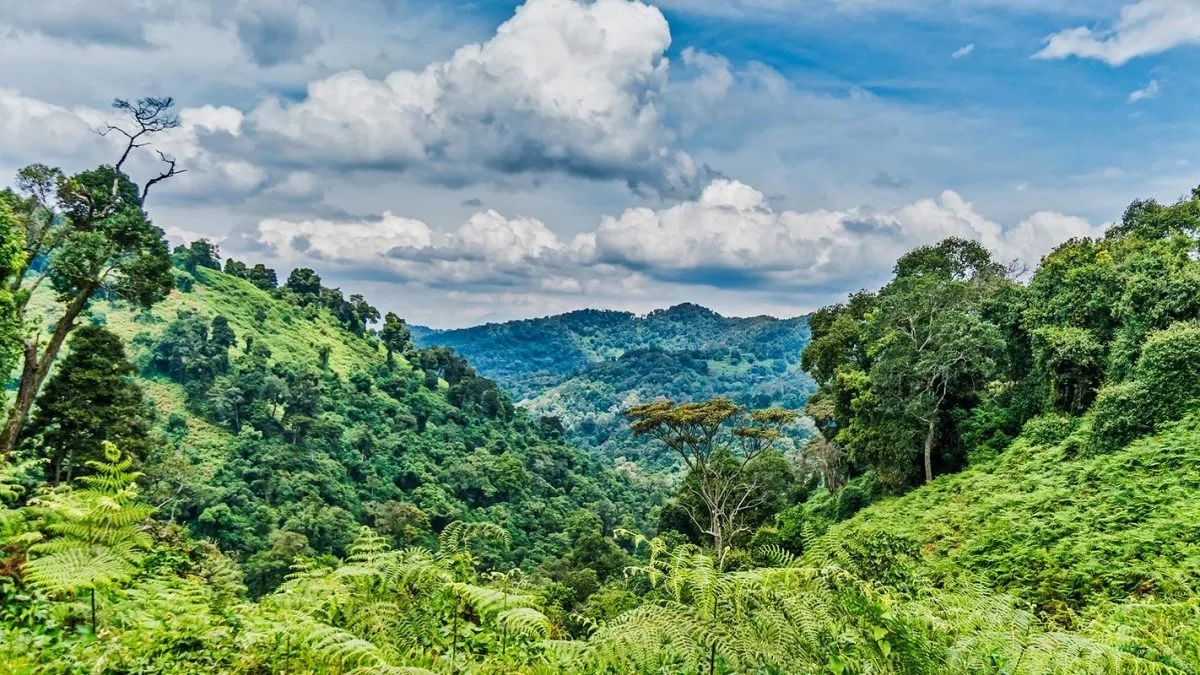
Overcast skies framing the dense, mist-prone forests of southwestern Uganda.
Uganda enjoys a tropical climate influenced by its location along the Equator, varied landscapes, large lakes, and differences in altitude. Although Uganda lies within the equatorial region, temperatures remain moderate rather than extremely hot because much of the country sits between 900 and 1,500 meters above sea level. This combination of elevation and tropical conditions creates a pleasant environment that supports wildlife, forests, wetlands, mountains, and savannah ecosystems throughout the year. Travelers planning a Uganda safari experience often discover that weather varies significantly from one region to another, making a detailed Uganda Weather Guide essential for successful travel planning.
Uganda experiences two broad rainfall periods and two relatively drier periods, although rainfall patterns differ between regions. The southern and western parts of Uganda generally receive more rainfall than the northern and northeastern areas. Understanding these regional variations helps visitors preparing for gorilla trekking adventures, wildlife viewing, birdwatching, mountain hiking, and cultural tours. Weather conditions influence road accessibility, forest trekking experiences, game viewing opportunities, photography conditions, and packing requirements throughout the year. Uganda’s climate remains favorable for tourism in all seasons, though conditions differ according to destination and activity. Uganda’s equatorial climate and seasonal rainfall patterns are widely recognized in tourism and climate references.
Uganda’s Equatorial Location and Climate Influence
Uganda lies astride the Equator, a geographical position that gives the country relatively stable temperatures throughout the year. Unlike destinations that experience dramatic seasonal temperature changes, Uganda maintains warm daytime conditions and cooler nights in many regions. Average temperatures vary according to altitude rather than latitude, making elevation one of the most important factors shaping weather in Uganda.
The presence of large water bodies such as Lake Victoria, Lake Albert, Lake Edward, and Lake Kyoga also influences rainfall and humidity. Lake Victoria, in particular, affects weather patterns in central Uganda by increasing moisture and contributing to localized rainfall. Areas around Entebbe, Kampala, and the Lake Victoria basin often experience different rainfall patterns compared to northern Uganda. Visitors exploring Uganda wildlife safaris or national park tours should understand that lake systems, mountains, and forests all contribute to microclimates across the country.
How Altitude Shapes Weather in Uganda
Altitude has a significant effect on Uganda weather. Although Uganda is close to the Equator, elevated regions remain much cooler than lowland areas. Kampala, situated at approximately 1,190 meters above sea level, experiences moderate temperatures, while the southwestern highlands and mountain regions record cooler conditions throughout the year.
Mountain environments around Bwindi Impenetrable National Park, Mgahinga Gorilla National Park, and the Rwenzori Mountains experience frequent mist, cloud cover, and cooler temperatures due to elevation. Travelers planning Bwindi gorilla trekking or mountain adventures should prepare for changing weather conditions, including rain even during relatively dry months. Highland conditions and seasonal trekking differences are frequently discussed in gorilla trekking guidance.
Lower altitude regions such as Kidepo Valley National Park and parts of northeastern Uganda tend to be warmer and drier. These differences explain why Uganda cannot be described using one national weather pattern. Travelers booking Uganda gorilla safaris or general wildlife experiences often combine destinations with completely different climates during the same trip.
Regional Weather Differences Across Uganda
Central Uganda, including Kampala and Entebbe, experiences moderate temperatures and relatively consistent rainfall because of the influence of Lake Victoria. Western Uganda, where many national parks are located, receives more rainfall and supports forests, wetlands, and fertile landscapes.
Southwestern Uganda contains high-altitude areas including Bwindi, Mgahinga, and Lake Bunyonyi. These regions remain cooler than much of the country and can experience mist and rain at any time of year. Visitors planning Lake Bunyonyi tours or gorilla trekking should pack warm clothing, especially for mornings and evenings. Cooler temperatures in highland destinations are noted by travel guides and destination resources.
Northern and northeastern Uganda generally experience lower rainfall and warmer temperatures. Kidepo Valley National Park, for example, often records drier conditions than southwestern forest areas. This variation creates unique safari experiences and influences wildlife movement patterns across different ecosystems.
Uganda’s Rainfall Patterns and Seasonal Variations
Rainfall is the most important seasonal factor affecting weather in Uganda. Many regions experience wetter periods around March to May and September to November, while relatively drier conditions often occur from December to February and June to August. However, rainfall timing varies depending on location, altitude, and local environmental influences.
Rain in Uganda does not necessarily mean continuous downpours throughout the day. Tropical rainfall often comes as short, intense showers followed by sunshine. This pattern means visitors can still enjoy outdoor activities during wetter months. Safari guides and travel planners frequently emphasize that wildlife viewing, birdwatching, and gorilla trekking remain possible throughout the year.
Travelers interested in seasonal wildlife experiences can learn more through gorilla trekking seasons and understand monthly travel trends through Uganda travel weather resources.
Why Uganda Does Not Experience Four Traditional Seasons
Unlike countries in Europe and North America that experience spring, summer, autumn, and winter, Uganda’s climate follows rainfall patterns rather than extreme temperature changes. Seasonal transitions are influenced mainly by precipitation and regional weather systems rather than dramatic shifts in heat or cold.
This makes Uganda an all-year destination for safaris, gorilla trekking, birding, cultural experiences, and nature travel. Visitors planning custom safari itineraries, Uganda holiday packages, or East Africa safari tours can travel in every month, provided they understand regional climate differences and prepare appropriately.
Understanding Uganda’s climate, altitude, rainfall, and regional weather patterns forms the foundation of every Uganda Weather Guide. These factors influence travel experiences, wildlife viewing, trekking conditions, and destination choices throughout the country, making climate knowledge an important part of planning a successful journey.
Uganda Weather by Month: January to December
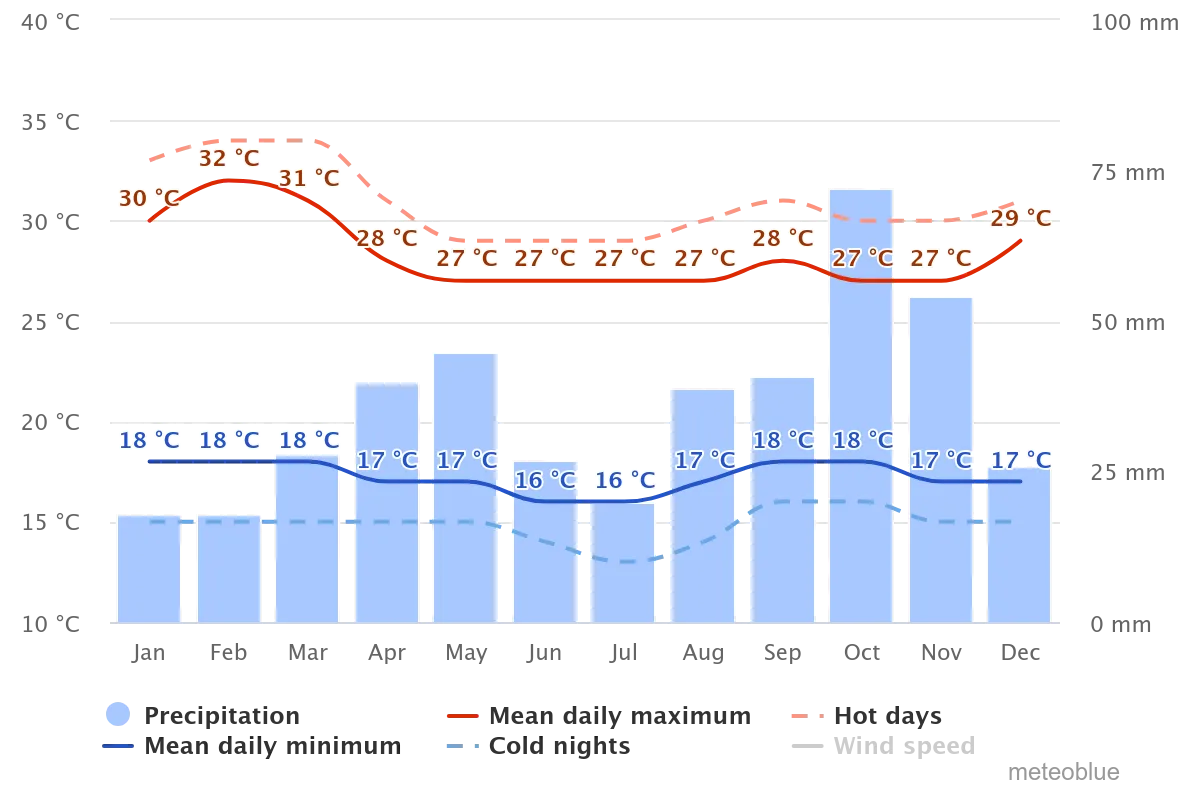
Average monthly temperature and precipitation data for Uganda.
Understanding Uganda weather by month is one of the most useful ways to plan a trip because Uganda does not have identical weather conditions across the entire country. Temperature, rainfall, altitude, vegetation and local geography all influence what travelers experience in different destinations. Uganda has periods that are generally drier and periods that are generally wetter, but rainfall can vary considerably between regions and individual years. For travelers comparing different periods, the February and March travel guide provides additional information about these transitional months.
Uganda Weather in January
January is generally part of Uganda’s shorter drier period, although conditions are not identical throughout the country. Many safari destinations can experience relatively favorable travel conditions, while higher-altitude forests can still receive rain. The weather is commonly warm during the day, with cooler conditions possible at night and at higher elevations. In savannah areas, relatively dry ground can make game-drive routes more comfortable, while vegetation may be less dense than during wetter periods. In southwestern Uganda, travelers should still prepare for changing conditions because mountain and forest weather can differ substantially from lowland safari areas.
January is also relevant for travelers planning gorilla trekking because the month falls within a period that is generally considered favorable for trekking conditions. However, the forests of Bwindi Impenetrable National Park and Mgahinga Gorilla National Park can receive rainfall at any time, so dry-season travel should not be interpreted as a guarantee of completely dry trails. Visitors preparing for forest trekking can also consult this gorilla trekking packing guide for practical preparation.
Uganda Weather in February
February is generally one of the more favorable months for traveling through Uganda, particularly for visitors interested in wildlife safaris, gorilla trekking and outdoor activities. The month falls within the shorter dry period, and rainfall is often lower than during the main wetter months. Roads and trails can therefore be easier to navigate in many destinations. However, Uganda’s regional differences remain important, and conditions in a highland forest should not be assumed to match those in a lowland savannah park.
The combination of relatively dry conditions and warm temperatures makes February attractive for safari planning. Wildlife viewing can also benefit from reduced vegetation density and the concentration of some animals around reliable water sources in drier environments. February is particularly useful for travelers seeking a balance between outdoor comfort and Uganda’s green landscapes. The site’s Uganda travel planning guide also identifies December through February as a shorter dry period.
Uganda Weather in March
March is an important transition month in the Uganda weather calendar. Conditions can begin shifting from the relatively drier period toward wetter conditions, particularly as the month progresses. The exact timing and intensity of rainfall can vary by destination. Travelers may experience sunny and warm conditions followed by rain, rather than a uniform change occurring across the whole country on a single date.
For safari travelers, March can provide a combination of relatively manageable conditions and increasingly green scenery. In forest destinations, however, rainfall can make trails wetter and more slippery as the wetter period develops. This is especially important for travelers planning hiking, chimpanzee tracking or gorilla trekking. The transition also makes March a useful month for travelers who prefer landscapes becoming increasingly lush rather than waiting for the height of the wetter period.
Uganda Weather in April
April generally falls within one of Uganda’s wetter periods, with rainfall becoming an important consideration when planning travel. Rainfall can affect road conditions, walking trails and outdoor schedules, particularly in areas where unpaved roads or steep forest paths are involved. However, April should not be interpreted as a month when travel is impossible. Uganda remains open to visitors throughout the year, and rainfall often occurs in periods rather than necessarily continuing without interruption all day.
The wetter conditions also contribute to vibrant vegetation and green landscapes. Forests can appear particularly lush, while birdwatching and landscape photography can benefit from the abundance of vegetation. Travelers visiting destinations such as Bwindi, Kibale or other forest environments should prepare for wet trails and changing weather. The Kibale forest walking guide provides additional context about seasonal trail conditions.
Uganda Weather in May
May generally remains within Uganda’s wetter period, although rainfall varies significantly from one part of the country to another. In many areas, repeated rainfall can keep roads and trails wet, while vegetation remains dense and green. Travelers should allow greater flexibility in their schedules because road travel and outdoor activities can take longer when surfaces become muddy.
For travelers interested in gorilla trekking or chimpanzee tracking, May can still be a suitable travel month with appropriate preparation. Waterproof clothing, suitable footwear and patience with changing conditions become more important. The wetter environment can create atmospheric forest scenery and lush landscapes, making May appealing to travelers who value green scenery and fewer visitors rather than prioritizing the driest possible conditions.
Uganda Weather in June
June marks the beginning of a generally drier period in much of Uganda. Conditions often become more favorable for road travel, wildlife viewing and outdoor activities, although rainfall can still occur, especially in forests and mountainous areas. June is therefore better understood as the beginning of a generally favorable dry period rather than the beginning of a completely rain-free season.
In savannah parks, drier conditions can improve access and visibility. Wildlife may also become easier to observe in some areas as water availability becomes more concentrated. In southwestern Uganda, June is commonly regarded as a favorable period for gorilla trekking because trails may be less muddy than during wetter months. Nevertheless, mountain forest weather remains unpredictable, and travelers should retain rain protection even during the drier season.
Uganda Weather in July
July is generally within Uganda’s longer drier period and is one of the most popular months for outdoor travel. Many safari areas experience relatively dry conditions, making game drives and road travel more convenient. Clearer weather can also provide useful conditions for photography and landscape viewing, although cloud cover and localized rainfall remain possible.
July is particularly relevant to visitors planning wildlife safaris and gorilla trekking. In forest regions, trails can be more manageable than during wetter periods, while savannah landscapes can offer good visibility. Because July is a popular travel period, travelers planning activities with limited capacity should organize their arrangements early. The seasonal discussion in the site’s Uganda safari comparison guide also identifies June through August as an extended dry period.
Uganda Weather in August
August generally continues the drier conditions experienced during June and July. Temperatures remain influenced by altitude and geography, so the experience in Kampala or a lowland park can differ from conditions in Bwindi, Mgahinga or the Rwenzori region. Travelers should therefore avoid packing solely on the assumption that Uganda has one uniform temperature throughout August.
For wildlife safaris, August can provide relatively favorable road conditions and useful visibility in many savannah environments. For gorilla trekking, the relatively drier conditions can make some trails easier to negotiate, although rain remains possible in the montane forests. Travelers interested in mountain environments should account for cooler temperatures, cloud, mist and sudden changes in conditions.
Uganda Weather in September
September can represent a transition between generally drier and wetter conditions in different parts of Uganda. The timing of rainfall varies geographically, so travelers should avoid treating September as uniformly dry or uniformly wet across the country. Some destinations can continue to experience favorable conditions, while others may begin receiving more frequent rainfall.
For safari planning, September can still offer good conditions, particularly in destinations where roads remain relatively accessible. In forest environments, travelers should be prepared for rain regardless of the broader seasonal classification. The month can also provide a useful balance between relatively favorable outdoor conditions and increasingly green landscapes as rainfall becomes more frequent.
Uganda Weather in October
October generally falls within Uganda’s wetter period, although the exact rainfall pattern differs between regions. Rain can make some unpaved roads and forest trails more difficult, particularly after heavier showers. Travelers should therefore allow additional time for road journeys and outdoor activities when planning itineraries during October.
The wetter weather also produces lush vegetation and vibrant scenery. Forest environments can become particularly green, while birding conditions can be attractive for visitors interested in Uganda’s diverse habitats. Travelers who do not mind occasional rain may find October rewarding because the country can appear exceptionally fresh and green during this period.
Uganda Weather in November
November is generally associated with the later part of Uganda’s wetter period. Rainfall patterns vary considerably across the country, with some southern and highland areas receiving more frequent rain than some northern regions. Travelers should therefore examine the weather conditions of their specific destinations rather than relying exclusively on a nationwide seasonal label.
Rainfall can create muddy conditions on some trails and roads, but it also supports lush vegetation and attractive scenery. November can therefore suit travelers who prioritize green landscapes, quieter travel periods and forest experiences over consistently dry conditions. Travelers heading into mountain forests should keep waterproof clothing and appropriate footwear available even when forecasts indicate periods of sunshine.
The November Uganda guide provides additional discussion of rainfall, temperatures and travel conditions during this month.
Uganda Weather in December
December generally begins a shorter drier period in many parts of Uganda, although rainfall remains possible and regional differences continue to matter. The month can provide a useful combination of relatively favorable outdoor conditions, warm daytime temperatures and attractive green scenery left by preceding rainfall.
December is also an important travel month because demand can increase around the end-of-year holiday period. Travelers planning safaris, gorilla trekking and other activities should consider both weather conditions and availability. In forest regions, rain protection remains useful because local mountain weather can change rapidly even during generally drier periods.
How Uganda Weather Changes Across the Twelve Months
Looking at Uganda weather by month reveals a pattern of broad seasonal tendencies rather than twelve completely separate weather systems. January and February are generally associated with a shorter drier period, March often represents a transition toward wetter conditions, April and May commonly fall within the wetter period, June through August generally bring drier conditions, September can act as a transition month, and October and November commonly experience increased rainfall before conditions become generally drier again toward December.
These patterns should always be interpreted alongside geography. A month that produces relatively dry conditions in a savannah park may still bring rain to a high-altitude forest. The influence of elevation, lakes, mountains, forests and regional rainfall patterns means that travelers should evaluate the weather of their actual destinations rather than relying on a single national average.
Uganda Weather by Month for Safari Planning
For safari travelers, the most useful approach is to match the month with the destination and activity. Drier periods can make roads and trails easier to navigate and can improve wildlife visibility in some savannah environments. Wetter periods can produce greener landscapes and can be attractive for birdwatching and photography, although muddy roads and trails may require additional preparation.
The same principle applies to gorilla trekking. Drier periods can make forest trails easier to navigate, but rainfall can occur in Bwindi and Mgahinga at any time because these are high-altitude rainforest environments. This means a traveler should never interpret a dry-season calendar as a promise of completely dry trekking conditions.
Uganda Weather by Month for Gorilla Trekking
Gorilla trekking operates throughout the year, and each season presents different conditions. The generally drier periods of June through September and December through February can offer more manageable trail conditions, while wetter periods can bring mud, rain and more challenging walking conditions. At the same time, wetter conditions can produce lush forest scenery and may appeal to travelers who prefer quieter periods.
The key consideration is preparation rather than attempting to eliminate the possibility of rain. Waterproof outerwear, suitable hiking footwear and flexible expectations are useful regardless of the month. Travelers should also remember that conditions can vary significantly between sectors and elevations within the gorilla trekking region.
Why Uganda Weather by Month Should Be Used as a Planning Guide
Monthly weather information is most useful when treated as a planning framework rather than a guarantee. Uganda’s weather is naturally variable, and rainfall can arrive earlier, later, more heavily or less heavily than a typical seasonal pattern suggests. Climate patterns also differ between destinations, meaning that a national monthly description cannot accurately predict the conditions at every lodge, park or forest.
For this reason, the best Uganda Weather Guide should combine monthly patterns with destination-specific information, elevation, planned activities and current forecasts closer to the travel date. This approach gives travelers a much more realistic understanding of what to expect and helps them prepare for both favorable and changing weather conditions.
Uganda Dry Seasons and Rainy Seasons Explained
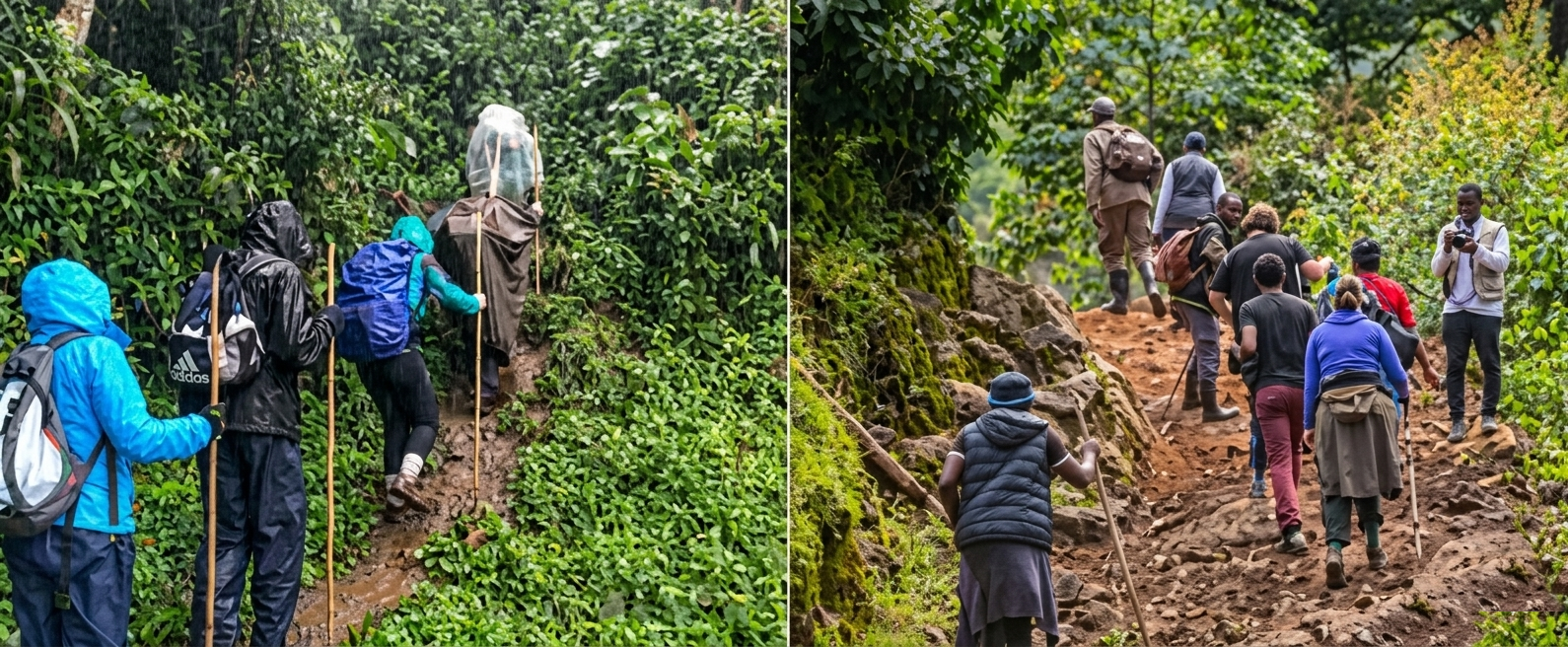
Hikers brave Uganda’s dynamic weather seasons on a jungle trek.
Understanding the dry and rainy seasons is essential when planning a trip because Uganda’s weather changes throughout the year and conditions can differ between regions. Uganda generally experiences two broader dry periods and two wetter periods, although the exact timing and intensity of rainfall varies from one destination to another. The dry periods are commonly associated with December to February and June to September, while wetter conditions are generally associated with March to May and October to November. Travelers looking at the wider annual pattern can also review Uganda travel seasons before choosing their travel dates.
What Is the Dry Season in Uganda?
Uganda’s dry season refers to periods when rainfall is generally lower and outdoor conditions are often easier for travel. The commonly recognized drier periods are December to February and June to September. These periods are particularly popular for safaris, gorilla trekking, hiking and other outdoor activities because roads and trails are generally less muddy than during wetter periods. However, dry season does not mean that every part of Uganda remains completely free of rain. Mountain forests, highland areas and locations influenced by large water bodies can still experience showers.
The longer dry period from June through September is especially important for travelers planning wildlife safaris. Reduced rainfall can make some unpaved roads easier to navigate, while lower vegetation density in some savannah environments can improve wildlife visibility. The site’s Uganda safari seasons guide also describes June to August as an extended dry period.
What Is the Rainy Season in Uganda?
Uganda’s rainy periods are generally associated with March to May and October to November. Rainfall is not necessarily continuous throughout these months. Instead, many areas experience periods of rain separated by sunshine or drier intervals. The amount of rainfall also varies significantly according to geography, altitude and local weather patterns.
The wetter months can make some roads, walking trails and forest paths muddy, particularly after substantial rainfall. At the same time, rainfall supports lush vegetation, replenishes water sources and creates vibrant landscapes. Travelers interested in the changing scenery between seasons can read Uganda seasonal travel for additional discussion of conditions around the transition between drier and wetter periods.
Uganda’s Long Rainy Season
March through May is commonly regarded as Uganda’s longer rainy period. April is often particularly associated with increased rainfall, although conditions vary across the country. Southern and western areas can experience substantial rainfall, especially in highland and forest environments. During this period, travelers should expect the possibility of wet roads, muddy trails and changes to outdoor schedules.
The long rainy season also has important benefits. Vegetation becomes exceptionally green, forests remain lush and landscapes can be particularly attractive for photography. For birdwatchers and nature enthusiasts, increased vegetation and seasonal ecological activity can provide a different experience from the drier months. Rain therefore should not automatically be interpreted as a reason to avoid Uganda.
Uganda’s Short Rainy Season
October and November are commonly associated with Uganda’s shorter rainy period. Rainfall during this period can vary substantially between northern, central, western and southwestern parts of the country. In areas around Bwindi and Mgahinga, mountain and forest conditions can be considerably wetter than conditions experienced in some lower-lying regions.
November can be particularly attractive to travelers who appreciate green landscapes and fewer visitors, although wet roads and muddy trails require additional preparation. November weather information provides further destination-planning context for travelers considering this period.
Does It Rain Every Day During Uganda’s Rainy Season?
No. Describing Uganda as having a rainy season does not mean that rain falls continuously every day or throughout the entire day. Rainfall can occur as short or intense tropical showers followed by periods of sunshine. The timing and duration of rainfall vary according to location, elevation and local weather systems.
This distinction is particularly important when planning a safari or trekking experience. A forecast showing rain does not necessarily mean that every planned activity will be cancelled. Instead, travelers should prepare for changing conditions and allow reasonable flexibility within their itinerary.
How the Dry Season Affects Uganda Safaris
Dry weather can make many safari routes more accessible, especially where roads are unpaved. In some savannah parks, reduced rainfall can also lead to lower vegetation density, which may improve visibility during game drives. Wildlife can become more concentrated around permanent water sources in some ecosystems, although animal movements remain naturally variable and should never be treated as guaranteed.
The drier landscape can also produce excellent conditions for landscape photography and long game drives. However, dry conditions may bring dust on some roads, and temperatures can feel warmer in exposed areas during the daytime. Travelers should therefore prepare for both sun and cooler morning or evening conditions.
How the Rainy Season Affects Uganda Safaris
Rainy-season safaris provide a different experience. Grasslands and forests become greener, seasonal water sources fill and landscapes can appear especially vibrant. Rain can make some roads more challenging, particularly on routes that are unpaved or poorly drained. Experienced safari drivers and appropriate vehicles become particularly important when conditions are wet.
The rainy period can also be attractive for photographers who want dramatic skies, fresh vegetation and atmospheric landscapes. Birdwatchers may also find the greener environment rewarding. The trade-off is that travelers need to be more prepared for changes in road conditions and occasional interruptions caused by heavy rainfall.
Dry Season Versus Rainy Season for Gorilla Trekking
Gorilla trekking is possible throughout the year, but weather can influence trail conditions. During generally drier periods, trails may be firmer and less slippery, making steep forest terrain easier to navigate. During wetter periods, rainfall can create muddy and slippery paths, particularly in the mountainous forests of Bwindi and Mgahinga.
The gorilla seasons guide explains the practical differences between wet and dry trekking conditions. Even during the dry season, however, travelers should carry rain protection because mountain rainforest weather can change quickly.
Advantages of Visiting Uganda During the Dry Season
The main advantage of Uganda’s drier periods is generally easier access to many outdoor destinations. Roads can be firmer, hiking trails can be less muddy and game drives can be more comfortable. These conditions make the dry season particularly popular with travelers combining several safari destinations within one itinerary.
Drier weather can also be convenient for travelers who want to combine wildlife viewing with gorilla trekking, chimpanzee tracking or hiking. Nevertheless, popularity can increase demand for accommodation and limited-capacity activities, so travelers should consider availability when selecting peak travel periods.
Advantages of Visiting Uganda During the Rainy Season
The rainy season has its own advantages. Uganda’s landscapes can become exceptionally green, forests can appear dense and vibrant, and waterfalls and streams may be more active. Travelers who enjoy scenery, photography, birdwatching and quieter travel periods may appreciate these conditions.
Wetter periods can also appeal to visitors who prefer to avoid the busiest travel periods. However, lower visitor numbers should not be assumed for every destination or date, and travelers should still verify availability before making plans.
Is Uganda Worth Visiting During the Rainy Season?
Yes. Uganda can be visited during the rainy season, provided travelers understand the conditions and prepare appropriately. The main disadvantages are potentially wetter roads, muddy trails and greater uncertainty around some outdoor activities. The advantages include lush scenery, green landscapes and a different character from the drier months.
The suitability of a rainy-season trip depends heavily on the itinerary. A traveler focused on a long-distance safari through remote areas may have different priorities from someone visiting a city, forest or established tourist attraction. Weather should therefore be evaluated together with the destination and activities rather than treated as a single nationwide condition.
Is Uganda Worth Visiting During the Dry Season?
Yes. The dry season is popular because relatively lower rainfall can make many outdoor activities more convenient. Safari roads and trekking trails are often easier to manage, and wildlife viewing conditions can be favorable in many savannah environments. These advantages make June through September and December through February important periods for travelers considering Uganda.
However, travelers should not assume that dry season means completely cloudless skies, zero rainfall or identical conditions across the country. Highland forests can remain wet, and local showers can occur even during broadly drier periods. The most useful approach is to combine seasonal climate information with destination-specific conditions and a current forecast closer to departure.
Dry Season and Rainy Season for Different Travel Activities
The best season depends on what a traveler intends to do. Wildlife safaris often benefit from drier roads and greater visibility, while gorilla trekking can be more comfortable when trails are less muddy. Birdwatchers may appreciate both seasons because resident species can be observed throughout the year and seasonal conditions can change habitat and bird activity. Hikers should consider trail conditions, altitude and rainfall rather than relying only on a national seasonal label.
Travelers planning forest activities should pay particular attention to local weather because forest environments can remain wet even when broader regional conditions are relatively dry. This is one reason Uganda’s weather should always be understood geographically rather than reduced to a simple dry-versus-wet calendar.
How to Choose Between Uganda’s Dry and Rainy Seasons
Travelers who prioritize easier road conditions, relatively predictable outdoor conditions and comfortable trekking generally have strong reasons to consider the drier periods. Travelers who prioritize lush landscapes, quieter travel periods and the visual character of green forests may find wetter months attractive.
There is therefore no single season that is objectively best for every visitor. The most suitable time depends on the destination, activities, tolerance for rain, desired scenery, travel schedule and availability. Understanding these differences allows travelers to choose a period that matches their priorities instead of assuming that one national season is automatically ideal for everyone.
Uganda’s Seasons Should Be Treated as General Patterns
The dry and rainy seasons provide a useful framework for understanding Uganda weather, but they should not be treated as rigid boundaries. Rainfall can begin earlier or later than expected, and different parts of the country can experience different conditions at the same time. Elevation, forests, lakes, mountains and regional geography all influence local weather.
For that reason, travelers should use seasonal information as a planning guide and then check current conditions closer to the travel date. This approach provides a more realistic understanding of Uganda’s weather and avoids the common mistake of assuming that a nationwide seasonal label can predict the exact conditions at every destination.
Weather in Uganda’s Major Safari and Tourist Destinations
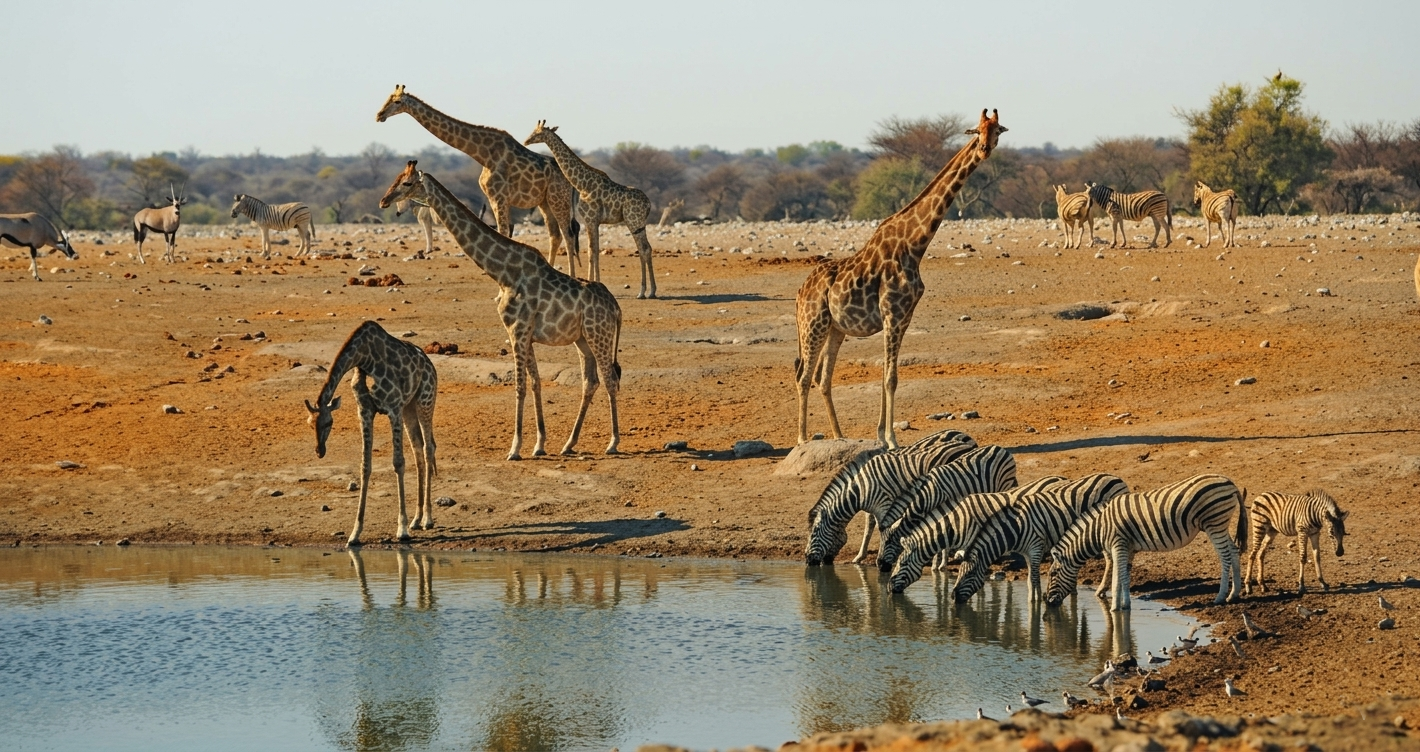
Dry weather brings diverse wildlife to permanent waterholes.
Uganda’s weather varies significantly from one destination to another because elevation, landscape, forests, lakes and regional geography influence local conditions. A traveler visiting Kampala, Murchison Falls, Kidepo Valley, Queen Elizabeth National Park, Kibale or Bwindi can therefore experience noticeably different temperatures and rainfall patterns during the same month. Understanding destination-specific weather is more useful than relying only on a national seasonal description. Travelers planning a safari can begin with Uganda safaris while considering the weather characteristics of each destination.
Kampala Weather and Climate
Kampala has a warm tropical climate influenced by its elevation and proximity to Lake Victoria. Temperatures are generally moderate rather than extreme, while rainfall can occur during different parts of the year. The city can experience sunshine followed by short or heavy showers, particularly during wetter periods. Because Kampala is often the starting point for journeys to national parks, understanding its weather is useful when planning the first and final stages of a Uganda itinerary.
Kampala’s urban environment can also make weather feel different from conditions in rural safari destinations. Roads, buildings and traffic can affect how travelers experience heavy rainfall, while temperatures can remain comfortable compared with hotter lowland areas. Visitors using Kampala as a base before traveling onward can combine their stay with wider Uganda tours and regional travel.
Entebbe Weather and Climate
Entebbe lies on the shores of Lake Victoria and experiences a climate strongly influenced by the lake. The combination of water, elevation and tropical conditions contributes to relatively moderate temperatures and noticeable humidity. Rainfall can occur during different periods of the year, meaning travelers arriving at Entebbe International Airport should be prepared for changing conditions regardless of the season.
The lakeside environment also makes Entebbe different from Uganda’s drier northeastern safari areas. Visitors may encounter humid mornings, cloud cover and rainfall while preparing for journeys inland. The nearby wetland environments are also important for birdwatching, and weather conditions can influence visibility and comfort during outdoor excursions. Travelers interested in combining Entebbe with nature experiences can explore Uganda birding opportunities.
Jinja Weather and Climate
Jinja is located in eastern Uganda near the source region of the River Nile and close to Lake Victoria. Its tropical environment supports relatively warm conditions throughout the year, while rainfall contributes to the area’s green vegetation. Weather can change during the day, making lightweight clothing and rain protection useful for visitors planning outdoor activities.
The surrounding landscape includes riverine environments, forests and agricultural areas, so weather conditions can vary slightly between the town and nearby rural attractions. Rain can influence outdoor activities, paths and roads, but it also contributes to the lush scenery associated with the region. Travelers planning eastern Uganda experiences can incorporate Jinja into broader Uganda travel itineraries.
Murchison Falls National Park Weather
Murchison Falls National Park is located in northwestern Uganda and generally experiences warmer and drier conditions than the highland areas of southwestern Uganda. The park’s lower elevation and savannah landscapes contribute to higher daytime temperatures, particularly during drier periods. Rainfall remains important because it influences vegetation, water availability and road conditions throughout the park.
During drier periods, some roads can become dusty and vegetation can become less dense. These conditions may improve visibility during game drives in some areas, although wildlife movements remain naturally variable. During wetter periods, vegetation becomes greener and some roads can become softer after substantial rainfall. Visitors planning this region can read Murchison Falls safaris when considering how the destination fits into a wider itinerary.
Queen Elizabeth National Park Weather
Queen Elizabeth National Park lies in western Uganda and contains a mixture of savannah, wetlands, forests, lakes and other habitats. Its weather is therefore influenced by several environmental factors. Temperatures are generally warm, while rainfall patterns vary throughout the year. The presence of lakes and surrounding highlands contributes to local differences in humidity, cloud formation and precipitation.
During drier periods, game-drive conditions can be relatively favorable, particularly where roads remain firm and vegetation becomes less dense. Wetter periods can produce greener scenery and may make some unpaved routes more challenging after heavy rain. Travelers combining Queen Elizabeth National Park with western Uganda destinations can also consider Queen Elizabeth safaris when planning their route.
Bwindi Impenetrable National Park Weather
Bwindi Impenetrable National Park has a very different climate from Uganda’s lower-lying savannah parks. Its high elevation, mountainous terrain and dense rainforest create cooler and wetter conditions. Rainfall can occur throughout the year, including during periods generally described as dry elsewhere in Uganda. Travelers should therefore never assume that a national dry season means completely dry conditions inside Bwindi.
Weather in Bwindi is particularly important for gorilla trekking because steep forest trails can become muddy and slippery after rainfall. Drier periods generally provide easier trail conditions, while wetter periods can make walking more demanding. The site’s Bwindi travel guide provides destination-specific information about visiting the forest.
Mgahinga Gorilla National Park Weather
Mgahinga Gorilla National Park lies in Uganda’s southwestern highlands and experiences cool, wet mountain conditions compared with many lower-elevation destinations. Elevation plays a major role in temperature, while mountainous terrain contributes to rapidly changing weather. Cloud, mist and rainfall can occur even when conditions elsewhere in Uganda are relatively dry.
Travelers planning gorilla trekking or mountain activities in Mgahinga should therefore prepare for changing conditions throughout the day. Waterproof outer clothing and suitable footwear are particularly useful because trails can become slippery following rainfall. Seasonal planning remains helpful, but local mountain weather should always be treated as changeable rather than completely predictable.
Kibale National Park Weather
Kibale National Park is a forested destination in western Uganda and generally experiences a humid tropical forest climate. Rainfall supports the dense vegetation that makes the region important for primates and other forest wildlife. Conditions can be wetter than those experienced in some open savannah parks, and rainfall can occur even during broadly drier national periods.
Weather is especially relevant for chimpanzee tracking because visitors spend time walking through forest terrain. Wet ground can make paths slippery, while rainfall can temporarily affect comfort and visibility. Nevertheless, the forest environment remains attractive throughout the year, and travelers can plan according to their preferred balance between drier trails and greener conditions.
Kidepo Valley National Park Weather
Kidepo Valley National Park in northeastern Uganda has a markedly different climate from the country’s southwestern mountain and rainforest regions. The landscape is characterized by broad savannah and semi-arid conditions, with generally hotter temperatures and lower rainfall than many parts of western and southwestern Uganda. Seasonal rainfall has a strong influence on vegetation and water availability.
During drier periods, temperatures can become high, particularly during the middle of the day, while dust can affect some roads. During wetter periods, vegetation becomes greener and temporary water sources can alter the appearance of the landscape. Because Kidepo is remote, travelers should consider weather alongside road conditions when planning access. The site’s Kidepo travel information can help put the destination into a broader journey plan.
Lake Mburo National Park Weather
Lake Mburo National Park lies in southwestern Uganda but has a warmer and generally drier character than the highland forests farther southwest. Its savannah, woodland and wetland habitats respond strongly to seasonal rainfall. During drier conditions, grasslands can become less lush, while rainfall brings renewed vegetation growth and greener landscapes.
The park’s relatively accessible location makes it a useful stop for travelers traveling toward southwestern Uganda. Weather can affect walking safaris, game drives and road conditions, so travelers should consider the season when choosing activities. Information about the region’s accommodation and seasonal access is also available through Lake Mburo travel resources.
Rwenzori Mountains Weather
The Rwenzori Mountains experience much cooler and more variable conditions than Uganda’s lowland areas. Increasing elevation produces progressively colder conditions, while cloud, mist, rain and other forms of mountain weather can occur rapidly. Conditions at higher elevations should not be compared directly with temperatures experienced in Kampala or the savannah parks.
Travelers planning mountain hikes need to prepare for changing weather and significant differences between lower trail sections and higher elevations. Rain can affect trail conditions, while cloud and mist can reduce visibility. The mountainous environment means that a favorable forecast at a nearby town cannot necessarily describe conditions at higher elevations.
Lake Victoria Region Weather
Lake Victoria has a major influence on weather conditions around its Ugandan shores. The large water body contributes moisture to the atmosphere and can influence cloud formation and rainfall. Entebbe, Kampala and other areas within the lake’s wider influence can therefore experience weather patterns that differ from the drier northeastern regions.
The lake region is also important for birdlife, wetlands and water-based activities. Weather can affect visibility, boating conditions and outdoor comfort, particularly when winds or rainfall increase. Travelers interested in comparing Uganda’s major lakes and their environments can explore Lake Victoria experiences alongside other destinations.
Western Uganda Weather
Western Uganda contains a complex mixture of lakes, forests, mountains, valleys and savannah landscapes. As a result, weather can change considerably over relatively short distances. Queen Elizabeth National Park can feel warmer than the highland areas around Bwindi, while Kibale’s forest environment can remain humid and wet. Travelers moving through the region should therefore pack for several types of conditions rather than one uniform climate.
The region’s varied weather is one reason western Uganda supports such diverse ecosystems. Rainfall sustains forests and wetlands, while comparatively drier areas support savannah habitats. This geographical variety allows travelers to combine wildlife, primate and mountain experiences within one journey while encountering different weather conditions along the route.
Northern Uganda Weather
Northern Uganda generally experiences warmer conditions than the elevated southwestern regions. Rainfall patterns also differ, with the north having a pronounced seasonal rhythm that influences vegetation, agricultural landscapes and wildlife habitats. Travelers should expect hotter conditions in many northern areas, particularly during the drier part of the year.
The difference becomes particularly noticeable when comparing northern destinations with Bwindi, Mgahinga or the Rwenzori Mountains. A traveler can therefore move from warm savannah conditions to considerably cooler highland environments within the same Uganda itinerary. This regional contrast is one of the most important features of Uganda’s overall weather system.
Northeastern Uganda Weather
Northeastern Uganda is among the country’s warmer and drier regions, particularly around Kidepo Valley. Rainfall is more limited than in many western and central areas, and seasonal changes can have a strong effect on vegetation and water availability. During dry periods, temperatures can be high and landscapes can appear much more arid than the green forests of southwestern Uganda.
The region’s climate contributes to its distinctive wildlife habitats and open landscapes. Travelers visiting Kidepo should consider the heat, road conditions and remoteness when preparing for a safari. Seasonal planning can help visitors choose between greener scenery after rainfall and generally drier access conditions.
Why Destination-Specific Weather Matters in Uganda
Uganda cannot be accurately described using one temperature or rainfall figure because its landscapes range from warm savannahs and lakeshores to cool mountain forests. Altitude, latitude, topography, vegetation and water bodies all influence local conditions. This means that the weather experienced during a safari in Kidepo can be very different from the conditions encountered during gorilla trekking in Bwindi.
For travelers planning multi-destination itineraries, the most reliable approach is to examine the climate of every major stop. A journey combining Kampala, Murchison Falls, Kibale, Queen Elizabeth and Bwindi may cross several different climate environments. Understanding these differences makes it easier to prepare appropriate clothing, footwear, rain protection and activity schedules.
How Uganda’s Regional Weather Influences Travel Planning
Regional weather affects more than temperature and rainfall. It can influence road conditions, trekking difficulty, visibility, wildlife viewing, photography, hiking comfort and the amount of time required for outdoor activities. In mountainous forests, rainfall can make trails muddy, while in dry savannah areas the same season can create dusty roads and higher daytime temperatures.
This is why a detailed Uganda Weather Guide should always connect climate information with the destination being visited. Travelers who understand these regional differences can plan more realistically and avoid expecting identical conditions across the country. For gorilla trekking specifically, the gorilla seasons guide provides additional information about the relationship between seasonal weather and forest trail conditions.
Planning a Uganda Trip Around Destination Weather
The best way to use Uganda weather information is to match the destination, activity and season rather than choosing dates based on a national average alone. A traveler focused on savannah wildlife may prioritize relatively dry road conditions, while someone focused on forest trekking may place greater emphasis on trail conditions. Birdwatchers, photographers and landscape enthusiasts may have different preferences again.
Uganda’s regional climate diversity is ultimately one of its strengths. Within a single itinerary, travelers can experience lakeside tropical conditions, warm savannah landscapes, humid forests and cool mountain environments. Understanding these differences turns the Uganda Weather Guide from a simple seasonal overview into a practical planning resource for the entire country.
Uganda Weather for Gorilla Trekking, Chimpanzee Tracking and Wildlife Safaris
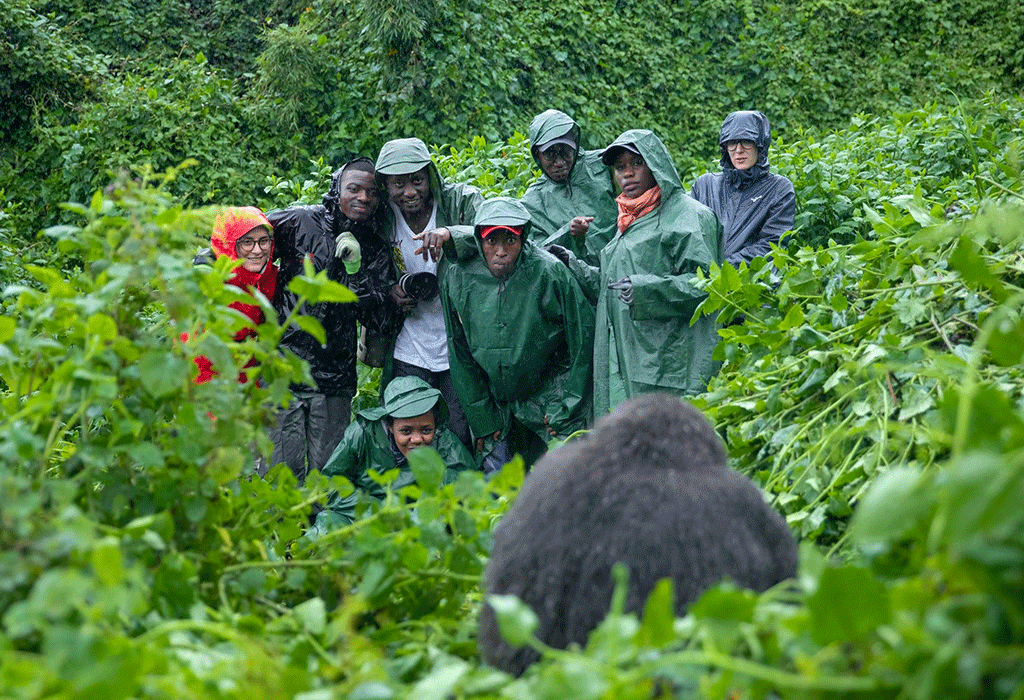
Rain ponchos are essential gear for wet season gorilla trekking.
Weather is one of the most important practical considerations when planning outdoor activities in Uganda. Gorilla trekking, chimpanzee tracking, wildlife safaris, birdwatching and hiking all take place in different environments, so the same weather pattern can affect each activity differently. A dry period may make some savannah roads easier to navigate, while a wet period can make forest trails muddy but create exceptionally green scenery. Understanding these differences helps travelers prepare realistically rather than assuming that Uganda has identical conditions everywhere. For broader planning, gorilla trekking information can be considered alongside destination-specific weather conditions.
Uganda Weather and Gorilla Trekking
Gorilla trekking takes place in the mountainous rainforest environments of Bwindi Impenetrable National Park and Mgahinga Gorilla National Park. These areas experience different conditions from Uganda’s lower-lying savannah parks because elevation, dense vegetation and mountainous terrain influence temperature, rainfall and humidity. Rain can occur even during periods that are generally considered dry elsewhere in the country, so travelers should prepare for changing conditions throughout the trekking day.
The generally drier periods can provide firmer trails and less mud, making steep sections easier to navigate. During wetter periods, rainfall can produce slippery and muddy paths, increasing the physical challenge of walking through dense forest. The gorilla packing guide explains why waterproof clothing and appropriate footwear are particularly important in these environments.
Dry-Season Weather for Gorilla Trekking
The periods generally associated with drier conditions in Uganda’s gorilla trekking regions are June through September and December through February. During these periods, trails are often less muddy and can be easier to walk. The reduced likelihood of rainfall can also make it easier to protect cameras and other equipment during the trek.
Dry conditions do not mean that rainfall is impossible. Bwindi and Mgahinga are high-altitude tropical forest environments, and localized showers can occur even during broadly drier periods. Travelers should therefore retain rain protection regardless of their selected month. Current information from Bwindi trekking guidance also emphasizes that rain can occur at any time in the forest.
Rainy-Season Weather for Gorilla Trekking
The wetter periods are generally associated with March through May and October through November. Rainfall can make forest trails muddy and slippery, especially on steep sections. Trekking may consequently require more careful footing and additional time. Waterproof clothing, suitable hiking boots and protection for cameras become particularly valuable during these periods.
The rainy season also transforms the forest environment. Vegetation becomes lush and vibrant, creating strong conditions for landscape and nature photography. The experience can therefore be rewarding for travelers who are comfortable with wetter conditions and want to experience the forest when it is particularly green.
Weather and Gorilla Trekking Trail Conditions
Rainfall affects gorilla trekking primarily through its influence on the terrain. Forest trails can contain steep slopes, exposed roots, muddy sections and uneven ground. When wet, these surfaces can become more slippery and require greater attention. Travelers should therefore consider footwear with suitable grip and clothing that remains practical when exposed to rain.
Trail conditions can also vary within the same park. A sector receiving less rain on one day may have noticeably different ground conditions from another area. Consequently, a national weather description cannot guarantee what a specific trekking route will look like on a particular morning.
Weather and Gorilla Trekking Photography
Weather influences photography during gorilla trekking in several ways. Dry periods can provide brighter conditions and reduce the immediate risk of rain reaching camera equipment. Cloud cover during wetter conditions can create softer, more diffused light, while mist and moisture can produce atmospheric forest scenes.
Rain protection becomes especially important when carrying cameras into the forest. Equipment should be protected against sudden showers, and travelers should avoid assuming that a clear morning guarantees dry conditions for the entire trek. Weather-aware preparation allows photographers to concentrate on the experience rather than constantly reacting to moisture.
Uganda Weather and Chimpanzee Tracking
Chimpanzee tracking occurs primarily in forest environments, including Kibale National Park, where humid conditions and rainfall are part of the forest ecosystem. Weather can influence trail conditions, visibility and walking comfort. During wetter periods, paths can become muddy and slippery, while drier periods can provide firmer walking surfaces.
Travelers planning chimpanzee activities should therefore consider both rainfall and the physical characteristics of the forest. A dry period may make walking more convenient, while wetter conditions can create lush vegetation and atmospheric scenery. Detailed information about chimpanzee permits and tracking arrangements is available in the chimpanzee tracking resource.
Weather and Chimpanzee Habituation
Chimpanzee habituation can involve considerably longer periods in the forest than a standard tracking experience. Weather therefore becomes an even more important preparation factor. Travelers may spend extended periods walking and observing chimpanzees, making rain protection, comfortable footwear, hydration and protection for equipment useful.
Because chimpanzees move through forest habitats rather than remaining in one fixed location, tracking conditions can vary during the day. Wet ground can increase walking difficulty, while dense vegetation can affect visibility. The combination of weather and forest terrain means that travelers should prepare for changing conditions rather than expecting a predictable route.
Uganda Weather and Wildlife Safaris
Weather affects wildlife safaris differently from forest trekking. Uganda’s savannah parks can become drier during the country’s generally dry periods, which may improve road conditions and visibility in some areas. Reduced vegetation in certain landscapes can make it easier to scan open areas for wildlife, although animal movements remain naturally unpredictable.
During wetter periods, rainfall supports new vegetation growth and produces greener landscapes. Some roads can become softer following heavy rainfall, particularly where surfaces are unpaved. At the same time, the green scenery can be particularly attractive for photography. Travelers planning different safari routes can review wildlife safaris while considering the weather characteristics of each park.
Weather and Game Drives
Game drives can take place during both dry and rainy periods. During drier weather, some roads are generally firmer and easier to navigate. Dust can become more noticeable on heavily traveled unpaved routes, particularly during prolonged dry conditions. During rainfall, roads may become muddy, and heavy showers can temporarily reduce visibility.
Weather can also influence how comfortable passengers feel during early-morning and late-afternoon drives. Temperatures can be cooler in the early morning than during the middle of the day, so layered clothing can be useful even in destinations that are generally warm.
Weather and Wildlife Visibility
Weather is only one factor affecting wildlife visibility. Vegetation, water availability, animal behavior, time of day and the skill of the guide all contribute to what travelers encounter. During wetter periods, increased vegetation can sometimes make animals harder to see in thick cover. During drier periods, open vegetation can provide wider sightlines in some savannah habitats.
Travelers should therefore avoid treating a particular season as a guarantee of seeing specific animals. Weather can influence the conditions under which wildlife is observed, but it does not determine animal movements with certainty.
Weather and Boat Safaris
Weather also matters for Uganda’s boat-based wildlife experiences. Wind, cloud cover, rainfall and water conditions can influence comfort and visibility on lakes, rivers and channels. On a boat safari, travelers should be prepared for exposure to sun as well as the possibility of rain.
The Kazinga Channel in Queen Elizabeth National Park is one example where water-based wildlife viewing forms an important part of a safari itinerary. The site’s Kazinga boat cruise information describes the experience and wildlife that can be observed from the water.
Weather and Birdwatching in Uganda
Uganda’s weather also influences birdwatching conditions. Rainfall affects vegetation, wetlands, flowering, fruit availability and insect activity, all of which can influence bird habitats. Wet conditions can make some paths muddy, but they can also produce lush environments that are attractive to birdwatchers.
Birdwatching can be undertaken across many Ugandan habitats, including forests, wetlands, lakeshores and savannah. The best conditions therefore depend on the specific species, habitat and destination rather than one universal national weather period. Travelers can explore birding safaris while considering how weather interacts with each habitat.
Weather and Hiking in Uganda
Hiking conditions can change significantly according to rainfall and altitude. Mountain and forest trails may become slippery after rain, while lower-elevation routes can become hot during sunny periods. Travelers should therefore consider both the forecast and the elevation profile of the route.
Mountain environments require additional caution because weather can change rapidly with increasing elevation. A comfortable morning at a lower elevation does not necessarily mean that conditions higher on the trail will remain the same. Travelers should follow local guides and park instructions when weather conditions become unfavorable.
Weather and Uganda Safari Photography
Weather can significantly influence photography during a Uganda safari. Dry conditions can provide clearer views across open landscapes, while cloud cover can soften strong sunlight. Rain can create reflections, greener vegetation and dramatic skies, but photographers need to protect cameras and lenses from moisture.
Forest photography presents additional challenges because dense vegetation can reduce available light. Rain and cloud can make forest conditions darker, while bright openings in the canopy can create strong contrasts. Travelers should therefore prepare equipment according to the destination rather than relying on a general safari photography setup.
What Weather Gear Is Useful for Uganda Safaris?
A practical approach is to prepare for both sun and rain. Lightweight rain protection is useful even during generally dry periods, particularly in forests and highland areas. Comfortable walking shoes or hiking boots are important for activities involving uneven or muddy terrain, while layered clothing can help travelers adapt to temperature differences between morning, afternoon and evening.
Camera and electronic equipment should also have protection against moisture. Travelers spending time in forests should expect humidity and possible rain, while those traveling through dry savannah environments may need to consider dust. The volcano trekking guide provides additional context about changing conditions in high-altitude environments.
Why Uganda Weather Should Not Determine Travel Dates Alone
Weather is important, but it should be considered alongside the purpose of the trip. A traveler primarily interested in gorilla trekking may prioritize trail conditions, while a wildlife photographer may value particular lighting and landscape conditions. A birdwatcher may have different priorities from someone planning a multi-park safari involving long road journeys.
The most useful approach is therefore to match weather expectations with the specific activity and destination. This produces a more realistic travel plan than simply choosing the month with the lowest expected rainfall.
Weather Preparation for Gorilla and Wildlife Activities
Travelers should check conditions for their specific destination before departure and remain prepared for changes during the activity. A current forecast is more useful for immediate planning than relying exclusively on a long-term seasonal average. In forest and mountain environments especially, weather can change quickly over short distances.
Primate experiences and other forest activities require preparation for humidity, changing temperatures and potentially wet trails. Similarly, safari travelers should consider road conditions, heat, dust and rainfall when moving between parks.
Gorilla Trekking Weather and Practical Preparation
Gorilla trekking is one of the activities most directly affected by weather because participants walk through steep, high-altitude forest terrain. Dry conditions can make trails easier to navigate, while rainfall can create mud and slippery surfaces. However, trekking remains possible throughout the year, provided travelers prepare appropriately and follow the guidance of park staff and guides.
The most reliable preparation is therefore not to attempt to predict every weather event but to carry appropriate rain protection, wear suitable footwear and understand that conditions can change. This principle applies equally to chimpanzee tracking, hiking and other forest activities.
Weather and the Overall Uganda Safari Experience
Uganda’s varied climate is part of what makes its safari environments so diverse. Warm savannah parks, humid forests, lakeshores and cool mountain landscapes can all occur within one itinerary. Weather influences how travelers move through these environments, but it also contributes to the vegetation and ecosystems that make each destination distinctive.
Travelers should therefore view Uganda weather as an important planning factor rather than an obstacle to travel. With realistic expectations and suitable preparation, gorilla trekking, chimpanzee tracking, wildlife safaris, birdwatching and hiking can all be approached throughout the year. The most important consideration is matching the season and destination with the traveler’s preferred experience while remaining prepared for Uganda’s naturally variable weather.
For additional preparation focused specifically on mountain trekking, trekking clothing guidance provides practical information about protecting against rain, changing temperatures and muddy forest conditions.
Uganda Temperatures, Rainfall, Humidity and Daylight Throughout the Year
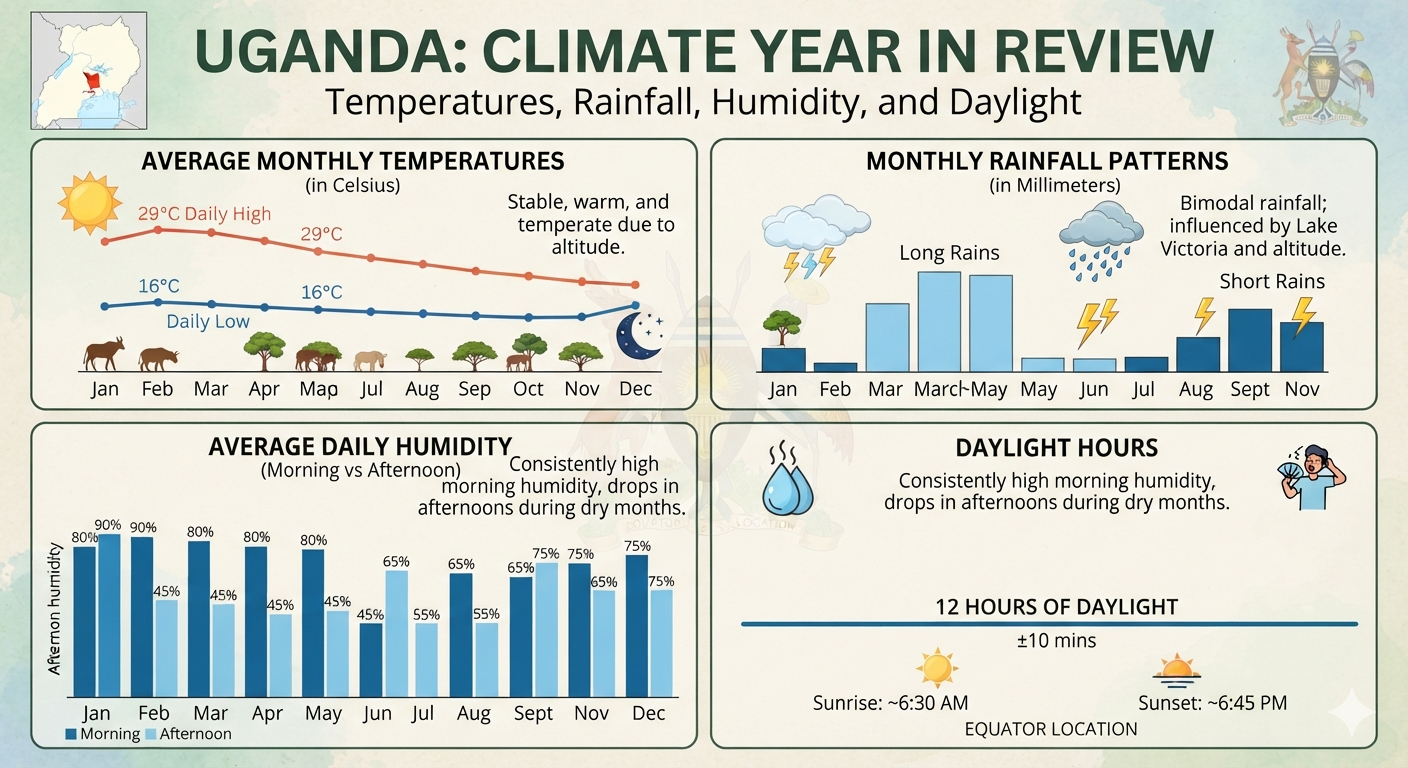
Uganda annual weather patterns highlighting steady temperatures and 12-hour daylight
Understanding Uganda temperatures, rainfall, humidity and daylight throughout the year provides a more accurate picture of the country’s climate than simply dividing the calendar into dry and rainy seasons. Uganda lies across the Equator, but its weather is strongly influenced by elevation, terrain, lakes, forests and regional geography. Consequently, temperatures and rainfall can differ considerably between Kampala, the northern savannah, the northeastern semi-arid landscapes, the western forests and the highlands of southwestern Uganda. Travelers planning a trip can use this Equator guide to understand Uganda’s geographical position and its relationship with climate.
Uganda Temperatures Throughout the Year
Uganda generally experiences warm temperatures throughout the year, but elevation creates substantial local differences. Lower-lying and warmer regions can experience higher daytime temperatures, while elevated areas such as southwestern Uganda and the Rwenzori region are considerably cooler. In the gorilla trekking regions, available travel information commonly describes daytime temperatures around 20°C to 25°C at lower elevations, with significantly cooler conditions possible at higher elevations. Travelers should therefore avoid assuming that Uganda has one nationwide temperature throughout the year.
The country’s elevation also explains why Uganda can feel relatively comfortable despite its equatorial location. Many populated and tourist areas are located at elevations high enough to moderate temperatures. Visitors moving between destinations can consequently experience noticeable changes in temperature within the same journey. Travelers preparing for mountain environments can also consult Rwenzori hiking information for a better understanding of colder and wetter high-altitude conditions.
Daytime Temperatures in Uganda
Daytime temperatures depend heavily on location, altitude, cloud cover and season. In warmer lowland and savannah environments, afternoons can feel considerably hotter than mornings. Around higher elevations, temperatures can remain much cooler, particularly when clouds, rain or mist are present. This contrast is particularly noticeable on itineraries that combine lowland wildlife parks with highland forests.
During the generally drier periods, sunshine can make exposed areas feel hot even when the overall climate remains moderate. Travelers undertaking game drives or walking activities should therefore consider sun exposure as well as the actual air temperature. A practical packing guide is particularly useful for understanding how clothing needs change between warm savannah environments and cooler forest areas.
Nighttime Temperatures in Uganda
Nighttime conditions can be substantially cooler than daytime conditions, particularly in elevated areas. Travelers staying in southwestern Uganda, Bwindi, Mgahinga or mountainous regions should not assume that warm daytime weather will continue after sunset. Clear nights can feel cooler, while cloud, rainfall and altitude can further affect the perceived temperature.
The difference between daytime and nighttime conditions is important when choosing clothing for a safari. A lightweight layer may be comfortable during the afternoon, while a warmer layer can become useful during early-morning game drives or evenings in higher-altitude destinations. The gorilla trekking information also emphasizes the need to prepare for changing temperatures and weather in southwestern Uganda.
How Altitude Changes Uganda Temperatures
Altitude is one of the strongest influences on temperatures across Uganda. As elevation increases, air temperatures generally become cooler. This explains why mountainous destinations such as the Rwenzori Mountains and the highland areas surrounding Bwindi and Mgahinga can feel very different from warmer lowland parks.
Altitude also influences how quickly weather conditions can change. Mountain environments can experience cloud, mist and rainfall while lower areas remain relatively sunny. Travelers planning high-altitude activities should therefore use destination-specific forecasts rather than relying on weather information from a distant town. The Bwindi travel guide provides additional destination context for the highland rainforest environment.
Uganda Rainfall Throughout the Year
Rainfall is one of the most important characteristics of Uganda’s climate, but it is not evenly distributed across the country. Central, western and southwestern areas generally receive substantial rainfall, while northeastern areas can be considerably drier. Forests and mountains can also create local rainfall patterns that differ from surrounding lowlands.
Uganda is commonly described as having two broader wetter periods, generally around March to May and October to November, separated by generally drier periods. However, these dates are broad climatic patterns rather than rigid national boundaries. The site’s weather comparison provides a similar overview of Uganda’s wet and dry periods.
Long Rainfall Period in Uganda
March through May is generally recognized as one of Uganda’s wetter periods. Rainfall can become frequent, and April is often associated with particularly wet conditions in many areas. The effect of this rainfall varies by destination. Forest regions can become very wet, while some northern and northeastern locations may experience different patterns.
Rainfall during this period contributes to green vegetation and supports forests, wetlands, grasslands and agricultural landscapes. For travelers, the main practical consequences can include muddy roads, slippery trails and changes to outdoor schedules after heavy showers. The Budongo Forest resource provides a useful example of how wet-season conditions can affect forest travel and trail surfaces.
Short Rainfall Period in Uganda
The second wetter period is generally associated with October and November, although regional differences are important. Southern and southwestern Uganda can receive considerable rainfall, while northern areas may experience different levels of precipitation. Rain often occurs as showers rather than continuous rainfall throughout the entire day.
For travelers, the short rainy period can produce lush scenery and greener landscapes. Forest destinations may become particularly vibrant, although trails can become muddy. The November weather guide provides additional information about rainfall patterns and temperatures during this period.
Uganda Rainfall and Regional Differences
Uganda’s rainfall distribution is strongly influenced by geography. The Lake Victoria region receives moisture from the lake, while mountains and forests influence local precipitation. Southwestern Uganda is generally wetter than northeastern Uganda, where semi-arid conditions are more pronounced. These differences mean that a rainy day in one destination does not necessarily indicate rainy conditions throughout the country.
This regional variation is particularly important for travelers planning multi-destination itineraries. A journey can move from a warm, relatively dry environment into a cooler and wetter forest within the same day or across consecutive days. Understanding these differences makes it easier to plan clothing, transport and activities appropriately.
Humidity in Uganda
Humidity is another important part of Uganda’s weather experience. Areas near large lakes, wetlands and dense forests can feel more humid because of the amount of moisture in the surrounding environment. Forest destinations such as Bwindi and Kibale can therefore feel noticeably different from open savannah landscapes even when temperatures are similar.
High humidity can make warm temperatures feel more noticeable, particularly during physical activities. Travelers walking through forests should wear practical clothing that allows comfortable movement and should remain adequately hydrated. The birding guide also demonstrates how Uganda’s varied forest, wetland and savannah habitats create different environmental conditions for outdoor activities.
Humidity in Uganda’s Forests
Tropical forests maintain moist environments because vegetation, rainfall and shade interact to retain moisture. Bwindi, Kibale and other forested areas can therefore feel humid even when rainfall is not occurring. Travelers walking through dense forest should expect damp vegetation, moist ground and occasional rain as normal environmental features.
Humidity can also affect camera equipment, clothing and other personal belongings. Waterproof bags or protective covers can be useful during forest activities, particularly when rain is possible. Travelers should allow wet clothing and equipment to dry properly when returning to accommodation.
Humidity Around Uganda’s Lakes
Large lakes influence local atmospheric moisture and can contribute to cloud development and rainfall. Lake Victoria is particularly important to the climate of central and southeastern Uganda. Areas near the lake can therefore have a different combination of humidity, cloud cover and rainfall from the drier northeastern regions.
The relationship between water and local climate is also visible around smaller lakes and highland water bodies. Travelers exploring lakeside destinations may notice cooler breezes, increased cloud cover or changes in weather during the day. The Lake Victoria guide provides additional context about the environment around Uganda’s major lakes.
Daylight Hours in Uganda
Because Uganda lies near the Equator, daylight duration changes relatively little throughout the year compared with countries farther from the Equator. Sunrise and sunset remain relatively consistent from season to season, although exact times vary according to location and date. This consistency makes Uganda suitable for outdoor activities throughout much of the year.
The practical difference for travelers is not usually a dramatic change in the number of daylight hours but changes in cloud cover, rainfall and the quality of available light. Early mornings can be cooler and clearer, while afternoon clouds or showers may affect visibility. Travelers planning photography should therefore pay attention to daily weather conditions as well as seasonal patterns.
Sunlight and Uganda Safari Conditions
Sunlight influences the appearance of Uganda’s landscapes and the comfort of travelers during outdoor activities. Open savannah areas can become hot under direct afternoon sunshine, while forest environments provide more shade. Cloud cover can reduce direct sunlight and create softer lighting, which can be beneficial for landscape and wildlife photography.
Travelers on game drives should consider the timing of activities because early mornings and late afternoons can feel cooler than midday. The February and March guide provides additional context about temperatures, rainfall and outdoor conditions during this part of Uganda’s annual weather cycle.
Uganda Weather and the Equatorial Sun
Uganda’s position close to the Equator means that solar radiation remains an important consideration throughout the year. Travelers should not assume that a cooler temperature automatically means weak sunlight. Cloud cover, altitude and local weather can change how intense the sun feels, but sun protection remains useful during outdoor activities.
This is particularly relevant during game drives, boat trips, hiking and sightseeing in open areas. Hats, sunglasses and appropriate sun protection can make outdoor experiences more comfortable. Travelers should also balance sun protection with rain protection because Uganda’s weather can change quickly during the day.
How Uganda Temperatures and Rainfall Affect Safari Planning
Temperature and rainfall influence the practical experience of traveling between Uganda’s national parks. During drier periods, roads in some savannah parks can be easier to navigate, while prolonged dry weather can also create dusty conditions. During wetter periods, vegetation becomes greener but some unpaved roads can become muddy after substantial rainfall.
The impact is even more pronounced in forest and mountain environments. Rain can make steep trails slippery, while cooler temperatures and humidity can affect comfort. Travelers planning a combination of safari and trekking activities should therefore expect to encounter different environmental conditions during the same trip.
How Uganda Weather Data Should Be Interpreted
Average temperature and rainfall information is useful for understanding broad climate patterns, but it should not be treated as a precise prediction for a particular travel date. Weather varies from year to year, and local conditions can differ substantially between destinations. A national average cannot accurately describe conditions on a particular mountain trail, forest path or remote safari road.
The best approach is to use historical climate information for long-term planning and a current local forecast for short-term decisions. This is especially important for travelers planning activities that depend on trail or road conditions. Weather information should therefore be treated as a planning tool rather than a guarantee.
Uganda Temperatures by Region
Central Uganda generally experiences warm but moderate conditions, while northern and northeastern areas can become hotter, particularly during drier periods. Western Uganda contains both warm lowland environments and cooler highland areas. Southwestern Uganda is strongly influenced by elevation, while the Rwenzori region becomes progressively colder at higher altitudes.
This regional pattern means that travelers should pack according to their itinerary rather than according to Uganda as a single climate zone. Someone visiting only a lowland savannah park may need different clothing from someone combining a wildlife safari with gorilla trekking or mountain hiking.
Uganda Weather and Outdoor Comfort
Outdoor comfort depends on the interaction between temperature, humidity, rainfall, wind, sunlight and physical activity. A moderate temperature can still feel demanding when combined with high humidity and strenuous walking. Conversely, a cool temperature can feel colder when accompanied by rain and wind at higher elevations.
Travelers should therefore focus on the complete weather environment rather than a single temperature number. This is particularly important for gorilla trekking, chimpanzee tracking, hiking and long game drives, where travelers remain outdoors for several hours.
Weather, Climate and the Uganda Travel Experience
Uganda’s combination of equatorial location, altitude, rainfall and varied landscapes creates a remarkably diverse climate. Warm savannahs, humid forests, lakeside environments and cool mountain regions can all be encountered within one country. This explains why Uganda temperatures cannot be represented by one figure and why rainfall patterns differ considerably between destinations.
The country’s climate also supports a wide range of ecosystems and tourism activities. Travelers can experience wildlife safaris in open grasslands, chimpanzee tracking in humid forests, gorilla trekking in highland rainforests and mountain hiking in much cooler environments. The weather becomes part of the character of each destination rather than simply a factor to avoid.
Using Uganda Temperature and Rainfall Information Before Travel
Before traveling, visitors should examine the weather patterns of each destination on their itinerary and then check current conditions closer to departure. This is particularly important when the itinerary crosses several regions with different elevations and rainfall patterns. A forecast for Kampala, for example, should not be used as a substitute for a destination-specific forecast for Bwindi, Kidepo or the Rwenzori Mountains.
Travelers who understand Uganda temperatures, rainfall, humidity and daylight can make better decisions about clothing, activity timing, transportation and equipment. The Sipi Falls resource is another useful example of how elevation and rainfall can influence both the landscape and the preferred timing of outdoor activities.
Uganda Weather Is Diverse Rather Than Uniform
The most important conclusion is that Uganda has no single weather experience. Temperature, rainfall and humidity change according to region, elevation, season and local geography. The Equator provides an important geographical foundation, but altitude and landscape determine many of the conditions travelers actually experience.
What to Pack for Uganda Weather: Clothing, Gear and Practical Preparation
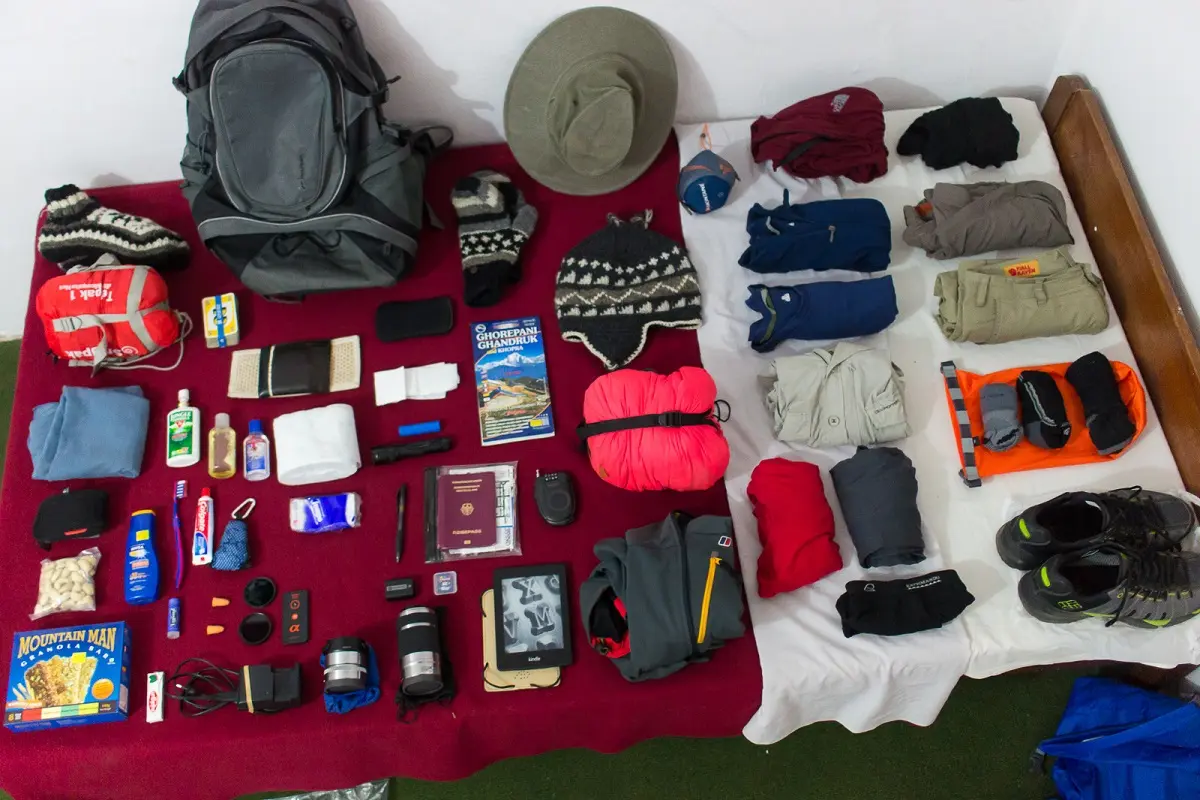
Recommended clothing, hiking gear, travel documents and personal essentials to pack for a gorilla trek from Rwanda.
Packing for Uganda weather requires preparation for sunshine, rainfall, humidity, changing temperatures and differences in elevation. A traveler visiting Kampala and a lowland savannah park will have different needs from someone combining a wildlife safari with gorilla trekking in Bwindi or hiking in the Rwenzori Mountains. The most reliable approach is to pack versatile items that can handle both dry and wet conditions without making luggage unnecessarily heavy. For travelers planning a complete itinerary, Uganda travel planning provides useful seasonal context for choosing clothing and equipment.
Why Uganda Weather Requires Flexible Packing
Uganda’s climate varies by region, altitude and habitat. A warm afternoon in a savannah park can be followed by a much cooler evening, while a forest trek can encounter rain even during a generally dry month. Mountain destinations can be cooler still, with rapidly changing conditions at higher elevations. Packing should therefore be based on the complete itinerary rather than the national average temperature alone.
The two broad dry periods, generally June to September and December to February, can reduce rainfall in many destinations, but rainforest areas can still receive showers. The wetter periods, generally March to May and October to November, require greater emphasis on waterproofing and quick-drying clothing. The Uganda packing guide provides destination-specific clothing recommendations for forest trekking.
Lightweight Clothing for Warm Uganda Weather
Lightweight, breathable clothing is useful for Uganda’s warmer destinations and daytime activities. Shirts and trousers made from quick-drying fabrics are practical because they can handle perspiration and occasional rainfall better than heavy materials. Neutral-colored clothing is also suitable for wildlife environments and photographs without creating unnecessary visual distractions.
Travelers should avoid building their entire wardrobe around heavy clothing because much of Uganda remains warm. Instead, lightweight garments can be combined with warmer layers when visiting higher elevations or traveling during cooler mornings and evenings.
Long-Sleeved Shirts for Forest and Safari Activities
Long-sleeved shirts are particularly useful for gorilla trekking, chimpanzee tracking, hiking and other activities involving dense vegetation. They provide coverage from sun, insects and vegetation while remaining practical during physical activity. Quick-drying synthetic materials or other moisture-managing fabrics can be more practical than heavy cotton in wet environments.
Travelers undertaking forest activities should consider carrying more than one shirt so that a wet garment does not become the only available option. The gorilla trekking guide provides further context about the forest environment and preparation requirements.
Long Trousers for Uganda’s Outdoor Activities
Long trousers are useful for activities involving forest vegetation, hiking trails and safari environments. They provide additional protection from vegetation and insects and can be more practical than shorts when walking through dense undergrowth. Lightweight, quick-drying trousers are particularly useful when rain is possible.
Travelers should choose trousers that allow unrestricted movement. This is particularly important for steep forest trails, where climbing, stepping over roots and navigating uneven terrain require comfortable clothing.
Rain Jacket and Waterproof Protection
A reliable rain jacket is one of the most useful items for a Uganda trip. Rain can occur during both wet and nominally dry periods, particularly in mountainous and forested regions. A lightweight waterproof jacket can be carried during the day without adding excessive weight and used when conditions change.
A jacket with a hood can provide additional protection during sudden showers. Breathable construction is useful during physical activities because it helps reduce discomfort caused by heat and perspiration. Trekking clothing guidance also emphasizes waterproof outerwear for Uganda’s mountain forests.
Waterproof Hiking Boots
Strong hiking boots are particularly important for gorilla trekking, chimpanzee tracking and mountain hiking. Forest trails can contain mud, uneven ground, exposed roots and steep sections. Waterproof boots with good traction can provide better comfort and stability when conditions become wet.
Boots should be properly fitted and worn before the trip rather than being used for the first time on a long trek. This helps travelers identify fit problems before undertaking demanding outdoor activities. Waterproofing is particularly valuable during the wetter months, although it remains useful during the dry season because sudden showers can occur.
Socks for Uganda’s Changing Weather
Good socks complement suitable hiking footwear. Moisture-managing hiking socks can help reduce discomfort during long walks and are especially useful when conditions are humid or wet. Carrying spare pairs is practical for travelers undertaking multi-day forest or mountain activities.
If socks become wet during a trek, having dry replacements available after returning to accommodation can improve comfort. Travelers should also ensure that footwear is allowed to dry properly before another demanding walking day.
Warm Layers for Cool Mornings and Higher Elevations
Although Uganda is tropical, temperatures can become cool in the early morning and evening, particularly in elevated regions. A lightweight fleece, sweater or warm jacket can therefore be useful. The need becomes more pronounced when traveling to Bwindi, Mgahinga or the Rwenzori Mountains.
Layering is generally more practical than carrying one very heavy garment. Travelers can remove a layer as temperatures rise and add it again when conditions cool. This approach is particularly useful during early-morning game drives and mountain activities.
Hat and Sun Protection
A hat can provide useful protection from direct sunlight during game drives, walking activities and sightseeing. A lightweight design that is easy to pack can be used across different destinations. Sunglasses can also improve comfort during prolonged exposure to bright conditions.
Sun protection remains relevant even when temperatures are moderate because Uganda’s equatorial location means travelers can experience substantial solar exposure. Outdoor activities should therefore be planned with both rain and sun protection in mind.
Waterproof Backpack or Daypack
A small daypack is useful for carrying water, rain protection, snacks, camera equipment and other essentials during outdoor activities. A rain cover or waterproof lining can help protect contents during sudden showers.
For gorilla trekking and other forest activities, a compact backpack is generally more practical than a large travel bag. Keeping essential items organized and accessible reduces the need to repeatedly open luggage while walking.
Protecting Cameras and Electronics From Uganda Weather
Rain and humidity can create challenges for cameras, phones and other electronic equipment. Waterproof bags, dry bags or protective covers can reduce the risk of moisture reaching sensitive equipment. This is particularly important during gorilla trekking, chimpanzee tracking, boat trips and forest walks.
Travelers should also remember that dry environments can create dust. Camera equipment used on savannah game drives may therefore require a different type of protection from equipment used in rainforest environments.
Quick-Drying Clothing for Wet Conditions
Quick-drying clothing is particularly valuable during Uganda’s wetter months. Garments that retain large amounts of water can remain uncomfortable for long periods in humid environments. Lightweight materials that dry relatively quickly are more practical for travelers who may experience rain during an outdoor activity.
Quick-drying clothing also reduces the amount of clothing that needs to be packed for a longer itinerary. Travelers can wash lightweight garments and allow them to dry between activities when accommodation conditions permit.
Gaiters for Muddy Forest Trails
Gaiters can be useful during wet-weather trekking because they provide additional protection between trousers and footwear. They can help reduce the amount of mud, dirt and moisture entering boots while walking through dense vegetation.
They are particularly relevant for travelers visiting Bwindi and Mgahinga during wetter periods, when trails can become muddy. They are not essential for every Uganda itinerary, so their usefulness depends on the activities and destinations included.
Gloves for Gorilla Trekking and Forest Hiking
Lightweight gardening or trekking gloves can be useful when walking through dense vegetation. They provide additional protection for the hands when travelers encounter rough vegetation or use walking support on steep sections.
Gloves should allow adequate movement and should not interfere with safely handling equipment. They are particularly practical for forest trekking rather than ordinary city sightseeing or vehicle-based game drives.
Trekking Poles and Walking Support
Walking poles can provide additional support on steep or muddy trails. They are most relevant to travelers undertaking gorilla trekking, mountain hiking or longer forest walks. Their usefulness depends on personal preference, trail conditions and the guidance provided by local staff.
Travelers should avoid relying on equipment alone for difficult terrain. Local guides understand trail conditions and should be followed when navigating steep, slippery or changing surfaces.
Insect Protection and Uganda Weather
Warm and humid environments can support insect activity, particularly around forests, wetlands and other habitats. Travelers should consider appropriate insect protection when preparing for outdoor activities. Long clothing can provide physical coverage, while travelers should follow the product instructions for any insect repellent they choose to use.
Insect considerations vary according to destination and season, so travelers should not assume that every region presents identical conditions. Forest trekking generally requires more attention to protective clothing than a short urban sightseeing activity.
Rain Protection for the Dry Season
One of the most common packing mistakes is assuming that the dry season means rain is impossible. Uganda’s dry periods generally have lower rainfall, but local showers can still occur. This is especially important in mountainous and rainforest areas.
A lightweight rain jacket can therefore remain in the daypack throughout the trip. This adds relatively little weight while providing useful protection when weather changes unexpectedly.
Packing for Uganda During the Wet Season
Travelers visiting during March to May or October to November should place greater emphasis on waterproofing. Rain jackets, waterproof footwear, backpack protection and quick-drying clothing become more important. Spare socks can also be valuable after wet forest activities.
The goal is not to pack excessive amounts of equipment but to protect the items that are most difficult to replace during travel. Waterproofing clothing, electronics and essential documents is usually more practical than attempting to prepare for every possible weather event.
Packing for Uganda During the Dry Season
During June to September and December to February, travelers can generally place greater emphasis on lightweight clothing, sun protection and comfortable footwear. Rain protection should nevertheless remain part of the luggage, especially when forest trekking is included.
Dry conditions can also increase dust on some unpaved safari roads. Travelers spending significant time on game drives may therefore appreciate clothing and bags that can tolerate dust and are easy to clean.
Packing for Gorilla Trekking in Uganda
Gorilla trekking requires more specialized preparation than an ordinary city or vehicle-based safari because the activity involves walking through mountainous rainforest. Travelers should prioritize sturdy footwear, long clothing, rain protection, suitable socks and a practical daypack.
The forest can remain wet regardless of the broader season. For this reason, waterproof protection should be considered essential rather than optional. The Bwindi trekking experience provides additional context about the environment in which this equipment is used.
Packing for Chimpanzee Tracking
Chimpanzee tracking also takes place in forest environments, making comfortable walking footwear and weather protection important. Lightweight long clothing, rain protection and a small daypack are practical choices for forest activities.
The precise packing requirements depend on the destination and duration of the activity. Travelers should avoid carrying unnecessary heavy equipment because forest walking can become demanding when trails are wet or uneven.
Packing for Uganda Game Drives
Game-drive packing can be simpler because travelers generally remain inside a vehicle. Lightweight clothing, a warm layer for early mornings, sun protection and rain protection are useful. A small bag can hold water, personal items, binoculars and camera equipment.
Warm clothing is particularly useful during early-morning drives in cooler seasons or elevated areas. During sunny afternoons, a hat and breathable clothing can make the experience more comfortable.
Packing for Boat Safaris
Boat activities require preparation for both sun and rain. Travelers should carry sun protection while also keeping a waterproof layer accessible. Electronics should be protected because water can come from rainfall, splashes or accidental contact with the boat environment.
Lightweight clothing is generally preferable because it dries more easily if exposed to water. A small waterproof bag can keep phones, cameras and documents protected throughout the activity.
Packing for Mountain Hiking in Uganda
Mountain hiking requires more attention to temperature and changing weather than many lowland activities. Warm layers, waterproof outerwear, suitable boots and moisture-managing clothing become increasingly important as elevation rises.
The Rwenzori Mountains can experience much colder conditions at high elevations than travelers encounter in Uganda’s lower-lying safari areas. Travelers undertaking high-altitude hikes should therefore follow the equipment requirements provided by the relevant guides and authorities rather than relying on ordinary safari clothing.
Packing for Uganda’s Hotter Regions
Travelers visiting warmer and drier regions such as northeastern Uganda should emphasize breathable clothing, sun protection and adequate hydration. Lightweight fabrics can make warm conditions more comfortable, particularly during outdoor activities.
The same traveler may still need a warm layer if the itinerary includes cooler highland areas. This is why adaptable clothing is more useful than packing exclusively for the hottest destination on the itinerary.
Documents and Personal Items
Important travel documents should be protected from rain and moisture, particularly when traveling through remote areas or participating in outdoor activities. Waterproof document sleeves or sealed bags can provide additional protection.
Travelers should also keep frequently needed items accessible rather than placing them at the bottom of large luggage. A small organized daypack is particularly useful during long outdoor activities.
How to Organize a Uganda Weather Packing List
The most efficient approach is to divide luggage into everyday clothing, outdoor clothing, weather protection and destination-specific equipment. This prevents travelers from carrying specialized gear throughout the entire trip when it is only needed for one activity.
A traveler combining Kampala, a savannah park, Kibale and Bwindi should prepare for warm urban conditions, outdoor heat, humid forest conditions and cool highland weather. Layering and lightweight waterproof equipment allow the same basic wardrobe to work across these environments.
The Most Important Principle When Packing for Uganda Weather
The most important principle is flexibility. Uganda weather is varied, and conditions can change according to destination, elevation, season and time of day. A successful packing strategy therefore combines breathable clothing for warm conditions with waterproof protection and warmer layers for cooler or wetter environments.
Travelers should not pack solely according to a national dry-season or rainy-season label. Instead, they should examine the destinations and activities on their itinerary and prepare for the conditions those environments can produce. With appropriate footwear, weather protection, adaptable clothing and protection for important equipment, travelers can remain comfortable across Uganda’s diverse climates.
Uganda Weather Safety, Travel Planning and Frequently Asked Questions

Common questions about planning a safe safari answered
Uganda weather should be treated as an important part of travel planning rather than simply a question of whether a particular month is wet or dry. The country’s equatorial position, varied elevations, forests, lakes, savannahs and regional differences produce different conditions across the country. A practical Uganda Weather Guide therefore needs to explain how travelers can interpret forecasts, prepare for rainfall and temperature changes, choose suitable travel periods, and adapt plans when local weather differs from seasonal expectations.
The broad seasonal pattern is useful as a starting point, but destination-specific conditions are more important for activities such as gorilla trekking, mountain hiking, wildlife viewing and forest walks. Current information from Uganda travel experts describes February and early March as part of a generally drier period, while other destinations can follow somewhat different rainfall patterns.
Is Uganda Hot All Year Round?
Uganda is generally warm throughout the year, but it is inaccurate to describe the entire country as uniformly hot. Elevation has a major influence on temperature. Lower-lying areas can be considerably warmer, while highland destinations and mountain environments can become cool, particularly during mornings, evenings and periods of rain.
This variation explains why travelers may need lightweight clothing for warm daytime conditions and warmer layers for elevated destinations. The temperature experienced in Kampala, a savannah park and Bwindi can differ substantially even when those destinations are visited during the same month.
Does It Rain Every Day in Uganda?
No. Rainfall varies by season and location, and even during wetter months rainfall does not necessarily continue throughout an entire day. Tropical showers can be followed by periods of sunshine, while some locations receive more frequent rainfall than others.
The southern and southwestern regions, particularly forested highland areas, can receive more rainfall than some northern and northeastern areas. Travelers should therefore avoid interpreting a national rainy-season label as meaning continuous rain everywhere in Uganda.
What Are Uganda’s Main Dry Seasons?
Uganda is commonly described as having two broad drier periods, approximately December to February and June to September. These periods generally offer lower rainfall in many areas and can provide favorable conditions for safari travel, trekking and other outdoor activities.
However, local variations are important. Mountain and rainforest environments can experience rain even during the dry season. Information from Uganda trekking seasons similarly emphasizes that dry and wet conditions affect trail surfaces, visibility and the overall trekking experience.
What Are Uganda’s Main Rainy Seasons?
The broad rainy periods are generally associated with March to May and October to November, although exact timing varies by region. Some areas can experience different rainfall patterns, meaning that travelers should examine weather information for each destination rather than relying solely on national seasonal descriptions.
Rainfall can affect roads, trails and outdoor schedules. In mountainous areas, heavy rain can make trails muddy and slippery. In savannah parks, rain can influence road conditions and vegetation. A useful Rwenzori weather guide illustrates how rainfall can substantially change hiking conditions in a high-altitude environment.
Which Months Are Best for a Uganda Safari?
There is no single best month for every safari because the ideal timing depends on the destination and traveler’s priorities. The generally drier periods can offer easier road conditions and more predictable opportunities for outdoor activities, while wetter periods can produce greener landscapes.
Travelers primarily interested in wildlife viewing may prefer generally drier periods, while photographers and travelers interested in lush scenery may appreciate wetter conditions. Weather is only one factor affecting wildlife sightings, and no season guarantees particular animal encounters.
What Is the Best Weather for Gorilla Trekking in Uganda?
Gorilla trekking can take place throughout the year. Many travelers prefer the generally drier periods because trails can be less muddy and easier to navigate. The wetter periods can make trails more slippery, but they can also produce lush forest scenery.
Importantly, Bwindi and Mgahinga are rainforest environments. Rain remains possible even during the dry season, so waterproof clothing and suitable footwear remain important regardless of travel month. The Bwindi travel information confirms the importance of waterproof clothing and sturdy footwear in the forest.
Is Uganda Weather Suitable for Hiking?
Uganda offers hiking opportunities in environments ranging from forested hills to high mountain terrain. Weather suitability depends heavily on the specific mountain or trail. Drier periods can provide firmer paths, while wet conditions can create mud and slippery surfaces.
Higher elevations can also be substantially cooler than surrounding lowlands. Travelers planning mountain hikes should therefore prepare for changing temperatures, rainfall and terrain rather than using lowland weather as their guide.
How Does Rain Affect Uganda Safari Roads?
Rain can affect unpaved roads by making some sections muddy or softer. The severity depends on the amount of rainfall, local drainage, soil type and road conditions. Some roads remain usable during rainfall, while others can become more challenging after substantial precipitation.
Professional guides and drivers can provide valuable local information because conditions can change faster than national weather summaries suggest. Current local knowledge can therefore be particularly useful when traveling in remote areas.
How Does Weather Affect Uganda Wildlife Viewing?
Weather can influence wildlife behavior, vegetation density, road accessibility and visibility. During drier periods, some animals may spend more time around available water sources, while vegetation can become less dense in some savannah environments.
During wetter periods, vegetation can become greener and denser. This can create excellent scenery but may sometimes make animals more difficult to spot. Wildlife remains unpredictable, so weather patterns should be viewed as one influence rather than a guarantee of sightings.
How Does Weather Affect Uganda Birdwatching?
Weather influences bird activity, habitat conditions and the accessibility of birding locations. Uganda’s forests, wetlands, lakes and savannahs provide different environments, and seasonal changes can affect what birders experience.
Birdwatchers should therefore consider the species and habitats they specifically want to visit when selecting travel dates. A general national weather forecast cannot determine birding conditions in every habitat.
What Should You Wear in Uganda’s Rainy Season?
Travelers visiting during wetter periods should prioritize lightweight, quick-drying clothing, a waterproof jacket and suitable footwear. For forest trekking, long trousers and long-sleeved shirts can provide practical protection from vegetation and insects.
Extra socks are useful when walking in wet conditions, while waterproof protection for electronics and documents can prevent unnecessary damage. The clothing requirements become more important when activities involve several hours outdoors.
What Should You Wear During Uganda’s Dry Season?
During generally drier periods, lightweight breathable clothing, sun protection and comfortable footwear are useful. Travelers should still carry a rain jacket when visiting forests and mountains because local showers can occur regardless of the broader seasonal pattern.
Early-morning activities may require an additional warm layer, particularly in elevated regions. Layering provides flexibility as temperatures rise during the day.
Does Uganda Get Cold at Night?
Some parts of Uganda can feel cool at night, particularly at higher elevations. Mountain and highland areas experience lower temperatures than warmer lowland locations. Rain and cloud can make conditions feel cooler as well.
Travelers should therefore include at least one warmer layer when visiting elevated destinations. This is particularly relevant for itineraries that include Bwindi, Mgahinga, Mount Elgon or the Rwenzori Mountains.
Does Uganda Have Four Seasons?
Uganda’s climate is not best understood using the four-season system commonly used in temperate regions. The country is near the Equator, and travel planning is generally more useful when based on wetter and drier periods together with regional variations.
Even the broad wet and dry periods should be treated as climate patterns rather than fixed boundaries. Rainfall can begin earlier or later than expected, and different parts of Uganda can experience different conditions simultaneously.
How Does Altitude Affect Uganda Weather?
Altitude generally causes temperatures to decrease as elevation increases. This is one reason Uganda’s highland destinations can feel much cooler than lowland areas. Mountain environments can also experience rapid changes in cloud cover and rainfall.
The effect is important when planning itineraries that combine wildlife parks with mountain or forest activities. Clothing suitable for a warm savannah afternoon may not be sufficient for a cool, wet highland morning.
How Does Uganda Weather Differ by Region?
Uganda’s weather varies geographically. Central areas around Kampala and Lake Victoria experience different conditions from the drier northeastern region. Western and southwestern Uganda contain both lower-lying landscapes and cooler highland environments.
This regional diversity is one of the most important facts to understand when using a Uganda Weather Guide. Travelers should always match the forecast to their actual destination rather than assuming that conditions in Kampala represent the entire country.
How Reliable Is a Uganda Weather Forecast?
Weather forecasts are useful for short-term planning, but conditions can change, particularly in mountainous and tropical environments. Historical climate data is more appropriate for deciding which general month or season to travel, while a current forecast is more useful close to the activity date.
Travelers should avoid treating a forecast as an absolute guarantee. A forecast indicating a dry period does not mean that a forest trek will definitely remain dry, just as a rainy forecast does not necessarily mean that rain will continue throughout the day.
Should You Cancel a Uganda Safari Because of Rain?
Rain alone does not necessarily mean that a safari should be canceled. Many Uganda activities continue during wet conditions, provided that roads, trails and local safety conditions remain suitable. Rain can also produce attractive landscapes and improve the appearance of vegetation.
The more important question is whether the specific activity can safely and practically continue under the prevailing conditions. Local guides, park authorities and accommodation providers can provide current information when severe weather affects an itinerary.
How Should Travelers Prepare for Unexpected Weather?
The simplest strategy is to carry adaptable equipment. A lightweight rain jacket, comfortable walking shoes, sun protection, a warmer layer and waterproof protection for electronics can cover many common weather changes.
Travelers should also keep important documents protected and avoid placing essential electronics where they can easily become wet. Good preparation reduces the inconvenience caused by unexpected showers without requiring excessive luggage.
What Is the Best Month to Visit Uganda?
The answer depends on what the traveler wants to do. Generally drier months such as January, February, June, July and August can provide favorable conditions for many outdoor activities, while December and September can represent useful transition periods depending on destination. Wetter months can be attractive for travelers who prioritize green landscapes and are comfortable with rain.
There is therefore no scientifically defensible single month that is universally best for every Uganda itinerary. The appropriate month depends on the destinations, activities, road conditions, personal preferences and current seasonal patterns.
How Should Weather Be Considered When Planning a Multi-Destination Uganda Trip?
A multi-destination itinerary should be planned around the weather characteristics of each region rather than using one nationwide forecast. A trip combining Kampala, a northern savannah park, Kibale and Bwindi can encounter several different climate environments.
Travelers should therefore examine elevation, rainfall patterns and activity requirements for every major destination. The Uganda gorilla safari information is particularly relevant when an itinerary includes southwestern rainforest areas where rainfall can occur throughout the year.
Uganda Weather and Responsible Travel
Weather conditions can affect roads, trails, vegetation and local ecosystems. Travelers should follow instructions from guides and park authorities when conditions become difficult. Remaining on designated routes and respecting local guidance helps reduce environmental impact while improving safety.
Responsible travel is especially important in sensitive forest and mountain environments. Weather should not be treated as a reason to disregard established conservation procedures or local instructions.
Final Uganda Weather Planning Advice
A reliable Uganda Weather Guide should never promise completely predictable conditions. Uganda’s climate is diverse, and rainfall, temperature and humidity can change according to region, altitude, season and local geography. The most useful strategy is to combine historical seasonal patterns with current destination-specific forecasts.
For most travelers, flexible clothing, reliable rain protection, suitable footwear and protection for electronics are the most practical preparations. The generally drier periods can make many outdoor activities easier, while wetter periods can provide greener landscapes and their own advantages. By understanding these differences and planning according to the actual destinations on an itinerary, travelers can make better-informed decisions about when to visit Uganda and how to prepare for its varied weather.
Uganda Weather Guide: Final Planning, Regional Climate Differences and Practical Travel Advice
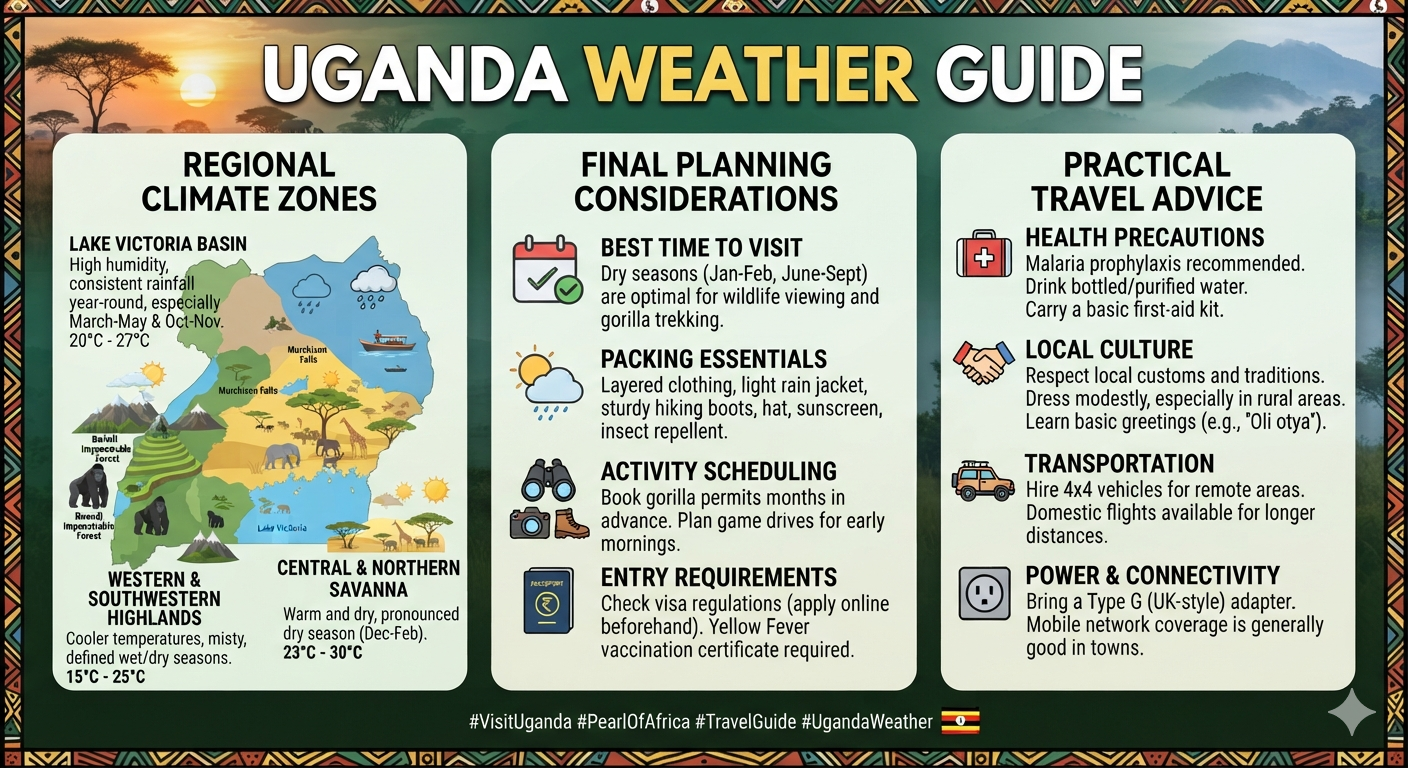
Essential weather guide and travel planning tips for visiting Uganda.
Uganda weather is best understood as a combination of broad seasonal patterns and significant regional differences. The country lies near the Equator, but altitude, lakes, mountains, forests and regional geography create noticeably different conditions from one destination to another. A traveler planning a safari, gorilla trekking experience, chimpanzee tracking excursion, hiking trip or general holiday should therefore look beyond a simple “dry season versus rainy season” description.
The broad pattern remains useful. Uganda generally experiences drier periods around December to February and June to August or September, with wetter conditions commonly occurring around March to May and September or October to November depending on the region. Current travel information from Uganda travel planning describes June to September and December to February as the main dry periods, while March to May and October to November are identified as greener periods.
Uganda Weather Should Be Planned by Destination
One of the most important principles in understanding Uganda weather is that national averages cannot accurately describe every destination. Kampala, Murchison Falls, Kidepo Valley, Bwindi, Mgahinga, Kibale and the Rwenzori Mountains occupy different environments and elevations. Consequently, temperature, rainfall, humidity and trail conditions can differ considerably on the same day.
This regional variation is especially important for travelers combining several destinations. Someone may begin a journey in a warm lowland environment and later reach a cool, humid highland forest. The Uganda attractions guide illustrates the country’s exceptionally varied landscapes and environments, which are directly relevant to understanding local weather differences.
Central Uganda Weather
Central Uganda, including the Kampala and Lake Victoria region, generally experiences a warm tropical climate moderated in part by elevation and the presence of large water bodies. Rainfall occurs throughout the year, although seasonal variations influence how frequently and intensely showers occur.
Travelers visiting Kampala should therefore prepare for warm conditions while keeping rain protection accessible. Weather in the capital should not, however, be used as a substitute for forecasts covering more distant safari or trekking destinations.
Western Uganda Weather
Western Uganda contains diverse landscapes ranging from savannahs and lakes to forests and highlands. Consequently, weather conditions vary significantly within the region. Queen Elizabeth National Park can experience conditions quite different from the elevated forests around Bwindi or Mgahinga.
Travelers planning western Uganda itineraries should consider both elevation and habitat. A safari through a lower-lying park may require lightweight clothing and sun protection, while a subsequent forest trek can require waterproof clothing and warmer layers.
Northern Uganda Weather
Northern Uganda generally experiences warmer conditions than many highland areas in the southwest. Rainfall patterns also vary from those found around Lake Victoria and the southwestern mountains. The northern safari region can consequently have a different appearance and road environment depending on the season.
Travelers visiting northern parks should consider heat, sun exposure and seasonal road conditions. The amount of rainfall received before and during a journey can influence vegetation and accessibility, particularly on unpaved roads.
Northeastern Uganda and Its Drier Climate
Northeastern Uganda has some of the country’s drier and more semi-arid environments. This is particularly relevant around Kidepo Valley and surrounding areas. Conditions here should not be assumed to match those in the wetter southwestern highlands.
Travelers visiting this region should prepare for stronger sun exposure and potentially hotter daytime conditions. Seasonal rainfall can dramatically transform the landscape, making timing particularly important for visitors interested in scenery, wildlife and road conditions.
Southwestern Uganda Weather
Southwestern Uganda includes elevated landscapes, volcanic areas and tropical forests. Bwindi and Mgahinga are particularly important examples because their rainforest environments can receive rainfall even when broader national conditions are relatively dry.
Altitude also means temperatures can be noticeably cooler than in lower-lying regions. Travelers undertaking gorilla trekking should therefore prepare for both rain and cool conditions regardless of the month selected.
How Lake Victoria Influences Uganda Weather
Large water bodies influence local atmospheric conditions, and Lake Victoria is particularly significant to central and southeastern Uganda. Moisture from the lake contributes to local cloud formation and rainfall patterns.
The influence of elevation and water is also visible around smaller highland lakes. The Lake Chahafi climate information, for example, describes moderate temperatures associated with the area’s elevation and notes seasonal differences in rainfall and clearer conditions during drier periods.
Uganda Weather and Equatorial Location
Uganda’s position close to the Equator helps explain why the country does not experience the extreme summer and winter temperature differences found in temperate regions. Daylight duration also changes relatively little through the year compared with locations farther north or south.
However, being near the Equator does not mean that temperatures are identical throughout Uganda. Elevation remains a major factor. Mountainous regions can be substantially cooler, while lower and drier areas can experience hotter daytime conditions.
Uganda Weather and Humidity
Humidity is particularly noticeable in forests, wetlands and areas close to large lakes. Dense vegetation and abundant moisture can make forest environments feel humid even when temperatures are not exceptionally high.
Humidity matters during physically demanding activities because warm, moist conditions can increase discomfort. Travelers undertaking long walks should wear breathable clothing, remain appropriately hydrated and carry suitable rain protection.
Uganda Weather and Safari Photography
Weather can have a major effect on photography. Clear conditions can provide strong visibility across landscapes, while clouds can produce softer light. Rain can temporarily reduce visibility but may also create dramatic skies, reflections and greener scenery.
Travelers should protect cameras and other electronics from both rain and dust. Weather protection is especially important when moving between savannah game drives and humid forest environments.
Uganda Weather and Wildlife Photography
Drier conditions can sometimes make wildlife easier to locate in open savannah because vegetation may be shorter and some animals can concentrate around reliable water sources. However, animal behavior remains unpredictable and weather cannot guarantee particular sightings.
During wetter periods, landscapes can become exceptionally green. Photographers interested in scenery may appreciate this transformation, even though denser vegetation can sometimes make wildlife harder to spot.
Uganda Weather and Gorilla Trekking
Gorilla trekking is conducted throughout the year, but trail conditions vary with rainfall. Generally drier months can provide firmer trails and easier walking, while wetter months can produce muddy and slippery conditions.
Rain should still be expected in Bwindi and Mgahinga during any month because these are highland rainforest environments. Travelers should therefore consider waterproof boots, rain protection and clothing suitable for changing temperatures. Gorilla trekking Uganda information confirms that trekking continues year-round while generally drier periods can make trails less muddy.
Uganda Weather and Chimpanzee Tracking
Chimpanzee tracking takes place primarily in forest environments where rainfall and humidity can affect trail conditions. Wet trails may become muddy and slippery, while drier conditions generally make walking easier.
Travelers should remember that forests can receive rain outside the main rainy seasons. Appropriate footwear and rain protection should therefore remain part of the preparation regardless of the selected month.
Uganda Weather and Mountain Hiking
Mountain weather requires particularly careful preparation because temperatures decrease with elevation and conditions can change rapidly. Rain, mist, cloud and cooler temperatures may occur even when lower areas are warm and relatively dry.
Travelers hiking Mount Elgon, the Rwenzori Mountains or other highland routes should follow destination-specific equipment and weather advice. General Kampala or safari-park temperatures are not sufficient for planning high-altitude excursions.
Uganda Weather and Road Conditions
Rainfall can influence road conditions, especially on unpaved routes used to reach national parks and remote accommodation. Heavy rainfall can create muddy sections, standing water or slower travel times. The effect varies according to drainage, soil and the specific road.
Travelers should allow flexibility in their schedules when visiting remote areas during wetter periods. Building additional travel time into an itinerary can reduce the pressure created by unexpected delays.
Uganda Weather and Safari Accommodation
Accommodation requirements can also vary according to weather and elevation. Travelers visiting cooler highland destinations may appreciate properties with appropriate bedding and warm indoor areas, while travelers in warmer lowland areas may prioritize ventilation and shade.
When booking accommodation, travelers should consider the climate of the specific destination rather than assuming that facilities throughout Uganda provide identical conditions.
Uganda Weather During the Christmas and New Year Period
December falls within one of Uganda’s generally drier periods, although local rainfall remains possible. This makes the Christmas and New Year period attractive for many travelers who want to combine wildlife activities, sightseeing and trekking.
Demand for accommodation and popular activities can increase during this period. Travelers should therefore plan well ahead, particularly when their itinerary includes activities with limited daily capacity.
Uganda Weather During January and February
January and February generally belong to the shorter dry period. Many regions experience relatively favorable conditions for outdoor activities, although localized rainfall remains possible. Temperatures can be warm during the day and cooler in elevated regions.
These months can be particularly useful for travelers combining wildlife safaris with forest activities because roads and trails are often easier to navigate than during wetter periods. Nevertheless, travelers should continue carrying rain protection.
Uganda Weather During March to May
March to May generally represents the first major wetter period in many parts of Uganda. April is commonly associated with particularly wet conditions in several regions, although the exact rainfall pattern differs across the country.
Travelers visiting during this period should be prepared for wet roads, muddy trails and frequent showers. The advantage is that vegetation becomes lush and landscapes can be particularly green and visually attractive.
Uganda Weather During June to September
June to September generally forms Uganda’s longer drier period. Lower rainfall in many areas can make safari roads and trekking trails more manageable. Wildlife viewing can also benefit from conditions that reduce vegetation density in some savannah environments.
September can become a transition month in some areas, with rainfall gradually increasing toward the second wetter period. September weather information highlights this transition and the generally favorable conditions that can occur during the month.
Uganda Weather During October and November
October and November are generally associated with the second wetter period, although regional variations are significant. Southern and southwestern regions can experience frequent rainfall, while some northern locations may follow different patterns.
The wet conditions can make trails muddy but can also produce lush vegetation and vibrant scenery. Travelers who are comfortable with occasional rain may find this period rewarding, particularly when their priority is greenery and lower visitor numbers.
When Is Uganda Weather Most Predictable?
The generally drier periods often provide more predictable conditions for many outdoor activities, but no period should be treated as completely rain-free. This is particularly true in rainforest and mountainous areas.
For travelers who need the most reliable trail and road conditions, the generally drier months can be a sensible choice. Those who prioritize green landscapes, fewer visitors or potentially lower accommodation costs may consider wetter periods instead.
How to Check Uganda Weather Before Departure
Travelers should use historical climate information when choosing a general travel window and current weather forecasts when preparing for specific travel dates. These two types of information serve different purposes and should not be confused.
A historical climate summary can indicate whether a month is generally wetter or drier. A current forecast can provide more useful short-term information about rainfall, cloud cover and temperatures around the actual travel date.
What Travelers Should Do When Forecasts Predict Rain
Rain in the forecast does not automatically mean that outdoor activities must be canceled. The significance depends on the intensity, duration, location and activity involved. A short shower may have little effect on a safari, while prolonged heavy rain can make a mountain trail considerably more difficult.
Travelers should follow the advice of local guides, drivers, accommodation staff and relevant authorities when weather conditions become difficult. Local information is often more useful than a generalized national forecast.
How to Build a Flexible Uganda Weather Itinerary
A flexible itinerary allows travelers to accommodate weather-related changes without losing important experiences. This is especially useful when traveling between remote destinations where road conditions can affect journey times.
Travelers can also avoid placing every important activity on a single day. Allowing some flexibility around transfers and outdoor activities can make an itinerary more resilient when weather changes unexpectedly.
The Relationship Between Weather and Uganda’s Landscapes
Uganda’s varied weather patterns contribute directly to its diverse landscapes. Rain supports tropical forests, wetlands, grasslands and agricultural areas, while drier periods alter vegetation and water availability. Elevation further creates distinct highland environments.
This relationship explains why Uganda can offer dramatically different scenery within a single journey. The weather is not merely a travel inconvenience; it is one of the factors responsible for the country’s ecological diversity.
The Relationship Between Weather and Uganda’s Wildlife
Seasonal changes influence vegetation, water availability and habitat conditions, all of which can affect wildlife behavior. During drier conditions, animals may become more concentrated around reliable water sources in some ecosystems. During wetter periods, vegetation becomes more abundant.
These patterns can influence the safari experience, but wildlife remains naturally unpredictable. Travelers should select travel dates based on broad seasonal advantages rather than expecting specific animal sightings.
The Relationship Between Weather and Uganda’s Forests
Uganda’s tropical forests retain moisture and can remain wet even during broader national dry periods. This is especially important for Bwindi, Mgahinga and Kibale. Travelers should therefore treat forest weather as its own category when preparing for trekking and nature walks.
Rainfall creates slippery ground, wet vegetation and muddy trails, while clear periods can improve walking conditions and visibility. Proper footwear and rain protection remain useful throughout the year.
Uganda Weather and Travel Comfort
Comfort depends on more than temperature. Humidity, rainfall, wind, sunlight, physical activity and altitude all influence how travelers experience weather. A moderate temperature can feel demanding during humid physical activity, while a relatively cool temperature can feel much colder when combined with rain.
This is why clothing should be layered and adaptable. Travelers should prepare for both warm and cool conditions when their itinerary includes multiple elevations or ecosystems.
Final Uganda Weather Recommendations
The most reliable way to plan around Uganda weather is to combine seasonal climate patterns with destination-specific information and a current forecast. The generally drier periods can provide easier conditions for many outdoor activities, while the wetter periods can offer greener landscapes and different travel advantages.
Travelers should pack for variability rather than for one expected weather condition. Lightweight clothing, a warm layer, reliable rain protection, suitable walking footwear and protection for electronics are useful across many Uganda itineraries. The Uganda gorilla safaris resource is particularly relevant for travelers combining forest trekking with other activities.
Ultimately, there is no universally perfect month for every Uganda trip. The best travel period depends on the destinations, activities, preferred weather conditions and tolerance for rainfall. Understanding Uganda weather at both national and regional levels allows travelers to make better-informed decisions while remaining prepared for the natural variability of a tropical country.