
Rwanda Wildlife Guide: Complete Introduction to Wildlife Safaris in Rwanda
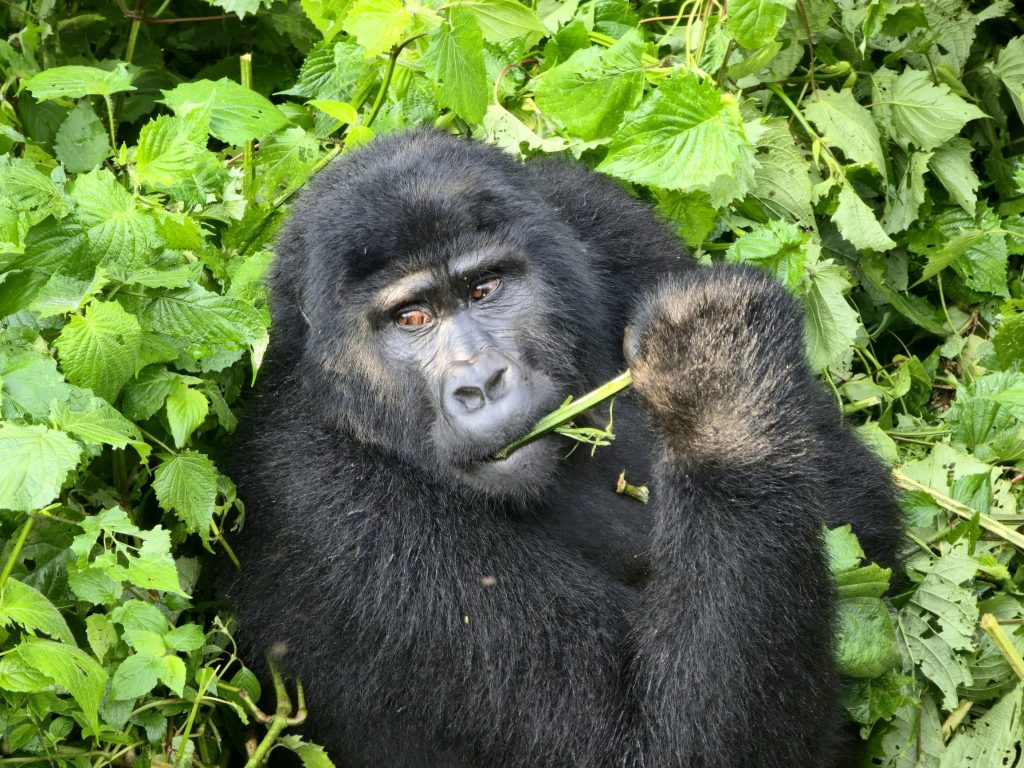
A mountain gorilla feeds in dense forest vegetation, highlighting one of the most iconic wildlife experiences featured in a Rwanda safari.
A Rwanda Wildlife Guide opens the door to one of Africa’s most diverse safari destinations, where tropical forests, volcanic mountains, wetlands, lakes and open savannah support remarkably different wildlife experiences within a relatively compact country. Although Rwanda is internationally associated with mountain gorillas, travellers can experience much more than primate trekking. A well-planned Rwanda safari can combine Big Five game viewing, mountain gorilla trekking, chimpanzee tracking, golden monkey encounters, birdwatching, boat safaris and scenic nature experiences. Safari Vacations and Travel Services Ltd designs wildlife journeys that connect Rwanda’s major protected areas while allowing travellers to understand how the country’s landscapes, animals and conservation areas differ.
Why Rwanda Is an Exceptional Wildlife Safari Destination
Rwanda offers an unusual combination of classic African savannah wildlife and rainforest primates. In the east, Akagera National Park provides game-viewing opportunities across savannah, woodland and wetland habitats, while northern Rwanda is dominated by the volcanic landscapes and forests of Volcanoes National Park. Travellers heading southwest encounter the extensive montane forests of Nyungwe, creating opportunities to combine very different ecosystems during one holiday. Those interested in traditional game viewing can begin with an Akagera wildlife safari, while visitors seeking a broader understanding of the destination can explore some of the safari activities in Rwanda available across the country.
Akagera is particularly important to a complete Rwanda Wildlife Guide because it provides the country’s strongest traditional African safari experience. Its landscapes support large mammals and predators alongside lakes and wetlands where travellers can encounter aquatic wildlife and abundant birdlife. Visitors interested in understanding what they may encounter can explore the different animals in Akagera National Park. The destination can also be explored in greater depth through information about Akagera’s lakes and wetlands, which form an important part of the park’s wildlife habitat.
Rwanda Wildlife Beyond the Big Five
A Rwanda wildlife safari should not be measured only by the number of large mammals seen during a game drive. The country’s wildlife diversity ranges from mountain gorillas and chimpanzees to golden monkeys, smaller primates, antelopes, predators, reptiles and numerous bird species. This diversity makes it possible to create a Rwanda wildlife tour around specific interests such as primates, photography, birding, conservation or a combination of several experiences. Travellers wanting a broader perspective can read about Rwanda beyond gorilla trekking, while a complete multi-park journey can include the experiences featured on a Rwanda gorilla and wildlife safari.
Akagera’s wildlife experience provides an especially strong contrast to Rwanda’s forest environments. Open areas allow visitors to search for elephants, buffaloes, giraffes, zebras, antelopes and predators, while the wetland system creates opportunities to observe hippos, crocodiles and water-associated birds. Travellers considering this side of Rwanda can also compare additional wildlife information through Anthill Safaris’ guide to a wildlife safari in Rwanda. These varied habitats explain why a Rwanda Wildlife Guide needs to cover far more than gorilla trekking alone.
Mountain Gorillas and Rwanda’s Forest Wildlife
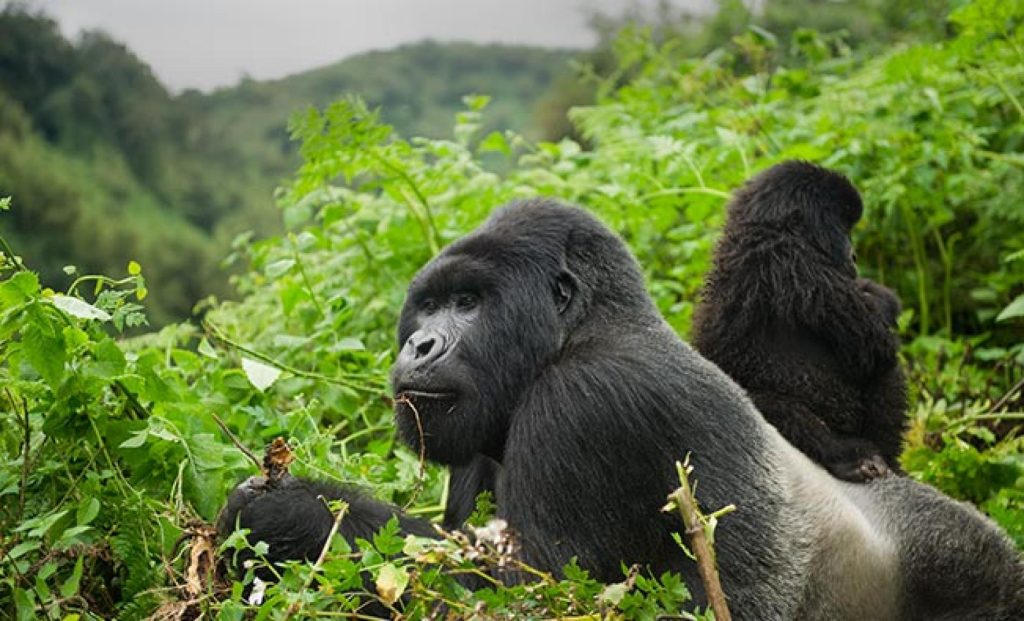
Mountain gorillas move through lush forest vegetation, highlighting one of Rwanda’s most iconic wildlife and primate experiences.
Mountain gorillas remain one of Rwanda’s most sought-after wildlife encounters and are protected within Volcanoes National Park in the country’s northwest. Gorilla trekking introduces visitors to a completely different style of safari from vehicle-based wildlife viewing. Instead of exploring open plains, trekkers enter dense mountain vegetation with experienced guides and trackers in search of habituated gorilla families. Travellers planning this experience can combine it with other wildlife attractions through a Volcanoes and Nyungwe safari, creating a journey that connects Rwanda’s volcanic and rainforest landscapes.
Volcanoes National Park is also associated with golden monkeys, birdlife and other forest species, making it valuable for travellers who want to experience Rwanda’s broader biodiversity. Gorilla trekking can therefore form one part of a much larger wildlife holiday rather than being treated as an isolated excursion. Additional information about primate experiences can be found in Anthill Safaris’ guide to gorilla trekking in Volcanoes National Park. Combining Volcanoes with Akagera is especially appealing because travellers move from high-altitude forest wildlife to savannah game viewing within the same Rwanda safari.
Chimpanzees, Monkeys and the Wildlife of Nyungwe Forest
Nyungwe Forest National Park adds another important dimension to the Rwanda Wildlife Guide. Its montane rainforest environment provides a setting for chimpanzee tracking, monkey encounters, forest birding and nature-based exploration. The experience differs significantly from both Akagera game drives and Volcanoes gorilla trekking, giving travellers another reason to combine several protected areas. Visitors researching this part of the country can explore information about Nyungwe Forest National Park and incorporate forest activities into a longer Rwanda wildlife itinerary.
Including Nyungwe is particularly rewarding for travellers interested in primates because Rwanda’s wildlife extends well beyond mountain gorillas. Chimpanzees and several monkey species create opportunities for visitors to compare different primate behaviours, habitats and trekking environments. When Akagera, Volcanoes and Nyungwe are combined, a Rwanda wildlife safari can move naturally from savannah animals to mountain gorillas and then to rainforest primates. This combination is one reason Rwanda works exceptionally well for travellers who want several distinct wildlife experiences without building an itinerary around only one national park.
Big Five Wildlife Safaris in Rwanda
Travellers searching for a Rwanda Big Five safari should focus primarily on Akagera National Park. Game drives provide opportunities to search for Rwanda’s large savannah mammals and predators while exploring varied landscapes that include grasslands, woodland, lakes and wetlands. The park has become central to Rwanda’s wildlife tourism and complements the country’s internationally known primate experiences. Those planning where to stay can review Akagera safari accommodation when building a multi-day wildlife itinerary.
Travellers who want to understand how the park fits into Rwanda’s wider safari experience can also explore Anthill Safaris’ information on Akagera National Park safaris. Spending more than one day in the park can create additional opportunities for wildlife viewing and allows travellers to experience both terrestrial and aquatic environments instead of treating Akagera simply as a quick excursion from Kigali.
Combining Rwanda’s Wildlife Experiences
One of the strongest ways to experience Rwanda is to combine different wildlife regions rather than selecting only one attraction. A journey might begin with savannah wildlife in Akagera before continuing northwest for mountain gorillas and golden monkeys in Volcanoes National Park, followed by forest primates in Nyungwe. Lake Kivu can also be incorporated between wildlife destinations for scenic relaxation. Travellers evaluating whether the country matches their interests can explore why visit Rwanda for safari before choosing the parks and experiences that best suit their available travel time.
Safari Vacations and Travel Services Ltd can structure Rwanda wildlife journeys around the traveller’s available number of days, preferred wildlife encounters, accommodation level and preferred pace. The Rwanda Wildlife Guide throughout this page will examine the country’s national parks, major animals, primates, birds, wildlife activities, travel seasons and practical safari planning in greater detail. Understanding these individual elements makes it easier to create a balanced itinerary that combines Rwanda’s savannah, rainforest, volcanic and wetland ecosystems without unnecessary repetition.
Best Places to See Wildlife in Rwanda: Rwanda National Parks Guide
Understanding where to see wildlife is an essential part of any Rwanda Wildlife Guide because the country’s most important species are distributed across very different ecosystems. Rwanda has four national parks: Akagera National Park, Volcanoes National Park, Nyungwe National Park and Gishwati-Mukura National Park. Together, these protected areas give travellers access to savannah wildlife, mountain gorillas, chimpanzees, golden monkeys, forest primates, rare birds, wetlands and spectacular mountain landscapes. Travellers researching the country’s protected areas can begin with this detailed guide to Rwanda national parks, which provides useful background for planning a wildlife-focused journey.
Each national park offers a distinct Rwanda wildlife safari experience. Akagera is the destination for traditional game drives and Big Five wildlife, Volcanoes is internationally known for mountain gorillas and golden monkeys, Nyungwe protects an extensive montane rainforest famous for chimpanzees and other primates, while Gishwati-Mukura provides a quieter forest experience centered around primates, birdlife and conservation. Combining these destinations allows travellers to experience Rwanda’s remarkable ecological diversity within one country. Anthill Safaris also provides a useful overview of Rwanda’s four national parks and the different experiences available within them.
Akagera National Park: Rwanda’s Premier Big Five Wildlife Destination
Akagera National Park is the most important destination for travellers searching for a traditional Rwanda wildlife safari. Located in eastern Rwanda near the Tanzanian border, the park combines open savannah, rolling hills, woodland, lakes and extensive wetlands. This mixture of habitats supports an impressive variety of mammals, birds and aquatic wildlife. Visitors who want several days of game viewing can consider a 3-day Akagera safari, which provides more time to explore the park than a short day excursion from Kigali.
Akagera is particularly important because it provides opportunities to search for lions, leopards, elephants, buffaloes and rhinos, making it Rwanda’s primary Big Five safari destination. Other animals include giraffes, zebras, impalas, topis, waterbucks, elands, hippos, crocodiles, baboons and several smaller mammals. Wildlife sightings vary according to season, location and animal movements, but understanding the park’s species beforehand helps visitors know what to expect. Safari travellers can explore this detailed overview of Akagera wildlife when preparing for game drives.
Game drives are one of the main ways to explore Akagera, while the park’s lakes create an opportunity to experience wildlife from a different perspective. Boat excursions can reveal hippos, crocodiles and numerous waterbirds along the shores, adding valuable variety to a Rwanda wildlife tour. Akagera is particularly suitable for travellers who want photography, family safaris, private game drives, birdwatching and conventional African safari experiences before or after visiting Rwanda’s primate destinations.
Volcanoes National Park: Mountain Gorillas and Golden Monkey Wildlife
Volcanoes National Park in northwestern Rwanda offers an entirely different wildlife environment. Instead of open plains, visitors encounter volcanic mountains, bamboo zones and montane vegetation associated with the Virunga Massif. The park is best known as Rwanda’s mountain gorilla trekking destination and is therefore one of the most important locations in any comprehensive Rwanda Wildlife Guide. Travellers planning a visit can use the detailed Volcanoes National Park Guide to understand the area’s wildlife experiences, trekking opportunities and safari planning considerations.
Mountain gorilla trekking is the park’s flagship wildlife experience, but Volcanoes National Park should not be viewed only as a gorilla destination. Golden monkey tracking provides another rewarding primate encounter, while the forest and mountain ecosystems support birds and smaller wildlife species. Hiking and nature-based experiences also allow visitors to appreciate the dramatic volcanic environment surrounding the wildlife habitats. Travellers comparing different activities can explore Volcanoes National Park attractions before deciding how many days to spend in the region.
The park works particularly well in combination with Akagera. A traveller can experience classic savannah wildlife during game drives and then continue to Volcanoes National Park for an immersive forest trekking experience. This contrast makes Rwanda attractive to visitors who want both Big Five wildlife and primates during the same holiday. Additional ideas can be found in Anthill Safaris’ overview of Volcanoes National Park safari activities, which explores the range of experiences available around Rwanda’s famous gorilla destination.
Nyungwe National Park: Chimpanzees and Rainforest Wildlife
Nyungwe National Park in southwestern Rwanda is another essential destination for travellers interested in primates and rainforest biodiversity. The protected montane forest creates a completely different setting from Akagera and Volcanoes. Chimpanzee trekking is among its best-known wildlife activities, but visitors can also encounter several monkey species, forest birds, butterflies and other smaller wildlife while exploring the trails. A detailed introduction to Nyungwe Forest National Park helps travellers understand why this forest deserves a place on a longer Rwanda wildlife safari.
Chimpanzees are especially important within the Nyungwe ecosystem and provide a fascinating contrast to mountain gorillas in Volcanoes National Park. Chimpanzees are highly active and often move through the forest canopy, meaning their tracking experience can differ substantially from gorilla trekking. Travellers interested in this activity should understand the terrain, tracking conditions, regulations and preparation involved before reaching the park. Safari Vacations and Travel Services Ltd provides further information on chimpanzee trekking in Nyungwe.
Nyungwe is also valuable for travellers interested in forest walks, birdwatching, landscape photography and viewing primates beyond chimpanzees. The rainforest environment makes the park one of Rwanda’s strongest destinations for travellers who prefer walking-based wildlife experiences rather than spending most of their safari inside a vehicle. Anthill Safaris provides additional information about the biodiversity and attractions that make Nyungwe National Park unique.
Gishwati-Mukura National Park: Rwanda’s Lesser-Known Forest Wildlife Destination
Gishwati-Mukura National Park is Rwanda’s fourth national park and provides a quieter alternative for travellers who want to explore forest ecosystems beyond the country’s better-known protected areas. Located in western Rwanda, the park consists of the Gishwati and Mukura forest blocks and forms part of the biologically important Albertine Rift landscape. Travellers interested in lesser-visited wildlife destinations can learn more through Safari Vacations and Travel Services Ltd’s guide to Gishwati-Mukura National Park.
The park protects chimpanzees, monkeys, birds and smaller forest wildlife while also representing an important conservation and forest-restoration landscape. It is particularly interesting for returning visitors, birdwatchers, primate enthusiasts and travellers who prefer less crowded natural environments. Experiences are generally more forest-focused than the traditional safari activities available in Akagera. Visitors researching what to see can also explore the different Gishwati-Mukura wildlife attractions before including the park in a Rwanda itinerary.
Which Rwanda National Park Is Best for Wildlife?
The best national park depends on the wildlife experience a traveller wants. Akagera is the strongest choice for Big Five wildlife, game drives and boat safaris. Volcanoes National Park is the priority for mountain gorillas and golden monkeys. Nyungwe is ideal for chimpanzees, other primates, rainforest walks and forest birding, while Gishwati-Mukura suits travellers looking for an emerging and less frequently visited primate and birding destination. There is therefore no single park that represents all wildlife in Rwanda.
Travellers who have enough time receive a more complete Rwanda wildlife experience by combining several parks rather than choosing only one. Akagera and Volcanoes are an excellent pairing for travellers wanting Big Five wildlife and mountain gorillas, while adding Nyungwe creates a broader primate and rainforest experience. Longer journeys can also incorporate Gishwati-Mukura and Lake Kivu, depending on available travel days and preferred pace.
Combining Akagera, Volcanoes and Nyungwe in One Rwanda Wildlife Safari
A multi-park itinerary provides one of the most rewarding ways to understand Rwanda’s wildlife diversity. Starting in Kigali, travellers can travel east towards Akagera for game drives and savannah wildlife before returning north or northwest towards Volcanoes National Park for mountain gorilla trekking. The journey can then continue through Rwanda’s western landscapes towards Lake Kivu and eventually Nyungwe National Park for chimpanzees and rainforest exploration.
This style of itinerary creates several distinct wildlife encounters without requiring travel between multiple countries. Safari Vacations and Travel Services Ltd already combines the country’s major protected areas within itineraries such as the Rwanda gorilla and wildlife safari, allowing travellers to experience different ecosystems while maintaining a practical route through the country.
Choosing the Right Rwanda Wildlife Destination
Choosing where to go should depend on the traveller’s main wildlife interests, available days, physical ability and preferred safari style. Travellers interested primarily in large mammals should dedicate sufficient time to Akagera, while those whose priority is mountain gorillas should concentrate on Volcanoes National Park. Primate enthusiasts may combine Volcanoes and Nyungwe, while birdwatchers can find valuable habitats across all four national parks.
A complete Rwanda Wildlife Guide therefore needs to consider the national parks as complementary rather than competing destinations. Akagera represents Rwanda’s savannah and wetland wildlife, Volcanoes protects important high-altitude primate habitats, Nyungwe preserves extraordinary montane rainforest biodiversity and Gishwati-Mukura adds an important restored forest ecosystem. Together they provide the foundation for Rwanda wildlife tours ranging from short game-viewing extensions to comprehensive multi-park safaris.
Akagera National Park Wildlife and Rwanda Big Five Safaris
Akagera National Park is the heart of Rwanda’s classic savannah wildlife experience and an essential destination in any complete Rwanda Wildlife Guide. Located in eastern Rwanda, the park protects a remarkable combination of open grasslands, rolling hills, acacia woodland, lakes, papyrus wetlands and seasonal floodplains. These varied habitats support Rwanda’s Big Five alongside giraffes, zebras, antelopes, hippos, crocodiles, primates and abundant birdlife. Travellers looking for the country’s most traditional African safari experience can explore Big Five game drives in Akagera, where wildlife viewing takes place across some of Rwanda’s most productive savannah landscapes.
Akagera adds an important dimension to Rwanda wildlife safaris because it provides experiences that are completely different from mountain gorilla trekking in Volcanoes National Park or chimpanzee tracking in Nyungwe. Here, visitors explore the wilderness mainly by safari vehicle and boat while searching for animals across open landscapes. The park is particularly important for travellers who want to combine Rwanda’s famous primates with lions, elephants, rhinos, buffaloes and other large mammals. A detailed overview of the facts about Akagera National Park provides additional insight into why the destination has become central to Rwanda wildlife tourism.
The Big Five Animals of Akagera National Park
Rwanda’s Big Five safari experience is concentrated in Akagera National Park. The five iconic species are the African lion, African leopard, African elephant, Cape buffalo and rhinoceros. Their presence makes Akagera particularly attractive to travellers who want a conventional African wildlife safari without leaving Rwanda. Visitors can learn more about the individual species and their habitats through this guide to the Big Five in Rwanda.
Sightings of all five species cannot be guaranteed on a single game drive because Akagera remains a natural wildlife environment where animals move freely. A longer stay generally provides more opportunities to explore different habitats and search for wildlife during various periods of the day. Lions may rest in grassland or woodland areas, elephants can move between feeding grounds and water sources, buffaloes are frequently encountered in groups, rhinos occupy suitable grazing and browsing habitats, while leopards remain among the more elusive predators. Anthill Safaris provides another useful overview of the Big Five safari in Akagera and what travellers can expect from wildlife-focused exploration of the park.
Lions in Akagera National Park
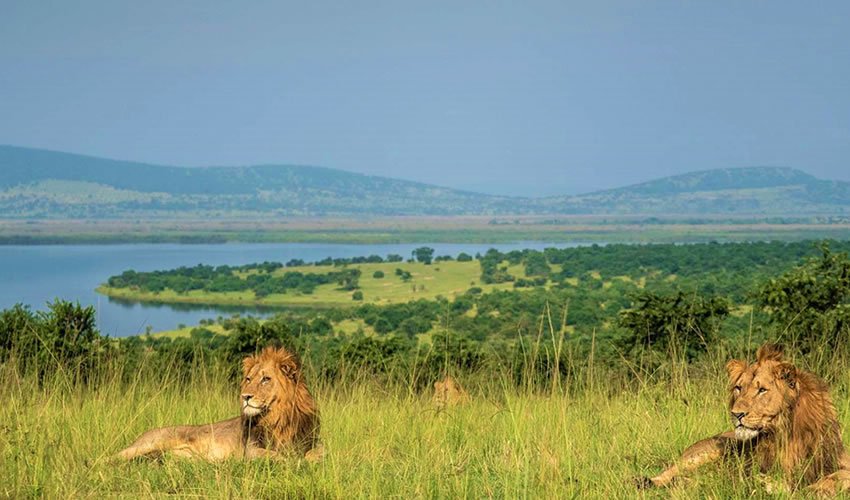
Two lions rest in the open grasslands of Akagera National Park, with the park’s lakes and rolling landscapes creating a spectacular Rwanda wildlife safari setting.
Lions are among the most exciting predators to search for during an Akagera wildlife safari. Their return to the park has played an important role in restoring the ecological character of Rwanda’s savannah ecosystem. Travellers may encounter lions resting in vegetation, moving across open country or interacting within their social groups. Early morning and later-day game drives can provide rewarding opportunities because wildlife activity often changes as temperatures rise and fall.
Lion sightings are never completely predictable, which is why experienced safari guiding is particularly valuable. Guides use knowledge of animal behaviour, previous sightings, tracks and habitat conditions when searching for predators. A full Rwanda Wildlife Guide should therefore explain that successful wildlife viewing is not simply about driving quickly through the park but about exploring habitats carefully and allowing enough time for natural encounters.
Elephants and Buffaloes in Akagera
African elephants are among Akagera’s most impressive large mammals. They may be encountered individually or in groups as they move between feeding areas, woodland, open plains and water sources. Watching elephants in Rwanda provides an important contrast to the country’s forest-based primate experiences and is one of the reasons travellers increasingly combine Akagera with Volcanoes National Park.
Cape buffaloes are another important member of Rwanda’s Big Five. They commonly inhabit grasslands, woodland edges and areas close to water. Herds can create excellent photographic opportunities, especially when encountered against Akagera’s rolling hills and open landscapes. Travellers who want a broader idea of species they may encounter can study the guide to animals in Akagera National Park before beginning their safari.
Rhinoceros and Leopard Sightings in Rwanda
Rhinoceros conservation has helped establish Akagera as a complete Big Five destination. Rhino sightings are particularly rewarding because these powerful animals represent one of the strongest examples of Rwanda’s broader wildlife restoration efforts. Depending on habitat conditions and animal movements, visitors may search for rhinos across suitable areas during guided game drives.
Leopards are generally more difficult to locate because of their secretive behaviour and ability to remain concealed in vegetation. This unpredictability often makes a leopard encounter one of the most memorable moments of an Akagera safari. Travellers interested in the broader conservation story behind the return and protection of major species can read about Akagera wildlife conservation, which has played a major role in rebuilding the park’s wildlife populations.
Wildlife Beyond the Big Five in Akagera National Park
Although the Big Five attract considerable attention, limiting an Akagera safari to these five animals would overlook much of the park’s biodiversity. Giraffes moving across open savannah, zebras grazing alongside antelopes and hippos resting in lakes all contribute to the overall wildlife experience. Impalas, topis, waterbucks, elands, warthogs and several smaller mammals may also be observed during game drives.
Primates add another dimension to Akagera’s wildlife. Baboons and monkeys may be encountered in suitable woodland and bush habitats, while smaller mammals become particularly interesting to travellers undertaking extended wildlife exploration. Anthill Safaris’ detailed guide to animals to see in Akagera provides a wider look at the species that share the park with the Big Five.
Game Drives in Akagera National Park
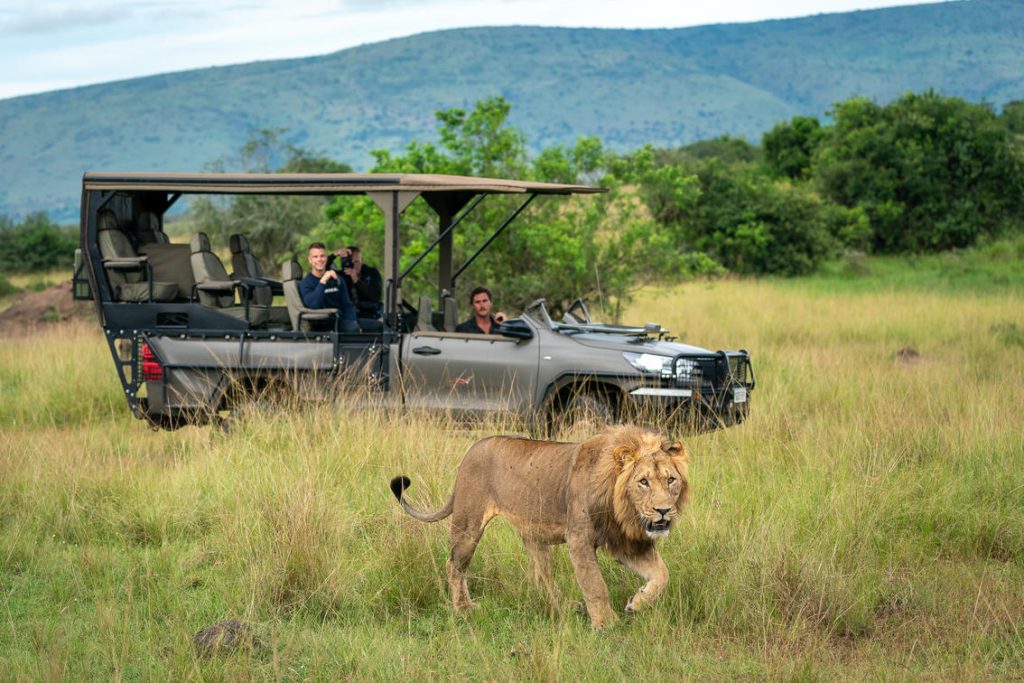
Travelers enjoy a close wildlife encounter with a male lion during an exciting game drive across the savannah of Akagera National Park.
Game drives are the primary wildlife-viewing activity in Akagera National Park. Safari vehicles travel through different ecological zones while guides search for animals and interpret the landscape. The experience changes throughout the park, with some areas characterized by woodland and bush while others open into broad plains where giraffes, zebras, buffaloes and antelopes may be easier to observe.
A longer game drive creates opportunities to explore more of the park and understand how wildlife distribution changes between habitats. Photographers can benefit from spending additional time around productive areas rather than rushing between sightings. Travellers who want enough time for both game viewing and a boat safari can consider a 3-day Akagera National Park safari, which provides a more complete introduction to Rwanda’s savannah wildlife.
Lake Ihema Boat Safaris and Aquatic Wildlife
Akagera is not exclusively a land-based wildlife destination. Its network of lakes and wetlands creates one of the most distinctive safari landscapes in Rwanda. Lake Ihema is especially important for boat-based wildlife viewing, allowing visitors to experience the park from the water rather than from a safari vehicle. Hippos are among the most characteristic aquatic mammals, while Nile crocodiles can also be observed around suitable shoreline habitats.
The lakes attract water-associated birds and other animals that come towards the shoreline to drink, feed or rest. This makes a boat safari a valuable complement to a game drive because it reveals another side of Akagera’s ecosystem. Travellers interested in understanding these habitats can explore the different lakes in Akagera National Park and their importance to the park’s wildlife.
Birdlife in Akagera National Park
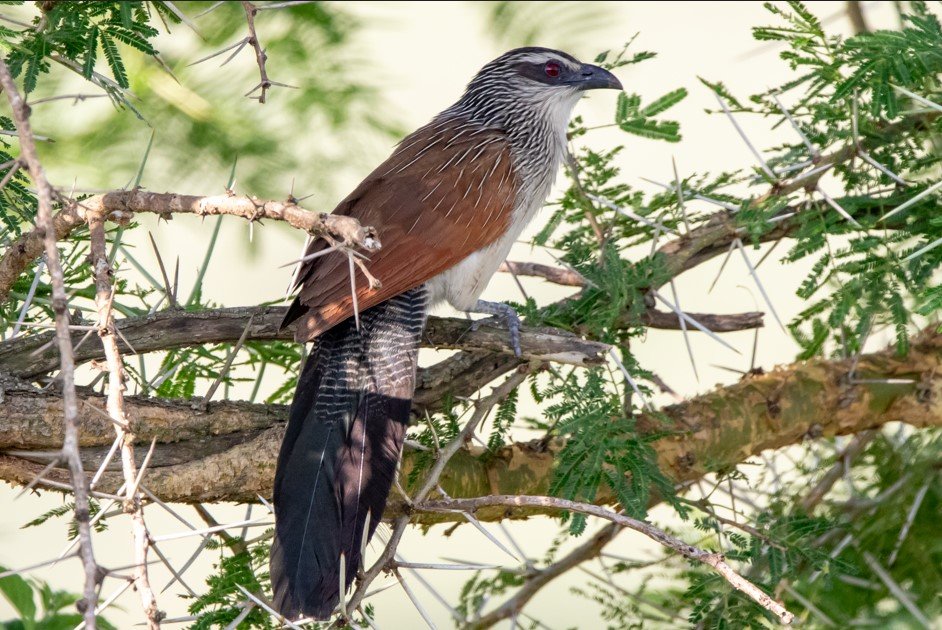
A striking bird perched among the trees of Akagera National Park, highlighting the park’s rich and diverse birdlife.
Birdwatching significantly increases the depth of an Akagera wildlife safari. Savannah, woodland, wetland and lake habitats create opportunities to observe a wide range of bird species within a relatively small geographical area. Raptors, waterbirds, kingfishers, herons, egrets and other species can be encountered depending on habitat and season. The papyrus wetlands are particularly valuable for travellers interested in specialized wetland birds.
Birdwatchers can combine game drives with boat excursions to explore different habitats during the same safari. Even travellers whose primary goal is seeing the Big Five often find that Akagera’s birds become an important part of the experience because many species are easily observed around water sources and open plains. This combination of mammals and birdlife makes Akagera suitable for both general wildlife travellers and specialist naturalists.
Day and Night Wildlife Experiences in Akagera
Wildlife activity changes considerably between daylight and darkness. Standard daytime game drives provide opportunities to search for the park’s large mammals across the savannah, while night experiences can reveal a different side of the ecosystem. Nocturnal wildlife tends to be more active after sunset, creating opportunities to search for species that may remain hidden during the warmer parts of the day.
Travellers interested in experiencing Akagera beyond a short daytime visit should consider spending at least one or two nights near or within the park. Choosing suitable accommodation helps reduce unnecessary travel and allows wildlife activities to be arranged more comfortably. Safari Vacations and Travel Services Ltd provides information on where to stay around Akagera, including accommodation considerations for different safari styles.
Best Time for Wildlife Viewing in Akagera National Park
Akagera can be visited throughout the year, although wildlife-viewing conditions change with seasonal rainfall, vegetation growth and the availability of water. Drier periods are often attractive for game viewing because vegetation can become less dense and animals may gather around dependable water sources. Wetter periods transform the landscape, bringing greener scenery and different photographic conditions.
The most suitable period therefore depends on whether the traveller prioritizes large-mammal viewing, birding, scenery, photography or overall safari conditions. Rather than choosing dates based only on general assumptions about Rwanda’s climate, travellers can compare seasonal conditions in this detailed guide to the best time to visit Akagera.
How Long Should You Spend in Akagera National Park?
The amount of time needed in Akagera depends on the traveller’s wider Rwanda itinerary. A short visit can introduce the park’s landscapes and wildlife, but spending two or three days generally creates more opportunities for varied game drives, photography and boat-based wildlife viewing. Longer stays are particularly useful for travellers who want to search for predators, explore different sections of the park and avoid treating the experience as a rushed excursion.
Akagera also combines naturally with Rwanda’s primate destinations. Travellers can begin with savannah wildlife before travelling towards Volcanoes National Park for mountain gorillas or continue through western Rwanda towards Nyungwe for chimpanzees. Safari travellers considering a broader route can explore how to approach Akagera, Volcanoes and Nyungwe within one Rwanda wildlife journey.
Why Akagera Is Essential to a Complete Rwanda Wildlife Guide
Akagera National Park completes Rwanda’s wildlife portfolio by providing the savannah experience that complements the country’s mountain and rainforest ecosystems. A traveller can search for lions, elephants, buffaloes, rhinos and leopards in Akagera before encountering mountain gorillas in Volcanoes National Park and chimpanzees in Nyungwe. Few Rwanda wildlife itineraries demonstrate the country’s ecological variety as clearly as this combination.
For travellers whose main priority is conventional African wildlife, Akagera deserves sufficient time rather than being treated simply as an addition to gorilla trekking. Its Big Five, plains game, aquatic wildlife, birds, predators, lakes and extensive landscapes make it one of Rwanda’s most important safari destinations. Anthill Safaris also explains why choose an Akagera safari, particularly for travellers looking to combine Rwanda’s famous primates with traditional game viewing.
Mountain Gorillas, Golden Monkeys and Wildlife in Volcanoes National Park
No Rwanda Wildlife Guide is complete without Volcanoes National Park, the country’s celebrated mountain wilderness and one of Africa’s most important primate destinations. Located in northwestern Rwanda within the greater Virunga Massif, the park protects bamboo forest, montane vegetation, volcanic slopes and high-altitude ecosystems that provide habitat for endangered mountain gorillas, golden monkeys, forest birds and other wildlife. Travellers preparing for this region can explore the complete Volcanoes National Park Guide to understand its wildlife, trekking experiences, landscapes and practical safari planning.
Volcanoes National Park offers a completely different Rwanda wildlife safari from the open savannah of Akagera National Park. Wildlife encounters here generally involve trekking through mountain forests rather than viewing animals from a safari vehicle. Mountain gorilla trekking remains the flagship experience, but golden monkey tracking, birdwatching, volcano hiking and conservation-related experiences give travellers several reasons to spend more than one day around the park. Those considering the country’s main primate experience can also explore the best option for gorilla trekking in Rwanda.
Mountain Gorillas in Volcanoes National Park
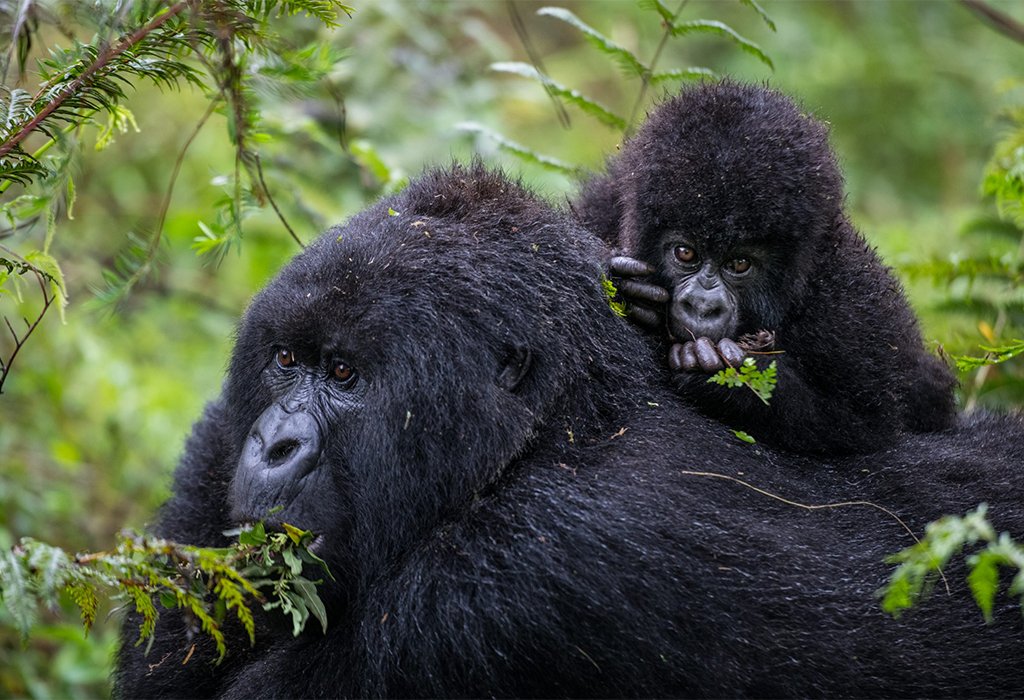
A young mountain gorilla rests on an adult’s back in the forests of Volcanoes National Park, highlighting Rwanda’s unforgettable gorilla trekking experience.
Mountain gorillas are the wildlife species most strongly associated with Volcanoes National Park. These endangered primates live in family groups across the forested slopes of the Virunga Mountains. A gorilla trek allows visitors to enter their natural habitat with trained guides and trackers before spending a regulated period observing a habituated gorilla family. Behaviour may include feeding, resting, grooming, interaction between adults and juveniles or movement through the surrounding vegetation.
The unpredictability of the forest is an important part of the experience. Gorillas move freely through their natural habitat, so trekking distances vary from one day to another. Some families may be located relatively close to accessible trails, while others may require a longer hike across uneven or elevated terrain. Travellers with limited time in Rwanda can study the structure of a one-day Volcanoes gorilla trek, although staying near the park before trekking normally creates a more relaxed wildlife experience.
Anthill Safaris also provides detailed information about gorilla trekking in Volcanoes National Park, including considerations surrounding permits, accommodation and the overall trekking experience.
Rwanda Gorilla Trekking Permits and Wildlife Access
Every traveller participating in mountain gorilla trekking in Rwanda requires an official gorilla trekking permit. Permits control visitor numbers and help regulate access to habituated gorilla families. Rwanda currently positions gorilla trekking as a high-value conservation experience, making permit planning one of the most important elements of a Volcanoes National Park wildlife safari. Travellers should therefore confirm availability before making other non-refundable arrangements. Safari Vacations and Travel Services Ltd provides more information about booking a Rwanda gorilla permit.
A trekking permit should not be confused with an ordinary entrance ticket for general sightseeing. It is linked to the controlled gorilla trekking experience and the date selected by the traveller. Because trekking groups are limited, permit availability can become restricted during popular travel periods. Early safari planning is particularly important for travellers with fixed international flights, honeymoon dates or other activities already scheduled around Rwanda.
What Happens During Rwanda Gorilla Trekking?
Gorilla trekking normally begins with registration and a briefing before visitors are allocated to trekking groups. Rangers explain forest procedures, responsible wildlife viewing and appropriate behaviour around mountain gorillas. Once trekking begins, visitors follow guides and trackers through the forest while searching for the assigned gorilla family. The duration of the search varies according to gorilla movements, terrain and forest conditions, so travellers should prepare for an active outdoor experience rather than expecting a fixed walking distance. More preparation details are available in the guide explaining how long gorilla trekking takes in Rwanda.
The encounter is most rewarding when visitors observe rather than attempt to influence natural gorilla behaviour. Mountain gorillas remain wild animals despite the habituation process that allows selected groups to tolerate controlled human presence. Following ranger instructions, maintaining appropriate distances and respecting photography regulations are essential elements of responsible Rwanda wildlife tourism.
Golden Monkey Trekking in Volcanoes National Park
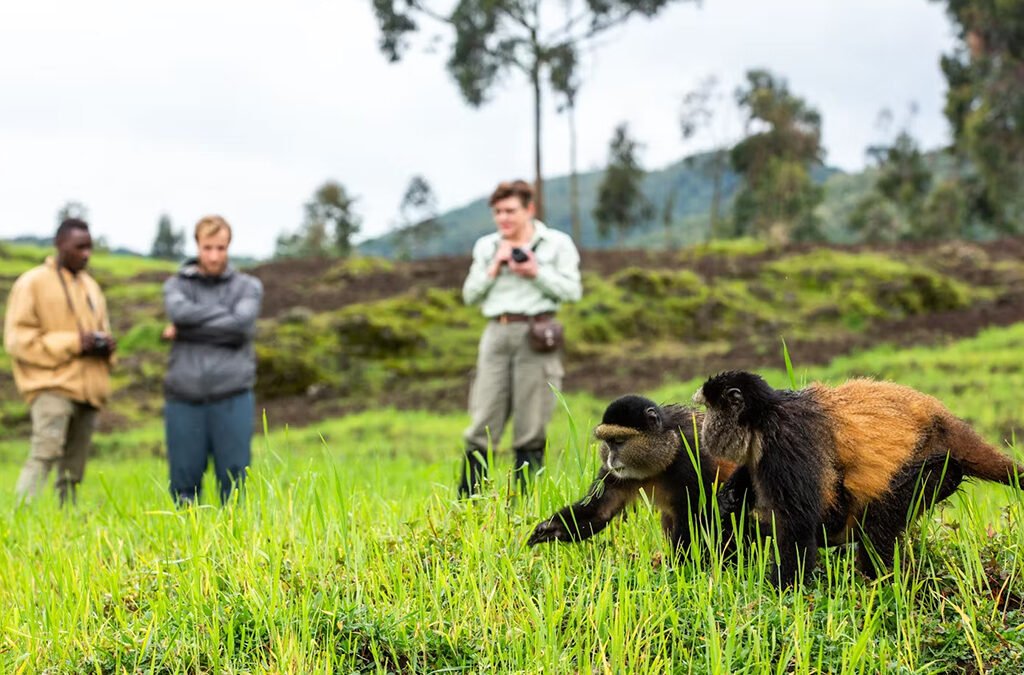
Travelers watch golden monkeys at close range during a guided trek in Volcanoes National Park, one of Rwanda’s most rewarding primate experiences.
Golden monkeys provide another distinctive primate experience within Volcanoes National Park. Their golden-orange colouring, energetic movement and preference for bamboo habitats create a wildlife encounter that differs significantly from gorilla trekking. Visitors often see the monkeys moving rapidly through vegetation, feeding and interacting socially, making the experience particularly interesting for wildlife photographers and travellers who want to observe different primate behaviours.
Volcanoes National Park is Rwanda’s destination for this activity, making Golden Monkey Trekking Rwanda an excellent addition to a wider Rwanda Wildlife Guide. The activity can often be scheduled on a separate day from gorilla trekking, allowing visitors to experience two endangered primates within the same protected landscape.
Travellers unfamiliar with the activity can also read about what to expect on a golden monkey trek. Anthill Safaris provides additional information about a golden monkey trekking safari in Volcanoes, including the forest environment in which these active primates are encountered.
Mountain Gorillas vs Golden Monkeys in Rwanda
Gorilla trekking and golden monkey tracking should be viewed as complementary rather than competing wildlife activities. Mountain gorillas are much larger, and encounters often involve quietly observing a family as individuals feed, rest and interact. Golden monkeys are smaller and generally much more active, frequently moving between bamboo stems and vegetation. This difference in behaviour creates two distinct wildlife photography and observation experiences.
Travellers who have enough time can schedule both activities on different days. Doing so provides a broader appreciation of Volcanoes National Park’s primate diversity while avoiding the need to choose only one wildlife encounter. Visitors comparing the experiences between destinations can explore this guide to golden monkey trekking in Rwanda and Uganda.
Other Wildlife in Volcanoes National Park
Mountain gorillas and golden monkeys dominate most discussions about Volcanoes National Park, but the protected ecosystem supports additional wildlife. Forest birds, small mammals and other species occupy different vegetation zones across the park. Wildlife sightings outside organised primate activities can be less predictable because dense vegetation makes forest animals harder to observe than species inhabiting Akagera’s open plains.
This distinction is important when planning a Rwanda wildlife safari. Volcanoes is primarily a forest and primate destination rather than a conventional game-driving park. Travellers interested in understanding its wider attractions can explore Volcanoes National Park wildlife activities, which extend beyond the mountain gorilla experience.
Birdwatching and Forest Biodiversity in Volcanoes
Birdwatching adds depth to a Volcanoes National Park wildlife experience, especially for travellers interested in the wider biodiversity of the Albertine Rift and Virunga landscapes. Different elevations, bamboo zones and mountain vegetation create habitats for numerous forest and highland birds. Combining birdwatching with primate trekking allows travellers to pay attention to smaller species that can otherwise be overlooked when the main objective is finding gorillas.
Serious birders may dedicate additional time to guided walks and forest-edge habitats, while general safari travellers can observe birds naturally during trekking and other park activities. The mixture of endangered primates, birds, mountain vegetation and volcanic scenery helps distinguish Volcanoes from Rwanda’s savannah wildlife destinations.
Volcano Hiking and the Virunga Landscape
The volcanic scenery surrounding the park is part of what makes wildlife exploration in northern Rwanda so distinctive. The Virunga landscape contains dramatic peaks and high-altitude vegetation that create an impressive backdrop to primate trekking. Hiking experiences can be incorporated for travellers interested in exploring the mountain environment beyond wildlife encounters.
Volcano hiking requires a different level of physical preparation from ordinary wildlife viewing and should be planned according to fitness, weather and available travel days. It can nevertheless add valuable variety to a Rwanda wildlife itinerary by combining primate encounters with mountain landscapes and active exploration.
Combining Volcanoes National Park Wildlife Experiences
Travellers spending several nights around Volcanoes National Park can create a varied itinerary instead of completing only a single gorilla trek. One day may focus on mountain gorillas, another on golden monkeys, while additional time can include hiking, birding or surrounding cultural and nature experiences. Anthill Safaris outlines several possibilities among the safari activities in Volcanoes National Park.
This approach is especially useful for travellers building a complete Rwanda wildlife safari. Volcanoes can be combined with Akagera National Park for Big Five game viewing and Nyungwe National Park for chimpanzees and other forest primates. The result is a wildlife itinerary that progresses from savannah animals to mountain gorillas, golden monkeys and rainforest species while showcasing several of Rwanda’s most important ecosystems.
Reaching Volcanoes National Park from Kigali
Volcanoes National Park is commonly reached by road from Kigali through Rwanda’s scenic northern highlands towards Musanze and Kinigi. Its road accessibility makes the park relatively straightforward to incorporate into a Rwanda wildlife itinerary after arrival in Kigali or after visiting Akagera National Park. Travellers planning this route can review information about gorilla trekking from Kigali before deciding how many nights to spend near the park.
Although short trips are possible, spending additional nights near Volcanoes National Park creates more flexibility for gorilla trekking, golden monkey tracking and other wildlife activities. It also reduces unnecessary long-distance road travel on trekking mornings and allows visitors to experience the landscapes surrounding the Virunga Mountains at a more comfortable pace.
Why Volcanoes National Park Is Essential to a Rwanda Wildlife Guide
Volcanoes National Park represents the mountain and primate side of Rwanda’s wildlife diversity. Akagera may provide lions, elephants, rhinos, buffaloes and savannah wildlife, but Volcanoes introduces travellers to an entirely different ecosystem where wildlife experiences depend on trekking through forests and volcanic landscapes. Mountain gorillas remain the headline attraction, yet golden monkeys, birds and the broader forest environment make the destination more diverse than a single-species safari.
Including Volcanoes National Park in a Rwanda Wildlife Guide therefore allows travellers to understand why Rwanda can combine conventional African wildlife safaris with some of the continent’s most remarkable primate encounters. When Volcanoes is linked with Akagera and Nyungwe, the resulting journey covers savannah wildlife, mountain gorillas, golden monkeys, chimpanzees, birds and several dramatically different natural landscapes within one Rwanda safari.
Chimpanzees and Primate Wildlife in Nyungwe and Gishwati-Mukura
Chimpanzees form an essential part of a complete Rwanda Wildlife Guide, giving travellers an opportunity to experience Rwanda’s rainforest wildlife beyond mountain gorillas and savannah animals. Nyungwe National Park in southwestern Rwanda is the country’s best-known chimpanzee trekking destination, while Gishwati-Mukura National Park provides another important forest habitat for chimpanzees and several monkey species. These protected forests add extraordinary primate diversity to a Rwanda wildlife safari and can be combined with Volcanoes National Park and Akagera National Park for a journey covering gorillas, chimpanzees, monkeys and Big Five wildlife. Travellers beginning their research can explore this detailed guide to Nyungwe Forest National Park and its rainforest wildlife experiences.
Unlike traditional game drives, chimpanzee and primate experiences involve exploring dense forest environments on foot with knowledgeable guides. Visitors listen for chimpanzee calls, movement through the canopy and other signs that help trackers locate primate groups. The forest itself becomes an important part of the safari, with towering trees, ferns, streams, birds, butterflies and other wildlife contributing to the experience. Nyungwe is particularly valuable because travellers can combine chimpanzee tracking with other nature activities without leaving the same protected forest.
Chimpanzee Trekking in Nyungwe National Park
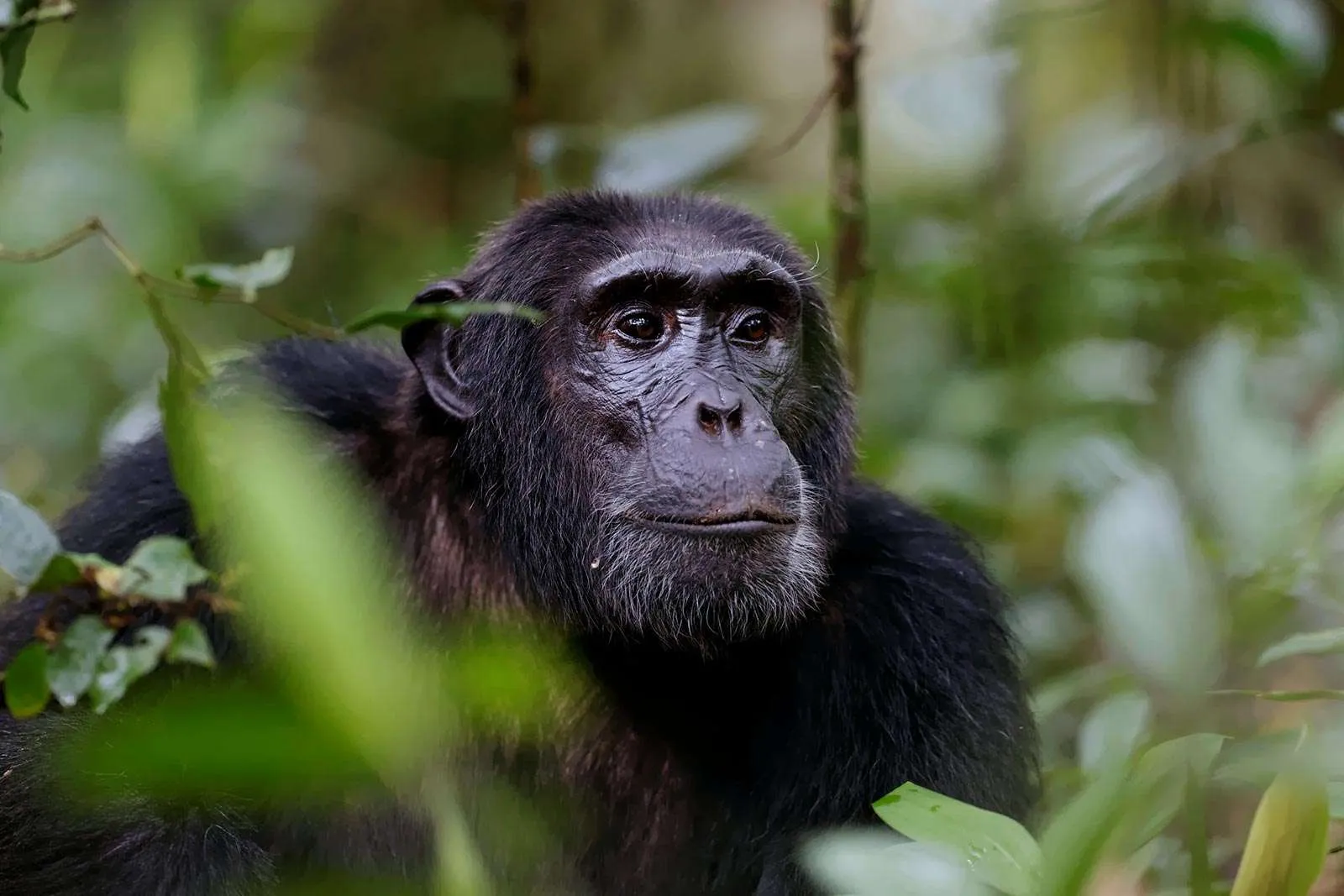
A chimpanzee rests within the lush rainforest of Nyungwe National Park, one of Rwanda’s premier destinations for primate trekking and wildlife encounters.
Chimpanzee trekking is one of the leading wildlife activities in Nyungwe National Park. Trekkers enter the forest accompanied by experienced guides who follow signs, sounds and known chimpanzee movements in search of habituated groups. Chimpanzees are extremely active primates and may travel quickly through the forest, climb high into trees, feed, vocalise or interact with other members of their community. Visitors preparing for the experience should understand the terrain and physical demands explained in this guide about chimpanzee trekking in Nyungwe.
Every trek is different because chimpanzees move naturally through their habitat. Some encounters require longer walks, while others may involve locating a group relatively quickly. Forest conditions, rainfall, terrain and chimpanzee movements can influence the difficulty of a trekking day. Travellers concerned about fitness or walking conditions can review information explaining how difficult chimpanzee trekking in Nyungwe can be.
Anthill Safaris also provides additional information about chimpanzee trekking in Nyungwe Forest, including the nature of the trekking experience and considerations travellers should understand when preparing for a primate safari.
What to Expect During a Nyungwe Chimpanzee Safari
A Nyungwe chimpanzee safari is more active than conventional wildlife viewing from a vehicle. Chimpanzees may move rapidly through the canopy and forest floor, requiring visitors to follow guides through uneven rainforest terrain. Once a group is located, travellers may observe feeding, grooming, resting, communication and social interactions. Vocal calls travelling through the forest often make chimpanzee tracking particularly atmospheric.
Proper clothing and footwear are important because rainforest trails may be steep, muddy or slippery. Long trousers, suitable walking shoes, rain protection and a comfortable daypack can improve the experience. Travellers wanting a deeper understanding of preparation, tracking areas and the nature of the activity can use the Nyungwe chimpanzee trekking guide when organizing their Rwanda wildlife safari.
Colobus Monkeys and Other Primates in Nyungwe
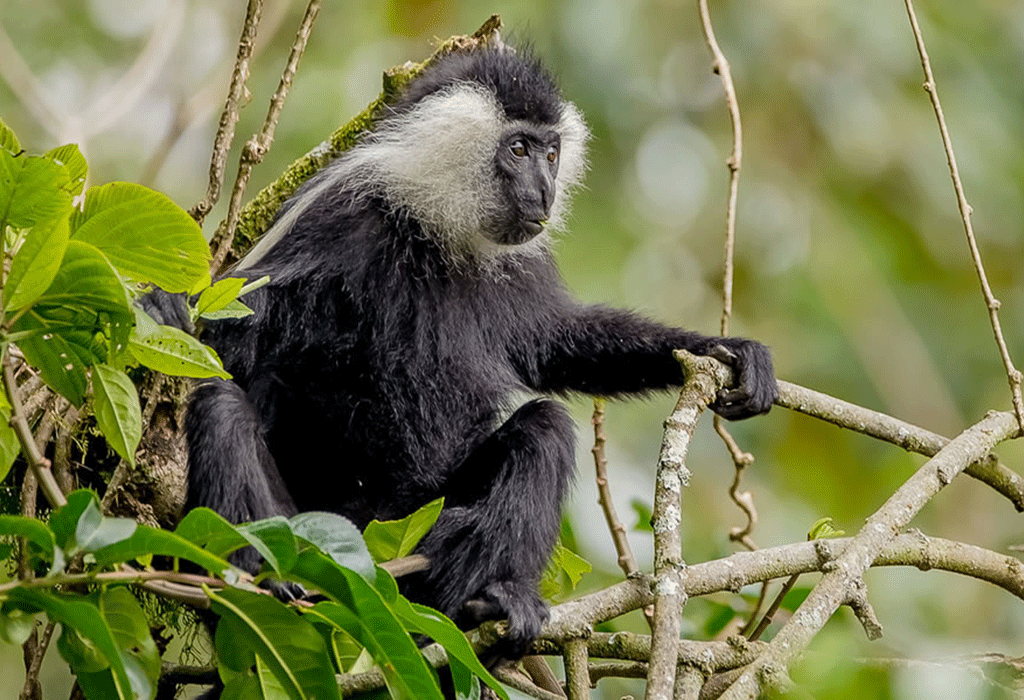
A black and white colobus monkey rests among the trees of Nyungwe National Park, highlighting Rwanda’s exceptional primate diversity.
Chimpanzees are not the only primates that make Nyungwe important to a Rwanda Wildlife Guide. The forest supports an impressive variety of monkeys, and travellers may encounter species such as black-and-white colobus monkeys, L’Hoest’s monkeys, blue monkeys, olive baboons and other forest primates depending on location and luck. Colobus monkey tracking is especially interesting because groups can be highly social and may contain numerous individuals moving together through the forest.
Combining chimpanzee trekking with additional primate experiences creates a more complete understanding of Nyungwe’s biodiversity. Instead of visiting the park only to locate chimpanzees and immediately departing, spending several days provides opportunities for primate tracking, forest walks and canopy exploration. The 3-day Nyungwe chimpanzee and canopy safari provides an example of how several rainforest experiences can be combined within one itinerary.
The Nyungwe Canopy and Rainforest Wildlife Experience
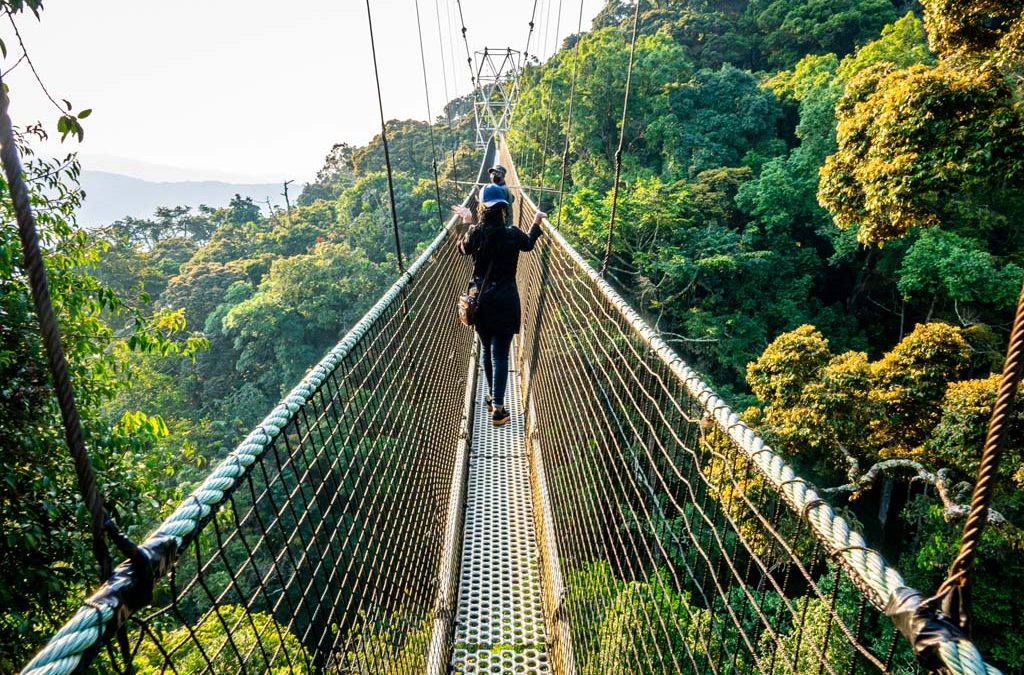
Travelers cross the famous canopy walkway high above Nyungwe’s rainforest, enjoying sweeping forest views and a unique perspective on Rwanda’s biodiversity.
Nyungwe’s wildlife experience extends beyond primate tracking. Exploring the forest canopy creates a different perspective of the rainforest and surrounding hills, while guided nature walks provide opportunities to observe birds, vegetation, butterflies and smaller wildlife that may otherwise be missed. These activities are valuable for travellers interested in biodiversity rather than focusing exclusively on large mammals.
Spending multiple nights near the forest also reduces unnecessary travel and provides more flexibility for scheduled activities. Accommodation options range across different comfort levels, and location can influence access to particular areas of the park. Travellers planning several wildlife activities can compare the best places to stay around Nyungwe when building their itinerary.
Night Wildlife Experiences in Nyungwe Forest
Forest wildlife changes considerably after daylight, creating opportunities to understand another side of Nyungwe’s ecosystem. Guided evening and night experiences can introduce travellers to sounds and wildlife behaviour that differ from daytime chimpanzee trekking. Nocturnal walks are particularly interesting for visitors who enjoy smaller mammals, insects, amphibians and the atmosphere of an African rainforest after dark.
These experiences can complement daytime primate tracking and help travellers appreciate the forest as a complete ecosystem rather than simply a chimpanzee destination. Additional information about the experience is available in this guide to night walks in Nyungwe Forest.
Chimpanzee Habituation and Primate Behaviour
Understanding habituation helps travellers appreciate why certain chimpanzee communities can be visited under controlled conditions. Habituation gradually familiarises wild chimpanzees with carefully managed human presence while allowing researchers, conservationists and guides to study natural behaviour. Observing chimpanzees within a forest environment can reveal complex social relationships, communication, feeding patterns and interactions between individuals.
Travellers interested in spending more time understanding primate behaviour can read about chimpanzee habituation in Nyungwe. Experiences and availability should always be confirmed during safari planning because park activities and access conditions can change.
Gishwati-Mukura National Park Primate Wildlife
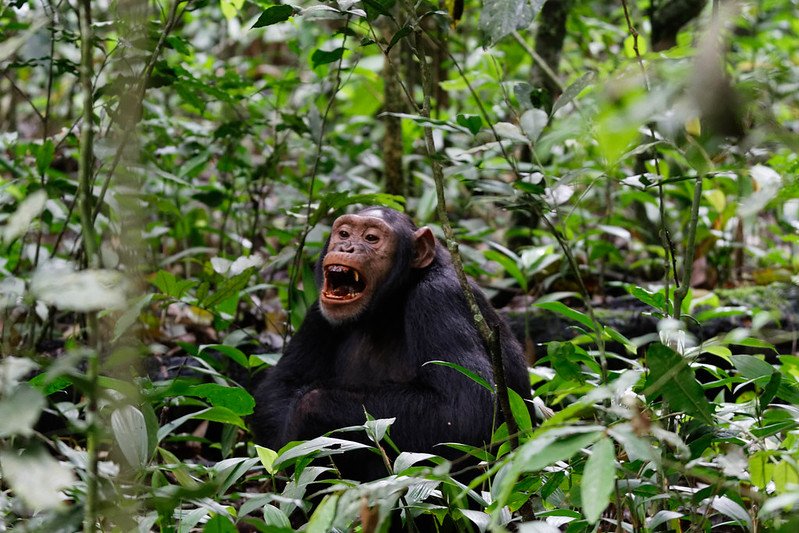
A chimpanzee in the lush forests of Gishwati-Mukura National Park, highlighting Rwanda’s lesser-known primate and rainforest wildlife experiences.
Gishwati-Mukura National Park adds another valuable dimension to Rwanda’s primate tourism. Located in western Rwanda, the park protects recovering montane forest habitats and provides a quieter environment for travellers interested in chimpanzees, monkeys, birds and forest conservation. Compared with Nyungwe, Gishwati-Mukura receives considerably less attention from mainstream Rwanda safari itineraries, which can make it appealing to experienced wildlife travellers looking beyond the country’s most famous destinations.
The protected landscape supports chimpanzees alongside other primates, including monkeys associated with Rwanda’s highland forests. Its conservation story is also significant because forest restoration and habitat protection remain central to the long-term survival of wildlife in the area. A detailed introduction to Gishwati-Mukura National Park provides further information about its wildlife and forest environment.
Travellers researching the park from another perspective can also explore Anthill Safaris’ overview of Gishwati-Mukura National Park and its combination of primate tracking, birdwatching, forest exploration and conservation experiences.
Chimpanzees and Monkeys in Gishwati-Mukura
Chimpanzees are among the most important wildlife species associated with Gishwati-Mukura, but the forest also provides habitat for several monkey species. This makes the park relevant to travellers creating a specialized Rwanda primate safari that goes beyond the better-known gorilla and chimpanzee destinations. Primate encounters can be complemented by birdwatching and guided forest exploration, creating a quieter nature experience focused on biodiversity.
Visitors should approach Gishwati-Mukura differently from Nyungwe because tourism infrastructure, wildlife habituation and available activities may not be identical between the two parks. Safari planning should therefore be based on current park conditions rather than assuming every Nyungwe experience can be duplicated in Gishwati. Travellers can explore the main Gishwati-Mukura tourist attractions when deciding whether the park fits their Rwanda wildlife itinerary.
Nyungwe vs Gishwati-Mukura for Primate Safaris
Nyungwe remains the more established destination for travellers whose primary goal is a Rwanda chimpanzee trekking safari. Its extensive rainforest, established trekking experiences and combination of chimpanzees, colobus monkeys, canopy exploration and birding make it suitable for first-time primate travellers. Gishwati-Mukura provides a different experience centred on a smaller restored forest landscape and is particularly attractive to visitors interested in emerging conservation destinations.
Rather than treating the two parks as competitors, travellers can view them as complementary examples of Rwanda’s forest conservation and primate diversity. Anthill Safaris’ guide to the top primate destinations in Rwanda further demonstrates how Rwanda’s chimpanzees, monkeys and mountain gorillas are distributed across several protected landscapes.
Combining Rwanda Chimpanzees With Gorillas and Big Five Wildlife
One of the strongest Rwanda wildlife itineraries combines chimpanzees in Nyungwe with mountain gorillas in Volcanoes National Park and Big Five game viewing in Akagera. This creates three dramatically different wildlife environments within the same journey. Travellers move from rainforest chimpanzees to the volcanic habitat of mountain gorillas before or after experiencing Rwanda’s savannah mammals.
Adding Gishwati-Mukura can deepen the experience for travellers with additional time or a specific interest in primate conservation. This combination demonstrates why a Rwanda Wildlife Guide should not focus on one famous species alone. Chimpanzees, colobus monkeys, golden monkeys, mountain gorillas, forest birds and savannah wildlife together make Rwanda suitable for both first-time African safari travellers and experienced wildlife enthusiasts.
Wildlife Animals in Rwanda: Mammals, Predators, Primates and Rare Species
Wildlife animals in Rwanda range from powerful African predators and large savannah mammals to endangered mountain gorillas, chimpanzees, golden monkeys, antelopes, aquatic wildlife and colourful forest birds. This diversity makes Rwanda Wildlife Guide research particularly interesting because visitors can experience several completely different ecosystems within one relatively compact destination. Akagera National Park protects Rwanda’s major savannah wildlife, Volcanoes National Park is famous for mountain gorillas and golden monkeys, while Nyungwe and Gishwati-Mukura protect important rainforest and primate habitats. Travellers researching the country can use this comprehensive Rwanda Travel Guide to understand how wildlife experiences fit into a wider Rwanda safari.
Unlike destinations known primarily for conventional game drives, Rwanda allows travellers to move between open savannah, wetlands, mountain forests and tropical rainforest environments. This means a single Rwanda wildlife safari can include elephants and lions in Akagera, mountain gorillas in Volcanoes, chimpanzees in Nyungwe and smaller forest primates in Gishwati-Mukura. Understanding the major wildlife groups helps visitors decide which national parks deserve the most time during their journey.
Big Five Animals in Rwanda
Rwanda is a Big Five safari destination, with Akagera National Park providing opportunities to search for lions, leopards, elephants, buffaloes and rhinoceroses. These animals represent the traditional Big Five associated with African safari travel and have helped establish Akagera as Rwanda’s main destination for vehicle-based wildlife viewing. Visitors researching these species can explore whether and where it is possible to see the Big Five in Rwanda.
Wildlife sightings remain natural and cannot be guaranteed because animals move freely across the park. Elephants and buffaloes can sometimes be encountered in open areas or near water, while predators such as lions and leopards require patient searching. Rhinos add another important conservation element to the Akagera experience. Travellers who want additional time to search for these animals can learn about the Big Five safari experiences in Akagera.
Lions, Leopards and Other Predators in Rwanda
Predators are among the most exciting wildlife animals to encounter during a Rwanda safari. Lions and leopards occupy the top of Akagera’s predator hierarchy, although their behaviour and visibility differ considerably. Lions may sometimes be found resting in grasslands, moving between territories or interacting with members of their pride, while leopards are secretive and often more difficult to locate because they can remain concealed within vegetation.
Other carnivores and nocturnal species also contribute to Akagera’s ecological diversity. Their presence demonstrates why travellers should look beyond only the most famous Big Five species. Patient game viewing can reveal wildlife that may be missed during a rushed safari. Safari Vacations and Travel Services Ltd’s guide to animals in Akagera National Park provides a wider overview of mammals travellers may encounter.
Travellers wanting another perspective on Rwanda’s different wildlife groups can also explore Anthill Safaris’ guide to a wildlife safari in Rwanda, which covers both Akagera’s savannah animals and Rwanda’s important primate destinations.
Elephants, Giraffes and Large Savannah Mammals
African elephants are among the largest and most impressive wildlife animals found in Rwanda. Akagera provides their primary protected savannah habitat within the country, where elephants can move between woodland, grassland and areas associated with water. Their size, family behaviour and constant movement make them particularly rewarding subjects for wildlife observation and photography.
Giraffes provide another unmistakable sight across Akagera’s open landscapes. Their height makes them relatively easy to recognize from a distance, especially when they move through acacia woodland or open plains. Buffaloes, zebras and several species of antelope add further variety, producing the classic East African savannah scenes many visitors expect from a Rwanda wildlife safari.
Zebras, Antelopes and Plains Wildlife in Rwanda
Plains wildlife forms an important part of the Akagera ecosystem even though these animals receive less attention than lions, rhinos and elephants. Zebras are among the park’s most recognizable grazing mammals, while impalas, topis, waterbucks, bushbucks and other antelope species occupy different habitats. Warthogs are another common feature of savannah wildlife viewing and may be observed feeding in open areas.
Watching these animals also helps visitors understand predator-prey relationships within Akagera. Antelopes and other herbivores form essential parts of the food web and influence how predators move through the landscape. A Rwanda Wildlife Guide should therefore give equal attention to the broader ecosystem instead of presenting wildlife viewing simply as a search for five famous animals.
Mountain Gorillas: Rwanda’s Most Famous Wildlife Species
Mountain gorillas are the animals most internationally associated with Rwanda. They inhabit the forested Virunga Mountains of Volcanoes National Park, where regulated trekking gives visitors an opportunity to observe habituated gorilla families in their natural environment. Their social behaviour, family relationships and imposing physical presence make gorilla trekking fundamentally different from wildlife viewing during an Akagera game drive.
Mountain gorillas are also central to Rwanda’s conservation and wildlife tourism identity. Travellers should therefore consider a gorilla encounter as part of the country’s wider biodiversity rather than treating it separately from a Rwanda wildlife safari. Anthill Safaris provides further information about the animals Rwanda is known for, including mountain gorillas and other prominent wildlife species.
Golden Monkeys in Rwanda
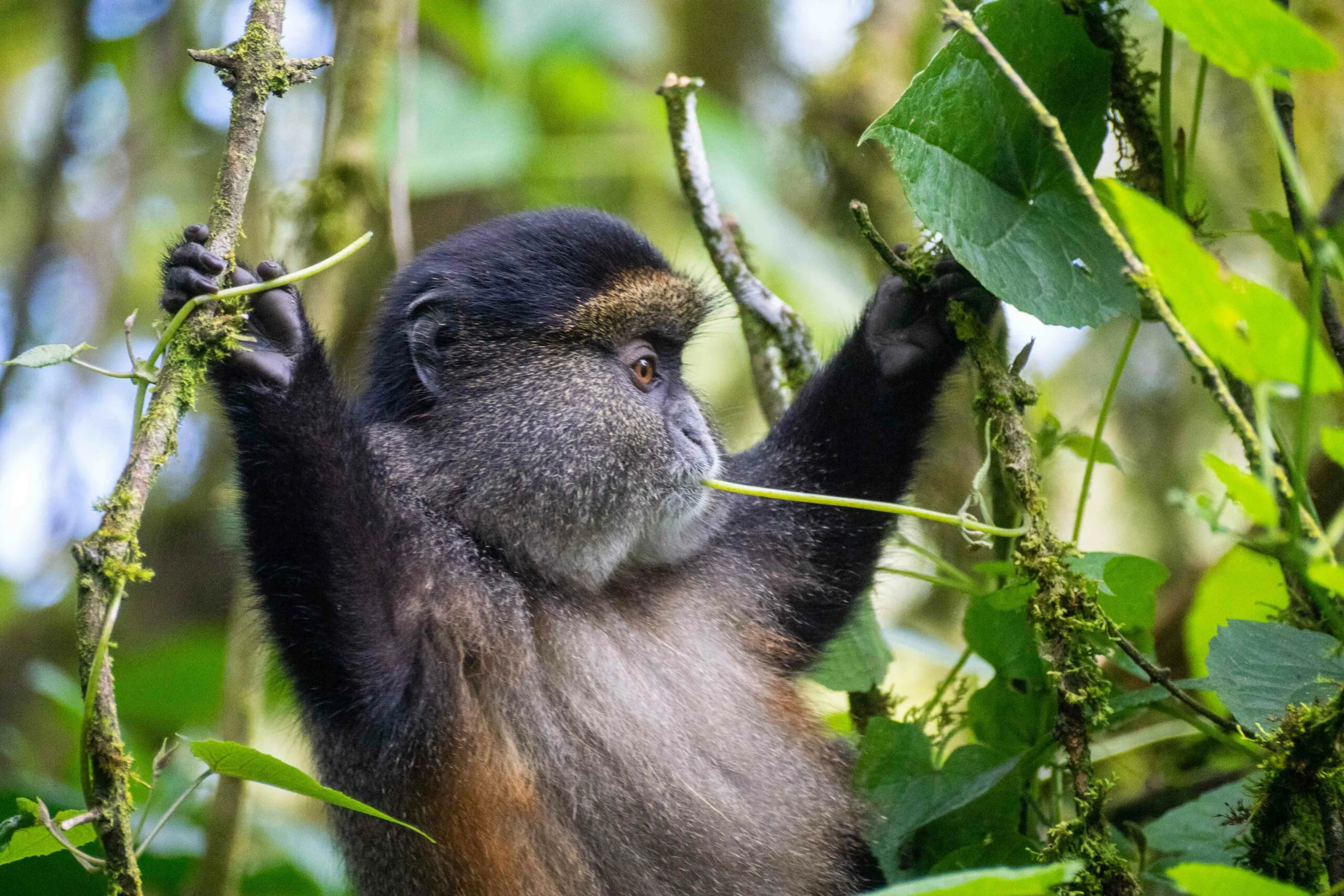
A golden monkey moves through Rwanda’s lush montane forest, highlighting one of the country’s most rewarding primate wildlife experiences.
Golden monkeys are another important primate found within Rwanda’s volcanic mountain environment. Their distinctive golden-orange fur and energetic behaviour make them particularly attractive to photographers and primate enthusiasts. They live within bamboo-rich habitats of Volcanoes National Park and provide an excellent second wildlife activity for visitors already travelling to the area for mountain gorillas.
Golden monkey tracking normally involves following active troops through the forest while observing feeding, movement and social interactions. Their behaviour can be fast-paced compared with mountain gorillas, creating a very different primate experience. Travellers can study the detailed Golden Monkey Trekking Rwanda guide when preparing for this wildlife encounter.
Chimpanzees and Forest Primates in Rwanda
Chimpanzees provide another major primate experience and are most strongly associated with Nyungwe National Park. Their social intelligence, vocal communication and highly active movements make chimpanzee trekking one of Rwanda’s most fascinating forest wildlife activities. Instead of remaining in one area, chimpanzees can travel quickly through the forest, sometimes requiring trackers and visitors to follow their movements across challenging terrain.
Nyungwe also protects several monkey species, giving visitors opportunities to encounter primates beyond chimpanzees. Black-and-white colobus monkeys and other forest monkeys contribute to the exceptional biodiversity of this protected area. Travellers interested in Rwanda’s rainforest wildlife can explore Nyungwe Forest National Park before deciding how many days to dedicate to primate trekking.
Primates and Smaller Wildlife in Gishwati-Mukura
Gishwati-Mukura National Park extends Rwanda’s primate wildlife beyond Volcanoes and Nyungwe. Its forest landscape provides habitat for chimpanzees, monkeys, birds and smaller wildlife while representing an important area of forest restoration and conservation. The park is especially suitable for travellers who have already experienced Rwanda’s better-known destinations and want to explore another part of the country’s natural heritage.
Visitors interested in primates, conservation and quieter forest exploration can read more about Gishwati-Mukura National Park wildlife. The park demonstrates that Rwanda’s primate diversity is distributed across several protected forests rather than concentrated entirely within Volcanoes and Nyungwe.
Hippos, Crocodiles and Aquatic Wildlife
Rwanda wildlife is not limited to animals living on open plains or inside forests. Akagera’s lakes and wetland systems support important aquatic species, particularly hippopotamuses and Nile crocodiles. Boat safaris provide an opportunity to observe this wildlife from the water while also viewing birds and occasionally other mammals approaching the shoreline.
Hippos spend much of the day associated with water and can often be located in suitable lake habitats, while crocodiles may be seen resting along banks or moving through the water. These encounters create valuable diversity within an Akagera itinerary because travellers can combine a land-based game drive with a completely different aquatic wildlife experience.
Birds and Smaller Wildlife Species in Rwanda
Birds are an essential part of Rwanda’s biodiversity and occur across savannah, wetlands, forests, agricultural landscapes and mountain habitats. Akagera provides excellent opportunities for savannah and wetland birding, while Nyungwe, Volcanoes and Gishwati-Mukura attract visitors interested in forest and Albertine Rift species. Travellers planning specialist birding can explore this detailed introduction to birdwatching in Rwanda.
Paying attention to smaller wildlife makes a Rwanda safari significantly richer. Butterflies, reptiles, amphibians, insects and smaller mammals all contribute to the functioning of Rwanda’s protected ecosystems. Specialist guides can help visitors recognize species that are easily overlooked when attention is focused exclusively on gorillas or the Big Five.
Rare and Endangered Wildlife in Rwanda
Some of Rwanda’s most sought-after wildlife experiences involve species requiring significant conservation protection. Mountain gorillas and golden monkeys are strongly associated with the Virunga mountain ecosystem, while chimpanzees depend on the continued protection of Rwanda’s remaining forest habitats. Rhinoceros conservation in Akagera has also contributed to restoring the country’s position as a Big Five safari destination.
Responsible tourism plays an important role in supporting protected landscapes when wildlife activities are carefully regulated. Visitors searching specifically for conservation-focused experiences can review Anthill Safaris’ guide to endangered wildlife in Rwanda and the protected areas where different species can be encountered.
Where to See the Different Wildlife Animals in Rwanda
Choosing the correct destination is essential because Rwanda’s wildlife is divided among very different habitats. Akagera is the priority for lions, leopards, elephants, buffaloes, rhinos, giraffes, zebras, antelopes, hippos and crocodiles. Volcanoes National Park is the country’s leading destination for mountain gorillas and golden monkeys. Nyungwe is particularly important for chimpanzees and rainforest primates, while Gishwati-Mukura adds another valuable forest wildlife destination.
Travellers wanting an overview of how these protected areas differ can explore the country’s Rwanda national parks. Understanding these ecological differences prevents unrealistic expectations and makes it easier to create a safari based on the wildlife species a traveller most wants to see.
Combining Rwanda’s Major Wildlife Species in One Safari
A well-designed Rwanda wildlife safari can combine many of the country’s flagship animals within one journey. Akagera can provide the Big Five and savannah wildlife before the itinerary continues to Volcanoes for mountain gorillas and golden monkeys. Nyungwe can then add chimpanzees and other rainforest primates, creating an exceptional contrast between vehicle-based game viewing and guided forest trekking.
Longer wildlife journeys can also incorporate birdwatching, Gishwati-Mukura and scenic destinations between the national parks. Travellers interested in combining several premium wildlife regions can study the structure of a Rwanda luxury wildlife safari. This multi-ecosystem approach is what makes a complete Rwanda Wildlife Guide valuable: Rwanda should not be viewed only as a gorilla destination, but as a country where savannah mammals, predators, primates, aquatic wildlife and rare species can form part of one diverse safari experience.
Birdwatching in Rwanda and the Best Rwanda Birding Destinations
Birdwatching is an important part of a complete Rwanda Wildlife Guide because the country’s compact landscapes contain an exceptional variety of bird habitats. Travellers can move between savannah grasslands, papyrus wetlands, lakes, montane rainforest, bamboo forest and high-altitude environments within one Rwanda birding safari. Akagera National Park, Nyungwe National Park, Volcanoes National Park and Gishwati-Mukura National Park provide particularly rewarding birding opportunities, while wetlands and natural areas outside the national parks add further diversity. Visitors beginning their research can explore this detailed guide to birdwatching in Rwanda before deciding which habitats and bird species to prioritize.
Rwanda is especially attractive to birdwatchers because a birding itinerary can easily be combined with other wildlife experiences. Travellers can search for savannah birds while watching elephants and giraffes in Akagera, look for forest species around Nyungwe while undertaking chimpanzee trekking, or combine birding in Volcanoes National Park with mountain gorilla and golden monkey experiences. This flexibility makes Rwanda suitable for specialist birders as well as general wildlife travellers who want birds to form part of a broader safari. Safari Vacations and Travel Services Ltd provides additional information on the best birding sites in Rwanda.
Why Rwanda Is an Excellent Birdwatching Destination
Rwanda’s birding strength comes from the variety of ecosystems found across a relatively small country. Eastern Rwanda contains savannah, wetlands and lakes, while western and northern regions rise into highland forests and volcanic landscapes. Each habitat attracts different bird communities, allowing birdwatchers to build a diverse species list without travelling enormous distances between destinations.
Specialist birders are particularly interested in Rwanda because parts of the country lie within the Albertine Rift, an important region for restricted-range and forest bird species. Nyungwe and Volcanoes National Parks are especially valuable for travellers interested in Albertine Rift birds, while Akagera provides an entirely different selection of savannah and wetland species. A broader introduction to these opportunities is available in this guide to birding in Rwanda.
Anthill Safaris also provides an overview of a birdwatching safari in Rwanda, including the country’s major birding environments and national parks.
Birdwatching in Akagera National Park
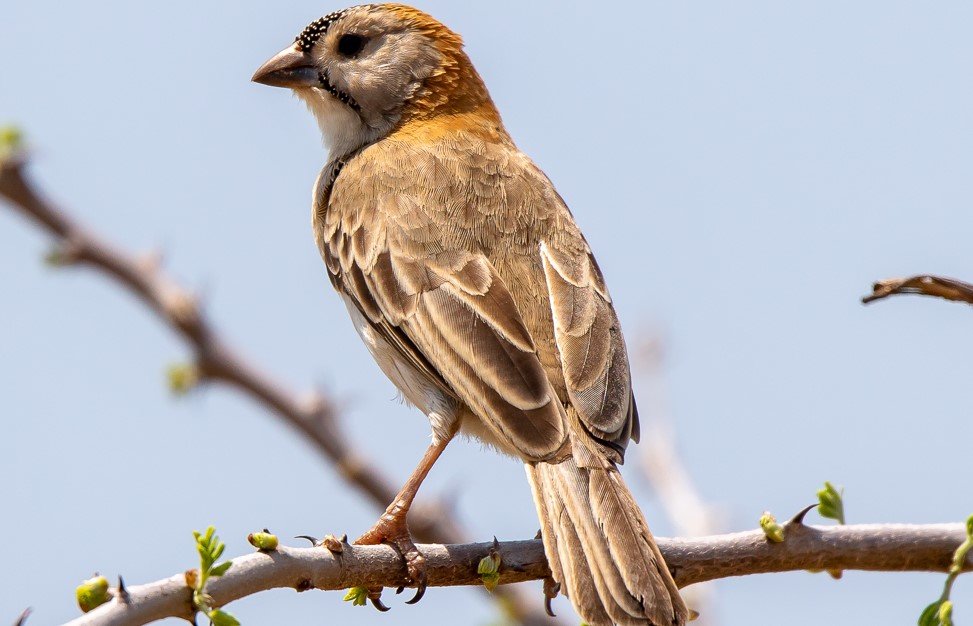
A small bird rests on a branch in Akagera National Park, highlighting the diverse birdlife that makes the park a rewarding destination for birdwatching in Rwanda.
Akagera National Park is one of Rwanda’s most rewarding birding destinations because it contains an extraordinary mixture of savannah, woodland, lakes, wetlands and papyrus habitats. These ecosystems support hundreds of bird species and allow birdwatchers to search for waterbirds, raptors, savannah specialists and wetland species while also enjoying conventional game viewing. Travellers can therefore combine birding with sightings of zebras, giraffes, antelopes, buffaloes, elephants and other mammals.
Akagera’s extensive wetland system is particularly important. Lakes and papyrus areas attract kingfishers, herons, egrets, African fish eagles and many other water-associated birds. Patient birders may also search for more specialized wetland species in suitable habitats. Visitors wanting to understand how birding fits among the park’s broader attractions can explore what Akagera National Park is known for.
Combining Akagera Birding With Game Drives
One of the advantages of birdwatching in Akagera is that visitors do not necessarily need to separate birding from their wider wildlife safari. Many species can be observed during regular game drives, particularly when travelling slowly through different habitats with a knowledgeable guide. Stopping around woodland, open plains and wetland edges creates opportunities to observe both birds and mammals during the same excursion.
A boat safari can expand the birding experience by providing access to lake and shoreline habitats that are difficult to observe from a vehicle. Travellers interested in combining these experiences can read about the different activities in Akagera National Park, including wildlife viewing and water-based exploration.
Birdwatching in Nyungwe National Park
Nyungwe National Park is one of the most important destinations for forest birding in Rwanda. Its extensive montane rainforest provides habitat for numerous forest specialists and Albertine Rift species, making the park particularly attractive to serious birdwatchers. Dense vegetation can make sightings challenging, but experienced guides use bird calls, habitat knowledge and familiarity with feeding areas to improve the chances of finding target species.
Nyungwe birding is often more physically demanding than birdwatching in Akagera because many routes involve forest trails and changing elevation. The reward is access to species associated with high-altitude rainforest habitats. Travellers can learn more about the forest environment through this guide to Nyungwe Forest National Park.
Anthill Safaris provides further information about a birding safari in Nyungwe Forest National Park, including the value of the forest for travellers searching for specialist and endemic birds.
Karamba Birding Trail in Nyungwe Forest
The Karamba Trail is one of the areas birdwatchers can explore within Nyungwe. Its forest environment and comparatively open sections can provide useful viewing opportunities, particularly when birds move between vegetation levels. Guided birding is valuable because many forest species can be located by sound before they are clearly visible.
Travellers planning specialist birding time in Nyungwe can study the Karamba Birding Trail in advance. Combining this type of focused birding walk with chimpanzee tracking, primate encounters and other forest activities creates a varied wildlife itinerary without requiring visitors to leave Nyungwe.
Albertine Rift Birds in Rwanda
The Albertine Rift is one of the reasons Rwanda attracts experienced African birdwatchers. Mountain forests across this region support species with limited geographical ranges, making destinations such as Nyungwe especially important for birders searching for regional endemics. Species identification can require patience because dense forest vegetation often allows birds to remain concealed even when their calls are clearly audible.
A specialist guide becomes particularly useful when searching for difficult forest species. Birders may spend substantial time around productive forest sections rather than attempting to cover long distances quickly. This slower approach differs from a conventional wildlife safari and allows travellers to appreciate bird behaviour, calls and habitat associations in much greater detail.
Birdwatching in Volcanoes National Park
Volcanoes National Park provides another important highland birding environment within Rwanda. Bamboo forest, montane vegetation and volcanic slopes create habitats that differ considerably from both Akagera’s savannah and Nyungwe’s extensive rainforest. Birding can be incorporated alongside mountain gorilla trekking, golden monkey tracking and hiking, making Volcanoes particularly suitable for travellers who want several wildlife experiences from one destination.
Visitors interested specifically in the park’s avifauna can explore Safari Vacations and Travel Services Ltd’s guide to bird watching in Volcanoes National Park. Longer stays around Musanze and Kinigi provide more flexibility for separating specialist birding days from demanding primate trekking activities.
Travellers wanting additional information about combining forest birds with Rwanda’s famous primates can also explore an unforgettable Volcanoes birding safari.
Birdwatching in Gishwati-Mukura National Park
Gishwati-Mukura National Park provides a quieter birdwatching environment in western Rwanda. The protected forest landscape supports forest specialists and Albertine Rift birds while giving travellers an opportunity to explore an emerging conservation destination away from Rwanda’s busiest wildlife routes. Birdwatching can also be combined with guided forest walks and primate experiences where available.
The park is particularly appropriate for returning visitors, specialist birders and travellers who want to broaden a Rwanda Wildlife Guide itinerary beyond Akagera, Volcanoes and Nyungwe. Additional information is available in this detailed guide to a Gishwati-Mukura birdwatching safari.
Birding Beyond Rwanda’s National Parks
Rwanda birdwatching is not restricted to national parks. Wetlands, lakes, agricultural landscapes, urban nature areas and forest edges can all provide productive birding opportunities. This is useful for travellers who have limited time or want to add birdwatching near Kigali before an international flight. Wetland environments can be particularly productive for waterbirds and papyrus-associated species.
Including these smaller sites can increase the variety of habitats visited without adding many days to an itinerary. Specialist birders may therefore combine national parks with carefully selected wetlands and community-managed natural areas according to their target species.
Best Time for Birdwatching in Rwanda
Birdwatching in Rwanda is possible throughout the year, but conditions change with rainfall, breeding activity, vegetation and seasonal bird movements. Forest trails can become wetter during rainy periods, while drier months may make some areas easier to access. Migratory species can also add variety during parts of the year, meaning the ideal travel period depends on the birds and destinations a visitor wants to prioritize.
Specialist birders should select travel dates based on target species rather than relying only on general safari-season advice. Travellers can compare seasonal considerations through Safari Vacations and Travel Services Ltd’s detailed Rwanda birding guide.
What to Carry on a Rwanda Birding Safari
Binoculars are among the most important items for a Rwanda birding safari, while a suitable camera and telephoto lens can be useful for wildlife photography. Forest birding may require comfortable hiking footwear, long trousers and rain protection because conditions can change quickly in highland areas. A field guide or reliable bird identification resource can help travellers record species encountered during the journey.
Birders visiting several ecosystems should prepare for both warm lowland conditions and cooler mountain environments. Carrying lightweight layers makes it easier to adapt between Akagera, Nyungwe and Volcanoes National Park. Specialist guides can also help visitors recognize calls and subtle identification features that may be difficult for first-time birders to notice.
Combining Birdwatching With Rwanda Wildlife Safaris
Birding works exceptionally well as part of a wider Rwanda wildlife journey. Akagera combines birds with Big Five game viewing, Volcanoes combines birding with mountain gorillas and golden monkeys, while Nyungwe provides chimpanzees, forest primates and specialist montane birds. Gishwati-Mukura can extend the journey for travellers interested in less frequently visited forest habitats.
This combination means visitors do not need to choose between a traditional wildlife safari and a dedicated Rwanda birding safari. Both experiences can be incorporated into the same itinerary by allocating sufficient time to each habitat. Anthill Safaris’ guide to the best birdwatching destinations in Rwanda also highlights how different national parks contribute distinct habitats and birding opportunities.
Within a complete Rwanda Wildlife Guide, birdwatching reveals an important side of the country that can easily be overlooked when attention is concentrated only on mountain gorillas and the Big Five. From Akagera’s wetlands and savannah to the montane forests of Nyungwe, Volcanoes and Gishwati-Mukura, Rwanda provides birders with diverse habitats, specialist species and opportunities to combine ornithology with primate trekking and conventional wildlife viewing.
Best Time to See Wildlife in Rwanda: Month-by-Month Safari Guide
Choosing the best time to see wildlife in Rwanda depends on the experiences a traveller wants to combine. Rwanda remains a year-round wildlife destination, but rainfall, vegetation, forest trail conditions and wildlife movements can influence game drives, gorilla trekking, chimpanzee tracking and birdwatching. The main dry period generally runs from June through September, while another relatively dry period occurs from December through February. Wetter conditions are commonly experienced from March through May and again around October and November. Travellers comparing seasons can begin with this detailed guide explaining the best time to visit Rwanda.
A complete Rwanda Wildlife Guide should not describe one season as perfect for every traveller. The drier months generally provide easier road and trekking conditions, while wetter periods transform forests and savannah into exceptionally green landscapes and can provide rewarding birding and photography conditions. Akagera, Volcanoes and Nyungwe also respond differently to seasonal weather, meaning the best month for a Big Five safari may not necessarily provide exactly the same advantages for someone concentrating on forest primates.
June to September: Rwanda’s Main Dry Wildlife Safari Season
June through September is among the most popular periods for a Rwanda wildlife safari. Rainfall is generally lower, roads are easier to navigate and trekking trails can be more manageable than during prolonged wet conditions. These months work especially well for travellers combining several destinations because Akagera game drives, Volcanoes gorilla trekking and Nyungwe forest activities can all be included within one itinerary.
In Akagera National Park, drier conditions can reduce vegetation in some areas and encourage animals to remain closer to dependable water sources, potentially making wildlife observation more productive. Visitors interested primarily in lions, elephants, rhinos, buffaloes, giraffes and other savannah species can explore the detailed guide to the best time to visit Akagera.
June through September is also popular for mountain gorilla trekking because relatively drier conditions may make forest trails easier to negotiate. However, Volcanoes National Park remains a high-altitude environment where rainfall can occur at any time, so waterproof clothing remains important even during comparatively dry months.
December to February: Short Dry Season Wildlife Safaris
December through February provides another attractive period for travellers planning a Rwanda Wildlife Guide itinerary. These months are often comparatively dry and can work well for combining Akagera, Volcanoes and Nyungwe. Conditions may be suitable for game drives, primate trekking, hiking and photography, although weather remains variable across Rwanda’s different elevations.
This period can be especially convenient for travellers planning Christmas, New Year or Northern Hemisphere winter holidays. Gorilla permits and preferred accommodation may receive significant demand during popular travel dates, so advance planning is sensible. Travellers concentrating on Rwanda’s most famous primate encounter can study this guide to the best time to see mountain gorillas.
Anthill Safaris also provides seasonal information on the best time to visit Rwanda, including how the country’s dry and wetter periods influence different safari activities.
March to May: Rwanda Wildlife Safaris During the Long Rains
March through May is generally associated with Rwanda’s wetter conditions. Frequent rainfall creates green landscapes across the country, and forest environments become particularly lush. Wildlife safaris remain possible, although visitors should prepare for muddy trails, changing road conditions and rainfall during outdoor activities.
This period can appeal to photographers who prefer dramatic clouds, rich vegetation and greener backgrounds. Forest wildlife experiences also continue throughout the year because mountain gorillas and chimpanzees remain within their protected habitats. Travellers comfortable with wet conditions may find that the rainy season offers a different atmosphere from the more heavily requested dry-season months.
October and November: Short Rainy Season in Rwanda
October and November typically experience increased rainfall after the main June-to-September dry period. Savannah vegetation begins becoming greener, while Rwanda’s forests receive additional moisture. Safari activities remain available, but travellers undertaking gorilla or chimpanzee trekking should expect potentially wet and slippery trails.
These months should not automatically be dismissed as unsuitable for a Rwanda wildlife safari. Rain frequently occurs in periods rather than preventing every activity throughout the entire day. Flexible clothing, suitable hiking footwear and realistic expectations allow travellers to enjoy wildlife experiences during wetter travel periods.
Best Time for Wildlife Viewing in Akagera National Park
Travellers whose main interest is traditional African wildlife normally prioritize Akagera National Park. June through September and the relatively drier months around December through February are widely preferred for game viewing because roads are generally easier to use and wildlife can become more concentrated around reliable water sources as conditions become drier.
Morning and later-day game drives can be particularly rewarding because temperatures are cooler and many animals may be more active than during the hottest parts of the day. Visitors who want to experience predators after sunset can also incorporate night game drives in Akagera into a multi-day wildlife itinerary.
Akagera remains accessible outside the dry season, and rainy periods can create beautiful green scenery and rewarding photographic conditions. Travellers should therefore consider the complete safari rather than choosing dates exclusively around game viewing. Safari Vacations and Travel Services Ltd also provides a broader Akagera National Park safari guide covering wildlife experiences and practical planning.
Best Time for Gorilla Trekking in Rwanda
Mountain gorilla trekking in Volcanoes National Park operates throughout the year, but June through September and December through February are particularly popular because relatively drier conditions can make trekking trails easier to navigate. Gorilla families remain in the forest throughout the year, so the season affects trekking comfort more than whether gorillas exist within the park.
Travellers should remember that Volcanoes National Park is a mountainous rainforest environment. Rain can occur even during the dry season, and trekkers should always prepare for mud, changing temperatures and dense vegetation. This detailed month-by-month gorilla trekking guide explains how different seasons can influence primate trekking.
Anthill Safaris also discusses the best time for gorilla trekking in Rwanda, with particular attention to trekking conditions during the country’s drier periods.
Best Time for Chimpanzee Trekking in Nyungwe
Chimpanzee trekking in Nyungwe is possible throughout the year, and choosing the best period involves balancing trail conditions with chimpanzee feeding and movement patterns. Drier months generally provide firmer trails and easier walking, while wetter periods can coincide with abundant forest food that may influence where chimpanzees spend their time.
This means there is no single month that guarantees an easier chimpanzee sighting. Forest conditions, fruit availability and chimpanzee movement can change independently of general rainfall patterns. Travellers can compare these factors in Safari Vacations and Travel Services Ltd’s detailed guide to the best time for chimpanzee tracking.
Visitors who want to understand trekking preparation and conditions more deeply can also read about chimpanzee trekking in Nyungwe before deciding which month best matches their physical ability and travel preferences.
Best Time for Birdwatching in Rwanda
Birdwatching in Rwanda can be rewarding throughout the year because the country contains resident forest, wetland, savannah and highland bird communities. Seasonal conditions nevertheless influence accessibility, vegetation and the presence of migratory birds. December and January can be particularly interesting because migratory species add to Rwanda’s resident birdlife, while other months provide opportunities for breeding activity and changing plumage.
Specialist birders should base travel dates on target species and habitats rather than assuming the conventional wildlife high season is automatically the best period. Akagera is particularly strong for savannah and wetland species, while Nyungwe and Volcanoes are important for forest and Albertine Rift birds. Travellers can compare destinations and seasonal considerations in the guide to the best birding sites in Rwanda.
Best Time for Rwanda Wildlife Photography
Wildlife photographers may value seasons differently from general safari travellers. Dry periods can provide easier game viewing in Akagera and more manageable trekking conditions in the forests, while rainy periods bring richer colours, dramatic skies and lush vegetation. The correct choice therefore depends on whether photography is focused on large mammals, primates, birds or landscapes.
Early morning and later afternoon light can be especially valuable in Akagera, while forest photography requires preparation for lower light levels and rapidly changing conditions. Gorilla and chimpanzee photographers should be comfortable working without flash and should carry equipment suitable for humid forest environments.
Best Months for Combining Akagera, Volcanoes and Nyungwe
Travellers wanting one complete Rwanda Wildlife Guide itinerary commonly combine Akagera National Park, Volcanoes National Park and Nyungwe. June through September and December through February are particularly convenient for this type of journey because comparatively dry conditions can support both game drives and forest trekking.
However, travelling during the wetter months remains possible for visitors comfortable with changing conditions. The advantage of Rwanda’s compact geography is that travellers can experience several ecosystems without undertaking extremely long transfers between countries. Safari travellers can compare route possibilities through this guide to planning a Rwanda safari.
Rwanda Wildlife Safari Month by Month
January and February can provide relatively dry conditions suitable for gorilla trekking, game drives and forest exploration. March, April and May generally become wetter, producing lush landscapes but potentially more difficult trekking conditions. June introduces the principal dry period, while July, August and September remain among the most popular months for multi-park Rwanda wildlife safaris.
October and November usually bring increased rainfall and greener landscapes before conditions often become relatively drier again during December. These patterns should be treated as seasonal guidance rather than fixed guarantees because tropical and mountain weather can change unexpectedly. A Rwanda wildlife safari can therefore be rewarding in every month when the itinerary, clothing and expectations are matched correctly to seasonal conditions.
Dry Season vs Rainy Season for a Rwanda Wildlife Safari
The dry season is generally better suited to travellers prioritizing easier trekking trails, straightforward road conditions and conventional game viewing. The rainy season can favour travellers who appreciate lush scenery, photography, quieter natural settings and rainforest atmosphere. Neither season completely eliminates rainfall or guarantees particular wildlife sightings.
Travellers should also consider permit availability and accommodation rather than selecting dates based solely on weather. Popular gorilla trekking periods can attract increased demand, making advance arrangements particularly important. Anthill Safaris provides additional seasonal guidance for travellers interested in chimpanzee trekking seasons in Rwanda.
Choosing the Best Time for Your Rwanda Wildlife Guide Itinerary
The best time to see wildlife in Rwanda ultimately depends on the traveller’s priorities. Big Five safari travellers may prefer the drier periods for Akagera, gorilla trekkers often favour months with relatively manageable forest trails, chimpanzee travellers should consider both trail conditions and forest food availability, while birdwatchers may select dates according to particular species and migration patterns.
For travellers wanting the broadest combination of Rwanda wildlife experiences, June through September and December through February provide convenient conditions for connecting Akagera, Volcanoes and Nyungwe. The wetter months remain valuable alternatives for visitors who are comfortable with rain and want greener landscapes. Understanding these seasonal differences makes it easier to design a Rwanda Wildlife Guide itinerary around wildlife interests rather than assuming there is only one correct month to visit.
How to Plan a Rwanda Wildlife Safari: Costs, Permits, Accommodation and Transport
Planning a Rwanda wildlife safari requires more than choosing which animals to see. Travellers need to consider safari costs, wildlife permits, accommodation, transport between national parks, the number of travel days and the activities that should be booked in advance. A carefully structured Rwanda Wildlife Guide itinerary can combine Big Five game viewing in Akagera National Park, mountain gorilla trekking in Volcanoes National Park, chimpanzee tracking in Nyungwe and additional birding or primate experiences without unnecessary travel. Understanding the major expenses before booking is particularly important, and travellers can begin by reviewing current information about Rwanda safari prices.
The total cost of a Rwanda wildlife safari varies according to the number of travellers, accommodation category, safari length, vehicle type, permits and activities selected. A short Akagera wildlife safari costs considerably less than a longer itinerary combining Akagera, Volcanoes and Nyungwe because gorilla trekking permits, additional accommodation nights, transport and forest activities significantly increase the overall budget. Rather than selecting a safari only according to the advertised starting price, travellers should understand exactly what is included in their quotation.
Understanding Rwanda Wildlife Safari Costs
Rwanda wildlife safari costs are normally influenced by accommodation, park fees, permits, transportation, meals, guides and the number of days spent travelling. Private safaris may cost more than group departures because the vehicle and guide expenses are shared among fewer travellers. However, private travel also gives visitors greater flexibility when photographing wildlife, adjusting the daily pace and connecting several national parks.
Accommodation can range from practical mid-range properties to high-end luxury lodges positioned close to Rwanda’s national parks. Gorilla permits are another major expense for travellers including Volcanoes National Park. Akagera entry and activity fees, chimpanzee tracking in Nyungwe, boat safaris, golden monkey tracking and other activities should also be considered when calculating the complete safari budget. Anthill Safaris provides another useful explanation of Rwanda safari prices and the main factors that influence the final cost.
Rwanda Gorilla Trekking Permit Costs
Mountain gorilla trekking in Volcanoes National Park requires a valid Rwanda gorilla trekking permit. The Rwanda gorilla permit is currently priced at US$1,500 per person for the standard trekking experience, making it one of the largest individual expenses in a Rwanda primate safari. Permit rates and conditions can change, so availability and the applicable rate should always be reconfirmed when the safari is being booked.
Gorilla permits are date-specific and availability is limited. Travellers with fixed dates should therefore avoid reserving all their accommodation and international arrangements before confirming trekking availability. Safari Vacations and Travel Services Ltd provides additional guidance on booking a Rwanda gorilla permit, including how permits fit into the wider Volcanoes National Park safari.
Chimpanzee and Other Wildlife Activity Permits
Travellers visiting Nyungwe National Park should also budget for chimpanzee tracking and any additional forest activities they intend to undertake. Chimpanzee permits, canopy experiences, guided birding, other primate tracking and forest activities are priced separately according to current park regulations. Because wildlife fees are periodically reviewed, travellers should work with current rates instead of relying on old safari articles or quotations.
When combining gorillas and chimpanzees, permits should be coordinated with the itinerary before accommodation is finalized. Safari Vacations and Travel Services Ltd explains the process in this guide to booking a gorilla and chimpanzee safari in Rwanda. Anthill Safaris also outlines practical steps for booking Rwanda primate safaris.
Akagera National Park Fees and Safari Activities
Akagera National Park has separate charges for entry and selected wildlife activities. Costs depend on residency status, length of stay and the experiences included. Game drives, guided activities, boat safaris and other park experiences can therefore affect the overall Rwanda wildlife safari cost. Travellers staying for several days should calculate park access together with accommodation rather than considering only the first day’s entrance fee.
A multi-day Akagera safari is particularly suitable for travellers who want enough time for game drives, Big Five wildlife, photography and a boat experience without rushing through the park. Those with limited time can compare the structure of a 2-day Akagera safari from Kigali when deciding how much time to allocate to Rwanda’s main savannah wildlife destination.
Choosing Accommodation Around Akagera National Park
Accommodation is an important part of planning an Akagera wildlife safari because lodge location can affect driving distances and access to different parts of the park. Some travellers prioritize comfort and wildlife views, while others prefer practical accommodation that allows a larger proportion of the budget to be spent on safari activities.
Options around Akagera range from safari camps and tented lodges to more exclusive properties. Travellers should consider location, meal arrangements, activity access and overall comfort when comparing properties rather than selecting accommodation solely according to room price. This guide to where to stay around Akagera National Park provides useful accommodation options for different safari styles.
Where to Stay Near Volcanoes National Park
Travellers trekking mountain gorillas should normally stay within convenient reach of Volcanoes National Park before the trekking morning. Gorilla activities begin with an early briefing, making accommodation location particularly important. Staying close to the park reduces the risk of delays and avoids an unnecessarily early transfer from Kigali on the trekking day.
The Volcanoes region has accommodation ranging from comfortable mid-range lodges to some of Rwanda’s most exclusive luxury properties. The correct choice depends on budget, comfort expectations and the number of nights required. Travellers can compare lodges near Volcanoes National Park when calculating the accommodation portion of their Rwanda wildlife safari.
Accommodation Around Nyungwe National Park
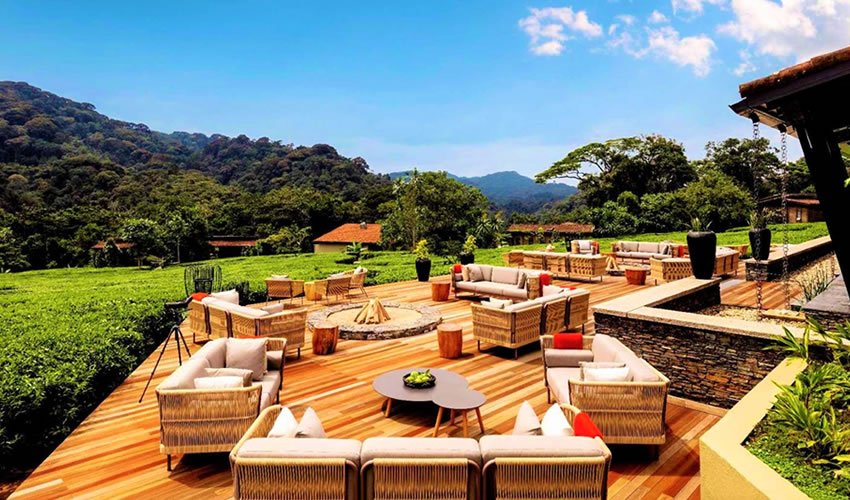
A scenic lodge near Nyungwe National Park offers comfortable accommodation surrounded by tea plantations, lush forests and Rwanda’s beautiful highland landscapes.
Nyungwe accommodation should also be selected according to the activities included in the itinerary. Chimpanzee tracking can begin early, so staying reasonably close to the relevant trekking area can make the experience more comfortable. Travellers should consider whether they are visiting primarily for chimpanzees, birding, canopy activities or several days of rainforest exploration.
Rwanda offers both high-end and more practical accommodation around the Nyungwe region. Comparing location, comfort and access to forest activities is essential when deciding which property fits the itinerary. Safari Vacations and Travel Services Ltd provides a detailed comparison of the best places to stay around Nyungwe National Park.
Transport Between Rwanda’s Wildlife Destinations
Road transport is the most common way to connect Rwanda’s major wildlife destinations. Kigali serves as the main arrival and departure point for many international travellers, from where safari vehicles can travel east towards Akagera, northwest towards Volcanoes National Park and southwest towards Nyungwe. Rwanda’s compact size makes it possible to combine several national parks without requiring domestic flights for every transfer.
A private safari vehicle with an experienced driver-guide provides flexibility for stops, photography and route adjustments. Four-wheel-drive vehicles can be particularly useful when travelling within wildlife areas or during wetter conditions. Travellers planning the full country can use this Rwanda travel guide to understand the main routes connecting Kigali and the national parks.
How Many Days Are Needed for a Rwanda Wildlife Safari?
The ideal safari length depends on the number of destinations included. Travellers concentrating only on Akagera can plan a short wildlife extension, while combining Akagera and Volcanoes normally requires additional days for road transfers, game drives and gorilla trekking. Adding Nyungwe creates a more comprehensive Rwanda Wildlife Guide itinerary but requires enough time to avoid spending every day moving between destinations.
A balanced multi-park safari should allow time for wildlife activities as well as comfortable transfers. Travellers should avoid attempting to visit Akagera, Volcanoes and Nyungwe within an unrealistically short itinerary because this reduces the amount of time available for the experiences themselves. Anthill Safaris provides additional practical guidance on planning a wildlife safari in Rwanda.
Planning a Rwanda Wildlife Safari on a Budget
Travellers can manage Rwanda safari costs by selecting comfortable mid-range accommodation, avoiding unnecessary luxury upgrades and designing a logical route that reduces excessive transport. Sharing a safari vehicle with additional travellers can also reduce the per-person transport cost. However, fixed wildlife fees such as gorilla permits cannot simply be reduced by choosing cheaper accommodation.
Budget planning should therefore concentrate on the areas where flexibility actually exists. Accommodation category, number of safari days, vehicle sharing and optional activities can all influence total expenditure. Travellers looking for practical ways to control costs can explore Rwanda budget safari options while still retaining the wildlife experiences that matter most.
What to Pack for a Rwanda Wildlife Safari

Essential gear for a Rwanda wildlife safari includes comfortable outdoor clothing, trekking equipment, reusable water bottles, travel documents and practical accessories for forest and savannah adventures.
Packing requirements change according to the activities included in a Rwanda wildlife safari. Lightweight neutral clothing works well for Akagera game drives, while gorilla and chimpanzee trekking requires stronger walking footwear, long trousers, rain protection and clothing suitable for cooler forest conditions. Binoculars are valuable for wildlife and birding, while cameras should be protected from dust and moisture.
Travellers visiting several national parks should pack for both warm savannah conditions and cooler high-altitude forests. Oversized luggage can become inconvenient when moving frequently between safari lodges, so practical packing is usually more useful than carrying unnecessary clothing. Safari Vacations and Travel Services Ltd provides additional Rwanda safari tips covering preparation and practical travel considerations.
Understanding What Is Included in a Rwanda Safari Price
Before confirming a Rwanda wildlife safari, travellers should understand exactly what the quoted price covers. Depending on the itinerary, the price may include a private safari vehicle, driver-guide services, accommodation, selected meals, park entrance fees and specified activities. Gorilla permits, chimpanzee permits, optional activities, drinks, international flights, personal expenses and gratuities may be included or excluded depending on the quotation.
A clear itinerary should identify the accommodation category, meal arrangements, activities, permits and transportation included for each travel day. This makes it easier to compare safari quotations accurately and prevents a seemingly cheaper package from becoming significantly more expensive after mandatory activities are added.
Building a Practical Rwanda Wildlife Guide Itinerary
A practical Rwanda wildlife itinerary should follow a logical geographical route while prioritizing the traveller’s main interests. Akagera provides Big Five game viewing and boat safaris, Volcanoes provides mountain gorillas and golden monkeys, while Nyungwe provides chimpanzees, other primates and rainforest wildlife. Lake Kivu can be incorporated between western destinations for additional scenery and relaxation when sufficient time is available.
Costs, permits, accommodation and transport should therefore be planned together rather than as separate parts of the safari. Securing time-sensitive wildlife permits first, selecting appropriately located accommodation and arranging a logical road route can make the overall Rwanda Wildlife Guide itinerary considerably more efficient. Proper planning allows travellers to spend more time experiencing Rwanda’s wildlife and less time correcting avoidable logistical problems during the journey.
Best Rwanda Wildlife Safari Itineraries and Complete Trip Planning
Choosing the right Rwanda wildlife safari itinerary depends on the number of travel days available, the wildlife species a visitor wants to see and the type of safari experience preferred. Rwanda’s relatively compact geography makes it possible to combine savannah wildlife, mountain gorillas, chimpanzees, golden monkeys, birdwatching and scenic landscapes within one journey. A complete Rwanda Wildlife Guide therefore needs to consider not only individual national parks but also how Akagera National Park, Volcanoes National Park, Nyungwe National Park, Lake Kivu and Kigali can be connected efficiently. Travellers comparing different options can explore these Rwanda safari packages to understand how shorter and longer itineraries can be structured.
Safari Vacations and Travel Services Ltd can organize Rwanda wildlife journeys ranging from short Akagera game-viewing safaris to longer multi-park itineraries combining the country’s most important wildlife habitats. A traveller with two or three days may concentrate on one destination, while five to seven days can combine two or three major wildlife regions. Eight to ten days provides greater flexibility for visitors who want a slower itinerary involving Big Five game viewing, gorilla trekking, chimpanzee tracking, golden monkeys, birding and Lake Kivu.
2-Day Akagera Wildlife Safari for Short Rwanda Trips
Travellers with limited time who primarily want traditional African wildlife can concentrate on Akagera National Park. A short itinerary from Kigali can include travel to the park, wildlife viewing, a Lake Ihema boat safari and a game drive across Akagera’s savannah landscapes. This itinerary works particularly well for travellers already visiting Kigali for business, conferences, gorilla trekking or another Rwanda holiday who want to add a compact wildlife experience.
A 2-day Akagera wildlife safari allows considerably more time in the park than attempting to travel from Kigali, complete a game drive and return within a single day. Spending a night around Akagera creates opportunities to experience both its terrestrial and aquatic habitats while keeping the overall Rwanda safari relatively short.
5-Day Rwanda Gorilla and Akagera Wildlife Safari
Five days can provide an excellent introduction to Rwanda for travellers whose two main priorities are mountain gorillas and traditional African wildlife. Akagera and Volcanoes National Park create one of the country’s strongest combinations because their environments are completely different. Akagera introduces visitors to savannah landscapes, Big Five wildlife and boat safaris, while Volcanoes provides a forest trekking experience among the Virunga Mountains.
A typical 5-day Rwanda gorilla and Akagera safari can include Kigali, Akagera game viewing, a Lake Ihema boat experience and mountain gorilla trekking in Volcanoes National Park. This type of itinerary is especially appropriate for first-time visitors who want two of Rwanda’s most contrasting wildlife encounters without extending their trip beyond one week.
Anthill Safaris also demonstrates this combination through its 5-day luxury Rwanda wildlife safari, which combines the mountain gorilla experience with Akagera’s savannah wildlife.
5-Day Rwanda Primate Safari for Gorillas and Chimpanzees
Travellers who have already experienced conventional African game drives elsewhere may prefer to concentrate on Rwanda’s primates. Volcanoes National Park and Nyungwe National Park can form the foundation of a wildlife itinerary focused on mountain gorillas, chimpanzees, golden monkeys and forest biodiversity rather than savannah game viewing.
The 5-day Rwanda primate safari combines Nyungwe and Volcanoes, providing chimpanzee tracking, rainforest exploration, mountain gorilla trekking and golden monkey tracking. This route is especially suitable for primate enthusiasts, wildlife photographers and travellers whose Rwanda Wildlife Guide priorities are concentrated on endangered and forest-dwelling species.
7-Day Rwanda Gorilla, Chimpanzee and Wildlife Safari
Seven days is one of the strongest safari lengths for first-time visitors who want to experience Rwanda’s principal wildlife destinations without creating an excessively long itinerary. A properly planned week can connect Akagera National Park, Volcanoes National Park and Nyungwe National Park while including Kigali and important road transfers between the parks.
The 7-day Rwanda gorilla and wildlife safari combines chimpanzees in Nyungwe, mountain gorillas in Volcanoes and game viewing in Akagera. The itinerary demonstrates how Rwanda’s rainforest, volcanic and savannah ecosystems can be incorporated into one wildlife journey.
Another option is a 7-day gorilla, chimpanzee and wildlife Rwanda safari, particularly appropriate for travellers who place equal importance on primates and classic wildlife. Rather than concentrating the entire holiday on one famous species, the journey introduces several of Rwanda’s major wildlife experiences.
7-Day Rwanda Safari With Primates, Wildlife and Boat Experiences
Wildlife travellers interested in combining land and water-based experiences can structure a week around game drives, primate trekking and boat activities. Lake Ihema in Akagera adds hippos, crocodiles, waterbirds and wetland scenery to the conventional savannah safari, while Rwanda’s forest parks provide gorillas, chimpanzees and other primates.
The 7-day Rwanda primates and wildlife safari provides an example of an itinerary combining Akagera, Volcanoes and Nyungwe with a Lake Ihema boat experience. This creates a particularly diverse Rwanda Wildlife Guide journey because wildlife is experienced from safari vehicles, forest trails and the water.
8-Day Rwanda Primate and Scenic Safari
Eight days provides additional flexibility for travellers whose main interest is primates but who also want scenic destinations between demanding trekking experiences. Instead of moving between national parks every day, visitors can incorporate Lake Kivu, cultural experiences and additional time around Volcanoes or Nyungwe.
An 8-day Rwanda primates safari can combine chimpanzees in Nyungwe, Lake Kivu, mountain gorillas, golden monkeys and the volcanic landscapes surrounding Volcanoes National Park. This itinerary works well for travellers who prefer forest wildlife and primates over a safari dominated by conventional game drives.
9-Day Rwanda Luxury Wildlife Safari
Travellers seeking a more relaxed safari can extend their journey to nine days and use higher-end accommodation around Rwanda’s national parks. Luxury itineraries are particularly effective when sufficient time is allowed to enjoy the lodges rather than transferring to another destination immediately after every wildlife activity.
The 9-day Rwanda luxury wildlife safari combines Nyungwe, Lake Kivu, Volcanoes and Akagera. Chimpanzee trekking, forest experiences, gorilla trekking, golden monkeys, a Lake Ihema boat safari and Big Five game viewing can therefore form part of one extended Rwanda wildlife journey.
Travellers who prefer travelling with a limited number of participants rather than on a completely private tour can also research a Rwanda small-group luxury safari. The best arrangement depends on privacy expectations, budget, wildlife interests and preferred travel pace.
Rwanda Wildlife Safari for Luxury Travellers
Luxury Rwanda wildlife safaris generally combine private transportation, carefully selected accommodation and sufficient time at each destination. The greatest advantage is not simply having a more expensive room; it is being able to create a better-paced journey around important wildlife activities. Staying close to gorilla trekking areas, choosing well-positioned Akagera accommodation and allowing recovery time after forest treks can significantly improve the overall safari experience.
Visitors researching premium travel can compare different approaches through this guide to luxury Rwanda safari tours. Luxury itineraries can still be wildlife-focused, with the accommodation and transport selected to complement rather than overshadow gorillas, chimpanzees, game drives and birdwatching.
Combining Akagera, Volcanoes and Nyungwe
Akagera, Volcanoes and Nyungwe create the strongest three-park combination for a comprehensive Rwanda Wildlife Guide itinerary. Akagera represents the savannah and wetland ecosystem, Volcanoes represents Rwanda’s volcanic mountain habitat, while Nyungwe introduces travellers to extensive montane rainforest. Each destination therefore contributes wildlife experiences that cannot simply be substituted by spending additional time in another park.
Anthill Safaris’ guide to travelling beyond gorillas to Akagera and Nyungwe also demonstrates why Rwanda should be viewed as a multi-ecosystem wildlife destination rather than solely as a gorilla trekking location.
Adding Lake Kivu to a Rwanda Wildlife Itinerary
Lake Kivu can provide a useful scenic break between wildlife activities, particularly when travelling between Nyungwe and Volcanoes National Park. Gorilla and chimpanzee trekking can be physically demanding, so incorporating time beside the lake allows travellers to slow the pace before undertaking another forest activity.
Lake Kivu should generally complement rather than replace Rwanda’s principal wildlife destinations on a wildlife-focused itinerary. Depending on available days, travellers may include boat excursions, lakeside scenery and relaxation before continuing towards the next national park. The additional time is particularly valuable on itineraries of seven days or longer.
Starting and Ending a Rwanda Wildlife Safari in Kigali
Kigali provides the natural starting and finishing point for most Rwanda wildlife itineraries because international travellers commonly arrive through Kigali International Airport. Akagera lies east of the city, Volcanoes National Park is reached by travelling northwest and Nyungwe is located towards southwestern Rwanda. The final order of destinations should be designed to reduce unnecessary backtracking while respecting confirmed permit dates.
Kigali can also be allocated additional time for travellers interested in Rwanda’s history, urban culture and museums. However, a wildlife-focused itinerary should balance city activities with sufficient time inside the national parks rather than reducing major wildlife experiences to short excursions simply to fit too many stops into one journey.
Choosing Between Short and Long Rwanda Wildlife Safaris
Short Rwanda safaris work best when travellers choose one or two priorities. Two to three days can focus on Akagera wildlife or mountain gorillas, while five days can combine gorillas with Akagera or Nyungwe. Seven days provides enough time for a broader combination, while eight to ten days can offer a more comfortable pace with additional wildlife, primate and scenic experiences.
Longer does not automatically mean better. A well-planned short itinerary based around specific wildlife interests can be more rewarding than a longer safari filled with unnecessary transfers. Travellers should therefore select destinations according to the animals and activities they value most rather than attempting to include every Rwanda attraction.
Creating a Balanced Rwanda Wildlife Safari
A balanced safari combines major wildlife encounters with realistic travel times and enough rest between demanding activities. Gorilla trekking should not necessarily be followed immediately by another strenuous forest trek if the itinerary allows flexibility. Similarly, Akagera deserves enough time for wildlife observation instead of being treated as a quick transfer stop between Kigali and another destination.
Travellers should also consider photography, birdwatching, accommodation style, fitness and personal interests when determining the final route. Anthill Safaris’ overview of Rwanda safari itinerary activities shows how gorilla trekking, game viewing, primate tracking and other experiences can be combined according to individual travel interests.
Rwanda Wildlife Guide Itinerary for First-Time Visitors
First-time visitors with approximately one week should strongly consider an itinerary combining Akagera and Volcanoes, with Nyungwe added when travel time allows. This provides the greatest contrast between Rwanda’s famous mountain gorillas and its traditional savannah wildlife. Travellers with eight to ten days can add chimpanzees, golden monkeys, Lake Kivu, birdwatching and additional time for wildlife photography.
The strongest Rwanda wildlife safari is ultimately the one that matches the traveller’s priorities rather than following a fixed formula. Some visitors want mountain gorillas to dominate the itinerary, others prioritize the Big Five, while specialist travellers may concentrate on primates, birds or photography. The variety of experiences highlighted throughout this Rwanda Wildlife Guide makes it possible to build short, mid-length and extended journeys around different wildlife interests while using Kigali as the main gateway.
Discover the Best of Rwanda Wildlife
Rwanda offers one of the most diverse wildlife experiences in East Africa, bringing together Big Five game viewing, mountain gorillas, chimpanzees, golden monkeys, exceptional birdlife and beautiful landscapes within a relatively compact destination. This Rwanda Wildlife Guide shows that the country is much more than a gorilla trekking destination. From the savannah plains and wetlands of Akagera National Park to the volcanic forests of Volcanoes National Park, the ancient rainforest of Nyungwe and the recovering ecosystems of Gishwati-Mukura, every protected area offers a different perspective on wildlife in Rwanda.
Travellers can build a Rwanda wildlife safari around their individual interests, whether the priority is searching for lions, elephants and rhinos, trekking mountain gorillas, tracking chimpanzees, photographing golden monkeys or discovering Rwanda’s remarkable birdlife. Combining several national parks creates the most complete experience and allows visitors to appreciate how dramatically Rwanda’s habitats and wildlife change across the country.The best Rwanda wildlife tours are those planned around realistic travel times, suitable accommodation, confirmed permits and enough time to experience each destination without rushing.
Safari Vacations and Travel Services Ltd can structure journeys ranging from short Akagera wildlife safaris to extended Rwanda gorilla, chimpanzee and Big Five itineraries, depending on travel dates, budget and preferred safari style.Whether visiting Rwanda for the first time or returning to explore more of its protected landscapes, the country’s combination of primates, predators, plains game, aquatic wildlife and birds provides extraordinary variety. With careful planning, a Rwanda wildlife safari can become a complete African wildlife journey that connects conservation, adventure, photography and some of the continent’s most memorable animal encounters.