Maasai Tribe and Culture

Maasai Tribe and Culture
Maasai Tribe and Culture: One of the famous tribes of Africa, the nomadic and pastoralist Maasai people are a Nilotic ethnic group. They inhabit large parts of northern, central, and southern Kenya that they selected. They also inhabit across the border in north Tanzania. The Maasai are in part famous ethnic people in East Africa due to their traditional origins. They’re from areas surrounding Masai Mara Game Reserve and Amboseli near the Tanzania border. Maasai people speak the Maa language. The Nilotic origins that they share link them in various ways to the Kalenjin tribe of Kenya. The tribe is famous for producing some of the best long-distance runners in the world. They have plenty of unique characteristics about their culture. We have thus listed some of them below, including their dress, diet, and way of life.
Tribe Facts
Maasai Shelter
The Maasai tribe, historically nomadic people, have traditionally relied on readily available materials. They have also relied on indigenous technology to construct their unusual and interesting housing. The traditional Maasai house was designed for people on the move and thus their houses were very impermanent. The houses are either circular or in loaf shape and women make them. Men build Circular Enkang (fences) that envelop their villages and this protects their cattle at night from wild animals.
Maasai Culture
Maasai society is firmly patriarchal. Retired elders usually join elder Maasai men to determine most major matters for the Maasai tribes. For Maasai people living a traditional way of life, the end of life is virtually without a formal funeral ceremony. Thus, the Maasai leave the dead out in the fields for scavengers. They have reserved burial in the past for great chiefs only. This is so because the Maasai believe that burial is harmful to the soil.
Traditional Maasai people’s lifestyle concentrates on their cattle which make up the primary source of food. Amongst the Maasai, the measure of a man’s wealth is in terms of children and cattle. So the more the better. They believe that a man who has plenty of cattle but not many children is poor, and vice versa. A Maasai myth says that God afforded them all the cattle on earth. This resulted in the belief that rustling from other tribes is a matter of claiming what is rightfully theirs. However, the practice has now become much less common.
Maasai Religion
The Maasai people are monotheistic, and their god is Engai or Enkai. Their god is mostly benevolent and manifests himself in the form of different colors, according to the feelings he is experiencing. The colors have precise meanings: black and dark blue mean that God is well-disposed towards men. Contrary, they identify red as a sign of their god’s irritation.
Enkai has two manifestations:
Enkai-Narok, the Black God, good and beloved, brings grass and prosperity. He comes through thunder and rain.
Enkai-na-Nyokie, the Red God, vengeful, brings famine and hunger. He comes through lightning and they identify him with the dry season.
You can trace back the importance of cattle to the Maasai’s religion and Enkai. Today most of the Maasai people are Christians and very few are Muslims.
Maasai Diet
One of the things that make the Maasai tribe and Culture unique is their diet. The traditional Maasai diet consists of six basic foods: meat, blood, milk, fat, honey, and tree bark. They drink both fresh and curdled milk. They drink fresh milk from calabash and sometimes they mix it with fresh cattle blood. Maasai obtain blood by nicking the jugular vein. They usually use blood and milk which they mix as a ritual drink. They also use it as nourishment for the sick.
The Maasai slaughter bulls, oxen, and lambs for meat on special occasions and for ceremonies. They then use the by-products of the animals – skin and hides as bedding. Meanwhile, they use cow dung for building (they smear it on the walls). The Maasai’s entire way of life truly revolves around their cattle. More recently, the Maasai people have supplemented their diet with farm crops. These include maize meal, rice, and cabbages among other food crops.
Maasai Clothing
Check out how the Maasai exhibit tribe exhibits their culture through clothing. Clothing varies by sex, age, and place. Young men wear black for several months after their circumcision. Although, they favor red among the Maasai. Black, Blue, checked and striped cloth is also worn, together with multi-colored African garments. In the 1960s the Maasai began to replace sheepskin, calf hides and animal skin for more commercial material. The cloth they used to wrap around the body is ‘Shúkà’ in the Maa language.
The Maasai women regularly weave and bead jewelry. This plays an essential part in the ornamentation of their body. Ear piercing and the stretching of earlobes are also part of Maasai beauty. Also, both men and women wear metal hoops on their earlobes.
Maasai Hair
The Maasai tribe and culture make both women and men mostly shave their heads to celebrate rites of passage such as circumcision and marriage. This represents the fresh start that will be made as one passes from one to another of life’s chapters. It’s only the Maasai warriors who are allowed to wear long hair, which they weave in thinly braided strands.
The Maasai name their children upon reaching the age of 3 “moons” and shave their heads clean apart. However, they don’t shave a tuft of hair, which resembles a cockade, from the nape of the neck to the forehead. They also shave young boys two days before circumcising them. The young warriors then allow their hair to grow and spend a great deal of time styling the hair.
Maasai Music and Dance
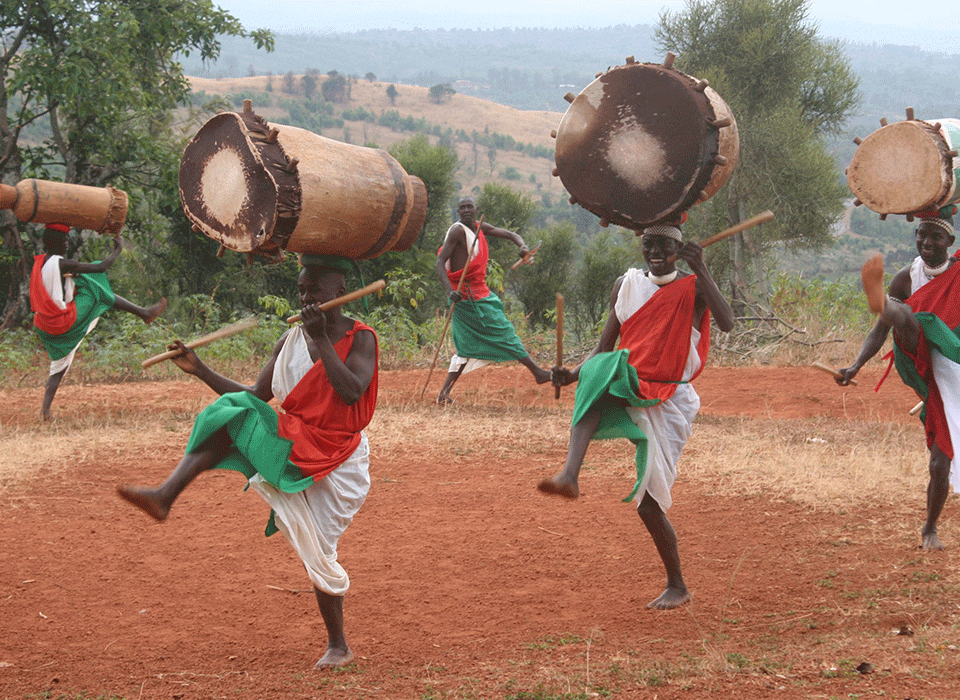
The Maasai people don’t use instruments when they are singing or dancing. All of their music is vocal, except for the large horns they use for certain songs. Their music comprises rhythms rendered by a chorus of vocalists singing harmonies, all the while the Olaranyani (song leader) sings the melody. The Olaranyani is usually the person who can best sing that song. When Olaranyani starts singing a line or title (Namba) of a song, the group responds with one unanimous call in acknowledgment. The beads that both the men and women wear also create a jingling sound themselves while the Masai jump and dance. Women recite lullabies, hum songs, and sing music that praises their sons.
The peak season for singing and dancing is during the rains, which is of course a favourable time to celebrate important passages of life such as circumcision and marriage. This mostly occurs around the manyattas and involves flirting.
What else to go for on a Kenya safari
With a variety of Game Reserves, National parks, and beaches, Kenya offers a magical safari experience to travelers all over the world except the Maasai Tribe and Culture. The country is despite different cultures, also very popular with safaris for fantastic wildlife viewing and bird watching. Also, Kenya has cultural trips to the Masai, Turkana, and Samburu tribes among others, and Mountain climbing. Watching the big five should be a top priority when it comes to safaris in Kenya. Thus, some of the destinations that are perfect for a combination with gorilla trekking in Rwanda include the following:
Masai Mara National Reserve:
Masai Mara National Reserve is the top tourist destination. It is near the border of Kenya and Tanzania. The Reserve is popular for its Savannah Plains and the large concentration of wildlife. Henceforth, you can view the wildlife all year round. This is the best place to spot the big five and all the large cats. There’s also a variety of both endemic and migratory bird species, not forgetting the wildebeest migration. Here, you see millions of wildebeest crossing the Mara River into Masai Mara for the lush green pastures and water. There are several activities in Masai Mara that you can do. Some of these include bird watching, wildlife viewing, cultural trips to the Masai, and guided nature walks.
Masai Mara National Reserve should be on your bucket list when planning a gorilla trek in the Rwanda and Kenya safari combo.
Samburu National Reserve:
Samburu National Reserve in Northern Kenya is one of Kenya’s secret jewels in the arid areas of the country. The park is small in size but has some of the rare and unique species in Kenya. These include the Beisa Oryx, Reticulated giraffe, Somali ostrich, Gerenuk, and Gravy Zebras. Many refer to these as “the Samburu five”. A safari to Samburu is a satisfying one with views of the large mammals and over 450 bird species. The Samburu people who have a unique culture worth getting to know and experiencing also occupy this park.
Tsavo National Park:
Tsavo National Park is one of Kenya’s oldest national parks. Furthermore, It is home to a wide range of wildlife. This includes cheetahs, leopards, kudus, lions, monkeys, buffaloes, water bucks, elephants, hippos, gerenuks, oryxes, and crocodiles among others. The National Park has two sections. Tsavo West National Park is mainly characterized by savannah woodland and mountains. Meanwhile, semi-arid and savannah grasslands characterize Tsavo East National Park.
Lake Nakuru National Park
Lake Nakuru National Park is a birding heaven for all birders across the world. The park has flocks of both greater and lesser flamingos that you can see throughout the year. The famous pink birds create a beautiful scenery that even looks spectacular from a distance. The Park is also home to wildlife species including the endangered white and black rhinos, Rothschild’s giraffes, and lions. Also, you encounter bushbucks, antelopes, leopards, baboons, Impalas, and other bird species both endemic and migratory. It is a good place to go sightseeing and tourists have a chance to explore the Great Rift Valley.
Amboseli National Park
Amboseli National Park popular for the huge crowds of elephants is a top safari destination in Kenya. You can thus easily combine it with a gorilla safari in Rwanda. The park has some amazing views of the wildlife, bird species, and Mount Kilimanjaro in neighboring Tanzania. This thus makes it one of the best Kenya safari destinations. The National Park has five different habitats, including savannah, wetlands, Dry bed (Amboseli), woodlands, and sulfur springs. You not only get to experience the cultural trips with the locals around the Park. But also, you have a chance to spot the big five.
The Kenya Coastline
Exploring the Kenya coastline is the best way to end your safari in Kenya. A coral reef protects Mombasa, making it the best place to go for a safari of relaxation. Meanwhile, at the same time, you have fun participating in the different activities. These include snorkeling, scuba diving, kite surfing, swimming, and fishing. This is the perfect getaway for locals, families, and couples. Also, it comes with a flawless range of luxurious accommodations and food. Conclusively, the coastline in Mombasa is worth visiting. The attractions in Mombasa that tourists visit the most are Fort Jesus and Diani. Diani additionally has the most pristine beaches and the best snorkeling on the African continent.
Aberdare National Park:
Moorland grasslands and gorges characterize Aberdare National Park in central Kenya. The National Park is home to wildlife including leopards, warthogs, lions, black rhinos, buffaloes, and elephants. Also, you can see spotted hyenas, and primates like baboons, vervet monkeys, and black and white colobus monkeys. Other possible sightings although rare include the giant forest hogs, blue duikers, African golden cats, and civet cats. Also, you can see Bongos and Serval cats among others. It is also home to over 300 bird species both endemic and migratory. Some of these include eagles, sparrow hawks, plovers, and sunbirds among others.