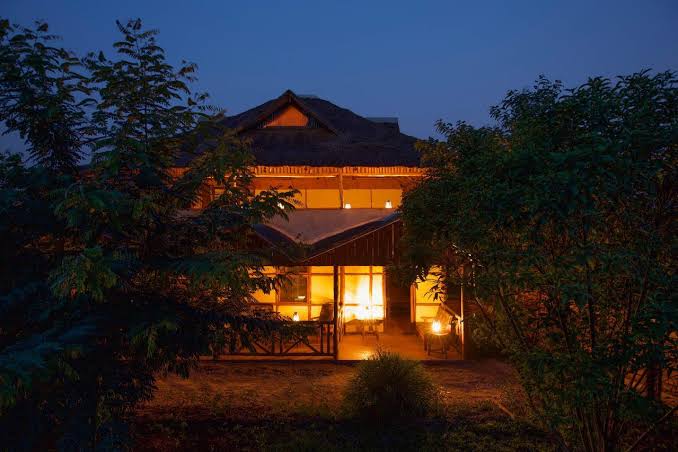
Why Do Lions Climb Trees?
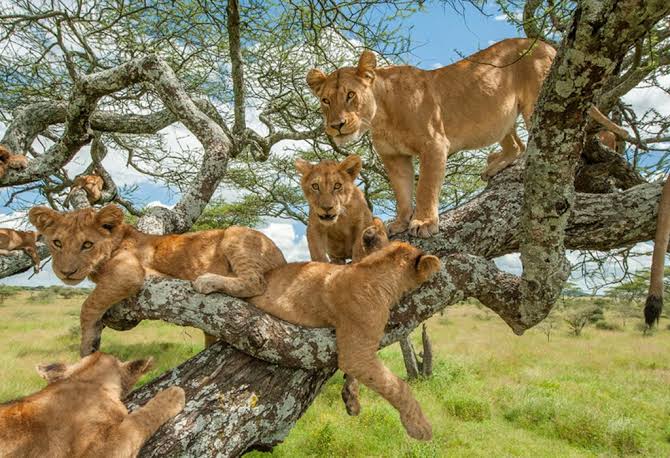
One of the most fascinating questions in any Tree-Climbing Lions Guide is simple: why do lions climb trees? The behavior is particularly famous in the Ishasha Sector of Queen Elizabeth National Park in Uganda, where visitors may encounter lions resting across large branches rather than lying on the open savannah. Uganda Wildlife Authority officially recognizes Ishasha for its tree-climbing lions, confirming that this behavior is one of the sector’s defining wildlife attractions.
Scientific observations of tree-climbing lions are not new. Stephen Makacha and George B. Schaller published observations of lions in Tanzania’s Lake Manyara National Park in the African Journal of Ecology in 1969, demonstrating that habitual tree use by some lion populations has been documented for decades. However, current search results did not identify a peer-reviewed study conclusively proving one single reason that explains why the Ishasha lions regularly climb trees. Explanations involving temperature, insects, visibility, resting opportunities and learned behavior should therefore be treated as proposed explanations rather than unquestioned facts.
For travelers interested in seeing the behavior firsthand, our tree-climbing lions guide explains why Uganda’s Ishasha Sector has become one of the most recognizable destinations for this unusual form of lion behavior.
Do Lions Climb Trees to Escape the Heat?
One frequently proposed explanation is that lions climb trees to find relief from conditions at ground level. Lions spend considerable portions of the day resting, and elevated branches can offer an alternative resting position above grasses and exposed ground. In Ishasha, visitors sometimes encounter lions stretched across substantial branches during daylight hours.
It is tempting to state simply that lions climb trees because the branches are cooler. However, a fact-checked Tree-Climbing Lions Guide should be more precise. Current search results do not establish temperature reduction as the single scientifically proven cause of habitual tree climbing among Ishasha lions. It remains one plausible explanation that may contribute to the behavior alongside several other factors.
The lions’ tendency to spend long periods resting above the savannah has nevertheless become an important part of the wildlife experience described in Safari Vacations and Travel Services’ guide to the Ishasha tree-climbing lions.
Do Lions Climb Trees to Avoid Biting Insects?
Another widely repeated explanation suggests that lions may climb above ground level to reduce irritation from biting insects. Savannah ecosystems contain numerous insects that can disturb resting mammals, so moving onto a raised branch could potentially provide temporary relief under certain conditions.
This explanation appears frequently in descriptions of both Ishasha and Lake Manyara lions, but it should not be presented as a scientifically settled answer. Information found in current search results supports its status as a proposed explanation rather than a conclusively demonstrated cause. A high-quality Tree-Climbing Lions Guide should therefore use wording such as “may,” “could” or “has been proposed” rather than stating that the lions definitely climb specifically to escape insects.
Safari travelers interested in how the lions use their environment can read more about the documented and commonly proposed behaviors of tree-climbing lions before visiting Queen Elizabeth National Park.
Do Trees Give Lions a Better View?
Elevation naturally changes what an animal can see across open country. From a suitable branch, a lion may have a broader view over nearby grassland than it would while lying within vegetation at ground level. This makes improved visibility another plausible explanation discussed in relation to tree-climbing lions.
That does not mean every lion climbs primarily to search for prey. Lions commonly spend much of their inactive period resting, and seeing a lion looking across the plains from a tree does not by itself prove that the animal climbed specifically for hunting purposes. The Tree-Climbing Lions Guide should make this distinction because observations of an animal’s position do not automatically establish its motivation.
The Ishasha landscape supports lions alongside numerous other savannah animals, creating a predator-prey environment that visitors can explore during game drives. More information about species occurring in this part of Queen Elizabeth National Park is available in our guide to wildlife in Ishasha.
Do Tree-Climbing Lions Hunt from Trees?
Lions are primarily terrestrial predators. They normally hunt on the ground rather than using branches as routine hunting platforms in the way people sometimes imagine after seeing photographs of tree-climbing lions. A lion resting above grazing animals may certainly be able to observe activity below, but this should not automatically be described as an arboreal hunting strategy.
Current search results do not provide sufficiently strong peer-reviewed evidence to establish that the Ishasha lions routinely climb trees specifically to launch attacks on prey from branches. Information not found in current search results. For accuracy, the Tree-Climbing Lions Guide should therefore avoid claiming that these lions normally leap from trees onto unsuspecting antelopes.
Visitors are much more likely to appreciate tree climbing as one component of a broader lion-viewing safari. Queen Elizabeth National Park remains an important destination for travelers hoping to encounter lions together with other large mammals, and our guide to the best places to see lions explains how Ishasha fits into Uganda’s wider predator-viewing opportunities.
Which Lions Are Able to Climb Trees?
Tree climbing is not evidence that the Ishasha lions belong to a separate lion species. They are lions, Panthera leo, displaying a striking behavior. The important distinction is behavioral rather than the creation of a special species called a “tree-climbing lion.”
Both young and adult lions are physically capable of climbing under suitable circumstances, although body size can obviously influence how easily an individual negotiates branches. Young lions are lighter and may appear more agile, while large adults require sufficiently strong trunks and branches to support them. Individual animals may also differ considerably in confidence and climbing behavior.
It would therefore be inaccurate to imply that every lion living in Ishasha will always be found in a tree. Wildlife sightings vary from day to day. Travelers may find lions resting on branches during one game drive and encounter them walking, feeding or resting on the ground during another. The unpredictability is part of experiencing the tree-climbing lions of Ishasha in a natural ecosystem rather than a controlled environment.
Can Male Lions Climb Trees?
Male lions are capable of climbing trees, but their large body mass and, in mature males, the additional bulk of the mane can make climbing appear more cumbersome than it does in smaller individuals. Large lions also need trunks and branches capable of supporting their weight.
This does not justify the common oversimplification that male lions cannot climb trees. Whether an individual climbs depends on the animal, the structure of the tree, local circumstances and behavior at that particular moment. A Tree-Climbing Lions Guide should therefore avoid dividing lions rigidly into climbers and non-climbers according to sex alone unless supported by population-specific research.
Travelers visiting the southern part of Queen Elizabeth National Park may encounter different members of a pride in different positions, which is why spending sufficient time on game drives can improve the quality of the overall wildlife experience. Safari options focusing on the region are covered in our Queen Elizabeth National Park safaris.
Can Lion Cubs Climb Trees?
Lion cubs and younger lions can climb, and their relatively small size can make movement among branches easier than for very heavy adults. Climbing can also form part of exploratory and playful behavior in young cats. However, the presence of climbing behavior among young lions should not be used by itself to prove why the adult Ishasha population habitually uses trees.
One possibility is that repeated exposure contributes to the continuation of the behavior. Young lions living within prides where other individuals regularly use trees can observe and experience the same environment throughout development. This makes learned or socially reinforced behavior a reasonable hypothesis, but current search results did not provide conclusive peer-reviewed evidence demonstrating precisely how habitual tree climbing is transmitted between generations in Ishasha.
How Do Such Heavy Animals Climb Trees?
Lions possess powerful forelimbs, strong shoulders and claws that can provide grip while moving up suitable trunks. However, they are considerably heavier than many highly arboreal cats, so the shape and structure of the tree are important. A large lion cannot simply climb every tree it encounters.
Trees with relatively accessible trunks, strong limbs and broad branching structures provide far more practical resting places than narrow or vertically challenging trees. Once a lion reaches a substantial horizontal branch, it can lie across it, position itself at a fork or allow its limbs to hang on either side while resting.
This helps explain the characteristic safari photographs associated with the Tree-Climbing Lions Guide: rather than balancing precariously on tiny branches, lions are often photographed stretched across substantial limbs capable of supporting their bodies.
How High Can Tree-Climbing Lions Climb?
There is no reliable universal height that can be given for an Ishasha tree-climbing lion. The height reached depends on the individual lion and the structure of the tree being used. Providing a precise maximum number without a verified study would create false accuracy.
Information not found in current search results for a scientifically established maximum climbing height specifically for Ishasha lions. Travelers should consequently be cautious when websites provide an exact maximum height without explaining the source of the measurement.
For safari purposes, what matters more is that lions may rest sufficiently high above the ground to create excellent viewing opportunities when vegetation, vehicle position, and the animal’s location cooperate.
Which Trees Do Ishasha Lions Prefer?
Uganda Wildlife Authority specifically describes the Ishasha Sector as famous for lions lounging in fig trees. Large trees with substantial branches provide the structural support necessary for heavy adult lions to rest above the ground.
The broader Ishasha landscape combines savannah, woodland and riverine habitats, allowing visitors to experience considerably more than a single lion sighting. The famous images of lions stretched along branches have nevertheless become one of the most identifiable wildlife scenes associated with Queen Elizabeth National Park.
Because the lions remain free-ranging animals, guides search suitable areas rather than bringing visitors to a guaranteed fixed location. Planning game viewing according to seasonal conditions can therefore be useful, and our best time to visit Queen Elizabeth National Park guide provides additional planning information.
How Long Do Lions Stay in Trees?
There is no fixed period that a tree-climbing lion must remain above ground. A lion may use a branch as a resting place and later descend to walk, interact with pride members, seek water, feed or become active for other reasons. Wildlife behavior changes throughout the day and according to environmental conditions.
For this reason, a photograph of lions sleeping in a tree should not create the impression that Ishasha lions spend their entire lives above ground. They remain terrestrial predators that happen to display unusually conspicuous tree use. The tree-climbing behavior is remarkable precisely because visitors can see such large terrestrial cats comfortably occupying elevated branches.
Is Tree Climbing Learned Behavior?
One of the most interesting possibilities is that habitual climbing may be reinforced socially within particular lion populations. If cubs grow up around adults that regularly climb suitable trees, they have repeated opportunities to interact with the same structures and potentially develop similar habits. This could help explain why certain populations become especially famous for regular tree use.
However, a fact-checked Tree-Climbing Lions Guide should not turn that possibility into a proven conclusion. Current search results did not identify definitive research demonstrating that Ishasha’s climbing tradition is transmitted entirely through social learning. Information not found in current search results.
What can be stated confidently is that the behavior occurs frequently enough in Ishasha to have become internationally associated with the area. Uganda’s national wildlife authority identifies Ishasha specifically with its tree-climbing lions, and scientific work has documented tree-climbing behavior in African lions elsewhere for decades.
Is There One Proven Reason Why Ishasha Lions Climb Trees?
No single explanation should currently be presented as definitive on the evidence located for this section. Cooling, avoiding insects, obtaining an elevated view, comfortable resting opportunities, and learned behavior are all explanations that may contribute, but confidently attributing the behavior to only one of them would go beyond the evidence found in the current search.
This uncertainty makes the lions more interesting rather than less important. Visitors are witnessing a real and well-recognized behavior whose precise combination of causes remains open to interpretation and continued study. A responsible Tree-Climbing Lions Guide should preserve that distinction between observation and explanation.
For travelers who want to incorporate Ishasha into a broader Uganda primate and wildlife journey, the region can also be connected with Bwindi Impenetrable National Park. Our guide to gorilla trekking and tree-climbing lions explains how the two major Uganda wildlife experiences can be included within the same safari route.
Why This Behavior Makes Ishasha Exceptional
The appeal of Ishasha is not simply that lions are physically capable of climbing. It is the opportunity to observe large wild lions using trees as conspicuous resting places within a natural savannah ecosystem. Uganda Wildlife Authority specifically promotes the Ishasha Sector for its tree-climbing lions, making the behavior an established part of Queen Elizabeth National Park’s wildlife identity.
For travelers using this Tree-Climbing Lions Guide to plan a safari, the key point is to maintain realistic expectations. Ishasha offers a genuine opportunity to search for tree-climbing lions, but sightings and specific behavior cannot be guaranteed. The animals choose where they move, when they rest and whether they climb.
That unpredictability is exactly what makes an encounter meaningful. Finding a pride stretched across the branches of a large tree after searching the Ishasha plains offers one of Uganda’s most distinctive predator-viewing experiences, while seeing the same lions walking through grassland provides an equally authentic view of how these remarkable animals live.
Tree-Climbing Lions of Ishasha, Uganda
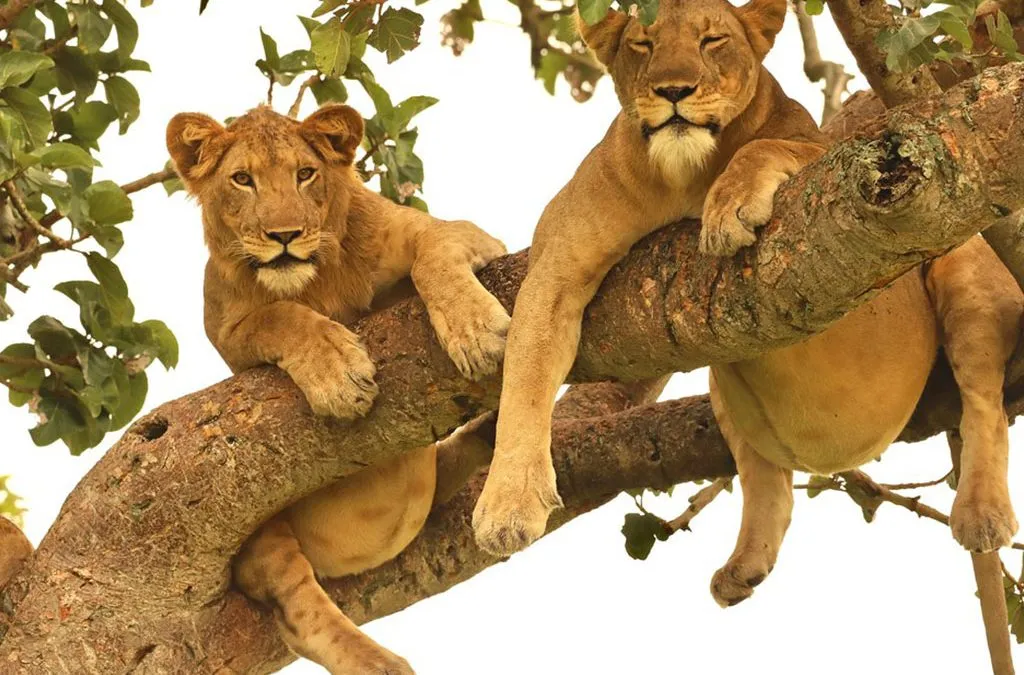
The tree-climbing lions of Ishasha are among the most distinctive wildlife attractions in Uganda. They live in the Ishasha Sector, the southern part of Queen Elizabeth National Park, where visitors search the open plains and large trees for lions resting above the ground. Uganda Wildlife Authority specifically identifies Ishasha as a place where lions climb trees and notes their association with fig trees. For travelers following a detailed Tree-Climbing Lions Guide, Ishasha is therefore the central destination for understanding and experiencing this unusual behavior.
Unlike a conventional lion safari where attention remains almost entirely on the ground, an Ishasha game drive encourages travelers to scan both the grasslands and the branches of mature trees. The lions remain completely wild, meaning their movements and choice to climb cannot be guaranteed. This unpredictability makes each encounter different and reinforces the importance of treating Ishasha as a natural wildlife experience rather than a staged attraction. Our complete guide provides further planning information for travelers interested in this remarkable Uganda safari experience.
Where Is the Ishasha Sector?
Ishasha lies in the southern part of Queen Elizabeth National Park in western Uganda. Uganda Wildlife Authority’s information for Bwindi Impenetrable National Park describes the route through Queen Elizabeth National Park’s southern Ishasha area and notes that Ishasha is approximately 64 kilometers from Bwindi. This geographical position is particularly useful for safari planning because travelers can combine savannah wildlife viewing with mountain gorilla trekking without returning to central Uganda between the two experiences.
Ishasha should not be confused with the better-known northern tourism areas of Queen Elizabeth National Park around Kasenyi and Mweya. It forms a separate southern wildlife-viewing sector with its own road network, landscapes and safari character. Travelers specifically interested in lions should allocate time to explore Ishasha rather than assuming that a game drive elsewhere in Queen Elizabeth National Park provides the same experience. Our Ishasha information explains where travelers normally search for Uganda’s famous tree-climbing lions.
Ishasha and Queen Elizabeth National Park
Ishasha is part of Queen Elizabeth National Park, one of Uganda’s major protected areas. The wider park contains a variety of habitats and wildlife-viewing areas, while Ishasha has developed a particularly strong international identity because of its lions. Uganda Wildlife Authority explicitly states that lions climb trees, particularly in Ishasha, making the behavior an officially recognized feature of the national park.
This distinction is important when planning a Tree-Climbing Lions Guide itinerary. A traveler can visit Queen Elizabeth National Park without necessarily spending enough time in Ishasha. Visitors whose priority is specifically tree-climbing lions should include the southern sector in their route and allow enough time for dedicated game drives.
Why Is Ishasha Famous for Tree-Climbing Lions?
Ishasha’s fame comes from repeated observations of lions resting in trees. Seeing a large African lion stretched across a branch creates a very different impression from seeing one resting in grass. The sight has become closely associated with Uganda safari photography and with the southern part of Queen Elizabeth National Park.
Uganda Wildlife Authority describes Ishasha’s lions as perching in fig trees. What should not be claimed, however, is that every lion in Ishasha climbs every day or that every visitor is guaranteed to see lions in trees. These are free-ranging predators whose movements depend on natural conditions and their own behavior.
Safari Vacations and Travel Services provides more destination-specific information about the lions and how this behavior has made Ishasha one of Uganda’s most recognizable predator-viewing destinations.
Landscape and Habitat of Ishasha
The Ishasha experience is shaped not only by lions but also by its open savannah environment, scattered trees, and other vegetation that create wildlife-viewing opportunities. Large trees are especially important to the visual identity of the sector because they provide the elevated resting places for which the lions have become famous.
Travelers should not imagine Ishasha as a dense forest where lions disappear into continuous tree cover. Game drives involve moving through savannah landscapes and searching suitable areas for wildlife. A knowledgeable driver-guide typically watches the surrounding plains as well as substantial trees where lions could potentially be resting.
The combination of open country and scattered tree cover also means visitors can encounter far more than lions. Our guide to wildlife covers the broader range of animals travelers may encounter while exploring this southern part of Queen Elizabeth National Park.
What Are Typical Tree-Climbing Lion Sightings Like?
A classic Ishasha encounter may involve spotting one or more lions resting across the limbs of a mature tree. Some individuals may lie lengthwise along a branch, while others may position themselves around a fork or allow their legs and tail to hang below them. At other times, the lions may remain on the ground, move through vegetation or disappear from the areas accessible to tourist vehicles.
This variation is why tree-climbing lion viewing should always be presented as wildlife searching rather than guaranteed viewing. Even though Ishasha is famous for the behavior, no responsible Tree-Climbing Lions Guide should promise that visitors will encounter a lion in a tree on a particular drive.
Wildlife Found Alongside the Lions
Tree-climbing lions may be Ishasha’s headline attraction, but the southern sector supports a wider savannah wildlife community. Uganda Wildlife Authority’s wider Queen Elizabeth National Park information describes the park as an important game-viewing destination, while safari observations in Ishasha can include prey species and other large mammals moving through the same ecosystem.
This wider biodiversity makes an Ishasha game drive worthwhile even when lions are not immediately visible. Travelers can continue exploring the landscape rather than treating the safari as successful only if a lion happens to be sitting in a tree. Those planning a predator-focused Uganda journey can also compare Ishasha with other destinations in our guide to Uganda’s best places for lion viewing.
Uganda Kob and the Ishasha Lions
Uganda Wildlife Authority specifically mentions Uganda kob in its description of the Ishasha tree-climbing lions. As herbivores sharing the same landscape with lions, kob form part of the predator-prey system that travelers may observe during game drives.
However, visitors should avoid assuming that every lion they see is actively hunting. Lions can spend substantial periods resting, and a pride discovered in a tree may remain relatively inactive during an observation. A good Tree-Climbing Lions Guide should explain both the dramatic predator-prey relationships of the ecosystem and the long periods of rest that characterize normal lion behavior.
Morning Versus Afternoon Lion Sightings
Both morning and afternoon game drives can be used to search for lions in Ishasha. The exact location and activity of lions can change, so travelers should avoid treating a particular hour as a guaranteed tree-climbing period. Information establishing one universally reliable time when Ishasha lions will always be in trees was not found in the current search results.
Where an itinerary permits, allocating more than one game-drive opportunity can reduce reliance on a single short visit. This is particularly relevant for travelers whose primary reason for entering Ishasha is photography or dedicated lion viewing.
What Is an Ishasha Game Drive Like?
An Ishasha game drive centers on slow wildlife searching. Rather than racing between predetermined lion locations, the experience involves observing the plains, investigating areas where wildlife is active and carefully checking suitable trees. Lions can move considerable distances, and conditions encountered during one safari may differ from those experienced the previous day.
Travelers should therefore arrive with realistic expectations. A skilled guide can use knowledge of the sector and recent wildlife activity to help search effectively, but the guide does not control the animals. The possibility of discovering the lions naturally is part of what makes the experience rewarding.
Visitors who want enough time for focused exploration can consider a dedicated safari that allows Ishasha to become a principal destination rather than only a brief stop between other parks.
How Long Should You Spend in Ishasha?
Travelers with a strong interest in tree-climbing lions should avoid planning their entire Ishasha experience around a very short transit stop. Spending at least enough time for a dedicated game drive provides a more meaningful opportunity to explore the sector, while an overnight stay can make additional morning or afternoon wildlife viewing possible.
The appropriate length depends on the wider itinerary. Travelers combining Queen Elizabeth National Park with Bwindi may use Ishasha as the wildlife link between the two destinations, while dedicated photographers may prefer additional game-drive time. No number of game drives can guarantee a sighting, but additional time naturally creates more opportunities to search different areas.
Can You See Tree-Climbing Lions Every Day?
No. The lions are free-ranging wild animals, and sightings should never be guaranteed. Ishasha’s reputation comes from its well-established association with tree-climbing lions, not from a promise that lions will occupy visible trees every day.
Weather, prey movements, lion movements, vegetation, road accessibility and simple chance can all affect a visitor’s experience. A lion pride may be visible during one game drive and difficult to locate later. It is equally possible to find lions on the ground rather than in trees.
For this reason, a factual Tree-Climbing Lions Guide should describe Ishasha as offering an opportunity to search for tree-climbing lions rather than guaranteeing them.
Tree-Climbing Lion Photography in Ishasha
Tree-climbing lions provide unusual photographic compositions because the animals can appear against foliage, branches and open sky rather than disappearing into grass. A resting lion may remain relatively still for a period, giving photographers time to observe posture, surrounding vegetation and changing expressions without needing to rush the encounter.
Photography must remain subordinate to responsible wildlife viewing. Visitors should follow park regulations and their guide’s instructions, remain within permitted areas and avoid pressuring a guide to approach wildlife irresponsibly simply to obtain a particular photograph.
Responsible Lion Viewing in Ishasha
Responsible viewing protects both visitors and wildlife. Tourists should remain inside safari vehicles where required, respect official park rules, avoid disturbing resting animals, and follow the instructions of Uganda Wildlife Authority personnel and qualified guides.
A lion lying quietly in a tree should not be deliberately disturbed to force movement, eye contact or a better photograph. Ethical wildlife tourism is based on observing natural behavior rather than manipulating it.
Travelers who want more time in both the lion habitat and Uganda’s mountain gorilla region can use a longer journey linking Ishasha with Bwindi Impenetrable National Park.
Conservation of Ishasha’s Lions
The significance of Ishasha’s lions extends beyond tourism. Uganda Wildlife Authority’s protected-area mandate includes wildlife and ecosystem conservation, and its current materials identify the tree-climbing lions of Ishasha among Uganda’s iconic wildlife resources.
Lions are large carnivores whose survival depends on functioning ecosystems, adequate prey, protected habitat and effective management of threats. Conservation therefore involves more than protecting individual lions. It also involves protecting the wider landscapes and ecological relationships that allow predator populations to persist.
Threats Facing Lions in the Queen Elizabeth Landscape
Uganda Wildlife Authority has a national strategic framework for large-carnivore conservation, and its current conservation materials recognize the tree-climbing lions of Ishasha as internationally significant wildlife. Large-carnivore conservation in human-used landscapes can involve challenges associated with habitat pressures, conflict between people and predators, illegal killing, and maintaining viable wildlife populations.
Specific current population figures for the Ishasha lions should not be inserted into a Tree-Climbing Lions Guide unless supported by a recent authoritative survey. Information establishing a definitive 2026 Ishasha lion population total was not found in the current search results used for this section.
Combining Ishasha with Bwindi Impenetrable National Park
One of Ishasha’s strongest safari-planning advantages is its position on a route connecting Queen Elizabeth National Park with Bwindi. Uganda Wildlife Authority states that Bwindi is approximately 64 kilometers from Ishasha, although actual journey time depends on road and weather conditions.
This makes it possible to build an itinerary that combines two very different wildlife experiences: savannah game viewing in search of tree-climbing lions and forest trekking in search of mountain gorillas. Travelers considering this combination can explore our dedicated combination guide.
Why Ishasha Belongs in a Tree-Climbing Lions Guide
Ishasha deserves a central place in any detailed Tree-Climbing Lions Guide because the association between the sector and tree-climbing lions is not simply a tourism slogan. Uganda Wildlife Authority directly identifies Ishasha as an area where lions climb and rest in fig trees, while its Bwindi access information also recognizes Ishasha as a place to search for these iconic lions when traveling through the region.
The experience is strongest when travelers understand that Ishasha is a complete savannah ecosystem rather than a single wildlife stop. The lions may be the principal attraction, but their behavior exists within a landscape of prey, vegetation, other wildlife and protected habitat. Searching patiently across this environment gives visitors a far more authentic experience than simply expecting a guaranteed photograph.
For travelers interested in combining the lions with Uganda’s broader wildlife and primate highlights, a Uganda itinerary can connect Ishasha with Bwindi and other areas of Queen Elizabeth National Park. This combination is one of the most practical ways to experience tree-climbing lions alongside some of Uganda’s other major wildlife attractions within the same journey.
Tree-Climbing Lion Safari Itineraries, FAQs and Planning
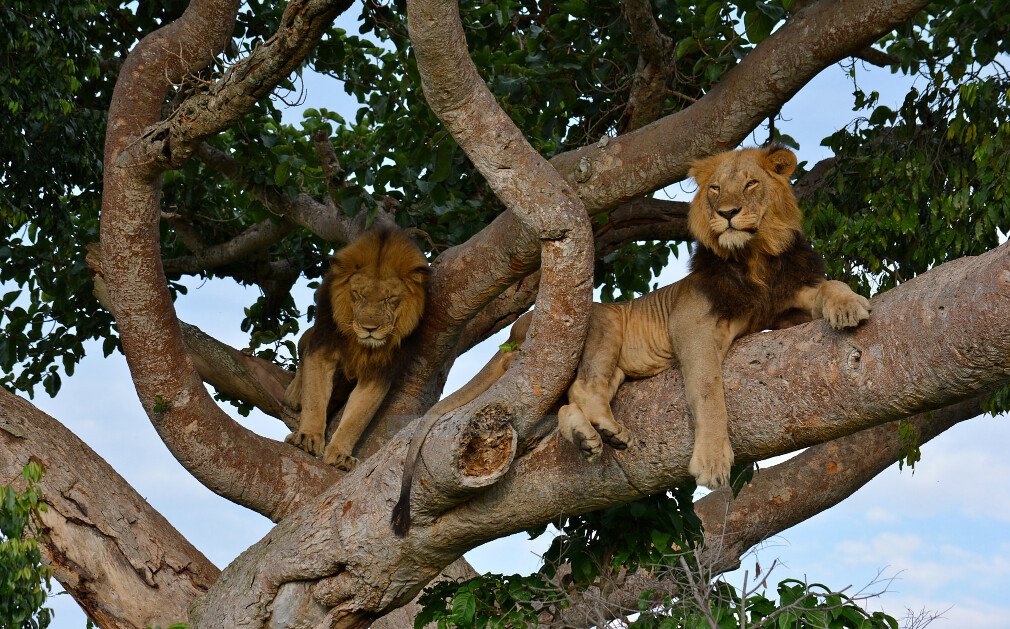
A well-planned Tree-Climbing Lions Guide should help travelers understand how to include the Ishasha Sector in a practical Uganda safari. Ishasha lies in the southern part of Queen Elizabeth National Park and fits naturally into itineraries continuing toward Bwindi Impenetrable National Park. This makes it possible to combine savannah wildlife viewing with mountain gorilla trekking in one western Uganda journey.
The best itinerary depends on the traveler’s available time, starting point and preferred activities. A short trip can focus mainly on Ishasha, while longer five-, six- or seven-day safaris can combine Queen Elizabeth National Park, Bwindi, the Kazinga Channel and other wildlife experiences.
3-Day Tree-Climbing Lions Safari
A three-day safari is one of the shortest practical options for travelers mainly interested in the tree-climbing lions of Ishasha. The trip can focus on reaching Queen Elizabeth National Park, exploring Ishasha and returning to the departure point.
The main activity is a dedicated Ishasha game drive. Travelers search the plains and suitable trees for lions while observing other wildlife. Because the lions are free-ranging, sightings cannot be guaranteed, and visitors should not assume every lion will be resting in a tree.
4-Day Queen Elizabeth National Park Safari
Four days provides more flexibility. Instead of concentrating exclusively on Ishasha, travelers can explore additional parts of Queen Elizabeth National Park. Depending on the itinerary, this may include conventional game viewing, a boat experience and wildlife viewing in different habitats.
Ishasha can remain the main area for searching for tree-climbing lions while the rest of the park introduces travelers to Uganda’s broader savannah ecosystem.
5-Day Tree-Climbing Lions and Gorilla Trekking Safari
Five days creates one of the most attractive Uganda wildlife combinations: tree-climbing lions in Ishasha and mountain gorilla trekking in Bwindi Impenetrable National Park.
The experiences are very different. Ishasha is explored mainly from a safari vehicle, while gorilla trekking involves walking through forest with authorized guides and trackers. A well-designed itinerary can allocate meaningful time to both destinations instead of treating Ishasha as a quick transfer stop.
5-Day Kazinga Channel and Tree-Climbing Lion Safari
Travelers more interested in Queen Elizabeth National Park can combine Ishasha with the Kazinga Channel. Ishasha provides terrestrial game viewing, while the Kazinga Channel offers a water-based safari experience between Lake George and Lake Edward.
This combination allows visitors to experience different habitats and prevents the entire safari from depending on a single lion sighting.
6-Day Uganda Gorilla and Tree-Climbing Lions Safari
Six days gives travelers more time to combine primates and savannah wildlife. A typical route can include Bwindi, Ishasha, wildlife viewing in northern Queen Elizabeth National Park and a boat cruise.
This duration is suitable for visitors who want gorilla trekking and tree-climbing lions while also experiencing a broader range of Uganda’s wildlife environments.
7-Day Uganda Gorilla Trekking and Wildlife Safari
A seven-day journey allows the Tree-Climbing Lions Guide experience to become part of a more complete Uganda safari. Travelers can include additional game drives and wildlife activities without rushing directly between Bwindi and Ishasha.
This duration is especially useful for travelers who want varied wildlife experiences while keeping the safari relatively compact.
Combining Tree-Climbing Lions with the Kazinga Channel
Ishasha and the Kazinga Channel complement each other well. Ishasha focuses on searching for lions and other terrestrial animals, while the Kazinga Channel offers a different perspective on wildlife using the water and shoreline.
Travelers with enough time do not need to choose between the two experiences.
Combining Tree-Climbing Lions with Gorilla Trekking
Combining Ishasha and Bwindi is one of the most useful Uganda safari options. Travelers can search for lions across open savannah and later trek through tropical forest in search of mountain gorillas.
Gorilla trekking requires advance permit planning, so permit availability can determine the exact order and dates of the safari.
Combining Tree-Climbing Lions with Chimpanzee Trekking
Travelers with additional time can extend the route to Kibale National Park. This creates a western Uganda circuit combining chimpanzees, Queen Elizabeth National Park, Ishasha’s tree-climbing lions, and mountain gorillas in Bwindi.
What Are Tree-Climbing Lions?
Tree-climbing lions are African lions that repeatedly climb and rest in trees. The term does not describe a separate species. Ishasha is particularly famous because lions there are regularly observed resting on large branches.
Where Can You See Tree-Climbing Lions in Uganda?
The best-known location is the Ishasha Sector of Queen Elizabeth National Park. It has become one of Uganda’s most recognizable wildlife destinations because of this unusual behavior.
Are Sightings Guaranteed?
No. Tree-climbing lions are wild animals. They may be resting in trees, walking on the ground, hidden by vegetation, or outside areas accessible to safari vehicles.
A responsible Tree-Climbing Lions Guide should never guarantee sightings.
What Is the Best Time to See Them?
Morning and afternoon game drives can both provide opportunities. No fixed hour guarantees that Ishasha lions will climb trees.
Ishasha can also be visited during different seasons, although rainfall can affect vegetation, roads and general wildlife-viewing conditions. No season guarantees tree-climbing behavior.
Why Do Ishasha Lions Climb Trees?
Several explanations have been proposed, including comfortable resting positions, escaping conditions at ground level, avoiding biting insects, and gaining a better view.
However, no single explanation should be presented as conclusively proven. These ideas are better described as possible contributing factors.
Do All Ishasha Lions Climb?
No. Individual behavior varies. Visitors may find lions on the ground even within a population famous for tree climbing.
Can Male Lions Climb Trees?
Yes. Lions of different sexes can climb suitable trees, although large adult males require strong branches capable of supporting their greater weight.
Do Tree-Climbing Lions Hunt from Trees?
There is insufficient evidence to describe tree-based ambush hunting as the routine hunting strategy of Ishasha lions. Lions remain primarily terrestrial predators.
How Many Days Do You Need in Ishasha?
There is no mandatory duration. A traveler passing between Queen Elizabeth National Park and Bwindi may include one dedicated game drive, while photographers and wildlife enthusiasts may prefer one or more nights.
More time increases opportunities to search but still cannot guarantee a sighting.
Is Ishasha Worth Visiting?
Yes, particularly for travelers interested in lions, wildlife photography and itineraries combining Queen Elizabeth National Park with Bwindi.
The strongest Tree-Climbing Lions Guide itinerary gives travelers enough time to search patiently, avoids promising guaranteed wildlife encounters, and combines Ishasha with other experiences according to individual interests. Three days can work for a focused lion safari, while five to seven days provide stronger opportunities to add the Kazinga Channel, broader Queen Elizabeth wildlife viewing and mountain gorilla trekking in Bwindi.
Conservation, Responsible Viewing and Planning a Tree-Climbing Lion Safari
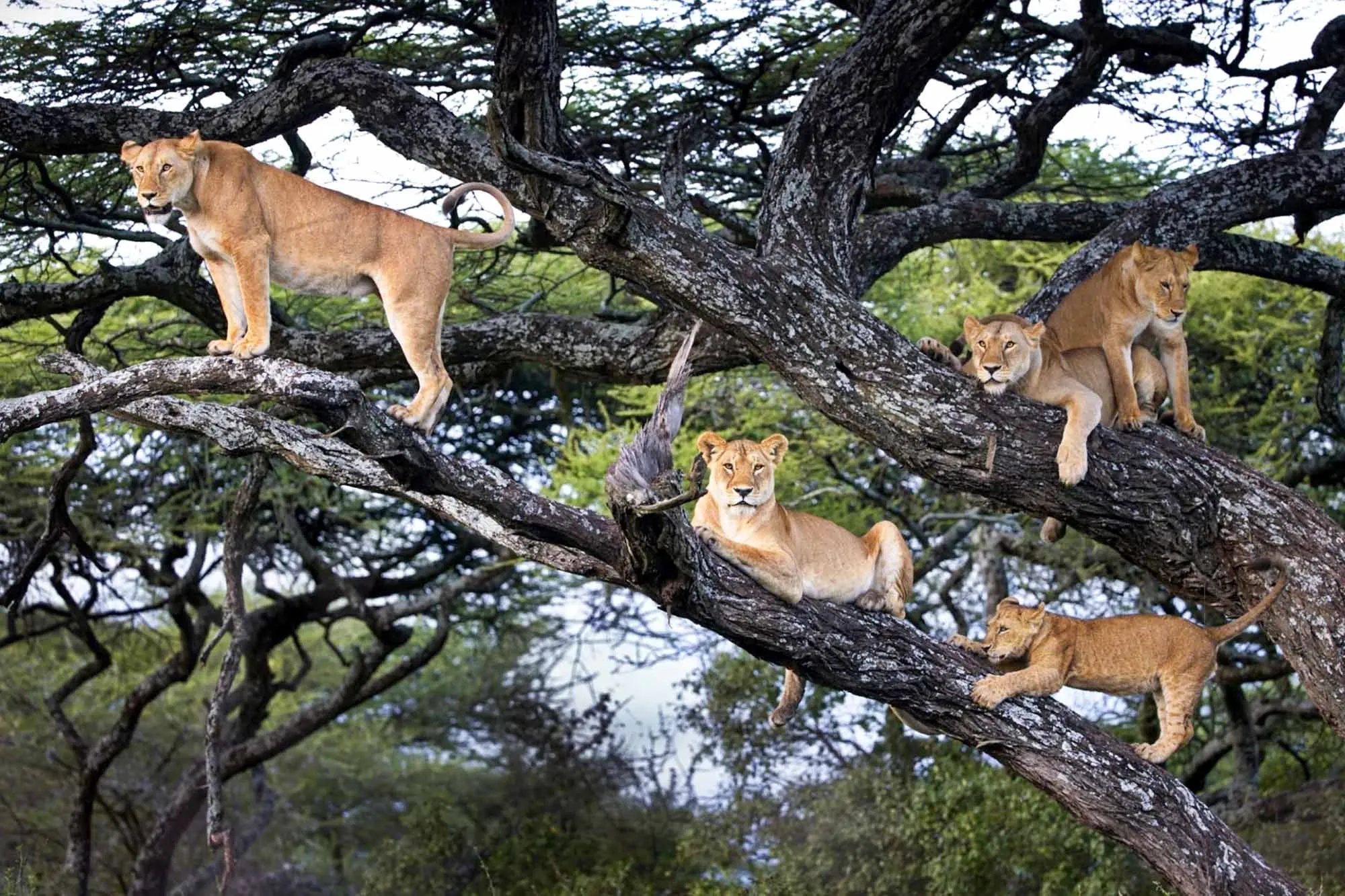
A complete Tree-Climbing Lions Guide should explain more than where travelers can see lions resting in trees. Conservation, responsible wildlife viewing, photography and careful safari planning are equally important. Ishasha’s lions are part of a functioning ecosystem within Queen Elizabeth National Park, and protecting that environment is essential to their future.
Lion conservation remains particularly important in Uganda. The source document reports that Uganda Wildlife Authority’s State of Wildlife Resources Report 2026 recorded a decline in Uganda’s estimated lion numbers from 314 in 2021–2022 to 291 in 2023–2025. These are national figures rather than a specific population estimate for Ishasha, but they demonstrate the continuing importance of protecting Uganda’s lions.
Why Conservation Matters in Ishasha
Protecting tree-climbing lions involves much more than protecting individual animals. Lions require suitable habitat, adequate prey populations and enough space to move, hunt, rest and reproduce.
The wider Queen Elizabeth landscape therefore plays an essential role. Vegetation, water, prey species and neighboring communities are all connected to lion conservation.
Uganda Wildlife Authority’s conservation approach includes protected-area management, community participation, environmental education, tourism development and efforts against wildlife crime. Tourism can contribute to the economic value of maintaining natural wildlife landscapes, but tourism alone should not be presented as the complete solution to lion conservation.
Threats Facing Uganda’s Lions
Large carnivores can face several pressures, including habitat changes, conflict involving livestock, illegal killing, and snares.
The source also notes that Uganda’s Strategic Action Plan for Large Carnivore Conservation 2024–2034 recognizes Queen Elizabeth National Park as an important lion conservation landscape. Historical Ishasha research has documented problems involving snaring, poisoning, and livestock-related conflict. However, older findings should not automatically be presented as descriptions of the exact situation today.
This distinction is important when producing an accurate Tree-Climbing Lions Guide. Conservation information should explain genuine challenges without exaggerating outdated evidence.
Responsible Tree-Climbing Lion Viewing
Responsible wildlife viewing begins with understanding that lions control the encounter.
Visitors might find a pride resting in a tree, see lions walking through grassland, or complete a game drive without locating them. Neither a professional guide nor park authorities can determine where free-ranging lions will be at a particular moment.
Travelers should never pressure guides to chase, surround or disturb lions for photographs. Safari vehicles should follow park regulations, remain in permitted areas and provide sufficient space for animals to behave naturally.
A responsible Tree-Climbing Lions Guide should therefore provide opportunities rather than guarantees.
Responsible Tree-Climbing Lion Photography
Seeing a lion stretched across the branches of a large tree can create extraordinary photographic opportunities. However, obtaining a photograph should never become more important than the animal’s welfare.
Visitors should not pressure guides to drive excessively close, block a lion’s path, or intentionally provoke movement. A resting lion does not need to look directly at the camera for the encounter to be successful.
Photographs showing natural resting behavior or interactions between pride members can often communicate more about the animal than a deliberately manipulated pose.
A telephoto lens can help photographers capture detailed images while maintaining an appropriate distance. Wider compositions are also valuable because they show the lion within the tree and surrounding Ishasha landscape.
Branches, foliage, strong sunlight, and the lion’s position can influence the final image. Photographers should therefore concentrate on observing natural behavior rather than expecting every encounter to produce the same classic photograph.
Why Patience Matters in Ishasha
Patience is one of the most important parts of searching for tree-climbing lions.
The animals are not positioned beside specific roads for tourists. Driver-guides must search suitable areas, examine large trees, watch the surrounding plains, and respond to wildlife activity.
Travelers making only a short stop should understand that sightings remain unpredictable. Spending more time in Ishasha creates additional opportunities to explore different locations, although even several game drives cannot guarantee that lions will be resting in trees.
Tree-Climbing Lion Game Drives and Lion Tracking
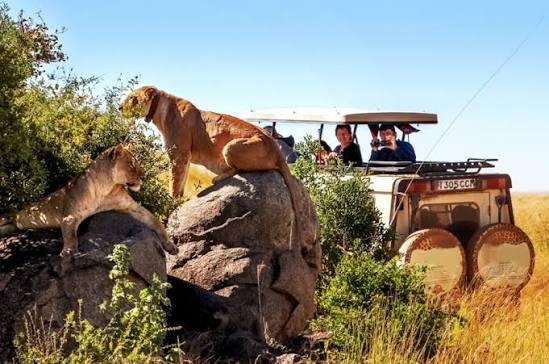
Travelers should understand the difference between a conventional Ishasha game drive and specialized lion tracking.
An ordinary Ishasha game drive involves searching for tree-climbing lions and other wildlife from a safari vehicle. Specialized lion tracking is a different experience offered within the wider Queen Elizabeth landscape and focuses more directly on locating lions and learning about aspects of their behavior and social organization.
Because availability, fees, and operating arrangements can change, travelers should confirm current information for their actual safari dates.
Should You Stay Overnight in Ishasha?
An overnight stay can be valuable for travelers whose main objective is seeing tree-climbing lions. Instead of briefly passing through Ishasha during a transfer, visitors can allocate additional time to game drives and the wider southern Queen Elizabeth ecosystem.
Whether an overnight stay is necessary depends on the overall itinerary, budget, accommodation availability, and importance of lion viewing. It can be particularly practical for travelers continuing toward Bwindi because Ishasha and Bwindi fit naturally into the same western Uganda safari route.
Combining Ishasha with the Kazinga Channel
Queen Elizabeth National Park offers much more than tree-climbing lions. The Kazinga Channel provides a contrasting wildlife experience by introducing travelers to aquatic and shoreline environments.
Combining Ishasha and the Kazinga Channel creates a more complete Queen Elizabeth safari. Travelers can search for terrestrial predators in the southern sector before experiencing a different wildlife environment elsewhere in the park.
Combining Ishasha with Gorilla Trekking
Bwindi Impenetrable National Park is one of the strongest additions to a Tree-Climbing Lions Guide itinerary.
The source notes that Uganda Wildlife Authority places Bwindi approximately 64 kilometers from Ishasha and describes much of the connecting route as unpaved, making a four-wheel-drive vehicle advisable.
Combining the destinations allows travelers to experience two dramatically different environments: Ishasha’s open savannah and Bwindi’s forest ecosystem with mountain gorilla trekking.
Planning the Right Amount of Time
There is no single ideal duration for every traveler. Short itineraries can concentrate primarily on Ishasha, while longer journeys can combine the lions with the Kazinga Channel, northern Queen Elizabeth National Park, and Bwindi.
Travelers particularly interested in lions should avoid making Ishasha only a rushed stop. Additional time creates more opportunities for game drives, but it should never be presented as guaranteeing a sighting.
Final Tree-Climbing Lions Guide Planning Advice
The best way to experience Ishasha is to arrive informed, patient, and realistic. Choose an itinerary providing meaningful wildlife-viewing time, respect Uganda Wildlife Authority regulations, and follow the instructions of professional guides. Photography should document natural behavior rather than interfere with it.
Most importantly, the future of the Tree-Climbing Lions Guide experience depends on conserving real lions within functioning ecosystems. Ishasha is more than a place to photograph lions in trees. It is a living savannah landscape, an important part of Queen Elizabeth National Park and one of Uganda’s most distinctive wildlife destinations.
Responsible tourism allows travelers to appreciate not only the famous lions but also the habitat supporting them and the conservation work required to protect Uganda’s wild predators for future generations.
Best Time, Costs, Accommodation and Practical Planning for Tree-Climbing Lions
Planning a successful Tree-Climbing Lions Guide safari requires more than knowing that the famous lions live in the Ishasha Sector of Queen Elizabeth National Park. Travelers also need to consider seasons, road conditions, accommodation location, safari duration, park fees, photography equipment, and how Ishasha fits into a wider Uganda itinerary. Uganda Wildlife Authority confirms that Queen Elizabeth National Park is one of Uganda’s principal protected areas and identifies Ishasha specifically with lions that climb and rest in fig trees.
The lions remain wild throughout the year, so no month guarantees that visitors will find them resting in trees. Seasonal conditions can nevertheless influence road access, vegetation, photography, and the overall comfort of game drives. Travelers researching their dates can compare seasonal timing before deciding when to include Ishasha in a Uganda safari.
What Is the Best Time to See Tree-Climbing Lions in Ishasha?
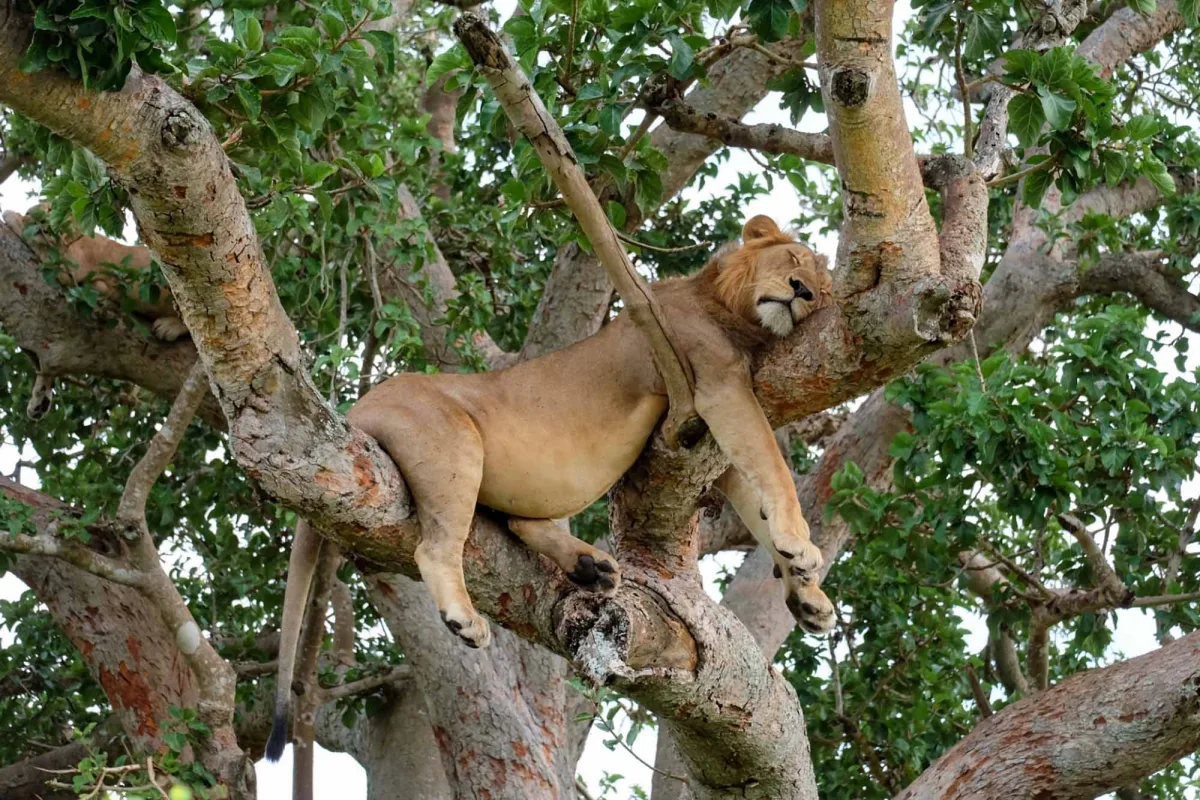
Tree-climbing lions can potentially be encountered in Ishasha at different times of the year. There is no scientifically verified month during which they are guaranteed to climb trees. A responsible Tree-Climbing Lions Guide should therefore separate the best time for comfortable safari travel from claims about guaranteed lion behavior.
Safari Vacations and Travel Services identifies June through September and January through February among the generally favorable dry-season periods for Queen Elizabeth National Park. During drier periods, roads can be easier to navigate, and vegetation conditions may favor conventional game viewing.
However, the wet months should not automatically be dismissed. Greener landscapes can create attractive photography conditions, birdlife can be excellent, and there may be fewer travelers than during popular dry-season periods. The decision should therefore depend on whether the visitor prioritizes road conditions, photography, lower visitor numbers or a wider Uganda itinerary.
Visiting Ishasha During the Dry Season
The drier periods are generally popular for wildlife safaris because tracks tend to be easier to use and vegetation may be less dense in some areas. Safari Vacations and Travel Services identifies January and February and the June-to-September period as favorable months for wildlife viewing in Queen Elizabeth National Park.
Popular travel periods can also create greater demand for vehicles and accommodation. Travelers planning a Tree-Climbing Lions Guide safari during peak periods should therefore secure their itinerary earlier rather than assuming suitable accommodation near Ishasha will remain available at short notice.
Visitors specifically targeting the lions should remember that dry weather does not guarantee tree-climbing behavior. The purpose of traveling during a favorable season is to improve the overall safari logistics and game-viewing experience, not to guarantee where an individual lion will rest.
Visiting Ishasha During the Rainy Season
Rainier periods can transform the Queen Elizabeth landscape into greener scenery. Safari Vacations and Travel Services notes that wetter months can offer lush vegetation and strong birding opportunities.
The principal practical consideration is that rainfall can affect unpaved roads. Uganda Wildlife Authority states that the route between Ishasha and Bwindi is mainly along a dirt road and strongly recommends a four-wheel-drive vehicle.
Rain should therefore be treated as a logistical consideration rather than a reason to claim that lions disappear. Tree-climbing lion sightings remain unpredictable in every season.
Where Exactly Should You Look for Tree-Climbing Lions?
The main destination is the southern Ishasha Sector of Queen Elizabeth National Park. Uganda Wildlife Authority specifically identifies Ishasha as an area where lions climb trees, especially fig trees.
A game drive involves searching through the sector rather than traveling to one permanent lion tree. Lions can change locations, rest on the ground or move into areas where they are difficult to observe. Travelers wanting more background on where the animals are normally searched for can use this dedicated Ishasha resource.
What Other Wildlife Can You See in Ishasha?
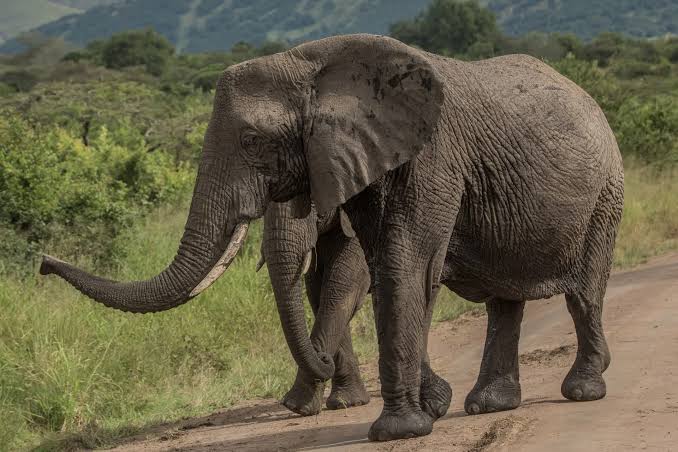
A Tree-Climbing Lions Guide safari should not be designed as though lions are the only animals worth seeing. Ishasha forms part of a functioning savannah ecosystem, and a game drive can produce other wildlife encounters while the guide searches suitable lion habitat.
Safari Vacations and Travel Services’ current Ishasha information discusses animals occurring in the sector in addition to its famous predators. Travelers can therefore approach a drive as a broader wildlife experience rather than judging its success solely on whether a lion happens to be lying across a branch.
How Much Does a Tree-Climbing Lion Safari Cost?
There is no single fixed price for every Tree-Climbing Lions Guide safari. Total cost depends on itinerary length, nationality or residency category where applicable, accommodation standard, vehicle arrangements, number of travelers, additional activities and whether Ishasha is combined with other national parks.
Uganda Wildlife Authority maintains an official rates page and currently identifies tariff changes for 2026–2027. Because fees can change and different visitor categories are charged differently, travelers should verify the tariff applicable to their actual travel date rather than relying on an older article.
A definitive all-inclusive 2026 price for every possible Ishasha safari was not found because no universal package exists. Information not found in current search results. Travelers should obtain a date-specific quotation based on their group size, accommodation, and itinerary.
Does Visiting Ishasha Require a Special Tree-Climbing Lion Permit?
Current official information confirms Queen Elizabeth National Park entrance charges and separately lists several park activities. The standard experience of searching for tree-climbing lions in Ishasha normally takes place during a game drive rather than through a permit comparable with a mountain gorilla trekking permit. Uganda Wildlife Authority’s payment information lists park entrance, game-drive, and other activity categories for Queen Elizabeth National Park.
Travelers should distinguish this from specialized predator or lion-tracking activities. Those can have separate arrangements and fees and should be confirmed for the intended travel date.
What Is the Difference Between an Ishasha Game Drive and Lion Tracking?
An Ishasha game drive involves exploring the sector in search of lions and other wildlife. Lion tracking is a more specialized activity associated with research-oriented predator observation in Queen Elizabeth National Park and should not automatically be treated as the same activity.
Safari Vacations and Travel Services maintains dedicated information about lion tracking. Because activity charges and operational arrangements can change, current availability and fees should be reconfirmed at the time of booking rather than copied from older pricing.
Where Should You Stay for a Tree-Climbing Lion Safari?
Location matters when choosing accommodation around Ishasha. Travelers primarily interested in the lions benefit from staying within convenient reach of the sector because this reduces unnecessary transfer time before and after game drives.
Ishasha Wilderness Camp’s official website confirms that the property is situated within the southern Ishasha Sector of Queen Elizabeth National Park on the Ntungwe River. The camp also describes the surrounding savannah as famous for tree-climbing lions.
Safari Vacations and Travel Services also identifies Ishasha Wilderness Camp, Enjojo Lodge and Ishasha Jungle Lodge when discussing accommodation for itineraries linking tree-climbing lions with Bwindi.
Accommodation availability, rates and classifications can change. Travelers should therefore confirm current pricing directly through their safari quotation rather than assuming historic lodge rates remain valid.
Should You Stay One or Two Nights in Ishasha?
A single overnight stay can work when Ishasha is part of a broader route between Queen Elizabeth National Park and Bwindi. Two nights can provide greater flexibility for travelers who place tree-climbing lions among their highest priorities because it can create additional game-drive opportunities.
Additional time should not be marketed as a guarantee of success. A longer stay only creates more opportunities to search. Lions can remain hidden, stay on the ground, or move beyond convenient viewing areas regardless of how many nights a traveler books.
What Should You Pack for Ishasha?
Practical safari clothing should be comfortable, suitable for changing weather and appropriate for vehicle-based wildlife viewing. Travelers should consider sun protection, a light rain layer, comfortable closed footwear, binoculars, camera equipment, charging equipment, and any essential personal medication.
Because Ishasha can be combined with several other Uganda activities, the final packing requirements depend on the full itinerary. A traveler continuing to gorilla trekking in Bwindi will need additional trekking equipment that would not be necessary for an Ishasha-only game drive. Safari Vacations and Travel Services provides a dedicated Queen Elizabeth National Park packing resource for further preparation.
What Camera Equipment Is Best for Tree-Climbing Lions?
A telephoto lens can be particularly useful because ethical wildlife photography requires maintaining suitable distance from animals. A wider lens can also be valuable for environmental photographs that show the lion within the tree and surrounding Ishasha landscape.
Travelers should bring sufficient batteries, memory capacity, and protection against dust and rain. Bean bags or other stable supports may be useful when photographing from a safari vehicle, depending on the vehicle design and guide’s instructions.
The goal should never be to pressure a guide into approaching too closely simply because a particular lens is inadequate. Travelers prioritizing cameras can also consult this Uganda wildlife photography guide when selecting travel dates.
Do You Need a 4WD Vehicle for Ishasha?
A four-wheel-drive safari vehicle is strongly advisable for routes involving Ishasha, especially when continuing toward Bwindi. Uganda Wildlife Authority specifically describes the Ishasha–Bwindi route as mainly dirt road and recommends a 4WD vehicle.
This becomes particularly important during rainy conditions when unpaved routes can be more challenging. Vehicle quality should therefore be treated as an important part of a Tree-Climbing Lions Guide itinerary rather than an afterthought.
How Far Is Ishasha from Bwindi?
Uganda Wildlife Authority states that Bwindi Impenetrable National Park is approximately 64 kilometers from Ishasha. It also describes Bwindi as approximately 160 kilometers from Mweya when traveling along the route through Ishasha.
The kilometer figure should not be converted into a guaranteed driving time because journey duration can vary with road conditions, rainfall, stops and the exact lodge or Bwindi sector being used.
Can You Combine Tree-Climbing Lions with Gorilla Trekking?
Yes. Geographically, this is one of the most practical combinations in western Uganda. Travelers can search for tree-climbing lions in the savannah of Ishasha before continuing toward the forest environment of Bwindi for mountain gorilla trekking.
Safari Vacations and Travel Services has a verified guide explaining this combination. Uganda Wildlife Authority independently confirms the Ishasha-to-Bwindi route, strengthening the logistical basis for joining the two destinations.
How Far in Advance Should You Book?
Travelers visiting only Queen Elizabeth National Park generally have more flexibility than those combining Ishasha with permit-controlled activities such as gorilla trekking. Nevertheless, accommodation and safari vehicles can become harder to secure during popular travel periods.
Safari Vacations and Travel Services notes that Uganda’s popular dry-season periods can create increased demand and recommends planning peak-season trips early.
When gorilla trekking is part of the same itinerary, permit availability becomes particularly important and can determine the dates around which the rest of the safari must be organized.
Is a Short Ishasha Safari Worth It?
Yes, provided expectations are realistic. Travelers with limited time can concentrate on the Ishasha Sector instead of attempting to cover too many distant parks. A short itinerary is especially suitable for visitors whose main objective is searching for Uganda’s tree-climbing lions.
Safari Vacations and Travel Services currently publishes a verified three-day Ishasha tree-climbing lion safari, demonstrating how the sector can function as the main destination rather than simply a brief stop on the way to Bwindi.
Final Practical Advice for Planning a Tree-Climbing Lions Guide Safari
The strongest Tree-Climbing Lions Guide itinerary gives Ishasha enough time to function as a genuine wildlife destination. Travelers should select their season according to overall safari priorities, use an appropriate vehicle, choose accommodation that supports convenient game drives and avoid building the trip around guaranteed lion sightings.
Current Uganda Wildlife Authority information confirms the importance of Ishasha as a tree-climbing lion destination and recommends four-wheel-drive transport on the largely dirt route toward Bwindi. Official UWA tariff information should be checked for the travel date because rates are subject to change.
Most importantly, visitors should allow the wildlife to determine the encounter. A lion resting high in a fig tree can become one of the most memorable scenes of a Uganda safari, but seeing lions walking across the plains, interacting with their pride or resting naturally on the ground is equally authentic. Good planning increases the quality of the safari; it does not control the animals.
Ishasha Tree-Climbing Lions Compared with Other Lion Safari Experiences
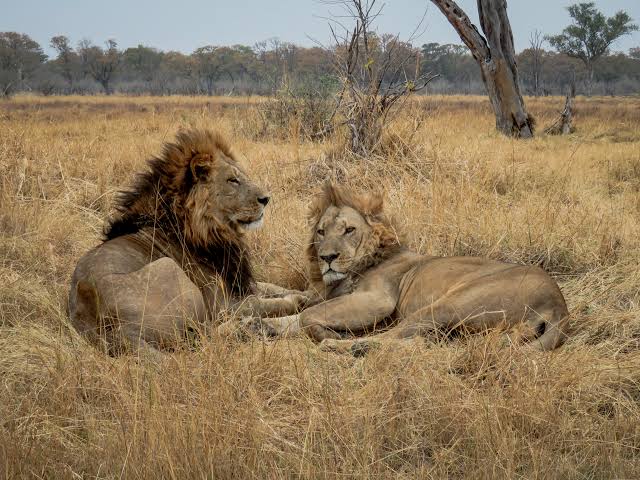
A detailed Tree-Climbing Lions Guide should help travelers understand what makes Ishasha different from other places where lions can be observed. Uganda has several protected areas supporting lions, including Queen Elizabeth National Park, Murchison Falls National Park and Kidepo Valley National Park. Uganda Wildlife Authority’s current large-carnivore conservation strategy identifies these three national parks as Uganda’s remaining principal lion landscapes.
What distinguishes Ishasha is not simply the presence of lions but the area’s established association with habitual tree use. Uganda Wildlife Authority specifically describes the Ishasha Sector of Queen Elizabeth National Park as famous for tree-climbing lions that can be seen resting in fig trees. Travelers researching this distinctive behavior can begin with our dedicated tree-climbing lion guide.
Why Is Ishasha Different from an Ordinary Lion Safari?
On many African wildlife safaris, lions are primarily searched for on the ground. Visitors may find them lying in grass, walking across savannah, feeding, interacting with pride members or resting beneath vegetation. Ishasha adds another possibility: finding large lions stretched across substantial tree branches.
The behavior changes the visual character of the encounter. Instead of concentrating entirely on grassland, travelers and guides examine large trees while moving through the Ishasha plains. A lion may be lying high enough for much of its body to remain clearly visible even when surrounding vegetation would otherwise conceal an animal resting at ground level.
However, the phrase “tree-climbing lions” should never create the impression that Ishasha lions permanently live in trees. They remain terrestrial African lions and may spend considerable time on the ground. Their repeated use of trees is the unusual behavior that has made Ishasha internationally recognizable.
Ishasha Tree-Climbing Lions versus Kasenyi Lions
Both Ishasha and Kasenyi are associated with lion viewing within Queen Elizabeth National Park, but they provide different safari experiences. Ishasha lies in the southern sector and is particularly famous for tree-climbing behavior. Kasenyi lies in another part of the Queen Elizabeth landscape and is known for conventional savannah predator viewing.
Safari Vacations and Travel Services’ current lion-tracking information states that specialized lion tracking takes place in areas including Kasenyi and Ishasha. Travelers should nevertheless distinguish specialized tracking from an ordinary game drive searching for free-ranging lions.
Visitors particularly interested in learning more about predator-focused activities can read about Queen Elizabeth lion tracking before deciding whether they want conventional game viewing, a specialized experience or both.
Ishasha Tree-Climbing Lions versus Lions in Murchison Falls National Park
Murchison Falls National Park is another major Uganda wildlife destination. Uganda Wildlife Authority describes it as Uganda’s oldest and largest national park, with extensive savannah, woodland and riverine habitats. Lions form part of the broader predator community of this northern Uganda ecosystem.
The principal difference for travelers using a Tree-Climbing Lions Guide is that Murchison Falls is not promoted by Uganda Wildlife Authority as Uganda’s characteristic tree-climbing lion destination. Ishasha holds that distinction. A traveler choosing Murchison should normally do so for the wider combination of savannah wildlife, the Victoria Nile and Murchison Falls rather than because of an expectation of habitual tree-climbing lion sightings.
This does not make one park universally better than the other. Murchison offers a broader northern Uganda safari environment, whereas Ishasha is the stronger choice when tree-climbing lion behavior is specifically the traveler’s priority.
Ishasha Tree-Climbing Lions versus Lions in Kidepo Valley National Park
Kidepo Valley National Park provides another contrasting lion-viewing environment. Uganda Wildlife Authority currently describes lions in Kidepo as being encountered around the Narus Valley and notes that they can be seen resting on rocky outcrops. This creates a very different setting from lions lying across the branches of Ishasha’s trees.
Kidepo is also geographically remote compared with the popular western Uganda circuit connecting Queen Elizabeth National Park and Bwindi. Travelers generally choose Kidepo for its remote wilderness landscapes and broader savannah safari experience rather than specifically for tree-climbing lions.
For a traveler whose main objective is seeing a lion displaying habitual tree-climbing behavior, Ishasha remains the more directly relevant destination based on current Uganda Wildlife Authority information. For someone prioritizing remote wilderness and classic savannah scenery, Kidepo presents a different and highly distinctive option.
Which Uganda Park Is Best for Tree-Climbing Lions?
For the specific search intent “Where should I see tree-climbing lions in Uganda?”, the most strongly verified answer is the Ishasha Sector of Queen Elizabeth National Park. Uganda Wildlife Authority explicitly identifies Ishasha as the country’s famous tree-climbing lion destination.
This distinction is important for search accuracy. It would be misleading to present all Uganda lion destinations as equivalent for this particular behavior. Lions occur in other major national parks, but Ishasha has the established tourism identity associated with lions repeatedly resting in trees.
Travelers wanting additional information about the animals themselves can explore our detailed account of the Ishasha tree-climbing lions.
Ishasha versus a Specialized Lion-Tracking Experience
A conventional Ishasha game drive and specialized lion tracking should not be treated as interchangeable products. During an ordinary game drive, travelers search naturally for lions and other wildlife while exploring the sector. Specialized tracking has a more focused objective and may involve additional arrangements.
Safari Vacations and Travel Services currently publishes separate information about experiential lion tracking in Queen Elizabeth National Park, demonstrating that it is treated as a distinct activity rather than simply another name for an ordinary Ishasha game drive.
For travelers primarily wanting the classic Tree-Climbing Lions Guide experience, an Ishasha game drive is the essential component. Travelers with additional time and a strong interest in predator ecology can investigate whether specialized tracking is available for their travel dates.
Ishasha versus Lion Filming and Professional Wildlife Photography
Professional filmmakers and serious photographers may have different requirements from ordinary safari visitors. They may need more time, specialized logistical support, carefully positioned vehicles and compliance with filming regulations or professional permissions.
Safari Vacations and Travel Services publishes separate information for professional lion filming in Uganda. This distinction is important because an ordinary tourist game drive should not automatically be described as providing the same access or arrangements as a professional filming expedition.
For conventional travelers, patient wildlife photography from an authorized safari vehicle remains the appropriate approach. A telephoto lens allows visitors to photograph naturally behaving lions without requiring an unnecessarily close approach.
Ishasha for First-Time Safari Travelers
Ishasha can work particularly well for first-time safari travelers when it forms part of a broader Queen Elizabeth National Park itinerary. The visitor can search for tree-climbing lions while still experiencing the larger savannah ecosystem rather than traveling to a location supporting only one attraction.
First-time visitors should understand that an Ishasha safari is not comparable with visiting a zoo or wildlife sanctuary where the location of an animal is known. Lions may move, rest out of sight or remain on the ground. Patience and realistic expectations are therefore essential.
A short lion-focused itinerary such as this verified three-day Ishasha safari can suit travelers who want Ishasha to be the central wildlife experience rather than one small stop in a much longer journey.
Ishasha for Wildlife Photographers
Photographers may find Ishasha especially attractive because tree-climbing behavior creates compositions that differ from conventional lion photographs. Branches can frame an animal, elevated lions can sometimes be photographed against open sky, and wider images can reveal the relationship between predator, tree and savannah.
Nevertheless, photographers should avoid expecting an unobstructed lion posed on an ideal branch. Leaves, harsh light, distance and the animal’s position can all influence image quality. The lion determines where it rests and which direction it faces.
Travelers whose main goal is photography may benefit from allocating multiple game-drive periods rather than relying on one short pass through Ishasha. More time creates more opportunities, although it still does not guarantee tree-climbing activity.
Ishasha for Families
A vehicle-based Ishasha safari can fit into a family wildlife itinerary because the principal game-viewing activity does not require the strenuous forest trekking associated with mountain gorilla tracking. Families should nevertheless confirm lodge policies, vehicle arrangements and any applicable park rules for children before travel.
Children should also be prepared for the reality that wildlife searching sometimes requires patience. The lions may not appear immediately, and an effective game drive can involve significant periods of watching and searching rather than continuous dramatic encounters.
Ishasha for Couples and Honeymoon Travelers
Couples can integrate Ishasha into a slower western Uganda itinerary combining wildlife, comfortable accommodation and other nature experiences. Rather than treating the lion sighting as a standalone activity, travelers can combine game drives with other parts of Queen Elizabeth National Park and then continue toward Bwindi.
The appeal lies in contrast: open savannah and large predators in Ishasha can be followed by mountain rainforest and gorilla trekking in Bwindi. This creates considerable variety without requiring travelers to move between distant countries.
Ishasha for Travelers Combining Lions and Gorillas
One of Ishasha’s strongest advantages over more distant Uganda lion destinations is its relationship with Bwindi Impenetrable National Park. Uganda Wildlife Authority states that Bwindi is approximately 64 kilometers from Ishasha and that the connecting journey is largely along a dirt road for which a four-wheel-drive vehicle is highly recommended.
This makes the lion-and-gorilla combination especially practical. Travelers can move from a savannah predator experience into one of Uganda’s major primate destinations within the same regional itinerary.
Safari Vacations and Travel Services currently publishes a five-day gorilla trek and lion-tracking combination that passes through the Ishasha Sector and includes searching for tree-climbing lions.
Is a 3-Day or 4-Day Tree-Climbing Lion Safari Better?
The answer depends on what the traveler wants to experience. Three days can be sufficient for a focused Ishasha journey when time is limited. Four days create more flexibility for additional Queen Elizabeth National Park activities and can reduce the pressure to compress wildlife viewing into a very short schedule.
Safari Vacations and Travel Services’ verified four-day tree-climbing lion itinerary includes wider Queen Elizabeth activities before dedicated tree-climbing lion searching in Ishasha.
Neither duration guarantees a lion sighting. The value of the additional day lies in broader safari opportunities and additional flexibility rather than a promise that wildlife will behave in a particular way.
Should You Choose Ishasha or a Longer Uganda Wildlife Circuit?
Travelers with only a few days can make Ishasha the principal destination. Those with a week or more can integrate it into a broader circuit containing primate trekking and additional savannah parks.
A longer itinerary is particularly useful for travelers visiting Uganda for the first time because it provides context. Seeing tree-climbing lions becomes one part of a diverse wildlife journey rather than the only objective. Safari Vacations and Travel Services’ verified eight-day Uganda circuit combines Bwindi, Kibale and Queen Elizabeth National Park and passes through Ishasha.
Tree-Climbing Lions versus Other Predators
Ishasha’s lions should also be appreciated within a wider carnivore ecosystem. Travelers naturally focus on lions because their tree-climbing behavior is visually dramatic, but a successful safari should remain open to other predator and wildlife observations.
The presence of other animals helps travelers understand that Ishasha is not a controlled lion-viewing enclosure. Predator movements are connected with prey distribution, habitat and ecological conditions across the landscape.
Are Ishasha Lions a Different Species from Other African Lions?
No evidence found in the current research supports describing Ishasha’s tree-climbing lions as a separate species. The distinguishing characteristic discussed in this Tree-Climbing Lions Guide is behavior, not a separate taxonomic identity.
Calling them “tree-climbing lions” is therefore a descriptive reference to what they do. It should not be interpreted as meaning that Uganda possesses a separate species called the tree-climbing lion.
Are Ishasha’s Lions the Only Lions in Africa That Climb Trees?
No. A fact-checked Tree-Climbing Lions Guide should avoid claiming that Ishasha contains the only tree-climbing lions in Africa or the world. Lions can climb in other locations, and habitual tree-climbing behavior is also famously associated with some lions in Tanzania.
What can be stated confidently from Uganda Wildlife Authority’s current information is that Ishasha is famous for this behavior and is Uganda’s principal destination associated with tree-climbing lions.
Does Ishasha Offer the Best Chance of Seeing Tree-Climbing Lions in Uganda?
Current official Uganda Wildlife Authority information identifies Ishasha specifically with tree-climbing lions, while its descriptions of other major lion destinations emphasize different characteristics. On that basis, Ishasha is the most directly relevant Uganda destination for travelers specifically seeking this behavior.
This should still be described as an opportunity rather than a guarantee. No ethical safari operator can control whether a wild lion climbs a tree during a particular visitor’s game drive.
What Makes an Ishasha Lion Encounter Special?
The strongest encounters combine behavior, landscape, and unpredictability. Spotting a lion after searching the open plains is already memorable. Discovering that same large predator resting comfortably across the limbs of a tree creates an unusual wildlife scene that has become closely associated with Uganda.
The experience becomes more meaningful when travelers understand that the lion has not been placed there for tourism. It selected the tree itself and can descend whenever it chooses. This is precisely why patience, responsible viewing and realistic expectations should remain central to every Tree-Climbing Lions Guide.
Which Travelers Should Prioritize Ishasha?
Ishasha is particularly suitable for travelers interested in lions, wildlife behavior, photography, and itineraries linking Queen Elizabeth National Park with Bwindi. It also works well for visitors who want something different from conventional ground-level predator sightings.
Travelers whose primary interest is waterfalls and Nile-based wildlife may prioritize Murchison Falls National Park, while visitors searching for remote wilderness may place greater emphasis on Kidepo. Those specifically searching for Uganda’s famous tree-climbing lion behavior should prioritize Ishasha.
How Should You Choose the Right Tree-Climbing Lion Safari?
Begin with the number of days available and the experiences that matter most. A short trip can concentrate on Ishasha. A four- or five-day journey can combine tree-climbing lions with other Queen Elizabeth National Park activities or Bwindi. Longer itineraries can add chimpanzee trekking, additional game drives and other Uganda destinations.
Travelers should also consider accommodation preferences, photography priorities, road travel tolerance and whether gorilla trekking is part of the same journey. Gorilla permit availability may influence itinerary dates, whereas wild lion behavior can never be scheduled.
For travelers who want a more predator-focused program, Safari Vacations and Travel Services also publishes a verified three-day Queen Elizabeth wildlife and experiential lion-tracking experience.
Final Comparison: Why Ishasha Stands Out
Uganda provides several excellent environments for observing lions, but these destinations should not be presented as identical. Murchison Falls offers an extensive savannah-and-Nile ecosystem. Kidepo provides remote wilderness and lions that Uganda Wildlife Authority notes can be encountered around rocky outcrops. Queen Elizabeth National Park offers varied wildlife habitats, while its southern Ishasha Sector contributes the exceptional behavior at the heart of this Tree-Climbing Lions Guide.
Ishasha’s strongest advantage is therefore specificity. Travelers do not visit merely because lions occur there; they visit because it is Uganda’s best-established destination for searching for lions displaying repeated tree-climbing behavior. The sighting remains unpredictable, which is exactly what makes finding the animals naturally so rewarding.
A carefully planned safari should give Ishasha sufficient time, avoid guaranteeing sightings and combine the sector with other attractions only when those experiences genuinely match the traveler’s interests. Whether Ishasha becomes a three-day lion-focused trip or one stage of a longer gorilla, chimpanzee and wildlife journey, its tree-climbing lions provide one of the most distinctive predator experiences in Uganda.
Tree-Climbing Lions Myths, Advanced FAQs and Final Safari Planning
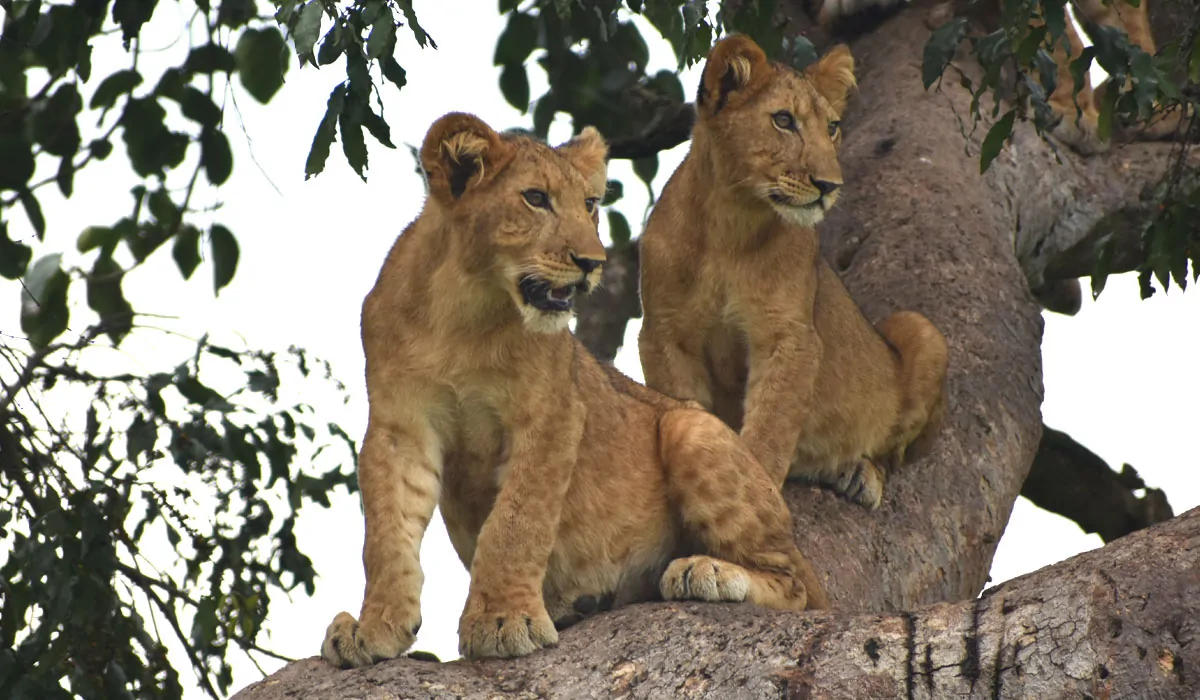
The final part of a comprehensive Tree-Climbing Lions Guide should answer the questions travelers commonly ask after learning where the lions live, why they climb, when to visit, and how to include Ishasha in an itinerary. It should also correct misleading claims that have become common in online safari content. Uganda Wildlife Authority identifies the Ishasha Sector of Queen Elizabeth National Park as one of the places where lions climb trees and specifically describes them using fig trees.
Visitors should approach Ishasha with realistic expectations. These are free-ranging African lions rather than animals conditioned to appear at a particular tourist viewpoint. Their location, activity, and decision to climb a tree cannot be scheduled. Travelers who want a broader introduction to the destination can begin with our complete Tree-Climbing Lions Guide.
Myth: Tree-Climbing Lions Are a Separate Species
Tree-climbing lions should not be described as a separate lion species. The term refers to behavior. Ishasha’s lions are famous because individuals within this population are repeatedly observed climbing and resting in trees, not because they belong to a special species known scientifically as the “tree-climbing lion.”
This distinction is important for SEO accuracy. Describing tree-climbing lions as a unique species would mislead readers. A factual Tree-Climbing Lions Guide should instead explain that tree use is an unusual and locally prominent behavior displayed by lions in Ishasha and also observed among lions in some other African landscapes.
Myth: Ishasha Is the Only Place in the World Where Lions Climb Trees
Ishasha should not be promoted as the only place on Earth where a lion can climb a tree. Uganda Wildlife Authority describes Queen Elizabeth National Park as one of the few places where lions are noted for tree climbing, particularly in Ishasha. The important claim that can be supported is that Ishasha is one of Africa’s most famous destinations for observing this behavior.
Making this distinction strengthens rather than weakens the page. Travelers receive an accurate explanation instead of an exaggerated tourism slogan, while Ishasha retains its genuine significance as Uganda’s best-known tree-climbing lion destination.
Myth: Every Ishasha Lion Is Always Found in a Tree
The phrase “tree-climbing lions” does not mean the animals permanently remain above ground. Lions can be found resting on the ground, moving through grassland, interacting with pride members or disappearing into areas where tourists cannot easily see them.
Finding lions in a tree is therefore a possibility, not a guaranteed daily event. Safari Vacations and Travel Services’ dedicated information about Ishasha’s tree-climbing Lions describes the sector and its famous behavior while recognizing that wildlife viewing depends on natural conditions.
Myth: Lions Only Climb Trees to Escape the Heat
Heat relief is frequently offered as an explanation for tree climbing, but it should not be presented as the conclusively proven reason for every Ishasha lion. Avoidance of biting insects, resting comfort, improved visibility and learned behavior have also been proposed as possible influences.
Information establishing one scientifically definitive cause for habitual tree climbing among the Ishasha lions was not found in the current search results. A high-quality Tree-Climbing Lions Guide should therefore describe these explanations as hypotheses or contributing factors rather than proven universal facts.
Myth: Tree-Climbing Lions Hunt by Jumping from Trees
Uganda Wildlife Authority’s current Queen Elizabeth National Park page says lions in Ishasha can perch in fig trees while watching Uganda kob below. However, this should not be expanded into an unsupported claim that Ishasha lions routinely hunt by jumping from trees onto prey.
Information establishing tree-to-ground ambush attacks as the normal hunting strategy of Ishasha lions was not found in the current search results. Lions remain predominantly terrestrial predators, and seeing a lion watching the plains from a branch does not by itself demonstrate that it intends to launch an attack from that position.
Myth: Tree-Climbing Lion Sightings Can Be Guaranteed
No responsible safari operator should guarantee that a visitor will find lions sitting in trees on a specific game drive. Guides can search areas where lions have recently been observed and examine suitable trees, but they cannot control wild animals.
Travelers should be particularly cautious about safari descriptions that imply a guaranteed tree-climbing encounter. A better promise is an opportunity to explore Ishasha in search of its famous lions while observing the other wildlife and landscapes encountered during the drive.
How Difficult Is It to Find the Tree-Climbing Lions?
The difficulty varies from day to day. Lions may sometimes be visible in prominent trees, while on another drive they may be on the ground, concealed by vegetation or elsewhere within their range. This is one reason knowledgeable guiding and sufficient game-drive time are valuable.
Safari Vacations and Travel Services publishes a dedicated resource explaining how travelers can find the lions in Uganda and plan their Ishasha visit.
Should You Visit Ishasha Only for the Lions?
Travelers can certainly make the lions their main objective, but Ishasha should be viewed as a wildlife ecosystem rather than a single-species attraction. Searching for lions takes place during game drives through a protected savannah landscape where other wildlife encounters form part of the experience.
This mindset becomes particularly important when the lions are difficult to locate. A safari should not be considered unsuccessful simply because no lion happened to climb a visible tree during the visitor’s time in the sector.
Is One Game Drive Enough?
One game drive may produce an excellent encounter, but there is no guarantee. Travelers for whom tree-climbing lions are a major priority may prefer more than one opportunity to search Ishasha.
Adding another drive does not guarantee success; it simply gives visitors additional time in lion habitat. Safari Vacations and Travel Services currently recommends spending meaningful time in Queen Elizabeth National Park when combining Ishasha with other attractions such as the Kazinga Channel.
Should You Stay Inside or Near Ishasha?
Accommodation close to the sector can reduce the amount of time spent transferring before and after lion searches. The best property depends on budget, preferred comfort level and availability for the intended dates.
Safari Vacations and Travel Services’ verified Ishasha accommodation information describes several options for visitors planning overnight stays in the southern sector. Travelers can use this Lodges guide as a starting point and then confirm current rates and availability for their actual travel dates.
Can You See the Lions While Driving Through Ishasha to Bwindi?
It is possible to include a search for tree-climbing lions while traveling between Queen Elizabeth National Park and Bwindi, but travelers should avoid assuming that merely driving through Ishasha guarantees a sighting. Uganda Wildlife Authority specifically describes the route to Bwindi through Ishasha as providing an opportunity to stop and search for the iconic tree-climbing lions.
UWA gives the distance from Ishasha to Bwindi as approximately 64 kilometers and states that the journey is mainly along a dirt road, with a four-wheel-drive vehicle highly recommended.
Is Ishasha Better as a Stopover or an Overnight Destination?
A stopover can work when a traveler’s schedule is restricted, especially when moving between Queen Elizabeth National Park and Bwindi. An overnight stay is generally more appropriate for visitors who consider tree-climbing lions a major safari priority because it can make additional wildlife-viewing time possible.
The choice should depend on the entire route rather than an arbitrary number of nights. A well-designed Tree-Climbing Lions Guide itinerary balances time in Ishasha with the other experiences the traveler genuinely wants to include.
Can You Combine Ishasha and the Kazinga Channel?
Yes. Both form part of the wider Queen Elizabeth National Park experience but offer very different styles of wildlife viewing. Ishasha is primarily explored by safari vehicle while searching for terrestrial wildlife and tree-climbing lions, whereas the Kazinga Channel provides a boat-based perspective on wildlife around the water.
Safari Vacations and Travel Services currently publishes a five-day itinerary combining the Kazinga Channel with tree-climbing lion Viewing, demonstrating how the two experiences can fit naturally within one Queen Elizabeth National Park journey.
Can You Combine Tree-Climbing Lions and Gorilla Trekking?
Yes. This is one of the strongest safari combinations available in western Uganda. Ishasha provides savannah game viewing, while Bwindi offers a completely different forest environment centered on mountain gorilla trekking.
Uganda Wildlife Authority independently confirms the route between Ishasha and Bwindi, making the combination geographically practical. Travelers can choose between road-based itineraries and, depending on the wider program, combinations using domestic flights for portions of the journey.
Can You Fly for Part of a Lions and Gorillas Safari?
Yes, some Uganda itineraries use domestic flights to reduce long road transfers. The exact airstrip, schedule, baggage conditions and transfer arrangements depend on the itinerary and current airline operations, so these should be checked for specific travel dates.
Safari Vacations and Travel Services publishes a verified five-day Gorilla and Queen Elizabeth Flying Safari for travelers comparing road-based and flight-supported options.
Can You Visit Ishasha from Kigali?
Yes. Kigali can be used as a starting point for some Uganda wildlife itineraries, provided travelers meet the applicable immigration and border-entry requirements. Safari Vacations and Travel Services currently publishes a verified three-day Queen Elizabeth National Park safari beginning in Kigali.
Travel times should not be treated as absolutely fixed because international border procedures, road conditions, traffic and the precise accommodation location can affect the journey.
Can You Visit Ishasha from Entebbe?
Yes. Entebbe is a common international arrival point for Uganda itineraries, after which visitors can travel west by road or use domestic aviation as part of selected itineraries. The best choice depends on time, budget and the destinations being combined.
Travelers with several days available can incorporate Queen Elizabeth National Park into a broader Uganda wildlife circuit rather than treating Ishasha as a standalone excursion.
Is Ishasha Suitable for First-Time Visitors to Uganda?
Yes. Ishasha can fit particularly well into a first Uganda safari because it can be combined with other highly contrasting experiences. A traveler might begin with savannah wildlife, continue to gorilla trekking and, on a longer itinerary, add chimpanzees or another national park.
Safari Vacations and Travel Services currently publishes advice and safari Packages for first-time travelers comparing Uganda’s major wildlife and primate experiences.
Is Ishasha Suitable for Experienced Safari Travelers?
Ishasha can be equally appealing to travelers who have already seen lions elsewhere in Africa. The attraction is behavioral rather than simply adding another lion species to a wildlife checklist. Finding a large terrestrial predator resting across a tree branch provides a different photographic and observational experience from conventional savannah lion viewing.
Experienced travelers may benefit from allocating additional time to Ishasha rather than trying to maximize the number of destinations visited. More time allows greater attention to animal behavior, photography and the wider ecology of the sector.
Is Ishasha Good for Birdwatching as Well as Lions?
Queen Elizabeth National Park supports substantial bird diversity in addition to large mammals. Safari Vacations and Travel Services describes the national park as an important birding destination because of its varied savannah, wetland, forest and lake-associated habitats.
Travelers interested in both predators and birds can therefore treat the journey as a broader natural-history safari rather than concentrating exclusively on lions.
Can Tree-Climbing Lions Be Seen During the Wet Season?
Ishasha can be visited during wetter periods, but rainfall can affect roads, vegetation and general game-drive conditions. The existence of a rainy season does not mean the lions leave Ishasha or lose the physical ability to climb.
Information proving that tree-climbing sightings stop entirely during particular rainy months was not found in the current search results. Claims that the lions can only be seen during a narrow dry-season window should therefore be avoided.
Can Tree-Climbing Lions Be Seen During the Dry Season?
Yes. Dry periods are widely promoted for Uganda wildlife viewing because vegetation and road conditions can be favorable. Safari Vacations and Travel Services’ existing Ishasha information identifies dry periods as attractive times for game viewing.
However, dry-season travel still does not guarantee that a lion will be in a tree. Weather conditions and animal behavior are separate considerations.
How Early Should You Book an Ishasha Safari?
There is no universal booking deadline for an ordinary Ishasha game drive. However, accommodation and safari logistics can become more constrained during popular travel periods. Travelers combining Ishasha with mountain gorilla trekking should pay particular attention to permit availability because gorilla permits are limited for specific trekking dates.
Therefore, travelers planning a multi-destination safari should organize the permit-dependent activity first and structure Ishasha and the surrounding wildlife itinerary around confirmed availability.
What Is the Biggest Mistake Travelers Make When Planning Ishasha?
One of the biggest planning mistakes is treating Ishasha as though it contains a guaranteed lion-viewing station. That expectation can lead travelers to allocate an unrealistically short period and assume they will simply arrive, photograph lions in trees and leave.
A more effective Tree-Climbing Lions Guide strategy is to allocate meaningful game-drive time, stay flexible and treat all wildlife encounters as natural. This approach produces a stronger safari even if the lions happen to remain on the ground.
Should Photographers Spend Longer in Ishasha?
Photographers with tree-climbing lions as a primary objective may benefit from additional time because lighting, animal position, vegetation, and weather can affect photographs significantly. A lion may be visible but partially hidden by foliage, facing away from the vehicle or lying in strong midday light.
Multiple viewing opportunities create different possibilities without guaranteeing any particular photograph. Ethical photographers should also resist attempts to manipulate an animal’s behavior for a better composition.
Should You Choose a Private or Group Safari?
Private safaris generally offer greater control over how long the vehicle spends at particular wildlife sightings, while group travel can reduce per-person costs by sharing transport expenses. Which option is better depends on budget, photography priorities, and the traveler’s preferred pace.
Travelers whose primary objective is detailed lion photography may value the flexibility of a private vehicle, whereas visitors who simply want Ishasha included within a broader safari may be comfortable sharing their experience.
How Does Ishasha Fit into a Longer Uganda Safari?
Ishasha works particularly well as part of a western Uganda wildlife circuit. Queen Elizabeth National Park can be combined with Bwindi for mountain gorillas and, on longer journeys, Kibale for chimpanzees. This allows travelers to experience savannah predators, rainforest primates and several contrasting ecosystems during one journey.
Visitors who want both Ishasha and wider Queen Elizabeth wildlife viewing can also use itineraries that connect the sector with the Kazinga Channel rather than leaving the park immediately after finding lions.
Can You Build an Entire Safari Around Lions?
Yes, although the journey should still acknowledge the unpredictability of wildlife. A short safari can make Ishasha its main destination and dedicate game-drive time specifically to searching for tree-climbing lions.
Safari Vacations and Travel Services currently publishes a verified three-day Ishasha Safari designed around this experience.
What Makes a Reliable Tree-Climbing Lions Guide?
A reliable guide should clearly separate verified facts from tourism folklore. It should explain that Ishasha is famous for tree-climbing lions without claiming that the behavior occurs every day. It should avoid describing the lions as a separate species, avoid inventing guaranteed sighting percentages, and avoid assigning one definitive reason for tree climbing when the available evidence does not establish one.
It should also explain practical considerations such as road conditions, game-drive time, accommodation location, the possibility of combining Ishasha with Bwindi and the importance of viewing lions responsibly.
Why Accurate Information Matters When Planning Ishasha
Wildlife tourism relies heavily on expectation. Statements such as “the lions always climb at midday,” “all Ishasha lions live in trees,” or “every visitor will see them” sound attractive but create false expectations unless supported by reliable evidence.
Accuracy is more useful. Uganda Wildlife Authority confirms that Ishasha is famous for tree-climbing lions. That verified distinction is strong enough without adding unsupported guarantees.
Final Decision: Is Seeing the Tree-Climbing Lions of Ishasha Worth It?
For travelers interested in African lions, unusual animal behavior, wildlife photography, or a route linking Queen Elizabeth National Park with Bwindi, Ishasha offers a highly distinctive safari experience. Uganda Wildlife Authority itself identifies the tree-climbing lions of Ishasha among Uganda’s iconic wildlife attractions.
The experience is most rewarding when visitors understand exactly what they are seeking. Ishasha does not promise a permanently occupied lion tree. It offers an opportunity to enter a protected savannah ecosystem and search naturally for lions whose repeated use of trees has made the sector famous.
A strong Tree-Climbing Lions Guide safari therefore combines patience, sufficient viewing time, appropriate transport, responsible wildlife behavior and realistic expectations. Travelers can make Ishasha the principal destination of a short safari or integrate it with the Kazinga Channel, Bwindi gorilla trekking and a longer Uganda wildlife circuit.
Whichever itinerary is selected, the central principle should remain the same: visit Ishasha to observe wild lions behaving naturally rather than expecting wildlife to perform on demand. Finding one of Uganda’s famous lions stretched across the branches of a fig tree is extraordinary precisely because the encounter remains genuinely wild.
How to Combine Tree-Climbing Lions with the Best Uganda Safari Routes
A Tree-Climbing Lions Guide becomes considerably more useful when it explains how Ishasha fits into a complete Uganda safari rather than treating the lions as an isolated attraction. The Ishasha Sector occupies the southern part of Queen Elizabeth National Park and sits conveniently on one of the most useful wildlife routes through western Uganda. Uganda Wildlife Authority confirms that Ishasha is famous for its tree-climbing lions and that the route south from Queen Elizabeth National Park toward Bwindi can pass through this sector.
This location gives travelers several itinerary choices. Ishasha can form the principal destination of a short lion safari, become a wildlife stop between Queen Elizabeth National Park and Bwindi, or form one stage of a longer journey incorporating gorillas, chimpanzees, the Kazinga Channel and additional game drives. Travelers beginning with the lions themselves can first explore this detailed Ishasha resource before choosing the most suitable route.
Why Ishasha Fits Naturally into a Western Uganda Safari
One of Ishasha’s greatest advantages is geography. It forms part of Queen Elizabeth National Park while also lying relatively close to Bwindi Impenetrable National Park. Uganda Wildlife Authority gives the distance between Ishasha and Bwindi as approximately 64 kilometers and states that the journey is mainly on a dirt road, with a four-wheel-drive vehicle highly recommended.
This means travelers do not necessarily need to make a major detour to include tree-climbing lions when traveling between Uganda’s savannah and gorilla destinations. Instead, a carefully planned route can turn what would otherwise be a transfer day into an additional wildlife-viewing opportunity.
However, travelers should avoid assuming that simply driving through Ishasha will automatically produce a lion sighting. Uganda Wildlife Authority describes the route as offering an opportunity to stop and search for the tree-climbing lions, not a guaranteed encounter.
Route One: Entebbe to Bwindi and Ishasha
A straightforward Tree-Climbing Lions Guide itinerary can begin in Entebbe or Kampala and travel toward Bwindi Impenetrable National Park for mountain gorilla trekking before continuing into Ishasha. This route works particularly well for travelers whose two highest priorities are gorillas and lions.
Safari Vacations and Travel Services’ verified five-day itinerary follows this general structure. It includes two nights around Bwindi, gorilla trekking, transfer to Ishasha, an evening game drive and additional morning and afternoon wildlife viewing in the southern sector.
Travelers interested in concentrating on these two experiences can study the five-day gorilla-and-lion combination when deciding how many nights to dedicate to each destination.
Route Two: Queen Elizabeth National Park to Ishasha and Bwindi
Another highly logical itinerary begins in the northern or central parts of Queen Elizabeth National Park before traveling south through Ishasha and continuing to Bwindi. This allows travelers to experience more than one section of Queen Elizabeth National Park before switching from savannah wildlife to rainforest primates.
Uganda Wildlife Authority confirms that the route toward Bwindi can pass through Ishasha and states that Bwindi is approximately 160 kilometers from Mweya and about 64 kilometers from Ishasha.
The advantage of this route is diversity. Travelers can enjoy traditional game drives elsewhere in Queen Elizabeth National Park, search for the famous tree-climbing lions in Ishasha and then continue toward mountain gorilla trekking.
Route Three: Kibale to Queen Elizabeth, Ishasha and Bwindi
For travelers with approximately one week, adding Kibale National Park creates one of Uganda’s strongest primate-and-wildlife circuits. The route can begin with chimpanzee trekking in Kibale, continue to Queen Elizabeth National Park for savannah wildlife and the Kazinga Channel, pass south through Ishasha and finish with mountain gorilla trekking in Bwindi.
Uganda Wildlife Authority confirms that Kibale National Park offers guided chimpanzee tracking from Kanyanchu Visitor Centre. Current UWA information lists daily tracking sessions and describes Kibale as one of Uganda’s principal chimpanzee destinations.
Safari Vacations and Travel Services’ current seven-day Uganda Gorilla Trekking and Wildlife Safari follows this broad western route, moving from Kibale to Queen Elizabeth National Park and then through Ishasha toward Bwindi. Its itinerary specifically notes that the Ishasha journey may provide opportunities to search for tree-climbing lions. Travelers comparing a complete week-long itinerary can use this structure as a practical starting point.
Why Add Chimpanzees to a Tree-Climbing Lions Safari?
Chimpanzee trekking adds an entirely different wildlife environment to a Tree-Climbing Lions Guide itinerary. Ishasha is predominantly a vehicle-based savannah experience, whereas chimpanzee trekking involves walking through tropical forest with trained guides.
The difference between these environments creates a more diverse safari. Travelers may spend one day following chimpanzee calls through forest, another watching elephants and antelopes on open plains, another searching large fig trees for lions and later trek through Bwindi in search of mountain gorillas.
Safari Vacations and Travel Services also publishes a verified seven-day chimpanzee and gorilla trekking journey passing through Kibale, Queen Elizabeth National Park and Bwindi.
Route Four: Bwindi, Ishasha, Kasenyi and the Kazinga Channel
Travelers with around six days can build a route that combines mountain gorillas with several parts of Queen Elizabeth National Park rather than visiting Ishasha alone. This makes sense for travelers who want the tree-climbing lions but also want traditional savannah game drives and a boat safari.
Safari Vacations and Travel Services’ verified six-day Uganda itinerary combines Bwindi with the Ishasha Sector before continuing into northern Queen Elizabeth National Park for wildlife viewing around the Kasenyi area and a boat-cruise experience.
This six-day safari demonstrates an important planning principle: visitors do not need to choose between Ishasha and the better-known activities elsewhere in Queen Elizabeth National Park when sufficient time is available.
Combining Ishasha with the Kazinga Channel
The Kazinga Channel provides a useful contrast to tree-climbing lion viewing. Ishasha is primarily explored by road, whereas the Kazinga Channel offers wildlife viewing from the water. Combining the two gives travelers different perspectives on Queen Elizabeth National Park’s ecosystems.
A complete Tree-Climbing Lions Guide itinerary should therefore consider whether travelers want Ishasha to stand alone or form part of a broader Queen Elizabeth experience. Those with several days available can normally gain more from the national park by exploring more than one habitat.
Combining Ishasha with Kasenyi
Kasenyi and Ishasha should not be treated as identical lion experiences. Ishasha is specifically recognized by Uganda Wildlife Authority for its tree-climbing lions, while other areas of Queen Elizabeth National Park offer more conventional savannah predator viewing.
Using both areas in the same safari can increase the diversity of game viewing. Visitors may search the northern plains for predators and other savannah mammals before continuing south toward Ishasha specifically to look for lions using trees.
Travelers comparing Uganda’s various predator destinations can use this guide to the best lions locations to understand how Queen Elizabeth National Park compares with Murchison Falls and Kidepo Valley National Park.
Route Five: A Short Ishasha-Only Safari
Not every traveler needs a week-long safari. Someone who has already completed gorilla trekking or who is primarily interested in tree-climbing lions can design a shorter itinerary centered specifically on Ishasha.
A short safari generally works best when travelers resist the temptation to add too many distant destinations. Long road transfers can consume valuable game-viewing time, particularly when the trip contains only a few days.
Safari Vacations and Travel Services currently publishes a verified three-day escape focused on Ishasha and its tree-climbing lions. This type of itinerary is most suitable when the traveler wants the lion experience to remain the central purpose of the trip.
Can Ishasha Be Included as a Stopover?
Yes. Uganda Wildlife Authority itself notes that travelers using the Queen Elizabeth National Park route toward Bwindi can stop in Ishasha to search for the iconic tree-climbing lions.
The important distinction is between a stopover and a dedicated lion safari. A short stop provides an opportunity, whereas spending a night in or near Ishasha can create time for additional game-drive periods.
Travelers for whom lions are only one of many interests may be satisfied with a stopover. Dedicated photographers or travelers specifically visiting Uganda because of the tree-climbing lions may prefer more time.
Can You Combine Ishasha with Lake Bunyonyi?
Lake Bunyonyi can be incorporated into longer southwestern Uganda itineraries, particularly after gorilla trekking. Safari Vacations and Travel Services’ current seven-day Uganda itinerary describes Lake Bunyonyi as an optional component depending on routing and accommodation arrangements.
This type of extension changes the pace of the journey. Ishasha focuses on wildlife searching, Bwindi on physically active forest trekking and Lake Bunyonyi can provide a quieter landscape experience after the more demanding safari activities.
Can You Combine Ishasha with Kigali?
Travelers arriving through Rwanda can build cross-border itineraries that continue into southwestern Uganda. The exact route depends on immigration requirements, travel documents, border procedures and the final Uganda destinations being visited.
A Kigali-based traveler particularly interested in gorillas and tree-climbing lions may consider entering southwestern Uganda, completing gorilla trekking and then continuing toward Ishasha. The correct order should be based on confirmed gorilla permit dates, accommodation and route logistics rather than simply trying to minimize kilometer distances.
Can You Start a Tree-Climbing Lion Safari from Entebbe?
Yes. Entebbe is a common starting and finishing point for Uganda wildlife itineraries. Travelers can travel west by road or use domestic flights for parts of selected safari programs before continuing by vehicle.
Road travel provides a closer experience of western Uganda’s changing landscapes but requires more time. Flight-supported itineraries may reduce some long transfer periods but generally cost more and still require road transfers between airstrips, lodges and national parks.
Should Ishasha Come Before or After Gorilla Trekking?
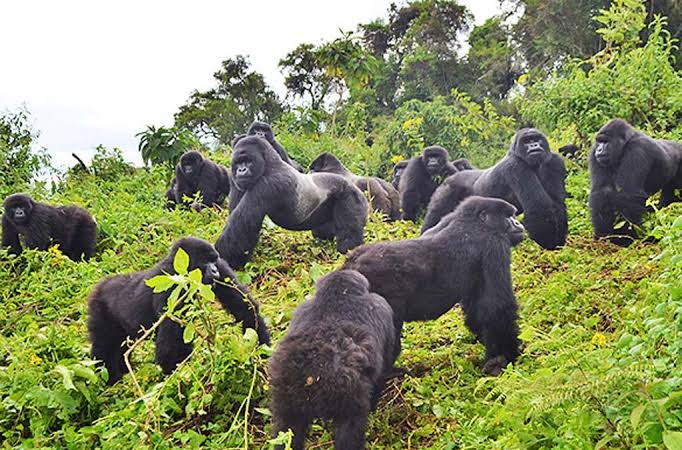
Either order can work. Some itineraries trek gorillas first and continue north toward Ishasha, whereas others visit Queen Elizabeth National Park and Ishasha before traveling to Bwindi.
The most important consideration is the fixed date and sector shown on the gorilla permit. Once that activity is confirmed, accommodation and Ishasha game drives can be arranged around it.
Safari Vacations and Travel Services publishes itineraries using both types of routing, confirming that there is no single mandatory direction for combining the two experiences.
How Many Days Should You Spend on a Lions and Gorillas Safari?
A short combination can be achieved in approximately four or five days when the route is carefully designed, while six or seven days allows more wildlife viewing and a less compressed schedule. Safari Vacations and Travel Services’ current gorilla-and-tree-climbing-lion planning information states that many travelers use four- to seven-day circuits, depending on time and budget.
Travelers should not assume that the shortest itinerary is automatically the best value. Reducing the number of days can increase the proportion of the journey spent driving and decrease the amount of time available for wildlife searching.
Is Seven Days Enough for Lions, Gorillas and Chimpanzees?
Yes, when the itinerary follows a logical western Uganda route. Safari Vacations and Travel Services’ verified seven-day Uganda Gorilla Trekking and Wildlife Safari links Kibale, Queen Elizabeth National Park, Ishasha and Bwindi within one week.
This is close to the minimum duration at which all three major wildlife themes can be combined without turning every day into a long-distance transfer. Travelers wanting slower travel, additional game drives or more time at individual destinations should consider extending the journey.
Is Ten Days Better Than Seven Days?
A longer safari provides greater flexibility but is not automatically necessary for every traveler. Ten days can make sense for visitors who want additional destinations, slower transfers, multiple game drives or cultural and scenic experiences alongside the principal wildlife activities.
Seven days is more appropriate for travelers prioritizing a concentrated western Uganda circuit. The choice should therefore be based on desired experiences rather than assuming that a longer itinerary is always superior.
Should You Add Murchison Falls to an Ishasha Safari?
Murchison Falls National Park can add another major savannah and Nile-based experience, but it lies outside the compact western Uganda circuit linking Kibale, Queen Elizabeth and Bwindi. Adding Murchison therefore requires additional travel time.
Uganda Wildlife Authority describes Murchison Falls National Park as one of Uganda’s major protected landscapes and distinguishes its famous waterfall and Nile environment from the tree-climbing lions of Ishasha.
Travelers with only five to seven days should carefully consider whether adding Murchison would make the journey unnecessarily rushed. Those with more time can build a broader Uganda wildlife circuit.
Should You Add Kidepo Valley National Park?
Kidepo Valley National Park offers a very different safari experience characterized by remote wilderness, extensive savannah and major wildlife populations. Uganda Wildlife Authority highlights lions, buffaloes, elephants and Uganda’s only wild ostrich population among Kidepo’s attractions.
However, Kidepo is geographically separate from the Ishasha–Bwindi–Queen Elizabeth circuit. Travelers primarily interested in tree-climbing lions and gorillas should generally complete the western route first before deciding whether they have sufficient time for a northern extension.
Which Route Is Best for First-Time Uganda Visitors?
For many first-time visitors, the Kibale–Queen Elizabeth–Ishasha–Bwindi route provides one of the strongest introductions to Uganda because it combines chimpanzees, traditional savannah wildlife, tree-climbing lions and mountain gorillas.
The route also allows travelers to move through dramatically different ecosystems without repeatedly returning to Kampala or Entebbe between every activity.
Those beginning to design a larger Uganda itinerary can use this comprehensive wildlife-and-Bwindi planning resource before finalizing the order and duration of individual destinations.
Which Route Is Best for Wildlife Photographers?
Photographers should generally prioritize time over the number of destinations. A rushed itinerary containing many parks may produce less useful photographic time than a slower program with repeated morning and afternoon drives.
For tree-climbing lions specifically, additional Ishasha game-drive periods create more opportunities for different light, animal positions and behaviors. This still cannot guarantee that lions will climb, but it gives photographers more time to work with whatever conditions occur naturally.
Which Route Is Best for Gorilla-Focused Travelers?
Travelers whose primary objective is mountain gorilla trekking can keep the Tree-Climbing Lions Guide portion relatively compact. One logical program involves Bwindi first, followed by Ishasha and then onward travel toward another section of Queen Elizabeth National Park or back toward Entebbe.
The advantage is that Ishasha adds a major savannah predator experience without requiring a completely separate safari to a distant lion destination.
Which Route Is Best for Primate Lovers?
The strongest route for primate-focused travelers is generally Kibale, Queen Elizabeth, Ishasha and Bwindi. Kibale provides chimpanzee trekking, while Bwindi provides mountain gorilla trekking. Queen Elizabeth National Park in between adds classic wildlife viewing and the possibility of finding Ishasha’s tree-climbing lions.
Uganda Wildlife Authority confirms daily chimpanzee tracking in Kibale and identifies Ishasha as Queen Elizabeth National Park’s famous tree-climbing lion sector.
Which Route Is Best for Travelers with Limited Time?
Travelers with only three days should generally avoid trying to include Kibale, Bwindi and Ishasha simultaneously. A Tree-Climbing Lions Guide safari of this length works better when focused mainly on Queen Elizabeth National Park and Ishasha.
Those with four or five days can begin considering a gorilla-and-lion combination. At six or seven days, additional Queen Elizabeth activities and Kibale become substantially easier to incorporate without excessive rushing.
Why a Private Driver-Guide Is Useful on the Ishasha Route
Western Uganda itineraries involve multiple road transfers, national park activities and wildlife-viewing periods. A private safari vehicle allows the route to be coordinated around confirmed permits, accommodation locations and changing road conditions.
It also provides flexibility during Ishasha game drives because wildlife movements cannot be predicted precisely. The purpose of flexibility is not to leave authorized roads or ignore park regulations but to allow reasonable time for observing naturally encountered wildlife.
Why You Should Not Overload Your Tree-Climbing Lions Itinerary
A common safari-planning mistake is attempting to visit too many distant destinations in too few days. Uganda contains numerous excellent national parks, but adding every major attraction can result in a trip dominated by road transfers.
A stronger Tree-Climbing Lions Guide itinerary concentrates on destinations that connect logically. Ishasha, Queen Elizabeth National Park and Bwindi fit naturally together. Kibale can be added to form a western Uganda circuit. More distant parks should usually be added only when the trip duration genuinely allows them.
How to Build the Best Tree-Climbing Lions Route
Begin by deciding which wildlife experience is non-negotiable. If mountain gorilla trekking is included, confirm permit availability and the correct Bwindi trekking sector. If chimpanzees are included, identify the appropriate Kibale date. Then place Queen Elizabeth National Park and Ishasha between or around these fixed activities according to the most practical road route.
Next, decide whether Ishasha is merely a transfer-day wildlife opportunity or one of the principal purposes of the safari. Travelers specifically interested in tree-climbing lions should allocate more game-drive time than travelers who simply want to search while passing through.
Finally, avoid building the itinerary around guaranteed wildlife encounters. Uganda Wildlife Authority verifies Ishasha’s reputation for tree-climbing lions, but the animals remain free-ranging and determine their own movements.
Final Route Recommendation for a Complete Tree-Climbing Lions Guide
For travelers wanting the most balanced introduction to western Uganda, one of the strongest routes begins in Entebbe, continues to Kibale National Park for chimpanzee trekking, moves south to Queen Elizabeth National Park for game drives and the Kazinga Channel, passes through Ishasha to search for tree-climbing lions, and finishes around Bwindi for mountain gorilla trekking.
Travelers with less time can remove Kibale and concentrate on Bwindi, Ishasha and Queen Elizabeth National Park. Those interested almost exclusively in lions can shorten the journey further and focus their safari on Ishasha.
The key advantage is flexibility. Ishasha can function as a major destination, an overnight wildlife stop or a valuable component of a transfer toward Bwindi. Its location approximately 64 kilometers from Bwindi, according to Uganda Wildlife Authority, gives travelers a rare opportunity to combine one of Uganda’s most recognizable savannah predator behaviors with one of the country’s most important rainforest wildlife experiences within the same regional journey.
For this reason, the strongest Tree-Climbing Lions Guide does not end with the question of where to find the lions. It helps travelers build a route in which Ishasha makes geographical and experiential sense. When combined thoughtfully with Queen Elizabeth National Park, Bwindi and, where time allows, Kibale, the search for tree-climbing lions becomes part of a much richer journey through Uganda’s savannahs and tropical forests.
Booking a Tree-Climbing Lions Safari: What to Confirm Before You Pay
Booking a Tree-Climbing Lions Guide safari requires more than choosing an attractive itinerary and making a payment. Travelers should understand exactly where the safari goes, how much time is allocated to Ishasha, what the quoted price includes, which accommodation is planned and what type of vehicle and guiding service will be provided.
These details are especially important because Ishasha’s tree-climbing lions are free-ranging wild animals. The quality of the experience therefore depends on good planning, sufficient wildlife-viewing time and realistic expectations rather than promises of guaranteed sightings.
Confirm That the Safari Actually Includes Ishasha
The first thing travelers should check is whether the itinerary specifically mentions the Ishasha Sector.
Queen Elizabeth National Park covers a much larger area than Ishasha. An itinerary that simply states “Queen Elizabeth National Park” does not necessarily mean travelers will visit the southern sector where the famous tree-climbing lions are commonly searched for.
Anyone booking primarily to see these lions should look for Ishasha by name. The itinerary should explain whether there is a dedicated game drive, an overnight stay near the sector or only a short wildlife search while traveling toward another destination.
Check How Much Time Is Allocated to Lion Searching
There is an important difference between briefly passing through Ishasha and spending a full morning or afternoon searching for wildlife.
Travelers whose main objective is seeing tree-climbing lions should consider an itinerary that provides meaningful game-drive time. More than one wildlife-viewing opportunity can be particularly valuable because the lions may be resting on the ground, hidden in vegetation or away from accessible roads during one drive.
Additional time increases opportunities but never guarantees a sighting.
Never Accept Guaranteed Lion Sightings
One of the most important rules when booking a Tree-Climbing Lions Guide safari is to be cautious of guaranteed wildlife claims.
Ishasha’s lions can rest in trees, walk through grassland, lie on the ground or remain completely out of sight. Even if a guide knows where lions were observed earlier, the animals may have moved before the next game drive.
A responsible safari operator should therefore promise a professionally organized search rather than a guaranteed tree-climbing lion sighting. The unpredictability of wild animals is an essential part of an authentic safari experience.
Confirm the Safari Vehicle and Driver-Guide
The safari vehicle can significantly influence the quality and comfort of an Ishasha experience.
Travelers should confirm what type of vehicle will be provided, whether passengers have reasonable wildlife-viewing access and whether the vehicle is appropriate for national park roads. This becomes especially important during wetter periods and on itineraries connecting Ishasha with Bwindi, where travelers can encounter unpaved roads.
A professional driver-guide is equally important. A knowledgeable guide understands Ishasha’s road network, wildlife behavior and responsible viewing practices. Good guiding involves patient searching, interpreting animal behavior and positioning the vehicle appropriately without disturbing wildlife.
Understand Exactly What the Safari Price Includes
Travelers should never assume that every “all-inclusive” safari contains identical services.
Before paying, the written quotation should clearly explain whether national park entrance fees, game drives, accommodation, meals, fuel, transportation, driver-guide services and relevant vehicle expenses are included.
Optional activities should be identified separately. Safari costs can change because of adjustments to accommodation rates, fuel costs, park tariffs and other operating expenses. Travelers should therefore use a current written quotation for their specific dates rather than relying on an older online price.
Understand Game Drives and Lion Tracking
Travelers should also understand exactly which activity they are booking.
A conventional Ishasha game drive involves driving through the sector searching for tree-climbing lions and other wildlife. Specialized lion tracking is a separate activity and should not automatically be assumed to form part of an ordinary game drive.
Availability, fees and operating arrangements for specialized activities can change, so these details should be reconfirmed for the actual travel dates.
Confirm Accommodation and Meals
The safari quotation should identify the intended accommodation or clearly describe the accommodation category.
Travelers should be cautious about paying for a vaguely described “midrange” or “luxury” safari without knowing the proposed property. Accommodation location can be particularly important in Ishasha because staying closer to game-drive areas can reduce unnecessary transfers and make morning or afternoon wildlife viewing more practical.
Meal arrangements should also be confirmed. Travelers need to know whether accommodation is offered on bed-and-breakfast, half-board or full-board terms and whether meals during transfer days are included. This becomes particularly useful when long game drives keep visitors away from their lodge for extended periods.
Check the Number of Nights in Ishasha
Not every traveler needs two nights in Ishasha. However, visitors should understand exactly how much time their chosen itinerary provides.
A transit itinerary might include only a short lion search, while a dedicated Tree-Climbing Lions Guide safari can provide multiple game drives. Longer stays can be especially useful for photographers and travelers for whom seeing the lions is a major priority.
Safari itineraries combining Ishasha and Bwindi can also allocate dedicated nights to each destination, creating sufficient time for both lion viewing and mountain gorilla trekking.
Understand What Happens When Lions Are Not Found
Wildlife sightings cannot be controlled. Travelers should not automatically expect a refund simply because lions were not visible unless their written booking terms specifically provide for one.
The safari operator can provide the agreed vehicle, professional guiding, park access and scheduled game drives, but cannot determine where wild lions will be located.
The source document found no general Safari Vacations refund policy specifically covering unsuccessful tree-climbing lion sightings.
Read the Payment and Cancellation Terms Carefully
Before paying any deposit, travelers should read the current written booking and cancellation conditions. Cancellation charges and payment deadlines can have significant financial consequences.
Importantly, the source document identified conflicting deposit information on different Safari Vacations website pages. One page stated a 20% initial tour deposit, while another referred to a 40% prior booking payment.
Because these figures conflict, travelers should not assume either percentage applies to their safari. The safest approach is to obtain a formal written quotation or invoice stating the exact deposit, remaining balance, payment deadline and cancellation conditions for the specific booking.
Final Booking Recommendation
A reliable Tree-Climbing Lions Guide safari should clearly identify Ishasha, provide sufficient game-drive time and explain the vehicle, accommodation, meals, park fees and guiding arrangements before payment.
Travelers should also avoid operators promising guaranteed lion sightings and should obtain written confirmation of all financial terms.
Careful booking does not guarantee that a lion will be resting across the branches of an Ishasha tree. What it does guarantee is that travelers understand what they are paying for and have chosen an itinerary designed to provide a genuine opportunity to experience Ishasha and its remarkable wildlife.
The Ishasha Ecosystem, Lion Behavior, Prey and Wildlife Relationships
A complete Tree-Climbing Lions Guide should explain more than where travelers can find Ishasha’s famous lions. The lions live within a functioning savannah ecosystem where predators, herbivores, vegetation, water, birds and seasonal conditions are closely connected. Ishasha is the southern sector of Queen Elizabeth National Park, and understanding this wider environment makes seeing its tree-climbing lions far more meaningful.
Why the Ishasha Ecosystem Matters to Tree-Climbing Lions
Lions depend on healthy habitats rather than trees alone. Ishasha’s open savannah provides hunting grounds and supports herbivores, while woodland, larger trees, riverine areas and seasonal vegetation provide resting areas and other essential habitat.
These different features create an ecosystem where lions can hunt, rest, reproduce and interact with other wildlife. Travelers should therefore approach Ishasha as a dynamic natural landscape rather than expecting to find lions permanently occupying a particular tree.
The Importance of Fig Trees
Large fig trees are strongly associated with Ishasha’s tree-climbing lions. Uganda Wildlife Authority specifically describes the area’s lions resting in fig trees while overlooking the surrounding savannah.
Strong trunks, accessible lower sections and broad horizontal branches can provide suitable resting places for these heavy animals. Not every tree offers the same support, which helps explain why particular large trees can be attractive to resting lions.
However, the term “tree-climbing lions” should not suggest that Ishasha’s lions are arboreal animals. They remain terrestrial predators that hunt, travel and spend considerable time on the ground. Tree climbing is a distinctive behavior rather than a completely different way of life.
Lion Behavior in the Ishasha Landscape
Lions spend considerable periods resting because conserving energy is important to their lifestyle. Their more active periods include hunting, movement, social interaction and territorial behavior.
In Ishasha, resting becomes particularly interesting when lions choose elevated branches. Visitors may find individuals stretched across large limbs, sometimes with their legs hanging over the sides. There is no fixed schedule determining when lions climb or leave trees, so sightings remain unpredictable.
Morning game drives can provide opportunities to observe lions moving during cooler conditions before settling down. Afternoon drives can also produce excellent sightings, including lions resting in trees. No universally reliable hour for seeing tree-climbing behavior was established in the source material.
Lion Prides and Tree-Climbing Behavior
Lions are highly social cats. A pride can contain related females, cubs and one or more adult males, although pride composition changes through births, deaths, dispersal and changes in male control.
Young lions living around experienced tree climbers can observe adults and interact with the same environment. Social learning may contribute to the persistence of climbing behavior, but the source does not establish exactly how this behavior passes between generations. It would therefore be inaccurate to claim that mothers deliberately teach every cub to climb.
Male lions can also climb trees. Large adult males are heavier, meaning the size and strength of branches become particularly important. Age and sex alone cannot determine whether an individual lion will climb.
Uganda Kob and the Ishasha Food Web
Healthy prey populations are essential to lion survival. Uganda kob are among the important herbivores within Queen Elizabeth National Park and form part of the prey base available to lions.
The relationship between predator and prey helps maintain natural ecological processes. However, seeing a lion watching kob from a tree does not necessarily mean it is preparing to hunt. Lions spend long periods resting and observing their surroundings.
Lions are predominantly ground-based hunters. They can use vegetation as cover, stalk prey and cooperate during some hunts, although individual lions can also hunt independently. The reviewed information does not establish jumping from trees as a routine Ishasha hunting technique.
Other herbivores, including buffalo, also form part of the wider ecosystem. Adult buffalo are powerful animals capable of defending themselves, demonstrating that predator-prey relationships are more complex than simply assuming lions dominate every encounter.
Other Wildlife in the Ishasha Ecosystem
Ishasha should never be viewed solely as a lion destination. Queen Elizabeth National Park supports other predators, including leopards, as well as elephants, numerous herbivores and extensive birdlife.
Birds contribute through activities such as predation, scavenging, seed dispersal and insect consumption. Elephants influence vegetation structure, while scavengers can benefit from food provided by predator kills. Together, these relationships demonstrate how interconnected the ecosystem is.
How Seasons Influence Ishasha
Seasonal rainfall changes vegetation, road conditions, and the appearance of Ishasha. During wetter periods, vegetation becomes greener and can create beautiful photographic backgrounds, although dense growth may make wildlife harder to locate.
Drier conditions can reduce vegetation density in some places and make unpaved tracks easier to navigate. However, dry weather does not guarantee lions in trees. The animals decide whether to rest above ground, on the savannah or somewhere outside visitors’ view.
Conservation and Responsible Lion Tourism
Protecting Ishasha’s lions requires protecting the entire ecosystem. Lions need adequate habitat, healthy prey populations and sufficient space. Conservation must also address challenges where large carnivores and neighboring human communities interact.
Effective conservation therefore involves protected-area management, research, monitoring, law enforcement, community engagement and habitat protection. Long-term research is particularly important for understanding changes in lion populations, movements, pride structure, mortality and conservation threats.
Responsible tourism also matters. Safari vehicles should maintain appropriate distances, and guides should never deliberately disturb resting lions merely to create better photographs. Ethical wildlife photography records natural behavior instead of manipulating animals.
Why Understanding Ishasha Makes the Safari More Meaningful
The tree-climbing lions remain Ishasha’s headline attraction, but the ecosystem supporting them is equally important. Healthy prey populations, vegetation, water, birds, predators and responsible conservation all contribute to the landscape in which these lions survive.
Travelers should therefore look beyond the branches. Watching Uganda kob grazing, observing birds, searching for other predators and noticing how weather changes the savannah provides a deeper understanding of Ishasha.
Seeing a lion stretched across a large fig-tree branch can still become the highlight of the safari. Yet understanding the ecosystem beneath that tree transforms the encounter from an unusual photograph into a meaningful wildlife experience. Ishasha’s tree-climbing lions are not isolated attractions; they are apex predators living within one of Uganda’s important protected savannah landscapes
Best Time to See Tree-Climbing Lions for Different Travelers
The best time to see tree-climbing lions in Uganda’s Ishasha Sector depends partly on the type of traveler and the wider safari experience they want. June to August and December to February are generally the most favorable dry-season periods for wildlife viewing because road conditions are usually easier and vegetation can be less dense. However, Ishasha can be visited throughout the year, and no month guarantees that its famous lions will be resting in trees.
Best Time for First-Time Safari Travelers
For first-time safari travelers, June to August and December to February are excellent periods to consider. Generally drier conditions make game drives and road transfers more straightforward, which can be particularly helpful for visitors experiencing an African safari for the first time.
First-time visitors should remember that Ishasha offers much more than tree-climbing lions. A safari should allow enough time to appreciate the wider Queen Elizabeth National Park ecosystem rather than concentrating entirely on one species.
Best Time for Wildlife Photographers
Wildlife photographers can find advantages in both dry and wet seasons. During the drier months, reduced vegetation in some areas can improve visibility and make wildlife easier to locate. June to August and December to February are therefore particularly attractive for photographers prioritizing clear wildlife encounters.
The wetter months provide different photographic opportunities. Greener vegetation, dramatic skies and lush landscapes can create more colorful environmental photographs.
Morning and late-afternoon game drives are particularly attractive for softer natural light. However, there is no verified specific hour when Ishasha lions reliably climb trees. Photographers should consider multiple game drives instead of depending on a single viewing period.
Best Time for Couples
Couples may find the dry periods of June to August and December to February particularly convenient. Easier road conditions can help create a more comfortable itinerary combining Ishasha with other areas of Queen Elizabeth National Park and Bwindi.
Couples can balance tree-climbing lion searches with scenic game drives, comfortable lodge stays and other wildlife activities. The ideal itinerary should prioritize quality time in each destination rather than rushing between numerous attractions.
Best Time for Honeymoon Travelers
Honeymoon travelers often prioritize comfortable travel conditions, quality accommodation, scenery and private safari experiences. June through August and December through February are favorable periods for these priorities.
A honeymoon itinerary can combine Ishasha’s tree-climbing lions with the Kazinga Channel, private game drives and mountain gorilla trekking in Bwindi. This creates a safari combining wildlife, scenery and distinctive experiences rather than focusing exclusively on lion viewing.
Best Time for Families
Families may also prefer the drier months, particularly when traveling with younger children. Generally better road conditions can make transfers more comfortable, while reduced rainfall may make daily safari schedules easier to manage.
Families should nevertheless avoid overcrowding their itinerary. Long transfers followed by very early game drives can become tiring, especially for younger travelers. Spending sufficient time around Queen Elizabeth National Park can create a more relaxed family safari.
Best Time for Senior Travelers
Senior travelers prioritizing comfort may prefer June to August or December to February. Tree-climbing lion viewing is primarily vehicle-based, making it physically less demanding than activities such as gorilla trekking.
However, transfers through southwestern Uganda can involve unpaved roads. Drier conditions may therefore provide a more comfortable experience. Senior travelers can also consider spending additional nights in each destination instead of undertaking long transfers on consecutive days.
Best Time for Travelers Combining Lions with Gorillas
Travelers combining Ishasha’s tree-climbing lions with gorilla trekking in Bwindi should consider conditions in both savannah and rainforest environments.
June to August and December to February are popular periods for this combination. The generally drier conditions can make road travel easier, although rain remains possible at any time around Bwindi.
The route between Ishasha and Bwindi includes dirt-road sections, making a suitable four-wheel-drive safari vehicle important. Travelers should also plan around gorilla permit availability, particularly during popular travel periods.
Best Time for Birdwatchers
Birdwatchers do not necessarily need to restrict their safari to the driest months. Wetter and greener periods can provide rewarding birding conditions in Queen Elizabeth National Park.
Travelers whose main interests include both birds and tree-climbing lions can therefore consider the wetter seasons, accepting the possibility of rain and more challenging road conditions in exchange for greener scenery and birding opportunities.
Best Time for Travelers Seeking Fewer Visitors
Travelers who value quieter safari conditions can consider wetter or transitional periods rather than concentrating exclusively on the popular dry seasons.
The trade-off is the possibility of heavier rainfall, thicker vegetation, and more challenging dirt roads. For photographers and experienced safari travelers who appreciate lush scenery and a quieter atmosphere, these conditions may still be worthwhile.
Exact monthly visitor numbers for Ishasha were not established in the supplied source.
Best Time for Budget-Conscious Travelers
Budget travelers may consider travel outside the busiest dry-season periods because some accommodation providers can have different seasonal pricing.
However, there is no universal rule that every Ishasha lodge provides wet-season discounts. Accommodation rates should therefore be checked for the actual travel dates rather than assuming that traveling during the rainy season will automatically be cheaper.
Best Time for Luxury Travelers
Luxury travelers can select dates according to lodge availability, private safari arrangements and their complete Uganda itinerary.
The dry seasons are attractive for comfortable road travel, while longer luxury safaris can combine Ishasha with Bwindi, Kibale and other destinations. Domestic flights may reduce some longer transfers, although Ishasha itself still requires vehicle-based wildlife searching.
Best Time for Travelers on a Short Safari
Travelers with only three or four days may benefit particularly from visiting during the generally drier months. A short itinerary has less flexibility if prolonged rainfall affects roads or planned game drives.
Short Tree-Climbing Lions Guide safaris should also remain geographically focused. Concentrating on Queen Elizabeth National Park and Ishasha provides more wildlife-viewing time than trying to include several distant destinations.
Best Time for Travelers on a Longer Uganda Safari
Travelers with seven days or more have greater seasonal flexibility. A rainy day is less likely to affect the success of the entire journey when several days are available.
Longer itineraries can combine Ishasha with Bwindi, Kibale, Lake Mburo or other Uganda destinations while allowing multiple game drives in search of the tree-climbing lions.
Final Recommendation
For first-time visitors, families, couples, honeymooners, seniors and travelers combining lions with gorillas, June to August and December to February are generally the strongest periods because of favorable game-drive and road conditions.
For birdwatchers, photographers seeking lush scenery and travelers interested in potentially quieter conditions, wetter or transitional months can also be rewarding.
Most importantly, there is no guaranteed month for seeing lions in trees. Ishasha’s lions remain free-ranging wild animals throughout the year. The best time should therefore be selected according to the traveler’s interests, road conditions, photography preferences, and wider Uganda itinerary