
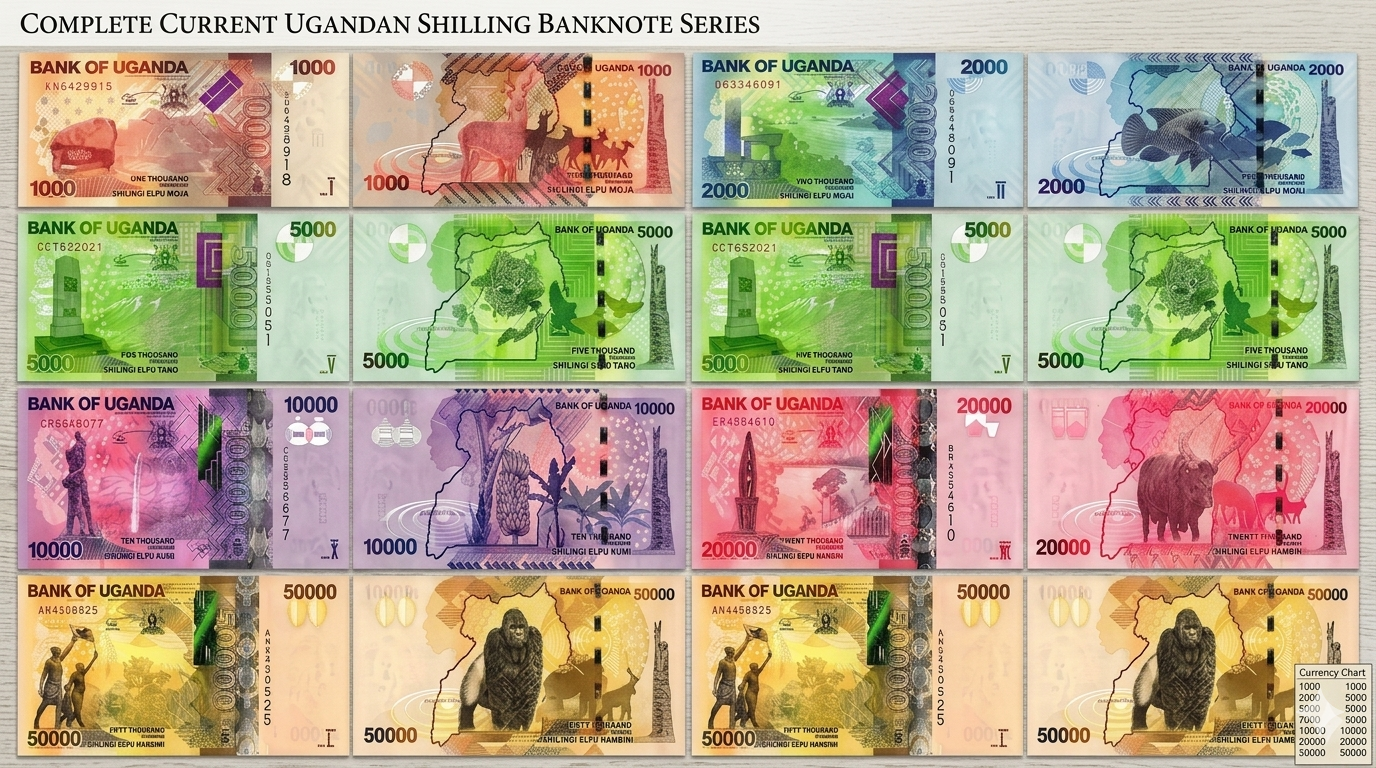
Clear overview showcasing the front and back of Ugandan currency notes.
Uganda Currency Overview
Understanding the local currency is one of the most useful parts of preparing for a trip to Uganda. Travelers need to know what currency is used, how local prices are expressed, how Uganda money compares with foreign currencies, and how currency arrangements fit into everyday travel. The official currency of Uganda is the Ugandan shilling, internationally identified by the currency code UGX.
The Ugandan shilling is used for domestic monetary transactions throughout the country. Visitors encounter Uganda currency when paying for goods and services, purchasing food, using local transportation, shopping, paying for accommodation, buying souvenirs and handling other everyday expenses.
For an international visitor, the first challenge is often simply becoming familiar with the local monetary system. A traveler arriving with US dollars, euros, British pounds or another foreign currency must understand how those funds relate to the Ugandan shilling and when local currency may be useful during the trip.
This Uganda Currency Guide begins with the fundamentals before moving into more practical subjects such as Ugandan shilling denominations, exchange rates, currency exchange, ATMs, cards, mobile money, safari spending, budgeting and money-safety considerations.
The objective is not merely to identify Uganda currency, but to help travelers understand how Uganda money fits into the wider travel experience.
What Is the Currency of Uganda?
The official currency of Uganda is the Ugandan shilling. Its international currency code is UGX. Travelers may encounter several expressions when researching the subject, including Uganda currency, Ugandan currency, Uganda money, Uganda shilling and Ugandan shilling. These terms generally refer to the country’s local currency.
Knowing the official name is important because it gives travelers a consistent reference when searching for exchange information, checking prices or preparing a travel budget. The code UGX is especially useful when using international financial platforms because it identifies the Ugandan shilling without ambiguity.
The Ugandan shilling is used throughout Uganda rather than being restricted to a particular city or tourism region. A visitor arriving through Entebbe International Airport and continuing to Kampala or another part of the country remains within the same national currency system.
However, the availability of particular payment services can differ between locations. Travelers should therefore distinguish between the national currency itself and the different ways in which they may access or use money during their journey.
Understanding the Ugandan Shilling
The Ugandan shilling forms the foundation of everyday monetary transactions in Uganda. Travelers will encounter it when looking at prices, receiving change, exchanging foreign currency, withdrawing cash and paying for many goods and services.
Uganda money is issued in different denominations of banknotes and coins. Becoming familiar with these denominations is an important part of learning how to use the local currency because travelers can otherwise find unfamiliar amounts difficult to interpret when they first arrive.
The numerical appearance of prices can also require some adjustment. Amounts expressed in Ugandan shillings may contain more digits than travelers are accustomed to seeing in their home currency. A large-looking number does not automatically mean that an item is unusually expensive.
Instead, visitors should consider the current exchange rate and the actual value of the goods or service being purchased. With some familiarity, travelers generally become more comfortable recognizing Uganda currency amounts without converting every individual transaction into their home currency.
This is one reason why learning the Ugandan shilling before departure can make the first few days of a Uganda trip much easier.
The Bank of Uganda and the National Currency
The Bank of Uganda is the country’s central bank and has the exclusive authority to design, issue and manage Uganda’s banknotes and coins. This makes the Bank of Uganda the central institution behind the country’s physical currency system.
The Bank of Uganda also has broader responsibilities within the country’s monetary and financial system. Its role includes monetary policy and other functions connected with maintaining the stability and operation of Uganda’s financial system.
For travelers, this means that Uganda currency is not simply a collection of notes and coins used by tourists. The Ugandan shilling is the country’s national currency and operates within an established central-banking and financial framework.
Understanding this background is useful because later parts of the Uganda Currency Guide will discuss exchange rates, foreign-exchange services and payment systems that operate within this wider financial environment.
What Does UGX Mean?
UGX is the international three-letter currency code used for the Ugandan shilling. Travelers may see UGX when searching for Uganda exchange rates, comparing travel costs, using currency-conversion services or reviewing financial information.
The code is particularly helpful when comparing currencies because it clearly identifies the currency being discussed. A traveler researching a price listed as UGX can immediately recognize that the amount is denominated in Ugandan shillings rather than US dollars, euros or another foreign currency.
Travelers preparing a Uganda itinerary can also use UGX when researching the expected cost of local transportation, food, accommodation, activities and other expenses. This makes the code a useful part of basic travel-money preparation.
Once visitors become familiar with UGX, they can more easily recognize Uganda currency information across travel websites, financial platforms and other sources.
How Uganda Currency Appears in Everyday Prices
Travelers encounter Uganda currency most frequently through prices. Restaurant menus, accommodation quotations, transportation charges, shops, markets and service providers may quote amounts in Ugandan shillings.
Visitors should pay attention to the currency in which a price is quoted before judging whether something is affordable. A number written in Ugandan shillings should not be compared directly with a number in a traveler’s home currency without considering the exchange rate.
For example, someone accustomed to seeing prices in dollars may initially find a Ugandan shilling price numerically large. The correct interpretation requires conversion into the traveler’s preferred reference currency.
Exchange rates also change over time, so a conversion calculated several months before a trip may not represent the rate available when the traveler actually exchanges money or makes a payment.
Why Uganda Currency Matters to Travelers
Understanding Uganda currency is particularly useful for international travelers because a trip may involve several different types of financial transactions. A visitor could pay for major travel arrangements before arriving, use local currency for smaller purchases and use other payment methods for selected services.
Travelers researching how to plan a Uganda national park safari should consider money management as part of the wider itinerary rather than treating currency as an afterthought.
This is also relevant to visitors planning specialized experiences. Travelers researching Uganda versus Rwanda gorilla trekking need to consider the complete financial structure of their trip, including local spending and the arrangements surrounding their booked activities.
Good currency preparation helps travelers understand what money they have available, what expenses they are likely to encounter and which payment options they may need during different stages of their journey.
Uganda Currency During Safari Travel
Uganda’s tourism circuit includes cities, national parks, forests, lakes and rural communities. This variety means that travelers may move between places with very different commercial environments during a single trip.
Someone traveling from Kampala toward a national park may have access to different financial services along the route than they would find in a remote tourism area. Understanding Uganda money before leaving major towns can therefore form an important part of practical trip preparation.
Travelers interested in Uganda’s tourist attractions should consider the financial environment of the destinations included in their itinerary. The same applies to visitors exploring wildlife destinations through Uganda national parks and safari experiences.
The key principle is preparation. Travelers should understand where they are going, what expenses are already arranged and what additional local spending may arise during the journey.
Uganda Money and Foreign Currency
International visitors commonly arrive in Uganda with money denominated in their home currency. Understanding the difference between foreign currency and Uganda currency is therefore essential when planning how to pay for expenses during the trip.
The US dollar can be relevant to international tourism, while the Ugandan shilling remains the country’s local currency. Travelers should not assume that every business, service provider or local transaction will treat foreign currency in the same way.
Anthill Safaris discusses this distinction in its resource on using dollars on a Uganda safari. Its information is useful as tourism context, but travelers should confirm payment arrangements with their own accommodation provider, tour operator or other service provider before departure.
The safest planning approach is to understand both the foreign currency you are bringing and the role of Uganda money in everyday local transactions.
Uganda Currency in Different Travel Environments
Currency requirements can feel different depending on whether a traveler is staying in an urban center, moving between destinations or spending several days in a rural tourism area. Major cities offer a broader range of commercial and financial services, while remote destinations require more advance planning.
This distinction matters for travelers visiting southwestern Uganda. Someone traveling toward the gorilla trekking region, for example, should consider financial preparation alongside the wider logistics of reaching the destination.
Travelers researching gorilla trekking in Uganda can use destination-specific information to understand the broader context of their trip. Currency planning should form part of that preparation rather than being left until the last moment.
The same principle applies to visitors combining gorilla trekking, wildlife safaris, cultural activities and city sightseeing within one itinerary.
Uganda Currency and Everyday Travel Spending
Visitors can encounter Uganda money in many ordinary situations. Small purchases, local transportation, food, refreshments, markets, souvenirs and services can all involve local currency. Understanding the denominations becomes increasingly valuable as travelers make more frequent purchases.
Transportation is one example. Uganda offers several ways to travel between destinations, and travelers may encounter different arrangements depending on whether they use private transportation, public transport or other local options. A broader overview of how to get around Uganda can therefore complement currency planning.
Travelers may also need local money for purchases that are not part of their prepaid itinerary. Even when accommodation and major activities have already been arranged, everyday spending can continue throughout the journey.
For this reason, a Uganda Currency Guide should consider both large travel expenses and the smaller transactions that make up everyday travel.
Understanding Uganda Money Before Departure
Travelers do not need to become foreign-exchange experts before visiting Uganda. However, learning the basic currency terminology before departure can make the arrival experience smoother. The most important starting points are the Ugandan shilling, the UGX code, the relationship between Uganda currency and the traveler’s home currency, and the different ways money can be accessed during the journey.
It is also useful to research the destinations included in the itinerary. Travelers visiting Uganda’s wildlife areas can review information about Uganda wildlife experiences and consider how their planned route may affect their access to financial services.
Travelers visiting the southwest can also review information about gorilla trekking permits in Uganda as part of understanding which major costs are normally arranged before the actual travel day.
The more clearly travelers separate prepaid expenses from local day-to-day spending, the easier it becomes to organize their travel money.
Uganda Currency and Travel Budget Planning
Currency planning should be connected to the overall travel budget. A visitor’s total trip cost can include international flights, accommodation, transportation, activities, park-related expenses, food, shopping and other personal spending.
Safari travelers should pay particular attention to the difference between costs arranged through a tour operator and expenses that arise independently during the trip. Information about mid-range and luxury safari arrangements illustrates why travel budgets should be based on the actual itinerary rather than a single assumed daily figure.
Anthill Safaris also provides information about using dollars in Uganda during a safari, which can help international travelers understand why foreign currency and local Uganda money may both be relevant in tourism.
The best currency plan is therefore one that matches the actual itinerary, payment arrangements and destinations rather than relying on a generic amount of cash.
Why Learning Uganda Currency Makes Travel Easier
Understanding Uganda currency can reduce uncertainty during everyday travel. Once visitors recognize UGX and become familiar with the general appearance and value of Uganda money, local prices become easier to interpret and ordinary purchases become less confusing.
Currency knowledge can also make it easier to communicate about money with service providers. Travelers who understand the local currency are better positioned to check quoted prices, compare costs and keep track of their spending.
This can be particularly useful when purchasing souvenirs or other locally available products. Visitors exploring cultural experiences can review Uganda cultural tours while also considering how local spending fits into the wider itinerary.
The goal is not to make travelers think about money constantly. Rather, good currency preparation allows them to spend with greater confidence and focus more attention on the experience itself.
Uganda Currency as Part of the Complete Travel Experience
Money is connected to almost every practical aspect of international travel. In Uganda, understanding the local currency helps visitors move from simply knowing that the Ugandan shilling exists to understanding how it is used during a real journey.
Whether the itinerary includes Kampala, Entebbe, Jinja, national parks, Bwindi, Kibale, Queen Elizabeth National Park or other destinations, the underlying national currency remains the Ugandan shilling. What changes is the type of transaction and the payment options available in each environment.
Travelers interested in gorilla trekking can also explore Uganda gorilla trekking information as part of their wider itinerary planning. Those interested in broader primate experiences can review chimpanzee trekking in Uganda while considering the financial arrangements associated with different activities.
Understanding Uganda money is therefore not an isolated travel topic. It supports better planning for transportation, accommodation, activities, shopping and everyday interactions throughout the country.
Key Points About Uganda Currency
Official currency: Ugandan shilling
International currency code: UGX
Country: Uganda
Currency authority: Bank of Uganda
Traveler priority: Understand local currency, exchange rates and available payment options before traveling
The most important fact in this Uganda Currency Guide is straightforward: Uganda’s official currency is the Ugandan shilling, identified internationally by the code UGX. The Bank of Uganda has the exclusive authority to design, issue and manage Uganda’s banknotes and coins.
For travelers, however, understanding Uganda currency involves more than memorizing its name. Visitors should become comfortable with the way Uganda money is expressed, understand how local prices relate to foreign currencies and consider how they will access and use money throughout their itinerary.
Travelers should also remember that exchange rates change and that payment arrangements can differ between providers and destinations. Current financial information should therefore be checked close to the time of travel rather than relying indefinitely on old conversion figures.
Once these fundamentals are understood, the next step is to examine the physical currency itself. Learning the different Ugandan shilling banknotes and coins, understanding their denominations and recognizing the money used in everyday transactions will make the practical side of traveling with Uganda currency much easier.
That foundation leads directly into the next section of this complete Uganda Currency Guide: Ugandan shilling notes, coins and denominations.
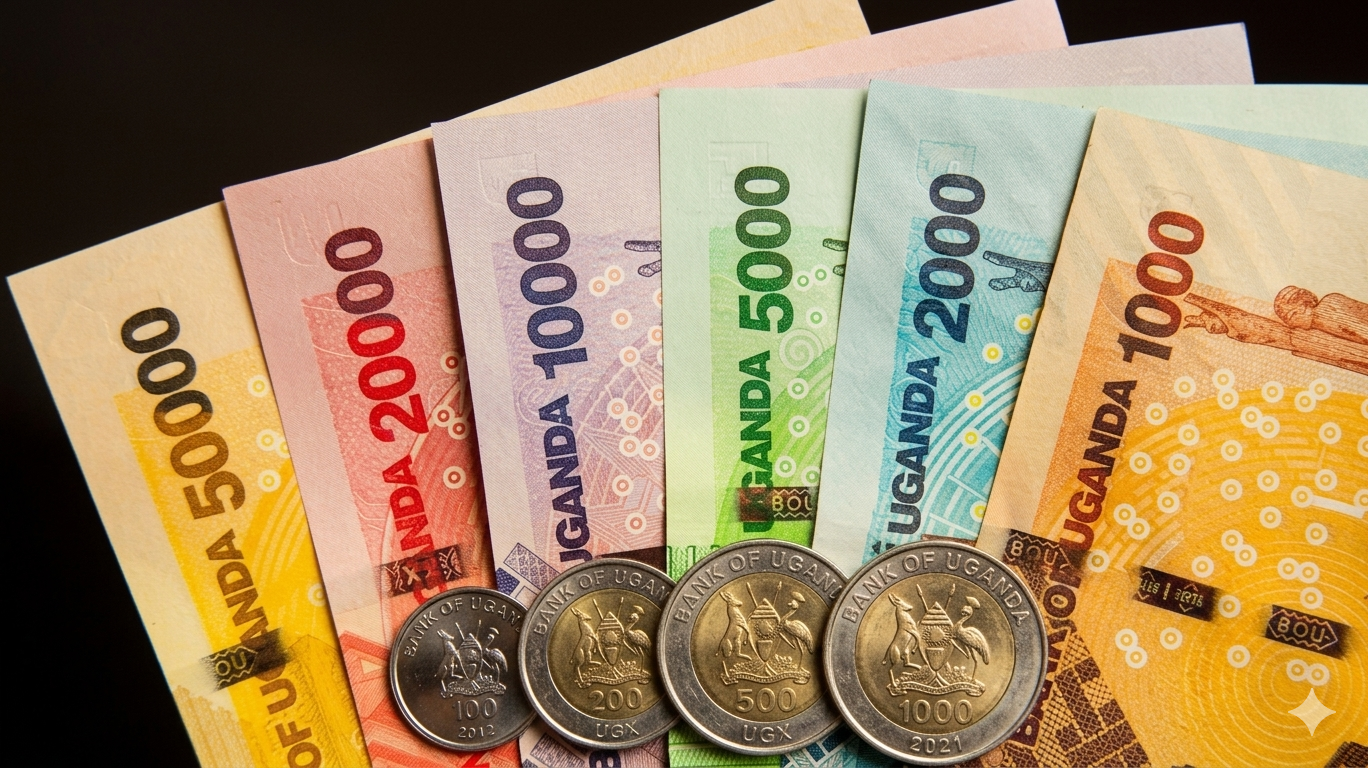
A clear layout showcasing the legal tender banknotes and coins of Uganda.
Ugandan Shilling: Notes, Coins and Denominations
Understanding Ugandan shilling notes, coins and denominations is an essential part of learning how to use Uganda currency. International visitors may initially find the numerical values unfamiliar because amounts in Uganda money can contain considerably more digits than amounts expressed in currencies such as the US dollar, euro or British pound. Learning the denominations before or soon after arrival makes it easier to recognize prices, count cash, receive change and manage everyday spending.
The Ugandan shilling is the official currency of Uganda and is identified internationally by the currency code UGX. Physical Uganda currency is issued in both banknotes and coins, with different denominations serving different purposes. Banknotes are generally used for higher-value transactions, while coins are useful for smaller values and change.
For travelers, the most useful approach is not simply memorizing a list of numbers. It is learning how the different denominations fit together and becoming comfortable recognizing them during real transactions. This is particularly valuable when visiting markets, restaurants, shops, transport points, accommodation facilities and tourism destinations.
What Are Ugandan Shilling Denominations?
A denomination is the stated value assigned to a particular unit of currency. In Uganda, the different denominations allow people to make transactions involving both small and large amounts without needing to use an impractical number of individual notes or coins.
When travelers see an amount such as UGX 5,000, UGX 20,000 or UGX 50,000, the number represents a value in Ugandan shillings. The number should not be interpreted directly using the visitor’s home currency. Instead, the traveler needs to consider the prevailing exchange rate to understand the approximate equivalent in another currency.
Understanding denominations also helps travelers distinguish between the physical notes they carry. Someone unfamiliar with Uganda currency may initially need to look carefully at the printed value on each note. With practice, recognizing common denominations becomes much quicker.
This basic knowledge is particularly helpful during the first few days of a Uganda trip, when many visitors are still becoming familiar with local prices and payment practices.
Ugandan Shilling Banknotes
Ugandan shilling banknotes make up an important part of Uganda currency. They are designed for transactions where using coins would be inconvenient and are available in a range of denominations suitable for different levels of spending.
The banknotes carry national imagery and other design elements that distinguish Uganda money from currencies issued by other countries. They also incorporate security features intended to help authenticate the notes.
Travelers should develop the habit of checking the printed denomination whenever receiving or handing over a note. This is more reliable than judging a note only by its color or physical appearance.
The Bank of Uganda is responsible for issuing and managing Uganda’s banknotes and coins as part of its role as the country’s central bank.
Common Ugandan Shilling Banknote Denominations
Travelers will commonly encounter Ugandan shilling banknotes in denominations of UGX 1,000, UGX 2,000, UGX 5,000, UGX 10,000, UGX 20,000 and UGX 50,000. These denominations cover a broad range of ordinary transactions and larger payments.
| Denomination | Currency | Practical significance |
|---|---|---|
| 1,000 | UGX 1,000 | Lower-value banknote useful for smaller transactions and change |
| 2,000 | UGX 2,000 | Useful for everyday purchases and smaller cash payments |
| 5,000 | UGX 5,000 | Common mid-range denomination for everyday spending |
| 10,000 | UGX 10,000 | Useful for a wider range of ordinary purchases |
| 20,000 | UGX 20,000 | Higher-value denomination for larger transactions |
| 50,000 | UGX 50,000 | High-value banknote that can reduce the number of notes carried |
The practical usefulness of each denomination depends on the transaction. A high-value note can be convenient for a larger payment but may be less convenient when making a very small purchase if the seller does not have sufficient change.
UGX 1,000 and UGX 2,000
The UGX 1,000 and UGX 2,000 denominations are among the lower-value Ugandan shilling banknotes. For travelers, lower denominations are useful because they allow smaller cash payments to be made without requiring a large note to be broken.
Having some lower-value Uganda money can be convenient when buying inexpensive items, paying for small services or receiving change. Travelers who carry only high-value notes may find themselves depending heavily on sellers to provide change.
Smaller notes can therefore be particularly useful during days when a traveler expects to make many small transactions. They can also help when moving through places where cash payments are more common.
Visitors do not need to carry large quantities of these notes. A reasonable mixture of denominations is generally more practical than relying exclusively on either very small or very large notes.
UGX 5,000 and UGX 10,000
UGX 5,000 and UGX 10,000 are useful middle-range Ugandan shilling denominations. They can bridge the gap between smaller everyday payments and higher-value transactions.
For travelers, these notes can be convenient because they provide enough value for many ordinary purchases without always creating the change problems associated with the largest denominations.
When first arriving in Uganda, visitors should take a moment to examine the printed values on their notes. Becoming familiar with the denomination markings helps prevent confusion, particularly when paying quickly or when several notes are being handled at the same time.
As travelers gain experience using Uganda currency, these denominations generally become easier to recognize without needing to stop and inspect every note.
UGX 20,000 and UGX 50,000
UGX 20,000 and UGX 50,000 are higher-value Ugandan shilling banknotes. These denominations can be useful when travelers need to make larger cash payments or want to reduce the number of physical notes they carry.
The practical issue with high-value notes is change. A traveler using a UGX 50,000 note for a very small purchase may encounter a situation where the seller cannot conveniently provide the required change.
For that reason, travelers should ideally maintain a mixture of denominations rather than carrying only UGX 20,000 and UGX 50,000 notes.
This approach is particularly useful during road trips and safari journeys where travelers may encounter different types of businesses and payment situations throughout the day.
Ugandan Shilling Coins
Coins represent the smaller-value side of Uganda currency. They are particularly important for transactions where using a banknote would be impractical or where an exact amount needs to be returned as change.
Common Ugandan shilling coin denominations include UGX 50, UGX 100, UGX 200 and UGX 500. Travelers may encounter these coins in ordinary cash transactions, particularly when receiving change.
| Coin denomination | Typical role |
|---|---|
| UGX 50 | Small-value transactions and change |
| UGX 100 | Small-value transactions and change |
| UGX 200 | Small-value transactions and change |
| UGX 500 | Higher coin denomination for small payments and change |
The availability of individual coins can vary in everyday circulation. Travelers should therefore focus on understanding the denominations they actually encounter rather than assuming that every coin will be present in every transaction.
How Travelers Can Organize Uganda Currency
Good organization makes physical Uganda money easier to use. Travelers carrying several denominations should consider keeping banknotes arranged in a wallet or secure travel pouch so that the values can be identified quickly.
Lower-value notes can be kept where they are easy to access for small purchases, while larger denominations can remain more securely stored until needed. Travelers should avoid displaying large amounts of cash unnecessarily.
Coins can also be kept separately from banknotes. A small compartment can make it easier to identify coins when exact change is needed.
This type of organization becomes increasingly useful when a trip involves several destinations and frequent cash transactions.
Why Small Ugandan Shilling Denominations Matter
Small denominations can make everyday travel considerably more convenient. A traveler may encounter situations where the amount being paid is relatively small, and having an appropriate denomination avoids the need to break a much larger note.
They can also be useful when receiving change. Rather than expecting every transaction to result in another banknote, travelers should be comfortable receiving coins and smaller notes as part of normal Uganda currency transactions.
This can be particularly relevant during local transportation, shopping, refreshments and other small purchases. Visitors planning a wider itinerary around Uganda’s tourist attractions may encounter many different spending situations.
The purpose of carrying smaller denominations is therefore convenience and flexibility, not simply having more physical cash.
Ugandan Shilling Denominations During Safari Travel
Safari travel makes understanding Uganda currency particularly useful because itineraries can combine cities, highways, national parks, lodges and rural communities. The availability and preferred method of payment may differ from one environment to another.
Travelers planning a safari should separate major prepaid expenses from additional spending during the journey. Accommodation, transportation and activities may already have been arranged, while personal purchases and other expenses may still require money during the trip.
For visitors researching gorilla trekking in Uganda, for example, understanding the difference between the main trekking costs and incidental spending can help with practical money planning.
Visitors considering different safari styles can also review mid-range and luxury safari options when deciding which expenses are likely to be prepaid and which may arise locally.
Having suitable Uganda currency denominations available gives travelers flexibility when dealing with smaller expenses along the way.
Recognizing the Value Printed on Each Note
One of the simplest ways to avoid confusion with Uganda money is to check the denomination printed on the note rather than relying only on its appearance. Visitors who are unfamiliar with Ugandan shilling notes should take a moment to verify the amount before completing a transaction.
This habit is useful in busy environments where transactions happen quickly. It can also help travelers avoid confusing one denomination with another when several notes are being handled together.
The same principle applies when receiving change. Travelers should count their money carefully and check that the denominations received correspond with the expected amount.
Taking a few extra seconds to check Uganda currency can prevent avoidable mistakes and helps travelers become comfortable with the local monetary system.
Uganda Currency Denominations and Tipping
Travelers may also encounter Uganda currency when giving tips. Having smaller denominations can make tipping more practical because visitors can choose an amount appropriate to the service without necessarily needing to break a large banknote.
Tipping practices can vary depending on the service, location and circumstances. Travelers should therefore research the specific context instead of assuming that one amount applies to every situation.
Visitors planning safari travel can review information about tipping a safari driver in Uganda when developing a broader travel budget.
The important currency lesson is simply that smaller denominations can provide greater flexibility when a traveler wants to make a modest cash payment or tip.
Ugandan Shilling Notes and Foreign Currency
International visitors should keep a clear distinction between Ugandan shilling denominations and foreign-currency values. A UGX 50,000 note is a 50,000-shilling denomination; its equivalent value in US dollars, euros or another currency depends on the applicable exchange rate.
This distinction becomes important when comparing prices online. Travelers should first identify whether a price is expressed in UGX or another currency before deciding how expensive a product, service or activity is.
Foreign currency may also appear in international tourism arrangements. Information from Anthill Safaris on using dollars in Uganda provides additional tourism context for visitors preparing for safari travel.
Even when a traveler carries foreign currency, understanding Uganda money remains important because local transactions may involve Ugandan shillings.
Ugandan Shilling Denominations for Different Purchases
Different denominations naturally suit different types of purchases. Smaller notes and coins are useful when the amount being paid is low, while larger notes become more convenient as transaction values increase.
Travelers should not assume that a particular denomination will always be accepted conveniently for every purchase. A large note may technically represent the correct amount or more than the amount required, but the seller may not have sufficient change.
This is why a mixed selection of Uganda currency is generally more practical than carrying only one denomination.
The ability to choose the appropriate denomination is one of the simplest ways to make cash transactions easier while traveling.
Ugandan Shilling Coins and Small Payments
Coins are an ordinary component of Uganda currency and should not be treated as unusual or unimportant. Their main practical purpose is to represent smaller values and facilitate change.
Travelers who receive coins should keep them organized rather than immediately discarding them or leaving them loose in luggage. A small amount of coins can become useful for subsequent purchases.
Visitors moving between destinations may accumulate coins throughout the journey. Keeping them in a dedicated compartment makes it easier to find the denomination needed when making a small cash payment.
Understanding coins is therefore just as much a part of learning Uganda money as recognizing the major banknotes.
Currency Denominations When Visiting Different Parts of Uganda
Uganda’s tourism landscape covers major cities, smaller towns, national parks, forests, lakes and rural communities. Travelers should therefore think about currency denominations in relation to their itinerary.
A visitor spending several days in Kampala may have different payment opportunities from someone spending several days in a remote safari destination. This does not change the national currency, but it can change how convenient particular denominations are.
Travelers interested in gorilla trekking in Uganda should consider their route and accommodation arrangements when preparing their travel money.
Planning denominations around the itinerary is a simple way to make Uganda currency more convenient to use.
Ugandan Shilling Denominations and Travel Budgeting
Knowing the denominations of Uganda currency is only one part of travel budgeting. Visitors should also understand how much of their planned spending is already covered by bookings and how much money they may need for expenses encountered during the trip.
A safari package may include several major components, while personal purchases, drinks, souvenirs, optional activities and other expenses may remain outside the package. The exact arrangement depends on the booking.
Travelers can therefore use the denominations as a practical tool for managing their available cash rather than trying to determine their entire trip budget from the physical notes alone.
Good planning combines an appropriate travel budget with suitable Uganda currency denominations and secure money management.
How Quickly Do Travelers Learn Uganda Currency?
Most travelers do not need to memorize every Ugandan shilling denomination before boarding their flight. A basic understanding of the main notes and coins is enough to begin. After several transactions, visitors usually become more familiar with the values they encounter most frequently.
A practical approach is to study the denominations before arrival, then carefully inspect each note received during the first few transactions. Travelers can gradually associate the printed numbers with the physical appearance of the notes.
It is also helpful to remember that UGX amounts can look large when compared with foreign currencies. This is a normal feature of the numerical expression of Uganda currency and should not be interpreted as an indication that a transaction is necessarily expensive.
With basic preparation, travelers can quickly become comfortable handling Uganda money.
Ugandan Shilling Notes, Coins and Denominations: Key Takeaways
Official currency: Ugandan shilling
Currency code: UGX
Physical forms: Banknotes and coins
Common banknote denominations: UGX 1,000, UGX 2,000, UGX 5,000, UGX 10,000, UGX 20,000 and UGX 50,000
Common coin denominations: UGX 50, UGX 100, UGX 200 and UGX 500
Practical travel approach: Carry a sensible mixture of denominations instead of relying exclusively on large notes
The most important lesson from this section is that understanding Uganda currency means understanding both its numerical values and its physical forms. Ugandan shilling banknotes provide the main denominations for many cash transactions, while coins support smaller payments and change.
Travelers should become familiar with UGX 1,000, UGX 2,000, UGX 5,000, UGX 10,000, UGX 20,000 and UGX 50,000 banknotes, as well as the smaller coin denominations they may encounter. Carrying a practical mixture of denominations can make everyday transactions considerably easier.
Travelers should also remember that currency designs and circulation can change. For the most current information about Uganda banknotes and coins, official information from the Bank of Uganda should take priority over old travel articles or outdated images.
Once travelers understand Ugandan shilling notes, coins and denominations, the next question is how much those amounts are worth in their own currency. This makes exchange rates the natural next topic in a comprehensive Uganda Currency Guide.
The next section will explain Uganda exchange rates, UGX conversions and how travelers can interpret the value of Uganda money when comparing it with major international currencies.
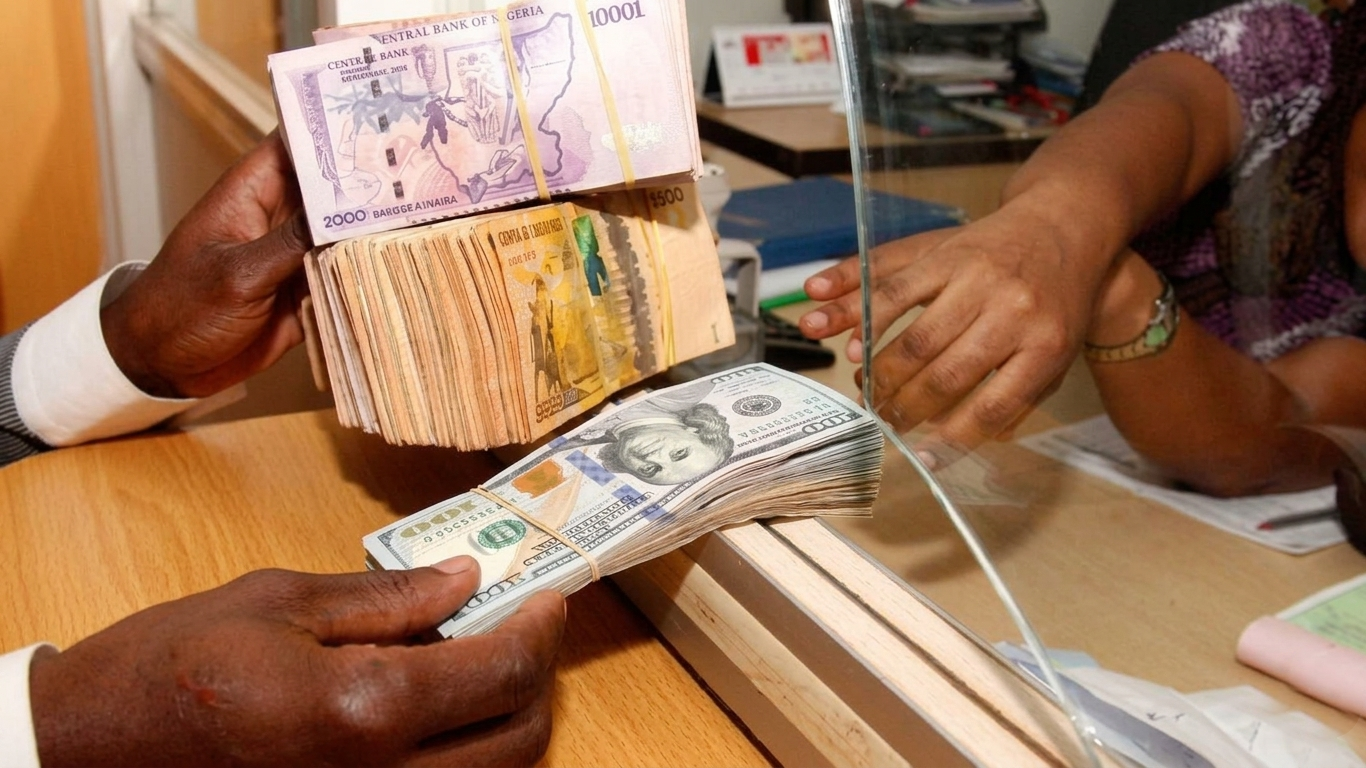
A bank teller processes a foreign currency exchange transaction.
Uganda Exchange Rates: Understanding UGX and Currency Conversion
Understanding Uganda exchange rates is one of the most important parts of planning a trip to Uganda. Once travelers know the Ugandan shilling notes, coins and denominations, the next step is learning how those amounts relate to the currencies they already use. This is particularly important for visitors arriving with US dollars, euros, British pounds or another foreign currency.
The Ugandan shilling is identified internationally by the currency code UGX. When a traveler sees a price expressed in UGX, the amount represents a value in Ugandan shillings. To understand what that amount means in a home currency, the traveler must use the applicable exchange rate at the time of conversion.
Exchange rates are not permanently fixed at one universal value for travelers. They can change over time because currency markets move continuously. The rate displayed by a bank, foreign-exchange provider, card network or other service may also differ from the rate a traveler sees elsewhere because providers can apply their own margins or charges.
For that reason, a reliable Uganda Currency Guide should teach travelers how exchange rates work rather than presenting one supposedly permanent UGX conversion figure that can quickly become outdated.
What Is the Uganda Exchange Rate?
The Uganda exchange rate is the relationship between the Ugandan shilling and another currency. For example, a traveler may want to know how many Ugandan shillings correspond to one US dollar. The answer depends on the current exchange rate being used.
The same principle applies when converting UGX into euros, British pounds, Canadian dollars, Australian dollars or other currencies. A traveler can start with either currency and calculate the corresponding amount in the other currency, provided the exchange rate and direction of conversion are understood correctly.
This distinction is important because an exchange-rate quotation can be presented in either direction. One source might show how many Ugandan shillings equal one unit of a foreign currency, while another might show how much one Ugandan shilling is worth in the foreign currency.
Travelers should therefore always check which currency is being used as the starting point before interpreting an exchange-rate figure.
Why Uganda Exchange Rates Change
Uganda exchange rates can change because currencies are traded in international financial markets. Supply and demand, economic conditions, interest-rate expectations, international trade, investor activity and other factors can influence currency values.
This means that a conversion calculated before a trip may not be exactly the same when the traveler arrives in Uganda. A travel budget should therefore allow for exchange-rate movement instead of assuming that an earlier conversion will remain unchanged.
The difference can be especially noticeable when converting a relatively large amount of money. Even a modest movement in the exchange rate can change the final amount received in Ugandan shillings.
For everyday travel planning, the most useful approach is to check current exchange information close to the time a transaction will actually take place.
UGX to USD: Understanding the Conversion
UGX to USD conversion is one of the most useful calculations for international visitors because the US dollar is widely used as a reference currency in international travel. However, travelers should always use the current exchange rate rather than relying on an old conversion remembered from a previous trip.
Suppose an exchange-rate source states that one US dollar is equivalent to a certain number of Ugandan shillings. To convert a US-dollar amount into UGX, the traveler multiplies the dollar amount by the quoted number of shillings per dollar.
To convert the other way, from UGX to USD, the traveler divides the Ugandan shilling amount by the quoted number of Ugandan shillings per US dollar.
Basic conversion principle
Foreign currency to UGX = foreign-currency amount × applicable UGX exchange rate
UGX to foreign currency = UGX amount ÷ applicable UGX exchange rate
These formulas are useful for understanding the direction of a conversion, but the final amount a traveler receives from an exchange provider may differ because of fees, commissions or the provider’s exchange-rate margin.
How to Read a UGX Exchange Rate
Reading an exchange rate correctly is essential. A quotation such as a certain number of UGX per US dollar means that the stated number of Ugandan shillings corresponds to one US dollar at that quoted rate.
The same logic applies to other currencies. If a quotation states a number of UGX per euro, that number tells the traveler how many Ugandan shillings correspond to one euro under the quoted rate.
Travelers should look carefully at the labels surrounding a conversion figure. A simple mistake in interpreting the direction can produce a completely incorrect calculation.
When using a currency-conversion service, always identify the source currency, destination currency, date and quoted rate before making an important financial decision.
Mid-Market Rate Versus the Rate You Actually Receive
One of the most important concepts in Uganda exchange rates is the difference between a reference or mid-market rate and the rate offered to an individual customer. A currency website may display a market-based reference rate, while a bank or foreign-exchange provider may buy and sell currency at different rates.
The difference between these rates is one way providers cover operating costs and earn revenue. Additional fees may also apply depending on the service being used.
As a result, a traveler should not assume that the amount shown by a currency converter is exactly the amount they will receive when exchanging physical cash.
For accurate budgeting, travelers should compare the actual rate and total charges associated with the specific transaction rather than looking only at a headline conversion rate.
Why Currency Exchange Providers Offer Different Rates
Different providers can quote different exchange rates because currency conversion is a commercial service. Banks, foreign-exchange businesses and other providers may use different pricing models, operating costs and margins.
The rate can also depend on whether the provider is buying foreign currency from a traveler or selling foreign currency to the traveler. These transactions are not necessarily priced at the same rate.
For travelers converting foreign currency into Uganda money, the relevant question is therefore not simply “What is today’s Uganda exchange rate?” It is also “What rate and total cost will I actually receive from this provider?”
This distinction can help travelers make more informed comparisons without assuming that the first displayed rate is automatically the final rate.
Uganda Exchange Rates for Travelers Carrying US Dollars
Travelers arriving with US dollars may want to convert part of their money into Ugandan shillings for local spending. The amount received depends on the current rate offered by the exchange provider and any applicable fees.
Travelers should check the condition and acceptability requirements for foreign banknotes before attempting an exchange because providers can have their own policies concerning the notes they accept.
It is also useful to keep exchange receipts or transaction records when appropriate. These records can help travelers understand how much they exchanged and the rate that was actually applied.
For broader safari planning, visitors can also review information about travel to Bwindi Impenetrable Forest when considering the financial and logistical requirements of a western Uganda itinerary.
UGX to EUR and GBP: Converting Other Major Currencies
The same principles used for UGX to USD conversion apply when converting Ugandan shillings into euros, British pounds or other currencies. The traveler needs a current exchange rate that clearly identifies both currencies and the direction of the quotation.
Travelers from Europe or the United Kingdom should avoid assuming that a previous conversion rate remains valid. Currency markets can move between the time a trip is booked and the date of travel.
When comparing a Uganda safari price with a home-currency budget, it is therefore sensible to calculate using a recent rate and leave some room for normal exchange-rate fluctuations and transaction costs.
This approach gives a more realistic picture of the potential cost of a trip than relying on a conversion calculated many months earlier.
How Exchange Rates Affect a Uganda Travel Budget
Exchange rates can influence the home-currency cost of a Uganda trip even when the Ugandan shilling price of a product or service has not changed. If the relationship between UGX and a traveler’s home currency changes, the converted amount will also change.
For example, a traveler who planned a budget using one exchange rate may find that the same UGX amount converts to a slightly different home-currency amount when the actual payment is made.
This is one reason experienced travelers avoid building an extremely precise budget around a single exchange-rate figure. A reasonable allowance for currency movement can make the budget more resilient.
The impact is generally more important for larger expenses than for small daily purchases, although the principle applies to every currency conversion.
UGX Conversion When Comparing Safari Prices
Many international travelers research Uganda safari prices in their preferred currency even though safari operators may quote prices in US dollars or other currencies. Understanding exchange rates helps travelers compare these prices with their own budgets.
The conversion should be performed using a current rate and should account for the currency in which the safari operator actually quotes the price. A traveler should not automatically convert a price from UGX if the original quotation was already made in US dollars.
For example, someone researching a multi-day chimpanzee and gorilla itinerary can review a seven-day chimpanzee and gorilla trekking safari while separately considering the currency in which the actual package is quoted.
This distinction prevents travelers from accidentally applying the same conversion twice.
Exchange Rate Calculations: A Simple Example
Suppose a traveler has a price expressed in UGX and wants to understand its approximate value in US dollars. The traveler first obtains a current quotation expressed as Ugandan shillings per US dollar.
The traveler then divides the UGX amount by the quoted number of Ugandan shillings per US dollar. The result is an approximate dollar value before considering exchange fees, provider margins or other transaction costs.
Illustrative calculation only
If a hypothetical rate were 1 USD = 3,500 UGX:
35,000 UGX ÷ 3,500 = 10 USD
This is an illustration of the calculation method, not a current Uganda exchange rate.
The example demonstrates why travelers should always identify the current rate before calculating the actual value of a purchase or travel expense.
Why You Should Not Rely on an Old Uganda Exchange Rate
An exchange rate published several months or years ago should not be treated as the current value of the Ugandan shilling. Currency values change, and old conversion figures can produce misleading travel budgets.
This is particularly important for articles and travel guides that remain online for many years. A page can correctly explain the principles of currency conversion while an old numerical exchange-rate example may no longer represent current market conditions.
For this reason, a responsible Uganda Currency Guide should distinguish between permanent educational information and time-sensitive exchange-rate data.
Travelers should check current rates close to the date of their transaction rather than relying on a static number embedded in an old article.
Currency Exchange and Remote Safari Destinations
Travelers visiting remote safari destinations should think about currency access before leaving major urban centers. An itinerary that includes long drives through rural areas may provide fewer opportunities to exchange foreign currency or access financial services.
This does not mean travelers should carry unnecessary amounts of cash. Instead, they should understand their itinerary and identify where they expect to obtain or use money.
For example, visitors researching a Kibale National Park itinerary can consider the journey between urban areas, accommodation and activities when thinking about payment arrangements.
Planning currency access as part of the itinerary can reduce the likelihood of arriving at a remote destination without a suitable payment option.
Uganda Exchange Rates and Foreign Currency Exchange Costs
The exchange rate is only one part of the cost of converting money. Travelers should also consider commissions, service fees and the difference between buying and selling rates where applicable.
A provider advertising an attractive exchange rate may still have other charges. Conversely, a provider with a slightly different quoted rate may have lower overall costs. The only meaningful comparison is the total amount the traveler gives up versus the total amount received.
This is why travelers should ask for the final amount they will receive before completing a significant exchange transaction when the provider’s pricing is not already clear.
Keeping the transaction record can also help travelers reconcile their spending later.
Understanding Uganda Currency When Using Dollars
Some international travelers may use US dollars for selected tourism-related payments, while other everyday expenses may involve Ugandan shillings. The two currencies should not be treated as interchangeable at an assumed fixed rate.
The applicable conversion depends on the transaction and the provider. Travelers should therefore confirm which currency a price is quoted in before paying and should understand whether any conversion has already been included.
Additional safari information about using dollars in Uganda on safari can provide useful context when preparing for a trip where both foreign and local currency may be encountered.
The safest budgeting approach is to keep the currencies and their exchange rates clearly separated in your calculations.
Using a Currency Converter for Uganda Travel
A currency converter can be useful for quickly estimating the value of a Uganda travel expense. Travelers can enter a UGX amount and select their preferred home currency, or enter a foreign-currency amount and convert it to UGX.
The result should be treated as an estimate unless the converter is explicitly showing the exact rate and conditions applicable to the transaction. A bank, card provider or exchange business may use a different rate.
Travelers should also pay attention to the date and time of the conversion because exchange-rate information is time-sensitive.
For major travel payments, use the actual payment provider’s quoted amount where available rather than assuming a generic converter will match the final transaction.
Common Uganda Exchange Rate Mistakes to Avoid
One common mistake is using an outdated exchange rate. Another is confusing UGX per foreign currency unit with foreign currency per UGX. These errors can produce dramatically incorrect calculations.
Another mistake is assuming that the rate shown by a search engine or currency converter is exactly the rate a bank or exchange provider will give the traveler. Reference rates and customer transaction rates can differ.
Travelers can also underestimate the effect of transaction fees. A conversion that appears favorable before fees may be less attractive once the full cost is considered.
Finally, travelers should avoid budgeting every last amount of money using one precise exchange-rate assumption. Allowing a reasonable margin for currency movement creates a more practical travel budget.
Uganda Exchange Rates and International Safari Planning
Exchange-rate knowledge becomes particularly useful when comparing Uganda with other East African destinations or when planning a multi-country itinerary. Travelers may encounter several currencies during one journey and should keep each conversion separate.
A traveler combining Uganda with Rwanda, for example, should not assume that a Ugandan shilling amount can be used as a direct measure of the value of a Rwandan franc amount. Each currency has its own exchange relationship with international currencies.
The same principle applies when planning safari packages, accommodation and transportation. Always identify the currency in which each price is quoted before adding the amounts to a travel budget.
Clear currency labeling is one of the simplest ways to avoid mistakes when building an international travel budget.
Practical Uganda Exchange Rate Checklist
Check the date of the exchange-rate information.
Confirm whether the quotation is UGX per foreign-currency unit or the reverse.
Compare the actual provider rate with any reference or mid-market rate.
Check whether commissions or other fees apply.
Keep the currency used for the original price clearly identified.
Allow some flexibility in the travel budget because exchange rates can change.
Uganda Exchange Rates: Key Takeaways
The Ugandan shilling has a floating exchange relationship with major international currencies, so its value against the US dollar, euro, British pound and other currencies can change over time. Travelers should therefore treat exchange rates as time-sensitive information.
The most important skill is understanding how to read a quotation and how to convert between UGX and another currency. Travelers should also distinguish between a reference exchange rate and the actual rate offered by a bank, exchange provider or payment service.
When planning a Uganda safari or holiday, exchange rates can help travelers translate local prices into a familiar currency and create a realistic budget. However, fees, provider margins and normal market movements should be considered before assuming that a conversion is exact.
Understanding Uganda exchange rates provides the foundation for the next part of this Uganda Currency Guide: learning where travelers can exchange foreign currency, how to approach currency exchange in Uganda and what factors to consider before completing a transaction.
Where and How to Exchange Foreign Currency in Uganda
Knowing where and how to exchange foreign currency in Uganda is an important part of preparing for a trip. International visitors may arrive with US dollars, euros, British pounds or another currency and need to obtain Ugandan shillings for local expenses. The most important principle is to use legitimate, regulated financial institutions or licensed foreign exchange businesses rather than informal money changers.
Uganda has a formal foreign-exchange market that includes commercial banks, licensed forex bureaus and money-remittance businesses. The Bank of Uganda regulates and supervises foreign exchange bureaus and money-remittance companies, and it advises members of the public to transact only with companies licensed to deal in foreign exchange. :contentReference[oaicite:0]{index=0}
For travelers, this means that exchanging money should be approached as a normal financial transaction rather than an informal negotiation. Before handing over foreign currency, identify the provider, check the displayed exchange rate, understand the amount you should receive and count the money before leaving the counter.
The best location depends on the traveler’s itinerary, the currency being exchanged, the amount involved and the availability of banking or forex services. Kampala and Entebbe provide many options, while travelers heading into remote safari areas should plan their currency needs before leaving major towns.
Where Can You Exchange Foreign Currency in Uganda?
The main places where travelers can exchange foreign currency in Uganda are licensed forex bureaus and commercial banks. These formal channels provide a more appropriate option than informal street-based currency exchange.
Forex bureaus specialize in foreign currency transactions and are commonly found in major urban centers. Commercial banks also provide foreign-exchange services, although the exact currencies, requirements, operating hours and transaction procedures can vary between institutions.
Travelers should not assume that every business displaying a currency symbol is authorized to conduct foreign exchange. The Bank of Uganda states that foreign-exchange businesses must be licensed and advises the public to transact only with licensed companies. :contentReference[oaicite:1]{index=1}
For a traveler, the safest starting point is therefore a recognized bank or a clearly identified licensed forex bureau.
Exchanging Money at Entebbe International Airport
Entebbe is the principal international gateway for many visitors arriving in Uganda. Travelers who need Ugandan shillings immediately after landing may look for a licensed forex bureau or other legitimate financial service available at or around the airport.
Exchanging a small amount soon after arrival can be convenient because it gives a traveler access to local currency for immediate needs. However, travelers should still compare the displayed rate and understand the amount being received before completing the transaction.
There is no requirement for a traveler to exchange every dollar or euro immediately after arrival. A visitor may choose to exchange only what is appropriate for immediate expenses and then use a bank or licensed forex bureau later if additional Ugandan shillings are required.
The practical decision should be based on convenience, the rate offered, transaction costs and the traveler’s planned itinerary rather than simply exchanging money because an exchange counter is available.
Exchanging Foreign Currency in Kampala
Kampala is Uganda’s capital and largest urban center, making it one of the most practical places for travelers who want to exchange foreign currency. The city has commercial banks and forex bureaus serving different types of customers.
Travelers staying in Kampala have the advantage of being able to compare several legitimate providers instead of exchanging all their money at the first available counter. This can be useful when converting a substantial amount.
The Bank of Uganda publishes official indicative foreign-exchange rates on a daily basis. These rates provide a useful reference for understanding market conditions, although the rate offered by an individual provider can differ. :contentReference[oaicite:2]{index=2}
A traveler comparing exchange providers should therefore look beyond a headline rate and consider the actual amount of Ugandan shillings received after any applicable charges.
Using a Commercial Bank to Exchange Foreign Currency
Commercial banks are another formal option for exchanging foreign currency in Uganda. Banks operate under the country’s financial regulatory framework, and the Bank of Uganda supervises commercial banks as part of its broader financial-sector mandate. :contentReference[oaicite:3]{index=3}
A bank can be particularly appropriate for travelers who already have a banking relationship with a major institution or who prefer to conduct financial transactions through a formal banking environment.
However, travelers should check the bank’s foreign-exchange procedures before visiting. Available currencies, identification requirements, transaction limits, service charges and opening hours can vary.
It is therefore sensible to confirm the practical requirements with the individual bank rather than assuming that every branch offers exactly the same foreign-exchange service.
Using a Licensed Forex Bureau in Uganda
A forex bureau is a business specializing in foreign currency exchange. For travelers, forex bureaus can provide a convenient way to convert foreign cash into Ugandan shillings.
The critical word is licensed. Uganda’s financial regulator specifically advises members of the public to transact only with companies licensed to engage in foreign-exchange business. :contentReference[oaicite:4]{index=4}
Travelers should look for a clearly identified formal business and avoid exchanging money with individuals offering unofficial rates on streets, at informal roadside locations or in other settings where the provider’s authorization cannot be established.
The objective is not simply to find the highest advertised rate. It is to complete the transaction safely, transparently and with a provider whose foreign-exchange business is properly authorized.
How to Compare Foreign Exchange Rates in Uganda
Comparing foreign exchange rates does not have to be complicated. Start by identifying the amount of foreign currency you want to exchange and the currency you expect to receive. Then check the provider’s quoted rate.
Next, ask whether there are commissions, service charges or other deductions. The most useful comparison is the final amount of Ugandan shillings you will actually receive.
Simple comparison method
Foreign currency amount → quoted exchange rate → fees or deductions → final UGX amount received
The provider offering the most attractive overall transaction is the one that should be evaluated, rather than the provider displaying the most impressive headline rate.
The Bank of Uganda’s published official exchange rates can provide a useful reference point when evaluating market conditions. :contentReference[oaicite:5]{index=5}
What Identification May Be Required?
Foreign exchange providers may have identification and transaction requirements, particularly for larger transactions. Travelers should therefore carry appropriate identification documents when planning a significant currency exchange.
The exact documentation and procedures can depend on the provider, transaction type and applicable regulations. Travelers should not assume that every forex bureau or bank will follow exactly the same process.
For this reason, a traveler who intends to exchange a substantial amount should ask the provider about documentation requirements before arriving at the counter.
Keeping transaction records is also sensible because they provide evidence of the exchange and can help the traveler track how much money has been converted.
How to Exchange US Dollars for Ugandan Shillings
US dollars are commonly encountered in Uganda’s tourism sector, while the Ugandan shilling remains the country’s official currency. Travelers who arrive with dollars may therefore decide to convert some of their money into UGX for everyday local spending.
The process is straightforward at a licensed forex bureau or bank: present the foreign currency, confirm the quoted exchange rate and any charges, complete the transaction, and count the Ugandan shillings received before leaving.
Tourism-focused sources also note that foreign currency is used in parts of Uganda’s tourism sector, while Ugandan shillings are important for everyday local transactions. :contentReference[oaicite:6]{index=6}
Travelers should therefore think of currency exchange as a way to obtain the right mixture of money for the different parts of their itinerary rather than as a requirement to convert everything at once.
Exchanging Euros and British Pounds in Uganda
Travelers arriving with euros or British pounds can also seek a licensed bank or forex bureau that handles the currency they hold. Availability and rates can differ between providers, so it is important to confirm that the desired currency is accepted before beginning the transaction.
Travelers should avoid assuming that the rate for one foreign currency can be applied to another. Each currency has its own exchange relationship with the Ugandan shilling.
The same comparison principles apply: check the current quotation, ask about charges, calculate the expected amount and confirm the final amount received.
Keeping the transaction receipt can also make it easier to track the exchange rate actually applied.
Should You Exchange All Your Foreign Currency at Once?
There is no universal reason for every traveler to exchange all foreign currency immediately. The appropriate amount depends on the length of the trip, planned spending, payment arrangements and access to additional financial services.
Converting only part of the available foreign currency can provide flexibility because the traveler retains some foreign currency for later use or future conversion. It can also reduce the need to carry large quantities of local cash unnecessarily.
At the same time, travelers heading into remote safari destinations should consider whether additional exchange opportunities will be available along their route.
The best approach is therefore itinerary-based: exchange enough for expected local needs while maintaining an appropriate backup payment option.
Exchanging Money Before Leaving Kampala or Entebbe
Travelers beginning a safari from Kampala or Entebbe may have more opportunities to exchange foreign currency than they will later encounter in remote areas. This makes major urban centers practical places to organize local cash before a long journey.
A safari itinerary can involve national parks, conservation areas, rural communities and long stretches of road travel. The further a traveler moves away from major towns, the more important advance planning becomes.
For example, travelers preparing for a trip involving western Uganda can review the Katuna border area as part of understanding the regional travel environment and cross-border movement of currencies. The area has historically been associated with exchange transactions involving Ugandan shillings, Rwandan francs and US dollars. :contentReference[oaicite:7]{index=7}
However, travelers should still prioritize licensed formal exchange providers rather than informal individuals offering currency conversion.
Currency Exchange at Hotels and Safari Lodges
Some hotels or safari lodges may assist guests with currency-related services, but travelers should not automatically assume that a hotel or lodge offers the same exchange rate as a bank or licensed forex bureau.
If a lodge offers to convert foreign currency, ask clearly about the rate and the final amount that will be provided. This allows the traveler to make an informed decision rather than accepting an exchange rate without knowing its implications.
This is especially important when exchanging larger amounts. A small difference in the rate can become more significant as the amount exchanged increases.
When possible, travelers should organize major currency exchanges through established financial institutions or licensed forex bureaus and treat lodge-based assistance as a convenience rather than automatically assuming it is the most competitive option.
Can ATMs Replace Foreign Currency Exchange?
ATMs provide another way for some international travelers to obtain Ugandan shillings without physically exchanging foreign banknotes at a forex bureau. However, ATM availability, card acceptance, withdrawal limits and bank charges can vary.
Tourism information about Uganda notes that ATMs can provide access to Ugandan shillings, while foreign exchange bureaus remain another option in major cities and airports. :contentReference[oaicite:8]{index=8}
Travelers should therefore consider ATMs and physical currency exchange as complementary options rather than assuming one method will work everywhere.
Before traveling, it is sensible to understand the policies of the card issuer, including foreign transaction fees and international withdrawal arrangements.
Why You Should Avoid Unlicensed Money Changers
The temptation to use an informal money changer can arise when someone offers a rate that appears significantly better than the rate displayed by formal providers. Travelers should treat such offers with caution.
The Bank of Uganda explicitly advises the public to transact only with companies licensed to deal in foreign exchange. :contentReference[oaicite:9]{index=9}
Using a formal provider gives the traveler a clearer transaction process and a more appropriate level of financial accountability. An unofficial exchange may leave the traveler with limited recourse if the amount received is incorrect or if the transaction creates another problem.
For a travel guide, the central rule is simple: do not sacrifice financial security merely to chase a slightly better-looking exchange rate.
Check the Bank of Uganda Exchange Rate Before Exchanging
The Bank of Uganda publishes official indicative foreign-exchange rates daily. These published rates are useful for travelers who want a reference point before discussing an exchange transaction. :contentReference[oaicite:10]{index=10}
The published rate should not automatically be interpreted as the exact amount a traveler will receive from a particular forex bureau or bank. It is better understood as a reference for prevailing market conditions.
Before exchanging a large amount, travelers can compare the provider’s quotation against the current official reference and then ask about any additional charges.
This simple check can help travelers recognize whether a quoted rate appears broadly consistent with current market conditions.
What to Do at the Forex Bureau Counter
A careful currency exchange transaction should be deliberate rather than rushed. Before handing over the money, confirm the currency being exchanged, the quoted rate and whether any fees apply.
After the transaction is processed, count the Ugandan shillings received and confirm that the amount corresponds with the agreed calculation. If a receipt is provided, keep it until you are satisfied that the transaction is correct.
Travelers should also avoid displaying large quantities of cash after completing an exchange. Organize the money discreetly before leaving the premises.
These simple habits reduce avoidable errors and make currency exchange in Uganda a more controlled and predictable part of the trip.
What Kind of US Dollar Notes Should Travelers Bring?
Travelers who intend to exchange US dollars in Uganda should pay attention to the condition and acceptability of their banknotes. Tourism-focused guidance for Uganda notes that some banks, forex bureaus and tourism businesses can have preferences concerning the age and physical condition of dollar notes. :contentReference[oaicite:11]{index=11}
Because acceptance policies can vary between providers, travelers should not assume that every foreign-currency note will automatically be accepted at the same rate or under the same conditions.
Before traveling, it is sensible to obtain clean, undamaged notes and verify current provider requirements if a substantial amount of cash will be exchanged.
This is especially relevant for travelers who intend to use US dollars for tourism-related expenses and convert some of the remaining money into Ugandan shillings for everyday spending.
How Much Foreign Currency Should You Exchange?
There is no single amount that is appropriate for every traveler. The amount of foreign currency to exchange depends on the length of the stay, the travel style, accommodation arrangements, planned activities and which expenses have already been paid.
A traveler staying in an urban hotel with extensive card-payment options may need a different amount of physical cash from someone traveling through rural areas where cash is more important.
Safari travelers should also separate their major prepaid expenses from incidental spending. If accommodation, transportation and activities have already been arranged, the remaining cash requirement may be focused on personal purchases and other expenses.
A practical approach is to exchange according to the itinerary rather than converting an arbitrary amount simply because a particular forex bureau is available.
Foreign Currency Exchange for Gorilla Trekking and Safari Trips
Travelers heading toward Uganda’s gorilla trekking destinations should consider their currency needs before beginning the journey into southwestern Uganda. Major financial services are easier to access in larger towns than in remote tourism areas.
If a traveler has already arranged the main safari costs, local currency may mainly be needed for smaller personal expenses, tips and purchases along the route. The exact requirements depend on the itinerary and what the safari package includes.
Visitors researching gorilla trekking travel arrangements should consider where their route passes through larger towns and where access to banking services may become less convenient.
The same planning principle applies to chimpanzee trekking, wildlife safaris and other journeys that move away from Uganda’s major cities.
Using Foreign Currency During Safari Travel
Some tourism businesses in Uganda quote or accept US dollars, particularly for safari-related services. However, this does not remove the usefulness of Ugandan shillings for everyday transactions.
Tourism sources describe this dual-currency environment, noting that US dollars are common in tourism while Ugandan shillings remain important for local purchases and services. :contentReference[oaicite:12]{index=12}
Travelers should therefore ask what currency is expected before making a payment. If the price is quoted in dollars, confirm the amount in dollars. If the price is quoted in UGX, use the applicable Ugandan shilling amount rather than trying to improvise a conversion.
Clear communication about the currency being used is particularly important when paying for accommodation, tours, activities or other significant services.
Currency Exchange and Tipping
Travelers may also exchange foreign currency into smaller Ugandan shilling denominations for tipping and small purchases. Local currency can be practical because recipients can use it directly without needing to convert foreign cash.
Travel guidance from Uganda safari operators recommends using local currency for tips where practical, while recognizing that US dollars may also be accepted in some tourism situations. :contentReference[oaicite:13]{index=13}
The important point is to avoid confusing denominations when tipping. Travelers should understand the value of the notes they are carrying before handing over cash.
This makes currency exchange into smaller denominations useful for travelers who expect to make frequent small cash payments during a safari.
Keep Your Exchange Receipt
A receipt provides a record of the exchange transaction. When one is issued, travelers should keep it until they have confirmed that the amount received is correct and the transaction is complete.
Receipts can also help travelers track how much foreign currency they converted and what rate was applied. This can be useful when managing a longer trip with several currency transactions.
If something appears inconsistent, the receipt provides useful information about the transaction that was processed.
Good record-keeping is especially useful when travelers exchange money more than once during a multi-destination Uganda itinerary.
Currency Exchange Mistakes to Avoid in Uganda
Do not exchange money with an unlicensed individual simply because the quoted rate looks attractive.
Do not assume the Bank of Uganda reference rate is automatically the rate you will receive from a commercial provider.
Do not forget to ask whether commissions or other charges apply.
Do not leave the exchange counter without checking the amount received.
Do not rely on an old exchange-rate figure when planning a current trip.
Do not carry unnecessary amounts of cash simply because you have access to a convenient exchange service.
Best Practice for Exchanging Foreign Currency in Uganda
The safest and most practical approach is to use a licensed forex bureau or established commercial bank, compare the current quotation, understand any charges and count the money before leaving the counter.
Travelers should also use the Bank of Uganda’s published exchange-rate information as a reference when evaluating the market rate. The Bank publishes official indicative rates daily. :contentReference[oaicite:14]{index=14}
For visitors traveling beyond Kampala and Entebbe, it is sensible to organize enough local currency before entering areas where financial services may be less accessible. At the same time, travelers should avoid exchanging more money than they reasonably need.
This balanced approach combines convenience, financial awareness and security.
Where and How to Exchange Foreign Currency in Uganda: Quick Guide
| Option | Best use | Important consideration |
|---|---|---|
| Licensed forex bureau | Exchanging foreign cash | Check license, rate, fees and final amount |
| Commercial bank | Formal banking and currency services | Confirm available currencies and requirements |
| ATM | Obtaining local currency electronically | Check card acceptance, fees and withdrawal limits |
| Hotel or lodge assistance | Convenience when other options are unavailable | Confirm the rate and total cost before exchanging |
| Informal money changer | Not recommended | Use licensed providers instead |
Key Takeaways: Exchanging Foreign Currency in Uganda
Foreign currency can be exchanged in Uganda through formal channels including licensed forex bureaus and commercial banks. The Bank of Uganda regulates and supervises foreign exchange businesses and advises members of the public to transact only with licensed companies. :contentReference[oaicite:15]{index=15}
Kampala and Entebbe are particularly practical locations for arranging currency exchange before traveling farther into the country. Travelers should consider their itinerary and organize an appropriate amount of Ugandan shillings before entering remote areas.
The Bank of Uganda’s daily published exchange rates can be used as a reference when evaluating current market conditions, but travelers should remember that the actual rate offered by an individual provider can differ. :contentReference[oaicite:16]{index=16}
Most importantly, compare the rate, understand the fees, use licensed providers, count the money received and keep the transaction record. These simple steps make exchanging foreign currency in Uganda safer and easier to manage.
Once travelers know where and how to exchange money, the next part of the Uganda Currency Guide can focus on using Uganda currency in everyday life, including cash payments, cards, ATMs, mobile money and practical payment considerations for visitors.
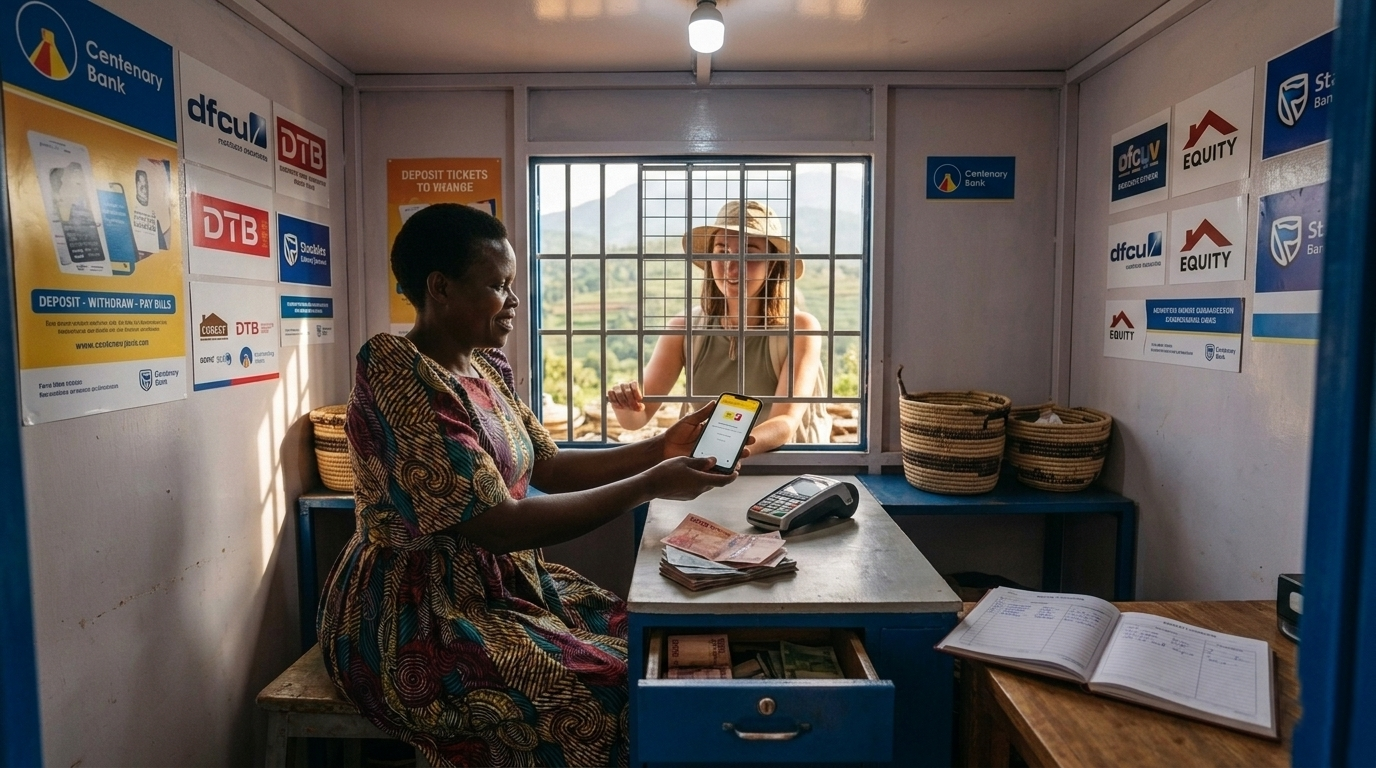
Using Cash, Cards, ATMs and Mobile Money in Uganda
Understanding how to pay for goods and services is an essential part of any Uganda currency guide. Visitors can encounter several payment methods during a trip, including physical Ugandan shillings, bank cards, ATMs and mobile money. The most appropriate option depends on the location, type of purchase and payment facilities available.
The Bank of Uganda oversees Uganda’s national payment systems and recognizes a range of payment arrangements, including automated teller machines, mobile money, electronic funds transfers and other payment systems. :contentReference[oaicite:0]{index=0}
Uganda’s payment environment is also becoming increasingly digital. Bank of Uganda’s June 2026 information on forthcoming over-the-counter cash withdrawal limits describes a continued shift toward electronic payments and reports sustained growth in mobile-money transactions. :contentReference[oaicite:1]{index=1}
For travelers, this means Uganda currency should be understood as more than the physical notes and coins in a wallet. Cash remains important, while cards, ATMs and mobile money can provide additional ways of accessing or transferring money.
Using Cash in Uganda
Cash in Ugandan shillings remains an important part of everyday payments. Travelers can use Uganda currency for many ordinary purchases, particularly where a business does not have card-payment facilities or where a small cash transaction is more convenient.
Physical cash can be particularly useful when traveling outside major urban centers. Uganda’s financial infrastructure is not identical in every part of the country, and remote destinations can have fewer payment facilities than Kampala and other major towns.
Keeping an appropriate amount of Uganda currency available can therefore make travel easier. The objective is not to carry unnecessarily large amounts of cash but to have enough local currency for foreseeable small purchases and situations where electronic payment is unavailable.
Cash is also useful as a backup. Even travelers who normally prefer cards or mobile payments can encounter circumstances in which physical Uganda currency is the simplest option.
When Cash Is Most Useful
Ugandan shillings are especially useful for smaller purchases and transactions where electronic payment facilities are unavailable. This can include some local markets, small shops, informal businesses, personal expenses and services in areas with limited financial infrastructure.
Cash can also be useful when traveling to remote tourism destinations. Safari routes can pass through rural areas where access to banking facilities and ATMs is less predictable than in major cities.
Travelers should therefore consider their itinerary when deciding how much Uganda currency they need. A traveler spending several days in Kampala may have easier access to ATMs and card facilities than someone immediately traveling into a remote national park.
Keeping smaller denominations available can make cash payments more convenient, particularly when making relatively small purchases.
Using Bank Cards in Uganda
Debit and credit cards provide another way for travelers to pay in Uganda. Card acceptance depends on the individual business and its payment infrastructure, so travelers should not assume that every establishment will accept an international card.
Larger hotels, established businesses and some tourism facilities are more likely to have electronic payment facilities than very small businesses. Even when a card is accepted, travelers should understand whether their particular card network is supported.
The Bank of Uganda regulates and supervises financial institutions and oversees national payment systems, supporting the safety and efficiency of payment services in Uganda. :contentReference[oaicite:2]{index=2}
For visitors, a bank card is best treated as an important payment option and backup rather than the only method of accessing money during an entire Uganda trip.
Using Credit Cards and Debit Cards for Travel Expenses
A traveler may use a debit or credit card for eligible purchases where the merchant has a compatible card-payment facility. This can reduce the need to carry large amounts of physical Uganda currency for higher-value transactions.
Before traveling, it is useful to understand the terms associated with your own bank card, including foreign-transaction charges, international withdrawal fees and any daily transaction limits imposed by the card issuer.
Travelers should also maintain a second payment method. A card can be declined, temporarily unavailable or unusable because of a technical problem, even when the traveler has sufficient funds.
Having some Uganda currency available provides a practical alternative when a card payment cannot be completed.
Using ATMs in Uganda
ATMs are an important way of accessing Uganda currency without exchanging all foreign cash before a journey. They allow eligible bank-card users to withdraw Ugandan shillings through the banking network.
ATM availability is an important consideration when traveling beyond major urban areas. Travelers should not assume that an ATM will be available at every safari destination or rural location.
The Bank of Uganda identifies ATMs as part of Uganda’s national payment infrastructure. :contentReference[oaicite:3]{index=3}
For a trip that includes remote destinations, it is therefore sensible to consider ATM access as part of the overall Uganda currency plan rather than waiting until the last available opportunity to obtain cash.
How Travelers Should Plan ATM Withdrawals
ATM planning should follow the travel itinerary. Travelers staying in major towns generally have more opportunities to access financial services than travelers heading into remote national parks.
Before leaving an area with reliable ATM access, consider whether the next part of the journey will provide another convenient opportunity to obtain Uganda currency. This is particularly relevant when visiting several remote destinations consecutively.
Travelers should also check their own bank’s international withdrawal conditions. Charges, exchange-rate policies and withdrawal limits can vary by card issuer and account.
A well-planned withdrawal can reduce the need for repeated transactions while avoiding the unnecessary risk of carrying more cash than is needed.
Mobile Money in Uganda
Mobile money is one of the most significant electronic payment methods in Uganda. Bank of Uganda’s payment-system framework defines e-money issuance, including mobile money, as a regulated payment activity that can support merchant payments, transfers and cash-in and cash-out services through agents. :contentReference[oaicite:4]{index=4}
The growth of mobile money means that Uganda’s modern payment environment extends well beyond physical Uganda currency. Money can be transferred electronically and used for eligible payments without requiring the recipient to receive physical banknotes.
Bank of Uganda’s 2026 information on payment trends reports that mobile-money payments have continued to grow and have averaged about 25% of transactions annually since financial year 2020/2021. :contentReference[oaicite:5]{index=5}
For visitors, however, access to mobile money depends on the particular service, account and registration arrangements available to them.
Mobile Money and Tourists
International visitors should distinguish between mobile-money services available to residents and the practical requirements for setting up and using a local mobile-money account during a short visit.
Mobile money can be extremely convenient when a traveler has the appropriate account and service access. It can reduce dependence on physical cash and provide an electronic method for eligible transfers and payments.
However, travelers should not build an entire Uganda currency strategy around mobile money unless they have confirmed that they can legally and practically access the relevant service for their trip.
For many visitors, a combination of Uganda currency and an internationally usable bank card remains a straightforward foundation, with mobile money considered an additional option where available.
Cash, Cards, ATMs and Mobile Money During a Uganda Safari
Safari travel requires particularly careful payment planning because itineraries often combine major cities with rural and remote destinations. A traveler may use a card at one stage of the journey and need physical Uganda currency later.
Major safari costs such as accommodation, park activities and transport may be arranged in advance, but travelers can still require local money for personal purchases and other expenses.
Remote destinations can have fewer ATMs and fewer card-payment facilities than major towns. This makes it important to obtain appropriate Uganda currency before traveling into areas where financial services are limited.
The best approach is therefore to combine payment methods according to the itinerary instead of expecting one method to work everywhere.
Using Payment Methods During Gorilla Trekking Trips
Gorilla trekking takes place in remote southwestern Uganda, where travelers should plan their access to Uganda currency before entering areas with fewer financial facilities.
A traveler may have already paid major trekking and accommodation costs, but local cash can still be useful for personal purchases, tips and souvenirs.
The most important consideration is not whether cash is the only payment method available, but whether the traveler has a reliable backup if a card or electronic payment cannot be used.
For remote trekking itineraries, a combination of Uganda currency, an appropriate bank card and advance financial planning provides greater flexibility.
Keeping Cash Secure During Travel
Travelers should handle Uganda currency responsibly and avoid carrying more cash than they reasonably need. Keeping money organized and secure makes it easier to monitor spending and reduces the consequences of losing a wallet.
When using an ATM, protect your PIN and pay attention to the surroundings. Avoid allowing unknown people to handle your card or observe your PIN.
It is also useful to keep emergency funds separate from the cash used for daily spending. This provides a backup if the main wallet is misplaced.
The same basic principle applies to cards and mobile devices: keep them secure and use appropriate account and device security measures.
Uganda’s Move Toward Digital Payments
Uganda’s financial system is continuing to develop toward broader use of electronic payment methods. Bank of Uganda’s current policy information describes a national shift toward electronic settlement and identifies digital alternatives including electronic funds transfers and mobile-money bank-to-wallet transfers. :contentReference[oaicite:6]{index=6}
This trend does not mean that physical Uganda currency has disappeared. Cash continues to have an important role, particularly for consumers and businesses that depend on physical transactions.
For travelers, the practical result is a mixed payment environment. Cash and digital payments can exist side by side, with the appropriate method depending on the location and transaction.
A modern Uganda currency guide should therefore explain both physical money and electronic payment methods so that visitors understand the full payment landscape.
Cash Versus Cards Versus ATMs Versus Mobile Money
| Payment method | Best suited to | Key consideration |
|---|---|---|
| Ugandan shillings | Small purchases, local transactions and remote destinations | Must be carried securely |
| Debit or credit card | Eligible merchants and larger established businesses | Acceptance varies |
| ATM | Obtaining additional Uganda currency | Access is less predictable in remote areas |
| Mobile money | Electronic transfers and eligible payments | Requires suitable service and account access |
No single payment method is universally best for every traveler or every location. A combination of methods generally provides the greatest flexibility.
Best Payment Strategy for Visitors to Uganda
For most visitors, the practical approach is to maintain access to several payment methods rather than depending entirely on one. Uganda currency should cover everyday cash needs, while a suitable bank card can provide another way to pay or obtain funds.
ATMs can provide access to additional Uganda currency when available, particularly in major towns. Mobile money can provide another electronic option for people who have appropriate access to the service.
The balance between these methods should reflect the itinerary. A city-based traveler may have frequent access to ATMs and electronic payments, while a traveler heading deep into rural or safari areas should plan more carefully for cash availability.
The central lesson of this Uganda currency guide is simple: use cash where it is most practical, use cards where they are accepted, use ATMs to replenish local currency when appropriate, and consider mobile money as part of Uganda’s wider digital payment environment.
Key Takeaways for Using Money in Uganda
Ugandan shillings remain an important part of everyday payments, particularly for smaller transactions and travel outside major urban centers.
Bank cards can provide convenient electronic payment options where merchants have compatible facilities.
ATMs can provide access to additional Uganda currency, but travelers should plan ahead when visiting remote destinations.
Mobile money is a major component of Uganda’s electronic payment environment, although visitors should understand the account and service requirements before relying on it.
The most flexible approach is to combine Uganda currency with appropriate electronic payment methods and plan according to the destinations on the itinerary.
Uganda Currency for Tourists and Safari Travelers
Understanding Uganda currency is an important part of preparing for a trip to Uganda. International visitors encounter a mixture of cash transactions, card payments, ATMs and mobile-money services, and the balance between these options changes as a journey moves from major cities into rural and safari destinations.
The Uganda shilling is the country’s official currency and is the primary local currency travelers encounter when paying for everyday goods and services. For safari travelers, however, financial planning needs to go beyond simply knowing the name of the currency. A successful Uganda currency plan considers where money will be needed, which expenses have already been prepaid, where additional cash can be obtained and which payment methods may be available along the route.
This is particularly important because Uganda safari itineraries commonly combine urban centers with remote tourism destinations. A traveler may have easy access to banking facilities in Kampala or Entebbe and then spend several days in an area where access to ATMs or card facilities is more limited.
Safari guidance for Bwindi, for example, specifically recommends carrying Ugandan shillings for tips and souvenirs because credit-card facilities may not be available in some remote areas. :contentReference[oaicite:0]{index=0}
Why Tourists Need Ugandan Shillings
International travelers sometimes arrive with US dollars, euros, pounds or another foreign currency. Those currencies can be useful for exchanging into Uganda currency, but they should not be confused with the country’s official local currency. Everyday transactions are generally easier when the traveler has Ugandan shillings available.
Ugandan shillings are particularly useful for smaller purchases and transactions where electronic payment facilities are unavailable. Depending on the itinerary, this can include local shops, markets, community activities, personal purchases, transport and other incidental expenses.
For tourists, carrying local currency also reduces the need to negotiate every small transaction using a foreign currency. It allows the traveler to understand prices directly in Uganda’s monetary system and makes ordinary purchases more straightforward.
The amount of Uganda currency a visitor needs depends on the length of the trip, itinerary, accommodation arrangements and personal spending habits. There is no single amount that is appropriate for every traveler.
Uganda Currency Before Your Safari Begins
The easiest point at which to organize your Uganda currency is before leaving the major urban areas on your itinerary. Kampala and Entebbe are important starting points for many international visitors and provide considerably more access to financial services than remote safari locations.
Before traveling into the countryside, review your itinerary and identify the destinations where you will spend several consecutive days. Consider whether you will have another convenient opportunity to obtain Ugandan shillings after leaving the city.
This is especially relevant for travelers visiting national parks and forest destinations. A safari can involve long road journeys between towns, lodges and protected areas, meaning that financial planning should be completed before reaching the most remote parts of the route.
A useful starting point is to separate prepaid safari costs from personal spending. If accommodation, transport and activities have already been arranged, your Uganda currency requirements may mainly concern incidental expenses, tips, souvenirs and purchases not included in the safari package.
Using Uganda Currency in Kampala and Entebbe
Kampala and Entebbe are important places for tourists to organize their finances because they are major urban areas with a broader range of financial and commercial services.
Visitors may find opportunities to use bank cards, obtain cash through ATMs and exchange foreign currency before continuing into rural parts of the country. The exact availability of individual services varies by location and provider.
For a traveler arriving at Entebbe International Airport and immediately continuing toward a national park, it is worth considering whether additional Uganda currency should be obtained before the journey moves farther from major commercial centers.
Planning this stage carefully can reduce the need to search for financial services later in the safari.
Uganda Currency on a Wildlife Safari
Wildlife safari travelers should think about Uganda currency differently from someone spending an entire holiday in Kampala. Safari routes often pass through rural areas where financial services are less concentrated.
A traveler may spend the morning in a national park, travel several hours by road and arrive at a lodge or community outside a major town. The payment facilities available at one point in the journey may therefore be different from those available later.
Physical Uganda currency can be useful as a backup even when the traveler has a functioning international bank card. Having local cash means that a traveler is less dependent on card acceptance or ATM availability.
This is one reason a Uganda currency guide is particularly relevant to safari travelers: financial convenience can change as the geographical environment changes.
Uganda Currency for Gorilla Trekking Travelers
Gorilla trekking is one of Uganda’s most internationally recognized tourism experiences, and travelers heading to Bwindi Impenetrable National Park should include local currency in their preparation.
The different Bwindi trekking sectors are located in southwestern Uganda, away from the country’s largest urban financial centers. Travelers can therefore benefit from arranging their personal spending money before reaching remote areas.
Safari guidance for Bwindi recommends carrying cash in Ugandan shillings for tips and souvenirs and notes that credit-card facilities may not be available in some remote areas. :contentReference[oaicite:1]{index=1}
For travelers combining gorilla trekking with other activities, local-currency planning should cover the entire route rather than focusing only on the trekking day.
Uganda Currency for Chimpanzee Trekking Travelers
Chimpanzee trekking destinations create similar considerations. Travelers visiting Kibale National Park or other forest destinations may spend substantial time outside major urban centers.
Kibale is a major primate tourism destination, and safari itineraries commonly combine chimpanzee experiences with accommodation and community activities in the surrounding region. :contentReference[oaicite:2]{index=2}
Travelers should therefore consider their cash requirements before entering the park area. Even when a lodge or tour operator accepts an electronic payment method, smaller local transactions may still be easier to settle using Uganda currency.
The same principle applies to travelers visiting Budongo Forest, Queen Elizabeth National Park and other destinations along extended Uganda safari routes.
Uganda Currency for Accommodation
Accommodation payment arrangements vary between properties. International visitors staying at established hotels and safari lodges may have access to card-payment facilities, while smaller accommodation providers can have different arrangements.
Before traveling, confirm which accommodation costs have already been paid and which expenses will be settled locally. This distinction can make a significant difference to the amount of Uganda currency you need to carry.
For example, a safari package may already include accommodation, meals and transport. The traveler may then need local money mainly for personal purchases, optional activities, souvenirs and tips.
Knowing exactly what your safari package includes is therefore an important part of planning your Uganda currency requirements.
Uganda Currency for Tips and Gratuities
Tips are one of the reasons safari travelers should have some local Uganda currency available. Guides, drivers and other tourism workers may receive tips depending on the service provided and the traveler’s personal choice.
Having suitable denominations makes tipping easier and avoids the need to break a large note for a relatively small payment.
Travelers should distinguish between the currency used for a tip and the amount of the tip itself. The appropriate amount depends on the circumstances and should not be confused with the face value of a Ugandan banknote.
For remote safari trips, organizing some Uganda currency before reaching the destination makes it easier to handle incidental payments without depending entirely on cards.
Uganda Currency for Souvenirs and Local Purchases
Souvenirs are another common reason tourists use Uganda currency. Travelers may purchase crafts, locally made products, artwork and other items during visits to markets, communities and tourism centers.
Payment methods vary between sellers. Physical Uganda currency can be useful because not every small business will have a card terminal or another electronic payment option.
When purchasing an item, confirm the price and currency before paying. If a price is quoted in a foreign currency, make sure you understand the exact amount before handing over cash.
Keeping souvenir spending separate from essential travel funds can also make it easier to monitor your budget throughout the safari.
Can Tourists Use US Dollars in Uganda?
US dollars can be encountered in Uganda’s international tourism sector, particularly around tourism-related services and transactions involving international visitors. However, travelers should not assume that every business will accept US dollars.
For ordinary purchases, Uganda currency provides a more direct way to pay because the Uganda shilling is the country’s official local currency.
Travelers should always establish the currency in which a price is quoted before making a payment. This is particularly important when comparing prices or calculating the value of a purchase.
Keeping some Uganda currency alongside any foreign currency can therefore make everyday transactions simpler.
Using ATMs During a Uganda Safari
ATMs can be useful for tourists who need additional Uganda currency during their trip. However, access becomes an increasingly important planning issue when an itinerary moves away from major towns.
Travelers should identify the last convenient opportunity to obtain cash before entering a remote section of their safari. Waiting until cash is almost exhausted can create unnecessary difficulty if the next destination has limited financial services.
The practical approach is to use major towns as financial resupply points and then travel into remote areas with enough Uganda currency for the foreseeable needs of the itinerary.
An ATM should therefore be considered a useful resource rather than something that is guaranteed to be available at every safari destination.
Mobile Money for Tourists in Uganda
Mobile money has become an important component of Uganda’s financial environment. It allows money to be transferred electronically and supports a wide range of transactions through regulated payment systems.
For international tourists, however, mobile money should be considered separately from simply carrying Uganda currency. Access depends on the particular service, account arrangements and requirements applicable to the user.
A traveler who already has appropriate access to a local mobile-money service may find it useful for eligible payments and transfers. A short-term visitor should not assume that the service can automatically replace cash and an international bank card.
Mobile money is best understood as an additional payment option within Uganda’s wider financial system rather than a universal replacement for Uganda currency.
How Much Uganda Currency Should a Tourist Carry?
There is no universally correct amount of Uganda currency that every tourist should carry. Spending needs vary according to the length of the trip, accommodation arrangements, safari package, personal habits and destinations visited.
Instead of choosing an arbitrary amount, calculate which expenses you expect to pay locally. Separate essential spending from optional spending and consider how many days you will spend away from reliable access to ATMs or other financial services.
A traveler staying in Kampala may have frequent opportunities to access financial services, while someone traveling through several remote national parks may need to organize more local cash before leaving major towns.
The best Uganda currency strategy is therefore based on the itinerary rather than a fixed cash figure.
Managing Uganda Currency on a Multi-Destination Safari
A multi-destination safari requires more deliberate financial planning because travelers can move between areas with very different levels of commercial infrastructure.
For example, a route connecting Kampala, Kibale, Queen Elizabeth National Park, Bwindi and Lake Bunyonyi can involve several days away from major urban centers. Safari itineraries of this kind commonly combine primate experiences, wildlife viewing and long road transfers. :contentReference[oaicite:3]{index=3}
The traveler should therefore assess where additional Uganda currency can be obtained before each remote segment. It is more practical to plan around the route than to assume that the next destination will have the same financial facilities as the previous one.
This approach also helps travelers avoid unnecessary interruptions to their safari simply because they need to locate a financial service.
Uganda Currency and Remote Safari Destinations
Remote safari destinations require more preparation because the availability of banks, ATMs and card-payment facilities can be less predictable than in large towns.
This is particularly relevant to travelers visiting forest parks and conservation areas in western and southwestern Uganda. Bwindi’s remote setting is one example where safari guidance recommends carrying local cash because card facilities may not always be available. :contentReference[oaicite:4]{index=4}
Travelers should therefore organize their Uganda currency before reaching the most remote section of their itinerary and retain an alternative payment method where possible.
The objective is not to carry excessive cash but to avoid becoming dependent on a financial service that may not be immediately accessible.
Uganda Currency and Safari Packages
Many safari travelers do not need to pay every travel expense separately during the trip. Safari packages can include combinations of accommodation, transportation, meals, park activities and permits depending on the itinerary and operator.
This means travelers should carefully check what is included before deciding how much Uganda currency to obtain. Money needed for expenses already included in the safari package should not be counted as personal spending money.
Instead, identify the costs that remain payable during the journey. These can include personal purchases, optional activities, souvenirs and tips, depending on the specific safari arrangement.
This simple distinction can make Uganda currency planning more accurate and prevent travelers from carrying substantially more cash than necessary.
Keeping Uganda Currency Secure
Travelers should protect their cash just as they would in any unfamiliar destination. Avoid displaying large amounts of Uganda currency unnecessarily and keep money in a secure location.
It is also sensible to avoid putting all available cash in one place. Keeping a separate reserve can provide a backup if the main wallet is lost or becomes inaccessible.
The same principle applies to bank cards. Travelers should protect their cards and PINs and avoid sharing financial information with unknown people.
Good money management is about maintaining access to funds without exposing unnecessary amounts of cash or financial information.
Common Uganda Currency Mistakes Tourists Should Avoid
One common mistake is assuming that an international bank card will work everywhere. Card acceptance varies, particularly outside major commercial centers.
Another mistake is waiting until reaching a remote safari destination before thinking about Uganda currency. Travelers should plan their access to cash before leaving areas with reliable financial services.
Visitors should also avoid confusing foreign-currency amounts with Uganda shilling amounts. Always establish which currency a price is expressed in before completing a transaction.
Finally, travelers should not assume that mobile money automatically solves every payment requirement. Access to mobile-money services depends on the relevant account and service arrangements.
Avoiding these simple mistakes makes it easier to manage Uganda currency throughout a safari.
Key Uganda Currency Tips for Tourists and Safari Travelers
Carry an appropriate amount of Uganda currency for everyday purchases and remote destinations.
Use major towns as opportunities to organize additional cash before traveling into remote safari areas.
Keep a suitable debit or credit card as an additional payment option rather than relying exclusively on cash.
Consider mobile money as an additional electronic payment method where you have appropriate access to the service.
Check which safari expenses are already included in your package before calculating your personal Uganda currency needs.
Most importantly, plan your money around your actual safari route. Uganda currency requirements can be very different between Kampala, Entebbe and remote national parks.
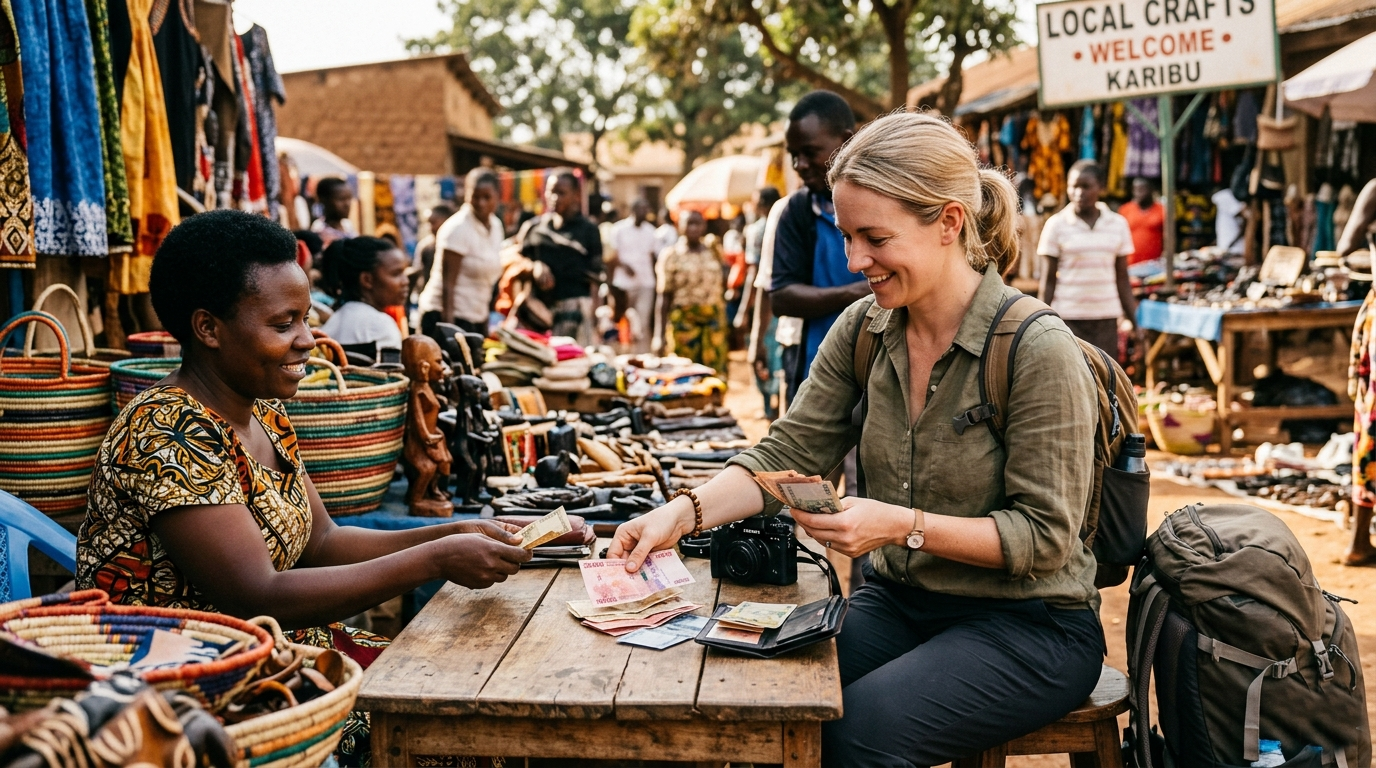
Understanding exchange rates and local prices helps when using cash.
Uganda Currency Exchange Rates, Prices and Money Tips for Travelers
Understanding Uganda currency exchange rates, prices and everyday money practices helps international visitors make better financial decisions during a trip. The Uganda shilling is the country’s local currency, but many travelers arrive with foreign currency and need to understand how exchange rates work before converting their money.
Exchange rates are not fixed at one permanent value. They move over time and can differ between financial institutions and foreign-exchange providers. The Bank of Uganda publishes official foreign-exchange rates on a daily basis, describing them as indicative of prevailing market conditions. :contentReference[oaicite:0]{index=0}
For tourists, the most important lesson is that an online or official reference rate should not automatically be treated as the exact amount a traveler will receive when exchanging physical foreign currency. The rate offered by a licensed foreign-exchange provider or financial institution can reflect the market conditions and transaction arrangements applicable at the time.
This section explains how travelers can understand Uganda currency exchange rates, compare prices, plan spending and avoid common mistakes when using money in Uganda.
How Uganda Currency Exchange Rates Work
An exchange rate expresses how much of one currency is equivalent to another currency. For a visitor traveling to Uganda, the exchange rate determines how much Uganda currency can be obtained for a foreign currency such as the US dollar, euro or British pound.
Suppose a traveler wants to convert foreign money into Ugandan shillings. The provider will apply its applicable rate to the amount being exchanged. The final amount received therefore depends on the rate used at the time of the transaction and any applicable charges or differences between buying and selling rates.
The Bank of Uganda provides official foreign-exchange information that allows the public to monitor currency movements and compare market conditions. :contentReference[oaicite:1]{index=1}
Checking a reliable reference rate before exchanging money can therefore help travelers understand whether an offered rate appears broadly consistent with current market conditions.
Why Uganda Currency Exchange Rates Change
Currency values change because foreign-exchange markets respond to economic and financial conditions. Uganda’s exchange-rate environment is influenced by factors affecting demand and supply for foreign currencies, monetary conditions and broader international developments.
For travelers, this means the conversion value they see before departure may not be identical to the rate available when they arrive in Uganda. The value can also differ between different dates during a longer trip.
The Bank of Uganda manages Uganda’s exchange-rate policy as part of its broader monetary and financial mandate. :contentReference[oaicite:2]{index=2}
Travelers should therefore avoid planning a trip around a single exchange-rate figure far in advance. A current rate should be checked when making an actual currency decision.
Official Uganda Currency Exchange Rates
The Bank of Uganda publishes official foreign-exchange rates through its website. Its current exchange-rate page provides daily information covering major international currencies as well as currencies of COMESA member states. :contentReference[oaicite:3]{index=3}
These published figures are useful for understanding the general market environment, but travelers should distinguish between an official reference rate and the actual transaction rate offered by a bank or licensed foreign-exchange provider.
The Bank of Uganda describes its published rates as indicative of prevailing market conditions. This distinction is important when calculating how much cash a traveler should expect to receive from an exchange transaction. :contentReference[oaicite:4]{index=4}
For current figures, travelers should consult the Bank of Uganda’s official exchange-rate information rather than relying on an old printed conversion table.
Uganda Currency Buying and Selling Rates
Travelers should understand the difference between buying and selling rates when exchanging foreign currency. A financial institution or foreign-exchange provider may quote different rates depending on whether it is buying foreign currency from the customer or selling foreign currency to the customer.
This is one reason why simply searching for a single Uganda currency exchange rate may not tell the whole story. A reference conversion may show an indicative market value, while the actual transaction involves a provider’s applicable buying or selling rate.
When comparing exchange options, travelers should look at the rate relevant to their transaction. Someone arriving with US dollars and requesting Ugandan shillings is effectively selling the foreign currency to the exchange provider.
Understanding this terminology makes it easier to compare offers without confusing the two sides of the exchange transaction.
Why the Rate You Receive May Differ From an Online Rate
An online currency converter can provide a useful reference, but the amount actually received when exchanging cash may differ. This can happen because online figures can represent market reference values rather than the transaction rate offered by a particular provider.
The Bank of Uganda’s official exchange-rate information is also described as indicative of prevailing market conditions rather than a guaranteed rate for every individual transaction. :contentReference[oaicite:5]{index=5}
Travelers should therefore compare the amount they will actually receive rather than focusing only on a headline exchange rate.
If a provider displays a rate and separately identifies a fee or charge, consider the overall cost before deciding where to exchange money.
How to Compare Uganda Currency Exchange Offers
The most useful comparison is the final amount of Uganda currency you will receive for a specific amount of foreign currency. This is more meaningful than comparing advertised rates without considering the complete transaction.
For example, if two providers quote different rates, ask how much Uganda currency you will receive after any applicable charges. This provides a clearer basis for comparison.
It is also important to compare like-for-like transactions. A rate for selling US dollars should not be directly compared with a rate for purchasing US dollars because the transaction directions are different.
A simple comparison method can help travelers make informed decisions without needing advanced knowledge of foreign-exchange markets.
Where Travelers Should Exchange Foreign Currency
Foreign-exchange transactions should be conducted through properly licensed financial institutions or foreign-exchange businesses. The Bank of Uganda supervises foreign-exchange bureaus and money-remittance businesses as part of Uganda’s regulated financial system. :contentReference[oaicite:6]{index=6}
The Bank of Uganda has specifically advised members of the public to transact only with companies licensed to engage in foreign-exchange business. :contentReference[oaicite:7]{index=7}
For international visitors, this is an important safety and consumer-protection consideration. A traveler should avoid informal currency dealings when a licensed provider is available.
Using regulated channels also makes it easier to obtain information about the transaction and retain documentation where appropriate.
Understanding Prices in Uganda Currency
Foreign visitors may initially find prices in Uganda currency difficult to interpret because amounts can contain several digits compared with the currency values they normally use at home.
The easiest approach is to become familiar with the appearance and denominations of Uganda’s banknotes and coins before making purchases. This helps travelers recognize amounts quickly and reduces confusion during everyday transactions.
Travelers should also pay attention to whether a quoted price is in Uganda shillings or a foreign currency. This is especially important when dealing with tourism-related services where international visitors may encounter prices expressed in different currencies.
When in doubt, ask the seller or service provider to clearly state the price and currency before completing the transaction.
How to Budget Using Uganda Currency
A useful travel budget separates expenses into categories rather than treating all spending as one amount. Accommodation, transport, meals, activities, shopping and personal expenses may have different payment arrangements.
For safari travelers, this is particularly important because major costs may have been paid before arrival. The remaining Uganda currency requirement can therefore be focused on expenses that are actually payable during the journey.
Creating a simple daily or trip-level spending estimate can help travelers determine when they need cash and when they can use other payment methods.
The goal is not to predict every purchase precisely but to understand the categories of expenditure and maintain sufficient access to funds throughout the itinerary.
Uganda Currency and Foreign-Currency Conversion During a Safari
Safari travelers should be especially careful about currency conversion because they may move through several destinations without returning to a major financial center.
A traveler who exchanges too little foreign currency may later need to search for a suitable exchange facility. A traveler who exchanges substantially more than necessary may finish the trip with excess Uganda currency that then has to be converted again.
A balanced approach is to estimate the local expenses that will actually require cash and consider where the next reliable opportunity for exchanging or obtaining money will be available.
This itinerary-based approach is particularly useful for trips combining Kampala with western Uganda, southwestern Uganda or other remote safari regions.
Foreign Currency Exchange and Banknotes
The physical condition of foreign banknotes can matter when exchanging cash. Travelers should keep foreign currency clean and undamaged and follow the requirements communicated by the exchange provider.
If a provider does not accept a particular note or currency, do not assume that another provider will necessarily apply the same policy. Requirements can vary between institutions.
The Bank of Uganda’s role includes issuing and managing Uganda’s banknotes and coins, while licensed financial institutions and foreign-exchange businesses handle customer transactions involving foreign currencies. :contentReference[oaicite:8]{index=8}
Travelers should therefore check exchange requirements before relying on a particular foreign-currency denomination.
Using Exchange Rates When Planning a Uganda Trip
Exchange rates are most useful when they help a traveler make a practical decision. Instead of memorizing a conversion figure months before departure, use current information to estimate the value of planned spending.
For example, a traveler can identify the approximate foreign-currency value of a planned Uganda shilling budget and then review the current market rate when the trip approaches.
The Bank of Uganda’s exchange-rate page provides current official reference information and historical exchange-rate functionality, making it a useful source for monitoring movements. :contentReference[oaicite:9]{index=9}
Because exchange rates can change, travelers should treat calculations as estimates until the actual transaction is made.
Avoiding Common Uganda Currency Exchange Mistakes
One common mistake is assuming that the first exchange rate found online is the exact rate a traveler will receive. Reference rates and actual transaction rates serve different purposes.
Another mistake is comparing only the headline rate while ignoring the final amount received. Travelers should consider the complete transaction when evaluating different exchange options.
Using an unlicensed foreign-exchange provider is another avoidable risk. The Bank of Uganda advises the public to transact only with licensed companies engaged in foreign-exchange business. :contentReference[oaicite:10]{index=10}
Finally, travelers should avoid exchanging more money than they reasonably expect to use unless they have a clear reason for doing so.
Uganda Currency Exchange Rate Checklist
| What to check | Why it matters |
|---|---|
| Current reference rate | Provides context for the prevailing currency market |
| Buying or selling rate | Shows which side of the transaction applies |
| Applicable charges | Can affect the final amount received |
| Provider licensing | Helps ensure the transaction is conducted through a regulated channel |
| Final Uganda shilling amount | Provides the clearest basis for comparing exchange options |
This checklist can help tourists evaluate Uganda currency exchange decisions without relying on a single advertised figure.
Understanding Uganda Currency Without Overcomplicating It
Travelers do not need to become foreign-exchange specialists to manage money effectively in Uganda. The most important principles are straightforward: understand that exchange rates change, compare the rate relevant to your transaction, use licensed providers and keep track of the currency in which prices are quoted.
The Bank of Uganda provides official exchange-rate information and supervises foreign-exchange businesses as part of its financial-sector responsibilities. :contentReference[oaicite:11]{index=11}
For safari travelers, the same principles should be combined with itinerary planning. The farther a journey moves from major commercial centers, the more important it becomes to understand where the next opportunity to obtain or exchange Uganda currency will be.
A well-planned approach allows visitors to focus on their Uganda experience while maintaining practical access to money throughout the journey.
Key Takeaways About Uganda Currency Exchange Rates
Uganda currency exchange rates change over time, so travelers should use current information when making financial decisions.
The Bank of Uganda publishes daily official foreign-exchange rates that are indicative of prevailing market conditions. :contentReference[oaicite:12]{index=12}
The actual amount received in an exchange transaction can differ from a reference rate.
Travelers should compare the final amount received and consider applicable transaction costs.
Foreign-exchange transactions should be conducted through licensed providers. :contentReference[oaicite:13]{index=13}
For safari travelers, currency planning should be based on the itinerary, especially when visiting remote destinations with fewer financial services.
Constraints Loaded
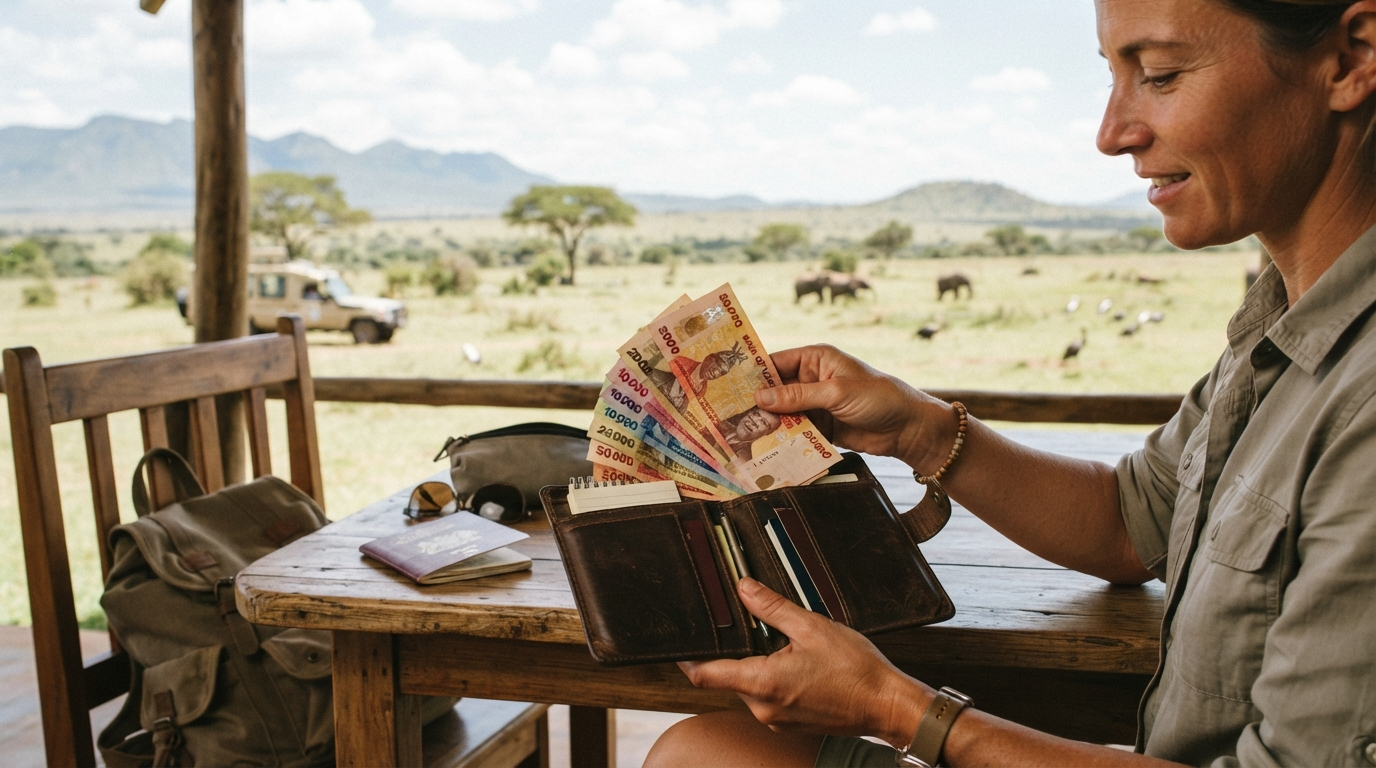
Safely managing cash and avoiding currency mistakes during a Uganda safari
Currency Safety, Counterfeits and Common Money Mistakes
Understanding Uganda currency safety is an important part of responsible travel. Visitors need to know how to handle cash carefully, how to respond when a banknote appears questionable, how to avoid confusion when counting money and how to use regulated financial services. These practical habits can make everyday transactions easier while reducing avoidable financial problems.
The Bank of Uganda has exclusive authority to design, issue and manage Uganda’s banknotes and coins. The central bank also periodically upgrades currency security features to reduce the risk of counterfeiting. :contentReference[oaicite:0]{index=0}
For tourists and safari travelers, Uganda currency safety is especially relevant because a journey may involve hotels, restaurants, markets, transport providers, safari lodges, community tourism activities and remote destinations. Payment conditions can vary considerably between these settings.
A good money-management strategy therefore combines local-currency knowledge with careful cash handling, awareness of legitimate financial services and sensible use of cards, ATMs and electronic payment methods.
Why Currency Safety Matters in Uganda
Currency is involved in many ordinary travel activities, from buying small items to settling expenses at accommodation establishments. A traveler who understands Uganda currency can identify denominations more easily, count change carefully and recognize when additional clarification is needed.
Currency safety is not simply about counterfeit detection. It also includes protecting cash from loss, avoiding unnecessary exposure of money, checking transactions before leaving a payment point and using authorized financial services.
This becomes particularly useful during a safari because travelers may make several small transactions while moving between destinations. Keeping financial records and organizing money carefully can make the journey easier to manage.
Visitors can also use reputable travel resources such as Uganda Rwanda Safaris when planning safari logistics and understanding how financial needs may fit into a broader itinerary.
How to Handle Uganda Shilling Banknotes Safely
Travelers should handle Uganda shilling banknotes with the same basic care they would apply to cash anywhere else. Keep notes organized, avoid unnecessary exposure of large amounts of money and check the amount involved in a transaction before handing over cash.
Separating frequently used spending money from a reserve can also make money management easier. The purpose is to maintain convenient access to everyday Uganda currency without constantly exposing all available cash.
When paying for goods or services, count the amount you intend to give and check the change you receive. This is especially useful when several banknote denominations are involved in the same transaction.
Travelers should also avoid rushing through cash transactions. Taking a few moments to verify the amount can prevent simple counting mistakes.
Recognizing Genuine Uganda Currency
The Bank of Uganda incorporates security features into Uganda’s currency and periodically upgrades those features as part of its efforts to reduce counterfeiting. :contentReference[oaicite:1]{index=1}
Travelers should become familiar with the general appearance of genuine Uganda currency before beginning a trip. Knowing the expected denominations, colors, designs and physical characteristics makes it easier to notice something unusual.
However, travelers should not rely on a single visual characteristic when deciding whether a banknote is genuine. Currency security features are designed to work together, and detailed verification should be based on official information from the Bank of Uganda rather than informal descriptions.
If a banknote appears suspicious, do not attempt to pass it to another person. Instead, seek clarification from a reputable financial institution or the relevant authorities.
What to Do If a Uganda Currency Note Looks Suspicious
A traveler may occasionally receive a banknote that appears unusual because of its condition, printing, appearance or other characteristics. An unusual-looking note should not automatically be treated as counterfeit, because legitimate currency can become worn or damaged through circulation.
The Bank of Uganda states that unfit or mutilated banknotes and coins can be submitted at commercial banks or Bank of Uganda branches for assessment and replacement at full face value, free of charge. :contentReference[oaicite:2]{index=2}
If you are uncertain about a banknote, the safest approach is to seek professional assessment rather than trying to determine its authenticity through guesswork.
Do not knowingly use a questionable note in another transaction simply because you received it elsewhere. A concern about a banknote should be handled through an appropriate financial channel.
Uganda Currency and Damaged Banknotes
Not every damaged Uganda shilling note is counterfeit. Banknotes naturally become worn through circulation, and travelers may encounter notes that are creased, dirty or otherwise unsuitable for normal circulation.
The Bank of Uganda provides a formal process for unfit or mutilated banknotes and coins. According to the central bank, members of the public may submit such currency at a commercial bank or Bank of Uganda branch for assessment and replacement at full face value, free of charge. :contentReference[oaicite:3]{index=3}
This distinction is useful for tourists because an unfamiliar or worn banknote should not automatically be described as counterfeit.
If a traveler has concerns about the condition of a note, professional assessment is preferable to attempting an informal exchange or passing the note to another person.
Counting Uganda Currency Correctly
Counting cash carefully is one of the simplest ways to improve Uganda currency safety. Before handing over money, separate the banknotes by denomination and establish the exact amount being paid.
After receiving change, count it before putting it away. If something does not appear correct, raise the issue immediately while the transaction is still clear to both parties.
Travelers should be particularly attentive when several denominations are being exchanged in one transaction. Familiarity with the appearance and value of the notes and coins can make this process easier.
Counting carefully does not require suspicion of every seller. It is simply a sensible financial habit that applies to cash transactions in any country.
Avoiding Confusion Between Uganda Shilling Denominations
Visitors who are unfamiliar with Uganda currency may initially find the denominations difficult to distinguish quickly. This can become more noticeable when making a purchase in a busy environment.
Before the trip, travelers can familiarize themselves with the denominations and general designs of Uganda’s current currency. The Bank of Uganda is the authority responsible for issuing Uganda’s legal-tender banknotes and coins. :contentReference[oaicite:4]{index=4}
When paying, slow down if necessary and verify the amount before handing over the cash. There is no benefit in rushing a transaction simply because other people are waiting.
A basic understanding of Uganda currency denominations can significantly improve confidence when making everyday purchases.
Using Licensed Foreign-Exchange Services
Currency safety also involves choosing where foreign money is exchanged. The Bank of Uganda licenses and supervises foreign-exchange bureaus and money-remittance businesses as part of Uganda’s regulated financial system. :contentReference[oaicite:5]{index=5}
Travelers should use properly licensed financial-service providers when exchanging foreign currency. This provides a more appropriate and accountable environment for a currency transaction than dealing with unknown individuals offering informal exchange.
The Bank of Uganda’s regulatory framework is designed to promote financial stability, responsible conduct and consumer protection within the financial sector. :contentReference[oaicite:6]{index=6}
For safari travelers, this is another reason to organize Uganda currency before traveling into remote areas rather than waiting until a convenient financial facility becomes difficult to find.
Common Uganda Currency Mistakes Made by Tourists
One common mistake is paying without first confirming the amount. Travelers unfamiliar with Uganda currency may sometimes focus on the appearance of a note instead of verifying its denomination.
Another mistake is exchanging money through an unauthorized person simply because the offered rate appears attractive. A better approach is to use regulated financial services.
Some visitors also carry all their cash together. Keeping all available money in one location can create unnecessary problems if that money is misplaced.
Another avoidable error is failing to keep transaction records for larger payments. Receipts and transaction confirmations can be useful when checking what has been paid or resolving a disagreement.
These are simple issues, but avoiding them can make Uganda currency management considerably easier.
Keeping Cash Secure During a Uganda Safari
Safari travelers should think about cash management as part of general travel organization. Keep money secure when moving between airports, hotels, lodges, towns and national parks.
Avoid displaying large quantities of Uganda currency unnecessarily. Take out only the amount required for a transaction and keep the remainder stored securely.
It can also be useful to separate everyday spending money from a reserve. This means that losing access to one portion of your cash does not necessarily mean losing access to every available travel fund.
Travelers should also protect payment cards and keep PINs and other financial credentials private.
Good Uganda currency safety practices are simple: carry what you need, protect the remainder and avoid unnecessary exposure of cash or financial information.
ATM and Card Safety in Uganda
ATMs and bank cards can reduce the amount of physical Uganda currency a traveler needs to carry, but electronic payments still require careful handling.
Choose ATMs located in appropriate and secure environments, protect your PIN and check your transaction before leaving the machine. If an ATM behaves unexpectedly, do not continue entering sensitive information simply to complete the transaction.
Travelers should monitor their account activity during a trip and retain transaction notifications or receipts where available.
The Bank of Uganda identifies ATMs, mobile money, electronic funds transfers and other payment arrangements as components of Uganda’s national payment system. :contentReference[oaicite:7]{index=7}
Mobile Money and Uganda Currency Safety
Mobile money is an important part of Uganda’s financial environment, but travelers should still treat mobile transactions as financial transactions requiring appropriate security.
Do not disclose confidential authentication information to another person. Before confirming a payment, check the recipient information and amount displayed by the service.
The Bank of Uganda oversees and modernizes Uganda’s national payment systems, which include mobile-money arrangements. :contentReference[oaicite:8]{index=8}
Tourists should use only payment services they are properly authorized and able to access, and they should keep transaction confirmations where appropriate.
Keeping Receipts and Payment Records
Receipts provide a simple record of a transaction. Travelers should keep receipts for significant payments, currency exchanges and other transactions where a record may be useful.
Digital confirmations can serve a similar purpose when a payment is made electronically. Keeping these records makes it easier to track expenditure and identify an unexpected transaction.
For safari travelers, keeping records can also help distinguish between expenses already included in a package and expenses paid separately during the journey.
A basic record of spending can therefore support both budgeting and Uganda currency safety.
What to Do When a Payment Seems Incorrect
If the amount of change appears incorrect, a receipt does not match the amount agreed or a card transaction appears different from what was expected, address the issue promptly.
First check the amount and the currency involved. Some apparent discrepancies are simply caused by a misunderstanding between Uganda shillings and a foreign currency.
If the issue concerns a financial institution or regulated payment service, use the provider’s established customer-support or complaints process. The Bank of Uganda’s consumer-protection framework emphasizes transparency, fair treatment and mechanisms for complaints and dispute resolution. :contentReference[oaicite:9]{index=9}
Keeping receipts and transaction confirmations makes these situations easier to explain.
Currency Safety for Gorilla Trekking and Remote Tourism
Travelers heading to Bwindi, Mgahinga and other remote tourism destinations should organize their money before entering areas where financial services may be less accessible.
The same principle applies to travelers working with safari operators specializing in gorilla trekking and other primate experiences. Anthill Gorillas Safaris is an example of a tourism resource focused on gorilla safari travel.
Remote travel does not necessarily mean that every transaction will require cash. Instead, travelers should understand the payment arrangements relevant to their particular accommodation, tour operator and itinerary.
A practical Uganda currency plan should therefore be completed before the remote section of a safari begins.
How to Avoid Carrying Too Much Uganda Currency
Carrying sufficient cash is useful, but carrying substantially more than necessary can create additional security concerns. Travelers should estimate their expected local spending and maintain alternative access to funds where appropriate.
The amount required will depend on the itinerary. A short urban stay and a multi-day safari through remote destinations can have very different cash requirements.
Instead of selecting an arbitrary cash amount, consider the number of days before the next reliable financial service, the expenses already included in the trip and the transactions that are likely to require physical Uganda currency.
This creates a more balanced approach to money management than simply carrying as much cash as possible.
Uganda Currency Emergency Planning
A sensible travel budget should include a backup plan in case a payment card fails, an ATM is unavailable or a traveler needs unexpected funds.
An emergency plan does not mean carrying a large quantity of cash in one location. Instead, travelers should maintain appropriate access to more than one payment method where possible.
Keep important financial information secure and know how to contact your bank or card provider if a payment instrument becomes unavailable.
For longer safari itineraries, review your payment options before leaving major towns and avoid waiting until all available Uganda currency has been spent.
Tourist Money Mistakes to Avoid in Uganda
Do not assume that every unfamiliar banknote is counterfeit simply because it looks different from the currency you use at home. Learn the official appearance and security information for Uganda currency.
Do not exchange foreign currency through unknown individuals when licensed financial services are available.
Do not hand over cash without confirming the amount and currency involved.
Do not display large amounts of Uganda currency unnecessarily.
Do not share confidential card, PIN or mobile-payment authentication information.
These simple precautions cover many of the most common areas where travelers can improve their Uganda currency safety.
Financial Consumer Protection in Uganda
Currency safety is part of a wider financial-consumer-protection framework. The Bank of Uganda states that its consumer-protection guidelines promote clear disclosure of product terms and costs, fair practices, customer-data protection and mechanisms for handling complaints and resolving disputes. :contentReference[oaicite:10]{index=10}
This is relevant to tourists when using regulated financial institutions and payment services. Customers should be able to understand the costs and important terms associated with financial products and services.
Travelers should therefore pay attention to transaction information rather than accepting unexplained charges or unclear payment instructions.
Using regulated financial channels and retaining transaction records provides a stronger foundation for resolving problems if they occur.
Uganda Currency Safety Checklist for Travelers
| Safety practice | What the traveler should do |
|---|---|
| Check denominations | Become familiar with Uganda shilling notes and coins before making frequent purchases. |
| Check suspicious notes | Seek professional assessment rather than passing a questionable note to another person. |
| Count cash | Verify both the payment and the change received. |
| Use regulated services | Exchange foreign currency through licensed financial-service providers. |
| Protect cash | Avoid displaying or storing all available money in one place. |
| Protect payment credentials | Keep PINs and authentication information private. |
| Keep records | Retain receipts and electronic transaction confirmations where appropriate. |
Following these practices helps travelers manage Uganda currency with greater confidence while maintaining sensible financial safeguards.
Practical Currency Safety for Safari Travelers
A safari combines financial planning with travel logistics. Before leaving a major town, confirm that you have the appropriate Uganda currency for the next stage of the journey and understand which expenses remain unpaid.
Keep cash organized and secure, use cards or electronic payments where appropriate and avoid depending entirely on one payment method.
Travelers can also review their safari arrangements with their operator before departure so that they understand which costs are included and which expenses will need to be settled separately.
Resources such as Uganda Rwanda Safaris and Anthill Gorillas Safaris can provide context for safari itineraries, while financial questions should be verified with the appropriate regulated financial institution.
What to Remember About Counterfeit Uganda Currency
The Bank of Uganda is responsible for issuing Uganda’s legal-tender currency and periodically upgrading security features to reduce counterfeiting risks. :contentReference[oaicite:11]{index=11}
Travelers should use official information when learning about Uganda currency security features rather than relying on social-media claims or unofficial descriptions.
If a note appears suspicious, do not knowingly put it back into circulation. Seek appropriate professional assistance instead.
The key principle is simple: understand the currency, handle it carefully and use legitimate financial channels.
Key Uganda Currency Safety Takeaways
Learn the denominations and general appearance of Uganda currency before traveling.
Count cash carefully when paying and when receiving change.
Use licensed and regulated financial-service providers when exchanging foreign currency.
Treat a suspicious banknote as a matter for professional assessment rather than passing it to someone else.
Protect cash, cards, PINs and mobile-payment credentials.
Keep receipts and transaction confirmations for important payments.
Plan Uganda currency needs before entering remote safari destinations.
The Bank of Uganda remains the authoritative source for information concerning Uganda’s legal-tender currency, currency issuance and official financial-sector guidance. :contentReference[oaicite:12]{index=12}
Constraints Loaded
Constraints Loaded
Uganda Currency Frequently Asked Questions
Understanding Uganda currency becomes much easier when travelers know what to expect before arriving. Questions about the Uganda shilling, banknotes, coins, exchange rates, foreign currency, ATMs, cards, mobile money, cash requirements and payments are common among international visitors.
The Uganda shilling is Uganda’s legal tender, and the Bank of Uganda is responsible for issuing and managing the country’s currency. The central bank also oversees important parts of Uganda’s financial and payment systems.
The answers below bring together the most important practical questions travelers may have when planning how to use Uganda currency during a holiday, business trip, safari or longer stay.
What Is the Currency of Uganda?
The official currency of Uganda is the Uganda shilling. It is the country’s legal tender and is issued under the authority of the Bank of Uganda.
When travelers see prices in Uganda, they will generally encounter amounts expressed in Uganda shillings. Visitors should confirm the currency whenever a price is quoted in a tourism or commercial transaction, particularly when discussing higher-value services.
What Is the Uganda Shilling Symbol and Currency Code?
The Uganda shilling is commonly abbreviated as UGX in international financial and currency contexts. Travelers may also see prices written using words such as Uganda shillings or shillings.
When comparing prices with another currency, check both the numerical amount and the currency designation. This is particularly important when reviewing hotel rates, safari costs, transport prices or other services quoted before arrival.
What Denominations of Uganda Currency Are Available?
Uganda uses both banknotes and coins. The denominations encountered by travelers vary in practical usefulness depending on the value of the transaction and the location.
The Bank of Uganda is the authoritative source for the current legal-tender denominations and official currency information. Travelers should consult current central-bank information when they need an authoritative list rather than relying on outdated travel material.
Knowing the appearance and relative value of the denominations can make everyday transactions easier, especially for visitors who have never used Uganda currency before.
Should Tourists Use Uganda Shillings or Foreign Currency?
The Uganda shilling is the local legal tender and is the primary currency travelers should understand for everyday transactions. Some tourism businesses may quote or accept prices in foreign currency under particular arrangements, but visitors should not assume that every merchant or service provider will accept foreign currency.
Using Uganda currency for local purchases can make price comparisons and change calculations easier. Before paying, confirm the amount and currency being requested.
For organized safaris, travelers should also check the payment terms provided by their tour operator because the currency accepted for a particular service can depend on the arrangement.
Where Can I Exchange Foreign Currency in Uganda?
Foreign currency can be exchanged through regulated financial institutions and licensed foreign-exchange businesses. Travelers should use legitimate financial-service providers rather than relying on informal individuals offering currency exchange.
The Bank of Uganda regulates and supervises parts of Uganda’s financial sector, including foreign-exchange bureaus and other financial institutions within its mandate.
Before completing an exchange, confirm the applicable rate, fees and amount you will receive. Keep the transaction receipt where one is provided.
Is It Better to Exchange Money Before or After Arriving in Uganda?
There is no single approach that is best for every traveler. What matters most is having an appropriate payment plan for the first part of the journey while using reputable financial channels.
Travelers arriving in Uganda should consider their airport transfer, first accommodation, meals and other immediate expenses when deciding how to access local currency.
For larger currency exchanges, compare the available regulated options and review the actual rate and charges rather than choosing a provider based only on an advertised headline rate.
Can Tourists Withdraw Uganda Currency From ATMs?
International travelers may be able to withdraw Uganda shillings using compatible international bank cards at suitable ATMs. However, card acceptance, ATM availability, withdrawal limits and fees can vary by card issuer, financial institution and location.
Travelers should check with their card provider before departure to understand international-use conditions, foreign-exchange charges and security requirements.
When using an ATM, protect your PIN and review the transaction information carefully. Travelers visiting remote safari destinations should not assume that an ATM will always be available when they need one.
Are Credit Cards and Debit Cards Accepted in Uganda?
Cards are used in Uganda, particularly through formal businesses and establishments equipped to process electronic payments. However, acceptance is not universal.
Travelers should therefore avoid building their entire Uganda currency plan around card payments. A combination of suitable payment methods can provide greater flexibility, especially when traveling outside major urban areas.
Before making a purchase, confirm whether the business accepts your particular card and whether additional charges may apply.
Can Tourists Use Mobile Money in Uganda?
Mobile money is an important component of Uganda’s payment environment. However, international visitors should not assume that they can automatically access every mobile-money service under the same conditions as a resident.
Availability depends on the specific service, account requirements, identification requirements and other applicable conditions. Travelers should verify their eligibility and payment options before relying on mobile money as their primary source of funds.
Regardless of the payment method, never disclose confidential PINs, passwords or authentication information to another person.
How Much Cash Should I Carry in Uganda?
There is no universally correct amount of cash that every visitor should carry. The appropriate amount depends on the itinerary, destination, accommodation, activities, payment options and length of time before the next reliable opportunity to access funds.
A traveler staying mainly in an urban area may have different requirements from someone spending several days in remote safari destinations.
The best approach is to estimate the cash expenses expected during the next stage of the journey and maintain an appropriate backup payment method.
Is Uganda Expensive for Tourists?
The cost of traveling in Uganda varies substantially according to travel style. Accommodation category, transport arrangements, safari activities, destination, length of stay and the services included in a tour package can all influence the total cost.
For this reason, it is more useful to divide a travel budget into specific categories than to label Uganda as simply expensive or inexpensive.
Travelers should calculate their expected costs in Uganda shillings and then compare the total with their home-currency budget using a current exchange rate.
What Is the Best Way to Carry Money in Uganda?
A balanced approach is generally more practical than depending entirely on physical cash or entirely on electronic payments. Travelers can organize an appropriate amount of Uganda currency for immediate expenses while maintaining access to another suitable payment method.
The exact combination depends on the itinerary. A city-based trip and a remote safari should not necessarily have identical money arrangements.
The most important principle is to keep money and payment credentials secure while maintaining reasonable access to funds.
What Should I Do If I Receive a Suspicious Uganda Shilling Note?
Do not knowingly pass a suspicious banknote to another person. If a note appears questionable, seek professional assistance from an appropriate financial institution or relevant authority.
A worn or damaged note is not automatically counterfeit. The Bank of Uganda provides procedures through which unfit or mutilated banknotes and coins can be assessed and, where eligible, replaced through appropriate financial channels.
The safest approach is to obtain an official assessment rather than relying on informal opinions.
How Can I Avoid Currency Scams in Uganda?
Use established and regulated financial-service providers for foreign-currency exchange and avoid handing money to unknown individuals offering unofficial exchange services.
When making a purchase, confirm the price, currency and amount before completing the transaction. Count your change before leaving the payment point.
Keep receipts for important transactions and check electronic payment confirmations carefully.
These basic precautions can reduce the likelihood of misunderstandings and help travelers maintain better control of their Uganda currency.
Should I Carry Uganda Currency on a Safari?
Safari travelers should have an appropriate way to make local payments, but the exact amount of physical Uganda currency required depends on the safari arrangements.
Before departure, check which services are included in the safari package and which expenses will be paid separately. Then plan the cash required for the remaining expenses.
Travelers heading toward remote destinations should plan ahead because access to financial services may be less convenient than in major towns.
Do I Need Uganda Currency for Gorilla Trekking?
Travelers undertaking gorilla trekking should review the payment arrangements for their entire itinerary rather than assuming that every expense will be paid in cash.
Major safari expenses may be arranged in advance, while personal spending and other costs may require separate payment. The appropriate Uganda currency plan therefore depends on the specific itinerary.
Travel planning resources such as Uganda Rwanda Safaris and Anthill Gorillas Safaris can be useful for understanding safari arrangements, while payment details should always be confirmed directly with the relevant operator.
Can I Use Foreign Currency in Uganda?
Foreign currency may be relevant to international tourism transactions, but visitors should not assume that every business will accept foreign notes. The Uganda shilling remains the country’s legal tender.
For ordinary local purchases, understanding Uganda currency is therefore more useful than depending entirely on foreign notes.
When a tourism provider quotes a price in another currency, confirm the payment terms before making arrangements.
Should I Exchange All My Foreign Money Into Uganda Shillings?
There is generally no need to convert all available travel funds into physical Uganda currency simply because you are visiting Uganda. The amount needed depends on your actual spending requirements and the payment methods available during the journey.
Converting only what is reasonably required can make cash management easier and reduce the amount of physical money that needs to be carried.
For larger currency decisions, compare current exchange rates and applicable fees through legitimate financial-service providers.
What Happens If My Uganda Currency Is Damaged?
A damaged banknote is not necessarily worthless. The Bank of Uganda provides procedures for handling unfit and mutilated banknotes and coins.
According to the central bank, eligible unfit or mutilated currency can be submitted at commercial banks or Bank of Uganda branches for assessment and replacement in accordance with the applicable requirements.
Travelers who receive a damaged note should seek appropriate financial assessment rather than automatically assuming that the note is counterfeit or unusable.
How Do I Check the Current Uganda Exchange Rate?
Exchange rates change over time, so travelers should check current information when preparing a significant currency transaction. The Bank of Uganda publishes foreign-exchange information and is an appropriate authoritative source for Uganda’s official financial information.
The rate shown by a financial institution or currency exchange provider may differ from an indicative market rate because providers can apply their own spreads, commissions or other charges.
Always consider the actual amount you will receive after applicable charges rather than comparing advertised rates alone.
Is It Safe to Carry Cash While Traveling in Uganda?
Cash can be a practical payment method in Uganda, but travelers should use normal financial-safety practices. Avoid displaying large amounts unnecessarily and keep money secure.
It is sensible to organize money so that only the amount needed for immediate transactions is easily accessible. The remainder should be kept securely.
Travelers should also avoid keeping all available funds in a single location and should maintain an appropriate alternative payment method when possible.
What Is the Most Important Uganda Currency Advice for First-Time Visitors?
The most important step is to become familiar with the Uganda shilling before beginning regular transactions. Understand the denominations, confirm prices before paying and count change carefully.
Use legitimate financial institutions and licensed exchange services when converting foreign currency. Keep payment cards, PINs and electronic-payment credentials secure.
For safari travelers, review the payment arrangements before leaving major towns and understand which expenses are already included in the itinerary.
Finally, avoid relying on outdated exchange-rate information. Current financial information should be checked when making significant currency decisions.
Uganda Currency Guide: Final Practical Checklist
Learn the Uganda shilling and become familiar with the denominations before traveling.
Confirm whether prices are quoted in Uganda shillings or another currency before making significant payments.
Use regulated financial institutions and licensed currency-exchange providers.
Check current exchange-rate information before making major currency exchanges.
Do not rely entirely on cash, cards or any single payment method.
Protect cash, bank cards, PINs and electronic-payment credentials.
Count Uganda currency carefully when paying and receiving change.
Keep receipts and electronic transaction confirmations for important payments.
Plan cash requirements before entering remote safari and tourism destinations.
For safari planning, travelers can review relevant itinerary information through Uganda Rwanda Safaris or Anthill Gorillas Safaris, while currency, financial and exchange-rate information should be confirmed through the appropriate official financial authorities.
With a basic understanding of the Uganda shilling, careful budgeting, sensible cash handling and awareness of available payment methods, travelers can approach financial transactions in Uganda with much greater confidence.