
Ultimate Kibale National Park Guide: Amazing Chimpanzee Trekking & Safaris
Kibale National Park, Uganda, is one of Africa’s finest rainforest destinations and the world’s premier location for chimpanzee trekking. Nestled in western Uganda at the foot of the Rwenzori Mountains, the tropical rainforest covers 795 square kilometres of lush tropical forest. It is home to over 1,500 wild chimpanzees and an incredible 13 species of primates—the highest concentration found anywhere in Africa. It also protects more than 375 bird species, 70 mammal species, beautiful crater lakes, and diverse forest ecosystems that make every visit unforgettable.
Whether you’re planning a chimpanzee trekking adventure, a chimpanzee habituation experience, bird watching safari, nature walk, or a complete Uganda wildlife safari, Kibale National Park offers remarkable experiences for every traveller. The park combines breathtaking scenery, exceptional biodiversity, and authentic cultural encounters, making it one of Uganda’s must-visit national parks.
A Map showing The Location of Kibale National Park
This comprehensive guide covers everything you need to know about Kibale National Park, including chimpanzee permit prices, the best time to visit, wildlife, accommodation, activities, how to get there, safari costs, travel tips, and expertly crafted itineraries. By the end of this guide, you’ll have all the information needed to confidently plan an unforgettable Kibale safari.
Quick Facts About Kibale National Park
| Feature | Details |
|---|---|
| 📍 Location | Kibale National Park is located in western Uganda, spanning the districts of Kabarole, Kamwenge, Kyenjojo, and Kasese. The park lies approximately 320 km (199 miles) from Kampala and about 26 km (16 miles) southeast of Fort Portal Tourism City. |
| 🌳 Size | The park covers approximately 795 square kilometres (307 square miles) of protected tropical rainforest, making it one of Uganda’s largest remaining natural forests. |
| ⛰ Altitude | The park ranges between 1,100 and 1,590 metres (3,609–5,217 feet) above sea level, providing a cool and comfortable climate throughout the year. |
| 🌡 Temperature | Average temperatures range between 14°C and 27°C (57°F–81°F). Mornings and evenings are usually cool, while afternoons are pleasantly warm. |
| 🌧 Annual Rainfall | Kibale receives between 1,500 and 1,700 mm (59–67 inches) of rainfall annually. The wet seasons occur from March to May and September to November. |
| 📅 Year Gazetted | Kibale Forest was officially gazetted as a National Park in 1993 to protect its rich biodiversity and unique tropical rainforest ecosystem. |
| 🦍 Number of Chimpanzees | The park is home to over 1,500 wild chimpanzees, making it the best destination in Africa for chimpanzee trekking and habituation experiences. |
| 🐒 Number of Primate Species | Kibale boasts 13 primate species, the highest concentration of primates in Africa, including chimpanzees, red colobus monkeys, black-and-white colobus monkeys, L’Hoest’s monkeys, grey-cheeked mangabeys, olive baboons, blue monkeys, and red-tailed monkeys. |
| 🦌 Number of Mammal Species | More than 70 mammal species have been recorded, including forest elephants, buffaloes, bush pigs, duikers, bushbucks, giant forest hogs, civets, mongooses, and several small carnivores. |
| 🦜 Number of Bird Species | Kibale National Park is home to over 375 bird species, including the African pitta, black bee-eater, crowned eagle, green-breasted pitta, and several Albertine Rift endemic birds. |
| ✈ Nearest Airport | The nearest airport is Kasese Airstrip, located about 75 km (47 miles) away. Domestic scheduled and charter flights connect Kasese with Entebbe International Airport. |
| 🚗 Driving Distance | The park is approximately 320 km (199 miles) from Kampala, a drive of about 5–6 hours. It is also about 2–3 hours from Queen Elizabeth National Park. |
| ☀ Best Time to Visit | Kibale can be visited throughout the year. However, the best months for chimpanzee trekking are December to February and June to September, when the forest trails are generally drier and easier to hike. |
Why Visit Kibale National Park?
Kibale National Park is one of Uganda’s most rewarding safari destinations, offering unforgettable wildlife encounters, breathtaking rainforest scenery, and exceptional biodiversity. Often referred to as the Primate Capital of the World, Kibale is famous for its incredible chimpanzee trekking experiences, rich birdlife, and diverse ecosystems. Whether you are a wildlife enthusiast, birdwatcher, photographer, or nature lover, Kibale National Park promises an adventure unlike any other.
The World’s Primate Capital
Kibale National Park has earned the title “Primate Capital of the World” because it supports the highest diversity of primates in Africa. The park is home to 13 different primate species, making it one of the best places on Earth to observe these fascinating animals in their natural habitat. Besides the famous chimpanzees, visitors may encounter black-and-white colobus monkeys, red colobus monkeys, L’Hoest’s monkeys, grey-cheeked mangabeys, blue monkeys, red-tailed monkeys, olive baboons, vervet monkeys, bush babies, and pottos. Nowhere else in East Africa offers such an impressive concentration of primates within a single protected area, making Kibale a dream destination for wildlife lovers and photographers.
Africa’s Best Chimpanzee Trekking Destination
Kibale National Park is widely regarded as the best destination in Africa for chimpanzee trekking. The park is home to over 1,500 wild chimpanzees, and visitors enjoy one of the highest chimpanzee sighting success rates in the world, often exceeding 90%. Guided by experienced Uganda Wildlife Authority rangers, trekkers venture through the rainforest to observe these intelligent primates as they feed, groom, communicate, and play. For those seeking a deeper experience, Kibale also offers the unique Chimpanzee Habituation Experience, allowing visitors to spend up to four hours with a semi-habituated chimpanzee community while accompanying researchers and conservationists.
Home to 13 Primate Species
Although chimpanzees are the park’s biggest attraction, Kibale’s incredible primate diversity makes every forest walk exciting. The park protects 13 primate species, including the endangered Uganda mangabey, one of the country’s endemic monkeys. During a single visit, it is possible to spot several monkey species moving through the forest canopy while baboons forage on the forest floor. This exceptional biodiversity makes Kibale one of the world’s leading destinations for primate research, conservation, photography, and ecotourism.
Explore One of East Africa’s Finest Tropical Rainforests
Covering nearly 795 square kilometres, Kibale National Park protects one of East Africa’s largest remaining tropical rainforests. Towering mahogany and fig trees, dense vegetation, colourful butterflies, crystal-clear streams, and peaceful forest trails create a magical atmosphere for visitors. The rainforest is alive with birdsong, monkey calls, and the sounds of nature, offering a truly immersive wilderness experience. Nature walks through this ancient forest reveal an astonishing variety of plants, insects, reptiles, and mammals that thrive within this unique ecosystem.
A Paradise for Birdwatchers
Kibale National Park is one of Uganda’s top birdwatching destinations, with over 375 recorded bird species. Bird enthusiasts can search for rare forest birds such as the African pitta, green-breasted pitta, black bee-eater, crowned eagle, yellow-spotted barbet, and several Albertine Rift endemics. The nearby Bigodi Wetland Sanctuary further enhances the birding experience, offering excellent opportunities to spot the elusive great blue turaco and many other colourful species. Whether you are an experienced birder or simply enjoy nature, Kibale offers exceptional birdwatching throughout the year.
Discover the Scenic Crater Lakes
Beyond its lush rainforest, Kibale National Park is surrounded by the breathtaking Ndali–Kasenda Crater Lakes, a scenic network of more than 50 volcanic lakes that add another dimension to your safari experience.
Among the most popular are Lake Nkuruba, Lake Nyinambuga, Lake Kyaninga, Lake Nyabikere, Lake Nyamirima, and Lake Lyantonde, each offering its own unique beauty and panoramic views. Nestled among rolling hills, tea plantations, and verdant countryside, these crystal-clear lakes create some of western Uganda’s most spectacular landscapes.
Visitors can enjoy guided nature walks, birdwatching, photography, canoeing on selected lakes, cultural encounters with local communities, or simply relax while admiring the tranquil scenery.
Whether you’re watching the sunrise over Lake Nyinambuga, exploring the forests around Lake Nkuruba, or taking in the stunning vistas of Lake Kyaninga, the crater lakes provide the perfect complement to an unforgettable chimpanzee trekking adventure in Kibale National Park.
Visit Bigodi Wetland Sanctuary
Located just outside Kibale National Park, Bigodi Wetland Sanctuary is one of Uganda’s finest community-based ecotourism projects. This protected wetland is famous for its rich biodiversity, including more than 200 bird species, eight primate species, colourful butterflies, and numerous reptiles. Guided walks along well-maintained boardwalks provide excellent opportunities to spot the magnificent great blue turaco, red colobus monkeys, black-and-white colobus monkeys, and many other wildlife species. Visiting Bigodi not only enriches your safari experience but also directly supports local communities through sustainable tourism initiatives, making it a rewarding experience for both visitors and conservation.
History of Kibale National Park
Kibale National Park has a rich conservation history that spans more than a century. Today, it is recognized as one of Africa’s most important tropical rainforests and the world’s leading destination for chimpanzee trekking. Its journey from a protected forest to a world-renowned national park reflects Uganda’s commitment to wildlife conservation, scientific research, and sustainable tourism.
From Forest Reserve to Protected National Park
Long before it became a national park, Kibale was valued by local communities for its forests, rivers, medicinal plants, and wildlife. During the colonial period, much of the forest was designated as a Forest Reserve in 1932 to protect valuable hardwood trees and regulate timber harvesting. Although limited logging took place in selected areas, large sections of the forest remained intact, preserving the rich biodiversity that exists today.
Recognizing the forest’s outstanding ecological importance, the Government of Uganda upgraded Kibale to National Park status in 1993. This change provided stronger legal protection for its wildlife and natural habitats while promoting tourism and scientific research. Today, Kibale National Park covers approximately 795 square kilometres of tropical rainforest and forms part of an important wildlife corridor connecting Queen Elizabeth National Park.
A Global Conservation Success Story
Kibale National Park plays a vital role in conserving one of East Africa’s largest remaining tropical rainforests. The park protects hundreds of plant species, over 70 mammals, 375 bird species, and the highest diversity of primates found anywhere in Africa.
Conservation efforts focus on protecting wildlife from habitat loss, illegal hunting, and deforestation while restoring degraded forest areas. Park rangers conduct regular patrols to safeguard wildlife, remove illegal snares, and educate nearby communities about the importance of conservation. Sustainable tourism has also become a key source of funding, with park entrance fees and chimpanzee permits directly supporting wildlife protection and community development projects.
As a result of these conservation efforts, Kibale continues to thrive as one of Uganda’s best-managed protected areas and remains a safe refuge for endangered chimpanzees and many other species.
World-Renowned Chimpanzee Research
Kibale National Park is internationally recognized as one of the world’s leading centres for chimpanzee research. Scientists have studied chimpanzees in Kibale for several decades, helping to improve our understanding of their behaviour, communication, feeding habits, social structures, health, and conservation needs.
One of the park’s most important research centres is the Makerere University Biological Field Station (MUBFS), established in 1970 near Kanyawara. Researchers from Uganda and around the world continue to carry out long-term studies that contribute to global primate conservation.
The knowledge gained from these studies has played a significant role in developing successful chimpanzee trekking and chimpanzee habituation experiences, allowing visitors to observe these remarkable primates while ensuring minimal disturbance to their natural behaviour.
Working Together with Local Communities
Thousands of people live around Kibale National Park and have traditionally depended on the forest for firewood, medicinal plants, water, and other natural resources. Today, conservation organizations, Uganda Wildlife Authority, and local communities work closely together to protect the park while creating sustainable livelihoods.
Community-based tourism initiatives, such as Bigodi Wetland Sanctuary, have become excellent examples of successful conservation partnerships. Revenue generated from tourism supports schools, healthcare, clean water projects, and local businesses while providing employment opportunities for guides, lodge staff, artisans, and farmers.
These partnerships encourage local people to protect wildlife and reduce human-wildlife conflicts, ensuring that both communities and conservation benefit from tourism.
Current Management of Kibale National Park
Kibale National Park is managed by the Uganda Wildlife Authority (UWA), the government agency responsible for protecting Uganda’s national parks and wildlife reserves. UWA oversees wildlife conservation, law enforcement, tourism management, scientific research, infrastructure development, and community engagement within the park.
Working alongside research institutions, conservation organizations, tour operators, and local communities, UWA continues to strengthen conservation programs while improving visitor experiences. Well-maintained trails, professional ranger guides, regulated chimpanzee trekking, and strict conservation policies ensure that Kibale remains one of Africa’s premier ecotourism destinations.
Today, Kibale National Park stands as a remarkable example of how conservation, scientific research, sustainable tourism, and community participation can work together to protect one of Africa’s richest rainforest ecosystems for future generations.
Wildlife in Kibale National Park
Kibale National Park is one of Africa’s richest biodiversity hotspots and is widely regarded as the primate capital of the world. Covering approximately 795 square kilometers of tropical rainforest in western Uganda, the park is home to over 70 mammal species, 13 primate species, more than 375 bird species, hundreds of butterfly species, reptiles, amphibians, and an extraordinary variety of trees and flowering plants. Its diverse ecosystems, ranging from mature rainforest and swamps to grasslands and woodland, support an impressive concentration of wildlife throughout the year.
Primates of Kibale National Park
Kibale National Park is internationally famous for having the highest diversity of primates in East Africa. Whether you are on a chimpanzee trek, a guided forest walk, or exploring Bigodi Wetland Sanctuary, encounters with monkeys and other primates are almost guaranteed.
Chimpanzees (Pan troglodytes schweinfurthii)
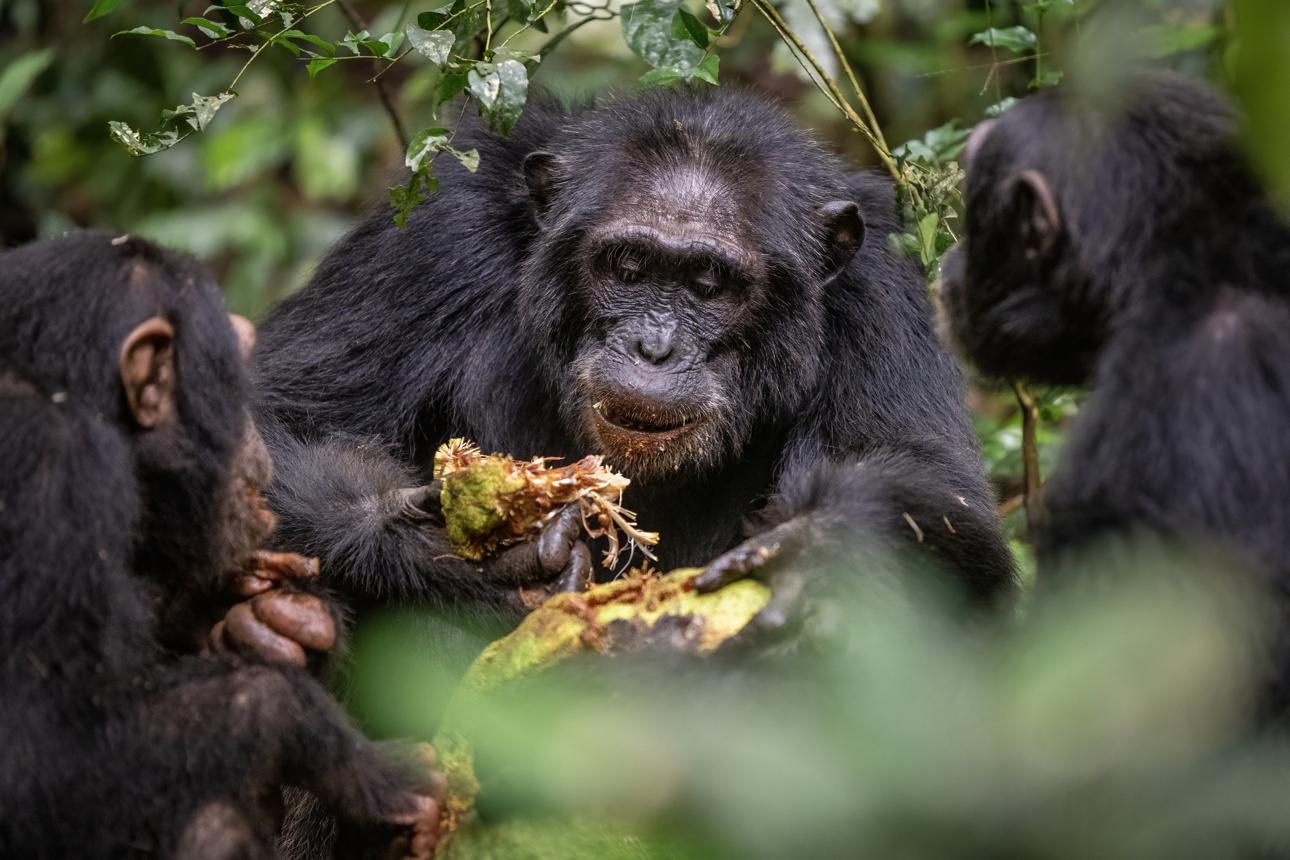
Chimpanzees are the star attraction of Kibale National Park. The park is home to approximately 1,500 chimpanzees, representing one of the largest remaining populations of the eastern chimpanzee. Every day, visitors have the opportunity to join chimpanzee trekking or the longer Chimpanzee Habituation Experience, both led by experienced Uganda Wildlife Authority ranger guides.
Chimpanzees share about 98.7% of their DNA with humans, making them our closest living relatives. Watching them interact in the wild is a remarkable experience. Visitors often observe chimps feeding on fruits, grooming each other, building nests, caring for infants, communicating through loud calls, and moving effortlessly through the forest canopy.
Chimpanzees are highly intelligent and use sticks to extract insects, stones to crack nuts, and leaves as sponges to collect drinking water. Their social groups can consist of over 100 individuals, although they usually split into smaller parties while foraging.
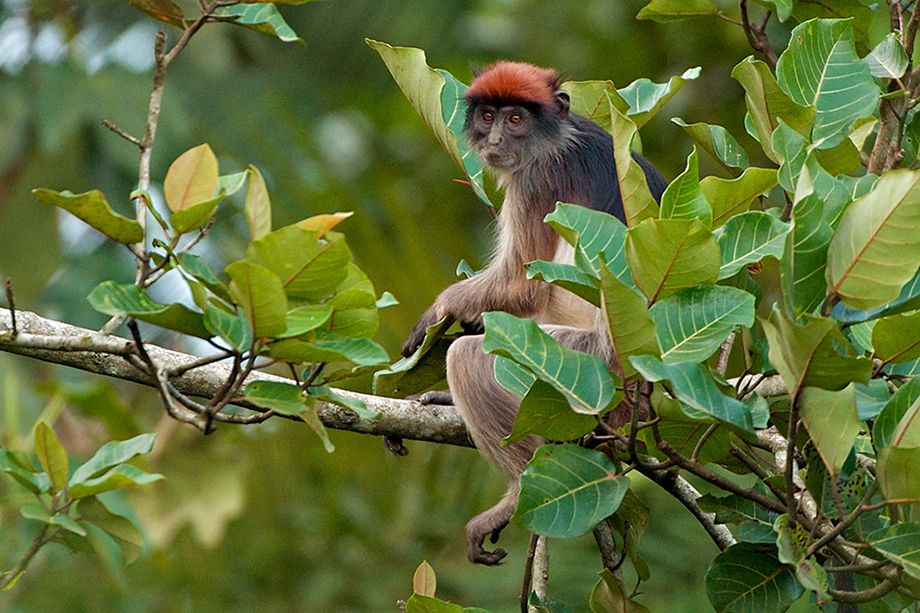
Ugandan Red Colobus Monkey (Piliocolobus tephrosceles)
The Ugandan red colobus is one of Kibale’s most iconic monkeys and is frequently encountered during forest walks. Recognizable by its rusty-red back, black face, and long tail, this endangered primate spends almost its entire life in the treetops.
Red colobus monkeys are highly social and often live in troops of more than 50 individuals. They feed primarily on young leaves, flowers, fruits, and seeds. Unlike many monkeys, they have a complex stomach that allows them to digest tough vegetation.
Chimpanzees occasionally hunt red colobus monkeys, making their predator-prey relationship one of the most studied in primate ecology.
 Black-and-White Colobus Monkey (Colobus guereza)
 Black-and-White Colobus Monkey (Colobus guereza)
The black-and-white colobus is among the most striking primates in Kibale National Park. Its glossy black coat contrasts beautifully with long white hair along its sides and tail, making it easy to identify.
These monkeys spend most of their time high in the forest canopy feeding on young leaves, fruits, flowers, and tree bark. Their specialized stomach enables them to digest leaves that many other primates cannot consume.
Black-and-white colobus monkeys are calm and are commonly seen resting in large trees close to forest trails.
L’Hoest’s Monkey (Allochrocebus lhoesti)
 L’Hoest’s Monkey (Allochrocebus lhoesti)
L’Hoest’s monkey is one of the more elusive residents of Kibale National Park. Easily recognized by its dark body and distinctive white beard, this monkey prefers dense undergrowth rather than the upper canopy.
Unlike many monkey species, L’Hoest’s monkeys spend a considerable amount of time on the forest floor searching for fruits, insects, leaves, seeds, and fungi. They are shy and usually retreat quietly when disturbed, making every sighting particularly rewarding.
Blue Monkey (Cercopithecus mitis)
 Blue Monkey (Cercopithecus mitis)
Blue monkeys are among the most frequently encountered primates during chimpanzee trekking. Despite their name, they are not actually blue. Their greyish fur often appears bluish under the forest light.
These agile monkeys feed mainly on fruits but also consume leaves, flowers, insects, and tree gums. They live in female-led groups and communicate through a wide range of vocalizations.
Blue monkeys often share the forest with red-tailed monkeys and black-and-white colobus monkeys.
Olive Baboon (Papio anubis)
Olive baboons are the largest primates found in Kibale National Park after chimpanzees. Highly adaptable and intelligent, they spend much of their time on the ground, moving through the forest in large troops that may exceed 100 individuals.
Their omnivorous diet includes fruits, roots, grasses, insects, eggs, reptiles, and occasionally small mammals. Olive baboons have a complex social structure with dominant males protecting the troop.
Visitors frequently encounter baboons along roads leading into the park and within the forest itself.
Grey-cheeked Mangabey (Lophocebus albigena)
 Grey-cheeked Mangabey (Lophocebus albigena)
The grey-cheeked mangabey is another highlight for primate enthusiasts. It has dark grey fur, pale cheeks, and a distinctive crest on its head.
These monkeys are highly active and move rapidly through the forest canopy searching for fruits, seeds, insects, flowers, and young leaves. They are excellent climbers and often travel long distances each day in search of food.
Grey-cheeked mangabeys are important seed dispersers, contributing significantly to the regeneration of Kibale’s rainforest.
Vervet Monkey (Chlorocebus pygerythrus)
Vervet monkeys are common around the park’s edges, nearby villages, and open woodland habitats. They have grey fur, black faces, and long tails.
These curious primates are highly adaptable and feed on fruits, seeds, flowers, insects, bird eggs, and occasionally small reptiles. Their intelligence and playful behavior make them popular among visitors.
Red-tailed Monkey (Cercopithecus ascanius)
The red-tailed monkey is one of Kibale’s most beautiful and easily recognized species. It has a reddish tail, white nose, expressive eyes, and colorful facial markings.
Highly active and social, red-tailed monkeys spend most of their time in the middle levels of the forest canopy feeding on fruits, flowers, leaves, and insects.
They often form mixed-species groups with blue monkeys, improving their ability to detect predators.
Bush Baby (Galagos)
Bush babies are small nocturnal primates rarely seen during daytime activities. However, visitors joining guided night walks have an excellent chance of spotting them.
These tiny primates have enormous eyes adapted for night vision and exceptionally powerful hind legs that allow them to leap several meters between trees.
Bush babies feed on insects, fruits, tree gums, nectar, and small vertebrates.
Potto (Perodicticus potto)
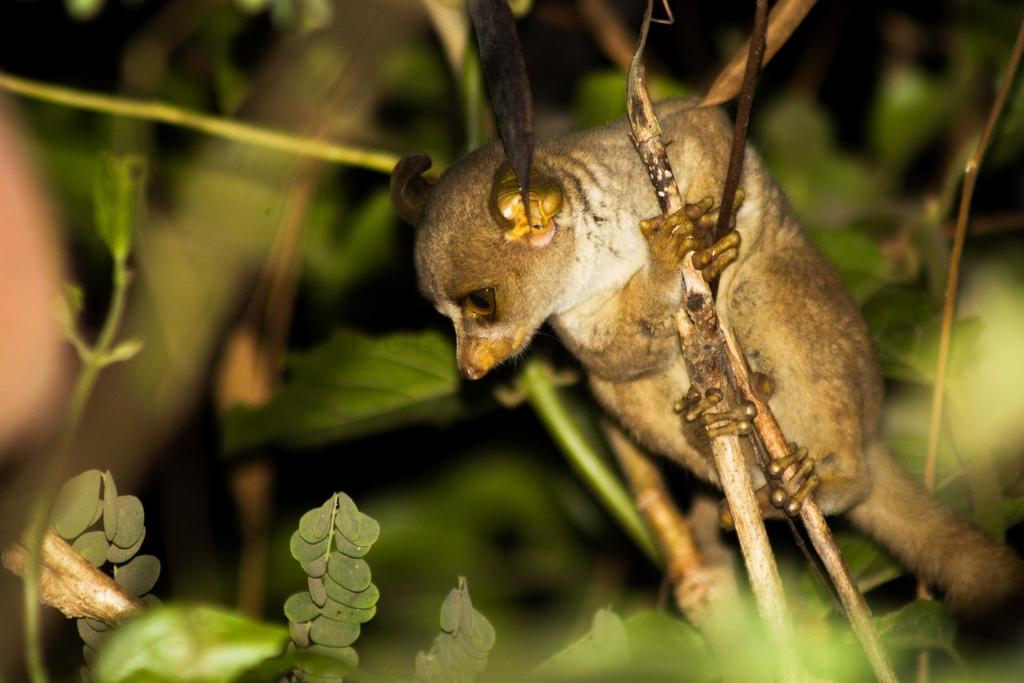 Potto (Perodicticus potto)
The potto is among Kibale’s most mysterious nocturnal primates. Slow-moving and secretive, it spends nearly all its life in the forest canopy.
Pottos feed mainly on fruits, insects, tree gums, and flowers. Their powerful grip allows them to move carefully along branches without attracting predators.
Although rarely seen during daytime, guided night forest walks occasionally reveal these fascinating creatures.
Other Mammals of Kibale National Park
Beyond its incredible primate diversity, Kibale National Park supports more than 70 mammal species, many of which thrive within its dense rainforest ecosystem.
Forest Elephant (Loxodonta cyclotis)
Forest elephants are among Kibale’s largest mammals, although sightings are relatively uncommon due to the dense vegetation. Smaller than the African savanna elephant, they have straighter tusks and rounded ears, and are well adapted to life in tropical forests.
Forest elephants play a vital ecological role by creating forest clearings, dispersing seeds, and maintaining healthy vegetation. Their movements help shape the rainforest ecosystem, benefiting countless other species.
Visitors are most likely to encounter signs of elephants, such as footprints, broken vegetation, or fresh dung, though lucky travelers may spot them during guided forest walks.
Bush Pig (Potamochoerus larvatus)
The bush pig is one of Kibale National Park’s most elusive mammals. Primarily nocturnal, it spends daylight hours hidden within thick vegetation before emerging at night to forage.
Bush pigs feed on roots, bulbs, fruits, grasses, insects, small reptiles, carrion, and agricultural crops near the park boundaries. Their reddish-brown coat, white facial markings, and sturdy build distinguish them from other wild pigs.
Although direct sightings are uncommon during daytime game activities, evidence of their presence—such as rooting marks and tracks—is frequently observed throughout the forest. They play an important ecological role by turning over soil while foraging, which helps with seed germination and nutrient cycling.
Birds of Kibale National Park: A Birdwatcher’s Paradise in Uganda
Kibale National Park is not only famous as the Primate Capital of the World but also ranks among the finest birdwatching destinations in East Africa. Covering approximately 795 km² of tropical rainforest, woodland, swamps, and grasslands, the park supports an astonishing 375+ recorded bird species, making it one of Uganda’s premier birding hotspots.
The park’s diverse habitats attract everything from tiny sunbirds and colorful turacos to elusive forest specialists, magnificent hornbills, powerful eagles, and several rare Albertine Rift endemic species. Whether you are a beginner or an experienced birder, Kibale offers rewarding birding throughout the year, with excellent sightings along forest trails, river valleys, wetlands, and the famous Bigodi Wetland Sanctuary.
Forest Birds of Kibale National Park
The ancient rainforest of Kibale provides one of the richest forest bird communities in Africa. Dense canopies, giant fig trees, forest streams, and thick undergrowth create ideal habitats for hundreds of forest-dependent species.
Many of these birds are difficult to find elsewhere in East Africa, making Kibale a dream destination for dedicated birdwatchers.
Notable forest birds include:
- Green-breasted Pitta
- African Green Broadbill
- White-naped Pigeon
- Yellow-spotted Barbet
- Speckled Tinkerbird
- Yellow-billed Barbet
- Joyful Greenbul
- Little Greenbul
- Red-tailed Bristlebill
- Western Nicator
- Purple-headed Starling
- Yellow-throated Nicator
- Brown-eared Woodpecker
- White-thighed Hornbill
- Black Bee-eater
The best forest birding is usually early in the morning when birds become highly active and vocal before the forest warms up.
Albertine Rift Endemic Birds
Kibale National Park lies close to the Albertine Rift, one of Africa’s most important biodiversity hotspots. Several species found here occur nowhere else except within the Albertine Rift region.
International birders highly seek these endemic birds.
Important Albertine Rift endemics include:
- African Green Broadbill
- Dusky Crimsonwing
- Blue-headed Sunbird
- Red-faced Woodland Warbler
- Purple-breasted Sunbird
- Regal Sunbird
- Collared Apalis
- Mountain Masked Apalis
- Archer’s Robin-Chat
- Stripe-breasted Tit
Among these, the African Green Broadbill is one of Uganda’s most prized bird species and is often considered a “must-see” by serious birdwatchers.
Hornbills of Kibale National Park
Hornbills are among the most spectacular birds found in Kibale. Their large bills, loud wingbeats, and distinctive calls make them easy to notice while exploring the forest.
These birds play a crucial ecological role by dispersing seeds throughout the rainforest, helping regenerate forest vegetation.
Hornbill species include:
- Black-and-white Casqued Hornbill
- White-thighed Hornbill
- African Pied Hornbill
- Crowned Hornbill
The Black-and-white Casqued Hornbill is particularly impressive, often seen flying high above the forest canopy with loud swooshing wingbeats.
Turacos of Kibale National Park
Turacos are among Uganda’s most colorful birds, and Kibale hosts several spectacular species.
Their brilliant green, blue, crimson, and purple plumage makes them favorites among wildlife photographers.
Turaco species include:
- Great Blue Turaco
- Ross’s Turaco
- Black-billed Turaco
The Great Blue Turaco is undoubtedly Kibale’s most iconic bird. Measuring almost 70 cm in length, it is one of Africa’s largest turacos and is frequently seen gliding between giant forest trees.
Kingfishers of Kibale National Park
Although kingfishers are commonly associated with rivers, Kibale’s rivers, wetlands, and forest streams support numerous species.
These colorful birds feed on fish, insects, frogs, and small reptiles.
Common kingfishers include:
- African Dwarf Kingfisher
- Blue-breasted Kingfisher
- Woodland Kingfisher
- Giant Kingfisher
- Pied Kingfisher
- Malachite Kingfisher
Bigodi Wetland Sanctuary offers excellent opportunities to observe kingfishers throughout the year.
Sunbirds of Kibale National Park
Sunbirds are Africa’s equivalent of hummingbirds. They are small, brilliantly colored nectar-feeding birds that pollinate numerous flowering plants within the forest.
Species include:
- Green-throated Sunbird
- Blue-throated Brown Sunbird
- Green-headed Sunbird
- Little Green Sunbird
- Purple-breasted Sunbird
- Blue-headed Sunbird
- Regal Sunbird
- Olive Sunbird
- Collared Sunbird
Male sunbirds display stunning metallic plumage that shimmers brilliantly in sunlight.
Raptors (Birds of Prey)
Kibale’s towering forest canopy supports numerous birds of prey that hunt monkeys, squirrels, rodents, reptiles, and smaller birds.
Important raptors include:
- African Crowned Eagle
- Cassin’s Hawk-Eagle
- Long-crested Eagle
- Palm-nut Vulture
- African Harrier-Hawk
- Lizard Buzzard
- Black Sparrowhawk
- Ayres’s Hawk-Eagle
- Bat Hawk
- African Hobby
The African Crowned Eagle is one of Africa’s most powerful forest raptors and is even capable of preying on young monkeys, making it a fascinating predator within Kibale’s ecosystem.
Night Birds
As darkness falls, Kibale transforms into an entirely different world. Guided night walks reveal fascinating nocturnal birds rarely seen during daylight.
Night bird species include:
- African Wood Owl
- Verreaux’s Eagle Owl
- Fraser’s Eagle Owl
- African Scops Owl
- Northern White-faced Owl
- Fiery-necked Nightjar
- Freckled Nightjar
- Square-tailed Nightjar
Listening to the haunting calls of these nocturnal birds is one of the highlights of a night forest walk.
Endemic and Rare Birds
Among Kibale’s most celebrated species are several birds with restricted distributions that attract birdwatchers from around the world.
Notable specialties include:
- African Green Broadbill
- Green-breasted Pitta
- Dusky Crimsonwing
- Blue-headed Sunbird
- Purple-breasted Sunbird
- Red-faced Woodland Warbler
- Regal Sunbird
- Archer’s Robin-Chat
- Collared Apalis
- Mountain Masked Apalis
These species are often a major highlight of birding tours through Kibale and neighboring forests.
Best Birding Months in Kibale National Park
Birdwatching in Kibale National Park is rewarding throughout the year. However, some months provide better trail conditions, clearer photography opportunities, increased bird activity and a greater chance of seeing migratory species.
| Months | Birding Conditions | Weather and Trail Conditions | Birding Highlights |
|---|---|---|---|
| January–February | Excellent | Generally drier conditions, easier forest walks and better visibility along the trails. | Active resident birds, breeding displays and excellent opportunities for forest photography. |
| March–May | Very Good | The main rainy season creates lush scenery, although some forest trails may become wet and slippery. | Increased bird calls, breeding activity, colorful vegetation and opportunities to see migratory species. |
| June–August | Excellent | This is one of the driest periods, with more accessible trails and comfortable birding conditions. | Excellent forest birding, easier photography and rewarding sightings around Kibale and Bigodi Wetland. |
| September–October | Very Good | Short rains may occur, but birding remains productive during the clearer periods of the day. | Active resident species, fresh vegetation and fewer visitors on some birding trails. |
| November | Good | Rainfall can be frequent, and visitors should prepare for muddy or slippery forest paths. | Migratory birds become more noticeable, while resident forest species remain active. |
| December | Excellent | Conditions usually become drier, improving trail accessibility and visibility. | A good combination of resident birds, migratory species and favorable photography conditions. |
Reptiles of Kibale National Park
Although Kibale National Park is best known for chimpanzees and other primates, its tropical forest also supports a remarkably diverse reptile community. Reptiles occupy almost every part of the ecosystem, from the forest floor and dense undergrowth to wetlands, tree trunks and the upper canopy.
A major scientific inventory of Kibale recorded 15 lizard species and 32 snake species. However, reptiles can be difficult to survey because many are secretive, nocturnal, highly camouflaged or active only during particular weather conditions. The park’s complete reptile diversity may therefore be greater than older inventories suggest.
Snakes in Kibale National Park
Kibale’s forest, swampy areas and woodland edges provide suitable habitats for several types of snakes. Most visitors rarely encounter them because snakes usually avoid people and remain concealed beneath vegetation, inside tree hollows, among fallen leaves or high in the forest canopy.
The park supports both venomous and non-venomous snakes, including forest cobras, vipers, tree snakes, egg-eating snakes, house snakes and pythons. Some species spend most of their time on the ground, while others are adapted to climbing trees and moving through dense vegetation.
The African rock python is among the largest reptiles associated with western Uganda’s forest and wetland environments. It is a powerful, non-venomous constrictor that may prey on rodents, birds and small mammals. Sightings are uncommon because pythons are secretive and usually remain close to thick vegetation, streams or swampy habitats.
Forest cobras and vipers may also occur within the wider Kibale ecosystem. These snakes generally avoid human contact and are seldom seen during ordinary chimpanzee trekking or guided nature walks. Visitors should remain on designated trails and follow the directions of their guides.
Chameleons
Chameleons are among the most fascinating reptiles visitors may encounter in Kibale. They are usually found on shrubs, low branches and forest-edge vegetation, where their slow movement and excellent camouflage make them difficult to notice.
Their independently moving eyes allow them to scan different directions at the same time, while their long, rapidly extending tongues help them catch insects. Chameleons also possess gripping feet and prehensile tails that allow them to move carefully through branches.
They are most easily found during guided night walks because torchlight can reveal their pale sleeping colours against green leaves. Guides familiar with their preferred habitats are often able to locate individuals that daytime visitors would easily overlook.
Lizards and Skinks
Several lizards and skinks inhabit Kibale’s forest floor, open clearings and sunny forest edges. Skinks are smooth-bodied reptiles that often move quickly through leaf litter, fallen logs and low vegetation in search of insects and other small invertebrates.
Agamas may occasionally be observed around open areas, roads, buildings and exposed tree trunks where sunlight is readily available. Unlike reptiles living deep inside the forest, these sun-loving species may be easier to see during warm parts of the day.
Geckos are generally nocturnal and are frequently associated with tree bark, rocky areas and buildings around lodges. Their specially adapted feet enable many species to climb vertical surfaces while hunting moths, mosquitoes and other insects.
Reptiles’ Role in Kibale’s Ecosystem
Reptiles form an important part of Kibale National Park’s food web. Snakes help control populations of rodents, frogs and small birds, while lizards consume large numbers of insects and other invertebrates. Reptiles also provide food for raptors, mongooses, civets and other predators.
Because many reptiles depend on stable temperatures, humidity, clean wetlands and intact vegetation, changes in their populations can provide clues about the health of the forest environment.
Where to See Reptiles in Kibale
Reptile sightings are never guaranteed, but visitors may encounter them around:
- Forest edges and sunny clearings
- Wetlands and slow-moving streams
- Leaf litter and fallen trees
- Shrubs along nature trails
- Bigodi Wetland Sanctuary
- Lodge gardens and nearby vegetation
- Night-walk routes
The best way to look for reptiles is during a guided nature walk with an experienced local guide. Visitors should never attempt to touch, disturb or handle a snake, chameleon or other reptile.
Amphibians of Kibale National Park
Kibale National Park’s rainfall, forest streams, swamps, pools and humid vegetation create ideal conditions for frogs and other amphibians. A detailed scientific survey documented 28 anuran species, meaning frogs and toads, within the park. The research also showed that Kibale’s amphibian and reptile community shares notable similarities with the forest fauna of Central and West Africa.
Amphibians are especially abundant during and immediately after rainfall. At these times, male frogs call loudly from ponds, swamp edges, trees, grasses and temporary pools to attract females.
Forest Frogs
Forest frogs occupy the moist undergrowth, leaf litter and low vegetation of Kibale’s rainforest. Many are small, beautifully patterned and extremely well camouflaged.
Some species remain close to the ground, hiding beneath fallen leaves or logs during the day. Others climb shrubs and trees, where they feed on flies, beetles, moths and other small invertebrates.
Because of their small size and secretive behaviour, forest frogs are often heard more frequently than they are seen. Their calls form an important part of Kibale’s night-time soundscape.
Tree Frogs
Tree frogs are adapted to living on leaves, branches and vegetation above the forest floor. Many possess adhesive toe pads that help them grip smooth surfaces and climb through wet foliage.
During the breeding season, males call from vegetation near temporary pools, swamps and forest streams. Different species produce distinct calls, allowing females to locate suitable mates even when several frog species are calling at the same time.
Tree frogs may display green, brown, yellow or patterned colouration that helps them blend into leaves and branches. Some become easier to locate at night when their eyes reflect torchlight.
Reed Frogs
Reed frogs are commonly associated with wetlands, grasses, reeds and vegetation surrounding pools. They are often small but brightly coloured, with markings that vary considerably between species and sometimes between individuals.
They are particularly active on wet evenings, when males gather around breeding sites and produce repeated calls. Bigodi Wetland Sanctuary and swampy habitats around Kibale can provide good opportunities to listen for and occasionally observe reed frogs.
Toads
Toads usually have stronger bodies, shorter legs and rougher skin than many forest frogs. They may be encountered on roads, trails, lodge grounds and open forest areas, especially after rainfall.
Most toads feed on insects, worms, spiders and other small animals. Their ability to consume large numbers of insects makes them ecologically valuable within the park and surrounding communities.
Breeding and Life Cycle
Most amphibians depend on water for reproduction. Females lay eggs in ponds, puddles, swamps, water-filled vegetation or slow-moving streams, depending on the species.
The eggs hatch into tadpoles, which live in water before undergoing metamorphosis into young frogs. Rainfall is therefore closely connected to breeding activity, and temporary pools created during wet weather can become important nurseries.
Some forest species have specialised breeding strategies. They may attach eggs to leaves above water, hide them in foam nests or use tiny water-filled spaces within plants.
Why Amphibians Are Important
Frogs and toads are both predators and prey. They consume mosquitoes, flies, beetles and other invertebrates while providing food for snakes, birds, small mammals and larger frogs.
Amphibians are also sensitive to pollution, changes in rainfall, rising temperatures and habitat disturbance because their permeable skin readily absorbs substances from the surrounding environment. Their presence can therefore indicate healthy wetlands, clean water and a functioning forest ecosystem.
Best Time to Observe Amphibians
The wetter months generally provide the greatest amphibian activity because rainfall fills pools and stimulates breeding. Frogs are most active:
- After afternoon or evening rain
- At night
- Around forest streams
- Near swampy habitats
- Beside temporary pools
- Within wet vegetation
- Along quiet forest-edge trails
A guided night walk offers the best chance of experiencing Kibale’s amphibians. Visitors should carry waterproof clothing, sturdy footwear and a torch, while avoiding handling frogs because substances on human hands may harm their sensitive skin.
Butterflies of Kibale National Park
Kibale National Park is one of Uganda’s most important forest butterfly habitats. A national biodiversity inventory listed 245 butterfly species known from Kibale Forest, including 40 restricted-range species and one regional endemic. The same assessment rated Kibale above average among Uganda’s surveyed forests for both butterfly diversity and conservation value.
The park’s butterfly richness is supported by its variety of habitats, including mature tropical forest, regenerating forest, woodland, wetlands, grasslands, forest edges and flowering gardens.
Forest Butterflies
Many of Kibale’s butterflies are closely associated with closed forest. The national biodiversity survey found that approximately 79% of the recorded species were linked either to closed forest or forest-edge habitats.
Deep-forest species are often observed flying through sunlit openings, settling on leaves or feeding on fallen fruit. Some remain close to the forest floor, while others occupy the middle and upper canopy.
Forest butterflies can be more difficult to photograph than open-country species because they frequently remain in shaded habitats and move rapidly between small patches of sunlight.
Swallowtails
Swallowtails are among the largest and most impressive butterflies found in Uganda. Many have long tails on their hindwings, bold markings and powerful flight.
They are often seen around flowering plants, damp ground, forest roads and mineral-rich patches. Males of some species gather on wet soil to absorb salts and other minerals, a behaviour known as mud-puddling.
Their caterpillars depend on particular host plants, making the protection of Kibale’s plant diversity essential for maintaining healthy swallowtail populations.
Charaxes Butterflies
Charaxes are powerful forest butterflies recognised for their strong flight, angular wings and richly patterned undersides. They frequently feed on fermenting fruit, tree sap and other mineral-rich organic material rather than relying exclusively on flower nectar.
Kibale is especially important for this group. The biodiversity inventory recorded a substantial proportion of Uganda’s known Charaxinae diversity within the forest.
They may be seen along forest trails where fruit has fallen from trees or near natural openings that allow sunlight to reach the ground.
Nymphalids
The family Nymphalidae includes many familiar African butterfly groups, such as foresters, commodores, pansies, admirals and mother-of-pearl butterflies.
These butterflies occupy a wide range of Kibale habitats. Some prefer deep forest, while others favour roadsides, wetlands, grasslands, gardens and disturbed forest edges.
Many nymphalids appear to stand on only four legs because their first pair of legs is reduced and held close to the body.
Acraeas
Acraeas are usually slender butterflies with orange, red, yellow, black or transparent wing patterns. Their slow and sometimes floating flight makes them relatively easy to observe around sunny forest edges and flowering vegetation.
Many species are chemically protected because their caterpillars feed on plants containing defensive compounds. Their bright colours warn predators that they may be unpleasant to eat.
Whites and Yellows
Butterflies in the Pieridae family include whites, yellows and sulphurs. They are frequently seen around open habitats, roadside vegetation, lodge gardens and wet mineral-rich soil.
Some species migrate or move seasonally in large numbers, while others remain associated with particular forest margins or wetland plants.
Skippers
Skippers are generally small, fast-flying butterflies with robust bodies and hooked antennae. They are often overlooked because of their rapid, darting movement and less conspicuous colours.
Kibale supports numerous skipper species, especially around forest edges, grasslands and low flowering plants. Their presence contributes significantly to the park’s overall butterfly richness.
Butterfly Feeding Behaviour
Not all butterflies depend primarily on nectar. In Kibale, different species may feed on:
- Flower nectar
- Fallen and fermenting fruit
- Tree sap
- Wet soil and mud
- Animal dung
- Decaying plant material
- Minerals along trails
- Moisture beside streams and puddles
The feeding behaviour of fruit-eating butterflies has made Kibale an important location for ecological research. More than 100 fruit-feeding butterfly species have been recorded in the park’s primary forest.
Ecological Importance of Butterflies
Butterflies contribute to pollination as they move between flowers in search of nectar. They are also an important source of food for birds, frogs, lizards, spiders and predatory insects.
Their caterpillars feed on specific host plants and transfer plant energy into the wider food web. Because many butterfly species respond quickly to changes in vegetation, forest structure and climate, researchers also use them as indicators of habitat condition.
A forest containing a broad variety of butterflies is likely to support diverse plant communities, stable microclimates and complex ecological relationships.
Best Places for Butterfly Watching in Kibale
Butterflies may be seen throughout Kibale, but productive locations include:
- Sunlit forest trails
- Kanyanchu visitor area
- Forest roads
- Bigodi Wetland Sanctuary
- Swamp edges
- Crater-lake vegetation
- Lodge gardens
- Flowering forest margins
- Damp mineral-rich ground
- Areas with fallen fruit
Best Time for Butterfly Watching
Butterflies are most active on warm, bright days when temperatures are high enough for flight. The best observation period is usually from mid-morning to early afternoon after the vegetation has dried.
The wetter seasons can produce lush vegetation, flowering plants, and newly emerged butterflies, although heavy rain may temporarily reduce their activity. Dry, sunny intervals following rainfall can be especially rewarding.
Visitors interested in butterfly photography should carry a camera with a close-focusing lens, move slowly and avoid casting shadows over resting butterflies. Binoculars with a close focusing distance can also be useful for observing individuals without approaching too closely.
What Is Chimpanzee Trekking?
What Is Chimpanzee Trekking in Kibale National Park?
Chimpanzee trekking is one of Africa’s most exciting wildlife experiences, offering visitors the rare opportunity to observe our closest living relatives in their natural rainforest habitat. Unlike a visit to a zoo or wildlife sanctuary, chimpanzee trekking takes you deep into the tropical rainforest, where wild chimpanzees roam freely, feed, socialize, communicate, and care for their young without human interference.
Kibale National Park, located in western Uganda, is widely regarded as the best destination in East Africa for chimpanzee trekking. The park protects approximately 1,500 eastern chimpanzees, representing one of the largest protected populations in Africa. Several chimpanzee communities have become habituated to human presence through years of careful conservation and research, allowing visitors to observe them safely while minimizing disturbance.
Chimpanzee trekking is much more than simply seeing wildlife. It is an immersive rainforest adventure that combines hiking through one of Africa’s oldest tropical forests with the thrill of encountering intelligent primates that share approximately 98.7% of their DNA with humans. Watching chimpanzees communicate through loud pant-hoots, use tools to obtain food, groom one another, defend territories, and nurture infants provides remarkable insight into human evolution and animal behavior.
Why Is Kibale National Park the Best Place for Chimpanzee Trekking?
Kibale National Park has earned an international reputation as Uganda’s premier chimpanzee destination because of its exceptional combination of chimpanzee numbers, excellent tracking success, experienced guides, and well-managed tourism.
The park’s lush rainforest provides an ideal habitat rich in fruiting trees, vines, insects, and fresh water. This abundance of food supports one of Africa’s highest densities of chimpanzees, making sightings more reliable than in many other forests.
Visitors also benefit from a highly organized tracking system. Experienced Uganda Wildlife Authority guides and trackers locate the habituated chimpanzee communities each morning before trekking groups enter the forest. Their knowledge of chimpanzee movements, feeding areas, vocalizations, and nesting sites greatly increases the chances of successful encounters.
For these reasons, Kibale consistently achieves a chimpanzee trekking success rate of over 90%, with many visitors enjoying close but carefully regulated observations of these remarkable primates.
What Makes Chimpanzees So Fascinating?
Chimpanzees are among the most intelligent animals on Earth. Their complex social structures, emotional intelligence, and problem-solving abilities continue to fascinate scientists and visitors alike.
During your trek, you may witness chimpanzees:
- Climbing tall forest trees with incredible agility.
- Swinging effortlessly through branches.
- Feeding on ripe fruits, leaves, seeds, flowers, termites, and ants.
- Grooming one another to strengthen social bonds.
- Mothers carrying infants on their backs or under their bellies.
- Juveniles chase each other through the canopy in playful games.
- Dominant males display strength through charging, branch shaking, and loud vocalizations.
- Using sticks to extract termites from mounds.
- Communicating through facial expressions, gestures, body language, and a variety of vocal calls.
Every trek is unique because chimpanzees are completely wild. Their behavior changes throughout the day depending on food availability, weather, social interactions, and the presence of neighboring chimpanzee communities.
A Truly Wild Wildlife Experience
Unlike traditional game drives, chimpanzee trekking is an active adventure. There are no vehicles once you enter the forest. Instead, visitors follow experienced guides along established trails and, when necessary, carefully move off-trail to locate the chimpanzees.
The journey itself is part of the experience. As you walk beneath towering mahogany and fig trees, you’ll encounter colorful butterflies, birds, monkeys, and perhaps forest elephants or bush pigs from a safe distance. The sounds of the rainforest—from birdsong to the distant calls of chimpanzees—create an unforgettable atmosphere long before you see the animals themselves.
Finding the chimpanzees often begins with listening. Guides pay close attention to pant-hoots, drumming on tree buttresses, and rustling in the canopy, gradually leading the group toward the chimpanzee community.
Habituated Chimpanzees
One of the reasons chimpanzee trekking in Kibale is so successful is the presence of habituated chimpanzee communities.
Habituation is a gradual process during which wild chimpanzees become accustomed to the non-threatening presence of researchers and guides over several years. This does not mean the chimpanzees are tame or domesticated. They remain completely wild and behave naturally while allowing people to observe them from a respectful distance.
This careful balance benefits both conservation and tourism. Visitors enjoy exceptional wildlife encounters, while revenue generated from permits supports chimpanzee conservation, anti-poaching patrols, scientific research, habitat protection, and local community development.
Conservation Through Tourism
Every chimpanzee trekking permit purchased contributes directly to protecting Kibale National Park and its wildlife.
Tourism revenue helps fund:
- Chimpanzee conservation programs.
- Anti-poaching patrols.
- Forest habitat restoration.
- Scientific research.
- Ranger training.
- Community education.
- Human-wildlife conflict mitigation.
- Sustainable tourism initiatives.
By participating in chimpanzee trekking, visitors become active contributors to the long-term conservation of one of Africa’s most important rainforest ecosystems.
Why Chimpanzee Trekking Should Be on Your Uganda Safari
Chimpanzee trekking complements Uganda’s famous gorilla trekking experience while offering something entirely different. Chimpanzees are far more vocal, energetic, and social than gorillas, creating a dynamic wildlife encounter filled with movement, calls, and fascinating interactions.
Many travelers combine Kibale National Park with destinations such as Bwindi Impenetrable National Park, Queen Elizabeth National Park, and Semuliki National Park to enjoy Uganda’s extraordinary diversity of wildlife, landscapes, and cultures.
Whether you are a wildlife enthusiast, photographer, birder, conservation supporter, or first-time safari traveler, chimpanzee trekking in Kibale National Park offers an unforgettable opportunity to witness one of humanity’s closest relatives living freely in one of Africa’s most beautiful rainforests.

Kibale vs Budongo vs Kyambura: Which Is Best for Chimpanzee Trekking?
Uganda offers several rewarding places to see wild chimpanzees, but the three destinations most frequently compared are Kibale National Park, Budongo Forest and Kyambura Gorge. Each destination offers a different forest environment, trekking experience and safari-planning advantage.
Kibale is generally the strongest choice for travelers whose main priority is having the most complete chimpanzee trekking experience. Budongo is particularly attractive to visitors combining chimpanzee trekking with Murchison Falls National Park, while Kyambura is convenient for travelers already visiting Queen Elizabeth National Park. The best destination therefore depends on whether chimpanzees are the central purpose of the trip or an additional activity within a broader wildlife safari.
| Comparison Factor | Kibale National Park | Budongo Forest | Kyambura Gorge |
|---|---|---|---|
| Best suited for | Travelers who want chimpanzee trekking to be one of the main highlights of their Uganda safari. | Travelers combining chimpanzee trekking with Murchison Falls National Park. | Travelers who want to add a short primate experience to a Queen Elizabeth National Park safari. |
| Chimpanzee population | Kibale protects Uganda’s largest and best-known chimpanzee population, with approximately 1,500 individuals across the wider park. | Budongo supports an important chimpanzee population within one of Uganda’s largest natural forests. | Kyambura contains a much smaller, geographically isolated chimpanzee community. |
| Reliability of sightings | Generally regarded as the most reliable of the three because of the large chimpanzee population, habituated communities and established tracking system. | Sightings can be rewarding, although chimpanzees may range widely depending on food availability and seasonal forest conditions. | Sightings may be less predictable because the gorge supports a smaller chimpanzee community within steep and enclosed terrain. |
| Tracking experience | A highly developed primate-tracking experience supported by experienced rangers, trackers and long-term chimpanzee research. | A quieter forest experience beneath impressive mahogany and ironwood trees, often with fewer visitors. | An adventurous descent into a dramatic forested gorge surrounded by the savannah landscapes of Queen Elizabeth National Park. |
| Terrain | Mostly forest trails with gentle hills, roots, occasional mud and sections of thick vegetation. | Generally manageable forest terrain, although the distance covered depends on the chimpanzees’ location. | The steep descent into and climb out of the gorge can feel more physically demanding, particularly after rain. |
| Trek duration | Standard tracking generally takes about two to five hours, depending on the chimpanzees’ movements, weather and terrain. | Duration varies according to where the chimpanzees are feeding, nesting or traveling that day. | Often suitable as a half-day safari activity, although the terrain and chimpanzee movements affect the total time. |
| Departure options | Several scheduled departures are normally available each day from Kanyanchu Visitor Centre, giving travelers greater itinerary flexibility. | Morning and afternoon sessions may be available, subject to current forest management arrangements and permit availability. | Tracking is normally organized in limited daily sessions, making advance booking important. |
| Chimpanzee habituation | Kibale offers a dedicated chimpanzee habituation experience that allows significantly more time in the forest than standard tracking. | The main visitor activity is standard chimpanzee tracking; available products should be confirmed when booking. | The primary visitor product is standard chimpanzee tracking rather than an extended habituation experience. |
| Other primates | Exceptional primate diversity, with opportunities to observe red colobus, black-and-white colobus, L’Hoest’s monkeys, red-tailed monkeys, blue monkeys and grey-cheeked mangabeys. | Supports several primates and numerous forest birds, although Kibale offers a broader flagship primate experience. | Other primates may be encountered, but the gorge’s smaller forest habitat offers less overall primate diversity than Kibale. |
| Complementary activities | Bigodi Wetland Sanctuary, birdwatching, crater lakes, community walks, nature walks and visits to Fort Portal. | Game drives, the Nile boat cruise, Murchison Falls, birdwatching and wildlife viewing within the wider conservation area. | Kazinga Channel boat cruises, game drives, lion tracking, birdwatching and visits to the crater-lake landscapes. |
| Main advantage | The most complete, specialized and reliable chimpanzee trekking destination in Uganda. | A quieter forest atmosphere and easy combination with a Murchison Falls safari. | Conveniently adds chimpanzee tracking to a Queen Elizabeth National Park itinerary. |
| Main limitation | Greater popularity means permits and nearby accommodation should be booked well in advance. | Less convenient for itineraries focused on southwestern Uganda, Bwindi or Queen Elizabeth National Park. | A smaller chimpanzee community and steep gorge terrain can make sightings less predictable. |
| Overall recommendation | Best overall choice | Best for Murchison itineraries | Best for convenient safari combinations |
Chimpanzee Habituation Experience in Kibale National Park
The Chimpanzee Habituation Experience in Kibale National Park is an extended primate adventure designed for travellers who want more than a brief encounter with wild chimpanzees. Instead of joining a standard trek and spending one hour with a fully habituated community, participants accompany Uganda Wildlife Authority guides, researchers and trackers as they follow chimpanzees that are still becoming accustomed to the presence of people.
The experience provides more time in the rainforest and a deeper understanding of chimpanzee behaviour, social relationships, communication and conservation. Participants may spend up to four hours with the chimpanzees after locating them, although the entire forest activity can occupy much of the day because it includes the initial search and the walk back to the starting point. The Uganda Wildlife Authority describes chimpanzee habituation as an all-year activity during which visitors spend an extended period following the chimpanzees.
Kibale National Park is especially suitable for this experience because it supports more than 1,500 chimpanzees distributed among several communities. Some communities are used for ordinary tourism, while others are monitored for research and habituation. This combination of a large chimpanzee population, experienced trackers and decades of scientific work has made Kibale Uganda’s principal destination for immersive chimpanzee encounters.
What Is Chimpanzee Habituation?
Chimpanzee habituation is the gradual process through which a wild chimpanzee community becomes familiar with the regular, non-threatening presence of researchers, trackers and carefully supervised visitors. The process does not tame or domesticate the chimpanzees. They continue to live independently, choose their own routes, search for natural food, defend their territories and interact according to their normal social structure.
When habituation begins, chimpanzees may avoid people, remain high in the canopy or move away when trackers approach. Researchers and field staff visit the community repeatedly over an extended period, behaving calmly and maintaining consistent safety procedures. With time, the chimpanzees learn that the observers do not present a threat.
The process can take several years because individual chimpanzees respond differently. Some may tolerate people relatively quickly, while others remain cautious for much longer. Mothers with young infants may be particularly protective, and dominant males may perform loud displays when assessing unfamiliar observers.
Visitors participating in the habituation experience therefore join an ongoing conservation and research process rather than simply visiting animals that are already completely comfortable around tourists. The chimpanzees may be more mobile and less predictable than those encountered during ordinary tracking, which makes the activity demanding but also highly authentic.
Chimpanzee Habituation vs Normal Chimpanzee Trekking
The most important difference between the two activities is the amount of time visitors may spend with the chimpanzees. Standard chimpanzee trekking normally allows approximately one hour of observation after the community has been located. The habituation experience permits up to four hours with the chimpanzees, giving participants more time to observe natural behaviour and understand relationships within the community. UWA’s published tariff specifically states that the habituation permit includes four hours with the chimpanzees.
Normal trekking generally follows a chimpanzee community that has already completed the habituation process. These chimpanzees are accustomed to the controlled presence of visitors, although they remain entirely wild. Habituation participants may follow a community that is still learning to tolerate observers. The chimpanzees may therefore move frequently, keep a greater distance or spend longer periods feeding in the canopy.
Standard tracking is ideal for travellers who want to see chimpanzees while following a broader Uganda safari itinerary. It normally fits into a morning or afternoon and leaves time for another activity, such as a Bigodi Wetland walk or transfer to a nearby destination.
The habituation experience is better suited to travellers who want chimpanzees to be a central part of their safari. It requires an early start, more patience and a greater willingness to walk through the forest for an extended period. The experience may take most of the day when the search, four-hour observation period and return hike are combined.
The two experiences also differ in the depth of observation. One hour can provide excellent sightings, but it may pass quickly, particularly when the chimpanzees are moving. Four hours allow visitors to settle into the rhythm of the community and watch behaviour develop over time.
| Comparison Factor | Chimpanzee Trekking | Chimpanzee Habituation Experience |
|---|---|---|
| Main purpose | To locate a fully habituated chimpanzee community and enjoy a shorter guided wildlife encounter. | To follow chimpanzees for a longer period while learning about their behaviour, research and habituation process. |
| Time with chimpanzees | Visitors normally spend approximately one hour with the chimpanzees after locating them. | Visitors may spend up to four hours with the chimpanzees after locating them. |
| Chimpanzee community | Usually involves a fully habituated community that is accustomed to supervised tourist visits. | May involve chimpanzees that are still undergoing or are closely associated with the habituation and research process. |
| Total activity duration | Usually takes several hours, including the briefing, forest search, one-hour observation and return walk. | Often takes most of the day because it includes a longer forest search and up to four hours of observation. |
| Starting time | Usually available during scheduled morning or afternoon sessions. | Normally begins early in the morning to allow enough time for an extended forest experience. |
| Physical difficulty | Generally moderate and suitable for most travellers with a reasonable level of fitness. | More demanding because participants may walk for longer and follow a mobile chimpanzee community through uneven forest terrain. |
| Behavioural observation | Offers a good introduction to feeding, grooming, movement, communication and family interactions. | Provides more time to observe changing behaviour, social relationships, feeding patterns, dominance displays and maternal care. |
| Photography opportunities | Suitable for general wildlife photography, although the one-hour viewing period may pass quickly. | Better suited to serious photographers because the longer period allows more time to adjust settings and wait for clear views. |
| Cost | Usually less expensive because the activity is shorter and includes approximately one hour with the chimpanzees. | More expensive because it offers a longer, more specialised and more immersive experience. |
| Group experience | More structured and suitable for visitors following a busy safari itinerary. | More specialised, patient and research-focused, with a stronger emphasis on learning and observation. |
| Best suited for | First-time visitors, families with eligible teenagers, general safari travellers and visitors with limited time. | Wildlife photographers, primate enthusiasts, researchers, conservation travellers and visitors who prefer immersive experiences. |
| Main advantage | More affordable, easier to fit into an itinerary and suitable for most travellers. | Offers more time with chimpanzees and a deeper understanding of their daily lives and social behaviour. |
| Main limitation | The one-hour viewing period may feel short, especially when chimpanzees are moving or hidden in thick vegetation. | Requires more time, greater physical stamina and a higher permit budget. |
Choose Chimpanzee Trekking When
Choose standard chimpanzee trekking when you want a shorter and more affordable primate activity that can easily fit into a wider Uganda safari. It is the better option for first-time visitors, travellers with limited time and those who plan to combine Kibale National Park with Bigodi Wetland Sanctuary, Queen Elizabeth National Park or another destination on the same itinerary.
Choose Chimpanzee Habituation When
Choose the chimpanzee habituation experience when observing chimpanzees is one of the main purposes of your safari. It is particularly rewarding for photographers, primate lovers and visitors who want more time to study feeding, grooming, communication, family relationships and movement within the chimpanzee community.
What Happens During The Chimpanzee Habituation Experience
The day normally begins early at the designated visitor or briefing point in Kibale National Park. Participants should arrive on time with their passports, permits, drinking water, packed food, rain protection and suitable forest clothing.
A Uganda Wildlife Authority ranger explains how the habituation process works, what visitors should expect and how to behave around the chimpanzees. The briefing also covers safety, disease-prevention measures, photography restrictions and the importance of following the ranger’s instructions.
The group then enters the forest, sometimes while the chimpanzees are beginning their morning activities. Trackers may use several signs to locate them, including fresh nests, discarded fruit, broken branches, footprints, dung and vocalisations. Chimpanzees are highly mobile and may cover considerable distances, particularly when preferred fruit is scarce.
One of the first signs that the community is nearby may be a distant pant-hoot echoing through the trees. Chimpanzees also drum against the large buttress roots of forest trees, producing a deep sound that travels through the rainforest. Guides listen to these calls and assess their direction while observing movement in the canopy.
Once the community is found, the permitted observation period begins. Visitors may see chimpanzees feeding in fruiting trees, resting on branches, grooming companions, travelling along the forest floor or interacting through gestures and vocalisations.
Mothers may carry small infants beneath their bodies and older young on their backs. Juveniles may chase each other, swing from vines or investigate objects found on the forest floor. Adult males may patrol, groom allies or perform dominance displays involving branch shaking, rapid movement and loud calls.
Because the observation period is longer than during ordinary trekking, visitors may witness several stages of the chimpanzees’ day. The community could begin in the canopy, descend to the ground and then travel to another feeding area. Individuals may separate and later reunite as smaller subgroups, reflecting the chimpanzees’ flexible fission-fusion social system.
The encounter is not guaranteed to produce uninterrupted close views. Wild chimpanzees decide where they travel and how they behave. They may remain high in dense foliage, move quickly, or spread across a wide area. Patience is therefore an important part of the experience.
Advantages of the Chimpanzee Habituation Experience
More Time With Wild Chimpanzees
The principal advantage is the opportunity to spend up to four hours with the chimpanzees after locating them. This extended period reduces the pressure to capture every observation immediately and allows visitors to appreciate more subtle behaviour.
A standard one-hour encounter may include feeding or resting. During four hours, visitors have a better chance of observing changes in activity, movement between feeding sites, grooming relationships, maternal care and communication between different members of the community.

Better Understanding of Chimpanzee Behaviour
Chimpanzees live in complex communities with alliances, hierarchies, family relationships and changing subgroups. These relationships can be difficult to understand during a short encounter.
The extended experience gives guides more time to identify individuals, explain their positions within the community and interpret their behaviour. Visitors may learn how dominant males maintain influence, how grooming strengthens alliances, how mothers protect infants and how calls help scattered members remain connected.
Greater Value for Wildlife Photography
Rainforest photography is challenging because of low light, thick vegetation and constant movement. During a one-hour trek, photographers may have limited time to adjust settings or wait for an animal to move into a clear position.
Four hours provide more opportunities to experiment with exposure, watch for behaviour and wait for suitable openings in the vegetation. Visitors may photograph portraits, family interactions, feeding, climbing, grooming and wider environmental scenes.
The additional time does not guarantee perfect photographs, but it generally offers a wider range of opportunities. Flash remains prohibited, and photographers must continue to follow all viewing-distance and safety rules.
A More Immersive Rainforest Adventure
The habituation experience is not limited to the chimpanzees. Spending longer in Kibale allows visitors to experience the forest’s changing sounds, light and wildlife.
Participants may hear hornbills, turacos and forest barbets, encounter red colobus or black-and-white colobus monkeys, observe butterflies along sunlit trails and learn about medicinal plants, forest ecology and animal tracks.
The longer duration creates a deeper sense of connection to the rainforest than a short excursion. For many participants, the search is as memorable as the final encounter.
Contribution to Conservation and Research
Permit revenue helps support wildlife management, ranger operations, habitat protection and the continued monitoring of chimpanzee communities. The habituation process also produces valuable information about chimpanzee movements, diet, social relationships and responses to environmental change.
Although tourists are observers rather than research assistants, their participation helps finance the systems that make long-term conservation and scientific monitoring possible.
Smaller and More Focused Experience
Habituation permits are limited, and participation is generally more specialised than standard tracking. This can create a quieter experience with more time for questions and interpretation.
Limited availability is also necessary to prevent excessive human exposure and reduce disturbance to chimpanzees that may still be adjusting to observers.
Chimpanzee Permit Prices in Kibale National Park (2026 & 2027)
Planning to go chimpanzee trekking in Kibale National Park? Below is a complete guide to the official Uganda Wildlife Authority (UWA) chimpanzee permit prices for 2026 and the revised rates that take effect from 1 January 2027.
Chimpanzee permits are required for both the standard chimpanzee trekking experience and the Chimpanzee Habituation Experience (CHEX). The prices vary depending on your visitor category.
Chimpanzee Permit Prices for 2026
The following permit fees apply throughout 2026 and are charged per person, per activity.
| Visitor Category | Chimpanzee Trekking 2026 | Chimpanzee Habituation 2026 | Price Difference |
|---|---|---|---|
| Foreign Non-Resident | US$250 per person | US$300 per person | Habituation costs US$50 more |
| Foreign Resident | US$200 per person | US$250 per person | Habituation costs US$50 more |
| East African Citizen | UGX 180,000 per person | UGX 250,000 per person | Habituation costs UGX 70,000 more |
Low-Season Chimpanzee Permit Discount (2026)
Uganda Wildlife Authority offers discounted chimpanzee trekking permits during the low tourism season.
Available during:
- April
- May
- November
Discounted Permit Rates
- Foreign Non-Resident: US$200 (Save US$50)
- Foreign Resident: US$150 (Save US$50)
Important Notes
- The discount applies only to standard chimpanzee trekking permits.
- It does not apply to the Chimpanzee Habituation Experience.
- Low-season discounted permits cannot be rescheduled once issued.
Chimpanzee Permit Prices From 1 January 2027
Effective 1 January 2027, Uganda Wildlife Authority will introduce revised chimpanzee permit fees. The new tariff also introduces a Rest of Africa visitor category.
| Visitor Category | Chimpanzee Trekking From 2027 | Chimpanzee Habituation From 2027 | Price Difference |
|---|---|---|---|
| Foreign Non-Resident | US$300 per person | US$400 per person | Habituation costs US$100 more |
| Foreign Resident | US$200 per person | US$300 per person | Habituation costs US$100 more |
| Rest of Africa | US$100 per person | US$250 per person | Habituation costs US$150 more |
| East African Citizen | UGX 180,000 per person | UGX 250,000 per person | Habituation costs UGX 70,000 more |
2026 vs. 2027 Chimpanzee Permit Price Changes
The table below compares the current permit prices with the revised tariffs that come into effect in 2027.
| Activity and Visitor Category | 2026 Price | Price From 2027 | Increase |
|---|---|---|---|
| Chimpanzee Trekking – Foreign Non-Resident | US$250 | US$300 | US$50 increase |
| Chimpanzee Habituation – Foreign Non-Resident | US$300 | US$400 | US$100 increase |
| Chimpanzee Trekking – Foreign Resident | US$200 | US$200 | No increase |
| Chimpanzee Habituation – Foreign Resident | US$250 | US$300 | US$50 increase |
| Chimpanzee Trekking – East African Citizen | UGX 180,000 | UGX 180,000 | No increase |
| Chimpanzee Habituation – East African Citizen | UGX 250,000 | UGX 250,000 | No increase |
What’s Included in The Chimpanzee Habituation Experience?
The Kibale chimpanzee trekking permit includes the services of a Uganda Wildlife Authority ranger-guide, the scheduled forest activity, and park entrance for the chimpanzee-tracking activity. Visitors are permitted approximately one hour with the chimpanzees after locating them.
The chimpanzee habituation permit includes the ranger-guide service, park entrance for the activity and up to four hours with the chimpanzees after locating them. Transport, accommodation, meals, porter services, travel insurance, tips and personal expenses are normally not included.
How to Book a Chimpanzee Habituation Permit
Chimpanzee habituation permits are issued by the Uganda Wildlife Authority. Travellers may arrange them through a licensed Ugandan tour operator or enquire directly with UWA.
Booking through a tour operator is often the easiest option because the operator can check availability, secure the permit, arrange accommodation and integrate Kibale into a complete Uganda itinerary. The traveller normally provides their full passport name, nationality, passport number and preferred trekking date.
Permit availability should be checked before confirming non-refundable flights or accommodation. Habituation spaces are much more limited than ordinary chimpanzee tracking places, so early booking is strongly recommended during the popular travel periods from June to September and December to February.
Since 1 March 2026, UWA’s previous seven-day provisional reservation window has been suspended. Permits are now secured only after full payment is made at the time of booking. An unpaid reservation can therefore no longer be held while a traveller decides or arranges payment.
The booking process generally involves confirming the travel date, checking permit availability, submitting the participant’s passport details, paying the full permit fee and receiving confirmation. Travellers should carefully check that the name and date on the confirmation match their passport and itinerary.
Permits are date-specific and issued for one person. Rescheduling, cancellation and refund conditions are governed by UWA’s current permit terms. Travellers should review these conditions before payment and purchase comprehensive travel insurance that covers illness, trip cancellation and other unexpected disruptions.
Physical Difficulty and Preparation
The chimpanzee habituation experience is generally more physically demanding than standard tracking because participants remain in the forest for longer and may follow a mobile community through areas away from the main trails.
Kibale’s terrain is not as mountainous as Bwindi, but visitors may encounter mud, exposed roots, low vegetation, streams and uneven ground. Rain can make trails slippery, while warm and humid conditions may increase fatigue.
Participants do not need to be athletes, but they should be comfortable walking for several hours. Regular walking before the trip can improve stamina. Visitors with knee, back, heart or mobility concerns should discuss the activity with their doctor and safari organiser before booking.
Carrying only essential items helps reduce fatigue. A porter may be useful for carrying water, food, cameras and rain gear while also providing valuable assistance over difficult sections.
What to Wear and Carry
Long trousers and a lightweight long-sleeved shirt protect the skin from insects, nettles and rough vegetation. Waterproof hiking boots with reliable grip are strongly recommended. Trousers can be tucked into long socks or worn with gaiters to reduce the chance of safari ants entering the clothing.
A lightweight rain jacket is essential because showers can occur even during Uganda’s drier seasons. Participants should also carry sufficient drinking water, a packed lunch or energy snacks, insect repellent, personal medication and a waterproof daypack.
Photographers should bring a camera suitable for low-light conditions, spare batteries, memory cards and a rain cover. Flash photography is prohibited. Binoculars are useful for viewing chimpanzees in the canopy and observing Kibale’s forest birds.
Who Should Choose the Habituation Experience?
 The chimpanzee habituation experience is particularly suitable for primate enthusiasts, wildlife photographers, researchers, repeat safari visitors and travellers who prefer slow, immersive wildlife experiences.
Standard tracking may be more appropriate for visitors with limited time, modest fitness levels or an itinerary containing several activities on the same day. It is also suitable for travellers who simply want a memorable first encounter with wild chimpanzees.
The habituation experience is the stronger choice when a traveller wants to dedicate a full day to chimpanzees and is comfortable accepting the unpredictable nature of following a wild community. Its value lies not only in seeing chimpanzees but in watching their daily lives unfold over a meaningful period.
Is the Chimpanzee Habituation Experience Worth It?
For visitors with a strong interest in primates, behaviour, conservation or photography, the experience is usually worth the additional cost and time. Four hours provide a much deeper encounter than the single observation hour available during standard tracking.
However, it should not be described as a guaranteed close-up experience. The chimpanzees remain wild and may move rapidly, stay in the trees, or remain partly hidden. The physical effort and patience required are part of what makes the experience authentic.
Kibale’s large chimpanzee population, longstanding research programs and experienced tracking teams make it the leading destination in Uganda for this specialised activity. Travellers who approach the day with patience, suitable clothing and realistic expectations are rewarded with one of Africa’s most educational and intimate primate experiences.
Other Common Activities Done in Kibale National Park
Bigodi Wetland Sanctuary Walk
The Bigodi Wetland Sanctuary is one of the most rewarding community-based tourism experiences near Kibale National Park and an excellent complement to chimpanzee trekking in Kibale. Located approximately 6 kilometres from Kanyanchu Visitor Centre, this protected wetland covers lush papyrus swamps, forest edges and grassland habitats that support an impressive diversity of wildlife. Managed by the local community through the Kibale Association for Rural and Environmental Development (KAFRED), the sanctuary has become a model for sustainable ecotourism in Uganda while directly improving local livelihoods through conservation.
The guided Bigodi swamp walk typically lasts between two and three hours along well-maintained trails and wooden boardwalks. During the walk, visitors have excellent opportunities to see several primate species, including black-and-white colobus monkeys, red-tailed monkeys, blue monkeys, grey-cheeked mangabeys, vervet monkeys and olive baboons. Bird enthusiasts will appreciate the sanctuary’s remarkable birdlife, with over 200 recorded bird species, including the highly sought-after Great Blue Turaco, papyrus gonolek, white-winged warbler and numerous kingfishers, hornbills, weavers and sunbirds.
Beyond its wildlife, the Bigodi Wetland Sanctuary offers visitors an opportunity to experience authentic Ugandan rural life. Guided cultural encounters introduce travellers to traditional farming practices, local medicinal plants, banana beer brewing, basket weaving and coffee processing, making the sanctuary one of the best destinations for combining nature, birding and community tourism near Kibale National Park.
Nature Walks in Kibale National Park
Nature walks in Kibale National Park provide a slower and more immersive way to discover one of Africa’s most biologically diverse tropical rainforests. Unlike chimpanzee trekking, these guided forest walks focus on the park’s extraordinary flora, smaller wildlife and ecological diversity. Experienced Uganda Wildlife Authority ranger guides explain the complex rainforest ecosystem while introducing visitors to towering mahogany trees, strangler figs, wild palms, lianas, orchids, and hundreds of medicinal plant species that have supported local communities for generations.
As visitors explore the forest trails, they frequently encounter colourful butterflies, reptiles, insects, forest birds and smaller mammals that are often overlooked during chimpanzee trekking. The peaceful atmosphere allows travellers to appreciate the sounds of singing birds, calling monkeys and rustling forest leaves while learning about the ecological relationships that make Kibale Forest National Park one of Uganda’s most important conservation areas.
Nature walks are suitable for visitors of most fitness levels and are ideal for photographers, botanists, birdwatchers and travellers seeking a deeper understanding of Uganda’s tropical rainforest ecosystem.
Exploring the Crater Lakes Near Kibale National Park
The region surrounding Kibale National Park is famous for its breathtaking volcanic crater lakes, which form part of the scenic Fort Portal crater field. These ancient lakes were created thousands of years ago by volcanic activity and today provide some of western Uganda’s most spectacular landscapes. Surrounded by rolling hills, tea plantations and tropical forests, the crater lakes offer a peaceful contrast to the dense rainforest of Kibale.
Popular lakes include Lake Nyinambuga, Lake Nkuruba, Lake Nyabikere and several smaller crater lakes scattered throughout the region. Visitors can enjoy guided hikes to panoramic viewpoints, canoeing on selected lakes, birdwatching, photography and relaxing nature walks. The elevated viewpoints provide magnificent views across multiple crater lakes, the Rwenzori Mountains and the endless green canopy of Kibale Forest.
Many safari itineraries combine chimpanzee trekking in Kibale National Park with a crater lake excursion, allowing visitors to experience both Uganda’s rich biodiversity and its stunning volcanic landscapes in a single day.
Cultural Tours Around Kibale National Park
A cultural tour near Kibale National Park Guide introduces visitors to the traditions, history and daily life of the Batooro and Bakiga communities that have lived alongside the rainforest for centuries. These cultural experiences provide valuable insight into how local people have coexisted with the forest while preserving their customs and natural heritage.
Visitors can participate in traditional dance performances, storytelling sessions, coffee processing demonstrations, basket weaving, banana beer brewing, local cooking experiences and visits to community projects supported by tourism. Many tours also include guided walks through villages, schools and local markets where travellers interact directly with residents and learn about conservation initiatives that help protect Kibale Forest while generating sustainable income for surrounding communities.
These authentic cultural encounters enrich any Kibale safari by adding a meaningful human dimension to the wildlife experience and supporting responsible tourism in western Uganda.
Photography in Kibale National Park
Photography in Kibale National Park offers exceptional opportunities for wildlife, landscape and nature photographers throughout the year. The park’s ancient rainforest, mist-covered canopy, colourful birdlife and incredible primate diversity provide endless photographic subjects for both amateur and professional photographers.
Chimpanzee trekking remains the highlight for many visitors, with opportunities to capture chimpanzees feeding, grooming, climbing, playing and interacting naturally within the forest. Other frequently photographed species include black-and-white colobus monkeys, red colobus monkeys, L’Hoest’s monkeys, blue monkeys, red-tailed monkeys and grey-cheeked mangabeys.
Outside the forest, the nearby crater lakes, tea plantations, Bigodi Wetland Sanctuary and dramatic sunsets over the Rwenzori Mountains create stunning landscape photography opportunities. Early morning and late afternoon generally provide the best natural lighting for photography, while the rainy seasons produce vibrant green vegetation and dramatic forest scenery that many photographers find particularly rewarding.
Night Walks in Kibale National Park
A night walk in Kibale National Park reveals an entirely different side of the rainforest after sunset. As darkness falls, many of the forest’s nocturnal animals become active, creating an exciting experience that few daytime visitors witness. Guided by experienced Uganda Wildlife Authority rangers, participants use spotlights to search for wildlife while learning about the fascinating adaptations of nocturnal species.
Night walks in Kibale National park offer opportunities to encounter bush babies, pottos, tree hyraxes, civets, genets, bats, owls, frogs, chameleons and numerous nocturnal insects. Visitors may also hear the distant calls of chimpanzees settling into their nests, along with the sounds of frogs, crickets and other rainforest inhabitants that create a unique nighttime atmosphere.
Although sightings vary with weather and season, night walks in Kibale Forest National Park provide a memorable addition to any Kibale safari, allowing visitors to appreciate the remarkable diversity of wildlife that emerges only after dark and gaining a deeper understanding of the rainforest’s 24-hour ecological cycle.
Accommodation in Kibale National Park
Choosing the right accommodation is an essential part of planning a memorable visit to Kibale National Park. The park and its surrounding areas offer a wide variety of lodging options to suit every budget and travel style, ranging from world-class luxury safari lodges to comfortable midrange properties, affordable budget accommodations and scenic campsites. Most lodges are conveniently located close to the Kanyanchu Visitor Centre, the main starting point for chimpanzee trekking in Kibale National Park, allowing visitors to reach the briefing point quickly on trekking mornings.
Whether you are planning a luxury honeymoon, a family holiday, a birdwatching expedition, a photography safari or a budget backpacking adventure, Kibale has accommodation that meets your needs. Many lodges overlook the lush rainforest, crater lakes or tea plantations, providing spectacular scenery and opportunities to observe monkeys, birds and butterflies directly from the lodge grounds. Several properties also organise guided forest walks, Bigodi Wetland Sanctuary excursions and cultural experiences, making them excellent bases for exploring Kibale Forest National Park.
Luxury Accommodation in Kibale National Park
Luxury accommodation in Kibale National Park combines exceptional comfort with breathtaking rainforest surroundings. These lodges provide spacious cottages or safari suites, elegant interiors, gourmet dining, personalised service and stunning views of the forest canopy, crater lakes or tea estates. Their close proximity to the chimpanzee trekking starting point makes them especially convenient for visitors participating in early morning activities.
Guests can enjoy spacious en-suite rooms with private verandas, comfortable king-size beds, hot showers, fine dining restaurants, bars, swimming pools, spa services, complimentary Wi-Fi, laundry services and beautifully landscaped gardens. Many luxury lodges are home to resident monkeys and colourful birds, allowing guests to experience wildlife without leaving the property.
Popular luxury lodges include Primate Lodge Kibale, the only lodge located inside Kibale National Park and within walking distance of the Kanyanchu Visitor Centre, making it a favourite for chimpanzee trekkers. Kyaninga Lodge, situated on the rim of Lake Kyaninga near Fort Portal, offers handcrafted log cabins, panoramic lake views, an infinity swimming pool and exceptional cuisine. Ndali Lodge, overlooking the scenic Ndali-Kasenda crater lakes, provides elegant cottages, tranquil gardens and spectacular views of the Rwenzori Mountains. These lodges are ideal for honeymooners, photographers, luxury travellers, birdwatchers and anyone seeking a premium safari experience.
Midrange Accommodation in Kibale National Park
Midrange accommodation in Kibale National Park provides an excellent balance between comfort, affordability and location. These lodges offer modern en-suite rooms, quality meals, friendly service and convenient access to chimpanzee trekking in Kibale National Park without the premium price of luxury accommodation.
Many midrange lodges feature beautiful gardens where guests regularly spot monkeys, birds and butterflies. They also offer restaurants serving local and international cuisine, comfortable lounges, bars, hot showers, free parking and complimentary Wi-Fi in common areas. Their peaceful settings make them ideal for relaxing after a day of wildlife adventures.
Among the most popular options are Chimpundu Lodge, known for its spacious cottages and swimming pool; Turaco Treetops, a tranquil forest lodge offering comfortable rooms and excellent birdwatching opportunities; and Isunga Lodge, perched on a hill overlooking Kibale Forest and the Rwenzori Mountains, offering panoramic views and easy access to Bigodi Wetland Sanctuary. These lodges are particularly suitable for families, couples, birdwatchers, photographers and travellers seeking excellent value for money.
Budget Accommodation in Kibale National Park
Budget accommodation around Kibale Forest National Park enables travellers to experience one of Uganda’s top safari destinations without exceeding their budget. Although simpler than luxury and midrange properties, these lodges provide clean, comfortable rooms, warm hospitality and convenient access to the park.
Budget lodges generally offer private or shared accommodation, restaurants, hot showers, gardens and secure parking. They are especially popular with backpackers, students, solo travellers and budget-conscious families whose priority is experiencing chimpanzee trekking in Kibale while keeping travel costs low.
Popular choices include Chimpanzee Forest Guesthouse in Bigodi, which offers peaceful gardens and excellent birdwatching, Kibale Forest Camp, located just a short drive from the Kanyanchu Visitor Centre and offering both safari tents and budget rooms, and Rweteera Safari Park, which combines affordable cottages with camping facilities in a quiet natural setting.
Camping in Kibale National Park
Camping is one of the most immersive ways to experience the beauty of Kibale National Park, Uganda. Surrounded by ancient rainforest, campers wake to birdsong and the calls of monkeys while enjoying a close connection with nature. Camping allows visitors to experience the sights and sounds of the rainforest at a fraction of the cost of traditional lodges.
Most campsites provide shared bathrooms, hot showers, restaurants, electricity, secure parking and campfire areas, ensuring a comfortable stay without sacrificing the authentic outdoor experience. Camping is particularly popular among adventurous travellers, backpackers, photographers, birdwatchers and organised safari groups.
The most popular camping options include Kibale Forest Camp Campsite, located only a few minutes from the chimpanzee trekking starting point, and Rweteera Safari Park Campsite, which offers spacious camping grounds in a peaceful rural setting with beautiful natural surroundings.
Choosing the Best Accommodation in Kibale National Park
The best accommodation in Kibale National Park depends on your travel preferences, budget and safari expectations. Luxury lodges provide exceptional comfort, personalised service and exclusive rainforest settings. Midrange lodges combine affordability with modern amenities and excellent locations. Budget accommodations offer comfortable stays for travellers looking to minimise costs while still enjoying the park’s highlights, and campsites provide an authentic rainforest experience for adventurous visitors.
Whichever option you choose, staying near Kibale Forest National Park places you within easy reach of chimpanzee trekking, chimpanzee habituation, Bigodi Wetland Sanctuary, crater lakes, birdwatching, nature walks and cultural experiences. A well-located lodge not only enhances convenience but also enriches your overall safari experience, making your visit to Kibale one of the most memorable adventures in Uganda.
Frequently Asked Questions About Kibale National Park
Why Visit Kibale National Park?
Yes, Kibale National Park is one of Uganda’s most rewarding safari destinations and is widely regarded as the best place in Africa for chimpanzee trekking. Often referred to as the “Primate Capital of the World,” the park is home to approximately 1,500 wild chimpanzees and 13 species of primates. Beyond its famous chimpanzees, Kibale National park offers outstanding birdwatching with more than 375 bird species, scenic rainforest nature walks, butterfly watching, crater lakes, Bigodi Wetland Sanctuary and authentic cultural experiences. Whether you are interested in wildlife, photography, birding or adventure travel, Kibale provides an unforgettable rainforest safari that complements gorilla trekking and traditional wildlife safaris in Uganda.
How many chimpanzees live in Kibale National Park?
Kibale National Park is home to an estimated 1,500 eastern chimpanzees (Pan troglodytes schweinfurthii), making it the largest protected population of chimpanzees in Uganda. Several communities have been habituated for tourism and research, allowing visitors to observe these intelligent primates in their natural rainforest habitat. The large chimpanzee population, combined with experienced Uganda Wildlife Authority guides, contributes to the park’s exceptionally high trekking success rate of over 95%.
Is chimpanzee trekking guaranteed in Kibale National Park?
While sightings of wild animals can never be guaranteed, chimpanzee trekking in Kibale National Park has one of the highest success rates in Africa. Visitors successfully locate chimpanzees on more than 95% of trekking excursions. Before each trek, experienced Uganda Wildlife Authority rangers monitor the movements of the habituated chimpanzee communities and communicate with trackers already inside the forest. This significantly increases the likelihood of finding the chimpanzees. Even on the rare occasion that they are not located immediately, the trek itself offers excellent opportunities to see other primates, colourful birds, butterflies and beautiful rainforest vegetation.
How difficult is chimpanzee trekking in Kibale National Park?
Chimpanzee trekking in Kibale is generally considered easy to moderately challenging and is suitable for most visitors with a reasonable level of fitness. Unlike mountain gorilla trekking, which often involves steep mountain terrain, Kibale’s trails pass through relatively gentle rainforest landscapes. Treks in Kibale National Park usually last between two and five hours, depending on where the chimpanzees are located on that particular day. Some groups may find the chimpanzees within 30 minutes, while others may walk for several hours before making contact. Wearing sturdy hiking boots, long trousers, and carrying drinking water will make the experience more comfortable.
How many primate species are found in Kibale National Park?
Kibale National Park boasts the highest diversity of primates in East Africa, with 13 recorded primate species. Besides chimpanzees, visitors may encounter black-and-white colobus monkeys, red colobus monkeys, L’Hoest’s monkeys, grey-cheeked mangabeys, blue monkeys, red-tailed monkeys, vervet monkeys, olive baboons, bush babies and pottos. This remarkable diversity is one of the reasons Kibale is internationally recognised as the “Primate Capital of the World” and a must-visit destination for wildlife enthusiasts and primate researchers.
Can children visit Kibale National Park?
Yes, children are welcome to visit Kibale National Park, and families can enjoy activities such as nature walks, birdwatching, cultural tours, Bigodi Wetland Sanctuary visits and crater lake excursions. However, the minimum age for chimpanzee trekking and chimpanzee habituation is 15 years, a regulation established by the Uganda Wildlife Authority to ensure visitor safety and minimise disturbance to the chimpanzees. Families travelling with younger children can still enjoy many of the park’s other attractions while older family members participate in trekking.
What is the best month to visit Kibale National Park?
Kibale National Park is open throughout the year, but the best months to visit are generally June to September and December to February, which coincide with the drier seasons. During these months, forest trails are less muddy, hiking conditions are easier, and wildlife viewing is particularly enjoyable. The rainy seasons from March to May and October to November also have their advantages, including lush green scenery, fewer tourists, excellent birdwatching and outstanding photography opportunities. Since chimpanzee trekking operates every day of the year, there is no bad time to visit Kibale.
How many days should I spend in Kibale National Park?
Most visitors spend two to three days in Kibale National Park, Uganda, which provides enough time to enjoy the park’s major attractions without feeling rushed. A typical itinerary includes chimpanzee trekking, a guided walk through Bigodi Wetland Sanctuary, exploration of the nearby crater lakes, and optional cultural experiences or birdwatching excursions. Travellers with a special interest in birding, photography, butterflies or the chimpanzee habituation experience may wish to stay for four or more days to fully appreciate the park’s remarkable biodiversity.
Can Kibale National Park be combined with Bwindi Impenetrable National Park?
Yes, combining Kibale National Park with Bwindi Impenetrable National Park is one of the most popular safari itineraries in Uganda. Kibale offers the country’s premier chimpanzee trekking experience, while Bwindi is home to nearly half of the world’s remaining mountain gorillas. Together, these parks provide an extraordinary primate safari that allows visitors to encounter both of humanity’s closest relatives in a single trip. Many itineraries also include Queen Elizabeth National Park, where travellers enjoy classic African game drives, boat cruises on the Kazinga Channel and the famous tree-climbing lions of Ishasha, creating a diverse safari that combines rainforest, savannah and mountain ecosystems.
Is Kibale National Park safe?
Yes, Kibale National Park Uganda is considered one of the safest national parks in Uganda and welcomes thousands of visitors from around the world each year. All tourism activities are conducted under the supervision of experienced Uganda Wildlife Authority ranger guides who are highly trained in visitor safety and wildlife management. The chimpanzees visited during trekking have been carefully habituated to human presence, and visitors receive a comprehensive safety briefing before entering the forest. By following the ranger’s instructions and observing park regulations, travellers can enjoy a safe, enjoyable and unforgettable experience in one of Africa’s most remarkable tropical rainforests.
Conclusion
Kibale National Park is more than just Uganda’s chimpanzee capital—it is one of Africa’s richest rainforest ecosystems. From unforgettable chimpanzee trekking and exceptional birdwatching to scenic crater lakes, guided forest walks, and authentic cultural experiences, Kibale National Park offers something for every traveller. Whether you are planning your first safari or returning to Uganda, Kibale National Park promises unforgettable memories, breathtaking scenery, and close encounters with nature. Contact Safari Vacations and Travel Services Ltd today to plan your personalized Kibale National Park safari.
Why Book Your Kibale National Park Safari with Safari Vacations and Travel Services Ltd?
Choosing the right tour operator for your Kibale National Park safari can make the difference between a good safari and a truly unforgettable adventure. Safari Vacations and Travel Services Ltd is a locally owned and operated Ugandan tour company with extensive experience in organizing exceptional safaris throughout Uganda and East Africa. Our deep local knowledge of Kibale National Park, its wildlife, accommodation, road conditions and seasonal travel patterns enables us to create authentic safari experiences that go beyond the ordinary.
We understand that every traveller is unique, which is why we specialize in designing fully tailor-made itineraries that suit your interests, travel style, schedule and budget, whether you are planning a luxury honeymoon, family holiday, birdwatching expedition, photography safari, solo adventure or group tour.
Our knowledgeable and professional safari guides are passionate about Uganda’s wildlife, birds, culture and history, providing informative and engaging experiences while ensuring your comfort and safety throughout the journey. We also take the stress out of travel planning by handling the entire chimpanzee trekking permit booking process, along with gorilla permits, park reservations and other essential logistics, giving you peace of mind, especially during peak travel seasons when permits are limited.
From your initial inquiry until the end of your safari, our dedicated team provides 24/7 customer support, offering prompt assistance with travel advice, itinerary adjustments and any questions that may arise before or during your trip. Our commitment to excellence has earned us outstanding reviews on TripAdvisor and SafariBookings, where travellers consistently praise our professionalism, personalized service, knowledgeable guides and well-organized safaris.
To ensure maximum comfort during your adventure, we operate a fleet of modern 4×4 Toyota Land Cruisers equipped for African safari conditions, featuring comfortable seating, pop-up roofs for wildlife viewing, air conditioning, charging ports, ample luggage space and regular maintenance for reliable performance across Uganda’s diverse landscapes.
We also believe in complete honesty and transparency, providing detailed quotations with clear, transparent pricing that outlines exactly what is included and excluded, with no hidden charges or unexpected costs.
At Safari Vacations and Travel Services Ltd, our goal is not simply to book your holiday but to create a seamless, authentic and memorable safari experience that exceeds your expectations.
Whether you dream of encountering wild chimpanzees in Kibale National Park, tracking mountain gorillas in Bwindi, exploring Uganda’s spectacular national parks or discovering the beauty of East Africa, our experienced team is committed to delivering personalized service, exceptional value and lifelong memories from the moment you arrive until your journey comes to an end.