
Where Primates Live in Congo-Brazzaville: Habitats, Forests and Protected Areas

The primates of Congo-Brazzaville live within one of the most important tropical forest landscapes in Central Africa. The Republic of the Congo contains extensive areas of Congo Basin rainforest, together with swamp forests, seasonally flooded forests, forest-savanna mosaics, rivers, wetlands and other interconnected habitats. These environments provide food, shelter, breeding areas and movement corridors for a wide range of primates, including western lowland gorillas, chimpanzees and numerous forest monkeys.
Understanding where the primates of Congo-Brazzaville live is essential for understanding their ecology. Primates do not occupy the forest uniformly. Different species select different combinations of vegetation, elevation, water availability, food resources and forest structure. Some spend most of their lives in the canopy, while others regularly move through the understory or forest floor. This ecological variation helps explain why a single protected landscape can support several different primate communities.
For travelers researching Virunga, gorilla destinations or wider Congo Basin wildlife, it is particularly important to distinguish the Republic of the Congo from the Democratic Republic of the Congo. Virunga National Park is in the Democratic Republic of the Congo, not Congo-Brazzaville. It is therefore not appropriate to use Virunga as a protected area within a guide specifically about the primates of Congo-Brazzaville.
The Congo Basin Rainforest and Primate Habitat
The Congo Basin forms the ecological background for understanding Congo-Brazzaville primates. The region contains some of Africa’s largest remaining expanses of tropical forest, creating an extensive landscape in which forest-dependent wildlife can survive. The Republic of the Congo forms an important part of this wider Central African forest system.
Rainforest habitat is particularly important because primates depend heavily on the vegetation structure of tropical forests. Trees provide fruits, leaves, seeds and other food resources, while branches and interconnected canopy layers provide routes for movement and places where arboreal species can rest or seek protection. Forest openings and clearings can also influence how animals move through their environment.
The relationship between forest structure and primates becomes especially important when studying species with different lifestyles. A canopy-oriented monkey may depend heavily on mature trees and connected crowns, while a more terrestrial species can make greater use of the forest floor. Great apes such as western lowland gorillas also interact with several layers of vegetation because their diets and movements are not restricted to one narrow part of the forest.
This is why protecting only individual animals is not enough. Effective conservation of the primates of Congo-Brazzaville requires protection of the forests, wetlands, food plants, water sources and ecological corridors on which those animals depend.
Dense Tropical Forests
Dense tropical forests provide some of the most important habitat for Congo-Brazzaville’s primate communities. These forests can contain multiple vegetation layers, from large emergent trees and continuous canopy to smaller trees, shrubs, vines and ground vegetation. Each layer can provide different resources for wildlife.
The canopy is particularly significant for arboreal primates. Movement through connected tree crowns can allow monkeys to travel while remaining above the forest floor. Feeding opportunities also vary according to tree species and seasonal fruit production. When particular trees produce fruit, they can become important feeding locations for several forest animals.
The lower forest layers are equally important. Dense vegetation can provide food and cover, while fallen fruits, leaves and other plant material contribute to the resources available closer to the ground. Western lowland gorillas, for example, can make extensive use of terrestrial vegetation and forest-floor resources.
For this reason, a useful Congo rainforest primates guide should not treat rainforest simply as a green backdrop. Forest structure directly influences where primates travel, what they eat, how they interact and how easily researchers or visitors can observe them.
Swamp Forests and Wetland Habitats
Swamp and wetland forests add another important dimension to the habitats of the primates of Congo-Brazzaville. These environments differ from upland rainforest because water availability, soil conditions and vegetation patterns influence which plants can grow and how animals move through the landscape.
Flooded or waterlogged areas can create natural barriers as well as corridors. During different seasons, water levels can change the accessibility of particular parts of the forest. These environmental differences can influence where primates feed, travel and establish regular movement patterns.
Wet forest environments should therefore be considered when discussing primate habitat in Congo-Brazzaville. They are part of the larger ecological mosaic rather than isolated ecosystems with no connection to surrounding forests.
Forest-Savanna Mosaics
Not every part of Congo-Brazzaville consists of continuous closed-canopy rainforest. Forest-savanna mosaics create transitional landscapes where woodland, grassland and forest environments occur together. These areas can support different wildlife communities from those found deep inside closed rainforest.
The ecological importance of these mosaics lies partly in their diversity. A landscape containing several habitat types can provide different resources within a relatively connected area. However, the exact importance of individual habitats varies between primate species, and species-specific claims should be based on verified distribution and ecological research.
For SEO purposes, this distinction is valuable because searches for primates in Congo-Brazzaville should not lead readers to believe that every species occurs everywhere within the country. Primate distribution is shaped by habitat preferences, food availability, historical range and conservation conditions.
Odzala-Kokoua National Park
Odzala-Kokoua National Park deserves a central position in any detailed discussion of the primates of Congo-Brazzaville. Current information from the park and conservation organizations identifies Odzala-Kokoua as a major protected landscape in the Republic of the Congo, with extensive forest, swamp-forest and savanna-forest habitats.
African Parks describes Odzala-Kokoua as covering approximately 13,546 square kilometres and identifies a variety of ecosystems within the park. Its wildlife includes western lowland gorillas and chimpanzees, making the park particularly important for research and conservation involving great apes.
The park’s ecological importance is not restricted to great apes. Current destination information also identifies primates such as black-and-white colobus, De Brazza’s monkeys and agile mangabeys. This makes Odzala-Kokoua particularly relevant when researching both the great apes and monkeys of Congo-Brazzaville.
Readers interested in wider Central African gorilla landscapes can also consult gorilla information for useful background on western and eastern gorilla groups, while keeping the geographic distinction between the Republic of the Congo and the DRC clear.
Why Odzala-Kokoua Is Important for Primates
The significance of Odzala-Kokoua comes partly from its scale and habitat diversity. A large protected landscape can preserve extensive areas of forest while reducing some of the pressures associated with habitat fragmentation. For species that require substantial areas of forest for feeding and movement, maintaining large connected habitats is particularly important.
The park is also significant because conservation is not simply about drawing boundaries around a forest. Long-term protection requires ecological monitoring, law enforcement, research, community engagement and responsible management. These components work together to maintain the conditions needed by wildlife.
For travelers searching for a primate safari in Congo-Brazzaville, Odzala-Kokoua is therefore one of the most important destinations to investigate. However, visitors should understand that observing wildlife in a rainforest is different from viewing animals in an open savanna. Dense vegetation can make sightings unpredictable, and animal movements are naturally variable.
Forest Structure and Primate Movement
The structure of tropical forest strongly influences how primates move. Species that spend considerable time in trees may use branches, vines and connected canopy pathways. Others move between trees and the ground depending on feeding opportunities, social behaviour and habitat conditions.
Large forest gaps can interrupt canopy routes, while fallen trees and dense understory can change movement patterns at ground level. Rivers and swampy areas can also affect the accessibility of different parts of a landscape.
These details are important when explaining why seeing primates in Congo-Brazzaville is a wildlife experience rather than a guaranteed viewing exercise. Even within a protected area, animals determine their own movements according to food, social activity, weather, threats and other ecological factors.
Why Large Connected Forests Matter
Habitat connectivity is one of the most important concepts in understanding the conservation of Congo-Brazzaville primates. A forest can remain apparently intact while becoming divided into smaller ecological units by roads, settlements, agricultural expansion or other forms of land-use change.
Connected forest allows wildlife to move between feeding areas and other parts of their range. It can also help maintain ecological processes across a wider landscape. For primates, this can be especially important where populations require substantial areas of habitat.
Large protected landscapes therefore have value beyond the number of animals tourists may see. They preserve ecological processes that support entire communities of plants and animals.
Protected Areas as Refuges for Congo-Brazzaville Primates
Protected areas provide a legal and management framework for conserving important wildlife habitats. In the Republic of the Congo, protected landscapes such as Odzala-Kokoua form part of the country’s broader strategy for conserving its forests and wildlife.
The importance of protected areas becomes clearer when considering the range of pressures facing tropical forests. Hunting, habitat conversion, infrastructure development and other human activities can affect wildlife populations when they occur without effective management.
Conservation therefore needs to operate at multiple levels. Protecting a primate species requires protection of individuals, populations and the habitats connecting those populations.
For additional context on how protected rainforest environments support primate communities elsewhere in the region, primate conservation information from another Congo Basin landscape can provide useful comparative background, although Kibira National Park itself is in Burundi and should not be presented as a Congo-Brazzaville destination.
Congo-Brazzaville Versus the Democratic Republic of the Congo
One of the most important factual distinctions in this subject is the difference between Congo-Brazzaville and the Democratic Republic of the Congo. They are two separate countries in Central Africa, despite both commonly being referred to simply as “Congo.”
Congo-Brazzaville is the Republic of the Congo, whose capital is Brazzaville. The Democratic Republic of the Congo is a separate country whose capital is Kinshasa. Their wildlife destinations, protected areas and tourism arrangements should therefore never be merged together when producing a fact-checked primate guide.
For example, Virunga National Park is in the Democratic Republic of the Congo. Likewise, Kahuzi-Biega National Park is in the DRC. They are important primate destinations, but they should not be described as protected areas in the Republic of the Congo.
This distinction is especially important for search engine optimization because people frequently use broad searches such as “Congo gorillas” or “Congo primates.” A high-quality article should satisfy the search intent while clearly explaining which Congo is being discussed.
The distinction also prevents the common mistake of combining mountain gorillas of the Virunga region with western lowland gorillas of Central African lowland forests simply because both are described as gorillas.
Other Congo Basin Forests and Their Regional Importance
The forests of the Republic of the Congo form part of a much larger ecological region extending across several Central African countries. Primates can occur across national borders where suitable habitat remains connected, meaning that conservation cannot always be understood entirely within political boundaries.
This regional perspective is useful when discussing the Congo Basin primates as a whole. However, a country-specific article still needs to identify exactly which species and habitats are confirmed within the Republic of the Congo.
That is particularly important for a page targeting primates of Congo-Brazzaville. Species lists should be based on verified national records rather than simply copying a list of primates known from the wider Congo Basin.
How Habitat Determines Which Primates Can Be Found
Different primates respond differently to forest conditions. Food availability is one of the most important factors. Fruit-eating species may depend on particular tree communities and seasonal fruiting patterns, while species that consume leaves or other vegetation may use different parts of the forest.
Body size and locomotion also influence habitat use. Larger terrestrial animals can move differently from smaller canopy specialists. Social behaviour can influence the amount of habitat a group needs, while seasonal changes can alter feeding and movement patterns.
This explains why the phrase monkeys of Congo-Brazzaville represents a diverse ecological category rather than a single type of animal. Each species has its own relationship with the forest.
Forest Protection and the Future of Congo’s Primates
The future of the primates of Congo-Brazzaville is closely linked to the future of the country’s forests. Maintaining large areas of suitable habitat is fundamental, but conservation also depends on effective management, scientific monitoring and cooperation with communities living around protected areas.
Responsible tourism can form part of this broader conservation system when it is carefully managed. Wildlife tourism should not be treated as the sole solution to conservation challenges, but well-managed tourism can increase the economic value associated with protecting natural landscapes and create opportunities for local participation.
Readers researching practical gorilla experiences can also review trekking preparation information, while remembering that equipment and visitor requirements can differ between countries, protected areas and individual wildlife activities.
Why Habitat Knowledge Improves Primate Watching
Knowing the habitat makes a primate encounter more meaningful. Instead of viewing an animal simply as a photograph, visitors can understand why it is using a particular tree, clearing or forest trail and how its behaviour relates to the wider ecosystem.
In Odzala-Kokoua, for example, the combination of forest and other habitat types contributes to a diverse wildlife landscape. The park’s western lowland gorillas, chimpanzees and forest monkeys occupy different ecological niches within this larger environment.
This is one reason a detailed guide to primates of Congo-Brazzaville should begin with habitat before moving into individual species profiles. Once readers understand the environments, the distribution and behaviour of the animals become easier to understand.
Responsible Exploration of Primate Habitats
Anyone entering a rainforest environment should treat the forest as a functioning ecosystem rather than a recreational backdrop. Wildlife observation should follow the rules established by park authorities and guides, and visitors should avoid actions that disturb animals or damage vegetation.
For travelers comparing different African primate experiences, conservation information can help explain why regulated wildlife tourism and careful visitor management are important to the protection of endangered primates. The principles discussed there are particularly useful when considering the broader relationship between tourism, conservation and communities.
For specialized gorilla-tourism context, gorilla experiences provide additional background on gorilla tourism in Uganda, Rwanda and the Democratic Republic of the Congo. They should not, however, be interpreted as evidence that those mountain-gorilla destinations are located in Congo-Brazzaville.
Information That Requires Species-Level Verification
A comprehensive national inventory of every primate species occurring in the Republic of the Congo should be assembled from authoritative species records before being presented as a definitive list. Information not found in current search results should not be filled with assumptions based on neighboring countries.
This approach is especially important because the Congo Basin spans multiple countries and several primate species have distributions that cross political boundaries. A species recorded in the Democratic Republic of the Congo, Gabon, Cameroon or another neighboring country cannot automatically be described as a confirmed species of Congo-Brazzaville.
The next section will therefore move from habitat into the major great apes of the Republic of the Congo, with particular attention to western lowland gorillas and chimpanzees and with their geographic distinction from the mountain gorillas of the Virunga region kept explicit throughout.
Great Apes of Congo-Brazzaville: Western Lowland Gorillas and Chimpanzees

A Western lowland gorilla mother carries her infant through the jungle.
The great apes are among the most important members of the primates of Congo-Brazzaville, and the Republic of the Congo is particularly significant for the conservation of western lowland gorillas and chimpanzees. Unlike the mountain gorillas associated with the Virunga Mountains of Uganda, Rwanda and the Democratic Republic of the Congo, the great apes of Congo-Brazzaville are primarily associated with the country’s extensive lowland tropical forests.
The distinction between these gorilla populations is essential. Western lowland gorillas belong to the western gorilla species, while mountain gorillas belong to the eastern gorilla species. Congo-Brazzaville is therefore an important destination for understanding western lowland gorillas, rather than a destination for mountain gorilla trekking.
Odzala-Kokoua National Park is central to this story. Current information from the park identifies the western lowland gorilla and chimpanzee among its best-known primates. The park is located in north-western Congo-Brazzaville within the Congo Basin and contains a mosaic of swamp forest, savannah-forest landscapes and river systems.
Readers researching gorilla and chimpanzee differences can use those comparative resources for broader primate context, while this section focuses specifically on the great apes confirmed in the Republic of the Congo.
Western Lowland Gorillas in Congo-Brazzaville
The western lowland gorilla, Gorilla gorilla gorilla, is the gorilla subspecies most strongly associated with the lowland forests of the Republic of the Congo. It is classified as Critically Endangered, and the protection of its remaining forest populations is an important conservation priority.
African Parks identifies western lowland gorillas as one of the principal species protected in Odzala-Kokoua National Park. Its current conservation information states that the species occurs in the Republic of the Congo and that Odzala is the organization’s principal protected-area site for this gorilla population.
The current Odzala destination information describes the park as a major sanctuary for western lowland gorillas and states that the park contains an estimated 7,200 western lowland gorillas. Population figures should always be treated as survey estimates rather than an exact count because counting animals across dense tropical forest is inherently difficult.
For additional background on gorilla biology and geographic differences, gorilla conservation material can help explain the distinction between western and eastern gorillas. The geographic context remains important because mountain gorillas should not be presented as residents of Congo-Brazzaville.
Western Lowland Gorilla Habitat
Western lowland gorillas occupy tropical forest environments rather than the high-altitude volcanic forests associated with mountain gorillas. In Congo-Brazzaville, this places them within the wider Congo Basin forest ecosystem.
Their habitat can contain dense forest vegetation, swamp forest, forest clearings and other vegetation communities. Odzala-Kokoua’s landscape includes swamp forest, savannah-forest mosaics and river systems, creating a complex environment in which western lowland gorillas and other wildlife can live.
Forest clearings known as baïs are particularly notable in Odzala. The official park information describes these nutrient-rich clearings as places where wildlife congregates, while the park’s visitor information identifies the Imbalanga Baï as an area where western lowland gorillas may be observed in their natural habitat.
These habitats demonstrate why the phrase Congo rainforest gorillas should not be interpreted as meaning that gorillas live only in one type of vegetation. Their environment is a broader ecological mosaic containing different forest structures and feeding opportunities.
Western Lowland Gorilla Appearance and Identification
Western lowland gorillas are large-bodied forest apes with powerful physiques, dark hair and distinctive facial features. Adult males develop a characteristic silver coloration across the back as they mature, which is why mature males are commonly called silverbacks.
Identification in the forest depends on more than body size. Observers can also consider the animal’s facial structure, body proportions, coat appearance, behaviour and social context. However, visitors should rely on trained trackers and guides rather than attempting to approach or identify animals independently.
This is especially important in dense rainforest, where visibility can be limited. A gorilla may be partially concealed by vegetation, and the animal’s position can change as the group moves through the forest.
Western Lowland Gorilla Diet
Western lowland gorillas are primarily plant-eating apes. Their rainforest environment provides a wide range of vegetation, and their feeding behaviour contributes to ecological processes within the forest.
Depending on habitat and seasonal availability, gorillas can consume leaves, shoots, stems, fruits and other plant material. The relative importance of different foods varies according to location and availability.
Feeding also connects gorillas to forest regeneration. African Parks notes that western lowland gorillas contribute to the ecological functioning of their rainforest habitat through processes including seed dispersal and effects on plant growth.
Western Lowland Gorilla Social Life
Western lowland gorillas are social animals, and their relationships are an important part of their ecology. Groups can contain adults and younger individuals, with social relationships influencing movement, feeding and daily activities.
A mature male may play an important leadership and protective role within a group, although gorilla social systems are more complex than simply describing every group as a rigid hierarchy. Individual relationships, age, sex and reproductive status all influence social dynamics.
Researchers studying habituated gorilla groups can therefore learn much more than simply where the animals feed. Long-term observation can reveal movement patterns, social relationships, health and behavioural changes.
Western Lowland Gorilla Communication
Communication among gorillas involves vocalizations, body postures, facial expressions and other forms of behaviour. These signals can help maintain social relationships, coordinate group activity and communicate responses to changes in the surrounding environment.
For researchers, understanding communication is particularly valuable because behaviour can provide information about the condition of individual animals and the relationships within a group.
Visitors should never attempt to imitate gorilla calls or deliberately provoke a response. Wildlife observation should remain passive and follow the instructions of professional guides and trackers.
Gorilla Habituation in Congo-Brazzaville
Gorilla habituation is an important part of modern research and carefully managed wildlife tourism at Odzala-Kokoua. Habituation involves gradually allowing selected wild gorillas to become accustomed to the presence of humans without intentionally changing their natural social organization.
African Parks reports that Odzala began its own gorilla habituation programme in 2015. A newer group was identified in 2022, and the park developed the Imbalanga group for research and carefully managed visitor opportunities.
Habituation is a long-term process. Researchers and trackers may spend substantial amounts of time following animals through dense forest and documenting their behaviour. African Parks describes habituation as important not only for tourism but also for research into gorilla health, behaviour and spatial use.
This makes gorilla tracking in Congo-Brazzaville different from simply visiting a zoo or wildlife enclosure. The animals remain wild, their movements are unpredictable and encounters depend on ecological conditions and the location of the group.
Chimpanzees in Congo-Brazzaville
Chimpanzees are the second major great ape highlighted in discussions of the primates of Congo-Brazzaville. Odzala-Kokoua National Park identifies chimpanzees alongside western lowland gorillas as among its most notable primates.
Chimpanzees belong to the genus Pan and are highly social great apes. Their behaviour, communication and ecological relationships make them an important subject for conservation research across Central Africa.
Unlike western lowland gorillas, chimpanzees have a different social structure and feeding strategy. They are capable of travelling through several layers of the forest and can make substantial use of trees for feeding, movement and resting.
Chimpanzee Habitat in Congo
Chimpanzees in the Republic of the Congo are associated with tropical forest environments. Odzala’s extensive forest landscape provides habitat for chimpanzees alongside western lowland gorillas and numerous other mammals.
The current park information confirms chimpanzee presence in Odzala-Kokoua, while African Parks’ broader conservation information identifies chimpanzees as one of the park’s important primate species.
Because chimpanzees use forest resources differently from gorillas, the two species can occupy overlapping landscapes without having identical ecological requirements.
Chimpanzee Diet and Feeding Ecology
Chimpanzees have a varied diet that can include fruits, plant material and other available food resources. Their ability to exploit different foods contributes to their adaptability within tropical forest ecosystems.
Fruit availability can influence movement because food resources are unevenly distributed across a rainforest. A chimpanzee community may therefore travel considerable distances in response to changing food conditions.
The forest itself is consequently central to chimpanzee survival. Protecting individual animals without protecting the connected forest that supplies their food would not provide a sufficient conservation strategy.
Chimpanzee Social Behaviour
Chimpanzees are highly social and live in communities with complex relationships. Their social behaviour differs significantly from the group structure typically associated with western lowland gorillas.
Chimpanzee communities can divide into smaller temporary parties and later come together again. This flexible social organization is an important part of chimpanzee ecology and helps the animals respond to changing food availability.
Social interactions can include grooming, play, communication, cooperation and competition. Researchers can use these interactions to understand relationships between individuals and the wider organization of chimpanzee communities.
Chimpanzee Intelligence and Tool Use
Chimpanzees are widely recognized for their cognitive abilities and complex behavioural repertoire. Across their range, researchers have documented sophisticated social behaviour and the use of tools for particular purposes.
However, tool use should not be treated as though every chimpanzee community demonstrates exactly the same behaviour. Behavioural traditions can vary between populations, and observations from one region should not automatically be attributed to every chimpanzee population in Congo-Brazzaville.
A scientifically responsible article should therefore distinguish between behaviours documented generally for chimpanzees and behaviours specifically documented in the Republic of the Congo.
Gorillas and Chimpanzees: Key Differences
Although both animals are great apes and share many biological characteristics, western lowland gorillas and chimpanzees differ substantially in appearance, social organization, movement and feeding ecology.
| Characteristic | Western Lowland Gorilla | Chimpanzee |
|---|---|---|
| Scientific group | Gorilla gorilla | Pan |
| Typical body build | Large and heavily built | More lightly built and highly mobile |
| Habitat in Congo-Brazzaville | Lowland tropical forests and associated habitats | Tropical forest environments |
| Social organization | Stable social groups with strong relationships | Complex communities with flexible party formation |
| Feeding | Heavily dependent on vegetation, with fruit also important | Broad diet including fruits and other forest foods |
| Conservation importance | Critically Endangered | Major conservation concern requiring protection of forest habitat |
For a broader comparison of these two great apes, comparisons and behaviour resources can provide additional background, although their principal travel focus is Uganda and Rwanda rather than Congo-Brazzaville.
Western Lowland Gorillas Versus Mountain Gorillas
The distinction between western lowland gorillas and mountain gorillas is particularly important for anyone researching Congo-Brazzaville gorillas.
Mountain gorillas are a subspecies of eastern gorilla and have a highly restricted distribution in the Virunga Massif and Bwindi landscape. Western lowland gorillas belong to the western gorilla species and occupy lowland forests across parts of Central Africa, including the Republic of the Congo.
This geographic difference affects habitat, appearance, tourism models and conservation programmes. A visitor researching gorilla experiences in Congo-Brazzaville should therefore look specifically for information about western lowland gorillas.
The wider regional distinction can be explored through photography information about mountain gorillas, but those animals should not be confused with the western lowland gorillas of Odzala-Kokoua.
Gorilla Conservation Status
The western lowland gorilla is classified as Critically Endangered. African Parks explains that the species faces threats including habitat destruction, commercial bushmeat hunting and disease.
Historical surveys at Odzala have also demonstrated why long-term monitoring matters. Earlier surveys documented substantial declines in gorilla numbers associated with hunting pressure and disease, including the effects of Ebola.
More recent conservation reporting indicates that protection efforts have produced important positive developments in Odzala. Current park information reports strong populations of western lowland gorillas, while African Parks continues to emphasize law enforcement, community engagement, research and habitat protection.
Threats Facing Chimpanzees and Gorillas
The major threats affecting great apes are closely connected to the condition of their forest habitat and human pressure on wildlife. Illegal hunting, habitat degradation and disease can have serious consequences for slow-reproducing primate populations.
African Parks identifies bushmeat hunting, illegal wildlife trade and disease among the pressures affecting great apes. Its conservation work at Odzala includes ranger patrols, population monitoring, research and community engagement.
Disease is particularly important for great apes because infectious diseases can spread rapidly through populations. Historical Ebola outbreaks had significant consequences for western lowland gorillas in the wider region, demonstrating why disease surveillance remains relevant to conservation planning.
Research and Monitoring of Congo’s Great Apes
Research is essential because rainforest environments make wildlife populations difficult to count accurately. Dense vegetation can limit direct observation, while animals move over large areas and may change their locations according to food availability and social behaviour.
Researchers therefore use several approaches, including direct observation of habituated groups, tracking, ecological surveys and other monitoring techniques. Camera traps and field surveys can provide additional information about species distribution and behaviour.
African Parks reports long-term monitoring and habituation work involving western lowland gorillas at Odzala-Kokoua. The work provides information about behaviour, health and spatial use while also supporting carefully managed tourism.
Lossi Gorilla Sanctuary and the Wider Landscape
The conservation story extends beyond the formal boundaries of Odzala-Kokoua. African Parks reports that the Lossi Gorilla Sanctuary, an area of approximately 350 square kilometres southwest of Odzala-Kokoua, was incorporated into the broader management partnership and contributes to wildlife corridors in the region.
This wider-landscape approach is important because great apes do not recognize political or administrative boundaries. Maintaining connections between suitable habitats can help conserve populations and ecological processes beyond individual protected-area boundaries.
Responsible Gorilla Observation in Congo-Brazzaville
Observing western lowland gorillas requires a conservation-first approach. Gorillas remain wild animals, and tourism must be designed around their welfare rather than around guaranteed visitor access.
Odzala’s gorilla habituation programme demonstrates this principle. Teams of primatologists and trackers spend long periods following and observing selected groups before animals become sufficiently accustomed to human presence for controlled visits.
Visitors should follow the instructions of park guides and trackers at all times. They should avoid sudden movements, unnecessary noise and any attempt to attract an animal’s attention. Photography should also remain secondary to the welfare of the animals.
General preparation information about trekking clothing can be useful for rainforest travel, but Congo-Brazzaville visitors should always follow the specific instructions issued for their destination.
The Ecological Importance of Great Apes
Western lowland gorillas and chimpanzees are not simply charismatic wildlife species. Their activities contribute to the functioning of the forest ecosystem.
Gorillas can influence vegetation through feeding and contribute to seed dispersal. Chimpanzees also interact with forest plants through feeding and movement. These ecological relationships mean that protecting great apes can contribute to protecting broader forest biodiversity.
This is one reason the conservation of the primates of Congo-Brazzaville should be approached as part of a wider ecosystem strategy rather than as an isolated effort focused on individual animals.
Great Apes as Indicators of Forest Health
Great apes can also provide useful information about the condition of their forest environment. Stable populations generally require adequate habitat, food resources and protection from excessive hunting pressure and other threats.
When populations decline, conservationists must investigate the underlying causes rather than focusing only on the animals themselves. Possible factors can include habitat changes, hunting, disease and changes in ecological conditions.
This makes long-term monitoring especially important in Congo-Brazzaville, where enormous forest landscapes can make population trends difficult to measure precisely.
Why Congo-Brazzaville Is Important for Great Ape Conservation
The Republic of the Congo holds an important part of the remaining habitat for western lowland gorillas. African Parks describes Odzala-Kokoua as a major refuge for the species and reports that the park is one of the key landscapes under active conservation management.
The combination of extensive rainforest, protected areas, scientific monitoring and conservation partnerships makes Congo-Brazzaville particularly important for the future of western lowland gorillas and other forest primates.
For travelers, this means that a visit to a well-managed protected area can offer more than wildlife viewing. It can provide an opportunity to learn about one of Central Africa’s most important forest ecosystems and the conservation work required to maintain it.
What Makes the Great Apes of Congo-Brazzaville Different?
The defining feature of the great apes of Congo-Brazzaville is their relationship with the country’s lowland Congo Basin forests. Western lowland gorillas are adapted to these forest environments, while chimpanzees occupy their own ecological and social niches within the same broader landscape.
Odzala-Kokoua provides an especially important setting because its extensive protected landscape supports both species alongside other primates and wildlife. The park’s combination of rainforest, swamp forest, savannah-forest mosaics and river systems creates a diverse environment in which these great apes can survive.
Final Perspective on Gorillas and Chimpanzees in Congo-Brazzaville
Western lowland gorillas and chimpanzees form the great-ape core of the primates of Congo-Brazzaville. Their survival depends on intact forests, effective protected-area management, scientific research, disease monitoring, law enforcement and cooperation with communities surrounding important wildlife landscapes.
The Republic of the Congo should therefore be recognized for its importance to western lowland gorilla conservation rather than being grouped indiscriminately with the mountain-gorilla destinations of East and Central Africa. Odzala-Kokoua stands at the centre of this conservation story, providing protected habitat for western lowland gorillas and chimpanzees and supporting research and carefully managed wildlife experiences.
For broader information about how regulated gorilla tourism can contribute to conservation, conservation tourism provides useful comparative context from other African gorilla destinations. The specific rules and conservation systems of Congo-Brazzaville should nevertheless be treated separately.
Information not found in current search results: a single authoritative, current national census providing a complete population count for every great-ape population across the entire Republic of the Congo. Where current figures are available, this guide uses destination or conservation-organization estimates and identifies them as estimates rather than exact counts.
Monkeys of Congo-Brazzaville: Species, Groups and Characteristics

Guide to the unique primates and monkeys of Congo-Brazzaville.
The monkeys of Congo-Brazzaville form one of the most diverse and ecologically important components of the country’s rainforest wildlife. Alongside western lowland gorillas and chimpanzees, the Republic of Congo supports a range of forest monkeys occupying different ecological niches. Current information from Odzala-Kokoua National Park specifically identifies black-and-white colobus, De Brazza’s monkey and agile mangabey among the park’s noteworthy primates, while conservation monitoring has also documented putty-nosed monkeys and grey-cheeked mangabeys. :
African Parks has also documented a mandrill in Odzala-Kokoua using a camera trap, providing a confirmed visual record of the species in the park. This is an important example of why a carefully researched guide to the primates of Congo-Brazzaville should distinguish between species with established records and species whose presence is based on older, incomplete or unverified reports.
The diversity of Congo-Brazzaville monkeys is closely connected to the country’s extensive Congo Basin forests. Different species use different combinations of canopy, understory, forest floor, clearings and riverine environments. Some are predominantly arboreal, while others regularly descend to the ground. Their diets also vary, with fruits, leaves, shoots, seeds and other forest resources contributing differently to the diets of different species.
For comparative background on African primates, forest primates can be explored through information about Budongo, while the Republic of Congo remains the geographical focus of this section.
Black-and-White Colobus in Congo-Brazzaville
Black-and-white colobus monkeys are among the most recognizable monkeys associated with the forests of Odzala-Kokoua. The park’s current visitor information specifically lists black-and-white colobus among its noteworthy primates.
Colobus monkeys are highly adapted to life in trees. Their body structure, long limbs and reduced thumbs are associated with an arboreal lifestyle, allowing them to move efficiently through branches. Their striking black-and-white coats can make them visually distinctive when they are moving through the canopy or sitting among the foliage.
Their dietary specialization is particularly important. Colobus monkeys are able to process substantial quantities of leafy vegetation, making them different from primates that depend more heavily on ripe fruit. Their digestive systems allow them to extract nutrients from fibrous plant material that many other mammals cannot process as efficiently.
This ecological specialization means that the availability and structure of forest vegetation can influence colobus distribution. Mature forest with suitable food trees can provide important resources, while fragmentation can interfere with movement between feeding areas.
Travelers researching colobus species should remember that examples from Uganda, Rwanda or Burundi cannot automatically be transferred to Congo-Brazzaville. Species identification and distribution must always be tied to the specific country and forest landscape being discussed.
De Brazza’s Monkey
De Brazza’s monkey is another noteworthy member of the primates of Congo-Brazzaville. Current Odzala information specifically identifies the species among the park’s notable primates.
De Brazza’s monkey is particularly recognizable because of its distinctive facial markings. Adults can have a white beard and contrasting facial features that make the species relatively distinctive when visibility is good. Its coloration provides useful identification characteristics for experienced guides and wildlife observers.
De Brazza’s monkeys are forest-dwelling guenons that can use both trees and lower forest layers. Their ability to move through dense vegetation allows them to occupy habitats that may be difficult for visitors to penetrate.
The species is also associated with riverine and swamp-forest environments in parts of its range. This makes the varied wetland and forest habitats of the Congo Basin particularly relevant when considering its ecology.
Because De Brazza’s monkeys can be secretive, a visitor should not assume that an apparently quiet forest contains no primates. Dense vegetation can conceal animals even when they are relatively close to a trail, river or observation point.
Agile Mangabey
The agile mangabey is specifically listed among the noteworthy primates of Odzala-Kokoua by the park’s official information. :
Mangabeys are generally characterized by complex social behaviour and an ability to exploit a variety of forest foods. The term “mangabey” covers several distinct species, so a responsible article should avoid treating all mangabeys as one animal.
For the Republic of Congo, the agile mangabey should be discussed as a species with its own ecological characteristics rather than simply being grouped together with grey-cheeked mangabeys or other mangabey species.
Agile mangabeys can move through forest vegetation while searching for food, and their movements can make sightings unpredictable. Their behaviour also demonstrates why primate watching in Congo-Brazzaville requires patience and experienced guides.
Grey-Cheeked Mangabey
Grey-cheeked mangabeys have also been recorded in Odzala-Kokoua. African Parks reported footage from an arboreal camera trap that included a grey-cheeked mangabey, demonstrating the value of monitoring wildlife at different levels of the rainforest.
The camera-trap record is particularly useful because traditional ground-based surveys can miss animals that spend substantial amounts of time above the forest floor. In 2024, African Parks reported that an arboreal camera installed approximately 20 metres above the ground recorded several rarely seen species and provided additional evidence of the diversity present in the park.
This illustrates an important principle for studying the monkeys of Congo-Brazzaville: absence from a particular observation does not necessarily mean absence from the wider forest. Different monitoring techniques reveal different parts of the primate community.
For broader mangabey comparisons, mangabeys are also discussed in relation to Uganda’s forest ecosystems, providing useful comparative context without changing the geographic focus of this Congo-Brazzaville guide.
Putty-Nosed Monkeys
Putty-nosed monkeys are another primate documented in Odzala-Kokoua. African Parks’ arboreal camera-trap project recorded putty-nosed monkeys moving through the forest canopy, adding valuable evidence about their use of the vertical forest environment.
The name comes from the distinctive pale or putty-coloured area around the nose. Their appearance can help experienced observers distinguish them from other forest guenons, although identification in dense rainforest can still be challenging.
Putty-nosed monkeys are associated with forest environments where they can exploit a range of plant resources. Their presence also demonstrates the importance of maintaining healthy canopy structures within protected landscapes.
Their detection by an arboreal camera is significant because much wildlife monitoring traditionally takes place on the ground. A camera positioned high in the canopy can capture animals that would otherwise remain difficult to document.
Mandrills in Odzala-Kokoua
Mandrills require particularly careful treatment in a national guide because their occurrence in Odzala-Kokoua has an unusual documentation history. African Parks reported that a camera trap captured the first recorded visual evidence of a mandrill in Odzala-Kokoua, despite previous claims of sightings in the area.
The confirmed camera-trap record was obtained in June 2019 on a walking trail used by visitors staying at Mboko Camp. African Parks explained that mandrills are found farther west in Gabon and that the Odzala footage confirmed their presence within the park.
This makes the mandrill an excellent example of why scientific verification matters. It would be misleading to present every historical sighting claim as equivalent to a documented record. Camera traps and other systematic monitoring methods can provide stronger evidence of species occurrence.
For SEO purposes, searches such as mandrills in Congo-Brazzaville can therefore be addressed accurately by explaining that Odzala-Kokoua has a confirmed visual record, rather than implying that mandrills are widespread and routinely encountered throughout the country.
Other Monkey Records in Odzala-Kokoua
Historical African Parks material has described a broader primate community within Odzala-Kokoua. An earlier park report referred to 16 primate species in the park, including western lowland gorillas, chimpanzees, De Brazza’s monkeys, crowned monkeys, putty-nosed monkeys and moustached monkeys.
However, older species inventories should be interpreted in their historical context. African Parks itself has emphasized the difficulty of conducting comprehensive biological surveys across such a large and complex rainforest landscape.
For this reason, this guide should distinguish between current park information, historical records and newly documented observations. A species mentioned in an older survey should not automatically be described as a regularly observed species today.
How Forest Structure Shapes Monkey Diversity
The diversity of monkeys in Congo-Brazzaville is partly explained by the extraordinary structural complexity of tropical rainforest. A single forest can contain emergent trees rising above the main canopy, a continuous upper canopy, smaller trees, vines, shrubs and dense vegetation near the ground.
Different monkeys exploit these layers in different ways. Some species spend substantial periods in the canopy, while others descend more frequently to lower vegetation or the forest floor. These differences reduce direct competition and allow several primate species to share the same broader landscape.
The presence of several species in one protected area therefore does not mean that they all use the forest identically. Instead, each species occupies its own ecological niche.
Monkey Diets in Congo’s Rainforests
Food availability is one of the strongest influences on monkey distribution and behaviour. Tropical forests provide fruits, leaves, flowers, shoots, seeds and other plant resources, but these resources are not distributed evenly throughout the landscape.
Fruit availability can change seasonally, causing some monkeys to alter their movements in response to feeding opportunities. Leaf-eating species have different nutritional requirements and can exploit vegetation that fruit-focused species may use less frequently.
This variation helps explain why the primate species in Congo-Brazzaville can coexist within the same forest. Their different diets and feeding strategies allow them to use different resources.
Monkey Social Groups
Social organization varies considerably between monkey species. Some form relatively stable troops, while others can show more flexible associations. Group size, composition and behaviour may also vary according to species, habitat and environmental conditions.
Social relationships influence feeding, movement and protection from predators. Group living can also improve the ability of individuals to detect potential threats because several animals can monitor the surrounding environment.
However, it is important not to assign the same social structure to every monkey in Congo-Brazzaville. A detailed species guide should describe social behaviour separately for each species where reliable information is available.
Monkey Communication
Communication is another important component of primate ecology. Forest monkeys can use vocalizations, facial expressions, body movements and other signals to communicate with members of their groups.
In dense rainforest, vocal communication can be particularly valuable because vegetation can prevent animals from maintaining constant visual contact. Calls may help individuals remain connected when a group spreads out during feeding.
Experienced guides can sometimes use calls and other signs to help locate primates, but visitors should never attempt to imitate animal calls or deliberately provoke wildlife. Natural observation is preferable to interfering with animal behaviour.
Arboreal Life and Canopy Movement
The rainforest canopy is one of the most important habitats for many monkeys of Congo-Brazzaville. Moving above the forest floor can provide access to food while reducing exposure to some terrestrial threats.
The arboreal camera-trap project at Odzala demonstrates how much wildlife activity occurs above the ground. African Parks installed a camera approximately 20 metres high and recorded putty-nosed monkeys and grey-cheeked mangabeys, among other species.
This evidence supports the importance of viewing the rainforest as a three-dimensional ecosystem. A visitor standing on a forest trail may see only a small portion of the wildlife occupying the trees overhead.
Travelers interested in the relationship between canopy environments and primates can explore canopy information from Nyungwe as comparative material, although Nyungwe is in Rwanda and should not be confused with a Congo-Brazzaville destination.
Forest Clearings and Monkey Observation
Forest clearings known as baïs are particularly important wildlife observation areas in Odzala-Kokoua. The official park information describes baïs as nutrient-rich clearings where wildlife gathers, and its visitor information identifies black-and-white colobus among the animals that may be observed at Imbalanga Baï.
These open areas can provide better visibility than dense rainforest. Instead of looking through layers of vegetation, visitors may be able to observe animals from designated viewing locations.
Baïs should not be interpreted as places where every primate species gathers predictably. Wildlife movements remain natural and sightings vary. Their main value is that they can create opportunities to observe forest wildlife in environments where visibility is better.
Why Monkey Sightings Are Not Guaranteed
Even in a protected area with high primate diversity, seeing a particular monkey species is never guaranteed. Animals move according to food availability, weather, social activity, disturbance and other ecological factors.
Dense vegetation can make monkeys especially difficult to observe. A group can remain above the trail, move rapidly through the canopy or remain concealed among leaves.
This is why primate watching in Congo-Brazzaville should be approached as a wildlife experience rather than a checklist exercise. The objective should be to observe natural behaviour responsibly rather than to demand a particular sighting.
How Researchers Find Forest Monkeys
Researchers use several methods to document primates in Congo’s forests. Direct observation can provide detailed behavioural information, while camera traps can reveal animals that are difficult to observe directly.
Arboreal cameras are particularly useful for species spending substantial time above ground. The 2024 Odzala camera-trap project demonstrated this by recording monkeys and other species from approximately 20 metres above the forest floor.
Historical surveys, biological inventories and modern monitoring programmes can therefore complement one another. Combining different methods provides a more complete understanding of the park’s primate community.
Why Species Identification Matters
Correct identification is essential when documenting the monkeys of Congo-Brazzaville. Several forest monkeys can appear similar when seen briefly through vegetation, while local names can sometimes be used inconsistently.
Scientific names provide an additional level of precision. A high-quality species profile should ideally include the common name, scientific name, confirmed distribution, habitat, feeding ecology and conservation status.
This is especially important in the Congo Basin because national boundaries do not correspond to biological distributions. A species found in Gabon or the Democratic Republic of the Congo may also occur in the Republic of Congo, but that occurrence should be independently confirmed before being included as a national record.
Monkey Diversity Compared With Other Congo Primates
The monkey community forms only one part of the wider primate assemblage. Western lowland gorillas and chimpanzees represent the great apes, while monkeys occupy several other evolutionary groups.
This distinction helps readers understand why a search for primates of Congo-Brazzaville produces a much broader subject than a search for gorillas alone. The country’s primate diversity includes large-bodied apes, canopy specialists, forest-floor users and smaller nocturnal primates.
Comparative information on habituation can help explain how researchers and visitors interact with habituated primates elsewhere in Africa, although the specific species and tourism arrangements in Congo-Brazzaville must be considered separately.
Conservation Importance of Congo’s Monkey Species
Protecting monkey species requires protecting the forests in which they live. Habitat destruction, hunting and illegal wildlife trade can affect primate populations, and African Parks identifies bushmeat poaching and illegal wildlife trade as significant threats to African primates.
Protected areas such as Odzala-Kokoua can provide important refuges by combining habitat protection, ranger patrols, monitoring and community-oriented conservation programmes.
The conservation value of these forests extends beyond individual monkey species. Forest protection also safeguards the plants, insects, birds, reptiles and mammals that form interconnected ecological communities.
Monkeys and Forest Ecosystem Function
Monkeys contribute to forest ecology through feeding, movement and interactions with vegetation. Fruit-eating species can transport seeds, while leaf-eating species influence vegetation through their feeding activity.
Their movements can connect different parts of the forest ecosystem. When animals travel between feeding locations, they participate in ecological processes that extend beyond the immediate area where they were observed.
This means that protecting Congo rainforest monkeys is also part of protecting broader forest ecosystem functions.
Responsible Observation of Congo-Brazzaville Monkeys
Responsible primate observation begins with allowing animals to behave naturally. Visitors should follow the instructions of guides and park authorities, maintain appropriate distances and avoid actions intended to attract or manipulate wildlife.
Photography should also be conducted without compromising animal welfare. Flash photography, loud noises, chasing animals or blocking their movement can create unnecessary disturbance and should be avoided where park regulations prohibit such behaviour.
General information about chimpanzee trekking provides useful comparative insight into responsible primate observation, but visitors to Congo-Brazzaville should always follow the rules issued for their specific protected area.
The Importance of Odzala-Kokoua for Monkey Research
Odzala-Kokoua is particularly valuable because its large protected landscape provides opportunities to study multiple primate species within one interconnected ecosystem. African Parks describes the park as a biological hotspot covering approximately 13,546 square kilometres, with swamp forests, savannah-forest landscapes and river systems.
The combination of current species observations, historical records and modern camera-trap surveys demonstrates that the park’s primate community is both diverse and still being documented.
For scientists, this creates opportunities to study distribution, behaviour and ecological relationships. For conservation managers, better information can support decisions about habitat protection and wildlife management.
Three-Dimensional Primate Monitoring
One of the most important lessons from recent Odzala research is that monitoring must account for the vertical structure of rainforest. Ground surveys alone cannot reveal everything happening in the canopy.
The arboreal camera-trap project recorded putty-nosed monkeys and grey-cheeked mangabeys from a camera positioned approximately 20 metres above the ground. This provides a practical demonstration of how technology can reveal species that might otherwise be overlooked.
Such approaches are increasingly important for developing a more complete picture of primate diversity in Congo-Brazzaville.
Historical Records Versus Current Evidence
A major challenge when preparing a definitive guide to the monkeys of Congo-Brazzaville is that biological knowledge changes as new surveys are conducted. A historical report may record a species that is difficult to detect today, while modern camera traps may confirm species that were previously poorly documented.
The best approach is therefore to distinguish current confirmed observations from historical records. This prevents the article from presenting old figures or sightings as though they were current population estimates.
Information not found in current search results should remain identified as unavailable rather than being replaced with an assumed species record.
Why Congo-Brazzaville’s Monkey Diversity Matters
The monkeys of Congo-Brazzaville are important because they represent a major component of the country’s rainforest biodiversity. Species such as black-and-white colobus, De Brazza’s monkey, agile mangabey, grey-cheeked mangabey and putty-nosed monkey demonstrate how many different ecological strategies can coexist within one forest landscape.
The confirmed mandrill record at Odzala further illustrates that the region’s biodiversity continues to produce important discoveries.
For anyone researching monkeys of Congo-Brazzaville, the most important lesson is that species diversity cannot be separated from habitat diversity. The survival of these primates depends on maintaining functioning forests, protecting wildlife populations and continuing systematic research.
Final Perspective on the Monkeys of Congo-Brazzaville
The monkey community of Congo-Brazzaville is diverse, highly adapted to forest life and still not completely documented in every part of the country. Odzala-Kokoua provides some of the strongest current evidence for this diversity, with official park information highlighting black-and-white colobus, De Brazza’s monkey and agile mangabey, while African Parks’ monitoring has documented putty-nosed monkeys, grey-cheeked mangabeys and a confirmed mandrill record.
Protecting these species requires more than protecting individual animals. Their future depends on maintaining extensive forests, controlling illegal hunting, supporting effective protected-area management and continuing research that reveals how different species use the Congo Basin ecosystem.
The primates of Congo-Brazzaville should therefore be understood as an interconnected community rather than a simple list of monkey names. Their diversity reflects the complexity of the forests they inhabit, and conserving those forests is fundamental to conserving the primates themselves.
For additional comparative primate information, habituation provides useful background on research-oriented primate experiences in Uganda, while mangabey information offers a comparative look at mangabeys in another East African forest. These pages are contextual references only and should not be interpreted as evidence of species distribution in Congo-Brazzaville.
Information not found in current search results: a single current, comprehensive national checklist establishing every monkey species occurring throughout the entire Republic of Congo. Accordingly, species claims in this section are restricted to records supported by the current park and conservation sources reviewed above.

ocial grooming behaviors observed across various primate species.
Understanding the behaviour and ecology of the primates of Congo-Brazzaville requires looking beyond individual species and examining how animals interact with the forest around them. The Republic of the Congo contains extensive Congo Basin rainforest, and protected landscapes such as Odzala-Kokoua contain a mosaic of swamp forest, savannah-forest landscapes and river systems. This habitat diversity creates different ecological opportunities for gorillas, chimpanzees and forest monkeys. African Parks describes Odzala-Kokoua as a 13,546-square-kilometre biological hotspot supporting chimpanzees, Critically Endangered western lowland gorillas and numerous other species.
The behaviour of a primate is closely connected to its habitat, food resources, social relationships and daily movements. A chimpanzee moving through the canopy does not use the forest in exactly the same way as a western lowland gorilla feeding on terrestrial vegetation, while a colobus monkey may spend much of its time exploiting resources high above the ground. This ecological separation allows several primate species to occupy the same broader landscape.
For broader comparative material on chimpanzee and gorilla behaviour, existing regional resources can provide useful background, but the ecology described here is specifically concerned with the Republic of the Congo.
How Forest Habitat Shapes Primate Behaviour
The Congo rainforest is a three-dimensional environment. Trees create several layers of vegetation, from the forest floor and understory to the main canopy and emergent trees. Primates exploit these layers differently according to their body structure, diet, social behaviour and ecological requirements.
Arboreal monkeys can use branches and connected tree crowns as movement routes, while western lowland gorillas can spend considerable time on the forest floor. Chimpanzees can move between ground and canopy environments depending on their activity and available resources.
This means that Congo rainforest primates cannot be understood simply by identifying which species occur in the forest. Their position within the forest and the way they use its different layers are equally important.
Daily Activity Patterns
Primates organize their daily activities around feeding, movement, resting and social interaction. The exact timing and duration of these activities varies between species and can also change according to environmental conditions.
For visitors, this creates an important distinction between wildlife observation and a scheduled animal performance. Wild primates decide when and where they move, and their behaviour can change according to food availability, weather, social circumstances and other ecological factors.
Chimpanzees can be particularly dynamic because communities may travel considerable distances while searching for food. Western lowland gorillas may also change their daily locations because their feeding areas and sleeping sites change over time.
Feeding Ecology of Congo’s Primates
Food is one of the strongest forces shaping primate behaviour. Tropical forests contain fruits, leaves, shoots, flowers, seeds and other food resources, but these resources vary between locations and seasons.
Western lowland gorillas are strongly associated with plant-based feeding, while chimpanzees have a broader diet that can include fruits and other available foods. Monkey species also show substantial dietary differences, with some specializing more heavily in leaves and others making greater use of fruits.
These dietary differences help reduce direct competition. Several primate species can occupy the same landscape because they do not necessarily exploit exactly the same resources in exactly the same way.
Western Lowland Gorilla Feeding Behaviour
Western lowland gorillas are important consumers of rainforest vegetation. Their feeding activities can influence vegetation and contribute to ecological processes such as seed dispersal.
African Parks explains that western lowland gorillas play a role in maintaining ecological balance in their rainforest habitat through seed dispersal and regulation of plant growth.
This ecological role gives the western lowland gorilla significance beyond its value as a wildlife tourism species. Protecting gorillas also means protecting the ecological relationships between the animals and the forests on which they depend.
Readers interested in this ecological relationship can explore forest gardeners for broader comparative information about gorillas and forest regeneration.
Chimpanzee Feeding Behaviour
Chimpanzees have flexible feeding behaviour and can exploit a variety of forest resources. Fruit can be particularly important, but chimpanzees are not restricted to one food category.
Because food resources can be distributed unevenly, chimpanzee communities may adjust their movements according to where suitable resources are available. This can contribute to extensive daily movement through the forest.
The relationship between food and movement also helps explain why chimpanzee behaviour in Congo-Brazzaville should not be described as static. The same community may use different areas of its habitat at different times.
Monkey Feeding Strategies
The monkey community of Congo-Brazzaville demonstrates an even wider range of feeding strategies. Colobus monkeys are adapted to processing leafy vegetation, while guenons and mangabeys can exploit fruits and other forest foods.
Species-specific diets influence where animals spend time. A monkey feeding on resources found primarily in the canopy may remain high in the trees, while another species may descend more frequently to lower vegetation.
This diversity is one reason the phrase monkeys of Congo-Brazzaville encompasses many different ecological strategies rather than one uniform group.
Social Behaviour of Western Lowland Gorillas
Western lowland gorillas are social great apes whose lives are strongly influenced by relationships within their groups. Adult males, females and younger animals interact through feeding, resting, movement and social behaviours.
Gorilla groups can change their locations frequently. African Parks notes that habituation teams tracking gorillas at Odzala follow animals whose nesting sites change from day to day.
This daily movement is important when interpreting gorilla observations. A group encountered in one part of the forest should not be assumed to remain there the following day.
Chimpanzee Social Dynamics
Chimpanzee social organization differs from that of western lowland gorillas. Chimpanzees live in complex communities in which individuals can form smaller temporary parties that change according to social and ecological circumstances.
Grooming, communication, play, cooperation and competition all contribute to chimpanzee social life. These relationships can be complex, and researchers use long-term observations to understand how individual relationships influence the wider community.
For a broader comparison of great-ape social behaviour, social behaviour provides useful comparative material, although its geographic focus is primarily East African gorilla and chimpanzee tourism.
Communication Among Congo’s Primates
Communication allows primates to coordinate activities, maintain social relationships and respond to changes around them. Vocalizations are particularly important in dense forests where vegetation can prevent animals from maintaining constant visual contact.
Chimpanzees are known for a complex range of vocal and behavioural signals. Monkeys also use calls to maintain contact with members of their groups and to communicate information about potential threats or social situations.
Western lowland gorillas use vocalizations and body language as part of their social communication. The precise meaning of a behaviour depends on its context, which is why experienced researchers observe patterns over long periods rather than interpreting isolated actions.
Grooming and Social Bonds
Grooming is an important social behaviour among many primates. It can help maintain relationships, reduce tension and reinforce social bonds.
The importance of grooming varies between species and individuals. In social primates, however, physical interactions can provide valuable information about relationships within a group.
Long-term observation is particularly useful because a single encounter cannot reveal the full social structure of a primate community.
Movement Through the Forest
Movement is a central part of primate ecology. Animals travel between feeding sites, resting areas, sleeping locations and other parts of their home range.
Forest structure can strongly influence these movements. A connected canopy may facilitate movement for arboreal monkeys, while fallen trees, dense understory, wetlands and rivers can influence movement closer to ground level.
Chimpanzees may move between canopy and ground environments, while western lowland gorillas can travel through dense vegetation while feeding and searching for new areas.
Canopy Ecology
The rainforest canopy contains a substantial portion of the food and shelter available to arboreal primates. It also creates an observation challenge because animals moving high above the ground can remain hidden from researchers and visitors.
African Parks has demonstrated the value of monitoring this vertical environment through arboreal camera traps. The organization’s Odzala research included a camera installed approximately 20 metres above the ground, allowing researchers to record wildlife activity that ground-based cameras might miss.
This technology reinforces an important ecological principle: the rainforest should be studied vertically as well as horizontally.
Forest Clearings and Primate Ecology
Natural forest clearings, known as baïs, are important landscape features in Odzala-Kokoua. African Parks explains that camera traps and time-lapse systems are used to study how wildlife uses these natural clearings, which can provide mineral resources such as salt.
These clearings can also create areas with improved visibility compared with dense forest. For researchers and wildlife observers, this can make it easier to document animal behaviour.
However, baïs should not be treated as guaranteed wildlife-viewing locations. Animal movements remain natural, and different species use clearings differently.
Primate Behaviour and Seasonality
Seasonal changes can influence primate ecology by changing the availability of food, water and suitable movement routes. Tropical forests do not remain ecologically identical throughout the year.
Fruit production can change according to seasonal conditions, while rainfall can affect forest-floor movement and the accessibility of particular areas. These changes can influence where animals spend their time.
For this reason, the behaviour observed during one visit cannot necessarily be generalized to every season or every year.
How Primates Use Different Forest Layers
One of the clearest examples of ecological partitioning is the use of different forest layers. Some monkeys spend much of their time in the upper canopy, while others make greater use of lower vegetation.
Western lowland gorillas can make extensive use of terrestrial vegetation, while chimpanzees can move between the forest floor and trees. This vertical separation helps multiple species coexist within the same landscape.
The result is a complex community in which different primates interact with different parts of the same forest ecosystem.
Primate Responses to Disturbance
Wild primates can respond to human disturbance by changing their movements, activity patterns or use of particular areas. The exact response depends on species, intensity and duration of disturbance.
This is one reason protected-area management is important. Effective conservation seeks to reduce harmful disturbance while maintaining the ecological conditions needed by wildlife.
Responsible wildlife tourism should therefore prioritize observation without unnecessary interference. Visitors should follow instructions from trained guides and avoid actions intended to provoke animals.
Primate Habituation and Research
Habituation has played an important role in research on western lowland gorillas at Odzala-Kokoua. African Parks explains that habituation is not simply a tourism activity; it is also a prerequisite for research because long-term observation of habituated groups provides information about health and behaviour.
Researchers spend substantial periods following groups through dense forest and documenting their activities. Because the animals change nesting sites regularly, monitoring requires consistent field effort.
This approach allows researchers to study behaviour in much greater depth than would be possible through occasional encounters.
Chimpanzee Habituation and Behavioural Research
Chimpanzee habituation can similarly support detailed behavioural observation. Researchers can study social relationships, feeding, communication and movement when animals become sufficiently accustomed to the presence of observers.
However, habituation must be carefully managed. The objective should be to obtain useful scientific information while minimizing unnecessary disruption to the animals.
Comparative information about habituation can help explain the general concept, but research and tourism protocols in Congo-Brazzaville should always be treated according to local management rules.
Primate Ecology and Seed Dispersal
Primates can influence forest regeneration through their feeding and movement. Fruit-eating species may transport seeds from one location to another, potentially contributing to plant regeneration away from the parent tree.
Western lowland gorillas are specifically recognized by African Parks for their role in seed dispersal and regulation of plant growth.
These ecological functions demonstrate why conserving primates can have wider implications for forest ecosystems.
Primates as Part of a Larger Food Web
Primates are connected to many other components of the rainforest ecosystem. They consume plants and fruits, disperse seeds, interact with other animals and can themselves form part of predator-prey relationships.
Their ecological relationships therefore extend beyond the individual species. A decline in one primate population can alter ecological interactions, although the precise consequences depend on the species and ecosystem involved.
How Researchers Study Primate Behaviour
Researchers use direct observation, tracking, camera traps, ecological surveys and long-term monitoring to study primates. Each technique provides different information.
Direct observation can reveal detailed social interactions. Camera traps can document elusive animals and activity at specific locations. Arboreal cameras are particularly valuable for species using the upper forest layers.
African Parks’ monitoring work at Odzala illustrates how combining technologies can improve understanding of wildlife use of the landscape.
Why Long-Term Monitoring Matters
Primate behaviour cannot be fully understood from short observations. Social relationships develop over time, habitats change and individuals may behave differently according to age, season and environmental conditions.
Long-term monitoring allows researchers to distinguish temporary observations from broader behavioural patterns. It also helps conservation managers evaluate whether populations and habitats are changing.
This is especially important for western lowland gorillas because African Parks describes long-term monitoring of habituated groups as a source of information about health and behaviour.
Primate Behaviour and Wildlife Observation
Understanding behaviour can make wildlife encounters more informative. Rather than simply looking for an animal, observers can watch how it feeds, moves, communicates and interacts with members of its group.
This approach is particularly valuable in a rainforest because sightings can be brief. Even a short observation can reveal useful ecological information when the observer understands what the animal is doing.
Visitors should nevertheless avoid interpreting every movement as having a definite meaning. Behavioural interpretation is most reliable when based on repeated observations and scientific knowledge.
Differences Between Gorilla and Chimpanzee Ecology
Western lowland gorillas and chimpanzees share the same broader forest landscape but occupy different ecological niches. Gorillas rely heavily on vegetation and can spend substantial time on the ground, whereas chimpanzees have a more varied feeding strategy and frequently use trees.
Their social systems also differ. Gorilla groups are generally more cohesive, while chimpanzee communities have more flexible social organization.
These differences demonstrate how two closely related great apes can coexist within the same rainforest while using its resources in different ways.
Differences Between Monkey Species
The same principle applies to the monkeys of Congo-Brazzaville. Black-and-white colobus, De Brazza’s monkeys, mangabeys and other forest monkeys differ in diet, movement, habitat preferences and social behaviour.
These ecological differences contribute to the exceptional diversity of the Congo Basin. Maintaining multiple habitat types is therefore important because different species may depend on different parts of the wider landscape.
Behavioural Adaptations to Dense Forest
Dense rainforest creates both opportunities and challenges for primates. Abundant vegetation provides food and cover, but thick foliage can also restrict visibility and make movement more difficult.
Primates have evolved different strategies for dealing with this environment. Arboreal species can move through branches, while terrestrial species use ground pathways and vegetation openings. Vocal communication can also help animals remain connected when visual contact is difficult.
Primate Ecology and Conservation
Understanding ecology directly supports conservation. If researchers know where animals feed, sleep, travel and reproduce, conservation managers can make better decisions about habitat protection.
African Parks reports that daily monitoring and tracking of gorilla groups at Odzala not only supports tourism but also generates research data used to guide conservation strategies.
This demonstrates the connection between field research and practical conservation management.
Human Pressure and Primate Behaviour
Human activities can alter the conditions under which primates live. Hunting pressure, habitat disturbance and other forms of human activity can affect wildlife populations and their use of landscapes.
African Parks identifies bushmeat poaching and illegal wildlife trade as significant threats to African primates and describes ranger patrols, surveys and community work as components of its conservation approach.
Protecting primate behaviour therefore requires protecting the environmental conditions that allow natural behaviour to continue.
Why Behaviour Matters to Primate Conservation
Behaviour provides conservation information that population counts alone cannot provide. Changes in feeding, movement, social relationships or habitat use can indicate that environmental conditions are changing.
For example, long-term observations of habituated gorilla groups can reveal changes in health, movement and social behaviour. Such information can complement broader population surveys.
Responsible Observation of Primate Behaviour
Responsible observation means allowing animals to behave naturally. Visitors should follow guide instructions, avoid deliberate disturbance and maintain the conditions required by park authorities for wildlife encounters.
The objective should not be to make an animal perform a particular behaviour for a photograph. The most valuable observation is one in which the animal continues its natural activity without being manipulated by the observer.
For broader practical information on responsible chimpanzee encounters, chimpanzee tracking provides comparative background from Uganda. The principles should not be assumed to replace the specific regulations of Congo-Brazzaville.
The Importance of the Congo Basin Forest
The ecological complexity of Congo-Brazzaville’s primates reflects the complexity of the Congo Basin itself. Extensive forest, swamp forest, savannah-forest mosaics and river systems provide a range of habitats within protected landscapes such as Odzala-Kokoua.
Protecting this landscape protects more than individual primate species. It preserves the ecological relationships connecting plants, primates and other wildlife.
Behavioural Diversity Among Congo-Brazzaville Primates
The primates of Congo-Brazzaville demonstrate an exceptional range of behavioural adaptations. Western lowland gorillas use terrestrial vegetation and live in cohesive social groups, chimpanzees display complex and flexible social behaviour, and forest monkeys occupy different levels of the rainforest and exploit different food resources.
This diversity is precisely why a comprehensive primate guide must examine ecology rather than simply provide a species list.
Final Perspective on Primate Behaviour and Ecology
The behaviour and ecology of Congo-Brazzaville’s primates are inseparable from the forests they inhabit. Food availability, vegetation structure, social relationships, seasonal conditions and habitat connectivity all influence how these animals live.
Odzala-Kokoua provides an especially valuable setting for understanding these relationships because its large protected landscape contains multiple forest environments and supports important populations of western lowland gorillas, chimpanzees and other primates.
For additional comparative context on primate research and wildlife observation, research and forest resources can be consulted, while information about Congo-Brazzaville should continue to rely on Republic-of-Congo-specific evidence.
Information not found in current search results: a complete, current behavioural profile for every monkey species occurring throughout the Republic of Congo. Species-specific claims should therefore be expanded only when supported by reliable records or dedicated scientific sources.
Conservation of Primates in Congo-Brazzaville: Threats, Protection and the Future

Protecting endangered primates from critical threats in Congo-Brazzaville.
Conservation is central to the survival of the primates of Congo-Brazzaville because these animals depend on large, functioning forest ecosystems. The Republic of Congo contains extensive Congo Basin rainforest, including the vast protected landscape of Odzala-Kokoua National Park. African Parks describes Odzala-Kokoua as a 13,546-square-kilometre biological hotspot supporting western lowland gorillas, chimpanzees and numerous other species. The scale of this protected landscape makes it particularly important for long-term primate conservation in Congo-Brazzaville.
Effective conservation cannot focus on one species alone. Gorillas, chimpanzees, mangabeys, colobus monkeys and other forest primates depend on interconnected habitats and ecological processes. Protecting the forest, reducing illegal hunting, strengthening wildlife monitoring and supporting local communities are therefore all important components of a comprehensive conservation strategy.
For comparative information about primate conservation and research-oriented experiences, Uganda provides useful examples, while the conservation circumstances of Congo-Brazzaville must be assessed independently.
Why Congo-Brazzaville Is Important for Primate Conservation
The importance of Congo-Brazzaville lies partly in the scale and ecological integrity of its Congo Basin forests. Large continuous forests can provide the space required by species that travel extensively or depend on diverse habitats.
Odzala-Kokoua is particularly significant because it protects a large and varied landscape containing swamp forests, savannah-forest mosaics and river systems. These different environments support a broad community of wildlife and create opportunities for conservation research.
For travelers researching gorilla and chimpanzee conservation, understanding the difference between great-ape species is important because each has different ecological requirements and conservation challenges.
Habitat Loss as a Primate Conservation Concern
Habitat loss is one of the fundamental threats facing forest primates. When forests are cleared, fragmented or substantially altered, animals can lose feeding areas, movement routes and suitable places for shelter.
Forest fragmentation can be particularly problematic for species that require extensive connected habitat. Even when some forest remains, isolated patches may not provide the same ecological conditions as a large continuous landscape.
Maintaining large protected forests is therefore an essential element of Congo-Brazzaville primate conservation. The value of protected areas extends beyond their boundaries because connected ecosystems can support movement and maintain ecological processes.
Broader information about forest ecosystems helps illustrate why protecting primates also means protecting the vegetation and ecological relationships on which they depend.
Bushmeat Hunting and Primate Conservation
Hunting is another major conservation concern for African primates. African Parks identifies bushmeat poaching and illegal wildlife trade among significant threats to African primates and describes enforcement, monitoring and community engagement as important elements of its conservation approach.
Primates can be particularly vulnerable to hunting because many species live in groups and can be targeted when encountered in forest environments. The consequences can extend beyond the animals directly removed because social structures and reproduction can also be affected.
Reducing illegal hunting requires more than patrols alone. Effective conservation can involve law enforcement, ecological monitoring, community engagement and the development of alternatives that reduce dependence on unsustainable wildlife exploitation.
Illegal Wildlife Trade
Illegal wildlife trade can affect primates in different ways, including the removal of animals from wild populations and the trafficking of wildlife products. African Parks identifies illegal wildlife trade as a serious threat to African primates.
Conservation organizations therefore need systems capable of detecting and preventing illegal activities while also addressing the conditions that allow wildlife trafficking to continue.
Strong protected-area management can help create safer environments for Congo rainforest primates, but conservation outcomes also depend on cooperation beyond park boundaries.
Protecting Western Lowland Gorillas
Western lowland gorillas are among the most important primate conservation priorities in Congo-Brazzaville. Odzala-Kokoua supports western lowland gorillas, and African Parks has developed long-term habituation and monitoring work involving gorilla groups in the park.
African Parks explains that habituation teams track gorillas through dense forest and collect information about their health and behaviour. Because gorilla groups can change nesting locations from day to day, monitoring requires sustained fieldwork.
This research provides information that can contribute to better conservation management. It also demonstrates how scientific research, wildlife protection and carefully managed tourism can operate within the same broader conservation framework.
Readers looking for comparative information about gorilla conservation can examine experiences from Uganda and Rwanda, while western lowland gorilla conservation in Congo-Brazzaville should remain geographically distinct.
Protecting Chimpanzees in Congo-Brazzaville
Chimpanzees are another important component of the country’s primate diversity. Their conservation requires protection of forest habitat, reduction of hunting pressure and continued research into population distribution and behaviour.
Chimpanzees use extensive forest areas and can travel considerable distances while searching for food. Maintaining connected forest therefore helps preserve the ecological conditions needed by chimpanzee communities.
Chimpanzee conservation also benefits from behavioural research because understanding feeding patterns, social organization and movement can help researchers determine how animals use protected landscapes.
Protecting Forest Monkeys
The conservation of the monkeys of Congo-Brazzaville is equally important. Species such as black-and-white colobus, De Brazza’s monkey, agile mangabey, grey-cheeked mangabey and putty-nosed monkey occupy different ecological niches.
Protecting only one part of the forest may therefore fail to protect every primate species equally. Some species may depend heavily on particular vegetation types, forest layers or wetland-associated habitats.
A landscape-level conservation strategy is consequently more appropriate than focusing exclusively on individual species.
Odzala-Kokoua National Park and Conservation
Odzala-Kokoua is one of the most important protected areas for understanding primate conservation in Congo-Brazzaville. African Parks manages the park and describes conservation activities that include wildlife monitoring, research, law enforcement and biodiversity protection.
The park’s large size is particularly important because it protects extensive areas of Congo Basin habitat. Its forests and associated landscapes provide space for large mammals and numerous primate species.
Information about gorilla conservation in the wider Congo region can provide comparative context, but Senkwekwe and Virunga concern the Democratic Republic of Congo rather than the Republic of Congo.
Wildlife Monitoring in Congo-Brazzaville
Monitoring is essential for determining whether conservation measures are producing meaningful results. Researchers can use direct observations, camera traps, ecological surveys and other technologies to document wildlife.
Odzala-Kokoua provides an important example of technological monitoring. African Parks has used camera traps and other monitoring systems to document biodiversity within the park, including animals that are difficult to observe directly.
Arboreal camera traps are especially useful for primates because many monkey species spend substantial periods above the forest floor. Monitoring the canopy can therefore reveal information that conventional ground-based surveys may miss.
Arboreal Camera Traps and Primate Research
The use of arboreal camera traps has expanded the ability of researchers to study rainforest wildlife. At Odzala-Kokoua, African Parks reported the use of a camera positioned approximately 20 metres above the ground.
The camera recorded species including putty-nosed monkeys and grey-cheeked mangabeys, demonstrating the importance of monitoring the vertical structure of the rainforest.
This approach is particularly relevant to the study of primates of Congo-Brazzaville because many species spend much of their lives in the canopy and may remain difficult to detect from the ground.
Why Long-Term Research Matters
Primate conservation depends on reliable information collected over time. A single observation can demonstrate that a species is present, but long-term research can reveal patterns in population distribution, habitat use and behaviour.
Long-term monitoring is particularly valuable for western lowland gorillas. African Parks’ habituation programme involves following gorilla groups through the forest and collecting information about their behaviour and health.
Research can therefore support conservation decisions while also improving understanding of the wider ecological relationships within the forest.
Primate Habituation and Conservation Research
Habituation is a carefully managed process in which wild animals gradually become accustomed to the presence of researchers or observers. At Odzala-Kokoua, gorilla habituation has been connected with research and monitoring.
African Parks explains that habituated gorillas provide opportunities for researchers to observe animals closely and gather information that would be difficult to obtain from completely unhabituated groups.
Habituation must nevertheless be managed responsibly because conservation objectives should remain more important than maximizing visitor access.
For comparison, chimpanzee habituation in Uganda demonstrates how long-term observation can support behavioural research, although the species, habitats and management systems differ from those of Congo-Brazzaville.
Community Participation in Conservation
Long-term conservation cannot depend entirely on protected-area boundaries. People living around forests can influence whether wildlife habitats remain secure, making community relationships an important part of conservation.
Conservation programmes can create incentives for communities to support wildlife protection when local people see tangible benefits from maintaining healthy ecosystems.
Community engagement can also help conservation organizations understand local priorities and develop strategies that address pressures on forests and wildlife.
Tourism and Primate Conservation
Well-managed wildlife tourism can contribute to conservation by creating economic value from living wildlife and intact forests. In protected areas where tourism is appropriately regulated, visitor activity can help support guides, conservation staff and local businesses.
However, tourism should not be treated as automatically beneficial. Poorly managed tourism can create disturbance, disease-transmission risks or excessive pressure on wildlife.
For this reason, responsible primate tourism in Congo-Brazzaville should prioritize animal welfare, conservation regulations and scientifically informed visitor management.
Responsible Gorilla Tourism
Gorilla tourism requires particularly careful management because great apes can be vulnerable to human disturbance and disease transmission. Visitors should follow all rules established by park authorities and trained guides.
Gorilla encounters should never be treated as opportunities to touch, feed or deliberately provoke animals. The purpose of responsible observation is to watch natural behaviour without unnecessarily changing it.
Comparative information about gorilla trekking provides useful background on regulated gorilla encounters in Uganda, Rwanda and the Democratic Republic of Congo, while Congo-Brazzaville’s western lowland gorilla experience requires its own local regulations.
Disease Risks for Great Apes
Close contact between humans and great apes can create disease-transmission concerns. Because gorillas and chimpanzees are biologically close to humans, responsible tourism and research programmes must take health precautions seriously.
Guidelines governing visitor behaviour, distance and contact are therefore important components of primate conservation. The specific rules applicable to Congo-Brazzaville should always be obtained from the relevant protected-area authorities or conservation managers.
Forest Protection and Carbon Storage
Protecting primate habitat also protects forests that store carbon and regulate ecological processes. The conservation value of Congo Basin forests therefore extends beyond wildlife.
Large intact forests provide habitat for primates while supporting wider ecosystem functions. Forest conservation can consequently deliver biodiversity benefits alongside broader environmental benefits.
For the primates of Congo-Brazzaville, this means that habitat conservation is not simply about preserving scenery. It is about maintaining the ecological systems required for feeding, movement, reproduction and social life.
Conservation of Forest Corridors
Forest connectivity can be important for species that move between feeding areas or require extensive home ranges. Maintaining connections between forest blocks can reduce isolation and help wildlife move through larger landscapes.
For arboreal monkeys, connected vegetation can provide movement routes through the canopy. For terrestrial primates, continuous forest can provide access to feeding and nesting areas.
Conservation planning should therefore consider the wider landscape rather than treating each protected forest as an isolated island.
Why Baïs Matter to Conservation
Natural forest clearings known as baïs are important ecological features in Odzala-Kokoua. African Parks uses monitoring systems at these clearings to understand wildlife use of the landscape.
Because animals may congregate around particular resources in baïs, these locations can provide useful opportunities for research and population monitoring.
Protecting baïs and the surrounding forest is therefore important because the ecological value of a clearing depends on the broader habitat connected to it.
Conservation of Primate Food Sources
Protecting primates requires protecting the plants and habitats that provide their food. Forest monkeys and great apes depend on different combinations of fruits, leaves, shoots, seeds and other resources.
When forests are degraded, food availability can change even when some vegetation remains. Conservation therefore needs to preserve healthy ecological communities rather than simply maintaining a minimum number of trees.
Seed Dispersal and Forest Regeneration
Primates can contribute to forest regeneration through their feeding and movement. Fruit-eating animals can carry seeds away from parent plants, helping distribute vegetation across the forest.
African Parks specifically identifies western lowland gorillas as contributors to seed dispersal and plant-growth regulation within their rainforest environment.
This ecological role demonstrates why conserving Congo rainforest primates can also contribute to maintaining healthy forest ecosystems.
Conservation Challenges in a Vast Landscape
The size of Congo Basin forests creates both an opportunity and a challenge. Large protected landscapes can support viable wildlife populations, but monitoring and protecting extensive areas require substantial resources.
Rangers, researchers and conservation organizations must cover large areas while responding to threats that may occur far from established roads or visitor facilities.
Technology such as camera traps can supplement field teams by providing information from locations that are difficult to monitor continuously.
Anti-Poaching and Law Enforcement
Law enforcement is an important component of wildlife conservation. African Parks describes ranger patrols and anti-poaching activities as part of its broader approach to protecting wildlife in African protected areas.
Effective enforcement can help reduce illegal hunting and wildlife trafficking while creating safer conditions for vulnerable species.
However, enforcement works best when combined with ecological monitoring, community engagement and long-term conservation planning.
Conservation Education
Education can help build understanding of why primates and forests are valuable. Local communities, visitors, guides and conservation workers all have different roles to play in protecting wildlife.
When people understand the ecological functions of primates, conservation becomes more than an effort to protect individual animals. It becomes an effort to maintain the wider forest system.
Scientific Discoveries and Conservation
New discoveries can strengthen conservation planning. African Parks’ documentation of a mandrill in Odzala-Kokoua illustrates how monitoring can reveal important information about species occurrence.
The organization reported that camera-trap footage provided the first recorded visual evidence of a mandrill in the park, despite previous claims of sightings. This distinction demonstrates why systematic evidence is important when assessing biodiversity.
Continued research may therefore improve understanding of the distribution and ecological requirements of the primates of Congo-Brazzaville.
Why Accurate Species Records Matter
Conservation planning depends on knowing which species occur in a protected area. Incorrect records can result in inappropriate assumptions about habitat requirements or population status.
For this reason, current verified observations should be distinguished from historical reports and unconfirmed sightings.
Where a comprehensive current national checklist is unavailable, responsible conservation writing should clearly state that limitation rather than presenting an assumed species list as fact.
The Role of Protected Areas
Protected areas provide some of the most important mechanisms for conserving Congo-Brazzaville’s primates. They can establish legal protection for forests while supporting patrols, monitoring, research and regulated tourism.
Odzala-Kokoua is particularly significant because of its enormous protected area and documented biodiversity. Its management demonstrates how habitat protection and scientific monitoring can operate together.
The Future of Primate Conservation in Congo-Brazzaville
The future of primate conservation in Congo-Brazzaville will depend on maintaining large forest landscapes while strengthening wildlife monitoring and reducing pressures such as illegal hunting and wildlife trafficking.
Continued research will also be important. New technologies, including arboreal camera traps, can reveal species and behaviours that conventional monitoring may overlook.
Conservation will be strongest when scientific research, effective protected-area management, responsible tourism and community participation work together.
What Visitors Can Do to Support Primate Conservation
Visitors can contribute positively by choosing responsible tourism operators, respecting protected-area rules and avoiding behaviour that disturbs wildlife.
Travelers should also understand that a successful primate encounter is not measured only by how close they get to an animal. A responsible encounter is one in which wildlife remains undisturbed and the visit contributes positively to conservation.
Comparative resources on chimpanzee tracking can help visitors understand responsible primate observation elsewhere in Africa, while local Congo-Brazzaville regulations should always take precedence during a visit.
Why Conserving Primates Means Conserving Forests
The central conservation lesson is simple: protecting the primates of Congo-Brazzaville requires protecting the forests in which they live.
Gorillas need extensive rainforest habitat and vegetation, chimpanzees require connected forest environments and forest monkeys depend on specific combinations of canopy and understory resources. Protecting these animals individually without protecting their habitat would provide only limited long-term security.
Forest conservation therefore remains the foundation upon which primate conservation depends.
Conclusion: The Future of Congo-Brazzaville’s Primates
Congo-Brazzaville remains exceptionally important for African primate conservation because its forests support western lowland gorillas, chimpanzees and diverse monkey communities. Protected landscapes such as Odzala-Kokoua provide essential habitat while also supporting research, monitoring and conservation programmes.
The principal challenges include habitat pressure, illegal hunting and wildlife trafficking, while important conservation opportunities include protected-area management, scientific research, wildlife monitoring, responsible tourism and community participation.
The future of the monkeys of Congo-Brazzaville and other primates will ultimately depend on maintaining healthy, connected forest ecosystems. Continued investment in reliable research and conservation management can improve understanding of these species and strengthen efforts to protect them.
Information not found in current search results: a single, current, comprehensive national assessment giving population estimates for every primate species occurring throughout the Republic of Congo. Species-level population claims should therefore be added only when supported by a current, authoritative survey.
Additional comparative resources include gorilla and chimpanzee conservation information from East Africa, while the verified gorilla trekking resource provides additional regional context. These sources are comparative and should not be presented as evidence of primate populations or conservation conditions in Congo-Brazzaville.
Where to See Primates in Congo-Brazzaville: National Parks, Forests and Wildlife Areas
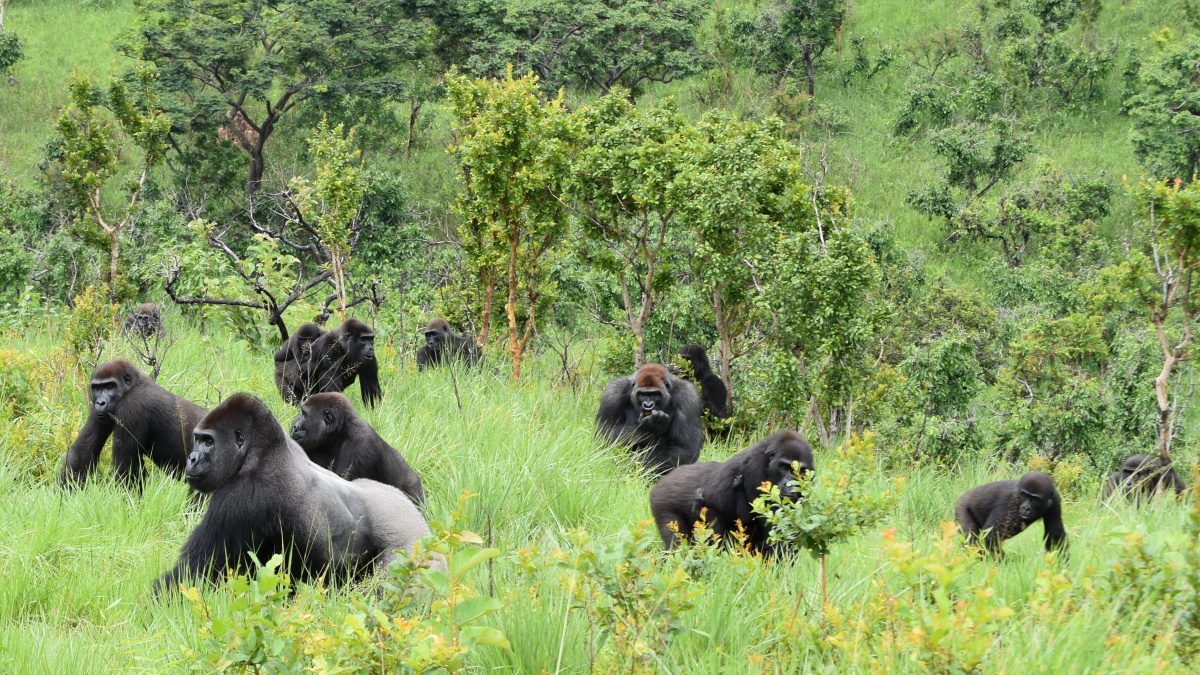
Gorillas gathering in a Congolese national park.
Congo-Brazzaville offers some of Central Africa’s most important rainforest habitats for primates, but reliable information about where individual species can be observed is uneven. For a fact-checked guide, the strongest approach is to distinguish between protected areas with documented primate records and locations where species occurrence has not been adequately confirmed in current sources.
Odzala-Kokoua National Park is the principal location to emphasize when discussing where to see primates in Congo-Brazzaville. The park protects a vast Congo Basin landscape containing rainforest, swamp forest, savannah-forest mosaics and river systems. Current information from the park and African Parks documents western lowland gorillas, chimpanzees and several monkey species within the protected area.
For broader comparative reading about forest primates and primate habitats elsewhere in the region, these resources are useful for context, but they should not be presented as evidence for species distribution in Congo-Brazzaville.
Odzala-Kokoua National Park
Odzala-Kokoua should form the core of any section about primate destinations in Congo-Brazzaville. African Parks describes the park as covering approximately 13,546 square kilometres and supporting a highly diverse wildlife community. Its habitats include extensive rainforest and swamp forest as well as savannah-forest mosaics.
The park is particularly significant for western lowland gorillas and chimpanzees. It is also documented as supporting forest monkeys including black-and-white colobus, De Brazza’s monkeys and agile mangabeys.
For visitors interested in primate observation, the importance of Odzala is not simply the number of species present. Its enormous protected landscape provides opportunities to study how different primates use different forest habitats.
Mboko Area and Gorilla Observation
The Mboko area of Odzala-Kokoua is particularly relevant to western lowland gorilla research and observation. African Parks has documented gorilla habituation work in the park, with field teams following groups through dense rainforest.
Gorilla groups do not remain in one fixed location. Their nesting areas change, and field teams must track them through the forest. Consequently, a responsible travel guide should avoid promising visitors a guaranteed location for a particular gorilla group.
Visitors researching gorilla experiences should also distinguish between western lowland gorillas in Congo-Brazzaville and mountain gorillas found in Uganda, Rwanda and the Democratic Republic of Congo.
Imbalanga Baï
Imbalanga Baï is one of the locations within Odzala-Kokoua where wildlife observation can benefit from the openness of a natural forest clearing. The park’s visitor information identifies black-and-white colobus among the wildlife that may be observed in this environment.
Baïs are ecologically important because they create relatively open areas within otherwise dense rainforest. Their mineral-rich conditions can attract wildlife and make animal movements easier to observe than in thick forest.
However, wildlife remains unpredictable. A baï should therefore be presented as a potential observation location rather than a guaranteed place to see a particular primate.
Forest Trails in Odzala-Kokoua
Forest trails provide another way to experience the primate habitats of Odzala-Kokoua. Walking through the forest allows visitors and researchers to experience the different vegetation layers used by gorillas, chimpanzees and monkeys.
Gorilla habituation teams may spend substantial periods walking through dense forest while tracking animals. These observations demonstrate how much field effort can be required to locate wild primates.
Unlike open savannah wildlife viewing, rainforest primate observation can involve listening for calls, examining tracks and signs and carefully scanning vegetation rather than simply watching a large animal from a distance.
River and Wetland Habitats
Odzala-Kokoua contains river systems and swamp forests that add ecological diversity to its rainforest environment. These habitats are important because primates do not use every part of the landscape in exactly the same way.
Some monkey species can be associated with particular vegetation structures or wetland-edge habitats, while gorillas and chimpanzees may travel across larger areas.
This habitat variation is one reason the park is valuable for Congo-Brazzaville primate safaris.
Primate Observation in Dense Rainforest
Seeing primates in Congo-Brazzaville requires different expectations from a conventional savannah safari. Dense vegetation can conceal animals even when they are relatively close to an observer.
Arboreal monkeys may remain high in the canopy, while chimpanzees can move rapidly between trees and the forest floor. Western lowland gorillas may also travel through dense vegetation while feeding.
The most useful approach is therefore to allow trained guides and trackers to interpret animal signs and movement rather than expecting every sighting to occur in an open area.
Arboreal Camera-Trap Evidence
Recent monitoring demonstrates why the forest canopy deserves special attention. African Parks reported the use of an arboreal camera positioned approximately 20 metres above the ground in Odzala-Kokoua.
The camera recorded species including putty-nosed monkeys and grey-cheeked mangabeys. This provides direct evidence that important primate activity can occur well above conventional ground-level observation points.
For anyone researching where to find monkeys in Congo-Brazzaville, this evidence is particularly valuable because it shows that the vertical structure of the forest must be considered.
Putty-Nosed Monkey Observation
Putty-nosed monkeys have been documented in Odzala-Kokoua through arboreal camera monitoring. Their presence reinforces the importance of canopy habitat within the park.
Because these monkeys can move through the upper forest, direct sightings may depend heavily on visibility, animal movement and the location of observers.
Consequently, an accurate travel guide should describe putty-nosed monkeys as documented inhabitants rather than guaranteeing routine sightings.
Grey-Cheeked Mangabey Observation
Grey-cheeked mangabeys have also been documented through arboreal camera trapping at Odzala-Kokoua. Their detection illustrates how monitoring technology can reveal species that may be difficult to encounter through conventional walking observations.
Mangabeys can exploit different forest resources and move through complex vegetation. Their ecology makes them an important part of the park’s wider primate community.
For comparison, habituation provides useful background on research-oriented primate experiences in Uganda, although the species and management systems differ from those in Congo-Brazzaville.
De Brazza’s Monkey Habitat
De Brazza’s monkey is among the noteworthy primates listed for Odzala-Kokoua. Its presence adds another example of the diversity of forest guenons within the Congo Basin.
The species is recognizable by its distinctive facial appearance and is associated with forest environments. Dense vegetation can nevertheless make observation difficult.
Visitors should therefore approach De Brazza’s monkey encounters as opportunities for natural observation rather than predictable wildlife appointments.
Agile Mangabey Habitat
Agile mangabeys are also identified among the notable primates of Odzala-Kokoua. Their inclusion demonstrates that the park supports several monkey groups with different ecological adaptations.
Mangabey behaviour can involve movement through forest vegetation while searching for food and maintaining contact with members of a social group.
Their presence contributes to the ecological richness that makes Odzala one of the most important locations for monkey watching in Congo-Brazzaville.
Black-and-White Colobus Observation
Black-and-white colobus monkeys are specifically highlighted by Odzala-Kokoua’s current visitor information. They are particularly adapted to arboreal life and can use the forest canopy extensively.
Their distinctive coloration can make them recognizable when visibility is good, but thick foliage can still make encounters challenging.
Imbalanga Baï provides one documented setting where visitors may have opportunities to observe this species under suitable conditions.
Mandrill Records in Odzala-Kokoua
Mandrills require particularly careful wording in a tourism guide. African Parks reported camera-trap evidence of a mandrill in Odzala-Kokoua, describing it as the first recorded visual evidence of the species in the park.
This is important because historical claims and confirmed records are not necessarily equivalent. A strong SEO article should explain that the mandrill has documented evidence in Odzala rather than suggesting that visitors routinely encounter mandrills throughout Congo-Brazzaville.
This distinction strengthens the credibility of the page and avoids overstating the country’s wildlife-viewing opportunities.
Chimpanzee Observation in Odzala-Kokoua
Chimpanzees are another major attraction for primate researchers and wildlife enthusiasts in Odzala-Kokoua. Their presence alongside western lowland gorillas makes the park particularly important for great-ape research.
Chimpanzees can move through both canopy and terrestrial environments. Their flexible movement patterns can make sightings unpredictable, particularly in dense forest.
For comparative information about chimpanzee tourism and permit systems elsewhere in Africa, this resource provides useful background, but Congo-Brazzaville-specific requirements must be verified independently.
Western Lowland Gorilla Observation
Western lowland gorillas are among the most important primates associated with Odzala-Kokoua. African Parks has established a gorilla habituation programme that allows researchers to follow groups and collect behavioural and health information.
Gorilla observation requires patience because groups move through the forest and change their nesting locations. This makes the experience fundamentally different from visiting animals in a confined enclosure.
For responsible tourism, the priority should remain observing gorillas without unnecessarily disturbing their natural activities.
Comparing Congo-Brazzaville With Other Congo Basin Destinations
Congo-Brazzaville should not be confused with the Democratic Republic of Congo. The two countries are separate states, even though both contain important parts of the Congo Basin.
This distinction is particularly important when discussing primate tourism. For example, Salonga National Park and Lomami National Park are in the Democratic Republic of Congo, not the Republic of Congo.
Information about Lomami can therefore be used for regional comparison, but it should never be presented as a Congo-Brazzaville destination.
Why Odzala Should Be the Main Primate Destination
Odzala-Kokoua offers the strongest documented combination of large protected habitat, great apes, forest monkeys, research activity and wildlife observation opportunities for a page focused specifically on Congo-Brazzaville.
The park’s size also allows the article to discuss multiple habitats rather than treating primate observation as a single-location activity.
For SEO, the phrase best place to see primates in Congo-Brazzaville should therefore be used carefully and supported by the available evidence rather than presented as an absolute ranking of every forest in the country.
What Makes Primate Sightings Difficult
Rainforest visibility is one of the biggest challenges. Trees, vines, leaves and understory vegetation can conceal animals, particularly monkeys moving through the canopy.
Animal behaviour also affects sightings. Primates may move away from trails, remain quiet or feed in locations that are difficult for observers to access.
These conditions mean that the quality of tracking and guiding can significantly influence the educational value of a forest visit, even though no responsible operator can guarantee a particular wild-animal sighting.
Best Habitats for Different Primates
Different primates can favour different forest structures. Western lowland gorillas can use terrestrial vegetation, chimpanzees can exploit both ground and canopy resources, and many monkeys are strongly associated with arboreal environments.
Baïs can offer increased visibility, while dense forest remains essential habitat even when it is more difficult for visitors to see through.
Understanding these differences makes a primate safari more informative because visitors can appreciate why animals occur in particular parts of the landscape.
Research Locations Versus Tourism Locations
Not every place where researchers document primates should automatically be described as a visitor destination. Scientific monitoring can occur in areas that are not open to tourism.
This distinction is important when designing a high-ranking page because it prevents the article from turning scientific records into unsupported tourism claims.
The safest approach is to describe confirmed wildlife records separately from places officially identified for visitor activities.
Responsible Primate Viewing
Responsible viewing should prioritize animal welfare and conservation. Visitors should follow the instructions of trained guides and protected-area authorities and avoid deliberately provoking animals.
Photography should also be conducted without interfering with natural behaviour. Wildlife encounters are most valuable when animals continue feeding, moving and interacting normally.
Comparative information about gorillas and forest ecology can help explain why maintaining natural behaviour is important to conservation.
Planning a Primate Visit to Congo-Brazzaville
A visitor planning a primate-focused trip should first establish which protected area is open to tourism and what activities are currently available. Access arrangements, accommodation, permits, guide requirements and seasonal conditions should be confirmed using current official information before travel.
This is particularly important in Congo-Brazzaville because tourism information can change and not every protected area with primate records necessarily offers routine visitor encounters.
A reliable guide should therefore separate confirmed current tourism information from historical wildlife records.
Using Wildlife Photography Responsibly
Photography can document remarkable primate behaviour, but the animal’s welfare should always come first. Visitors should avoid chasing animals for photographs or attempting to force an animal into a particular position.
In dense forest, patience is often more valuable than movement. Remaining quiet and allowing animals to continue their normal behaviour can produce better observations than attempting to approach too closely.
Why Guides and Trackers Matter
Experienced field teams can interpret signs that casual visitors might overlook. Calls, tracks, feeding signs, broken vegetation and recent movement can all provide information about where wildlife may be travelling.
Gorilla habituation work at Odzala demonstrates the level of effort required to monitor forest primates. Teams can spend extended periods moving through dense vegetation while following groups.
This field knowledge is one of the reasons professionally managed primate observation can provide more educational value than an independent walk through unfamiliar rainforest.
Beyond Gorilla Tourism
Congo-Brazzaville’s primate tourism potential extends beyond western lowland gorillas. Chimpanzees and several monkey species contribute to the broader wildlife experience.
This diversity makes the country particularly interesting for travelers whose primary interest is rainforest ecology rather than a single flagship species.
The strongest SEO strategy is therefore to present the destination as a broader Congo-Brazzaville primate safari experience while maintaining precise species-level claims.
What Current Evidence Supports
Current sources reviewed for this section support Odzala-Kokoua as a significant primate destination and document western lowland gorillas, chimpanzees and several forest monkeys there. African Parks’ monitoring has also produced important records of canopy-dwelling primates and a mandrill.
These records provide a strong evidence base for discussing Odzala-Kokoua without claiming that every primate species in the Republic of Congo can be reliably seen by tourists.
Three Important Distinctions for Travelers
First, the Republic of Congo is different from the Democratic Republic of Congo. Second, a species record is not automatically a tourism guarantee. Third, a protected forest can contain many primates even when sightings remain difficult.
Keeping these distinctions clear will make the finished primates of Congo-Brazzaville page more accurate and more useful to readers planning a wildlife experience.
Final Perspective on Where to See Primates
For a detailed page about where to see primates in Congo-Brazzaville, Odzala-Kokoua National Park should be the central destination because current evidence supports its importance for western lowland gorillas, chimpanzees and a diverse community of forest monkeys.
Within the park, habitats such as rainforest, swamp forest and natural baïs provide different ecological settings for wildlife observation. Imbalanga Baï is particularly relevant for black-and-white colobus observations, while arboreal camera-trap research demonstrates the importance of the canopy.
The key SEO opportunity is to provide detailed, evidence-based information without turning documented species records into guaranteed sightings. This approach allows phrases such as best place to see primates in Congo-Brazzaville, where to see monkeys in Congo-Brazzaville, Congo-Brazzaville primate safari and Odzala-Kokoua primate safari to be incorporated naturally while maintaining factual accuracy.
Information not found in current search results: a complete current national ranking of all primate-viewing locations in the Republic of Congo, together with verified visitor access and guaranteed species-sighting probabilities for each location. Such claims should not be added without stronger current evidence.
Additional comparative resources include chimpanzee, Lomami, and lowland information. The Lomami and Kahuzi-Biega resources concern the Democratic Republic of Congo and should therefore be clearly labelled as regional comparisons rather than Congo-Brazzaville destinations.
Primate Safari Experiences in Congo-Brazzaville: Tracking, Research and Wildlife Observation

Wildlife observation and tracking during a safari in Congo-Brazzaville.
Experiencing the primates of Congo-Brazzaville is fundamentally different from visiting a conventional savannah wildlife destination. The country’s rainforest environment requires visitors to move through dense vegetation, rely on experienced field teams, and understand that wild primate encounters cannot be guaranteed. Among the country’s protected landscapes, Odzala-Kokoua National Park is particularly important because current conservation information documents western lowland gorillas, chimpanzees and several forest monkey species within the park.
A well-designed Congo-Brazzaville primate safari should therefore combine wildlife observation with an understanding of rainforest ecology, conservation research and responsible tourism. The experience is not simply about finding an animal; it is about understanding how primates live within one of Africa’s major rainforest ecosystems.
For regional comparison, primate research experiences in Uganda demonstrate how habituation and long-term observation can be incorporated into wildlife tourism, although the species and management systems in Uganda should not be confused with those of Congo-Brazzaville.
What a Primate Safari in Congo-Brazzaville Involves
A rainforest primate experience can involve walking through forest habitats, observing wildlife at natural clearings, listening for animal calls, interpreting feeding signs and learning about conservation research. The exact activities available to visitors depend on the protected area, current tourism arrangements and conservation-management policies.
Odzala-Kokoua is especially important because its conservation programme combines wildlife protection, research and monitoring. This provides a strong foundation for discussing primate safaris in Congo-Brazzaville without presenting unverified sightings or unsupported tourism claims.
Western Lowland Gorilla Experiences
Western lowland gorillas are among the most significant primates associated with Odzala-Kokoua. African Parks has documented a gorilla habituation programme in the park in which field teams follow groups through dense rainforest and collect information about their behaviour and health.
A gorilla experience in this environment is therefore more than simply walking to a predetermined viewing point. Gorilla groups move through the forest, change nesting locations and respond naturally to their surroundings.
Visitors researching gorilla experiences should distinguish western lowland gorillas in Congo-Brazzaville from mountain gorillas in Uganda, Rwanda and the Democratic Republic of Congo.
Chimpanzee Experiences in the Rainforest
Chimpanzees are another important component of the primate community in Odzala-Kokoua. Their presence makes the park particularly valuable for people interested in great-ape ecology.
Chimpanzees can use both the forest floor and canopy, making observations unpredictable. Their movements can also be rapid, and dense vegetation can make individuals difficult to follow visually.
This means that a responsible Congo-Brazzaville chimpanzee experience should emphasize natural observation rather than promising close or guaranteed encounters.
Monkey Watching in Congo-Brazzaville
The primate experience extends beyond gorillas and chimpanzees. Current information from Odzala-Kokoua documents forest monkeys including black-and-white colobus, De Brazza’s monkeys, agile mangabeys, putty-nosed monkeys and grey-cheeked mangabeys.
These species use different parts of the rainforest. Some are strongly associated with the canopy, while others may use lower vegetation or move through different forest layers.
For this reason, monkey watching in Congo-Brazzaville can provide a more varied ecological experience than focusing exclusively on great apes.
Walking Through the Rainforest
Walking is an important component of rainforest wildlife observation. Unlike open savannah landscapes where animals can sometimes be detected from considerable distances, dense rainforest requires careful attention to the surrounding environment.
Visitors may need to listen for calls, watch the canopy and observe movement in vegetation. Guides and trackers can help interpret signs that are difficult for inexperienced observers to recognize.
The physical conditions can also vary considerably depending on rainfall, vegetation and terrain, so visitors should follow the instructions of the local field team throughout the experience.
Natural Baïs and Wildlife Observation
Natural forest clearings known as baïs can provide important wildlife observation environments within the Congo rainforest. Their relatively open character can make animals easier to detect than in dense vegetation.
Imbalanga Baï in Odzala-Kokoua is particularly relevant when discussing wildlife observation because park information identifies black-and-white colobus among the animals associated with this habitat.
However, a baï should never be described as a guaranteed location for a particular animal. Wildlife movements remain natural and unpredictable.
Canopy Observation and Arboreal Primates
The vertical structure of the rainforest is critical to understanding the primates of Congo-Brazzaville. Many monkeys spend significant amounts of time above the forest floor, meaning that ground-level observation alone cannot reveal the complete primate community.
African Parks has reported arboreal camera-trap monitoring in Odzala-Kokoua, including a camera positioned approximately 20 metres above the ground. The equipment recorded putty-nosed monkeys and grey-cheeked mangabeys.
This evidence demonstrates the importance of looking upward when studying rainforest primates and highlights the value of technological monitoring in conservation.
Primate Research and Tourism
Research adds considerable value to a primate safari because it explains what visitors are observing. Gorilla habituation programmes, camera-trap surveys and biodiversity monitoring can all contribute information about wildlife populations and habitat use.
A responsible tourism experience should therefore present conservation as part of the story rather than treating primates purely as photographic attractions.
For comparison, chimpanzee and gorilla research elsewhere in East Africa illustrates how behavioural differences between great apes influence field observation.
Why Wildlife Sightings Cannot Be Guaranteed
Wild primates are free-ranging animals. Their movements depend on food availability, weather, social behaviour and many other environmental factors.
Even within a protected area with a healthy primate population, visitors may encounter some species more easily than others. Canopy-dwelling monkeys can be particularly difficult to observe when foliage is dense.
A fact-checked travel page should therefore avoid claims such as guaranteed gorilla sightings, guaranteed chimpanzee sightings or guaranteed monkey encounters unless an official source specifically supports such a statement.
The Role of Guides and Trackers
Experienced field personnel can make a major difference to the educational value of a rainforest experience. Trackers can interpret animal signs and guide visitors through habitats while maintaining appropriate wildlife-viewing practices.
Gorilla habituation work demonstrates the level of expertise required to follow rainforest primates. Field teams must move carefully through dense vegetation while monitoring animal behaviour.
The guide’s role is therefore not simply to locate wildlife but also to help visitors understand the forest and behave responsibly around animals.
Photography During Primate Experiences
Wildlife photography can be an important part of a primate experience, but it should never take priority over animal welfare. Visitors should avoid chasing animals, deliberately disturbing them or attempting to force better photographic positions.
Rainforest photography can also be technically challenging because animals may be partially hidden by vegetation and light levels can vary beneath the canopy.
Patience is often more useful than movement. Remaining quiet and allowing animals to continue their natural behaviour can produce a more authentic observation.
Conservation as Part of the Safari Experience
A strong Congo-Brazzaville primate safari should explain why the forest itself matters. Western lowland gorillas, chimpanzees and forest monkeys depend on functioning rainforest ecosystems.
Protecting these habitats also supports countless other plants and animals. Conservation therefore operates at the ecosystem level rather than focusing exclusively on individual primate species.
This makes a primate safari an opportunity to learn about rainforest conservation as well as wildlife.
Community and Conservation
Protected-area conservation is closely connected with communities living around forest landscapes. Long-term wildlife protection requires approaches that recognize local livelihoods and encourage sustainable relationships with protected areas.
Community participation can complement law enforcement, scientific monitoring and habitat protection. The most durable conservation systems generally require cooperation between multiple stakeholders.
Responsible Wildlife Viewing
Visitors should follow all rules established by the protected-area authority and conservation managers. They should remain with authorized guides, avoid unnecessary disturbance and respect instructions concerning distance and behaviour.
Animals should never be fed, touched or deliberately provoked. The objective of responsible observation is to allow wildlife to continue normal behaviour.
Comparative information about gorilla ecology helps demonstrate why natural behaviour and healthy forest systems are important to the wider ecosystem.
Great Apes Versus Forest Monkeys
The great apes and smaller forest monkeys provide different observation experiences. Gorillas and chimpanzees have complex social systems and large bodies, while many monkey species are more agile and spend substantial periods in the canopy.
Understanding these differences can make a primate safari more rewarding because visitors begin to recognize how each animal uses its ecological niche.
Mandrill Records and Scientific Observation
Mandrills are another example of why scientific evidence matters when discussing Congo-Brazzaville’s primate diversity. African Parks reported camera-trap evidence of a mandrill in Odzala-Kokoua and described the record as the first visual evidence of the species in the park.
This should not be transformed into a claim that mandrills are routinely encountered by tourists. A documented scientific record and a reliable tourism sighting opportunity are different things.
How Technology Improves Primate Research
Camera traps can monitor locations that researchers cannot watch continuously. Arboreal cameras are particularly useful because many primates spend time in the upper forest layers.
Such technologies can supplement direct field observations and provide evidence about species presence and habitat use.
The growing use of technology therefore creates new opportunities for understanding the primate diversity of Congo-Brazzaville.
Educational Value of a Primate Safari
A rainforest primate experience can teach visitors about animal behaviour, habitat structure, conservation and the ecological relationships connecting wildlife to vegetation.
Instead of measuring the quality of a trip only by the number of animals photographed, travelers can evaluate the experience by what they learn about the forest and its wildlife.
This educational approach is especially valuable in Congo-Brazzaville, where the rainforest itself is one of the most important parts of the experience.
Comparing Primate Experiences Across Central Africa
Congo-Brazzaville’s primate experience should be distinguished from destinations in neighbouring countries. Uganda and Rwanda are particularly well established for mountain-gorilla and chimpanzee tourism, while the Democratic Republic of Congo provides opportunities involving mountain gorillas and eastern lowland gorillas.
Congo-Brazzaville’s significance lies especially in its Congo Basin rainforest setting and western lowland gorilla populations.
For a broader comparison, Congo wildlife information can provide regional context, but the Okapi Wildlife Reserve is in the Democratic Republic of Congo and should not be presented as a Republic of Congo destination.
What Makes the Experience Different
The combination of extensive rainforest, relatively remote landscapes and scientifically important wildlife gives Congo-Brazzaville a distinctive primate-tourism profile.
The experience can appeal particularly to travelers interested in rainforest ecology, conservation research and less conventional wildlife destinations.
However, tourism infrastructure, access and current security conditions should always be verified before travel because conditions can change.
Preparing for a Forest Primate Experience
Travelers should obtain current information about access, permits, accommodation, transportation, health requirements and park rules before making arrangements. These details can vary according to the destination and current management arrangements.
Because this section focuses on factual destination information, no unsupported claim should be made about current permit prices, opening dates or guaranteed wildlife encounters without a current authoritative source.
Why Patience Matters
Patience is one of the most important qualities during rainforest wildlife observation. Primates may remain hidden, move through dense foliage or change direction unexpectedly.
A slower approach can allow visitors to notice subtle signs of animal activity that would otherwise be missed.
This is particularly important when observing canopy species, where movement may initially appear only as leaves shaking high above the forest floor.
The Broader Value of Primate Tourism
Responsible tourism can help demonstrate the economic and educational value of intact forests. When carefully managed, wildlife tourism can complement conservation by creating incentives to maintain protected landscapes and supporting employment connected with tourism.
Nevertheless, tourism should remain one component of a broader conservation system that includes law enforcement, research, habitat protection and community engagement.
Why Odzala-Kokoua Should Lead the Page
For readers searching for primate safari experiences in Congo-Brazzaville, Odzala-Kokoua provides the strongest documented foundation for the topic. The park combines extensive rainforest habitat with documented western lowland gorillas, chimpanzees and several monkey species.
The park’s conservation and monitoring programmes also provide credible material for explaining how researchers study primates in a difficult rainforest environment.
This makes Odzala-Kokoua more useful as the central case study than listing numerous locations without equally strong current evidence.
Final Perspective on Primate Experiences
A Congo-Brazzaville primate safari should be presented as a rainforest conservation and wildlife experience rather than a guaranteed checklist of animal sightings. The strongest documented opportunities centre on Odzala-Kokoua National Park, where western lowland gorillas, chimpanzees and several forest monkeys are recorded.
The experience can include forest walks, wildlife observation at natural clearings, gorilla research and habituation activities, biodiversity monitoring and opportunities to understand the ecology of the Congo Basin rainforest.
For a high-quality page targeting searches such as Congo-Brazzaville primate safari, primate safari in Congo, where to see primates in Congo-Brazzaville, Congo rainforest primate experience and western lowland gorilla safari Congo-Brazzaville, the most important principle is to distinguish verified wildlife records from guaranteed visitor experiences.
Information not found in current search results: a comprehensive, current national schedule showing every primate tourism activity available in every protected area of the Republic of Congo, together with current prices and guaranteed species-sighting rates. These details should not be added without authoritative current verification.
For regional comparison, Kibale offers a well-documented Ugandan primate-tourism example, while filming provides additional context on research and documentary work involving primates. These resources concern Uganda and should remain clearly identified as comparative material rather than evidence about Congo-Brazzaville.
Threats Facing the Primates of Congo-Brazzaville

Conservationists provide medical care to a vulnerable gorilla in Congo.
The survival of the primates of Congo-Brazzaville depends on the continued protection of the country’s extensive rainforest ecosystems. The Republic of Congo contains major forest landscapes that provide habitat for western lowland gorillas, chimpanzees and numerous monkey species. Odzala-Kokoua National Park is particularly important because it protects a large Congo Basin landscape and supports populations of several important primates.
Current conservation information identifies several pressures that require continued attention, including illegal hunting, habitat degradation, wildlife trafficking and disease. These threats do not operate independently. A decline in forest quality can increase pressure on wildlife, while hunting and disease can affect already vulnerable populations.
Illegal Hunting and Bushmeat Pressure
Illegal hunting is one of the major threats to African primates. Great apes and monkeys can be targeted for bushmeat, while young animals may also become victims of the illegal wildlife trade.
African Parks identifies bushmeat poaching and illegal wildlife trade as serious threats to primates. In protected landscapes such as Odzala-Kokoua, anti-poaching operations therefore form an important part of protecting wildlife.
The significance of this threat is particularly clear for western lowland gorillas and chimpanzees because both species can be affected by direct hunting pressure as well as the wider disruption caused by illegal activities.
Wildlife Trafficking
Wildlife trafficking creates additional pressure on primate populations. The removal of animals from the wild can affect individual animals, social groups and wider populations.
Young primates are particularly vulnerable when adults are killed or captured. Conservation programmes therefore need to address trafficking alongside conventional anti-poaching measures.
Protecting the primates of Congo-Brazzaville requires enforcement systems capable of detecting illegal activities while also addressing the economic and social conditions that can contribute to wildlife exploitation.
Habitat Destruction
Forest habitat is fundamental to the survival of Congo-Brazzaville’s primates. Gorillas, chimpanzees and forest monkeys depend on vegetation for food, shelter and movement.
Habitat destruction can reduce available resources and fragment previously connected forest. Fragmentation can make it more difficult for wildlife to move between suitable areas and may isolate populations.
Protecting large continuous forest landscapes is therefore one of the most important long-term strategies for primate conservation in Congo-Brazzaville.
Forest Fragmentation
Even where forest is not completely cleared, fragmentation can alter the ecological conditions available to wildlife. Roads, development and other changes can divide previously connected habitats.
Large protected landscapes such as Odzala-Kokoua are valuable partly because they preserve extensive areas of connected habitat. African Parks describes the park as one of the world’s largest remaining intact forest systems.
Maintaining connections between protected forests can therefore be important for the long-term conservation of mobile forest species.
Disease and Western Lowland Gorillas
Disease is an especially serious conservation concern for western lowland gorillas. African Parks reports that Ebola caused severe historical declines among gorillas around Lossi Gorilla Sanctuary and Odzala-Kokoua.
More recent conservation work has therefore incorporated health precautions into gorilla habituation and monitoring programmes. The park’s teams follow health and safety protocols designed to reduce disease-transmission risks.
This illustrates why gorilla conservation in Congo-Brazzaville involves both wildlife protection and disease management.
Human-Wildlife Interaction
People living near protected forests depend on natural resources and ecosystem services. African Parks reports that thousands of people live close to Odzala-Kokoua and that surrounding communities depend on the forest.
Conservation strategies must therefore consider the relationship between wildlife protection and local livelihoods. Sustainable development, employment and community engagement can help strengthen support for protected areas.
A successful conservation programme needs to protect wildlife while also recognizing the legitimate needs of communities living around forest landscapes.
The Importance of Anti-Poaching Patrols
Rangers play an important role in protecting wildlife from illegal activities. African Parks describes patrols, intelligence gathering and law enforcement as key components of its management approach in Odzala-Kokoua.
Anti-poaching work is particularly challenging in large rainforest landscapes because patrol teams must cover extensive areas of dense vegetation and river systems.
Effective protection therefore requires trained personnel, appropriate equipment, intelligence and sustained institutional support.
Why Monitoring Matters
Wildlife monitoring helps conservation managers understand where animals occur and how populations change over time. At Odzala-Kokoua, researchers use direct observation, camera traps and other monitoring methods.
Camera traps are particularly valuable because they can document wildlife in locations that researchers cannot continuously observe.
Arboreal camera trapping has also demonstrated the importance of monitoring above the forest floor, where many primate species spend significant periods of time.
Protecting Primate Habitat Through Conservation Management
Protected-area management provides a framework for combining habitat protection, wildlife monitoring, law enforcement and community engagement.
African Parks has managed Odzala-Kokoua since 2010 through a partnership with the Republic of Congo. The management programme has subsequently incorporated the Lossi Gorilla Sanctuary.
The continued protection of these landscapes is important because western lowland gorillas, chimpanzees and other Congo rainforest primates depend on functioning forest ecosystems.
The Role of the Lossi Gorilla Sanctuary
Lossi Gorilla Sanctuary forms part of the broader conservation landscape associated with Odzala-Kokoua. African Parks reports that the sanctuary covers approximately 380 square kilometres under the current management arrangement.
Its importance extends beyond its boundaries because protected areas and surrounding forest concessions can contribute to wider wildlife corridors and landscape-level conservation.
Why Community Engagement Matters
Long-term conservation is more effective when local communities are involved. African Parks describes community development initiatives around Odzala-Kokoua, including programmes intended to provide benefits associated with protected-area management.
Employment, education, healthcare and other community benefits can help create stronger relationships between conservation organizations and neighbouring communities.
For the primates of Congo-Brazzaville, these relationships are important because wildlife protection cannot depend entirely on what happens inside a park boundary.
Conservation and Tourism
Responsible tourism can contribute to conservation by creating economic value around protected landscapes and wildlife. African Parks identifies tourism as one component of the broader conservation model at Odzala-Kokoua.
However, tourism must be carefully managed. Great apes are particularly sensitive to human disturbance and disease risks, so visitor activities should follow strict guidelines established by conservation authorities.
The objective should be to support conservation without compromising animal welfare.
Gorilla Habituation and Conservation
Gorilla habituation has research and conservation value beyond tourism. African Parks explains that habituated groups can be monitored closely, allowing researchers to collect information about behaviour, health and spatial use.
The process takes years and requires dedicated trackers and researchers. It also provides conservation managers with better knowledge of the animals they are protecting.
Habituation should therefore be presented as a scientific and conservation activity as well as a potential tourism opportunity.
Protecting Chimpanzees
Chimpanzee conservation requires protection of forest habitat and reduction of hunting pressure. Because chimpanzees can move through extensive forest areas, maintaining connected habitats is particularly valuable.
Research and monitoring can help conservation managers understand chimpanzee distribution and habitat use.
Protecting chimpanzees also contributes to the broader ecological integrity of Congo Basin forests.
Protecting Forest Monkeys
The conservation discussion should not focus exclusively on great apes. Congo-Brazzaville’s forests also support diverse monkey communities.
Current information from Odzala-Kokoua documents species including black-and-white colobus, De Brazza’s monkeys, agile mangabeys, putty-nosed monkeys and grey-cheeked mangabeys.
Different monkey species use different forest layers and habitats, making ecosystem-level protection important for maintaining the country’s wider primate diversity.
The Importance of Forest Clearings
Natural forest clearings known as baïs can be important locations for wildlife monitoring. African Parks explains that these clearings can provide mineral-rich resources that attract wildlife.
Camera traps and time-lapse monitoring can help researchers understand how animals use these areas.
Protecting the surrounding forest is equally important because the ecological value of a baï depends on its connection to the wider rainforest.
Technology in Primate Conservation
Technology is increasingly useful for monitoring difficult-to-observe wildlife. Ground camera traps can document animals moving through forest trails, while arboreal cameras can monitor species using the canopy.
African Parks has documented an arboreal camera trap installed approximately 20 metres above the ground at Odzala-Kokoua. Such monitoring provides information that conventional ground-based methods can miss.
Technology therefore complements rather than replaces field researchers, trackers and conservation teams.
The Importance of Long-Term Research
Primate populations cannot be understood from isolated observations alone. Long-term monitoring allows researchers to identify trends and evaluate whether conservation measures are working.
Odzala-Kokoua’s gorilla habituation programme provides an example of sustained field research. Teams repeatedly monitor habituated groups and gather information about their behaviour and health.
This long-term approach strengthens the scientific foundation for primate conservation in Congo-Brazzaville.
Why Accurate Population Data Matters
Population estimates can change as new surveys become available. Different surveys may also use different methods and cover different areas.
For this reason, population figures should always be attributed to a specific survey or authoritative source rather than presented as permanent national totals.
This is particularly important for SEO content because outdated wildlife statistics can make an otherwise comprehensive page unreliable.
The Future of Primate Conservation
The future of the primates of Congo-Brazzaville will depend on maintaining large forest habitats, controlling illegal hunting, reducing disease risks and strengthening research.
Odzala-Kokoua demonstrates how protected-area management can combine law enforcement, scientific monitoring, community engagement and tourism.
The continuing challenge is to maintain these efforts over the long term while responding to changing environmental and social pressures.
Final Perspective on Threats to Congo-Brazzaville’s Primates
The major threats facing Congo-Brazzaville’s primates are interconnected. Illegal hunting can directly remove animals, habitat degradation can reduce the resources available to surviving populations, wildlife trafficking can further increase pressure, and disease can have devastating effects on great apes.
Conservation responses therefore need to be equally comprehensive. Protected areas, ranger patrols, scientific monitoring, disease precautions, community engagement and responsible tourism all have roles to play.
Odzala-Kokoua remains particularly important because it combines a vast protected forest landscape with documented populations of western lowland gorillas, chimpanzees and other primates. African Parks’ current information also confirms continuing research, monitoring and conservation activities in the park.
Information not found in current search results: a single current national assessment assigning precise population figures to every primate species in the Republic of Congo. Species-level population claims should therefore be tied to specific authoritative surveys rather than generalized across the country.
Planning a Primate Safari in Congo-Brazzaville: When to Go, What to Expect and How to Prepare

Preparing for your remote Congo expedition.
Planning a primate safari in Congo-Brazzaville requires a different approach from planning a conventional savannah safari. The Republic of Congo’s most important primate destination, Odzala-Kokoua National Park, lies within the Congo Basin rainforest and supports western lowland gorillas, chimpanzees and other forest primates. The park covers approximately 13,867 square kilometres according to African Parks’ 2024 annual report and is managed through a partnership involving the Government of the Republic of Congo and African Parks.
The planning process should therefore focus on the current availability of tourism activities, access arrangements, conservation requirements, accommodation, the nature of rainforest travel and realistic expectations about wildlife sightings. A well-designed Congo-Brazzaville primate safari is not simply a search for gorillas or chimpanzees; it is an opportunity to experience a protected Congo Basin ecosystem while learning about the conservation work supporting its wildlife.
Why Odzala-Kokoua Is Central to Primate Safari Planning
Odzala-Kokoua should be the primary focus for travelers researching where to see primates in Congo-Brazzaville. African Parks describes the park as a biological hotspot in the Congo Basin and records chimpanzees, critically endangered western lowland gorillas and numerous other mammals within the protected landscape.
The park also has a long conservation history. It was designated in 1935, received Biosphere Reserve status in 1977 and was granted World Heritage status in 2023. Its combination of rainforest, swamp forest, savannah-forest mosaics and river systems creates a diverse environment for wildlife.
Understanding the Gorilla Experience
Western lowland gorillas are one of the major reasons travelers consider a gorilla safari in Congo-Brazzaville. African Parks reports that gorilla habituation has been conducted in Odzala since 2015, with teams tracking habituated groups to support research and conservation.
Gorilla habituation is a long-term process rather than a simple tourism activity. Field teams spend extensive periods following groups through dense rainforest while monitoring behaviour, health and movement.
Travelers should therefore understand that a gorilla experience in Odzala is shaped by the animals’ natural movements and by the work of the researchers and trackers.
Current Gorilla Habituation Development
African Parks reports that a new gorilla group was identified in 2022 after earlier habituation groups were no longer suitable for the programme. The new group is located near the eastern headquarters and within walking distance of Camp Imbalanga. African Parks stated that the group was being prepared for visits by small numbers of tourists.
This is an important distinction for SEO content. The article should describe the documented development of gorilla habituation rather than promising that every visitor will automatically receive a gorilla encounter.
Planning Around Camp Imbalanga
Camp Imbalanga is an important part of the current tourism story at Odzala-Kokoua. African Parks reports that the camp opened in 2023 as an ecotourism destination in the rainforest. It includes accommodation on wooden platforms and an observation tower overlooking Imbalanga Bai.
The camp’s location is particularly relevant because Imbalanga Bai provides a more open setting within the surrounding rainforest. African Parks notes that wildlife including forest elephants and western lowland gorillas can be observed around such forest clearings.
Choosing the Right Time to Travel
Travelers should avoid presenting a single month as an absolute best time for a primate safari in Congo-Brazzaville unless current destination-specific evidence supports that conclusion.
Rainforest conditions can influence walking conditions, visibility and wildlife observation. Rather than relying on a generic Central African tourism calendar, travelers should obtain current information about weather, park access, camp operations and available activities for their intended travel dates.
Information not found in current search results: a sufficiently authoritative current month-by-month ranking proving that one specific month is universally the best time for primate viewing in Odzala-Kokoua.
Understanding Rainforest Conditions
Odzala’s rainforest environment can be substantially different from open savannah destinations. Dense vegetation, swamp forest, rivers and natural clearings form part of the landscape.
Travelers should therefore expect changing ground conditions and variable visibility. Forest wildlife may also be concealed by vegetation even when it is present nearby.
These environmental conditions are an essential part of planning a realistic Congo rainforest safari.
Walking, Boat and Stationary Wildlife Experiences
African Parks describes several ways of experiencing Odzala-Kokoua, including activities conducted on foot and by boat as well as simply remaining still and observing the rainforest.
This variety is important because the park’s rivers, forests and natural clearings create different opportunities for wildlife observation.
The precise activities available should always be confirmed with the current park or tourism operator before travel.
Preparing for Primate Tracking
Primate tracking should be approached as a guided field activity. Gorilla habituation teams may spend hours moving through dense forest because groups change their nesting locations and move naturally through their habitat.
This means travelers should be prepared for an experience in which searching and observation are part of the adventure rather than expecting wildlife to appear at a predetermined viewing point.
Setting Realistic Wildlife Expectations
Wild primates are unpredictable. Even when a park contains important populations, individual animals can move outside areas where visitors are currently searching.
Gorillas may change nesting locations, chimpanzees can move through dense vegetation and smaller monkeys may remain high in the canopy.
A responsible Congo-Brazzaville primate safari should therefore never be marketed around guaranteed sightings unless an official source explicitly provides such a guarantee.
Planning for Chimpanzee Observation
Chimpanzees are documented among the important wildlife of Odzala-Kokoua. African Parks’ biodiversity information identifies chimpanzees alongside western lowland gorillas within the park’s rainforest ecosystem.
Their presence makes Odzala particularly interesting for travelers who want to understand great-ape ecology rather than focusing on a single species.
Planning for Monkey Observation
Travelers should also consider the park’s wider monkey diversity. Monitoring and biodiversity activities at Odzala have documented species including moustached monkeys and other forest primates. African Parks has also used arboreal camera traps to monitor wildlife activity within the forest canopy.
This reinforces the importance of looking beyond gorillas when planning a primate safari in Congo-Brazzaville.
Why the Forest Canopy Matters
Many rainforest primates spend considerable time above ground. Conventional ground-based observation cannot capture every aspect of their behaviour.
African Parks reports that an arboreal camera trap installed approximately 20 metres above the ground has been used to monitor species at tree level. This demonstrates the importance of the vertical structure of the rainforest when studying its wildlife.
Planning for Photography
Wildlife photography in dense rainforest requires patience. Vegetation can obscure animals, light can vary beneath the canopy and primates may move rapidly.
Travelers should prioritize responsible observation rather than attempting to obtain a photograph at the expense of animal welfare.
The best photographic opportunities may come from remaining quiet and allowing wildlife to behave naturally.
Understanding Conservation Requirements
Primate tourism in Odzala operates within a conservation framework. African Parks states that daily gorilla monitoring and tracking support both tourism and research, while law enforcement and community engagement contribute to protecting wildlife.
Visitors should therefore follow all instructions provided by park authorities and field teams.
Why Disease Precautions Matter
Disease is a significant conservation concern for great apes. African Parks reports that gorillas in the region have suffered severe historical impacts from diseases including Ebola.
Gorilla habituation programmes consequently require careful monitoring and health protocols. Visitors should follow all current health and wildlife-viewing requirements issued by the responsible authorities.
Planning Accommodation
Accommodation should be selected according to the current tourism programme and the specific activities travelers want to undertake.
Camp Imbalanga is one documented tourism development within Odzala-Kokoua. African Parks reports that it opened in 2023 and was designed to support ecotourism while creating sustainable revenue opportunities.
Other accommodation options should be verified directly through current official tourism information before being presented as operational.
Understanding Access and Logistics
Access to a remote rainforest destination requires more advance planning than a typical city-based trip. Travelers should confirm transportation arrangements, park entry requirements, accommodation availability and the precise location of their activities before departure.
Information not found in current search results: a complete current door-to-door transportation schedule covering every route into Odzala-Kokoua. Exact transportation information should therefore be obtained from the current park or authorized tourism provider rather than inferred.
Planning a Responsible Safari
Responsible travel should support conservation while minimizing disturbance to wildlife. Visitors should remain with authorized guides, respect viewing instructions and avoid behaviours that could stress animals.
The principle is particularly important for gorillas and chimpanzees because these species are susceptible to human-associated disease transmission.
Understanding the Role of Local Communities
Community involvement is a central component of conservation at Odzala-Kokoua. African Parks reports that approximately 12,000 people live within 10 kilometres of the park and depend on ecosystem services provided by the forest.
The organization also reports that most permanent park staff are Congolese nationals, with a significant proportion coming from communities around the park.
This makes community participation an important part of understanding how conservation and tourism interact in the region.
Tourism and Conservation Funding
Tourism can contribute to conservation and local economic opportunities when properly managed. African Parks identifies sustainable tourism and revenue generation as components of its approach to Odzala-Kokoua.
The relationship between tourism and conservation should nevertheless be described carefully. Tourism is one component of a wider system that also includes law enforcement, scientific research, habitat protection and community development.
Research as Part of the Experience
One of the distinctive characteristics of Odzala’s primate programme is the relationship between tourism and research. Gorilla habituation enables scientists to study behaviour, health and spatial use over extended periods.
This means that travelers can gain a deeper understanding of primate conservation by learning how researchers and trackers work in the field.
How to Build a Primate-Focused Itinerary
A primate-focused itinerary should prioritize the current activities actually available rather than attempting to include every possible wildlife experience.
A suitable structure can combine rainforest exploration, primate observation, wildlife viewing at forest clearings and time devoted to understanding conservation work.
The exact number of days required should be determined by current access, accommodation availability and the specific activities offered during the travel period.
Planning for a Specialist Wildlife Interest
Travelers with a strong interest in primates should communicate that interest when arranging their visit. This can help ensure that the available activities align with their expectations.
However, specialist interest should never be interpreted as a guarantee of seeing a particular species.
The value of the trip can remain high even when sightings are limited because the forest itself provides an important ecological and educational experience.
Why Current Verification Matters
Odzala-Kokoua’s tourism and conservation programmes continue to develop. African Parks’ current website includes recent information about the park, gorilla habituation and community programmes.
For this reason, travel articles should avoid relying exclusively on old permit prices, accommodation lists or historical access information.
A high-quality Congo-Brazzaville primate safari guide should clearly separate current information from historical records.
Final Planning Checklist
Before traveling, visitors should confirm the current park access arrangements, accommodation availability, permitted activities, transportation arrangements, wildlife-viewing rules and any health requirements applicable to their trip.
They should also understand that rainforest wildlife encounters are naturally unpredictable and that responsible observation is more important than maximizing the number of photographs.
Final Perspective on Planning a Congo-Brazzaville Primate Safari
Planning a primate safari in Congo-Brazzaville begins with understanding Odzala-Kokoua National Park and its role in protecting the Congo Basin rainforest. The park provides documented habitat for western lowland gorillas, chimpanzees and other primates and combines wildlife conservation with research, community programmes and tourism.
The most important planning principle is accuracy. Current access, accommodation, activities and health requirements should be verified before travel, while wildlife sightings should always be treated as opportunities rather than guarantees.
Information not found in current search results: a complete authoritative current price list for all primate activities, a definitive month-by-month wildlife-sighting ranking and a comprehensive current transport schedule covering every possible route into Odzala-Kokoua. These details should not be invented or presented as confirmed facts.
Primate Conservation, Research and the Future of Congo-Brazzaville’s Primates

Protecting endangered primates through active field research in Congo.
The future of the primates of Congo-Brazzaville depends on the long-term protection of rainforest habitats, effective wildlife law enforcement, scientific monitoring, disease management and meaningful conservation partnerships. The Republic of Congo contains globally important Congo Basin forests, and Odzala-Kokoua National Park represents one of the country’s most significant protected landscapes for western lowland gorillas, chimpanzees and other forest primates.
Conservation of these species cannot depend on a single intervention. Protecting gorillas requires maintaining suitable habitat, reducing illegal hunting, monitoring health and understanding social groups. Protecting chimpanzees requires many of the same measures while recognizing their different behaviour and habitat use.
Why Conservation Is Critical for Congo-Brazzaville Primates
The Congo Basin rainforest provides food, shelter and movement corridors for a large variety of wildlife. Primates are therefore dependent on the continued ecological integrity of the forest rather than isolated patches of suitable habitat.
Western lowland gorillas, chimpanzees and forest monkeys all contribute to the ecological complexity of these forests. Their protection requires maintaining the wider ecosystem in which they live.
For travelers researching primate conservation in Congo-Brazzaville, this ecosystem perspective is essential because protecting individual animals without protecting their habitat cannot provide a complete long-term solution.
Odzala-Kokoua as a Conservation Landscape
Odzala-Kokoua National Park is central to conservation discussions involving the primates of Congo-Brazzaville. African Parks describes the park as one of the important remaining intact forest landscapes in the Congo Basin and identifies western lowland gorillas, chimpanzees and numerous other species among its wildlife.
The park’s conservation importance extends beyond individual primates. Its extensive forests, swamp forests, savannah-forest mosaics, rivers and natural clearings form an interconnected landscape supporting many species.
This makes landscape-scale protection particularly important for the future of Congo’s rainforest wildlife.
Western Lowland Gorilla Conservation
Western lowland gorillas are one of the most important conservation priorities associated with Odzala-Kokoua. Their protection requires monitoring, habitat preservation and efforts to reduce direct threats.
African Parks has conducted gorilla habituation work in Odzala, allowing researchers and trackers to follow selected groups and collect information about their behaviour and health.
Research associated with habituated groups can provide valuable information for conservation management while also helping specialists understand how gorillas use their rainforest environment.
Gorilla Habituation as a Research Tool
Habituation is a gradual process in which wild animals become accustomed to the presence of human observers without being domesticated. In Odzala, habituation has been used as part of a broader conservation and research programme.
The process requires time, experienced trackers and careful monitoring. Gorilla groups continue to behave naturally while researchers collect information that can contribute to understanding their ecology.
For comparison, habituation programmes in Uganda demonstrate how prolonged observation can support primate research, although Uganda’s mountain-gorilla and chimpanzee programmes involve different species and management systems.
Protecting Chimpanzees
Chimpanzee conservation requires protection of both forest habitat and individual animals. Chimpanzees are highly mobile and can use extensive areas of rainforest while searching for food and maintaining social relationships.
Long-term protection therefore benefits from maintaining large connected forest landscapes.
Scientific monitoring can also provide information about population distribution, habitat use and threats, helping conservation managers make better decisions.
Protecting Forest Monkey Species
The conservation story extends well beyond great apes. Congo-Brazzaville’s rainforest supports a diverse community of monkeys occupying different ecological niches.
Species documented in Odzala-Kokoua include black-and-white colobus, De Brazza’s monkeys, agile mangabeys, putty-nosed monkeys and grey-cheeked mangabeys.
The protection of these species depends on maintaining the forest structure they require, including canopy, understory vegetation, food-producing trees and natural forest clearings.
Why Forest Connectivity Matters
Large connected forests can provide animals with greater opportunities to move between feeding areas, nesting locations and suitable habitats.
Fragmentation can interrupt these movements and create ecological changes that affect wildlife even when some forest remains standing.
Maintaining large protected landscapes is therefore one of the most important strategies for Congo rainforest primate conservation.
Combating Illegal Hunting
Illegal hunting remains an important conservation concern for African wildlife. Primates can be targeted directly for bushmeat, while other wildlife may also be affected by hunting activities within forest landscapes.
Effective conservation therefore requires patrols, intelligence gathering, law enforcement and community engagement.
Anti-poaching work is particularly challenging in extensive rainforest areas because large territories must be monitored across difficult terrain.
Wildlife Trafficking and Primates
Wildlife trafficking creates additional pressure by removing animals from their natural populations. Young primates can be especially vulnerable when adult animals are killed or when animals are captured illegally.
Combating trafficking requires more than protecting a single national park. It involves enforcement, public awareness and cooperation among conservation authorities and other institutions.
Reducing illegal demand is therefore an important part of protecting the wider primate population of Congo-Brazzaville.
Disease Prevention and Great Ape Conservation
Disease represents a particularly serious concern for great apes because some pathogens can move between humans and wildlife.
Historical Ebola outbreaks caused major losses among western lowland gorillas in parts of the Congo Basin. This history demonstrates why health monitoring and disease-prevention procedures are essential components of modern gorilla conservation.
Visitors, researchers and field teams should therefore follow all current health protocols established by the responsible conservation authorities.
Scientific Monitoring
Scientific monitoring allows conservationists to build evidence about wildlife populations and habitat use. Researchers can use direct observation, camera traps, acoustic information and other methods depending on the species and research objective.
Monitoring is especially valuable in dense rainforest because many animals remain difficult to observe directly.
The resulting information can help managers identify important habitats and understand how wildlife responds to environmental changes.
Camera Traps and Primate Research
Camera traps have become important tools for documenting wildlife activity. They can operate continuously in locations where researchers cannot remain throughout the day.
Arboreal camera trapping is particularly useful for primates that spend significant amounts of time in the canopy.
Such technology complements field tracking and provides another source of evidence about the diversity and distribution of Congo’s rainforest wildlife.
Why Canopy Monitoring Is Important
Many forest monkeys are highly adapted to life above the ground. A conservation programme that concentrates exclusively on terrestrial habitats could therefore overlook important aspects of primate ecology.
Monitoring the canopy helps researchers understand how species use different vertical layers of the forest.
This is particularly relevant when studying smaller monkeys that may rarely descend to the forest floor.
Natural Forest Clearings and Conservation
Natural forest clearings, commonly known as baïs, can play important ecological roles. These open areas can attract wildlife and create opportunities for observation and monitoring.
Protecting a baï alone, however, is not sufficient. The surrounding forest remains essential because animals use the wider landscape to reach feeding areas, nesting locations and other resources.
Conservation planning must therefore consider both individual wildlife sites and the broader ecosystem surrounding them.
Community Participation in Conservation
People living around protected forests have an important relationship with the landscape. Communities may depend on forest resources and can be directly affected by conservation policies.
Long-term conservation therefore benefits from approaches that provide meaningful opportunities for local participation and economic development.
When communities can benefit legally from conservation and tourism activities, protected areas can become more closely connected with local economic interests.
Employment and Conservation
Protected-area management can create employment through ranger services, tourism, research, hospitality, guiding and other conservation-related activities.
Local employment can also strengthen knowledge of the landscape because people who understand the surrounding forests can contribute valuable local expertise.
Conservation employment should therefore be considered part of the broader social dimension of protecting the primates of Congo-Brazzaville.
Tourism as a Conservation Incentive
Well-managed wildlife tourism can give protected forests economic value while creating opportunities for visitors to learn about conservation.
Odzala-Kokoua has developed ecotourism facilities and wildlife experiences that connect visitors with the rainforest and its wildlife.
Tourism should nevertheless remain carefully managed so that visitor activity does not compromise wildlife health or natural behaviour.
Responsible Primate Tourism
Responsible tourism begins with respecting wildlife-viewing rules. Visitors should remain with authorized guides and follow all instructions concerning distance, movement and behaviour around animals.
Primates should never be fed, touched or deliberately disturbed for photographs.
The objective should be to observe animals while allowing them to continue their normal activities with minimal human interference.
The Importance of Conservation Education
Education can help visitors understand why primates and their habitats require protection. A well-designed safari should explain not only what species live in the forest but also the ecological and conservation challenges they face.
Travelers can return from a safari with a deeper understanding of rainforest ecosystems and the importance of maintaining protected landscapes.
This educational dimension can make Congo-Brazzaville primate tourism more meaningful than a wildlife-viewing experience focused solely on photographs.
Research Partnerships
Conservation research often depends on partnerships among protected-area authorities, conservation organizations, researchers and local communities.
Long-term research programmes can provide information that short-term wildlife observations cannot.
These partnerships can also improve knowledge about animal health, population trends, habitat use and the effectiveness of conservation interventions.
The Role of Wildlife Filming
Wildlife filming can contribute to public understanding of primates by documenting behaviour and conservation work. However, filming activities must be conducted under appropriate rules that minimize disturbance.
Regional examples of specialist primate filming demonstrate why production teams require careful planning and appropriate protocols.
For comparison, primate filming resources from Uganda provide useful background on documentary work involving gorillas and chimpanzees, although they should not be treated as evidence about filming procedures in Congo-Brazzaville.
Why Accurate Population Information Matters
Population figures for wild primates should always be linked to a specific survey, study or authoritative conservation assessment.
Different surveys may cover different geographical areas and use different methods, meaning that numbers cannot always be compared directly.
A high-quality page about the primates of Congo-Brazzaville should therefore avoid presenting unsupported national population estimates as permanent facts.
The Importance of Long-Term Protection
Primate conservation is not achieved through a single project or a short-term intervention. Forest protection, anti-poaching, monitoring and community programmes must continue over many years.
Long-term conservation is especially important for slow-reproducing great apes because population recovery can take considerable time following severe declines.
This makes sustained protection of Congo Basin forests essential for the future of western lowland gorillas and chimpanzees.
Regional Primate Conservation Comparisons
Comparisons with other African primate destinations can help explain different conservation models, but geographical distinctions must remain clear.
For example, Uganda’s Kibale National Park is a major chimpanzee destination, while Bwindi and Mgahinga are important mountain-gorilla destinations. These are different ecosystems from the Congo Basin forests of Congo-Brazzaville.
A regional chimpanzee and gorilla safari illustrates how Uganda combines different primate experiences within one itinerary, but it should not be presented as a Congo-Brazzaville tourism product.
Lessons From Uganda’s Primate Tourism
Uganda provides a useful comparative example because chimpanzee trekking, chimpanzee habituation and mountain-gorilla tourism have developed into established wildlife experiences.
These experiences demonstrate the importance of permits, guides, research, visitor rules and habituated animal groups.
However, the conservation circumstances of Uganda and Congo-Brazzaville are different, so lessons should be treated as regional comparisons rather than direct substitutes.
Lessons From Chimpanzee Habituation
Chimpanzee habituation can provide researchers with extended opportunities to observe behaviour. It also demonstrates how carefully managed human exposure can produce wildlife encounters while maintaining a research focus.
For a broader regional comparison, chimpanzee habituation information can help explain the concept and its role in primate research.
Congo-Brazzaville’s own programmes should nevertheless be described according to their specific management arrangements and current evidence.
What Travelers Can Do to Support Conservation
Travelers can support conservation by choosing legitimate protected-area experiences, following wildlife rules, respecting local communities and avoiding activities that contribute to illegal wildlife exploitation.
They can also help conservation by learning about the species they encounter and sharing accurate information about the importance of protecting rainforest ecosystems.
Responsible travel is particularly valuable when visiting destinations where wildlife tourism is closely connected with conservation programmes.
Why the Future Depends on Forest Protection
The long-term survival of the primates of Congo-Brazzaville ultimately depends on forests remaining ecologically functional.
Even the most effective anti-poaching programme cannot compensate indefinitely for the loss of essential habitat. Conservation therefore needs to protect the forest itself while simultaneously protecting the animals living within it.
Large intact landscapes provide the foundation upon which wildlife protection, research and sustainable tourism can operate.
The Role of the Next Generation
Conservation depends on future generations understanding the value of biodiversity. Young people living near protected forests can become researchers, conservationists, guides, educators and community leaders.
Environmental education can therefore contribute to conservation far beyond the immediate protection of individual animals.
Building knowledge about primates and rainforest ecosystems is one of the ways conservation can become a long-term social priority.
Future Opportunities for Primate Research
Advances in camera trapping, wildlife monitoring and field research could improve knowledge of Congo-Brazzaville’s primate communities.
Better information can help identify important habitats, monitor changes and evaluate conservation programmes.
However, new findings should always be incorporated into tourism content only after they have been confirmed through reliable scientific or conservation sources.
The Future of Primate Tourism in Congo-Brazzaville
The future of primate tourism in Congo-Brazzaville will depend on balancing visitor experiences with conservation priorities.
Gorilla habituation, rainforest exploration and wildlife observation can provide powerful educational experiences, but tourism must remain subordinate to the protection of wildlife and habitat.
If tourism grows responsibly, it can help demonstrate the economic and educational value of protecting Congo Basin forests.
Building a Sustainable Primate Safari Model
A sustainable Congo-Brazzaville primate safari model should combine wildlife protection, scientific research, community participation and carefully managed tourism.
It should not rely exclusively on visitor revenue or on a single flagship species.
Instead, the model should recognize that gorillas, chimpanzees, monkeys, forest elephants, birds, plants and countless other organisms form part of the same rainforest ecosystem.
What Conservation Success Would Look Like
Conservation success would involve secure forest habitats, effective protection against illegal hunting, healthy wildlife populations, reliable scientific monitoring and meaningful benefits for communities around protected areas.
For primates, success would also mean maintaining natural social groups and reducing avoidable disease and human disturbance.
These objectives require long-term commitment rather than short-term projects.
Why Evidence-Based Tourism Content Matters
A detailed article about the primates of Congo-Brazzaville should reflect the same principles of accuracy that underpin scientific conservation.
Species should not be listed merely because they are associated with the broader Congo Basin. A species documented in the Democratic Republic of Congo, for example, should not automatically be described as a confirmed species in the Republic of Congo.
Similarly, historical records should be distinguished from current tourism opportunities.
Three Essential Principles for the Future
The first principle is habitat protection. Without healthy forests, primate populations cannot remain secure over the long term.
The second principle is evidence-based management. Conservation decisions should be supported by monitoring and scientific research.
The third principle is responsible human participation. Communities, visitors, researchers, governments and conservation organizations all have roles in protecting the ecosystem.
Final Perspective on the Future of Congo-Brazzaville’s Primates
The future of the primates of Congo-Brazzaville is closely connected to the future of the Congo Basin rainforest. Western lowland gorillas, chimpanzees and forest monkeys depend on functioning habitats that remain sufficiently large and connected to support their ecological needs.
Odzala-Kokoua provides an important example of how protected-area management can combine wildlife protection, research, gorilla habituation, tourism, law enforcement and community engagement. The conservation value of the park therefore extends well beyond individual primate sightings.
Regional resources such as chimpanzee tourism information, Kibale primate information and gorilla travel guidance can help readers understand comparable primate experiences elsewhere in Africa, while keeping the geographical distinction between Uganda and Congo-Brazzaville clear.
Additional comparative information is available through gorilla and safaris resources, but these concern regional gorilla tourism and should not be interpreted as evidence about the Republic of Congo.
Information not found in current search results: a single authoritative current national recovery plan covering every primate species in the Republic of Congo, with species-by-species population targets and definitive future population projections. Such information should not be invented or extrapolated.
Frequently Asked Questions About the Primates of Congo-Brazzaville

Key facts about gorillas and chimpanzees in Congo-Brazzaville.
The primates of Congo-Brazzaville include western lowland gorillas, chimpanzees and a diverse range of forest monkeys. Odzala-Kokoua National Park is particularly important for primate conservation, research and carefully managed wildlife experiences. The questions below address the most useful information readers need when researching Congo-Brazzaville primates.
What primates are found in Congo-Brazzaville?
Congo-Brazzaville supports a diverse community of forest primates. Among the primates documented in Odzala-Kokoua are western lowland gorillas, chimpanzees, black-and-white colobus, De Brazza’s monkeys, agile mangabeys, putty-nosed monkeys and grey-cheeked mangabeys.
The exact species encountered depends on the habitat, location and current wildlife-monitoring information. Readers should distinguish species specifically documented in the Republic of Congo from species associated more generally with the wider Congo Basin.
Where can you see primates in Congo-Brazzaville?
Odzala-Kokoua National Park is one of the most important destinations for wildlife experiences involving the primates of Congo-Brazzaville. African Parks identifies western lowland gorillas and chimpanzees among the park’s wildlife and describes the park as a major Congo Basin conservation landscape.
Travelers should verify current tourism activities, access arrangements and available wildlife experiences before planning a visit.
Can you see gorillas in Congo-Brazzaville?
Yes. Western lowland gorillas occur in Congo-Brazzaville, including within the Odzala-Kokoua landscape. African Parks has also conducted gorilla habituation work in the park as part of research and conservation.
This is different from the mountain-gorilla experience in Uganda and Rwanda. Readers comparing destinations can explore gorilla trekking information for regional context, but the species and ecosystems should not be treated as identical.
Are the gorillas in Congo-Brazzaville mountain gorillas?
No. The principal gorilla associated with Congo-Brazzaville’s rainforest conservation programmes is the western lowland gorilla.
Mountain gorillas are associated with the Virunga Massif and Bwindi landscapes in the region rather than the lowland rainforest environment of Odzala-Kokoua.
Can you see chimpanzees in Congo-Brazzaville?
Yes. Chimpanzees are documented among the wildlife of Odzala-Kokoua National Park.
Chimpanzee observation in dense rainforest can be unpredictable because the animals move through different forest layers and can remain concealed by vegetation. A sighting should therefore be treated as a wildlife opportunity rather than a guaranteed event.
What is the difference between gorillas and chimpanzees in Congo-Brazzaville?
Gorillas and chimpanzees are both great apes, but they differ considerably in appearance, social behaviour, movement and habitat use.
Western lowland gorillas are generally associated with terrestrial movement and strong social groups, while chimpanzees are highly mobile and spend substantial time both on the ground and in trees.
For a broader comparison of the two apes, chimpanzee and gorilla information provides useful regional context.
What is gorilla habituation?
Gorilla habituation is the gradual process through which wild gorillas become accustomed to the presence of human observers while remaining wild animals.
In Odzala-Kokoua, habituation has been incorporated into conservation and research. Field teams track selected groups and gather information about behaviour, movement and health.
How long does gorilla habituation take?
Habituation is a gradual process and should not be treated as an activity that can be completed within a short period.
The length of the process depends on the animals, the research programme and the management objectives. Current information should be obtained from the responsible conservation authority before quoting a specific timetable for a particular group.
Why is gorilla habituation important?
Gorilla habituation can provide researchers with opportunities to observe individual animals and social groups over extended periods. This can improve understanding of behaviour, health and habitat use.
It can also support carefully managed wildlife tourism where authorized by the relevant conservation programme.
Is Congo-Brazzaville good for a primate safari?
Congo-Brazzaville is particularly interesting for travelers seeking rainforest wildlife and less conventional African safari experiences. Odzala-Kokoua combines extensive forest habitat with documented populations of western lowland gorillas, chimpanzees and other primates.
The experience is different from a traditional savannah safari because dense vegetation, forest clearings, rivers and canopy habitats influence wildlife observation.
What makes Odzala-Kokoua important for primates?
Odzala-Kokoua protects a large Congo Basin forest landscape. Its extensive habitat provides space for numerous species and supports conservation programmes involving great apes and other wildlife.
The park’s significance is therefore not limited to one primate species. Its value lies in protecting an interconnected rainforest ecosystem.
Are western lowland gorillas endangered?
Western lowland gorillas are classified as Critically Endangered by the International Union for Conservation of Nature.
Their conservation status reflects serious historical and ongoing pressures, including hunting, habitat disturbance and disease.
What are the biggest threats to Congo-Brazzaville primates?
The major conservation pressures include illegal hunting, wildlife trafficking, habitat degradation, forest fragmentation and disease.
The relative importance of individual threats can differ between species and locations. For this reason, conservation information should be connected to a specific species, protected area or research programme rather than generalized across every primate in the country.
Does habitat loss affect Congo-Brazzaville primates?
Yes. Forest primates depend on suitable rainforest habitat for food, shelter, movement and reproduction.
Large connected forest landscapes are especially valuable because they allow wildlife to move between different areas of suitable habitat. Maintaining forest connectivity is therefore an important part of long-term primate conservation.
Does hunting threaten primates in Congo-Brazzaville?
Illegal hunting is a recognized conservation concern for African wildlife, including primates.
Anti-poaching patrols, intelligence gathering, law enforcement and community engagement are among the measures used to reduce illegal wildlife exploitation in protected landscapes.
Can disease affect gorillas and chimpanzees?
Yes. Great apes can be affected by infectious diseases, including diseases that can move between humans and wildlife.
The history of Ebola in parts of the Congo Basin demonstrates the potential scale of disease impacts on western lowland gorillas. This is why modern gorilla research and tourism programmes require appropriate health and visitor-management protocols.
Are Congo-Brazzaville primates protected?
Important primate habitat is protected through national parks and other conservation areas. Odzala-Kokoua is one of the country’s major protected landscapes and is managed through a partnership involving the Republic of Congo and African Parks.
Protection, however, is not simply a matter of drawing boundaries around a forest. Effective management also requires law enforcement, monitoring, research and cooperation with surrounding communities.
What role do local communities play in primate conservation?
Communities living around protected forests are important partners in conservation. Their livelihoods can be closely connected to surrounding ecosystems, making community participation essential to long-term conservation.
Employment, conservation education and sustainable economic opportunities can help strengthen relationships between protected areas and neighbouring communities.
Can tourism help protect Congo-Brazzaville primates?
Responsible tourism can contribute to conservation by creating economic value around protected landscapes and supporting employment and conservation programmes.
Tourism should nevertheless be carefully managed. Wildlife welfare, disease prevention and habitat protection must remain more important than maximizing visitor numbers or guaranteeing animal encounters.
Is primate tourism in Congo-Brazzaville the same as gorilla trekking in Uganda?
No. Although both destinations provide opportunities to encounter great apes, the species, habitats, protected-area systems and tourism programmes are different.
Uganda’s principal gorilla experience involves mountain gorillas in Bwindi Impenetrable National Park and Mgahinga Gorilla National Park, while Congo-Brazzaville’s major rainforest-gorilla conservation programme focuses on western lowland gorillas.
Travelers interested in a comparative experience can read about primate habituation in Uganda while keeping the geographical and species differences clear.
Can you combine gorilla and chimpanzee experiences?
In principle, a primate-focused itinerary can be designed around different species, but the practical possibilities depend on the destination, current tourism operations and available permits or activities.
Readers should not assume that a gorilla and chimpanzee experience can automatically be combined within a single Congo-Brazzaville itinerary.
What other monkeys can be found in Congo-Brazzaville?
Odzala-Kokoua’s documented primate diversity extends beyond gorillas and chimpanzees. Species reported from the park include colobus monkeys, De Brazza’s monkeys, mangabeys and putty-nosed monkeys.
This diversity makes the region valuable for travelers interested in rainforest ecology rather than only great apes.
Why are forest clearings important for primate research?
Natural forest clearings, or baïs, can concentrate wildlife and create opportunities for observation. Researchers can use these areas to monitor wildlife activity and study how animals interact with their environment.
Protecting the surrounding forest remains essential because animals use the broader landscape beyond the clearing itself.
How are primates monitored in Congo-Brazzaville?
Conservation teams can use direct observation, tracking, camera traps and other research techniques. Arboreal camera traps are particularly useful for documenting animals that spend time in the forest canopy.
These techniques complement rather than replace field researchers and experienced trackers.
Is primate photography possible in Congo-Brazzaville?
Wildlife photography can be part of a responsible rainforest experience, subject to the rules established by the park and conservation authorities.
Dense vegetation, changing light and animal movement can make photography challenging. Visitors should prioritize observing wildlife without disturbing animals simply to obtain a photograph.
What should visitors expect when tracking rainforest primates?
Visitors should expect a genuine wildlife-search experience rather than a controlled encounter. Primates can move, hide in vegetation and change their location during the day.
Patience, careful listening and following the instructions of professional guides are important components of responsible wildlife observation.
Is primate trekking physically demanding?
Physical demands depend on the location, terrain, vegetation, weather and movement of the animals being tracked.
Rainforest terrain can be uneven and muddy, and wildlife may move away from established paths. Travelers should obtain current information about the specific activity before deciding whether it is suitable for them.
What is the best time to see primates in Congo-Brazzaville?
There is no sufficiently authoritative current source in the search results supporting a universal month-by-month ranking for primate sightings throughout Congo-Brazzaville.
Weather, forest conditions, animal movements and the specific activity can all influence the experience. Travelers should therefore confirm current seasonal conditions with the park or authorized operator.
Are primate sightings guaranteed?
No responsible wildlife guide should treat sightings of wild primates as guaranteed.
Even when a protected area contains an established population, animals can move beyond the area being searched or remain concealed by vegetation. Wildlife tourism should therefore emphasize the natural experience rather than promises of guaranteed encounters.
What is the difference between a primate safari and a conventional safari?
A conventional African safari often emphasizes large mammals in open grassland, while a primate safari in Congo-Brazzaville focuses more heavily on rainforest ecosystems and species that can be difficult to observe.
The experience can involve forest walking, tracking, canopy observation, natural clearings and research-based interpretation.
Why should travelers choose a specialist primate itinerary?
A specialist itinerary can give greater attention to the ecology, behaviour and conservation of primates rather than treating them as one component of a general wildlife trip.
This approach is particularly appropriate for photographers, wildlife researchers, students and travelers with a strong interest in rainforest ecosystems.
How can travelers support primate conservation?
Travelers can support conservation by using legitimate tourism services, following park regulations, respecting wildlife-viewing distances and avoiding illegal wildlife products.
They can also contribute indirectly by learning about conservation and sharing accurate information about the importance of protecting Congo Basin forests.
Why is accurate information about Congo primates important?
The term primates of Congo-Brazzaville covers many species and habitats. It is therefore important not to transfer population figures, species lists or tourism information from neighbouring countries without verifying that the information applies specifically to the Republic of Congo.
This is especially important when distinguishing Congo-Brazzaville from the Democratic Republic of Congo, which contains different protected areas and primate populations.
What is the future of primate conservation in Congo-Brazzaville?
The future depends on continued forest protection, effective law enforcement, scientific research, disease prevention and community participation.
Odzala-Kokoua demonstrates how these components can operate together through protected-area management, wildlife monitoring, gorilla habituation, tourism and community programmes.
What is the most important thing to know about Congo-Brazzaville primates?
The most important point is that the country’s primates are part of a much larger Congo Basin ecosystem. Protecting gorillas, chimpanzees and forest monkeys requires protecting the forests on which they depend.
A well-designed Congo-Brazzaville primate safari should therefore be viewed not simply as a wildlife-viewing trip but as an opportunity to understand one of Africa’s important rainforest ecosystems and the conservation work required to maintain it.
Final Answer: Are the Primates of Congo-Brazzaville Worth Learning About?
Yes. The primates of Congo-Brazzaville represent an important part of the country’s rainforest biodiversity. Western lowland gorillas, chimpanzees and numerous forest monkeys contribute to the ecological richness of the Congo Basin.
Odzala-Kokoua provides a particularly important setting for understanding these species because conservation, research, habitat protection and carefully managed tourism occur within the same landscape.
Information not found in current search results: a single current authoritative source providing definitive national population totals for every primate species in the Republic of Congo. Species-specific population figures should therefore be quoted only when tied to a current, identifiable survey or authoritative conservation assessment.
Conclusion: The Primates of Congo-Brazzaville and Their Conservation Future

A gorilla in its natural rainforest habitat within Congo-Brazzaville.
The primates of Congo-Brazzaville form an important part of the Congo Basin’s rainforest biodiversity. Among the best-documented great apes in Odzala-Kokoua National Park are the Critically Endangered western lowland gorilla and chimpanzee. The park also supports a wider community of forest primates within a landscape of rainforest, swamp forest, savannah-forest mosaics and river systems. African Parks describes Odzala-Kokoua as one of the world’s biologically important forest landscapes.
A Major Destination for Understanding Congo’s Primates
Odzala-Kokoua is particularly significant because conservation, research and wildlife monitoring operate together within the same protected landscape. Gorilla habituation has been conducted in the park since 2015, providing researchers with opportunities to study gorilla behaviour, health and spatial use over extended periods.
This research-based approach makes the park important not only for visitors interested in primate habituation, but also for understanding how long-term scientific observation can contribute to wildlife conservation.
Western Lowland Gorillas Remain a Conservation Priority
Western lowland gorillas remain one of the most important conservation priorities associated with Congo-Brazzaville. African Parks identifies poaching, habitat loss and zoonotic disease as serious threats to gorillas and reports that health and safety protocols are applied during habituation work.
The history of Ebola in the region demonstrates why disease prevention is particularly important. African Parks reports that an Ebola epidemic between 1994 and 2004 resulted in an estimated 95% decline in gorilla numbers around Lossi Gorilla Sanctuary and across Odzala-Kokoua.
Chimpanzees Are Equally Important to the Rainforest Ecosystem
Chimpanzees are another important component of the primates of Congo-Brazzaville. African Parks identifies chimpanzees among the wildlife of Odzala-Kokoua, and the park’s biodiversity work continues to improve knowledge of its rainforest species.
Readers interested in comparing African great-ape experiences can also explore chimpanzee and gorilla safaris elsewhere in the region, while recognizing that Uganda’s primate destinations involve different species, habitats and tourism systems.
Conservation Depends on Protecting the Forest
The long-term future of Congo-Brazzaville’s primates depends on protecting the rainforest ecosystem on which they rely. Forest protection provides food, shelter, nesting areas and movement routes for primates while simultaneously supporting countless other organisms.
Odzala-Kokoua’s extensive protected landscape is therefore valuable beyond its individual wildlife sightings. Its forests form part of a larger ecological system that requires sustained protection.
Research Is Strengthening Knowledge
Modern monitoring techniques are helping conservationists understand wildlife within the park. African Parks reports the use of camera traps, time-lapse cameras, forest transects and human-impact surveys. An arboreal camera trap installed approximately 20 metres above the ground has also helped document species that might not be detected by ground-based monitoring.
Such methods are especially useful in dense rainforest environments where direct observation can be difficult.
Communities Are Part of the Conservation Solution
Conservation cannot be separated from the people living around protected forests. African Parks reports that approximately 12,000 people live within 10 kilometres of Odzala-Kokoua and depend on ecosystem services provided by the forest.
The park’s community programmes include Eco-Teams that collect biodiversity and human-wildlife information around villages. These initiatives demonstrate how local participation can contribute directly to conservation knowledge and management.
Responsible Tourism Has a Role
Responsible tourism can provide economic value to protected landscapes while giving visitors an opportunity to understand rainforest conservation. Gorilla habituation at Odzala has both research and tourism relevance, while tourism can contribute to employment and conservation financing.
However, wildlife welfare must remain the priority. Visitors should follow all instructions from authorized guides and conservation personnel and respect the health protocols established for great-ape encounters.
Congo-Brazzaville Should Be Viewed as a Complete Rainforest Destination
The appeal of the primates of Congo-Brazzaville extends beyond seeing one particular animal. A rainforest experience can reveal relationships between primates, elephants, birds, plants, rivers, forest clearings and surrounding communities.
This wider perspective is important because conservation success depends on maintaining functioning ecosystems rather than protecting isolated species independently.
A Regional Perspective
Uganda provides useful comparative examples of primate tourism, including chimpanzee tracking, chimpanzee habituation and mountain-gorilla trekking. Information about Budongo Forest and its chimpanzee conservation landscape can help readers understand another African rainforest environment.
Likewise, gorilla safaris provide a regional comparison for travelers researching African great-ape tourism. These examples should be treated as comparisons rather than evidence about the Republic of Congo.
The Future of Congo-Brazzaville’s Primates
The future of the primates of Congo-Brazzaville will depend on continued habitat protection, effective law enforcement, scientific monitoring, disease prevention and community participation.
Odzala-Kokoua demonstrates the importance of combining these approaches. African Parks reports that conservation law enforcement, community engagement and biodiversity monitoring are contributing to the protection of the park’s wildlife.
Protecting the forest is ultimately the foundation for protecting its primates. Without secure habitat, conservation programmes cannot provide lasting protection for gorillas, chimpanzees and other forest species.
Final Conclusion
The primates of Congo-Brazzaville deserve greater attention because they represent an important part of one of Africa’s most significant rainforest ecosystems. Western lowland gorillas and chimpanzees are central to the conservation story, while the wider primate community demonstrates the exceptional ecological diversity of the Congo Basin.
Odzala-Kokoua provides a particularly valuable example of how protected-area management, scientific research, gorilla habituation, community development and responsible tourism can work together. Its importance lies not simply in the possibility of seeing a gorilla or chimpanzee, but in protecting the forest ecosystem that makes their survival possible.
For anyone researching primates of Congo-Brazzaville, the central message is clear: sustainable conservation requires long-term protection of habitat, evidence-based wildlife management and meaningful participation by communities surrounding protected areas.
Information not found in current search results: a single authoritative current national assessment providing definitive population totals for every primate species occurring throughout the Republic of Congo. Species-specific population figures should therefore be attributed to identifiable surveys or authoritative conservation sources rather than presented as unsupported national totals.